VOLUME 37, ARTICLE 23, PAGES 727,742
PUBLISHED 20 SEPTEMBER 2017
http://www.demographic-research.org/Volumes/Vol37/23/ DOI: 10.4054/DemRes.2017.37.23
Descriptive Finding
Loneliness among Polish migrants in the
Netherlands: The impact of presence and
location of partners and offspring
Thijs van den Broek
Emily Grundy
© 2017 Thijs van den Broek & Emily Grundy.
This open-access work is published under the terms of the Creative Commons Attribution NonCommercial License 2.0 Germany, which permits use, reproduction, and distribution in any medium for noncommercial purposes, provided the original author(s) and source are given credit.
1 Introduction 728
2 Data 729
3 Measures 729
4 Method 731
5 Results 731
6 Discussion 736
7 Acknowledgements 737
Loneliness among Polish migrants in the Netherlands:
The impact of presence and location of partners and offspring
Thijs van den Broek1
Emily Grundy2
Abstract
BACKGROUND
Research using nonmigrant samples indicates that having a partner and children is protective against loneliness. Such beneficial effects may be weaker for migrants with partners and/or children living in different countries.
OBJECTIVE
We assess how feelings of loneliness among Polish migrants in the Netherlands compare to levels among the general Dutch population and how migrants’ feelings of loneliness vary by presence and location of partners and offspring.
METHODS
We used weighted data from the Families of Poles in the Netherlands survey (n=1,129). Wald tests were used to compare levels of loneliness among Polish migrants with scores reported in a different study for the general Dutch population. Linear regression was used to estimate how presence and location of partners and children were associated with loneliness.
RESULTS
Polish migrants in the Netherlands were lonelier than the general Dutch population. Among men, those who had been in the Netherlands for longer were lonelier than those who had more recently arrived. Unpartnered men and men with a partner living abroad were lonelier than men with a partner living in the Netherlands. For women, no effects of presence and location of a partner were found. Presence and location of children made little difference.
CONCLUSIONS
Although loneliness is often considered a problem for older individuals, feelings of loneliness are also strong among working-age Polish migrants. Consistent with studies
on nonmigrant samples, we found that men with a partner were less lonely than unpartnered men, but only when the partner also resided in the Netherlands.
1. Introduction
Loneliness is the negative, subjective experience of a discrepancy between the desired and the achieved network of social relationships (De Jong Gierveld, Van Tilburg, and Dykstra 2006). It is a known risk factor for poor health and mortality (Hawkley and Cacioppo 2010). More than four decades ago, Weiss (1973: 16) identified individuals “who have entered into a new community” as a group living in conditions likely to give rise to loneliness. Migrants may have a particular need for a supportive network of social relationships to help cope with the stress of having to adapt to new, often largely unknown, and challenging conditions, but migration is likely to disrupt existing networks. This mismatch between needs for and availability of a supportive network may lead to loneliness.
The current study focuses on Polish migrants in the Netherlands. Between 2004, when Poland joined the European Union, and 2015, the number of people of Polish origin in the Netherlands increased from less than 40,000 to 150,000 (Statistics Netherlands 2016). Poles are today the second largest group of migrants of European origin in the Netherlands after Germans (ibid.). Poland and the Netherlands differ greatly with regard to family culture. Poland is one of the most conservative and the Netherlands one of the least conservative countries in Europe with regard to family norms (Jappens and Van Bavel 2012). Language differences are also significant, with Dutch being a Germanic and Polish a Slavic language. Recent studies have linked language differences and cultural differences between the host country and the country of origin to raised levels of migrant loneliness (De Jong Gierveld, Van der Pas, and Keating 2015; Wu and Penning 2015). We may thus expect substantial loneliness among Polish migrants in the Netherlands.
Netherlands typically have partners who also live in the Netherlands, but a substantial minority have partners living abroad (Dagevos 2011). In transnational relationships, partners have fewer opportunities to support each other, and partnered people who do not list their partner as the most important source of support in their personal network of social relations are known to have strong feelings of loneliness (Van Tilburg 1988, as cited in De Jong Gierveld et al. 2006). Similarly, distance between parents and children may hamper opportunities for the mutual exchange of support (Hogerbrugge and Komter 2012) and be detrimental to the quality of the relationship (Bengtson and Roberts 1991). Poor-quality relationships with children are, in turn, associated with loneliness among parents (Koropeckyj-Cox 2002).
2. Data
Our data is from the Families of Poles in the Netherlands (FPN) survey (Karpinska et al. 2016). In the Netherlands, newcomers with the intention of staying longer than four months are required to register in the municipality where they reside. For the FPN survey, a sample of Polish-born adults who had at least one Polish parent, had registered for the first time between January 2004 and August 2014, and were between 18 and 49 years old at the time of the most recent registration (which may have been up to ten years before data collection) was drawn from the combined population registers. Data collection took place between October 2014 and April 2015. Two modes of data collection were used: a web survey (76.4%) and computer-assisted personal interviews (CAPI, 23.6%). The response rate was 51.5%. Data was weighted to adjust for systematic nonresponse. For more information about data collection, nonresponse, and weights in the FPN survey, we refer to Karpinska et al. (2016). After exclusion of two respondents with a reported age below 18, a final sample of 1,129 respondents remained.
3. Measures
between (1) those having children living in the Netherlands but no children living abroad, (2) those having children living abroad but no children in the Netherlands, (3) those having children living in the Netherlands and children living abroad, and (4) those who were childless.
We controlled for factors shown in previous studies to be associated with loneliness, such as age group, level of education, health status, financial strain, and religiosity (Ciobanu and Fokkema 2017; Routasalo and Pitkala 2003; Yang and Victor 2011). We also included indicators of length of residence, proficiency in the Dutch language, and employment status, as these are likely to be associated with extent of integration and so may also be associated with loneliness.
Respondents were aged between 20 and 58 years old at the time of the interview. We distinguished between (1) those up to 30 years old, (2) those between 31 and 40 years old, and (3) those older than 40. A dummy variable captured whether or not respondents were employed. Education was coded in accordance with the International Standard Classification of Education (ISCED-97). We distinguished between low (ISCED 0‒2), intermediate (ISCED 3‒4), and high (ISCED 5‒6) educational attainment.
4. Method
We conducted Wald tests to compare the loneliness of Polish migrants with the scores for the general Dutch population reported by De Jong Gierveld and Van Tilburg (2010). F-tests were conducted to assess whether loneliness varied by presence and location of partners and of children. We used ordinary least squares regression to estimate how the presence and location of partners and children were associated with loneliness after adjusting for a range of sociodemographic characteristics. Given that antecedents of loneliness are known to vary by gender (Dahlberg et al. 2015; Dykstra and De Jong Gierveld 2004; Van den Broek 2017), we estimated separate models for women and men and subsequently tested whether coefficient estimates differed between the two by estimating a pooled model in which every term in the model was interacted with a gender dummy.
5. Results
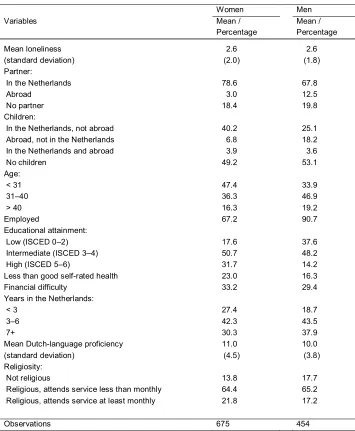
Descriptive statistics are shown in Table 1. Average loneliness scores were similar for women and men. The overall mean loneliness score (m = 2.6) was significantly higher than the mean scores reported by De Jong Gierveld and Van Tilburg (2010) for the 18– 59 age group (F(1, 1128) = 287.4, p<.001) and the 60–79 age group (F(1, 1128) = 121.7, p<.001) in the general Dutch population.
Figure 1 shows that loneliness scores varied considerably by presence and location of partner. On average, unpartnered women were less lonely than women with a partner, regardless of whether the partner was living in the Netherlands or not. Men were also considerably less lonely when a partner was present, but not when the partner was living abroad. The variation by presence and location of partner was significant for women (F(2, 672) = 3.1, p<.05), as well as for men (F(2, 451) = 14.5, p<.001).
Table 1: Descriptive statistics: Polish migrants aged 20‒58 in the Netherlands
Women Men
Variables Mean /
Percentage
Mean / Percentage
Mean loneliness 2.6 2.6
(standard deviation) (2.0) (1.8) Partner:
In the Netherlands 78.6 67.8
Abroad 3.0 12.5
No partner 18.4 19.8
Children:
In the Netherlands, not abroad 40.2 25.1 Abroad, not in the Netherlands 6.8 18.2 In the Netherlands and abroad 3.9 3.6
No children 49.2 53.1
Age:
< 31 47.4 33.9
31‒40 36.3 46.9
> 40 16.3 19.2
Employed 67.2 90.7
Educational attainment:
Low (ISCED 0‒2) 17.6 37.6
Intermediate (ISCED 3‒4) 50.7 48.2 High (ISCED 5‒6) 31.7 14.2 Less than good self-rated health 23.0 16.3 Financial difficulty 33.2 29.4 Years in the Netherlands:
< 3 27.4 18.7
3‒6 42.3 43.5
7+ 30.3 37.9
Mean Dutch-language proficiency 11.0 10.0 (standard deviation) (4.5) (3.8) Religiosity:
Not religious 13.8 17.7
Religious, attends service less than monthly 64.4 65.2 Religious, attends service at least monthly 21.8 17.2
Observations 675 454
Figure 1: Loneliness by presence and location of partner
Source: The Families of Poles in the Netherlands survey, 2014‒2015.
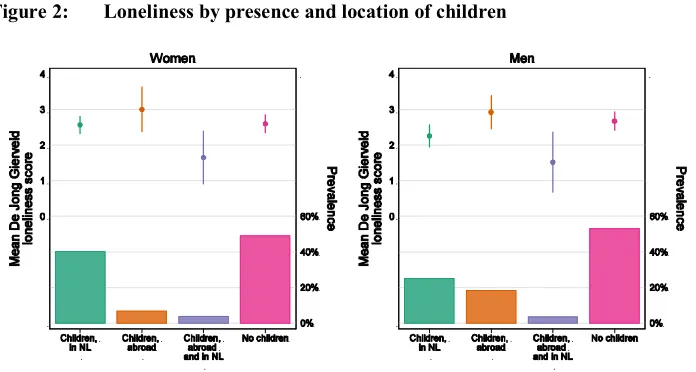
Figure 2: Loneliness by presence and location of children
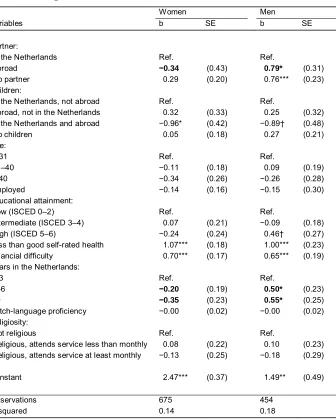
Results of the multivariate analyses are presented in Table 2. For women, no association between the presence or location of a partner and loneliness was found. The small group of women with children both in the Netherlands and abroad was less lonely than women with children living in the Netherlands only, women with children abroad but not in the Netherlands (Δb: −1.28, p<.01), and childless women (Δb: −1.00, p<.05). Women with less than good self-rated health and those having difficulty making ends meet were lonelier than their counterparts in better health and better financial circumstances. None of the other explanatory variables were significantly associated with loneliness among women.
Table 2: Results of linear regression models of loneliness among Polish migrants in the Netherlands
Women Men
Variables b SE b SE
Partner:
In the Netherlands Ref. Ref.
Abroad −0.34 (0.43) 0.79* (0.31) No partner 0.29 (0.20) 0.76*** (0.23) Children:
In the Netherlands, not abroad Ref. Ref.
Abroad, not in the Netherlands 0.32 (0.33) 0.25 (0.32) In the Netherlands and abroad −0.96* (0.42) −0.89† (0.48) No children 0.05 (0.18) 0.27 (0.21) Age:
< 31 Ref. Ref.
31‒40 −0.11 (0.18) 0.09 (0.19) > 40 −0.34 (0.26) −0.26 (0.28) Employed −0.14 (0.16) −0.15 (0.30) Educational attainment:
Low (ISCED 0‒2) Ref. Ref.
Intermediate (ISCED 3‒4) 0.07 (0.21) −0.09 (0.18) High (ISCED 5‒6) −0.24 (0.24) 0.46† (0.27) Less than good self-rated health 1.07*** (0.18) 1.00*** (0.23) Financial difficulty 0.70*** (0.17) 0.65*** (0.19) Years in the Netherlands:
< 3 Ref. Ref.
3‒6 −0.20 (0.19) 0.50* (0.23) 7+ −0.35 (0.23) 0.55* (0.25)
Dutch-language proficiency −0.00 (0.02) −0.00 (0.02) Religiosity:
Not religious Ref. Ref.
Religious, attends service less than monthly 0.08 (0.22) 0.10 (0.23) Religious, attends service at least monthly −0.13 (0.25) −0.18 (0.29)
Constant 2.47*** (0.37) 1.49** (0.49)
Observations 675 454
R-squared 0.14 0.18
Notes: Data is from the Families of Poles in the Netherlands survey, 2014‒2015; weighted. Bold indicates that coefficient estimates differ significantly between men and women (p < .05).
6. Discussion
This study shows that Polish migrants in the Netherlands are on average relatively lonely compared to the general Dutch population. Our finding that feelings of loneliness among a representative group of working-age Polish migrants also exceeded those of the 60‒79 age group in the general Dutch population as reported by De Jong Gierveld and Van Tilburg (2010) is noteworthy, because levels of loneliness tend to be lower in midlife than in old age (Yang and Victor 2011). Although it could be expected that length of residence in the Netherlands might be negatively associated with loneliness, loneliness among male (but not female) Polish migrants was greatest among those who had lived in the Netherlands for longest.
Future research is needed to determine whether the high levels of loneliness among Polish migrants are attributable to the migration experience or to selection. It should be noted that levels of loneliness are high in Eastern European countries (De Jong Gierveld, Dykstra, and Schenk 2012; De Jong Gierveld and Van Tilburg 2010; Hansen and Slagsvold 2016; Yang and Victor 2011), and Victor, Burholt, and Martin (2012) have argued that feelings of loneliness among people with a migrant background tend to mirror those of the general population in the country of origin. In the current study we compared feelings of loneliness of Polish migrants only to levels for the general population reported elsewhere. Future research could build on this and assess whether the antecedents of loneliness for Polish migrants differ from those for the nonmigrant Dutch population or for other migrant groups.
Earlier studies have explored the role of socioeconomic status, health, and the experience of discrimination as antecedents of loneliness among persons with a migrant background (e.g., Fokkema and Naderi 2013; Visser and El Fakiri 2016). We extended this research by focusing on the impact of the presence and location of partners and offspring. Having a partner and, to a lesser extent, having children are known to protect against loneliness. The presence of close family is even more strongly linked to psychological well-being for Eastern Europeans than for Western Europeans (Grundy, Van den Broek, and Keenan 2017; Moor and Komter 2012). However, migration may involve separation from partners and children, in which case the beneficial effects of partners and offspring may be weaker. Those separated by migration might even be lonelier as a result of missing their family.
nonmigrant samples, which have reported that partnership status is more strongly associated with loneliness for men than for women (Dykstra and De Jong Gierveld 2004; Van den Broek 2017). The finding that working-age male migrants with partners abroad are a group at risk of raised feelings of loneliness may have considerable public health implications, given the rising number of people of Polish origin in the Netherlands and the fact that loneliness is a known predictor of morbidity and mortality.
7. Acknowledgements
The research presented here is based on Wave 1 data from the Families of Poles in the Netherlands survey. Financial support for this survey comes from the ERC Advanced Investigator Grant “Families in Context” (ERC, 324211).
References
Bengtson, V.L. and Roberts, R.E.L. (1991). Intergenerational solidarity in aging families: An example of formal theory construction. Journal of Marriage and
Family53(4): 856–870.doi:10.2307/352993.
Ciobanu, R.O. and Fokkema, T. (2017). The role of religion in protecting older Romanian migrants from loneliness. Journal of Ethnic and Migration Studies
43(2): 199–217.doi:10.1080/1369183X.2016.1238905.
Dagevos, J. (ed.). (2011). Poolse migranten. De positie van Polen die vanaf 2004 in Nederland zijn komen wonen [Polish migrants. The position of Poles who since
2004 started living in the Netherlands]. The Hague: SCP Netherlands Institute
for Social Research.
Dahlberg, L., Andersson, L., McKee, K.J., and Lennartsson, C. (2015). Predictors of loneliness among older women and men in Sweden: A national longitudinal study. Aging and Mental Health 19(5): 409–417. doi:10.1080/13607863. 2014.944091.
De Jong Gierveld, J., Dykstra, P.A., and Schenk, N. (2012). Living arrangements, intergenerational support types and older adult loneliness in Eastern and Western Europe. Demographic Research 27(7): 167–200. doi:10.4054/DemRes. 2012.27.7.
De Jong Gierveld, J., Van der Pas, S., and Keating, N. (2015). Loneliness of older immigrant groups in Canada: Effects of ethnic-cultural background. Journal of
Cross-Cultural Gerontology30(3): 251–268.doi:10.1007/s10823-015-9265-x.
De Jong Gierveld, J. and Van Tilburg, T. (2006). A 6-item scale for overall, emotional, and social loneliness. Research on Aging 28(5): 582–598. doi:10.1177/ 0164027506289723.
De Jong Gierveld, J. and Van Tilburg, T. (2010). The De Jong Gierveld short scales for emotional and social loneliness: Tested on data from 7 countries in the UN generations and gender surveys. European Journal of Ageing 7(2): 121–130.
doi:10.1007/s10433-010-0144-6.
De Jong Gierveld, J., Van Tilburg, T., and Dykstra, P.A. (2006). Loneliness and social isolation. In: Vangelisti, A.L. and Perlman, D. (eds.). Cambridge handbook of
Dykstra, P.A. and De Jong Gierveld, J. (2004). Gender and marital-history differences in emotional and social loneliness among Dutch older adults. Canadian Journal
on Aging23(2): 141–155.doi:10.1353/cja.2004.0018.
Dykstra, P.A. and Fokkema, T. (2007). Social and emotional loneliness among divorced and married men and women: Comparing the deficit and cognitive perspectives.
Basic and Applied Social Psychology 29(1): 1–12. doi:10.1080/01973530
701330843.
Fernández-Alonso, A.M., Trabalón-Pastor, M., Vara, C., Chedraui, P., and Pérez-López, F.R. (2017). Life satisfaction, loneliness and related factors during female midlife.Maturitas72(1): 88–92.doi:10.1016/j.maturitas.2012.02.001. Fokkema, T. and Naderi, R. (2013). Differences in late-life loneliness: A comparison
between Turkish and native-born older adults in Germany.European Journal of
Ageing10(4): 289–300.doi:10.1007/s10433-013-0267-7.
Grundy, E., Van den Broek, T., and Keenan, K. (2017). Number of children, partnership status, and later-life depression in Eastern and Western Europe. The
Journals of Gerontology, Series B.doi:10.1093/geronb/gbx050.
Hansen, T. and Slagsvold, B. (2016). Late-life loneliness in 11 European countries: Results from the Generations and Gender Survey. Social Indicators Research
129(1): 445–464.doi:10.1007/s11205-015-1111-6.
Hansen, T., Slagsvold, B., and Moum, T. (2009). Childlessness and psychological well-being in midlife and old age: An examination of parental status effects across a range of outcomes. Social Indicators Research 94(2): 343–362. doi:10.1007/ s11205-008-9426-1.
Hawkley, L.C. and Cacioppo, J.T. (2010). Loneliness matters: A theoretical and empirical review of consequences and mechanisms. Annals of Behavioral
Medicine40(2): 218–227.doi:10.1007/s12160-010-9210-8.
Hogerbrugge, M.J.A. and Komter, A.E. (2012). Solidarity and ambivalence: Comparing two perspectives on intergenerational relations using longitudinal panel data.
The Journals of Gerontology: Series B 67B(3): 372–383. doi:10.1093/geronb/
gbr157.
Hurtado-de-Mendoza, A., Gonzales, F.A., Serrano, A., and Kaltman, S. (2014). Social isolation and perceived barriers to establishing social networks among Latina immigrants. American Journal of Community Psychology 53(1–2): 73–82.
Jappens, M. and Van Bavel, J. (2012). Regional family cultures and child care by grandparents in Europe. Demographic Research 27(4): 85–120. doi:10.4054/ DemRes.2012.27.4.
Karpinska, K., Fokkema, T., Conkova, N., and Dykstra, P.A. (2016).Codebook of the Families of Poles in the Netherlands (FPN) survey. Wave 1. Version 1, April 2016. DANS.doi:10.17026/dans-zep-et7y.
Koropeckyj-Cox, T. (2002). Beyond parental status: Psychological well-being in middle and old age. Journal of Marriage and Family 64(4): 957–971.
doi:10.1111/j.1741-3737.2002.00957.x.
Moor, N. and Komter, A. (2012). Family ties and depressive mood in Eastern and Western Europe.Demographic Research27(8): 201–232. doi:10.4054/DemRes. 2012.27.8.
Ornelas, I.J., Perreira, K.M., Beeber, L., and Maxwell, L. (2009). Challenges and strategies to maintaining emotional health. Qualitative perspectives of Mexican immigrant mothers. Journal of Family Issues 30(11): 1556–1575.doi:10.1177/ 0192513X09336651.
Routasalo, P. and Pitkala, K.H. (2003). Loneliness among older people. Reviews in
Clinical Gerontology 13(4): 303–311.doi:10.1017/S095925980400111X.
Silver, A. (2014). Families across borders: The emotional impacts of migration on origin families. International Migration 52(3): 194–220. doi:10.1111/j.1468-2435.2010.00672.x.
Statistics Netherlands (2016). 150 duizend inwoners van Poolse herkomst [150.000
inhabitants of Polish origin]. Retrieved July 10, 2017, from
https://www.cbs.nl/nl-nl/nieuws/2016/24/150-duizend-inwoners-van-poolse-herkomst.
Van den Broek, T. (2017). Gender differences in the correlates of loneliness among Japanese persons aged 50‒70. Australasian Journal on Ageing. doi:10.1111/ ajag.12448.
Victor, C.R., Burholt, V., and Martin, W. (2012). Loneliness and ethnic minority elders in Great Britain: An exploratory study. Journal of Cross-Cultural Gerontology
27(1): 65–78.doi:10.1007/s10823-012-9161-6.
Victor, C.R. and Yang, K. (2012). The prevalence of loneliness among adults: A case study of the United Kingdom. The Journal of Psychology146(1–2): 85–104.
Visser, M.A. and El Fakiri, F. (2016). The prevalence and impact of risk factors for ethnic differences in loneliness.European Journal of Public Health26(6): 977– 983.doi:10.1093/eurpub/ckw115.
Weiss, R.S. (1973). Loneliness: The experience of emotional and social isolation. Cambridge: MIT Press.
Wu, Z. and Penning, M. (2015). Immigration and loneliness in later life. Ageing and
Society35(1): 64–95.doi:10.1017/S0144686X13000470.
Yang, K. and Victor, C. (2011). Age and loneliness in 25 European nations.Ageing and