* Corresponding author.
E-mail: [email protected] (M. EghbaliZarch) © 2012 Growing Science Ltd. All rights reserved. doi: 10.5267/j.ijiec.2012.010.001
International Journal of Industrial Engineering Computations 4 (2013) 127–138
Contents lists available at GrowingScience
International Journal of Industrial Engineering Computations
homepage: www.GrowingScience.com/ijiec
Differential evolution algorithm for multi-commodity and multi-level of service hub covering location problem
M. EghbaliZarch*, M. Abedzadeh and M. Setak
Department of Industrial Engineering, University of K.N.Toosi, Tehran, Iran
A R T I C L E I N F O A B S T R A C T
Article history: Received 10 August 2012 Received in revised format 14 September 2012
Accepted September 27 2012 Available online
28 September 2012
The hub location problem involves a network of origins and destinations over which transportation takes place. There are many studies associated with finding the location of hub nodes and the allocation of demand nodes to these located hub nodes to transfer the only one kind of commodity under one level of service. However, in this study, carrying different commodity types from origin to destination under various levels of services (e.g. price, punctuality, reliability or transit time) is studied. Quality of services experienced by users such as speed, convenience, comfort and security of transportation facilities and services is considered as the level of service. In each system, different kinds of commodities with various levels of services can be transmitted. The appropriate level of service that a commodity can be transmitted through is chosen by customer preferences and the specification of the commodity. So, a mixed integer programming formulation for single allocation hub covering location problem, which is based on the idea of transferring multi commodity flows under multi levels of service is presented. These two are applied concepts, multi-commodity and multi-level of service, which make the model's assumptions closer to the real world problems. In addition, a differential evolution algorithm is designed to find near-optimal solutions. The obtained solutions using differential evolution (DE) algorithm (upper bound), where its parameters are tuned by response surface methodology, are compared with exact solutions and computed lower bounds by linear relaxation technique to prove the efficiency of proposed DE algorithm.
© 2012 Growing Science Ltd. All rights reserved Keywords:
Hub covering location Multi-commodity Multi-level of service Differential evolution algorithm Response surface methodology Lower and upper bounds
1. Introduction
Hub location is extensively applied in transportation (Campbell, 2007), telecommunication (Klincewicz, 1998), postal (Çetiner, 2006) and cargo delivery systems (Alumur & Kara, 2008a; & Tan & Kara, 2007). In these systems, to take advantage of the economies of scale, hubs are intermediates for transmitting the flows instead of sending flows directly among all origin-destination pairs. Hubs are special facilities, which consolidate and distribute the flows.
demand nodes to located hubs such that optimize the whole network. The primary aim of the p-hub median problem is to minimize the total transportation flow cost between origin-destination pairs and the number of located hubs. In HLP with fixed expenditure, the number of hubs is considered as a decision variable. The p-hub center is to maximize the minimum cost for (1) every origin-destination pair, (2) movement on every origin to hub, hub to hub and hub to destination link and (3) movement between a hub and an origin/destination. In most cases, in hub location problem, every hub pair is connected and there is no direct connection between two demand nodes.
In fact, not all demand nodes can be allocated to each hub. For instance, in air transportation systems low capacity feeder aircraft transport passengers from the low-demand, smaller sized airports to the larger hub airports where passengers are transported to their destinations on bigger capacity aircrafts (Sim, 2007). Hence, capacity feeder limits the number of hub airports where non-hub airports can be assigned to. In postal and cargo delivery systems, customer satisfaction occurs when considered commodities are sent from origin to destination in a promised delivery times (Tan & Kara, 2007). Therefore, each demand node cannot be allocated to hubs. Campbell (1994) presented hub covering location problem for the first time. Kara and Tansel (2003) suggested linear and Wagner (2004) proposed better formulations. Ernst et al. (2005) introduced cover radius for the first time. Hamacher and Meyer (2006) compared different formulations of HCoP and analyzed its feasibility poly-hedron. They also proposed a binary search, which was based on the inverse relationship between p-hub center and hub covering problem.
Tan and Kara (2007) applied the latest arrival hub covering to the cargo delivery sector in Turkey. Alumur and Kara (2008b) considered hub covering problem over incomplete network allowing at most four hub stops on a route from any origin to destination, while focusing on cargo application. Calik et al. (2009) studied single allocation hub covering problem over incomplete hub networks and proposed a tabu-based heuristic algorithm. Mohammadi et al. (2010) studied single allocation hub covering location problem under a capacity constraint and proposed a hybrid algorithm based on a genetic algorithm and simulated annealing. Mohammadi et al. (2011b) presented a model for capacitated single allocation hub covering location that instead of using capacity constraints to limit the received flow of each hub, the second objective function was introduced to minimize the service times in the hubs and a weighted-based multi-objective imperialist competitive algorithm was designed to find near-optimal solutions.
Mohammadi et al. (2011a) studied the location model for hub covering problem behaving as M/M/C queues and presented a nonlinear formulation and proposed an improved imperialist competitive algorithm to solve the model. Karimi and Bashiri (2011) studied hub covering problem with different coverage types over complete hub networks and proposed two heuristic procedures. Zarandi et al. (2012) studied the multiple allocation hub set-covering problem considering the backup coverage and mandatory dispersion of hubs. Ghodratnama et al. (2012) presented a new fuzzy bi-objective model for hub covering problem with specific features such as considering production facilities, time horizons and transportation vehicles.
M. EghbaliZarch et al. / International Journal of Industrial Engineering Computations 4 (2013) 129
The Postal Service divides mail into different services, called classes. Each class of mail has different features, postage prices, and presort requirements. For most of mailing systems, the content of the material and postage will determine the selected class of mailing. In air transportation systems, passengers can choose the service level of their preferred aviation company according to ticket prices, non-delay flights, type of airplanes and reliability of services. In telecommunication networks massage or information, in form of voice, data and/or video is transmitted over communication links (e.g. copper cables, radio links or satellite links) (Klincewicz 1998).
In public transportation, each passenger can be traveled under various modes (e.g. walking, driving, bicycling, Commuter Rail / Subway / Bus, taxi, boat). Therefore, in each system with regard to its characteristics, different kinds of commodities with various levels of services can be transmitted. The appropriate level of service that a commodity can be transmitted through is chosen by customer preferences and the specification of the commodities. The innovation of this research was to consider two concepts of multi-commodity & multi-level of service in hub covering location problem, simultaneously.
This paper presents a hub covering location problem, which is based on the idea of transferring multi commodity flows under multi levels of service. To handle real-size problems, we propose a differential evolution algorithm. This paper is organized as follows. Section 2 elucidates the mathematical model. Section 3 explains the proposed differential evolution algorithm. Section 4 illustrates the computational results on Australian Post (AP) data set. At the end, conclusions are remarked.
2. Mathematical Model
The model in this paper is an extension to Ernst and Krishnamoorthy (1999). In the model of Ernst & Krishnamoorthy (1999) only one kind of commodity under one level of service is transmitted in the network, which is not associated with many real-world problems. Therefore, we apply two indexes (n
& m) to distinct different commodities transmitted under various levels of services with different
transportation expenditures.
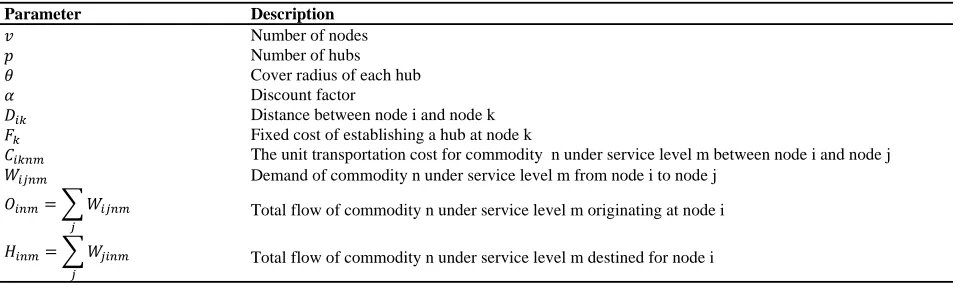
Let V be a given node set with v nodes. The proposed model locates the pre-determined number of hubs and then assigns non-hub nodes (demand nodes) to locate hubs based on single allocation concept such that each of the origin-hub and hub-destination links meet specified value (cover radius). This model helps to determine the routes for trafficking multi commodity flows under various levels of services from origin to destination through located hubs. The objective of proposed model is to minimize the total cost of flows between any origin-destination points and the total cost of establishing hubs. The applied parameters and variables of the models are summarized in Table 1 and Table 2, respectively.
Table 1
Model parameters
Description
Parameter
Number of nodes Number of hubs Cover radius of each hub Discount factor
Distance between node i and node k Fixed cost of establishing a hub at node k
The unit transportation cost for commodity n under service level m between node i and node j Demand of commodity n under service level m from node i to node j
Total flow of commodity n under service level m originating at node i
=
Total flow of commodity n under service level m destined for node i
Table 2
Model Variables
Variable Description
equals 1 if node i is allocated to hub k
Consistent with the literature, if Xkk=1, it means that node k is a hub
The total amount of flow of commodity n under service level m emanating from node i that is routed between hubs k and l.
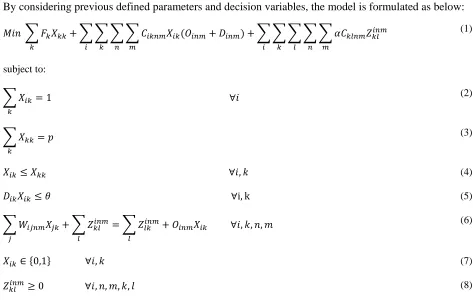
By considering previous defined parameters and decision variables, the model is formulated as below:
+ ( + ) + (1)
subject to:
(2) = 1 ∀
(3) =
(4) ≤ ∀ ,
(5) ≤ ∀i, k
(6)
+ = + ∀ , , ,
(7) ∈ 0,1 ∀ ,
(8) ≥ 0 ∀ , , , ,
The objective function minimizes total cost of transferring multi commodity flows under various levels of service between any origin-destination points and the total cost of establishing hubs. Eq. (2) ensures that every node is assigned to exactly one hub. Eq. (3) states just p hub can be established. Eq. (4) ensures that node i cannot be assigned to node k unless there is a hub at node k. Eq. (5) makes sure that node i can only be allocated to hub k, if distance between i and k is at most the radius . Eq. (6) is the multi commodity flow balanced under various levels of service equation. Eq. (7) and (8) state that variable is bigger than zero and is a binary variable.
3. Differential Evolution algorithm
M. EghbaliZarch et al. / International Journal of Industrial Engineering Computations 4 (2013) 131
differential mutation operation is known as donor vector and finally an offspring formed by recombining the donor with the target vector is called trial vector (Das & Suganthan, 2010).
Fig. 1. Main stages of the DE algorithm (Das &Suganthan, 2010)
3.1 Representation of the solution
Any solution encoding procedure should show the location of hub nodes and the allocation of demand nodes to located hub nodes. In this procedure for presenting the given network, some integer numbers are used. The solutions are presented as a matrix. Each column shows a node in the network, in which its elements value explain the number of the hub and the nodes, which are allocated to them. Furthermore, when the value of each element on the entire column is equal to zero, the node is considered as a demand node. If the value of the element that is on the same row and the same column is equal to one, that node is considered as a hub and the rest of the elements show the demand nodes allocated to it. For example, a sample solution is obtained as follows:
=
0 0 0 0 0 0 1 0 0 0 0 0 0 0 1 0 0 0 0 0 0 0 0 1 0 0 0 0 0 0 0 1 0 0 0 0 0 1 0 0 0 0 0 0 0 1 0 0 0 0 0 0 0 0 1 0 0 0 0 0 0 0 0 1
Fig. 2. The representing network of the S solution
In this solution, node 6, 7, 8 are hubs. In addition, node 5 is allocated to hub 6, nodes 1, 2 are allocated to hub 7 and nodes 3, 4 are allocated to hub 8.
3.2 Initial population
For creating the initial population, first p numbers of hubs are located randomly and form a hub vector. In the allocation step, the remaining nodes are allocated to the located hubs based on their distance from located hubs. If a non-hub node can be allocated to more than one hub, it will be allocated to first hub of mentioned hub vector. After structuring the whole network, the flow balanced constraint will be checked. The above process is applied iteratively to create the entire population.
3.3Function evaluation
The evaluation is an operation to evaluate how good the network structure of each individual is. The evaluation function consists of calculating the objective function value of the network representing by each individual.
Initialization of Vectors
Crossover/Re
combination Selection
1
2
7 6
8 5
3 4
Difference-vector based
3.4 Mutation
Mutation is selected based on the difference of the individual vectors. Randomly selected three individuals , and from a group (in generation g)
(9)
, = , + . ( , − , )
Differential Evolution algorithm is based on real-coded, but this model use 0-1. For binary discrete search space, Kennedy and Eberhart (1997) adapted particle swarm optimization (PSO) to search in binary spaces. PSO applies a sigmoid transformation to the velocity component of Eq. (10) to squash the velocities into a range [0,1], and forces the component values of the locations of particles to be 0’s or 1’s.The equation for updating the positions of Eq. (9) is as follows
, =
1
1 + , (10)
, = 1 < ( , )
0 ℎ (11)
3.5 Crossover
Crossover is to increase the population diversity and ensures that there is a part of the contribution of the previous generation. The crossover operator constructs the offspring , by mixing components of
the current individual , (Target matrix) and the , (mutant matrix) generated by mutation. There are
two types of crossover used in DE, binomial and exponential ones. In the proposed algorithm, binomial crossover is applied. Binomial crossover replaces the elements of vector , usingthe following rule:
(12)
Y, = ,
0,1 < =
, ℎ
The feasibility of trial matrix that is computed in this stage should be checked. If the trial matrix is not feasible, then it will be necessary to repair it.
3.6 Repairing procedure
The solution that a trial matrix is shown should be feasible. The procedure of repairing the solutions is explained as follow:
• If the number of elements with value one on the main diagonal is more than P (more than p hub), then random P elements with value one will be kept and other elements change their values to zero. Otherwise, we randomly change their values from elements on the main diagonal with value zero to one until the elements on the main diagonal with value one will be equal to P.
• The zero value of elements on the main diagonal will force the entire column to get zero values.
• If the value of element on the main diagonal is equal to one and sum of its entire row is more than one then the elements, which are not located on the main diagonal will change their values to zero.
• Finally, cover constraint will be checked and if non hub node does not allocated to any hub, then it will be allocated to located hubs according to cover constraint. At the end, flow balanced constraint will be checked.
3.7 Selection
3.8 Fo ex nu to co the sur ex Af to ve or , = 8 Numerica
or more det plained. Fr umber F sca
the third on mponents w e next step rvives to th ample as fo
, =
fter random the third o locity comp 1.This proc Fig. 3 , , al Example tails about rom the cu ales the diffe
ne to obtain with the tar
of the algo he next gene ollow:
0 0 0 0 1 0 0 0 0 0 0 0 1 0 0 0 0 0 0 1 0 0 0 0 1 0 0 0 0 0 0 0 1 0 0 0 0 0 0 0 1 0 0 0 0 0 1 0 0 0 0 0 1 0 0 0
m sampling, one are cho ponent to sq cedure show
3. A sigmoid
M. EghbaliZarc
( , ) ≤
this algori urrent popul erences of a n the donor get vector. orithm call eration (Da 0 0 0 0 0 0 0 0 0 0 0 0 0 0 0 0
+ 0.6 ∗
three indivi osen to obt quash the ve ws in Fig. 3.
d transforma and
ch et al. / International
( . )
ithm and it lation, thre any two of t vector ( , To keep th s for select s & Sugant
0 1 0 0 0 0 1 0 0 0 0 0 0 0 0 0 0 0 0 0 0 0 0 0 0 0 0 0 0 0 0 0 0 0 0 0 0 0 0 0
iduals and a ain the don elocities int .
ation to the ve d force the co
l Journal of Industrial E
ts operators ee individua these three i ). In crosso he populatio
tion to dete than, 2010)
0 0 0 0 0 0 0 0 1 0 0 1 0 0 0 0 1 0 0 1 1 0 0 1
− 1 0 0 0 1 0 0 0 added scale nor vector. to a range [0
elocity comp omponents v
Engineering Computati
s, an exam als are sam
individuals over operat on size cons
ermine whe . This proce
0 0 0 0 0 0 0 1 0 0 0 0 0 0 1 0 0 0 0 0 0 0 0 0 0 0 0 1 0 0 0 0 0 0 0 1 0 0 0 0 0 0 0 0 0 0 0 0 1 0 0 0 0 0 0 1
d difference A sigmoid 0, 1] and fo
ponent to squ values to be 0
ions 4 (2013)
mple with 8 mpled, rand and the sca tor, the dono stant over s ether the tar
edure is app
0 0 0 0 0 = −0.6 0 0 − 0 −0.6 0 − 0 0
e of two of d transform orces the com
uash the velo 0 or 1
nodes and domly. No
aled differen or vector ex ubsequent g rget or the plied on the
6 0.6 0 0 1 0 0 0 0 0 0 0 1 0 0
0.6 0 0 0 1 0 0 0 0 1 0 0 0 0 6 0 0 0 1 0.6 0
0.6 0 0 0 1.6 0 0 0 0 0 1 0 0 0 0 0 1 0 0 0 0
f these three ation is app mponent va
ocities into a
13
(14
d 3 hubs is ow, a scalar nce is added xchanges its generations trial vector e mentioned 0 0 0 0.6 0 0 0 0 0 0 0 e individuals plied to the alues to be 0
As illu fea ge ele hu to ste 4. In ba tes of co Du 4.1 Th res pa
s shown in ustrates a s asibility. Fir t zero valu ements on t ub (the value
cover const eps.
Fig. 4. Bino
Computat
this section ased on a po st the perfor algorithm mpare Low uo T9300 pr
1 Parameter
he quality o sponse surfa arameters. T
Fig. 4, the solution of rst of all, th ues such as the main di
e of the enti traint. Chec
omial crossov
tional Resu
n, the propo ostal deliver
rmance of t solutions (u wer bound co rocessor (2.
rs Tuning
of an algori face method This method
e trial vecto the proble he zero valu column 1,2 agonal of tr ire specific cking cover
ver by mixin
ult
osed model ry in Sydne the propose upper bound omputed by .50 GHz) w
ithm is sign dology (RSM dology is int
or is create em and sho ue of eleme 2,3,7 and 8 rial matrix row is equa and flow ba
ng componen (m
is impleme ey, Australi d DE algor d) and optim y linear relax with 2 GB of
nificantly af M), an appro
troduced by
ed after mu ould be ente
nts on the m 8. After that
be equal to al to zero), alanced con
nts of the cur mutant matrix
ented on sub ia for the fi
ithm, a com mal solutio xation (LR) f RAM oper
ffected by oach based y Wilson an
utation and ered to the main diagon
t, locating P
o one). If th then it will nstraint will
rrent individu x)
bsets of AP irst time (Er mparison is ons, which i ) technique rating under
the values on DoE tec nd Box (195
crossover s e repairing
nal will forc
P hub is ch here is a nod be allocate l be perform
ual , (Targ
dataset. AP rns & Krish accomplish is gained by
on a system r the system
of its param chniques ha
51) for the
stages. This stage for c ce the entir hecked (It s de not alloc ed to one hu med after all
get matrix) an
P dataset ha hnamoorthy hed between y GAMS23 m with Intel m windows.
meters. In t as been used first time. R
s individua checking its
e column to should be 3 cated to any ub according of previous
nd the ,
as been used y, 1996). To n the quality 3.5. We also (R) Core TM
M. EghbaliZarch et al. / International Journal of Industrial Engineering Computations 4 (2013) 135
paper is applied by Design Expert 8 software, which is designed for some experiments to define the promising initial parameter values and leads to improvements in terms of the quality of the solutions.
4.2. Computing the Cover Constraint
Eq. (15) explains Sahraeian and Korani's (2010) approach for calculating the cover radius to apply it in the model. By using distance table, the minimum number in each column is obtained (without zero), these values denote vicinity to nodes. Also by choosing maximum number among the minimum numbers of columns, cover radius is found.
= ( ) (15)
[
The mentioned dataset does not have data related to commodity and service level type. Hence, Eq. (16) shows how to calculate demand of commodity n under service level m from node i to node j and the unit transportation cost for commodity n under service level m between node i and node j is generated randomly close to unit costs of dataset.
= (16)
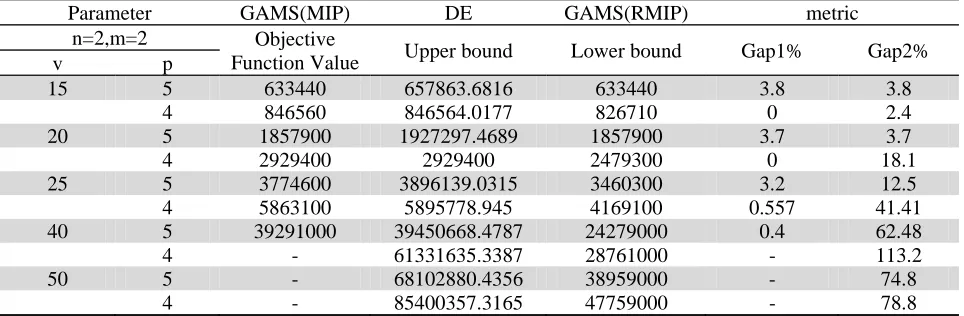
The results of comparison with different values of parameters are shown in Table 3.
Table 3
The summary of the performance of the proposed model, GAMS in two circumstances and relative gaps
Parameter GAMS(MIP) DE GAMS(RMIP) metric
n=2,m=2 Objective
Function Value Upper bound Lower bound Gap1% Gap2%
v p
15 5 633440 657863.6816 633440 3.8 3.8
4 846560 846564.0177 826710 0 2.4
20 5 1857900 1927297.4689 1857900 3.7 3.7
4 2929400 2929400 2479300 0 18.1
25 5 3774600 3896139.0315 3460300 3.2 12.5
4 5863100 5895778.945 4169100 0.557 41.41
40 5 39291000 39450668.4787 24279000 0.4 62.48
4 - 61331635.3387 28761000 - 113.2
50 5 - 68102880.4356 38959000 - 74.8
4 - 85400357.3165 47759000 - 78.8
[[
In this section, five instances with a number of nodes, V, ranging from 15 to 50 are considered. The optimal values of these instances solved by solver GAMS (Cplex) are given in column under optimal objective function value. The column under upper bound give the value of the best solution of DE algorithm and the lower bound column show the value for these instances by relaxing mixed integer programming.
(17)
1% = − × 100
(18)
2% = − × 100
The obtained results show that since it is no longer possible to optimally solve the instances, then the percent deviation between the upper and lower bound is considered. Two mentioned metrics can test the quality of computed bounds and specify how weak they are. Tight bounds resulted from upper and lower bound show how good bounds they are. By considering the small percent deviation of upper bound and optimal solution in small instances and weak lower bound, it can be concluded that the proposed algorithm has acceptable performance.
5. Conclusion
In this study, systems carrying different commodity types from origin to destination under various levels of services (e.g. price; punctuality, reliability or transit time) have been studied. For accommodating the hub covering location problem with the real-world data, it is necessary to apply these two concepts (multi-commodity and multi-level of service) in the models. In each system with regard to its characteristics, different kinds of commodity with various levels of service can be transmitted. The appropriate level of service that a commodity can be transmitted through is chosen by customer preferences and the specification of the commodity. In this paper, a mixed integer programming formulation for the hub covering location problem, which is based on the idea of transferring multi commodity flows under multi levels of service is presented. To solve large-sized instances a differential evolution algorithm has been proposed.
The parameters of the algorithm are tuned by response surface methodology. Computational results have compared upper bound (the best solution of DE algorithm) with lower bound and optimal solutions for small instances. The percent deviation between upper and lower bounds shows the quality of computed bounds and specify how weak they are. By considering the small percent deviation of upper bound and optimal solution in small instances and its weak lower bound, it can be concluded that the upper bound has acceptable quality and the proposed algorithm showed a little gap between the solutions obtained by proposed algorithm and GAMS results.
References
Alumur, SA., & Kara, B.Y. (2008a). Network hub location: the state of art.European Journal of
Operational Research, 1, 1-21.
Alumur, S., & Kara, B.Y.(2008b). A hub covering network design problem for cargo applications in Turkey. Journal of the Operational Research Society, 10, 1349-1359.
Box, G.E.P., & Wilson, K.(1951). On the experimental attainment of optimum conditions. Journal of
the Royal Statistical Society. Series B (Methodological), 13, 1-45.
Campbell, J.F.(1994). Integer programming formulations of discrete hub location problems.European
Journal of Operational Research, 2, 387-405.
Campbell, J.F. (2009). Hub location for time definite transportation. Computers & Operations
Research, 36, 3107-3116.
M. EghbaliZarch et al. / International Journal of Industrial Engineering Computations 4 (2013) 137
Çetiner, S., Sepil, C., & Süral, H. (2010). Hubbing and routing in postal delivery systems. Annals of
Operations Research, 181, 109-124.
Das, S., & Suganthan, P.N. (2010). Differential evolution: A survey of the state-of-the-art.
Evolutionary Computation, IEEE Transactions, 99, 1-28.
Ernst, A., Jiang, H. & Krishnamoorthy, M.,(2005). Reformulations and computational results for uncapacitated single and multiple allocation hub covering problems.Unpublished Report, CSIRO Mathematical and Information Science.
Ernst, A.T., & Krishnamoorthy, M. (1996). Efficient algorithms for the uncapacitated single allocation p-hub median problem. Location Science,4, 139-154.
Ernst, A.T., &Krishnamoorthy, M. (1999). Solution algorithms for the capacitated single allocation hub location problem. Annals of Operations Research, 86, 141-159.
Fazel Zarandi, M., Davari, S.& Haddad Sisakht, S. (2012). The Q-coverage multiple allocation hub covering problem with mandatory dispersion. Scientia Iranica
Ghodratnama, A., Tavakkoli-Moghaddam, R., & Azaron, A. (2012). A fuzzy possibilistic bi-objective
hub covering problem considering production facilities, time horizons and transporter vehicles.The
International Journal of Advanced Manufacturing Technology, 1-20.
Hamacher, H.W., & Meyer, T. (2006). Hub cover and hub center problems. Departament of
Mathematics, University of Kaiserslautern, Germany.
Klincewicz, J.G. (1998). Hub location in backbone/tributary network design: a review. Location
Science, 6, 307-335.
Kennedy, J., &Eberhart, R.C.(1997). A discrete binary version of the particle swarm algorithm. IEEE
TRANSACTION.
Karimi, H., & Bashiri, M. (2011). Hub covering location problems with different coverage types. Scientia Iranica,18, 1571–1578.
Kara, B., & Tansel, B. (2003). The single-assignment hub covering problem: Models and linearizations.Journal of the Operational Research Society, 59-64.
Lobato, F.S., Gedraite,R. & Neiro, S.M.S.,(2012). Solution of flow shop scheduling problems using the differential evolution algorithm.3rd International Conference on Engineering Optimization, Rio de Janeiro, Brazil.
Mohammadi, M., Jolai, F. & Rostami, H. (2011a). An M/M/c queue model for hub covering location problem.Mathematical and Computer Modelling, 54, 2623–2638.
Mohammadi, M., Tavakkoli-Moghaddam, R. & Rostami, H. (2011b) A multi-objective imperialist competitive algorithm for a capacitated hub covering location problem. International Journal of
Industrial Engineering Computations. 2, 671-688.
Mohammadi, M., Tolui, H. & Yousefi, M. (2010). Solving a hub covering location problem under capacity constraints by a hybrid algorithm. Journal of Applied Operational Research, 2, 109-116. O'kelly, M.E. (1987). A quadratic integer program for the location of interacting hub
facilities.European Journal of Operational Research, 3, 393-404.
Rao, R.V. & Patel, V.,(2012). An elitist teaching learning based optimization algorithm for solving
complex constrained optimization problems.International Journal of Industrial Engineering
Computations, 3, 535-560.
Rao, R.V. & Patel,V. (2013) Comparative performance of an elitist teaching-learning-based optimization algorithm for solving unconstrained optimization problems. International Journal of
Industrial Engineering Computations.
Sim, T.K.T. (2007). The hub covering flow problem and the stochastic p-hub center problem. United states: ProQuest Information and Learning Company.
Tan, P.Z., Kara, B.Y. (2007). A hub covering model for cargo delivery systems. Networks, 1, 28-39.
Wagner, B.,(2004) Model formulations for hub covering problems. Journal of the Operational
Research Society, 7, 932-938.
Sahraeian, R., & Korani, E. (2010). The hierarchical hub maximal covering problem with determinate cover radiuses. IEEE Transaction.

![Fig. 33. A sigmoidd transformaandation to the ved force the coelocity compomponents vponent to squvalues to be 0uash the velo0 or 1 ocities into a range [0, 1]](https://thumb-us.123doks.com/thumbv2/123dok_us/8906060.1834094/7.612.73.533.394.683/sigmoidd-transformaandation-force-coelocity-compomponents-vponent-squvalues-ocities.webp)