World Maritime University
The Maritime Commons: Digital Repository of the World
Maritime University
World Maritime University Dissertations Dissertations
2000
The enhanced enforcement of IMO [International
Maritime Organization] conventions by the
Vietnam Register
Tran Anh DuongWorld Maritime University
Follow this and additional works at:http://commons.wmu.se/all_dissertations
This Dissertation is brought to you courtesy of Maritime Commons. Open Access items may be downloaded for non-commercial, fair use academic
Recommended Citation
Duong, Tran Anh, "The enhanced enforcement of IMO [International Maritime Organization] conventions by the Vietnam Register" (2000).World Maritime University Dissertations. 401.
WORLD MARITIME UNIVERSITY
Malmö, Sweden
THE ENHANCED ENFORCEMENT OF IMO
CONVENTIONS BY THE VIETNAM REGISTER
By
TRAN ANH DUONG
Vietnam
A dissertation submitted to the World Maritime University in partial fulfilment of the requirements for the award of the degree of
MASTER OF SCIENCE
in
THE DECLARATION
I certify at the material in this dissertation that is not my own work has been identified, and that no materials is included for which a degree has previously been conferred on me.
The contents of this dissertation reflect my own personal views, and are not necessarily endorsed by the University.
(Signature)
21/08/2000 (Date)
Supervised by:
Capt. Sven-Åke Wernhult
Lecturer, Maritime Safety and Environment Protection World Maritime University
Assessor:
Lt. Cdr. Maximo Q. Mejia, Jr.
Lecturer, Maritime Safety and Environment Protection World Maritime University
Co-assessor:
Capt. W. B. Rial
Chairman, Caribbean Port State Control
DEDICATION
ACKNOWLEDGEMENTS
The author would like to express special thanks to Mr Nguyen Van Ban, Director General of the Vietnam Register, for nominating him to study at World Maritime University.
The author would like to thank the International Co-operation Committee of IMO for providing him the scholarship for his two-year study at WMU.
Gratitude is extended to Captain Sven-Ake Wernhult for his valuable comments made on the dissertation, which focused on the dissertation's objectives and to his English teacher Inger Battista for her valuable advice on literature and grammatical matters.
Special thanks are due to Nguyen Thi Thuy Ha - the author’s wife, friend, and inspiration - for her invaluable love, assistance, and sacrifice during his two-year study at WMU.
ABSTRACT
Title of dissertation: The enhanced enforcement of IMO conventions by the
Vietnam Register.
Degree: MSc
In line with the IMO’s policy of shifting to the flag State implementation, the paper is a study of statutory activities of the Vietnam Register, analysing the internal and external business environment of the organisation; its objective is to address measures for improving the performance of statutory surveys and certification of VR. A brief overview is taken of the present functioning of the Vietnam Maritime Administration in order to examine the jurisdiction of VR pertaining to the enforcement of the IMO conventions ratified by the government for Vietnamese flag ships.
All aspects of the infrastructure of VR concerning statutory matters are investigated to indicate the recent status of the internal business environment of the organisation. Additionally, the external business environment of VR is investigated through status of the Vietnamese mercantile fleet and the Vietnamese ship building and repairing industry, the activities of the port State control in the Asia-Pacific region and the IMO instruments on flag State implementation.
The concluding chapter proposes the measures for solving the difficulties under each issue with the purpose of enhancement of the capacity of VR to perform statutory tasks.
TABLE OF CONTENTS
Declaration ... iii
Acknowledgements ... iv
Abstract ... v
Table of Contents ... vii
List of Tables ... xiii
List of Figures ... xv
List of Abbreviations ... xvi
1. Introduction ... 1
1.1 Introduction ... 1
1.2 Objectives of the dissertation ... 2
1.3 Methodology ... 2
1.4 Outline of the work ... 3
2. Vietnam Maritime Administration ... 4
2.1 General ... 4
.1 Vietnamese merchant fleet ... 4
.2 Shipyards in Vietnam ... 4
.3 Seaports ... 5
.4 Sea-going personnel and maritime training ... 5
.5 Other related business ... 5
.1.1 The Vietnam Maritime Code ... 6
.1.2 Subsidiary legislation ... 6
.1.3 International conventions ... 7
.2 The organisation ... 7
.2.1 Vietnam National Maritime Bureau ... 8
.2.2 Vietnam Register ... 8
.3 Analysing the delivery tasks of VMA ... 9
.3.1 Advisory functions ... 9
.3.2 Administrative functions ... 10
.3.3 Developmental and promotional functions ... 11
.3.4 Regulatory functions ... 12
.1 General superintendence and co-ordination ... 13
.2 Registration of ships ... 14
.3 Surveys, inspections and certification of ships; Ensuring the safety of fishing vessels and other small craft ... 15
.4 Examination and certification of seafarers; Manning of ships; Crew matters ... 16
.5 Conducting inquiries or investigations into shipping casualties ... 17
.6 Dealing with matters pertaining to prevention, control and combating of marine pollution ... 17
.7 Dealing with matters relating to maritime search and rescue; Dealing with the removal of wrecks ... 18
2.3 Conclusion ... 18
3. Enforcement of IMO Conventions - The Recent Situation ... 19
3.1 Rules and regulations ... 19
3.2 Organisation for exercising statutory duties ... 19
3.4 Vietnam Register quality management system ... 22
3.5 Control procedures for organising the statutory activities ... 23
.1 Procedure for statutory surveys ... 23
.2 Procedure for verifying a Safety Management System ... 24
.3 Procedure for plan approval ... 25
.4 Procedure for issuing full-term statutory certificates ... 26
.5 Procedure for reviewing and evaluating survey documents ... 26
.6 Procedure for statutory surveys on behalf of other classification societies ... 27
.7 Procedure for dealing with PSC matters ... 28
.8 Procedure for establishment, revision and provision of the Guidelines for surveyor ... 29
.9 Procedure for establishment, revision and provision of the certificate and survey report forms ... 29
.10 Procedure for compilation and notification of the ship status ... 30
.11 Procedure for marine casualty investigation ... 30
.12 Procedure for recognition and delegation of authority to foreign classification societies ... 32
3.6 Delegation of statutory survey and certifications ... 32
3.7 The performance of VR in recent years ... 34
4. External Business Environment Analysis ... 36
4.1 The Vietnamese mercantile fleet ... 36
.1 The diversity of the fleet ... 36
.2 The technical condition of the fleet ... 37
.3 The changing of the fleet in recent years and its expanded direction ... 39
.1 The Vietnamese ship building yards ... 43
.2 The Vietnamese ship repairing yards ... 45
.3 The development directions of the Vietnamese ship building and repairing industry ... 46
4.4 The activities of Port State Control in the Asia-Pacific region ... 47
.1 Tokyo Memorandum of Understanding on Port State Control ... 47
.2 The detention of Vietnamese flag ships in the Asia-Pacific region ... 48
4.5 The IMO instrument on flag State implementation ... 50
.1 The IMO’s sub-committee on flag State implementation ... 50
.2 Guidelines for the authorisation of organisations acting on behalf of the administration ... 51
.3 Model agreement for the authorisation of recognised organisations acting on behalf of the administration ... 53
.4 Specifications on the survey and certification functions of recognised organisations acting on behalf of the administration ... 54
.5 Guidelines to assist flag States in the implementation of IMO instruments ... 54
.6 Self-assessment of flag State performance ... 54
5. SWOT Analysis and Issues ... 56
5.1 SWOT analysis ... 56
.1 Strengths ... 56
.1.1 Management system ... 56
.1.2 Rules and regulations ... 58
.1.3 Organisation and personnel ... 59
.1.4 Relationship with the maritime industry ... 60
.2.1 Management system ... 61
.2.2 Laboratory facilities, tools and equipment ... 62
.2.3 Personnel ... 63
.3 Opportunities ... 63
.3.1 The successfully launched QMS ... 63
.3.2 The improvement of the Vietnamese maritime industry ... 64
.3.3 The international recognition of VR ... 65
.4 Threats ... 66
.4.1 The technical condition of the Vietnamese fleet ... 66
.4.2 The characteristics of the Vietnamese shipowners ... 66
.4.3 The developmental trend of the Vietnamese maritime industry ... 67
5.2 Issues ... 67
6. Proposals for Measures ... 68
6.1 Handling of IMO matters ... 68
.1 Revision of control procedures ... 68
.2 Participating in IMO activities ... 68
6.2 Enhancement of the qualification of VR surveyors ... 69
6.3 Enhancement of the test and research capacity ... 70
6.4 Information to the Vietnamese shipowners ... 71
References ... i
Appendices ... iv
Appendix I Chapters of the Vietnam Maritime Code ... v
Appendix II The organisation chart of VINAMARINE ... vi
Appendix IV
VR rules and regulations ... viii Appendix V
VR main branch offices ... x Appendix VI
Agreement governing the delegation of statutory certification services for vessels registered in Finland between the Finnish Maritime
LIST OF TABLES
Table 1
VR staff trained abroad ... 21
Table 2
VR performance from 1997 to 1999 ... 35
Table 3
The particulars of the Vietnamese mercantile fleet ... 36
Table 4
The average figures of the Vietnamese mercantile fleet ... 37
Table 5
The matrix age of the Vietnamese mercantile fleet ... 38
Table 6
The Vietnamese mercantile fleet by types and main SOLAS sizes ... 38
Table 7
The average age of the Vietnamese mercantile fleet by types and main
SOLAS sizes ... 39
Table 8
Vietnamese flag ships purchased form foreign countries in recent years
... 40
Table 9
Table 10
The categories of the Vietnamese shipowners ... 41
Table 11
The major Vietnamese shipowners and their fleets ... 42
Table 12
The major Vietnamese coastal-ship owners and their fleets ... 42
Table 13
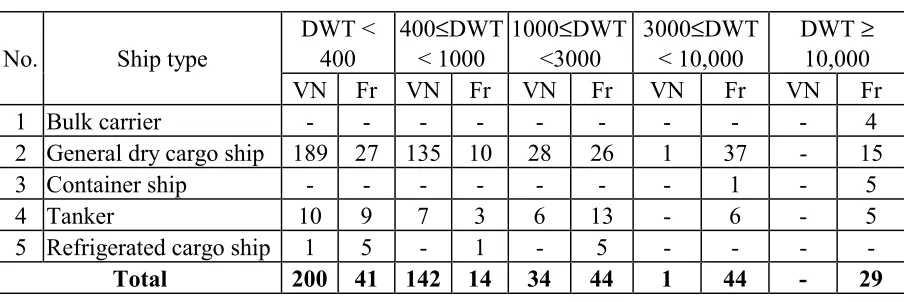
The Vietnamese mercantile fleet by ship types, deadweight and place
of built ... 43
Table 14
The Vietnamese ships detained by Tokyo MOU members ... 48
Table 15
Deficiencies by categories for detained ships in 1996, 1997, 1998 and
LIST OF FIGURES
Figure 1
The Vietnam Maritime Administration ... 7
Figure 2
LIST OF ABBREVIATIONS
ABS American Bureau of Shipping
BV Bureau Veritas
BVQI Bureau Veritas Quality International
ClD Sea-going Ship Classification Department
CMI Comite´ Maritime International
COLREG 72 Convention on the International Regulations for Preventing
Collisions at Sea, 1972
DNV Det Norske Veritas
DWT Deadweight (metric ton)
FSI Sub-committee on Flag State Implementation
GL Germanischer Lloyd
GT Gross tonnage
IACS International Association of Classification Societies
ILO International Labour Organisation
IMO International Maritime Organisation
InD Industrial Department
INMARSAT 76 Convention on the International Maritime Satellite Organisation (INMARSAT) and Operating Agreement, 1976
IrD International Relationship and Development Department
IsD International Safety Management Department
ISO International Organisation for Standardisation
Load Lines 66 International Convention on Load Lines, 1966
LR Lloyd’s Register of Shipping
M.C.O Maximum continuous output (HP)
MARPOL 73/78 International Convention for the Prevention of Pollution from Ships, 1973, as modified by the Protocol 1978 relating thereto
MEPC Maritime Environment Protection Committee
MOT Ministry of Transport
MOU Memorandum of Understanding
MSC Maritime Safety Committee
NK Nippon Kaiji Kyokai
OfD Offshore Department
PSC Port State Control
QMS Quality Management System
RuD Rule Department
SOLAS 74/78 International Convention for the Safety of Life at Sea, 1974, as
amended by the Protocol 1978 relating thereto
STCW International Convention on Standards of Training, Certification
and Watchkeeping for Seafarers, 1978, as amended
SWOT Strengths, Weaknesses, Opportunities and Threats analysis
TCVN Vietnam National Standard
Tonnage 69 International Convention on Tonnage Measurement of Ships, 1969
UNDP United Nations Conference on Trade and Development
VINAMARINE Vietnam National Maritime Bureau
VINASHIN Vietnam Shipbuilding Industry Corporation
VMA Vietnam Maritime Administration
CHAPTER I
Introduction
1.1 Introduction
It is the responsibility of the Vietnam Register (VR) to establish and maintain measures for the effective application and enforcement of most provisions of the IMO instruments ratified by the Vietnamese Government to the ships, which are entitled to fly the Vietnamese flag. These instruments consist of:
- the International Convention for the Safety of Life at Sea, 1974, as amended by the Protocol 1978 relating thereto, as amended;
- the International Convention for the Prevention of Pollution from Ships, 1973, as modified by the Protocol 1978 relating thereto, as amended (Annex I and Annex II);
- the International Convention on Load Lines, 1966;
- the Convention on the International Regulations for Preventing Collisions at
Sea, 1972, as amended; and
- the International Convention on Tonnage Measurement of Ships, 1969.
1.2 Objectives of the paper
In order to get a real picture of VMA and the Vietnamese shipping industry, the author will examine the major aspects of the functional basis of VMA and the data from the past, present and the plan for the near future development of the Vietnamese shipping industry. These resources are analysed with regard to:
- identifying VMA;
- examining the recent status of the enforcement of IMO technical conventions in Vietnam;
- analysing the internal and external business environment of VR;
- indicating the factors, which need to be improved in order to achieve more
effective outputs; and
- proposing measures for achieve the above objectives.
1.3 Methodology
The author’s knowledge gained in the two years of study at WMU and experiences gained during working time in VR are mainly used in this study. By interviewing WMU resident/visiting lecturers and professors, students from other courses, as well as maritime administration authorities during field studies, the author concentrated on the actual implementation of VR. Besides that, the study also analyses the actual activities of the Vietnamese shipping industry.
In addition, information was obtained from relevant technical issues collected in WMU field studies, insights from relevant visiting professors and WMU’s lecturers and WMU library information, which includes published periodicals, and books. Information was also obtained from the Vietnam Register Book of Ships, reports, technical papers, magazines and bulletins of VR, VINAMARINE and other governmental agencies concerned in Vietnam, which the author collected during the mid-term vacation in 1999.
1.4 Outline of the work
This paper is a one-volume work divided into six chapters. As will be seen, the first chapter concentrates on the general layout of the dissertation.
The second chapter is concerned with the clarification of the structure and authorised functions of VMA. In order to achieve the objective, the author will first give a brief recent picture of the maritime industry in Vietnam and analyse the legal instruments to which VMA is established in line with the form of a Maritime Administration pointed out by former-resident Professor P. S. Vanchiswar at WMU in the “Establishment/Administration of maritime matters with particular reference to developing countries”.
The third and fourth chapters will deal with:
- the recent status of the enforcement of IMO technical conventions by VR;
- the recent situation and the near future development plan of the Vietnamese
fleet and its owners and of the Vietnamese shipbuilding and ship repairing industry;
- the activity of the Port State control in Asian-Pacific countries and its
influences to the Vietnamese flag ships; and
- the IMO instruments relating to the implementation of the flag State.
CHAPTER II
Vietnam Maritime Administration
2.1 General
Situated in the eastern part of the Indochina peninsula, surrounded on the east, the south and the southwest by the Gulf of Tonking, the East Sea and the Gulf of Thailand, Vietnam has a long coast line measuring up to 3,444 kilometres, excluding the islands (The World Factbook 1993, p. 412), and one million square kilometres of judicial waters. Since the beginning, the sea and maritime transport has had a very important role in the economy of the country.
2.1.1 Vietnamese merchant fleet
The Vietnamese merchant fleet comprised 840 ships at the end of 1999 with a total deadweight of 1,636,869 tons. Vietnamese ships have been sailing on 30 international sea routes and have visited over 100 international seaports around the world. With regard to carriage of cargo, the Vietnamese fleet has carried 11,440,576 tons in 1997, 12,866,309 tons in 1998 and 16,266,300 tons in 1999. The fleet is owned by 321 owners, most of whom are small shipping companies. There are only about ten major national shipping companies.
2.1.2 Shipyards in Vietnam
Among these 60 shipyards, 10 are supervised by the Ministry of Defence, 14 by the Vietnam Shipbuilding Industry Corporation (VINASHIN), and the remaining 36 by regional state owned shipyards. Most of the major shipyards are supervised by VINASHIN.
2.1.3 Seaports
Ports are a major sector of the maritime industry. At the end of 1998, there were over 100 ports in Vietnam of varying sizes. In recent years, the total cargo throughput handled by them has been increasing rapidly: 36 million tons in 1995, 39.7 million tons in 1996, 45.76 million tons in 1997, 56.89 million tons in 1998 and 67.54 in 1999. The seaport system is composed of three strategic components - the northern seaport system, the central seaport system and the southern seaport system.
2.1.4 Sea-going personnel and maritime training
One of the basic components of efficient merchant shipping is the sea-going personnel who man them and ensure safety and the proper operation of ships. From statistics assembled for 31 December 1998, there were 6110 Vietnamese masters and nautical officers and 4373 Vietnamese chief engineers and engineer officers throughout the country.
The maritime training infrastructure consists of three main institutes: the Vietnam Maritime University (VIMARU) and the Maritime Technical and Training School No.1 in Haiphong, VIMARU branch and the Maritime Technical and Training School No.2 in HoChiMinh City.
2.1.5 Other related businesses
companies are interested in providing services such as towing, minor repairing, bunkering, and food and water supplying for ships when they are in port.
2.2 Vietnam Maritime Administration
2.2.1 Vietnam maritime legislation
.1 The Vietnam Maritime Code
As the country is involved to a quite high degree in maritime activities, there is a need for suitable maritime legislation to govern them. The highest legal instrument, the Vietnam Maritime Code (thereafter called “the Code”), was adopted by the National Assembly on 30 June 1990 (enforced on 01 January 1991). The Code consists of eighteen Chapters as shown in Appendix I, which cover all the principal activities of Vietnamese merchant shipping and provide the legal framework for the national maritime administration.
.2 Subsidiary legislation
For the effective operation of the provisions of the Code, the various rules and regulations need to be promulgated as subsidiary legislation.
Under the Code, a number of important legal instruments have been produced by the Prime Minister’s Office and Ministry of Transport defining the duties, responsibilities and the organisation of the maritime administrative machinery, in which the most important ones are:
- Decision No.239/HDBT, dated 29 June 1992, by the Prime Minister on
the establishment of VINAMARINE;
- Decision No.31/Ttg, dated 02 February 1993, by the Prime Minister on
the duties, responsibilities and the organisation of VINAMARINE;
- Decision No.203/Ttg, dated 28 December 1992, by the Prime Minister on
sea-going ship registration activities in Vietnam;
- Decision No.639/Ttg, dated 12 August 1997, by the Prime Minister on
- Decision No.75/Ttg, dated 03 February 1997, by the Prime Minister on duties, responsibilities and organisation of the Vietnam Register.
There are also a certain number of rules and regulations, which have been formulated by the maritime administrative machinery and approved by the proper governmental level for implementation in the maritime field.
.3 International conventions
Under the provisions of the Code, an international maritime treaty, to which Vietnam is a Party, is declared as national law. At the present time, Vietnam has only ratified eight IMO conventions, i.e. IMO Convention and 1993 Amendments, SOLAS 74/78, MARPOL73/78 Annex I and Annex II, Tonnage 69, Load Lines 66, COLREG 72, STCW 78, INMARSAT 76 and INMARSAT OA 76; none of the ILO conventions, UNDP conventions or CMI conventions regarding maritime activities was ratified. However, Vietnam has been a party to the most important multilateral maritime convention, that is the United Nations Convention on the Law of the Sea 1982.
2.2.2 The organisation
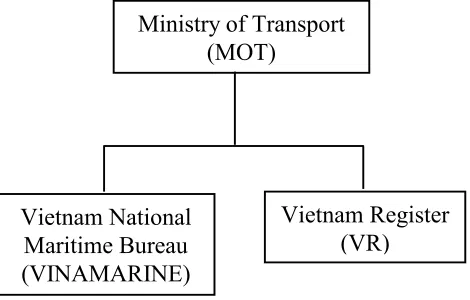
The Vietnam Maritime Administration (VMA) under the general direction of the Ministry of Transport (MOT) is the administrative agency that enables the government to satisfactorily and efficiently undertake the functions embodied within the Code and the framework of the country’s overall maritime policy.
Figure 1: The Vietnam Maritime Administration Ministry of Transport
(MOT)
Vietnam Register (VR) Vietnam National
While MOT italics is responsible for maritime legislation, implementation of broad government policy and for overall co-ordination, as well as for concerted action in harmony with the other related ministries, VMA performs the functions and roles of the subsidiary organisation for MOT through its two main independent organisations:
- the Vietnam National Maritime Bureau (VINAMARINE), and
- the Vietnam Register (VR).
The structure of the Vietnam Maritime Administration is given in Figure 1.
.1 Vietnam National Maritime Bureau
VINAMARINE is the authority of the State Administration of the shipping industry in Vietnam. The earliest form of the recent bureau was founded on the
13th November 1945 as a maritime department of MOT. At the beginning of
1955, the Department was upgraded to be the Waterway Transport Bureau. Together with the development of the transport infrastructure and the need for professional administrative machinery for maritime transport, the MOT by
Decision No.1046 on the 5th May 1965 decided to establish the Maritime
Transport Bureau to assist it in exercising the functions pertaining to maritime activities; it is now recognised as the founding day of VINAMARINE. On the
29th June 1992, by Decision No.239/HDBT of the Prime Minister, the
organisation’s name was changed to VINAMARINE.
Appendix II describes the organisation chart of VINAMARINE.
.2 Vietnam Register
was officially founded according to Decision No.345/TL of MOT. This day has officially been recognised as the founding day of VR.
After reunification in 1975, this section was upgraded as the Vietnam Register of Shipping (VIRES) on the 19th January 1979. Since 1990, the organisation has been responsible for the technical supervision and classification services for offshore installations; furthermore, it has also been responsible for implementation and development of the vehicle technical safety inspection system since 1995.
Considering the important roles of the organisation in the transport field, on the 3rd February 1997, the Prime Minister, by Decision No.75/Ttg, redefined its functions and jurisdiction and also changed its name to the Vietnam Register with the Headquarters situated in the capital City Hanoi.
The organisation structure of VR is as shown in Appendix III.
2.2.3 Analysis of the delivery tasks of the Vietnam Maritime Administration
The roles and functions of VMA are defined by the Code and the related Decisions of the Government. Thus, VMA is responsible for performing:
- advisory functions,
- administrative functions,
- developmental and promotional functions, and
- regulatory functions
as the subsidiary machinery for MOT.
.1 Advisory functions
Obviously, the advisory functions of VMA are in the form of advising the Government on the related responsible tasks, and the drafting of maritime legislation and shipping policy for consideration and approval at the political level. In exercising these functions, VINMARINE is authorised to perform the following major tasks:
- preparing strategy, a five year programme and long term plans for the
throughout the country, which covers shipping, ports, shipbuilding, ship repair, maritime training, etc. and submitting them to the Minister of MOT for consideration, and thereafter, to the Prime Minister, for approval;
- proposing to the Minister of MOT and the Prime Minister the ratification
of international maritime conventions and the signing of shipping acts and protocols; and
- drafting laws, ordinances, circulars, regulations, policies, rules of
management, procedures and legal norms on maritime activities, and reporting to the Minister of MOT for his decision, if empowered, or for his submission to the Government.
In addition, VR is responsible for drafting rules and regulations, and other related technical legal documents for safety and quality of the objects under its responsibilities and submitting to MOT or the Ministry of Science, Technology and Environment for consideration, approval and promulgation;
.2 Administrative functions
Clearly VMA is not only part of the overall Public Administration of the government but is also a specialised executive arm of the government regarding maritime matters. Therefore, it has to discharge its administrative functions in the same way as any other administrative unit, following the same administrative and financial rules and procedures, to ensure implementation of shipping policy, and to carry out the mandated specialised functions. In these functions, VINAMARINE is responsible for:
- proclaiming the circulars giving guidelines on the implementation of
maritime legislation;
- considering, together with other competent authorities of the Government, the issuance of licences on co-operation and investment as well as operating permits in the shipping field;
- promulgating the statutes of seaports, and declaring their opening for
navigation under authorisation of the Minister of MOT;
- issuing entry permits to foreign ships and boats entering into the
territorial waters of Vietnam in accordance with the national legislation and international shipping customs;
- issuing permits and guidelines, and exercising control over the statutory activities of shipping agents, shipbrokers, pilotage, maritime service agents and shipping representatives at home and abroad;
- leading maritime inspections and exercising control over the execution of laws, regulations and state provisions in shipping
- performing the procedures of a shipping public notary as provided by
laws; and
- acting as investor/sponsor or as administrative agency for maritime
construction projects envisaged in the State plan and authoritatively managed by it.
.3 Developmental and promotional functions
- together with competent state authorities, participate in domestic and foreign investment projects directed at maritime infrastructure development in Vietnam;
- submission for approval, or approval as empowered, of the new
formation or upgrading of seaports and navigation aids systems throughout the country;
- governing and leading work on research and application of shipping
technology as well as training, examination and certification of ship officers;
- analysing and assessing the most suitable types and numbers of ships
required to meet the scale of development planned, and making proposals for expansion of the national fleet; and
- cooperating with the Ministry of Trade and the Ministry of Finance in
making subsidiary policy for shipping, shipbuilding and ports, as well as the policy for apportionment of trade and cargo sharing.
.4 Regulatory functions
Generally, the functions embodied in national maritime legislation, especially those pertaining to registration of ships, maritime safety, marine personnel, maritime casualty investigation and protection of the marine environment are enforced by the Maritime Safety Administration in most countries. The Maritime Safety Administration is an integral part of the Maritime Administration and is the specialised executive arm of a maritime government. The tasks of the Maritime Safety Administration in Vietnam are laid on both VINAMARINE and VR. The most vital regulatory functions of the Maritime Safety Administration take the form of:
- General superintendence and co-ordination;
- Registration of ships;
- Manning of ships;
- Conducting inquiries or investigations into shipping casualties;
- Dealing with matters pertaining to prevention, control and combating of
marine pollution;
- Dealing with matters relating to maritime search and rescue;
- Crew matters;
- Ensuring the safety of fishing vessels and other small craft; and
- Dealing with the removal of wrecks.
.4.1 General superintendence and co-ordination
The functions of general superintendence and co-ordination of the work of the Maritime Safety Administration in Vietnam are exercised by the Chairman of VINAMARINE, and the General Director of VR as they are the statutory officials duly appointed and appropriately empowered under Decision No.239/HDBT and Decision No.203/Ttg of the Prime Minister.
The Vietnam National Maritime Bureau is the authority of the State Administration of the shipping industry of Vietnam. Acting on behalf of the Minister of MOT the chairman of the Bureau is responsible to the Prime Minister and the Minister for exercising the functions of the State Administration over the shipping industry throughout the country, which consists of all State-run (central and local authorities) and non State-run companies, organisations and individuals (including foreign organisations and individuals in Vietnam).
(Article 1, Decision No.239/HDBT) “The General Director of the Vietnam Register is responsible for organising, managing and directing all the sea-going ship registration activities in Vietnam under the provisions of the Vietnam Maritime Code ...”
.4.2 Registration of ships
The registration of a ship is used as evidence of the right to fly the flag of the State as well as the right of ownership and mortgage. Relevant to the question of registration of ships, Articles 91, 92, 93 and 94 of the United Nation Convention on the Law of the Sea 1982 lay down the international principles in this connection. The procedure for registration of ships is set out in several provisions of the Code and the Rules for Registration of Sea-going Ships and
Seafarers (Decisions No.91/CP, dated 23rd August 1997, by the Prime
Minister).
According to these provisions, it is mandatory for the following kinds of vessels to be registered in the National Registry Book of Ships:
a. self-propelled sea-going vessels with propulsion engines of 75 (hp) and
above;
b. non-propelled sea-going vessels with a gross tonnage of 50 GT and
above; or with a deadweight of 100 tons and above; or with a length measured at the designed waterline of 20 meters and above;
c. vessels of smaller sizes than mentioned in a. and b. but engaged in
international voyage; and
d. fishing vessels, fish processing vessels and vessels used for the domestic transport of fish.
VINAMARINE is responsible for issuing the Certificates of Registry for those sea-going vessels satisfying the criteria in paragraphs a., b. and c., and other related requirements about the qualifications for ownership, and for entering and maintaining the required ship’s particulars in the National Registry Book of Ships. The vessels under paragraph d. are under the responsibility of the Ministry of Fisheries.
requirements of national legislation and ratified IMO conventions if necessary, or for delegating the tasks to international classification societies.
.4.3 Surveys, inspections and certification of ships; Ensuring the safety of fishing vessels and other small craft
The tasks pertaining to this item are mostly performed by VR as empowered under Articles 13, 18 and 25 of the Code, and defined by the Decisions No.75/Ttg and No.203/Ttg of the Prime Minister, covering the following:
- to review and approve technical designs for new building, conversion,
renewal or reinstallation of sea-going ships;
- to carry out inspections/testings of, and issue relevant certificates to, materials, equipment and components intended for the objects, which are under scope of service of VR;
- to carry out surveys/inspections of sea-going ships, floating structures, offshore installations, work machines, boilers, pressure vessels, lifting appliances, containers, etc., under construction/manufacture, conversion, repair or assembly;
- to carry out surveys/inspections of the above objects in service;
- to issue relevant certificates in compliance with the requirements of those rules and regulations, technical standards and IMO technical conventions that have been ratified by Vietnam;
- to measure, calculate and issue tonnage certificates according to the
International Convention on Tonnage Measurement of Ships 1969 or the relevant national regulation;
- to carry out audits of, and issue certificates as required by, the ISM Code and in conformity with the ISO 9000;
- to publish the register books and to maintain technical records on the means of transport and projects which are under inspections/surveys. In addition to VR, VINAMARINE is empowered by Decision No.239/HDBT of the Prime Minister to perform inspections pertaining to port State control of foreign ships, as well as inspections and detention of unseaworthy/unsafe ships. .4.4 Examination and certification of seafarers; Manning of ships; Crew
matters
The standards for examination of various grades of seafarers and their appropriate certification constitute the first element in determining the standards of safety and efficiency of the ships being operated. Clearly, all maritime countries through their respective Maritime Safety Administrations should decide upon the standards and systems required in consultation with the parties concerned. As defined by Decisions No.239/HDBT and No.31/Ttg, VINAMARINE is in charge of:
- establishing the standards for the competency and proficiency of seafarers and the appropriate grade and level at which seafarers have to perform their duties on board the ships, and submitting to the concerned authority for approval and proclamation; and
- issuing or withdrawing certificates of competency and seapasses for crew
working on board ships of over 100 DWT belonging to enterprises and individuals throughout the country.
The second element is the manning structure of the ships, especially the “certificated manning”. In regulating it, VINAMARINE is empowered to: - establish the safe manning standards, the labour conditions and discipline
of seafarers in Vietnamese ships and submit to the concerned authority for approval and proclamation;
- co-ordinate with other related authorities to examine the health of maritime personnel and sea-going ships’ medical care.
Obviously, the third element, the fundamental determinant of the quality chain, is the quality of the relevant maritime education and training (MET) of seafarers. The Vietnamese maritime education and training institutions are authorised to conduct examinations of seafarers; VINAMARINE is entitled to monitor and audit the performance of MET institutions as regards standards of education, training and examination of seafarers, and further on, to plan and assist in the development of maritime training in Vietnam.
.4.5 Conducting inquiries or investigations into shipping casualties
The primary purpose of these functions is to ascertain the facts, to obtain all the relevant information, and to determine as precisely as possible the cause(s) of maritime casualties, so as to enable the government to take the necessary steps to prevent, as far as practicable, the reccurrence of similar casualties. In order to fulfil these functions, VINAMARINE is responsible for leading and co-ordinating casualty investigations regarding shipping activities. In addition, VR is obligated to take part in carrying out investigations of casualties involving transport.
.4.6 Dealing with matters pertaining to prevention, control and combating of marine pollution
Furthermore, there are also the obligations of the Vietnam Oil and Gas Corporation and the Vietnam Coast Guard for organising marine pollution combating within their respective areas of responsibilities. However, the role of co-ordinating and participating in combating marine pollution at area and national levels has not yet been assigned by legislation to any organisation. .4.7 Dealing with matters related to maritime search and rescue; Dealing with
the removal of wrecks
According to national policy and the circumstances in Vietnam,
VINAMARINE is obligated, under Decision No.780/Ttg, dated 23rd October
1996, of the Prime Minister, to be a Member of the National Search and Rescue Committee, and to be lead organisation when co-ordinating with other organisations to provide search and rescue services at sea.
The provisions pertaining to wrecks are laid down in Chapter XII of the Code, which entitles the Minister of MOT to be responsible for all matters dealing with wrecks.
2.3 Conclusion
CHAPTER III
Enforcement of IMO Technical Conventions - The recent situation
3.1 Rules and Regulations
As discussed in Chapter II, VR is a public organisation responsible for enforcing the statutory surveys and certification as required by the national rules and incorporated IMO conventions (SOLAS 74/78, MARPOL 73/78, Tonnage 69, Load Line 66, and COLREG 72); in addition, it functions recently as a non-profit classification society. In order to determine the structural and mechanical fitness of ships and other marine structures for their intended purpose and to promote the safety of life, property and marine environment, the organisation has been establishing, revising and abolishing a system of rules and regulations, which consists of class requirements and statutory requirements (see Appendix IV for details).
These rules and regulations and a number of guidelines and instructions are real powerful instruments for the supporting departments, branch offices and surveyors in carrying out their duties.
3.2 Organisation for exercising statutory duties
(OfD) have the function to manage the class matters and the following statutory tasks:
- the management of statutory surveys for Vietnamese flag ships, foreign flag
ships, and on behalf the other classification societies;
- the establishment, revision and/or abolition of survey record, survey report and certificate forms and the custody of survey records for ships;
- the preparation of statistics for Vietnamese flag ships and ships under class; - the issuance of full-term statutory certificates;
- the assessment of survey records and survey reports;
- the issuance of lists of survey status and notification of ship’s recommendation; - the establishment, revision and abolition of rules and regulations relating to
international conventions;
- the compilation of the publications of rules and regulations relating to
international conventions;
- co-operating with the Training Department to plan and execute the education
and training for personnel;
- the approval of various plans of a new ship under construction or a VR classed ship under conversion;
- the tonnage measurement, assignment of loadlines, approval of stability booklet and the various booklet as required under the international conventions;
- the establishment, revision of the guidances for surveyors pertaining to
statutory surveys;
- appraisal of request for “exemptions” from any statutory requirements;
- participating in maritime casualty investigation conducted by VINAMARINE;
- delegating the statutory surveys and certification to the international
classification societies who have been signed the agreements with VR;
- type approval of machinery, equipment, automatic devices, materials, welding
- surveys and certification of fixed and mobile offshore units.
The 23 branch offices are responsible for carrying out site surveys and issuing of authorised reports, records and certificates under the direction of the departments in the Headquarters; they cover all the most attractive maritime locations over the country, including Haiphong, HoChiMinh City, Quangninh, Vungtau, Nhatrang and Danang (see Appendix V).
3.3 Personnel
VR currently employs 700 staff, including 600 technicians with qualification of university graduate and postgraduate; among them, the site surveyors for sea-going ships are 129.
Right after joining VR, every staff member has had to undergo the required training courses held at VR Headquarters or at premises of the manufacturers/builders or assemblers. Training time required for staff to be a junior marine surveyor is from two to three years, including 120 hours of theory knowledge at Headquarters and on the job training.
VR staff trained abroad Table 1
International organisations/institutions Number of VR surveyors
Lloyd’s Register of Shipping 32
Bureau Veritas 5
Germanischer Lloyd 12
Det Norske Veritas 4
Nippon Kaiji Kyokai 14
Russian Maritime Register of Shipping 8
Polish Register of Shipping 3
American Bureau of Shipping 2
Korean Register of Shipping 2
International Maritime Academy 2
World Maritime University 5
SIDA (Sweden) 2
Total 91
Source: Vietnam Register Technical Journal, No.2
seminars and workshops are organised at the Headquarters or at regional offices to maintain and update staff knowledge, such as the ISM Code, ISO 9000, enhanced survey programs, and financial management.
Many VR surveyors and inspectors have been appointed to attend training/seminars abroad, held by international organisations, IMO or IACS members. As at the end of 1999, the numbers of VR staff trained abroad can be seen in Table 1.
Seven VR staff members have studied at World Maritime University since 1994; among them five have already graduated. Others are still studying English, and expecting to get access to join courses at WMU in the future. Annually, from 5% to 7% of VR turnover is spent for staff training and training materials/equipment.
3.4 Vietnam Register Quality Management System
Mission statement
The mission of VR is to serve the public interest as well as the needs of our clients by promoting the security of life, property and natural environment, primarily through the development and improvement of standards and the performance of design appraisal, surveys/testings during construction/manufacture and in service of water crafts, roadway and railway motor vehicles and offshore installations.
Quality Policy
It is the policy of VR to provide the quality services to achieve our mission and meet demands of our clients. VR activities of classification and certification for safety and quality are always assured in truth, reliability, promptness, and cleanness and constant improvement. The policy is understood, implemented and maintained at all levels of VR.
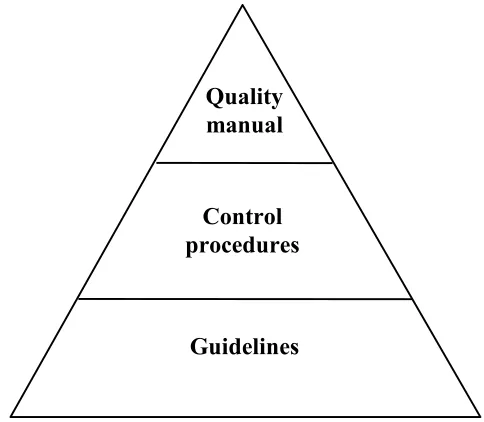
VR has also collaborated with BV quality division in drafting its quality manual and control procedures. The quality management system was documented to communicate to everyone in the organisation:
- The mission of the system
- The policy of the organisation
- Employee’s responsibilities within the organisation
- The operational procedures.
In April 2000, VR quality management system, which consisted of the Quality Manual and 47 Control Procedures, was successfully verified by BVQI for achieving an ISO 9002 quality management system certificate. The Quality Manual consists of 4 chapters and two annexes, including the General Director’s statement, concerning the growth and development of the organisation and the decision by management to formalise and document the commitment to achieve better service in the shipping industry. The chapters are as follows:
VR Quality Manual
Chapter 1: Mission statement, quality policy, and the declaration of VR General
Director
Chapter 2: Quality Manual - Introduction Chapter 3: Definitions
Chapter 4: Obligations under the Quality Manual
The Control Procedures following this Quality Manual are discussed in section 3.5 of this Chapter.
3.5 Procedures for organising the statutory activities
3.5.1 Procedure for statutory surveys
The procedure defines the unified steps and the responsibilities of the relevant levels of delivery machinery in carrying out statutory surveys of sea-going vessels. It organises the statutory surveys conducted for:
- the Vietnamese ships engaged in international voyages under requirements of
- the Vietnamese ships engaged in domestic voyage and non-convention size ships under requirements of national rules; and
- foreign ships as delegated by their flag States.
Under the text of this procedure, the General Managers of ClD or InD is responsible for:
- giving instructions as requested by the branch office and the surveyors carrying out the survey;
- leading the flag-in surveys or initial surveys of in-service ships;
- considering the request of shipowner, delegating the statutory surveys for the proper international classification societies;
- conducting inspections of sea-going ships as required by the Board of
Directors;
- verifying the survey reports and survey records;
- solving the matters pertaining to delegations; and
- proposing to issue or issuing full-term certificates under authority. The Directors of the branch offices are responsible for:
- considering the survey applications;
- leading and conducting the surveys;
- verifying the survey reports, survey records, and invoices;
- issuing short-term certificates and full-term certificates under authority;
- issuing receipts
The surveyors are responsible for:
- determining scope of surveys;
- carrying out the surveys;
- preparing survey reports, survey records, and invoices. 3.5.2 Procedure for verifying a Safety Management System
The General Manager of IsD is in charge of:
- governing the verifications;
- considering the survey application;
- appointing verifying team and the leading auditor; - solving the matters pertaining to delegations; and
- proposing the Board of Directors to issue full-term DOC and SMC.
The Directors of the branch offices are responsible for:
- co-ordinating with IsD to perform intermediate verifications of the safety
management systems of ships; and
- appointing auditor as requested by the General Manager of IsD.
The auditors are obligated for:
- carrying out the verifications in according to Guidelines for Verification of
Safety Management Systems; and
- issuing invoices.
3.5.3 Procedure for plan approval
The principles for design approval and duties of bodies involved are indicated within the text of this procedure. It applies for both the approval of new building designs and the conversion designs of sea-going ships and offshore units.
The heads of the departments/branch offices functioned the task are responsible for:
- governing the design approval under authority;
- appointing the approval team; and
- signing the approved documents.
In addition, the General Manager of RuD is in charge of instructing and monitoring the design approval within VR.
The members of approval team are responsible for:
- examining and evaluating the design in accordance with the proper
requirements; and
- performing design approval in compliance with Rule for manage and approve
The clerical staff is responsible for:
- receiving applications and design documents;
- documenting the designs and transferring the design documents to appointed
approval team;
- compiling the recommendations or reports from the approval team, and
submitting to the head of unit for approval;
- sending the approved design to responsible VR units and designer/shipbuilder;
- issuing invoices.
3.5.4 Procedure for issuing full-term statutory certificates
The procedure defines the unified steps for issuing full-term statutory certificates and the duties of the related VR units. It is composed of:
- issuing statutory certificates for Vietnamese ships engaged in international
voyages under requirements of international and national requirements;
- issuing statutory certificates for Vietnamese ships engaged in domestic voyages under national requirements;
- issuing statutory certificates for foreign ships as delegated by their flag State; - issuing document of compliance for foreign ships that their flag State are not
party to the international conventions.
As indicated in the text, the General Managers of ClD and OfD are responsible for verifying the survey documents of sea-going ships and offshore units and proposing the Board of Directors to issue certificates or issuing certificates under authority. The General Managers of IsD is responsible for proposing the Board of Directors to issuing DOC and SMC.
3.5.5 Procedure for reviewing and evaluating survey documents
The site surveyors are in charge of reviewing the reports submitted by the sub-contractors, such as thickness measurement reports, non-destructive testing reports, continuous machinery survey reports and under-water survey reports.
The Directors of the branch offices are responsible for:
- reviewing the survey documents prepared by site surveyors; and
- conducting the random verifications for the completed survey documents.
The General Managers of ClD, OfD and InD are responsible for:
- reviewing the survey documents received from the branch offices;
- monitoring the “actions to be taken” for correcting non-conformities; - proposing to issue or issuing full-term certificates under authority; and
- conducting the random verifications for the completed survey documents.
3.5.6 Procedure for statutory surveys on behalf of foreign classification societies The procedure defines the unified steps for carrying out statutory surveys of in-service sea-going ships and offshore units on behalf of the other classification societies, and the responsibilities of the related VR levels.
The General Manager of ClD and OfD are in charge of:
- checking the survey authority and consulting with the classification society
involved, if necessary;
- appointing branch office or surveyors to perform the survey;
- instructing and monitoring the surveys; and
- reviewing the survey documents.
The Directors of the branch offices are responsible for:
- conducting the surveys as directed by the ClD or OfD;
- reviewing the survey documents and invoices prepared by the surveyors; and
- signing the survey documents and issuing receipts.
The site surveyors are responsible for:
- determining the scope of surveys;
- carrying out the surveys; and
3.5.7 Procedure for dealing with PSC matter
The aim of the procedure is to determine the appropriate actions of VR for ensuring that any PSC information pertaining to Vietnamese ships and VR class ships is investigated, analysed and evaluated and that the proper measures are taken to prevent the reoccurrence.
The General Manager of ClD is responsible for: - leading and deciding the response activities;
- co-ordinating with PSCs, related foreign maritime administrations,
classification societies, shipowners, and ships’ masters to solve the detentions;
- appointing branch offices or surveyors to carry out inspections of detained
ships when it arrived Vietnamese ports;
- authorising other classification societies to perform surveys of detained VR
class ships to rectify the deficiencies;
- informing PSCs about the actions taken by VR with detained ships; and
- preparing inspection reports and submitting them to the Board of Directors. The Manager of the Statutory Survey Section is responsible for:
- compiling, analysing and evaluating of PSC information;
- consulting with PSCs, related foreign maritime administrations, classification societies, shipowners, and ships’ masters;
- proposing the measures to the General Manager of ClD for correcting and
preventing reoccurrence; monitoring the performance of these measures; - preparing quarterly statistic figures and detention list of ships.
The Directors of branch offices are responsible for:
- conducting the inspections of detained ships as required by the General
Manager of ClD;
- leading and monitoring the inspections and the measures for correcting and
preventing reoccurrence.
- preparing reports and proposing the measures for correcting and preventing reoccurrence.
3.5.8 Procedure for establishment, revision and provision of the Guidelines for Surveyor
The procedure defines the unified steps for establishing and amending the Guidelines for Surveyors so that the Guidelines are in compliance with the updated national legislation, the international conventions, and the agreements between VR and the other classification societies; it also indicates the duties of the related VR units and the procedure for publication and delivery to surveyors.
The Board of Directors is responsible for:
- making decision to establish, amend, publish and deliver the Guidelines; and
- proclaiming new Guidelines and the Amendments.
The General Managers of the departments are in charge of:
- compiling and reviewing the proposal of the need of new Guidelines or
Amendments from VR units;
- proposing the need to the Board of Directors for approval;
- conducting the works for drafting the texts;
- monitoring the interpretation of the texts; The heads of the other units are responsible for:
- proposing the need of new Guidelines or Amendments; and
- co-ordinating with the departments in charge to draft the texts.
The General Manager of IrD is obligated for the publication of the Guidelines.
3.5.9 Procedure for establishment, revision and provision of the certificate and survey report forms
The procedure organises the tasks to establish and to revise the forms pertaining to activities of VR for complying with the updated national, international and foreign maritime administrations requirements. It also defines the duties of VR units and the provision of the forms.
- establishing or revising forms for compliance with relevant requirements;
- requiring to print the forms;
- delivering the forms to related VR units;
- storing of the forms.
The Directors of the branch offices are responsible for:
- ensuring to apply proper survey report, survey record, and certificate forms;
and
- maintaining the forms;
- proposing to establish/revise and be additionally provided the forms. The General Manager of IrD is responsible for printing the forms.
The clerical staff is responsible for typing and reviewing the forms and for submitting to General Managers for approval.
3.5.10 Procedure for compilation and notification of the ship status
The procedure defines the unified steps for updating and maintaining the technical information of VR class ships, and the duties of VR units involved.
The General Manager of ClD is responsible for:
- updating accurately the ships’ technical information;
- maintaining the updated information;
- sending the ships’ technical information to the branch offices, and shipowners if necessary; and
- listing the ships over due and ships being withdrawn VR class.
The General Manager of Computerised Department is responsible for maintaining the ships’ technical information in VR network.
3.5.11 Procedure for marine casualty investigation
The procedure aims to organise the activities pertaining to:
- collecting and analysing the maritime casualty information;
- determining the root causes of the accidents;
- determining the measures related to the performance of VR or other parties to prevent reoccurrence; and
- amending or revising rules and guidelines of VR.
The Board of Directors is responsible for:
- leading the participating in serious maritime casualty investigations;
- declaring the opinion of VR in related with the serious maritime casualty; and
- approving the measures for preventing.
The General Managers of departments are responsible for:
- conducting or participating in the serious maritime casualty investigations as required by the Board of Directors;
- monitoring the performance of the branch offices in doing this task;
- compiling, analysing the gathering information, and proposing the preventive
measures.
The Directors of branch offices are responsible for:
- conducting the maritime casualty investigations;
- co-ordinating with related departments or administrative organisations in the
maritime casualty investigations; and
- reporting the information and sending the related document to the departments
in charge.
Investigators are responsible for:
- carrying out the maritime casualty investigations;
- analysing the gathering information;
- co-operating with other administrative officers in the maritime casualty
investigations;
- determining, if possible, the causes and proposing the preventive measures. The staff in charge of the departments is responsible for:
- compiling the investigations’ information under authority; and
3.5.12 Procedure for recognition and delegation of authority to foreign classification societies
The procedure indicates the unified steps for considering the capabilities of the foreign classification societies for recognition and delegation of the statutory work, and the responsibilities of related units.
The Board of Directors is responsible for reviewing and signing agreement. The General Manager of IrD is responsible for:
- conducting and monitoring the drafting process;
- dealing with the suggestions from other VR units;
- discussing the articles with related classification society; - submitting to the Board of Directors for signing; and
- updating and providing the agreement.
The head of the other VR units are responsible for:
- examining and giving suggestions for the agreement; and
- implementing the articles of the signed agreement.
3.6 Delegation of statutory surveys and certification
Nowadays, more than 100 governments have authorised the international classification societies, in view of their expertise and the world-wide availability of qualified surveying staff, to implement the statutory regulations of the conventions and related codes and resolutions, either wholly or partly, and issue statutory certificates on their behalf. Such delegation is permissible under the IMO convention system. However, it is important to note that delegating administrations still retain their responsibilities and obligations under the conventions they have ratified.
The problem has been overcome by authorising the international classification societies to act on behalf of VR. The following factors are also considered as the reasons why VR delegates the statutory tasks to them.
- the class surveys and the statutory surveys for the overall control of ship safety should avoid duplicated jobs; and
- the international classification societies are capable of maintaining a world-wide network of qualified surveyors; having comprehensive classification rules compiled on the basis of sound research and development; efficient and effective feedback of significant technical data via survey reports and an internationally recognised quality management system.
VR has signed agreements for mutual co-operation and substitution in the field of ships/offshore classification and certification with all members of IACS as below:
- American Bureau of Shipping
- Bureau Veritas
- China Classification Society
- Det Norske Veritas
- Germanischer Lloyd
- Korean Register of Shipping
- Lloyd’s Register of Shipping
- Nippon Kaiji Kyokai
- Registro Italiano Navale
- Russian Maritime Register of Shipping.
These agreements generally include the following items:
- subject and scope of agreement, definitions
- classification standards and records
- survey during construction, conversion and repair of ships
- periodical survey on in-service ships
- surveys relating to the manufacture of materials and products intended for
- statutory surveys
- exchange of rules, regulations and other publications
- communications
- training VR personnel
- invoicing and sharing of fees and expenses
- liability
- settling disputes
- amendment, validity and entry into force
- legal restraints.
However, these agreements are likely the co-operative agreements between two classification societies; under which, the signing parties can assist each other with class and statutory surveys of their classed ships.
By entering into the agreements with VR, the class rules of these societies are simultaneously recognised by the provisions of the Vietnamese Maritime Code to serve as basis for the design and construction of the Vietnamese flag ships.
In case a Vietnamese flag ship is holding class of one of these parties, and at the request of the shipowner, VR could issue an “Survey Authority” to delegate the statutory surveys and issue of certificates for the appropriate society. The delegation does usually not cover the tonnage computation, the tasks under the ISM Code, the approval of ships’ manuals, booklets and plans, and the issue of exemption certificates. However, there are just LR, DNV, NK and GL being delegated to perform the statutory matters.
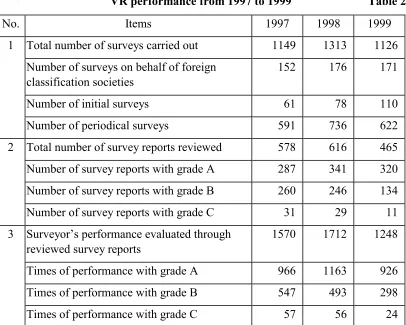
3.7 The performance of VR in the recent years
VR performance from 1997 to 1999 Table 2
No. Items 1997 1998 1999
1 Total number of surveys carried out 1149 1313 1126
Number of surveys on behalf of foreign classification societies
152 176 171
Number of initial surveys 61 78 110
Number of periodical surveys 591 736 622
2 Total number of survey reports reviewed 578 616 465
Number of survey reports with grade A 287 341 320
Number of survey reports with grade B 260 246 134
Number of survey reports with grade C 31 29 11
3 Surveyor’s performance evaluated through reviewed survey reports
1570 1712 1248
Times of performance with grade A 966 1163 926
Times of performance with grade B 547 493 298
Times of performance with grade C 57 56 24
CHAPTER IV
External Business Environment Analysis
4.1 The Vietnamese mercantile fleet
4.1.1 The diversity of the fleet
The total number of self-propelled sea-going steel ships of all kinds of dry cargo ships and liquid bulk ships was 549 ships according to the Vietnam Register Book of Ships at the end of 1999. As shown in Table 3, the general dry cargo ships dominated the fleet with 85.25 % in number, 54.81 % gross tonnage, 52.58 % ton deadweight and 64.48 % maximum continuos output of main engines (M.C.O).
The particulars of the Vietnamese mercantile fleet Table 3
No. Ship type Number Gross tonnage Deadweight M.C.O
1 Bulk carrier 4 54,983 92,119 32,800
2 General dry cargo ship 468 401,053 601,016 409,164
3 Container ship 6 62,061 73,918 52,976
4 Tanker 59 205,979 368,551 120,366
5 Refrigerated cargo ship 12 7,700 7,373 19,265
Total 549 731,776 1,142,977 643,571
It is clear that there is an imbalance in types of ships. The number of general dry cargo ships is too high in terms of tonnage distribution by type, accounting for 54.81 % against the world distribution of only 20%. There are low percentages of the specialised ships such as container ships, bulk carriers and crude oil tankers that can contribute to huge quantity of cargo carrying capacity.
rice - a commodity that is transported under break-bulk type. Crude oil is a strategic export commodity, which contributes to the main income of the country. Recently the quantity of containerised cargoes has increased. So, from the demand point of view, the Vietnamese fleet should have respectively a larger number of specialised ships than present types in order to meet the national demand.
However, from Table 4, in terms of the average size, the bulk carrier and container ship are the two biggest types with the average gross tonnage over 10,000. The general dry cargo ship and reefer ship are rather small with an average gross tonnage between 500 and 1000.
The average figures of the Vietnamese mercantile fleet Table 4
No. Ship type Gross tonnage Deadweight M.C.O Age
1 Bulk carrier 13,746 23,029.68 8,200.00 20.00
2 General dry cargo ship 857 1,284.22 874.28 14.12
3 Container ship 10,344 12,319.68 8,829.33 17.83
4 Tanker 3,491 6,246.63 2,040.10 20.05
5 Refrigerated cargo ship 642 614.43 1,605.42 26.00
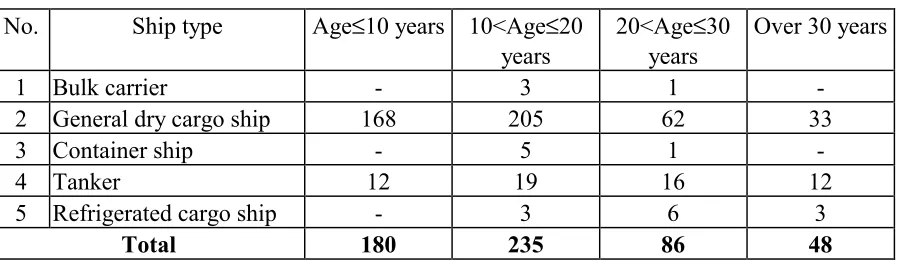
4.1.2 The technical condition of the fleet
there is a vital need to introduce effective countermeasures for the rehabilitation of the Vietnamese fleet.
The matrix age of the Vietnamese mercantile fleet Table 5
No. Ship type Age≤10 years 10<Age≤20
years
20<Age≤30 years
Over 30 years
1 Bulk carrier - 3 1
-2 General dry cargo ship 168 205 62 33
3 Container ship - 5 1
-4 Tanker 12 19 16 12
5 Refrigerated cargo ship - 3 6 3
Total 180 235 86 48
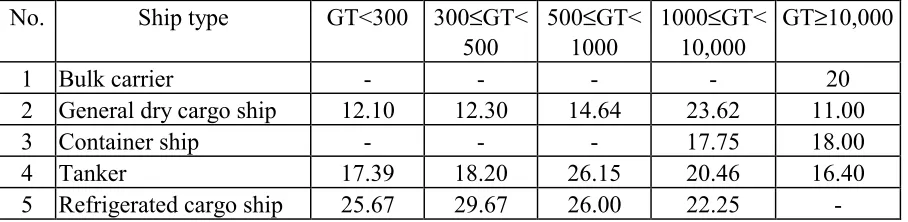
If looking at the diversity of ships according to main applicable sizes of SOLAS 74/78 and the appropriately average ages at these sizes in Table 6 and Table 7, there will be a big challenge to the maintenance of the carrying capacity for the Vietnamese fleet in the coming year.
Table 6 The Vietnamese mercantile fleet by types and main SOLAS sizes
No. Ship type GT<300 300≤GT<
500
500≤GT< 1000
1000≤GT< 10,000
GT≥10,000
1 Bulk carrier 0 0 0 0 4
2 General dry cargo ship 230 120 44 73 1
3 Container ship 0 0 0 4 2
4 Tanker 18 10 13 13 5
5 Refrigerated cargo ship 3 3 2 4 0
Total 251 133 59 94 12