University of New Orleans University of New Orleans
ScholarWorks@UNO
ScholarWorks@UNO
University of New Orleans Theses and
Dissertations Dissertations and Theses
Spring 5-23-2019
Let Me Take a #Shelfie: An Assemblage Explored Through
Let Me Take a #Shelfie: An Assemblage Explored Through
Framing
Framing
Courtney D. Brandabur
University of New Orleans, [email protected]
Follow this and additional works at: https://scholarworks.uno.edu/td
Part of the Sociology of Culture Commons
Recommended Citation Recommended Citation
Brandabur, Courtney D., "Let Me Take a #Shelfie: An Assemblage Explored Through Framing" (2019). University of New Orleans Theses and Dissertations. 2592.
https://scholarworks.uno.edu/td/2592
This Thesis is protected by copyright and/or related rights. It has been brought to you by ScholarWorks@UNO with permission from the rights-holder(s). You are free to use this Thesis in any way that is permitted by the copyright and related rights legislation that applies to your use. For other uses you need to obtain permission from the rights-holder(s) directly, unless additional rights are indicated by a Creative Commons license in the record and/or on the work itself.
Let Me Take a #Shelfie: An Assemblage Explored Through Framing
Submitted to the Graduate Faculty of the University of New Orleans in partial fulfillment of the requirements for the degree of
Master of Arts in Sociology
by
Courtney Brandabur
B.S. Louisiana State University, 2015
ii
Table of Contents
List of Illustrations ... iii
Abstract ... iv
Introduction ...1
Literature Review ...5
The Self and Identity ...5
The Internet, Social Media, and Social Media’s Creation of Self ...7
The Internet ...7
Social Media ...9
Social Media’s Creation of the Self ...11
Framing and Cultural Materialism ...14
Assemblage Framework: Bringing It All Together ...18
All Ideas Assembling to Form an Approach ...21
Methodology ...22
Let Me Take a #Shelfie ...28
The Multiple Framing of a #Shelfie ...31
A Deeper Look at Shelfie ...39
Discussion and Analysis ...46
Problems & Limitations ...48
Conclusion ...49
References ...50
Appendix A ...55
iii
List of Illustrations
Figure 1 ...22
Figure 2 ...24
Figure 3 ...25
Figure 4 ...33
Figure 5 ...34
Figure 6 ...36
Figure 7 ...37
Figure 8 ...38
Figure 9 ...38
Figure 10 ...39
Figure 11 ...41
Figure 12 ...42
Figure 13 ...43
Figure 14 ...44
iv
Abstract
As emerging technologies rapidly change the way that individuals socially interact,
researchers can look back to older theories of social organization in order to apply traditional
concepts to new ways of being. A #shelfie is a popular hashtag used on Instagram, a social media
application, typically used with a post that consists of any visual media containing book(s) or
item(s) related to literature in a physical space within, around, and/or upon a piece of furniture.
This thesis is centered around the examination of a data collection that gathered top #shelfie posts
on Instagram for the purpose of visual content and textual analysis. I argue that users are
performing and constructing identities using curated #shelfies that actually span beyond the
original typical bookshelf content, that this particular content is being utilized mostly by users
identifying as women, and that it highlights areas of multiple framing occurring at the same time
through Instagram and the objects being posted. My thesis is anchored within a multi-disciplinary
framework that utilizes Erving Goffman’s theories of self and framing, cultural materialism as
framing from scholars such as Daniel Miller, and that this analysis can be understood in a
Deleuzian lens by examining how assemblage theory can help to navigate what #shelfie is, how it
was produced, and what it may mean for future studies of digital media and the self. There will be
no pixel left unturned.
1
Introduction
Before I began my time as a graduate student in UNO’s sociology program, I was working
for a local non-profit sexual assault crisis center in the New Orleans area. I was often confronted
with individuals who described their post-assault lives as narratives that had a “before the assault”
and “after the assault” timeline. At this time, I was intensely fascinated by how individuals
reckoned their senses of selfhood alongside their trauma and how it transformed them.
Unfortunately, this also caused me to become quite pompous in my thoughts about the world. I
began to distill the morality of the world around me into two stark camps of bad vs. good, illogical
vs. logical, etc. These experiences bled over into my personal life. I walked around feeling utterly
indestructible with an absolute philosophy, a dangerous but expectable thing from a young
twenty-something. Life is much easier to navigate if you believe that you truly know what is wrong and
right with no shades of gray in between.
During this time, I accompanied a friend to a mutual acquaintance’s house. This
acquaintance was nice, but I had labeled him as decidedly un-feminist and problematic in my
black-and-white thought process. While he was talking with my friend, I absentmindedly
wandered over to his bookshelf, something I often did in people’s homes out of habit. I had already
gleefully guessed what I would find on his bookshelf because I had a concrete idea about who he
was as a person: travel books and old Maxim magazines. To my utter surprise, I began discovering
that this acquaintance had a small but tidy collection of books that spanned across various
disciplines. My ego deflated entirely when I realized that much of his collection overlapped with
2
On the way back, I told my friend that I wanted to study bookshelves from other people
because I was shaken by my discovery. I began contacting people through social media, asking if
I could come into their homes and interview them about their bookshelves. To my surprise, I easily
collected participants. At the time, it was an art project that focused on photography of the
bookshelf and an in-depth interview with set questions. As the interview progressed, the photos
shifted from the bookshelf and objects to more photos involving the participant without their face
attached until finally a portrait shot revealed the owner attached to the bookshelf at the end. I did
four interviews, three with individuals and the last with a couple whom lived together. This casual
research foray was surprising, but ultimately, reaffirming of my original discovery with my
acquaintance: that people possess multifaceted selves and their book collections might serve as an
entryway into that exploration. This data, although unsystematic, revealed that none of the five
participants had ever read their entire collection (often carrying guilt about this), that they had
mixed origin stories about where their physical bookshelves came from (from Target sales to
family heirloom pieces), and that they had specific books attached to a great level of meaning for
various reasons. These interviews are still live on at thelibriproject.blogspot.com for those
interested in reading them.
Research requires systematic investigation. I discovered this during my time at UNO when
I was exposed to social science theorists and research methodology classes. In my discussions with
my advisor, Dr. Compton, I realized that I was growing increasingly interested with the way that
individuals utilized social media for self-expression and identity performance. What began as an
art project interest in bookshelves pushed me into the world of the #shelfie, a user-generated post
that typically consisted of a person’s bookshelf or a specific reading collection. While my art
3
the shelfie occupied a unique intersection of the self, social media, and cultural materialism in
which users shared their intimate spaces to the online world. In some ways, it highlights the new
areas that researchers can look towards for analysis. In my case, the shelfie existed in a way that
was easy to collect data, involved the use of social media, and did not require lugging around heavy
camera equipment. The shelfie occupies an important moment in history, one in which individuals
are increasingly utilizing technology in ways that are meaningful for the user. This thesis sets out
to take a snapshot of this content and understand what is occurring when a user posts a shelfie.
Undeniably, a growing amount of human life depends on technology. The emerging
technologies of the last three decades have revolutionized the way that individuals navigate their
lives, and this naturally includes social activity. A person in an environment with regular computer
access has the ability to connect with a potentially massive network of peers through social media.
Friendships and romances are forged within rapid messages exchanged on screens. Deaths are
mourned by posting photos and detailing fond memories about the departed in captions. Social
media has plucked the most profound human rituals and brought them into a digital space.
Understanding the way that technology is changing lives is paramount to social science. We can
propose applying foundational theories and adapting them to ever-evolving technological
processes which can provide rich areas of research that are rooted in intellectual lineage and
informed by modern knowledge. Somewhere in a constellation of variables, shelfies sit at the
crossroads of technology, self, and the material world.
This thesis is centered around the multi-disciplinary examination of a data collection in
which top #shelfie posts on Instagram were gathered for visual content and textual analysis. I argue
that users are performing and constructing identities using curated #shelfies that actually span
4
by users identifying as women, and that it highlights areas of multiple framing occurring at the
same time through Instagram and the objects being posted. My thesis is anchored within a
multi-disciplinary framework that utilizes Erving Goffman’s theories of self and framing, cultural
materialism as framing from scholars such as Daniel Miller, and that this analysis can be
understood in a Deleuzian lens by using assemblage theory to help navigate what a shelfie is, how
it was produced, and what it may mean for future studies of digital media and the self. We take
traditional methods as the jumping off point for digital exploration: to apply and to discover what
5
Literature Review
The Self and Identity
The self is constructed of multiple identities that have been made within social experiences,
as individuals both reflect on how they behave in their roles and respond to the reactions of others
to their behavior (Mead 1934). Erving Goffman, the late famed sociologist, was well-known for
his proposed dramaturgical theory of self: that the self is performed and the performance is
maintained through a variety of means (Goffman 1959). The means often included following social
scripts that are both formed by individuals and informed by the societal context which they live
in. Goffman’s ideas about the presentation of self have been expanded by other scholars, but the
idea of performance has developed into a strong intellectual thread that spans beyond his original
scope.
Perhaps most striking in theories from Mead and Goffman is the idea of collaboration in
the process of creating the self. Humans do not exist in a vacuum but are constantly navigating a
complex network of social interactions that provide valuable information for identity. The self is
a carefully curated performance that is inherently collaborative in nature. Within this notion,
researchers have found that these networks have evolved as technology has advanced. As humans
interact in the digital sphere, online interactions mimic their real-life counterparts and provide for
another layer of authentic self-development. In her work on identity in a networked world, Jenny
L. Davis refers to this process as self-triangulation, which is partially “accomplished when online
identity performances and offline identity performances point to, and reflect, the same self” (2014,
6
Based upon the ideas of Goffman’s dramaturgical theory, the presentation of self (in his
similarly titled book), examined human behavior in social interactions and focused on the
appearance of individuals to others (1959). Individuals perform as actors in a play, attempting to
influence others’ impressions while utilizing various techniques to maintain the performance.
Goffman stated that “everyone is always and everywhere, more or less consciously, playing a role”
and that these roles inform what individuals know about others and themselves (1959, p. 12).
Anyone familiar with Goffman’s work may accuse him of dancing around the concepts
that he introduces, a man that weaves a complex tapestry of abstract notions without quite
finishing, and those accusers include myself to a degree. A reader may find that The Presentation
of Self is the easiest of Goffman’s book to digest and sit with. In less than three hundred pages, the
theorist served up a concise theory that would eventually evolve with his later expansion on
frameworks. Presentation of Self is a necessary foundation for understanding Goffman’s later
work, as it tells the reader that there are certain truths and theatrical metaphors that must be
understood: a human acts, an actor exists in a context, a performance is always observed (even if
only by the self), an actor attempts to control the performance as much as possible based on the
situation (1959). The gist of this book was that human existence pulses with possibility and that
possibility is only achievable through interaction. His later work would expand upon the contexts
in which the interaction takes place and bring about Frame Analysis, which will be discussed in a
latter section on framing.
The self is collaborative, and identity reflects an individual’s connection to their social
environment; it is social experiences that shape the self and give a person their idea of selfhood
(Cooley 1902; Mead 1934). Goffman developed this idea, of the ‘self’ as a result of social
7
individuals in relation with other individuals and society overall (1959; 1986). There is a distinctly
muted inclusion of the material world in this argument. A discussion about the importance of
physical environment, the actual stage in which an actor performs on, and the objects and props
used by an individual will be discussed in a latter section on cultural materialism and framing.
Ultimately, this body of work operates off the idea that the self is a collaborative process and that
technology has allowed us to understand new aspects and processes that the self may be
undergoing in the age of social media, as proposed in the next section.
The Internet, Social Media, and Social Media’s Creation of Self
The Internet
Digital work can feel distinctly odd compared to offline research. The researcher
instinctively steps into a role of the observer, but there are slices of human life that pull a researcher
in as a participant. In some ways, it has never been easier to interact. Henry Jenkins asserts that
the age of social media has brought about a “participatory media culture”, a culture that offers few
obstacles for artistic expression alongside encouragement for creating content (Jenkins et al., 2006;
Jenkins 2006). Possession of a smartphone provides a way to create and share content easily. Gone
are the days of a family waiting for the money and occasion to arrange pictures in their best Sunday
dress. Moments are captured instantaneously, a perfect harmony of the flashing temporary nature
of life at the intersection of technological achievement. I selfie, therefore I am.
If you are an American citizen with some financial means, it is likely that you have
experienced the Internet as an embedded tool in your life, meaning that the Internet has been built
into everyday objects. You can track your package delivery on your phone, your dinner can be
8
software. If not your personal life then the internet and online technologies are likely part of the
modern work life. The promise of this “embedded internet” in everyday life is that it will be a
smarter and more efficient way to do things for people (Hines 2015, p. 32). This is the age of Web
2.0, what theorists like Jenkins and contemporaries describe as encouraging participation from
users and fostering user-generated content, where technology has seemingly crept into our lives in
virtually every facet (Murugesan, 2007).
In 2006, Time magazine nominated “You” as the person of the year with a shiny cover that
was intended to reflect the reader’s face onto a graphic of a computer (A Cultural History of Web
2.0). The internet has arisen from a vast collection of individuals and groups, an assemblage of
technological and social intersections. In Ethnography for the Internet, Christine Hines explores
the idea of “embedded” and then pushes past it into the realm of an embodied Internet, one in
which the Internet exists both theoretically and practically as another sphere of human experience.
Drawing from science fiction narratives, Hines points out that this is not a person literally plugging
into their computer to be transported physically somewhere (perhaps in the future such technology
will be available), but that the identities formed on and through the Internet are increasingly
becoming attached to our offline identities. “This notion of multiple ways of being, and multiple
notions of physicality, offers a useful way of understanding the complexities of online experience,”
she explains and cites the example of family member immersed in playing an online game while
in the living room, illustrating their physical presence but with a lack of offline engagement that
signals to other family members what their priorities are (2015, p. 42). The internet can truly be
an immersive place. In their work on virtual experiences, Boellstorff et al. declared that individuals
9
their nonvirtual environments (p. 1). For social interactions, this means that offline ways of
communicating are being translated online through social media.
Social Media
As part of Web 2.0, social media has taken an important role in modern society. Social media can
be seen as the collection of “digital interactive tools used for production, consumption, and sharing
of user generated content within a network” (Davis, Compton, Farris, Love, 2015, p. 9). Scholars
have argued that social media platforms can only be properly understood with an approach of
‘polymedia’, meaning that one platform is considered as part of collective social media, as each
platform’s meaning and utilization is relative to the other platforms (Madianou & Miller, 2013).
In this approach, one must understand that users utilize platforms such as Facebook or Instagram
quite differently. Additionally, some scholars place an importance on rejecting the notion that
online interaction is different from face-to-face or offline interaction, arguing that online
communication is as meaningful with the internet’s embedded presence in human life (Miller et
al., 2016, p. x).
Originally launched in 2010, Instagram is a visual content-sharing, social media application
(Markowitz, 2012). Instagram is only one of many social media applications, but it remains one
of the most popular. What once began simply as a photo-sharing platform has now added
video-sharing and temporary daily stories that allow users to share immediate but fleeting snapshots of
their lives. With other 500 million active users, the application has garnered appeal on a national
and global scale (Flynn, 2016).
Studies of Instagram are particularly fascinating as they must contend with interactions
10
identity, social interaction, and how digital spaces are unique from in-person experiences.
Researchers have examined how student athletes utilize Instagram for self-presentation (Smith &
Sanderson, 2015), how the application’s usage can affect image satisfaction and contain potential
negative effects for romantic relationships (Ridgway & Clayton, 2016), how adolescents construct
identities and how their peers mediate these constructions with potential double-standards for
female peers (Mascheroni, Vinct, & Jimenez, 2015), and even how female entrepreneurs utilize
aggressive self-branding in order to portray an image of passionate and glamorous work lifestyles
(Duffy & Hund, 2015). These studies reflect the growing interactions occurring online and how
different groups of people are navigating their digital lives which have become increasingly
intertwined with in-person identities. The reality is that social media provides another extension
for life experiences but must also be understood for the ways that digital spaces are different and
that these differences will continue to emerge as research evolves.
In order to understand Instagram, or any application from the last five years, one must
understand that social applications operate using algorithms. An algorithm is defined by
Merriam-Webster’s dictionary as “a step-by-step procedure for solving a problem or accomplishing some
end especially by a computer” ( n.d.-a). Applications like Instagram are not currently required to
provide technical explanations for how their programs work, although a variety of online
publications are constantly attempting to deconstruct how it operates (Carbone, 2018). Due to the
nature of the commercial world and the long-term investment costs of academic work, scholarly
work on Instagram is largely forced to concentrate on users’ actions. The business realm operates
at a much faster rate than academia, which depends on aggregated data from long periods of time
or small-scale studies focused on a sample. What does this mean for researchers? Instagram can
11
intellectual property, meaning that outside sources are often using educated guesses to make
assumptions about algorithmic systems.
This technical understanding of Instagram is necessary as researchers have to acknowledge
that they are not accessing data without a structure built for bias. Instagram is foremost a business
and has recently rolled out supported content, allowing companies to pay for promotion. This
represents a disruption in “organic content” and illustrates the power of algorithmic-based
businesses. Such algorithms usually link to a decreased presence of technological agency as users
are not inherently interacting with the design “with an agenda” (Milan, 2015, p. 3-4). These
structural differences are important for researchers to consider when studying how online
environments are different from non-virtual interactions.
Due to all the technological revolutions in the past three decades, researchers have been
required to adapt and invent new ways of approaching life as social interactions increasingly take
place online. Out of these potential research approaches, digital humanities have emerged as a way
to tackle this issue and is described as doing “work at the intersection of digital technology and
humanities disciplines” (Drucker et al., 2014). There are debates over whether digital humanities
should be considered its own separate discipline or if it is simply a group of methods that have
been developed, another way of doing research (Schreibman, Siemens, & Unsworth, 2016). Future
work as technology develops will likely see rise to increased amounts of studies within digital
humanities.
Social Media’s Creation of the Self
How does one participate in a community like Instagram? You can scroll, like, and favorite
12
content. Within the confines of algorithmic-based networks, tidily collected through hashtags,
certain groups emerge with organized content. This is where my interest lies: the investigation and
exploration of a phenomenon known as #shelfie. There is a lot to be said for a picture. Present
within each shelfie is a carefully crafted story. Careful because it must be. The user has taken time
to frame their physical space, to showcase those certain objects which they find meaningful.
Framing is vital to understanding what is occurring in a shelfie, but first, we must answer this
question: how do individuals use social media for their collaborative process of self?
If humans are forming selfhood through interaction then logically social media provides
extended ways for this collaborative process. The online presentation of self reflects how offline
actions have simply come online. Instead of having a conversation with a classmate in a school
hallway, a student can send a message to a classmate to discuss homework, form a private or public
group for the class, or even make a post about the class. This falls into the theoretical understanding
of theorists such as Mead and Goffman. Individuals triangulate the self by trying to get their online
presentations to match up to an authentic idea of self in the offline world (Davis, 2014).
I have claimed that shelfie is a careful performance, partially because of the amount of
curation inherently involved in social media. The term curation dreams up ideas of art directors
staging galleries and indeed, this idea is not far off from what may be happening with users using
social media but there is a focus beyond the aesthetic. People curate themselves in complex ways,
typically bridging their online personas with their offline experiences and identity. The term
digital curation describes the ways in which users locate and acquire attention for themselves in
an oversaturated network of content (Davis, 2017, p. 770). Digital curation is about as much as an
individual’s production as well as their consumption. Davis argued that there is productive
13
with networked contacts and navigate content with discriminating strategies (2017, p. 773). This
fits well within Goffman’s idea of how the self is performed with collaborative feedback. If this is
how individuals use social media to construct self then the next step is to explore what type of
individuals are engaging with social media with high participation. Here, the selfie emerges as a
North star and points directions towards younger generations for a number of reasons.
Undoubtedly, the shelfie has arisen from the phenomenon of the selfie, which can be
deconstructed to understand how this type of post developed. Selfie, which refers to a self-portrait
taken with a digital camera or a smart device usually to be shared via some form of social media,
was named the word of the year by the Oxford English Dictionary in 2013 (Qiu et al., 2015). The
selfie has always been linked to younger generations with research pointing to the millennial
generation in the United States overwhelmingly focusing on self in digital networks while older
generations participate at a much lesser scale with posts like the selfie (Pew Research Center,
2014). One of the earliest examples of a selfie taken by a teenager was actually the Grand Duchess
Anastasia Nikolaevna of Russia at age 13, who managed to take a portrait of herself using a mirror
and sent it to a friend via letter (1914).
Age plays a factor in participation with technology. Scholar danah boyd (spelled
specifically in the lowercase) has spent most of her career looking at the ways that teenagers use
social media. She argued that the term “digital native” is something thrown around with great
energy by adults discussing younger generations, insinuating that there is something different
about these individuals and their experiences since they grew up with digital technology (2014, p.
22). As boyd points out, many of the experiences or interactions occurring online for teenagers are
experiences that also exist in the offline world, and that accessibility of technology varies wildly
14
accessibility is a vital one for digital humanities, as Christine Hines suggests that the Internet has
largely been popular for North America, Europe, and Australia, citing statistics as late at 2012 (p.
7).
According to social media demographics in the United States by the Pew Research Center,
women are more likely to be users of social media, specifically Pinterest, Facebook, and Instagram
(Anderson, 2015). Online women were 7% more likely to utilize Instagram than online men,
although online forums remained popular for men (Duggan, 2015). Growth on Pinterest and
Instagram doubled from the year 2012 to 2015, while other platforms remained more stable;
Facebook remains the most popular social media platform but the rates of online adults using
Facebook did not significantly change from 2012 to 2015 (Duggan, 2015). While three-quarters
of Facebook users visit the site daily, about six-in-ten Instagram users visit the application at the
same frequency (Pew Research Center, March 2018). The median American utilized three of the
eight most popular social platforms (Twitter, Instagram, Facebook, Snapchat, YouTube,
WhatsApp, Pinterest, and LinkedIn), but a large portion (59%) of social media users claim that it
would not be difficult for them to give up social media (Pew Research Center, March 2018). Thus,
before one embarks on a study of Instagram, they may assume that their data collection will reflect
younger female Western identities and experiences.
Framing and Cultural Materialism
Daniel Miller argues that material things can frame life and often do so in a way that is
overlooked by most people which he termed ‘the humility of things’ due to objects’ unprecedented
effects on human life (2009). An old souvenir from a vacation is left in a corner to collect dust, but
15
physical form! Similar to Erving Goffman’s idea of frame analysis and Ernst Gombrich’s own
version of framing, Miller asserts that patterns of objects are central to shaping social order and
this type of framing is “that which orders life and behavior without our being aware of it” (p. 4).
Indeed, in his own work on creative persons, he remarked that objects and physical environment
took an unprecedented amount of meaning for people navigating through life (p. 20). Goffman and
Gombrich’s approaches represent more of a conceptual framing while Miller argues for a framing
structured by material culture.
Goffman’s Frame Analysis is a lengthy 576 pages excluding the introductions and index.
It was originally published in 1974 and builds off all the concepts that he had described fifteen
years earlier in The Presentation of Self. As Miller discusses, in this work, Goffman “argued that
much of our behavior is cued by expectations, determined by the frames which constitute the
context of action” (2010, p. 109). Goffman attempts to explain how “frames” are used to form an
individual’s perception of the world around them. In a way, a person uses this conceptual frame as
one uses a picture frame: to structure content. Drawing on his foundational dramaturgical theory,
using stage and theatre as a metaphor to discuss interactions, Goffman argued that not only do
individuals exist in certain roles and act out their existence through curated performances, but
individuals use frameworks to understand their experiences (1974, p. 25) Frame analysis is thus,
the theory that Goffman used to describe how these conceptual frames are constructed. Every
situation that an individual can be in will utilize these frames.
Alford A. Young Jr used frame analysis in his work looking at culture and poverty, using
framing as a way to understand how low-income men use and perform images of their experiences.
He cited framing as a vital tool for understanding the lives of his participants and how people in
16
varied experiences of low-income black men as they navigated their lives and job prospects in an
impoverished Detroit. Traditional cultural analyses suggested that men from this socioeconomic
and racial background were shoved into the predicament of being expected to aggressively act on
any work or educational opportunity that presented itself while simultaneously punishing those
men who opted against those opportunities.
Beyond real-life experiences, framing can be especially useful for analyzing images. Visual
frame analysis has been used by Goffman himself in works like Gender Advertisements. Eeva
Luhtakallio from the University of Helsinki used visual frame analysis to look at online images of
activism and how activists were being framed in France and Finland. She argues that visual frame
analysis does not provide tidy defined framings that can be applied to every situation, but
developed her own approach using key concepts of frame analysis to explain how media
representation directs framing (2013, p. 34). Indeed, in order to approach images in a systematic
way, each researcher must find his or her own method that will be led by the research. For
Luhtakallio, this meant looking at the nature of the subjects in her photos. She found that protests
were often framed around the male activists and when police were pictured as opposition that they
appeared as faceless militarized robots. The performance of these pictures implies an incredible
power dynamic between activists and authorities while the author illustrated that the performed
gender was male in most cases. In this study, visual frame analysis was utilized to work with a
large number of photos and allowed for interpretations by examining the dynamics surrounding
how these images were produced and how they are likely to be perceived.
Frames tell us about culture, but culture cannot arise from conceptual framing alone. In his
work on social movements, Hank Johnston states that “ultimately frame analysis is about how
17
interpretation” for individuals (p. 218). At any moment, an individual is utilizing frames to
understand the world. One must notice that Johnston has specifically called attention to objects as
being a part of framing. Where Goffman potentially fails to account for the importance of objects
is in part due to his emphasis on human interaction and the sociological trend to attach greater
meaning to the actor rather than the actor’s culture (Snow & Benford, 2000). Throughout his
works, Goffman appears to lump both objects and behavior in the same realm. Riggins (1990)
argued that it was necessary for Goffman to do so as he primarily focused on face-to-face
interaction that favored the importance of actions over objects in the environment. Riggins points
out that Goffman was far from skipping over the potential importance of objects, as the concept of
objects conveying prestige was one of Goffman’s earlier ideas and “Goffman thought that prestige
and self-esteem had to be continually affirmed through public contact with high-status objects” (p.
346). Yet, objects do not place a high importance throughout the theoretical works and instead,
take a backseat to the flourishing actions happening upon the stage.
For scholars like Daniel Miller, the magic of framing arises from the physical world, the
materials in which we interact with and are structured by. While Goffman’s idea of frame analysis
allows us to look at interaction, there needs to be a more comprehensive understanding of the
physical stage in which events are occurring. If you were to look around someone’s home, you
might say that humans tend to collect physical objects for reasons like practical utilization,
aesthetic decoration, or even symbolic value. Miller certainly found this in his numerous ventures
into studying material objects in works such as The Comfort of Things and Stuff. In the field of
examining material objects (an emerging field often known as material culture studies), various
branches of social science have continued to study how individuals interact with things in their
18
described the ingrained rituals and outlooks of people due to their life experiences (1977). Miller
builds off this understanding from Bourdieu by calling the intuitive affinity for certain orders of
the material world (the normative) an important expression of ‘aesthetic’ (2008, pg. 19).
Webb Keane summarizes social science’s findings on the purpose of material things in
relation to individuals quite poetically:
Material things index the human productive activity that went into them, they materialize
social and cosmological structures that would otherwise elude direct experience, they foster
the development of the person’s sense of separateness from a world that resists its desire
and the self-motivated agency that acts on that resisting world, they serve as stable anchors
and instigations for memory, feelings and concepts. (Tilley, Keane, Küchler, Rowalands,
& Spyer, 2006, p. 201-2)
If the multidisciplinary findings on material objects seem overwhelming in scope, then how
are researchers to approach digital objects? In studying the community around #shelfie, theory
around material culture helps to navigate how emerging online spaces affect the self. In this case,
the importance of objects is two-fold: 1) in the offline content being broadcast virtually, i.e. the
individual and their physical space that they are intending to share (for example, a bookshelf) and
2) the digital object that the user then produces and posts to the Instagram audience (the picture of
the bookshelf).
Assemblage Framework: Bringing It All Together
What makes a #shelfie? In some ways, #shelfie has been brought about due to a number of
reasons: Web 2.0’s encouragement for user participation, the accessibility of technology, the
19
Guatarri described “assemblage” as a dynamic configuration of individual parts that make up a
whole, a heterogenous collection of various entities that assist in explaining non-linear complexity
(1988). Assemblage theory is inherently useful in explaining complex systems as the theory
emphasizes and allows for fluidity. In their work on exploring eating disorder recovery on
Instagram, Andrea LaMarre and Carla Rice based their exploration of posts with eating disorder
related hashtags in a Deleuzian feminist frame (2017, pg.1). They describe research as an
assemblage in itself, as it describes any and all phenomena that are subject to social inquiry, which
includes the subjects of studies alongside the researcher and research methods utilized to produce
research (pg. 4). They tackled their examination of this online community by considering the
assemblage of “users, images, text, comments, hashtags, digital platforms, audiences, and power
structures” as it allowed for deeper analysis beyond a top-down approach that emphasized that
these posts were produced in a particular time, space, and physicality (pg.4). In this way, the
assemblage of recovery that they explore illustrates that the components (which make up
“recovery”) are both material and meaningful.
The work on recovery is not the first approach to use Instagram with assemblage theory.
Aaron Hess argued that selfies on Instagram occupy the intersection of many assemblages,
acknowledging that they are often consisting of contradictory subjectivities, as one would expect
with an assemblage approach (pg. 1629) He claimed that the assemblage itself of selfie could be
broken down into four main components: “the self, physical space, the device, and the network”
(pg. 1632). Along this argument, he contends that selfies are staged performances with a sense of
authenticity. This follows along Goffman’s dramaturgical theory of self and in fact, the inclusion
of physical space and the relationship of self between that space brings up ideas of Bourdieu’s
20
Furthermore, the inclusion of a discussion on authenticity circles back around to Davis’ claims
that users are attempting to reconcile their online and offline selves according to authenticity. By
using assemblage theory, we can see with a selfie how the user produces content, attaches meaning
to material space, navigates networks, and how there is a relationship between the user and the
device (pg. 1630). What the works of Hess and researcher team, LaMarre and Rice, highlight is
the ability to view a specific phenomenon arising out of Instagram through an assemblage
framework.
If assemblage can work to explain selfie and recovery related posts then it stands to reason
that one can ground shelfie within an assemblage framework. As this literature review has broken
down, the shelfie consists of similar components to the selfie: the user, social media, and the
cultural materials within the user’s content. However, as opposed to the selfie where the main
emphasis is upon the user, the shelfie forces more attention on the physical objects and
environment being framed. Within this shelfie assemblage is also how framing is being used in
that Instagram frames content within social media and a user frames content within the confines
of their physical space. The first part is akin to Goffman’s idea of frame analysis and Gombrich’s
idea of art frames, while the second part emphasizes how theorists such as Miller argue our
environments frame our lives by prompting us in unconscious ways. For example, looking at a
shelfie, one might find equal meaning in how a user has arranged their books on their shelf while
one can also argue the physical structure of the shelf has framed the way the user can arrange those
books.
Furthermore, within discussions of digital communities and participatory culture,
researchers like LaMarre and Rice have organized their research by themes that have arisen from
21
constructed by users, but also how the online narrative of recovery on Instagram was largely
homogenous. For example, users often posting photos of their meals along with discussions about
their eating disorder recovery and highly feminized “after” recovery photos that highlighted sexual
attraction from men as a potential positive aspect of their “recovering” bodies (pg. 5-8). Here, there
is an important implication. While online communities can allow users to express themselves more
easily, there is an assemblage of content that arises out of what becomes popular with users. In the
case of the shelfie as we will see in the data collection, this means that posts are often quite similar
in appearance, but there are other new evolutions of shelfie which are arising to expand the original
definition.
All Ideas Assembling to Form an Approach
I hold forth upon agreements with Goffman and Mead that the self is a multi-faceted
organism constructed in part by interaction and performance. However, I find their arguments
lacking in consideration with how people interact with their environment and even how this
physical space may influence a performance. Thus, I find agreement with scholars like Daniel
Miller on ideas around cultural materialism influencing the individual to form a more well-rounded
approach on selfhood. Finally, I take great consideration from LaMarre and Rice with their
22
Methodology
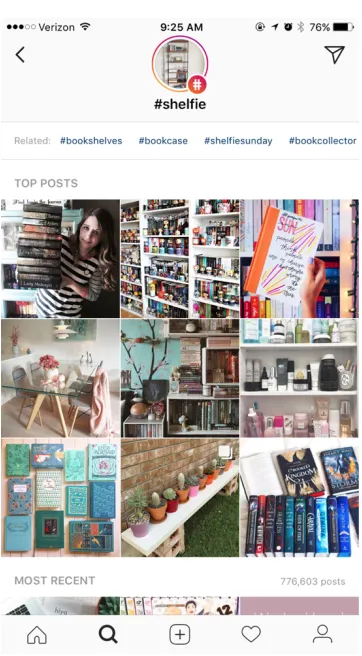
Figure 1. Example screenshot of the top nine posts for #shelfie. Screenshot by author.
This research originally came out of an idea for an anthology chapter, but it quickly
progressed to my thesis work. In the summer of 2017, I set out to track #shelfie on Instagram
using the “Top Posts” feature provided by the application which is powered by an algorithm to
sort posts with high amounts of engagement. Over two weeks, I captured just under a hundred
images as each day contained nine high-performing photos, resulting in data for ten days during
the months of July and August. I copied the information from each user’s caption and coordinated
it with their responding picture in my research since I was interested in looking at both visual and
23
be coded as Female, Male, Commercial (an account cleared stated to be run by a business), or
Unknown (an account that could either not be identified as male or female or represented an
“aesthetic” account that may be owned by multiple people or one person). Overall, I ended up with
88 pictures to analyze, as one file was unfortunately corrupted, and the OP had deleted this content.
Part of the reason for choosing two weeks as a way to capture data was two-fold: context
and resources. In terms of context: I was utilizing the University of New Orleans library’s
resources to find all of my research articles. While this resulted in being able to find a handful of
academic works relating to Instagram which used an image collecting methodology, these papers
were largely few and far between. This can be attributed to (as per the discussion in the Literature
Review) the simple fact that Instagram is a less popular application to study versus something like
Facebook. Furthermore, the visual media requires a time-consuming amount of work since it goes
beyond mere textual analysis. In terms of resources: I was a fresh-eyed graduate student and not a
team of paired researchers, like in the work of LaMarre and Rice’s article from 2017. Most of the
recent papers that I have found to be helpful for my research were being submitted in 2017, as
referenced by LaMarre and Rice’s work, when I was beginning my data collection. I modeled my
approach more on a realistic goal that would allow me to deeply examine the images that I
collected. In fact, I have spent several hours on each of the eighty-eight images, but this work must
be distilled in the confines of a thesis that neither aggravates its readers with gratuitous length
24
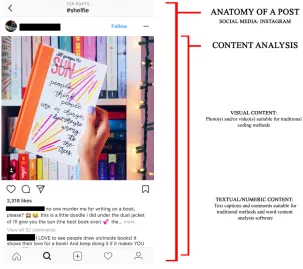
Figure 2. Example screenshot of Instagram with corresponding labels to indicate structure. Screenshot and figure by author.
At this time, Instagram looked differently than it does in 2019. For example, the application
had not yet extended their Live option, which now allows for videos filmed live to be posted to a
separate section that exists as IGTV (Constine, 2017; “Welcome to IGTV,” 2018). As Instagram
evolves, it continues adding more extensive options to share media. For example, it has extended
the time allowed for videos posted as regular posts and even allowed multiple photos in one post
(Strange, 2016). Figure 2 is a screenshot that shows the appearance of a regular Instagram post
25
Figure 3. Example screenshot of one of the top nine posts from Instagram for #shelfie. Screenshot and figure by author.
Qualitative analysis with visual content can be difficult, as methods typically involve
coding the images with clear recognizable categories, such as: book, shelf, person. These
categories can then be described with great detail depending on one’s research interest. For the
purpose of this research, images are evaluated and described using concise descriptions that
explain the content of the image with notes on the perceived aesthetic details, such as amount of
color and brightness of the photo.
For the purpose of analyzing visual content, I have coded Instagram images with variables
(what categories or types of things are present within the image; ex: shelf, plant, figurine) along
26
For textual and numerical data, the options are more concrete. In order to understand what
I was looking at in terms of the levels of social interactions, I imported my data into Stata to run
numbers for a snapshot. I wanted to look at three things with the data: what kind of person was
posting, what levels of engagement were happening, and if the original definitions of #shelfie were
being used correctly.
When I began my research, I initially defined a shelfie as: any visual media containing
book(s) or item(s) related to literature in a physical space within, around, and/or upon a piece of
furniture. Despite the use of “shelf”, I wanted to include the carefully crafted posts of users who
often displayed their current reading choices outside of shelves but still within a curated space and
did not want to exclude those with a book collection who may not possess a shelf. However, as the
research progressed, I began to realize that another definition of #shelfie would be needed: any
visual media illustrating a curated space with personal artifacts that were placed distinctly on
shelves, often with an attention to the interior design. I used these two definitions to code the
research photos as non-shelfie (0), book focus shelfie(1), and decoration focus shelfie(3).
Appendix A contains the visual content descriptions of every image along with their coded
definition.
My primary concern for my data analysis was the ability to look at the data (photo and text)
to observe what was occurring in these #shelfie posts and what these posts could tell us about
culture in the age of social media. My goal was to be able to compile the data and then observe it
through the research lens to pick up on any patterns that were occurring. There has been no
scholarly work on #shelfie and a cursory search on Google Scholar will only bring up geological
papers discussing continental shelves. However, other researchers have looked at certain hashtags
27
their particular approach, they utilized thematic analysis (Braun & Clarke, 2006; Braun & Clarke,
2014) to observe patterns and an assemblage approach to discuss their findings with a feminist
approach. While I will take into considerations of gender (such as women using social media more
than men), this thesis uses the approach of the assemblage framework and analysis that considers
the various form of framing occurring in these posts.
The shelfie is fascinating because of what it is and what is represents. It is a digital object
produced by users to showcase material items. This type of post expresses aspects of the self and
is shared on Instagram, a social media platform, which encourages engagement from other users.
Within these shelfies, users tell stories about themselves: about what they find dear, about what
28
Let Me Take a #Shelfie
According to the demographic information available through research sources like the Pew
Research Center, one can reasonably expect to find more women posting on Instagram. In fact,
this was the case for the shelfie with users being coded as female making up more than half of the
posts for the data collection.
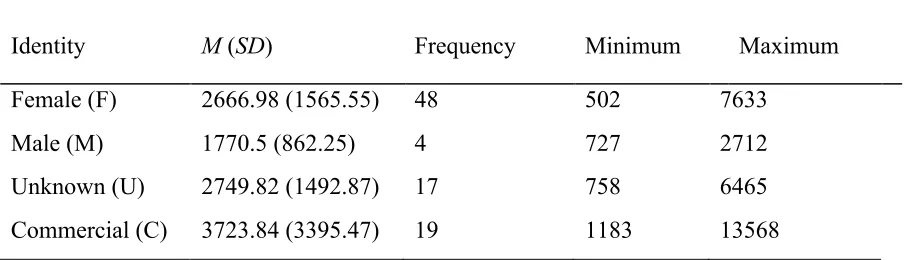
Table 1
Summary Statistics with Average Likes, Sorted by Identity Category
Identity M (SD) Frequency Minimum Maximum
Female (F) 2666.98 (1565.55) 48 502 7633
Male (M) 1770.5 (862.25) 4 727 2712
Unknown (U) 2749.82 (1492.87) 17 758 6465
Commercial (C) 3723.84 (3395.47) 19 1183 13568
Out of 88 posts, women were by far the most represented identity group for #shelfie usage
with 48 “female” coded posts, followed by commercial and unknown at a near tie. The
discrepancies between the four means of average likes in Table 1 are interesting, as the commercial
identity group has a higher average than any other group although with only nineteen occurrences.
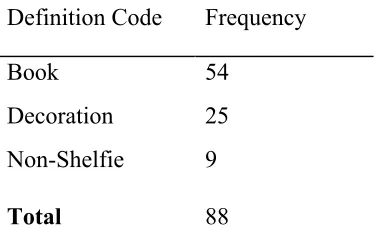
After establishing the definitions for the book focus and decoration focus shelfies, I went
through several times to code each of the 88 photos. Out of 88 posts, book focus shelfie emerged
as the majority with decoration focus shelfie coming in second. Only nine out of the 88 photos
29 Table 2
Frequency of Coded Definitions for Photos
Definition Code Frequency
Book 54
Decoration 25 Non-Shelfie 9
Total 88
Caption Analysis
While Instagram is naturally rich in visual media, the accompanying captions to user posts
are important sources of information. They can aid researchers in understanding a more complex,
well-rounded portrait of digital interactions. In the case of #shelfie, all 88 post captions were
recorded in order to contribute to a comprehensive analysis. Of the 88 captions, nineteen captions
contained a language other than English. Of these nineteen posts with a language other than
English, these posts were coded with the following results: seven book-focus, eight decoration
focus, and four photos that did not count as a shelfie. The four photos that were coded as not
constituting either a book or decoration shelfie were all posted by the same user.
Concerning the English captions, I utilized ATLAS.ti software to use the “Word Cruncher”
tool which analyses aggregate text data to reveal the frequency of certain words. I chose to use the
option of ATLAS.ti’s “stop list” or a list of pre-determined common words that help sort out filler.
The free/trial version of ATLAS.ti’s software does not allow for customizing the stop list beyond
certain measures. With this software, all of the caption information from data collection was
30
words were ultimately the focus for this analysis. Three of the top twenty appears to be words from
the German language, but there was no option to run two stop lists from English and German for
one analysis.
Word Frequency of Text Captions
Word Frequency
shelfie 45
books 28
book 23
31
The Multiple Framing of a #Shelfie
In theory, Instagram is a perfect application to apply framing theory, as Instagram
essentially provides digital picture frames that users look at. This fits well with Goffman and
Gombrich’s ideas since framing involves conceptual frames that provide meaning and context to
situations and these ideas can be applied to applications like Instagram. For example, rather than
the stage of the traditional dramaturgical example from Goffman, individuals have the
application’s user interface, how Instagram looks and operates from the user’s end. As individuals
scroll, they observe a post with visual media (as of September 2017: an image, multiple images,
or a short video clip) that may be accompanied by a text caption. As the visual media is liked or
viewed by other users, Instagram updates those statistics to be shown underneath the visual media.
Users may also comment on posts unless the poster has disabled this option. Users may also tag
other users in the actual visual content or in the corresponding captions.
When one holds their cell phone in their hand, it is a rectangle-shaped device. All of the
media, notifications, and actions happening on this device occur on a small screen that weighs less
than a pound. If one were to open Instagram or Facebook, this application would launch and fill
up this screen. The mobile phone is itself a frame, but the application has opened a new frame with
its own primary framework. It is a digital space, populated with algorithmic content tailored by a
user’s aggregated history of actions on and off the application. On Instagram, the user can now
utilize the search function for hashtags, names of peoples, usernames, and even go to a curated
“Explore” tab that compiles posts that a user is likely to enjoy based on their past interactions (for
32
While the issue of algorithmic-based activity has been discussed, it should be noted that
users are capable of agency in their own ways. A user can like a particular hashtag and seek out
similar content on their own. In fact, hashtags are used to code content much like research.
Hashtags can help build digital interactions, a sort of organizing that arises from a user’s decision
to structure their content around a particular tag (Highfield & Leaver, 2015) A user interested in
art can look up popular art-related hashtags until they discover a particular hashtag that contains
media with a higher personal relevance. Perhaps this user will then follow another user that
produces and posts such content. Brands, artists, and public figures rely on this type of intuitive
searching to grow their audience. It should be noted that hashtags are up to users to utilize and
with the growing interest in digital marketing, sometimes users will post unrelated hashtags to
their content with the goal of increasing overall audience.
Is Instagram’s framework as authentic as the conceptual frameworks used in everyday life?
A common narrative around social media accuses these platforms of encouraging selfishness and
increasing egotism in the digital population. Despite frequent articles emerging to decry Instagram
as a motivator of selfies and self-obsession, research has not found significant evidence to suggest
that selfies in themselves are encouraging rampant narcissism (Barry et al., 2017). Additionally, if
we were to consider the presentation and performance of the self merely translating from real life
to the digital sphere, an argument can be made for Instagram’s frame merely copying the frames
society already has. “Overall, such posts were not associated with narcissism or self-esteem, with
some specific themes showing small correlations with narcissism and concerns regarding societal
attitudes about appearance. Some aspects of participants’ Instagram activity (i.e., number of likes
for selfies and posies; number of followers) were significantly correlated with posting posies”
33
Figure 4. Screenshot of one of the top nine posts that was positively coded as a shelfie. Screenshot with notes by author.
Figure 4 illustrates an example of a positively coded #shelfie. There are books and personal
artifacts on shelves and the user has even placed themselves within the picture. This picture is
highly curated: a user has artfully positioned a part of themselves and taken an aesthetically
pleasing picture, one that specifically relates to #shelfie that they’ve utilized in their caption. If
social media did not exist, would such a curated image be likely to be shared with a group of
strangers? The framing of Instagram exists within the rules of social media, digital tools that allow
and encourage a user to construct media to share. For further analysis, one can look at the
34
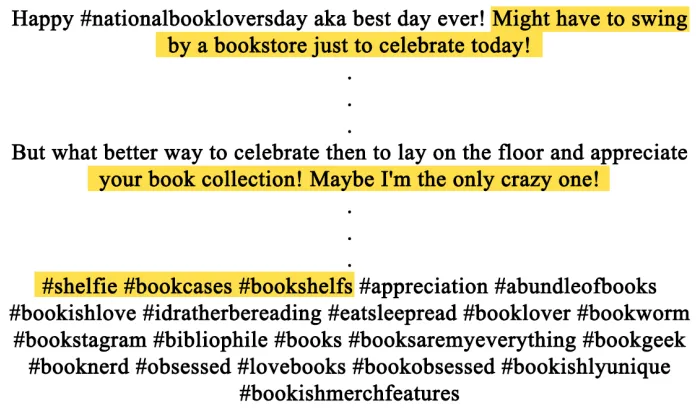
Figure 5. The corresponding caption to the shelfie from Figure 4. Screenshot and corresponding text emphasis by author.
Figure 5 shows the accompanying caption to the previous photo. I have highlighted
sections that are particularly relevant. The OP engages the audience by noting what his or her plans
might be for the day, incorporating their visual subject matter (a #shelfie) with an implication that
there is an authenticity behind the OP’s focus. Note that the user addresses the audience with a
familiar tone and then suggests in a light-hearted tone that maybe OP is different from the other
presumable book lovers in the community by engaging in the act of laying on the floor to admire
his or her own book collection. While the action and words are intended to be relatable, the
audience for the OP knows on some level that the user took a significant amount of time to produce
the visual content and the corresponding caption. The trailing hashtags at the end are relevant, as
35
the post as hashtag inclusion reflects a decision upon the part of the user (Highfield & Leaver,
2015). On a surface level, the entire post (image and caption with an interactive commenting
section) requires strategy and performance. The user has set up and acted out something while
simultaneously transforming a strategic performance into a place of interaction, allowing other
users to comment and connect with OP.
I have proposed using framing concepts with Instagram because they can be adapted to the
application. From a Goffman approach, the user produces a performance within the Instagram
framework to an audience that has the option of interacting. Users, whether they are the content
posters or the audience (and they are likely both), engage in strategic methods to create relevant
visual media and accompanying captions. Such strategy implies heavy out-of-frame activity for
planning and execution, but this seems understood by users of Instagram as it works within the
Instagram framework. From a cultural materialist approach, the objects within the shelfies
represent meaningful belongings and an environment that acts upon the individual (Miller 2009).
Visual content analysis involves studying a collection of visual media in order to discover
patterns. Researchers in various fields have developed ways of performing visual content analysis.
For example, Luhtakallio used Goffman’s frame analysis in her work on activist images and
utilized the concept of master frame to describe the way that a cognitive schema about normal
phenomena helps individuals form an interpretation of interactions (2013). For Daniel Miller’s
exploration of thirty people from a particular street in London, he presents each chapter as a portrait
as an entryway into understanding how to interpret people through their belongings (2010). I will
first discuss shelfies among their three definitions (book focus, decoration focus, and non-shelfie)
and discuss the patterns that are arising within these photos as an exploration of the assemblage of
36
Figure 6. A post positively coded as a book focus shelfie.
In this book focus shelfie, three white bookshelves hold an assortment of books and a few
decorative items. The shelves are tidy with a spotlight on the left shelf, likely from a natural source
of light. Within the caption, the user comments that she could not remember the last time she
posted a picture without any significant editing, but this photo only received a cropping before it
was posted. “Dream up something wild and improbable” is printed on a pillow, a quote from a
popular young adult author, Laini Taylor, from her book, Strange the Dreamer. Another pillow on
the bottom shelf reads: “The world belongs to those who read.” A collection of Funko “Pops!”
figurines take up an entire small shelf in the left bookshelf. Funko is a manufacturer of collectibles,
most well-known for their “Pops!” line which features large-headed toys from popular fictional
works (Ali, 2018). In this shelfie, some of these Funko figurines depicted are from the Harry Potter
37
“For all that I pose and create images, I walked into this one,” the user wrote. The user
admits that she poses and produces images in a meaningful way but implies that this particular
image has a spontaneous air. The difference is enough to remark upon.
Figure 7. A post positively coded as a decoration focus shelfie.
The user caption for Figure X for this shelfie was posted in Swedish, although it is tagged
with the English hashtags of green, shelfie, greenpottery, and mirror. Clearly, these ceramic pieces
have been placed strategically on this hanging shelf and organized by their green tones, as
suggested by the organized hashtags around green. The plants also take up the lower corners of
38
Figure 8. A post positively coded as a non-shelfie.
Posts that were coded as non-shelfie are
more easily understood. The hardest of these to code
were photos that toed the line towards decoration
focus shelfies, but ultimately consisted of photos
focusing on interior design with little to no inclusion
of a shelf being utilized to store or display material
objects (see Figure 9 in which the focus is on a
dining room table). There were only ten posts tagged
with #shelfie that failed to relate to the original
understanding of shelfie. That being said, this does
not mean that users are deliberately attempting to change #shelfie with a post using this hashtag
while depicting content that is not a shelfie. There are a number of reasons that a user may use a
hashtag. Usually, it is for the purpose of accurately tagging their content and to be included within
a specific community. For example, the users in this data collection with book shelfies were
39
sometimes using #bookstagram, another popular hashtag that gathers like-minded bibliophiles
together online (Hammoudi, 2018). A deeper look at shelfies allows this to be more easily
understood.
A Deeper Look at Shelfie: An Assemblage of Patterns
On August 15th, 2017, one user wrote, “Hi
lovelies! 💖 I hope you're doing well today 🙈
Today I received The Library of Fates in the mail
as our August BOTM for @thebookboundsociety
and I'm quickly moving through omg it's SO good
📖🌿 What are you currently reading? #shelfies”
for her caption on a photo displaying her
bookshelf. From a visual perspective, one can note
the collection of colors in the bookshelf. From the
top, there are warm shades ranging from blood
tangerine to pale pastel pink on the top shelf. The
middle shelf contains mostly notes of yellow, blue, and black; interestingly, a Hufflepuff (a
fictional house from Harry Potter represented by the colors yellow and black) mug ties together
the unity of the colors on the shelf. On the bottom shelf, the colors are much darker. Funko “Pops”
decorate each shelf and correspond in a complementary manner to each of the color schemes
(bright warm tones on top, a mixture of yellow and cool tones in the middle, and the dark collection
at the bottom).