Research Paper:
The Moderating Role of Integrative Self-Knowledge
and Self-Control in the Relationship Between Basic
Psychological Needs and Self-Compassion
Sharareh Shamsi1, Salah Sufi1*
1. Department of Psychology, Bukan Branch, Islamic Azad University, Bukan, Iran.
* Corresponding Author:
Salah Sufi, PhD.
Address: Department of Psychology, Bukan Branch, Islamic Azad University, Bukan, Iran.
Tel: +98 (918) 8749879
E-mail: [email protected]
Background: The present study investigated the moderating role of integrative self-knowledge and self-control in the relationship between the basic psychological needs and self-compassion among the students of Bukan Branch, Islamic Azad University, Iran.
Objectives: The purpose of this study was the moderating role of Integrative Self-Knowledge and Self-control in relation to Basic Psychological Needs with self- compassion.
Materials and Methods: This study employed a correlational method. The statistical population consisted of all students of Islamic Azad University (N=2200) studying in the academic year of 2016-2017; of whom, 384 students (male and female) were selected by proportional stratified sampling method. The instruments used in this study included the Basic Psychological Needs Scale, Integrative Self-Knowledge Scale, Self-Compassion Scale, and Self-Control Scale. Pearson’s correlation coefficient and the structural equation model were used to analyze the obtained data.
Results: The findings indicated a positive and significant relationship between the basic psychological needs, integrative self-knowledge, self-control, and self-compassion (P≤0.01). Moreover, the integrative self-knowledge and self-control models demonstrated a desirable goodness-of-fit in the association between basic psychological needs and self-compassion.
Conclusion: The results of model revealed that the basic needs exerted a greater impact on self-compassion through integrative self-knowledge path, compared to self-control path.
A B S T R A C T
Keywords:
Integrative self-knowledge, Self-control, Basic psychological needs, self-compassion
Citation Shamsi S, Sufi S. The Moderating Role of Integrative Self-Knowledge and Self-Control in the Relationship Between
Basic Psychological Needs and Self-Compassion. Avicenna J of Neuropsychophysiology. 2017; 4(4):145-152. http://dx.doi. org/10.32598/ajnpp.4.4.145
:
http://dx.doi.org/10.32598/ajnpp.4.4.145 Use your device to scan
and read the article online
elf-compassion encompasses three com-ponents of mindfulness, self-kindness, and common humanity feelings. In this sense, those with higher self-compassion, when encountering failures and disappointments resulting from their own actions or individual defects and weaknesses, try to accept these failures instead of denying, exaggerating or ruminating them. They also treat themselves with care, compassion, and kindness rather than criticizing and blaming self. Moreover, they recognize that the failures and defects are common among all human beings and are not inclusive to them; they believe that humans can commit mistakes and be misled [1]. Investigating self-compassion has revealed that the high scores of Self-Compassion Scale (SCS) are associated with less anxiety and depression [2], greater happiness, optimism, and curiosity [3], less anxiety in the face of threats against oneself [4], and a reduced feeling of contempt and shame [5].
Research on the developmental stages of compas-sion has demonstrated that self-compascompas-sion passes gradually through the stages of overall empathy [6], self-centered empathy [7], empathy with others’ feelings [8], and finally, compassion to self. Different psychological theories have addressed and discussed humanity needs and took them into consideration at different levels. Some scholars regard human needs as innate [9]. One of the approaches examining basic psy-chological needs is self-determination theory which specifies autonomy, competence, and relatedness (at-tachment) as three basic needs. Self-determination is one of the universal capacities and the basis for vol-untary actions. It is mainly accomplished when an in-dividual feels capable of deciding about his/her own behavior and setting his/ her goals [9].
Integrative self-knowledge refers to the individuals’ ef-forts to integrate the past, present, and future experi-ences to promote themselves [10]. In other words, in-tegrative self-knowledge involves paying close attention to the present personal experiences (experiential self-knowledge) and considering the past personal experi-ences (reflective self-knowledge) to better understand oneself [11, 12]. Gorbani (2014) defines integrative self-knowledge as the third system of mental process-ing that incorporates the integration of consciousness and subconsciousness. It is, therefore, related to the suppression of emotions in which a person consciously and unconsciously eliminates one’s thoughts and
emo-expression [13].
Self-control is defined as the ability to modify and adapt oneself to the environment as well as to change one’s internal responses and hindering attitudes in line with the standards, values, and morals for long-term goals [14]. Likewise, Baumeister (2002) deems self-con-trol as the ability of individuals to recognize and adjust desires and emotions; it is manifested through will, self-regulation, and the ability to postpone the pleasure or reward [15].
Different studies highlighted the association between the fulfillment of basic needs and various positive out-comes, such as wellbeing, performance, and persever-ance; it also prevents them from negative outcomes like diseases and treatment cessation [16]. There is a positive relationship between satisfying basic needs (autonomy, competence, and relatedness), and well-being and self-compassion [17]. Studies investigated the relationship between integrative self-knowledge and self-control of the “Perfect Man” [18] and the rela-tionship between self-compassion and self-knowledge among Iranian Muslims [19]. In these studies, a high correlation was found between self-compassion, mind-fulness, and integrative self-knowledge. If self-control is not accompanied by self-compassion and integrative self-knowledge, it will not be positively correlated with mental health.
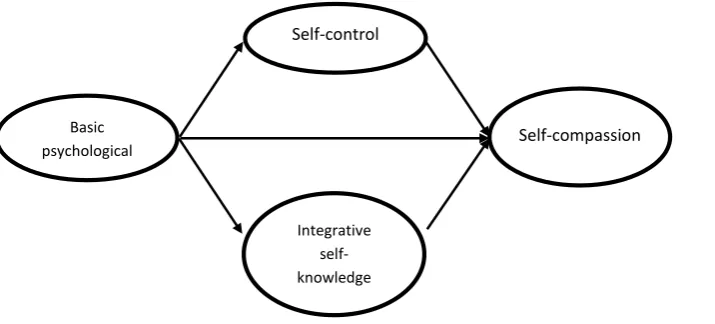
Furthermore, previous studies corroborated the re-lationship between basic needs and self-compassion [20,21], fundamental needs and control [19], self-control and integrative self-knowledge [18], compas-sion and integrative self-knowledge [5,18,22-25], and self-compassion and self-control [5,25]. Therefore, in line with the above-mentioned studies, the present study examined the mediating roles of integrative self-knowledge and self-control in the relationship between the basic psychological needs and self-compassion with-in the framework of a model. Fwith-inally, relywith-ing on previ-ous theories and research, this study aimed to test the following conceptual model and answer the following questions (Figure 1):
Does the conceptual model of self-knowledge and self-control have an acceptable fitness-of-good in the relationship between the students’ basic psychological needs and self-compassion? Can integrative self-knowl-edge and self-control play a mediating role between ba-sic psychological needs and self-compassion?
2. Materials and Methods
The present study employed a correlational non-experimental method. The statistical population com-prised all male and female students of Islamic Azad University of Bukan City, Iran, who were studying in the academic year of 2016-2017 (N=2200). The research sample consisted of 327 students (male & female), and due to the large population size, Morgan table was used. The proportional stratified sampling method was applied for sample selecting; a certain number of male and female students were proportionally selected (136 females & 191 males).
Study tools
Basic Psychological Needs Scale
Basic Psychological Needs Scale (BPNS), developed by La Guardia, Ryan, Couchman, and Deci (2000), includes 21 items which are scored based on a 7-point Likert-type scale (1=not true at all, 7=completely true). La Guardia et al. reported the reliability coefficient of this scale for father, mother, friends, and a romantic partner as 0.91, 0.91, 0.91, and 0.91, respectively [26]. The validity of this Scale was found to be satisfactory in the conducted
studies [27]. Cronbach's α coefficient of this scale was also reported between 0.76 and 0.79 on a sample of Ira-nian managers and university students [28]. Cronbach’s α coefficient of this study was equal to 0.78.
Integrative Self-Knowledge Scale
This 12-item scale was developed by Ghorbani et al. (2008). The items are scored based on a 5-point Likert-type scale (from mostly incorrect to mostly correct). In
their study on three Iranian and three American sample groups, Ghorbani et al. reported the Cronbach’ α coeffi-cient of this scale to be 0.82, 0.81, 0.81 for the first, sec-ond, and third Iranian samples, respectively and 0.78, 0.78, and 0.74 for the first, second, and third American samples, respectively [10]. The convergent, criterion, dif-ferential, and incremental validities were also approved in this study. Cronbach’s α coefficient of this study was equal to 0.81.
Self- Compassion Scale-Short Form (SCS-SF)
SCS, designed by Raes, Pommier, Neff, and Van Gucht (2011), consists of three main elements; self-kindness versus harsh self-judgment, common humanity feelings versus the feelings of isolation, and mindfulness versus over identification [29]. The long form of this scale in-cludes 24 items and the short form consists of 12 items which are responded on a 5-point Likert-type scale (1=almost never, 5=almost always) by respondents. Raes et al. reported the internal consistency of 0.86 for this scale [29]. The factor analysis of scale items, same as that of the long form, demonstrated 6 expressed factors and one factor for self-compassion; Cronbach’s α coefficient was calculated as 0.83 for all items. Cron-bach’s α coefficient was 0.84 in this study.
Self-Control Scale
Self-Control Scale was developed by Tangney, Bau-meister, and Luzio Boone (2004). The long form of this scale includes 36 items, and the short form which is used in the present study encompasses 13 items, scored on a 5-point Likert-type scale (1=never, 5=very much). The internal consistency of this scale was reported to be 0.83 and 0.89, respectively, in two separate studies.
Basic psychological
needs
Integrative self-knowledge
Self-control
Self-compassion
ported as 0.87 [30]. The obtained Cronbach’s α coeffi-cient was 0.80 in this study.
Data analysis
Mean and standard deviation were used to analyze the descriptive data. Additionally, Pearson’s correlation coefficient and the structural equation model were em-ployed to analyze inferential data.
3. Results
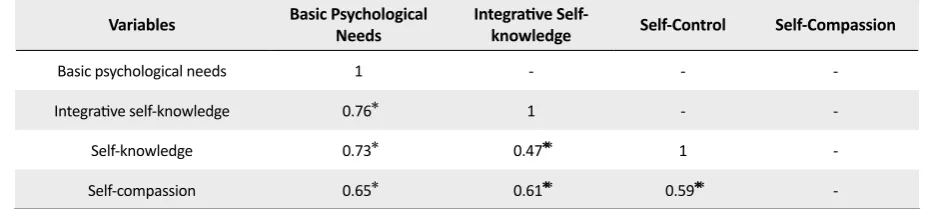
The descriptive summary of study variables is
pre-sented in Table 1. The correlation matrix of variables
is presented in Table 2 As per Table 2, there is a posi-tive significant correlation (P≤0.01) between the basic psychological needs, integrative self-knowledge, and self-control, and self-compassion with the correlation coefficients of r=0.65, r=0.61, and r=0.59, respectively. Furthermore, a positive significant relationship (P≤0.01) was found between basic psychological needs, and inte-grative self-knowledge and self-control with correlation coefficients of r=0.76 and r=0.73, respectively.
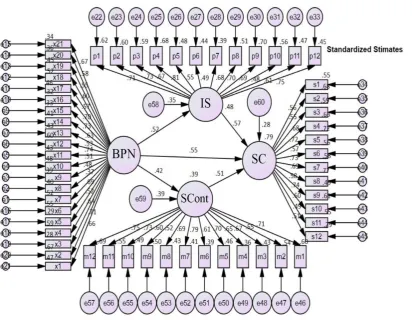
determine the fit of the conceptual model of integrative self-knowledge and self-control in the association be-tween basic psychological needs and self-compassion, the path analysis with the maximum exponential meth-od was used. Table 3. The results of gometh-odness-of-fit of the conceptual model of integrative self-knowledge and self-control in the relationship between basic psycho-logical needs and self-compassion
According to Table 3, the related indexes, including Chi-squared test, Adjusted Goodness of Fit Index (AGFI), Normalized Goodness of Fit Index (NGFI), Relative Goodness of Fit Index (RGFI), and Root Mean Square Er-ror of Approximation (RMSEA) were explored; each was determined based on the hypothesized model. Then, according to the paths expressed by the correction in-dices based on the scientific evidence, some paths were established for improving the fitness of model. The val-ue of each index is displayed in Table 3, which indicates a satisfactory goodness-of-fit for the final model.
The obtained results of exploring the goodness-of-fit of the structural presented model display the goodness-of-fit of the model (Table 3). This is because the RMSEA value is
Table 1. The mean and standard deviation of variables in the sample group
Mean±SD Variables
80.90±8.34 Basic psychological needs
48.53±6.02 Integrative self-knowledge
48.64±6.80 Self-compassion
50.54±6.54 Self-control
27.04±2.92 Autonomy
26.26±3.40 Competence
27.59±3.75 Relatedness
Table 2. Matrix of Correlation among research variables
Self-Compassion Self-Control
Integrative Self-knowledge Basic Psychological
Needs Variables
-1
Basic psychological needs
-1 0.76 ⃰
Integrative self-knowledge
-1
0.47 ⃰⃰⃰
0.73 ⃰
Self-knowledge
-0.59 ⃰⃰⃰
0.61 ⃰⃰⃰
0.65 ⃰
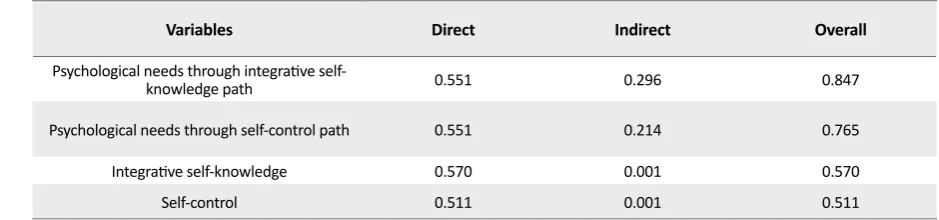
≤0.08 (RMSEA<0.08), indicating a satisfactory goodness-of-fit for the structural model; moreover, the values of CFI, NFI, RFI are all ≥0.9. According to Table 4, basic psychological needs exert an overall effect of 0.847 on the students’ self-compassion through the integrative self-knowledge path. In addition, psychological needs have a total effect of 0.765 on self-compassion through self-control path. In general, basic psychological needs justify the 0.78% variance of students’ self-compassion variations through integrative knowledge and
self-control. Furthermore, psychological needs exert the highest influence on self-compassion via integrative self-knowledge path.
4. Discussion
The main objective of this study was to evaluate and explain the structural equation model for the relation-ship between different basic psychological needs and self-compassion, and the mediating role of self-knowl-Figure 2. Ideally Fit Model of relationship between variables
Table 3. The results of investigating the goodness-of-fit of conceptual model
Result Value
Acceptable Range Fit Index
Acceptable 1.992
3> (The ratio of chi-squared on the degree of freedom) dfx2
Acceptable 0.991
0.9< CFI
Acceptable 0.971
0.9< NFI
Acceptable 0.994
0.9< RFI
Acceptable 0.054
edge and self-control among students. Given the final model and the fitness-of-good indices, the model has an acceptable goodness-of-fit. This result is consistent with the previous studies [6,10, 22,23].
The collected results indicated that the basic needs have a greater impact on self-compassion through in-tegrative self-knowledge path. This can be justified on the basis that satisfying basic psychological needs re-sult in higher quality behaviors and greater consistent actions by engaging in autonomous tasks. Therefore, by satisfying basic psychological needs, integrative self-knowledge can increase self-compassion. This, in turn, can also improve self-compassion through the individ-ual’s better understanding of self and one’s conditions, making timely decisions, and a sense of overcoming the consequences. Finally, an individual with integrative self-knowledge openly accepts his/her present, past, and future experiences and analyzes them (through engaging the brain in actions requiring the higher and complex levels). Thereby, integrative self-knowledge can affect peoples’ self-compassion in different situa-tions [24].
In fact, students’ higher self-compassion increases integrative self-knowledge. The way our peers, family, and strangers treat us and our belief about being treat-ed in the future have important implications on our ideas about ourselves. When we expect to be rejected due to some of our characteristics, we can change sev-eral possible different answers and start selecting from ‘ourselves’. To the extent that it is likely to avoid being rejected by others, teenagers and young people can potentially choose this way. Access to the correct and desirable choices reflects the creation of an ideal per-sonal identity [31].
Regarding the effect of psychological needs on self-compassion through the self-control path, it can be stated that self-control in different emotional
situa-tions helps a person to employ better practices when facing different conditions. Self-control is also associ-ated with better compatibility, higher self-esteem, and better communication skills; furthermore, owing to its relationship with the satisfaction of basic psychological needs, the individuals spend greater time on managing their emotional feelings.
Self-control in different situations makes a person think more about him/herself, self values, and make more decisions on applying compassion for oneself and others. Ultimately, people with higher self-control can make better use of the time and apply more appropriate methods for performing their work [30]. However, the direct impact of psychological needs on self-compas-sion was observed in less than two paths. In explaining these findings, Neff and Pommier’s revealed a positive and significant correlation between basic psychological needs and self-compassion [21]. In other words, the co-efficient correlations between autonomy, competence, and relatedness with self-compassion were 0.67, 0.61, and 0.55, respectively (P≤0.01).
The outstanding role of integrative self-knowledge is important in such situations. This hypothesis suggests that integrative self-awareness is more of a metacontex-tual need than a contexmetacontex-tual one. According to this study, the need for integrative self-awareness is felt when a person is able to establish a balance between his/ her own needs and society in spite of strong communication ability and self-control. Therefore, they need to consider their position from an extended viewpoint and estab-lish integration between intellect and heart. As a result, an individual’s self-control makes self-compassion. This finding is the very interaction of consciousness and con-trol that manifests the role of self-concon-trol more than
ever [20, 23,25, 32].
Overall Indirect
Direct Variables
0.847 0.296
0.551 Psychological needs through integrative
self-knowledge path
0.765 0.214
0.551 Psychological needs through self-control path
0.570 0.001
0.570 Integrative self-knowledge
0.511 0.001
5.Conclusion
The conceptual model of integrative self-knowledge and self-control has a satisfactory goodness-of-fit in the correlation between basic psychological needs and compassion. This indicates that if integrative self-knowledge and self-control be considered as a mediator variable in the relationship between basic psychological needs and self-compassion, the independent variable of basic psychological needs can exert a greater impact on the students’ self-compassion; however, the direct ef-fect of psychological needs on self-compassion is much less striking.
Like other humanity studies, this study encountered some limitations, including the use of self-report ques-tionnaires and inability in experimentally investigating the causal relationships between variables. In addition, the present study was conducted among the university students; to generalize the collected results, further studies can be conducted among the high school stu-dents, teachers, office employers, etc. Future research is recommended to take the roles of self-compassion and basic psychological needs into account in designing another model; they should also consider the mediating role of empathy along with the other two variables. Pay-ing attention to the role of studied variables in the edu-cational and cultural programs of universities can con-tribute to the improvement of students’ mental health.
Ethical Considerations
Compliance with ethical guidelinesAll ethical principles were considered in this article. The participants were informed about the purpose of the re-search and its implementation stages; they were also as-sured about the confidentiality of their information; More-over, They were allowed to leave the study whenever they wish, and if desired, the results of the research would be available to them.
Funding
This research did not receive any specific grant from funding agencies in the public, commercial, or not-for-profit sectors.
Authors' contributions
All authors contributed in preparing this article.
Conflict of interest
The authors declared no conflict of interest.
References
[1] Neff KD. Self-compassion: An alternative conceptualization of a healthy attitude toward oneself. Self and Identity. 2003; 2(2):85-101. [DOI:10.1080/15298860309032]
[2] Neff KD, Pisitsungkagarn K, Hsieh YP. Self-compassion and self-construal in the United States, Thailand, and Taiwan. Journal of Cross-Cultural Psychology. 2008; 39(3):267-85. [DOI:10.1177/0022022108314544]
[3] Neff KD, Rude SS, Kirkpatrick KL. An examination of self-compas-sion in relation to positive psychological functioning and person-ality traits. Journal of Research in Personperson-ality. 2007; 41(4):908-16. [DOI:10.1016/j.jrp.2006.08.002]
[4] Neff KD, Kirkpatrick KL, Rude SS. Self-compassion and adaptive psychological functioning. Journal of Research in Personality. 2007; 41(1):139-54. [DOI:10.1016/j.jrp.2006.03.004]
[5] Gilbert P, Procter S. Compassionate mind training for people with high shame and self-criticism: Overview and pilot study of a group therapy approach. Clinical Psychology & Psychotherapy. 2006; 13(6):353-79. [DOI:10.1002/cpp.507]
[6] Hoffman ML. Empathy, social cognition and moral action. In: Kur-tines WM, Gewirtz JL, Lamb JL, editors. Handbook of Moral Behav-ior and Development. Didcot: Taylor & Francis; 2013.
[7] Haidt J. The emotional dog and its rational tail: A social intui-tionist approach to moral judgment. Psychological Review. 2001; 108(4):814-34. [DOI:10.1037/0033-295X.108.4.814]
[8] Izard CE. Translating emotion theory and research into preven -tive interventions. Psychological Bulletin. 2002; 128(5):796. [DOI:10.1037/0033-2909.128.5.796]
[9] Deci EL, Ryan RM. The” what” and” why” of goal pursuits: Human needs and the self-determination of behavior. Psychological Inquiry. 2000; 11(4):227-68. [DOI:10.1207/S15327965PLI1104_01]
[10] Ghorbani N, Watson PJ, Hargis MB. Integrative self-knowledge scale: Correlations and incremental validity of a cross-cultural measure developed in Iran and the United States. The Journal of Psychology. 2008; 142(4):395-412. [DOI:10.3200/JRPL.142.4.395-412] [PMID]
[11] KabatZinn J. Participatory medicine. Journal of European Acad-emy of Dermatology and Venereology. 2000; 14(4):239-40. [DOI:10.1046/j.1468-3083.2000.00062.x]
[12] Arch JJ, Craske MG. Laboratory stressors in clinically anxious and non-anxious individuals: The moderating role of mindful-ness. Behaviour Research and Therapy. 2010; 48(6):495-505. [DOI:10.1016/j.brat.2010.02.005] [PMID]
lidity of self-control measures. Journal of Research in Personality. 2011; 45(3):259-68. [DOI:10.1016/j.jrp.2011.02.004] [PMID] [PM-CID]
[15] Baumeister RF, Juola Exline J. Virtue, personality, and social rela-tions: Self-control as the moral muscle. Journal of Personality. 1999; 67(6):1165-94. [DOI:10.1111/1467-6494.00086] [PMID]
[16] Sheldon KM, Elliot AJ, Kim Y, Kasser T. What is satisfying about satisfying events? Testing 10 candidate psychological needs. Jour-nal of PersoJour-nality and Social Psychology. 2001; 80(2):325-39. [DOI:10.1037/0022-3514.80.2.325]
[17] McCullough ME, Willoughby BL. Religion, regulation, and self-control: Associations, explanations, and implications. Psychological Bulletin. 2009; 135(1):69-93. [DOI:10.1037/a0014213] [PMID]
[18] Ghorbani N, Watson PJ, Rezazadeh Z, Cunningham CJ. Dialogical validity of religious measures in Iran: Relationships with integra-tive self-knowledge and self-control of the “Perfect Man” (Ensān-e Kāmel). Archive for the Psychology of Religion. 2011; 33(1):93-113. [DOI:10.1163/157361211X552209]
[19] Ghorbani N, Cunningham CJ, Watson PJ. Comparative analysis of integrative self-knowledge, mindfulness, and pri-vate self-consciousness in predicting responses to stress in Iran. International Journal of Psychology. 2010; 45(2):147-54.
[DOI:10.1080/00207590903473768] [PMID]
[20] Mehri Y, Ghorbani N, Langroudi M. [The relationship between sat-isfaction of basic psychological needs, integrative self-knowledge, mindfulness, self-compassion, self-control, and mental health in-dicators teachers’ job performance (Persian)]. Industrial/Organiza-tional Psychology Quarterly. 2012; 3(11):20-9.
[21] Neff KD, Pommier E. The relationship between self-compassion and psychological needs concern among college undergraduates, community adults, and practicing meditators. Self and Identity. 2015; 12(2):160-76. [DOI:10.1080/15298868.2011.649546]
[22] Kashanaki H, Ghorbani N, Hatami J. [Studying the effect of feeling suppression and psychological and physical symptoms according to integrative self- knowledge, mindfulness, self-compassion, social de-sirability and self- control (Persian)]. Applied Psychological Research Quarterly. 2016; 7(3):55-70.[DOI:10.22059/japr.2016.61151].
[23] Neff KD, Costigan AP. Self-compassion, wellbeing, and happiness. Psychologie in Österreich. 2014; 2(3):114-9.
[24] Ghorbani N, Watson PJ, Fayyaz F, Chen Z. Integrative self-knowl-edge and marital satisfaction. The Journal of Psychology. 2015; 149(1):1-8. [DOI:10.1080/00223980.2013.827614] [PMID]
[25] Hollis-Walker L, Colosimo, K. Mindfulness, self-compassion, and happiness in non mediator: A theoretical and empirical examina-tion. Personality and Individual Differences. 2011; 50(2):222-7.
[DOI:10.1016/j.paid.2010.09.033].
[26] La Guardia JG, Ryan RM, Couchman CE, Deci EL. Within-person variation in security of attachment: A self-determination theory perspective on attachment, need fulfillment, and well-being. Journal of Personality and Social Psychology. 2000; 79(3):367-84. [DOI:10.1037//0022-3514.79.3.367] [PMID]
[27] Milyavskaya M, Gingras I, Mageau G, Koestner R, Gagnon H, Fang J. Balance across contexts: The importance of balanced need satisfaction across various life domains in adolescence. Personality & Social Psychology Bulletin. 2009; 35(8):1031-45. [DOI:10.1177/0146167209337036] [PMID]
collectivist values: Evidence of compatibility in Iran and the United States. Personality and Individual Differences. 2014; 35(2):431-47. [DOI:10.1016/S0191-8869(02)00205-2]
[29] Raes F, Pommier E, Neff KD, Van Gucht D. Construction and facto-rial validation of a short form of the self-compassion scale. Clini-cal Psychology & Psychotherapy. 2011; 18:250-5. [DOI:10.1002/ cpp.702] [PMID]
[30] Tangney JP, Baumeister RF, Boone AL. High self-control predicts good adjustment, less pathology, better grades, and interpersonal success. Journal of Personality. 2004; 72(2):271-324. [DOI:10.1111/ j.0022-3506.2004.00263.x] [PMID]
[31] Ghorbani N. [‘I’ as interpreted by me (Persian)]. Tehran: Bineshno; 2013.