Please cite this article as: A. A. Tofigh, M. Bashiri, M. Manteghi, M. Jalili, A New Model for Fleet Assignment Problem, Case Study of Iran Air Network at Vision 2036, International Journal of Engineering (IJE), TRANSACTIONS B: Applications Vol. 28, No. 11, (November 2015) 1614-1623
International Journal of Engineering
J o u r n a l H o m e p a g e : w w w . i j e . i rA New Model for Fleet Assignment Problem, Case Study of Iran Air Network at
Vision 2036
A. A. Tofigha, M. Bashirib, M. Manteghic, M. Jalili*d
aDepartment of Industrial Engineering, University of Amirkabir, Iran bDepartment of Industrial Engineering, University of Shahed, Iran cDepartment of Industrial Engineering, University of Maleke Ashtar, Iran dDepartment of Industrial Engineering, Material and energy research center, Iran
P A P E R I N F O
Paper history: Received 19 June 2015
Received in revised form 08 August 2015 Accepted 16 October 2015
Keywords:
Fleet Assignment Problem Airline planning Hub problem
A B S T R A C T
The fleet assignment problem (FAP) assigns the type of airplane at each flight segment. Since airplane is an expensive resource, poor fleet assignment can cause a great increase in costs of airlines. There are so many consideration which should be tackled in formulation of a FAP problem, especially the parameters regarding to the airplanes. This paper presents a novel, mixed integer programing for formulation of FAP problem. The aim of this paper is to assign most appropriate fleet type to flight while minimizing the cost and determining optimal number of plane for each fleet. The model guarantees that each pair of nodes is served in a limit of planes utilization time constraint. The model was applied in a real example. In this example the demand matrix between 69 airports in Iran was estimated for year 2036. Finally, the most appropriate fleet was determined in the outlook 2036. The results show that the airplane assignment by the proposed model will need less purchasing cost comparing to current fleet needs and total investment cost in air industry will be decreased so much.
doi: 10.5829/idosi.ije.2015.28.11b.09
1. INTRODUCTION1
The increase in transportation demand had made the public transportation more important. It is therefore vital to improve planning and scheduling of transportation in order to decrease costs. Air travel is a major and expensive mode of transportation which needs large investment. Due to existing of many specifications for every airplane, formulation of FAP problem faces with a high degree of complexity.
Planning of the airlines services have three steps including, Demand forecasting, Fleet assignment and Crew planning. Demand forecasting is to predict the volume of trips between two airports in a network. There are so many techniques to forecast, for example regression, time series and system dynamics [1].
1*Corresponding Author’s Email: [email protected] (M. Jalili)
The fleet assignment problem (FAP) is to determine the type of plane to assign to each flight segment based on equipment capabilities and availabilities, operational costs, and potential revenues [2]. In the FAP problem, the number of airplanes and utilization time are the limitation which should be considered. The FAP is crucial in airline planning because it reduces costs and investments. The crew planning includes strategies of airlines to engage and assign employment to airplane and airports [3]. This step is very important because the costs of crew is the second item of the airline cost profile after the fuel cost.
planning. In this study, we try to present a model which consider the airline concerns about fleet characteristics.
The all parameters which are applied in the proposed model did not used by researches in the literature. The proposed model selects appropriate number of airplane of each fleet and assigns them to flight legs in the network. It permits assignment of two or more fleet to a flight legs simultaneously. In this paper, main contributions can be mentioned as follows:
-Developing a new model for the FAP which considers fleet characteristics while in previous researches, fleet assignment is done inside of a predefined network with considering of less characteristics.
-Optimization of network structure and fleet assignment in an integrated approach.
Also, the strengths of this study can be mentioned as follows:
There are some concerns for the airlines for example selecting appropriate and optimum location of hub (connection) airports and considering fleet characteristics. Because the purchasing cost is a major element in the cost profile of airlines, characteristics associated to the fleet should be employed to assigning. Introducing of a decision method to be a useful tool for airlines scheduling and planning is major strength of this work.
Analysis of the work for a real case and its related analysis is another strength of this study.
The rest of this paper is organized as follow: A literature of research is discussed in section 2. Detailed description of the proposed model is described in Section 3. Numerical example are reported in Section 4. Finally, conclusion and direction for the future research are presented in the last section.
2. LITERATURE REVIEW
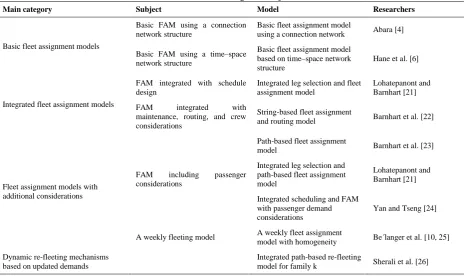
Efficient and appropriate formulation and solution for FAP have been discussed in the literature, and many researchers focused on this scope. Abara [4] was one of the first researchers to address realistically sized fleet assignment problemsusing a connection-based network structure. In his network, arrived and departed time of flight were considered. Then, Berge and Hopperstad [5] and Hane et al. [6], used this network structure in formulating the fleet assignment problem. Hane et al. [6] have proposed a series of preprocessing steps that aim to reduce the size of the network as well as the computational effort.
Rushmeier and Kontogiorgis [7] employed some preprocessing techniques to solve the problem more effectively without having to specify feasible connections for eachflight . They also considered some additional crew-based side-constraints in their model.
They designeda heuristic method to solve the problem in which the LP (linear programming) relaxation is first solved and theresulting solution is rounded to obtain an initial solution which is fed into a depth-first branch-and-boundprocess. Chung and Chung [8] attempted to solve the fleet assignment problem using genetic algorithm. They introduced modified operators to apply in genetic algorithm. A weekly fleet assignment model is presented by Kliwer and Tschoke [9].
They used a simulated annealing (SA) approach to deal with higher complexity. Belanger et al. [10] proposed a model for the periodic fleet assignment problem with time windows in which departure times are also determined.
In fleet assignment, profit is maximized by minimizing two types of costs: operational and spill costs [11]. Operational costs are those for flying the flight leg with the assigned aircraft type and usually include factors such as fuel and landing fees. Spill costs represent lost opportunity costs that arise if passenger demand exceeds the aircraft capacity and thus, potential revenue is lost [12]. Cacchiani and Salazar-González [13] considered fleet-assignment, aircraft-routing and crew-pairing problems of an airline flying and introduced a mathematical formulation based on binary variables. Finally, they applied a heuristic method to solve a real case. Ozdemier et al. [14] applied the general mathematical formulation of FAP to Turkish airlines and prepared an optimized set of airplanes for using in the Turkish network. Tavakkoli moghadam et al. [15] presented a new multi-period mathematical model and a solution procedure to optimize the railcar fleet size and freight car allocation, wherein car demands, and travel times, are assumed to be deterministic, and unmet demands are backordered.
Vaziri [16] assessed 123 variables to identify key characteristics reflecting air transport potentials in five sets namely, air transport, socio-economic status,
population demography, geographical and
environmental features and political features. Bazargan [17]introduced operating costs in the fleet assignment model, with passenger-spill costs, recapture rate flight cover and etc. An optimum solution is found in Bazargan`s study.
TABLE 1. A review on main categories, subjects and models on FAP
Main category Subject Model Researchers
Basic fleet assignment models
Basic FAM using a connection network structure
Basic fleet assignment model
using a connection network Abara [4]
Basic FAM using a time–space network structure
Basic fleet assignment model based on time–space network structure
Hane et al. [6]
Integrated fleet assignment models
FAM integrated with schedule design
Integrated leg selection and fleet assignment model
Lohatepanont and Barnhart [21]
FAM integrated with
maintenance, routing, and crew considerations
String-based fleet assignment
and routing model Barnhart et al. [22]
Fleet assignment models with additional considerations
FAM including passenger
considerations
Path-based fleet assignment
model Barnhart et al. [23]
Integrated leg selection and path-based fleet assignment model
Lohatepanont and Barnhart [21]
Integrated scheduling and FAM with passenger demand considerations
Yan and Tseng [24]
A weekly fleeting model A weekly fleet assignment
model with homogeneity Be´langer et al. [10, 25]
Dynamic re-fleeting mechanisms based on updated demands
Integrated path-based re-fleeting
model for family k Sherali et al. [26]
3. PROBLEM FORMULATION
In this section, to assign fleet to the network, we propose a two steps procedure. Step 1 determines the network structure and step 2 determines the assigned fleet (FAP) for extracted routes.
Suppose the demand between nodes in a network (demand matrix) are given and the goal is to serve demands with minimum cost. We should select the appropriate fleet and the number of airplanes for each fleet to serve all demands in the each network. Airline should determine the arcs between nodes to build a new network with redistributed demands. So, as mentioned before the proposed method of this paper consists of two steps. First, we should construct the optimum arcs between demand points and as a second step we should assign airplanes for each arc. Figure 1 presents the procedure discussed above. In step 1 the airline determines the routes in the network, finally in the step 2 the efficient airplane assignment is associated to the demand arcs. The model which used for constructing network is P- hub median model while total transportation costs should be minimized. Also a proposed model is presented for the second step of the proposed approach.
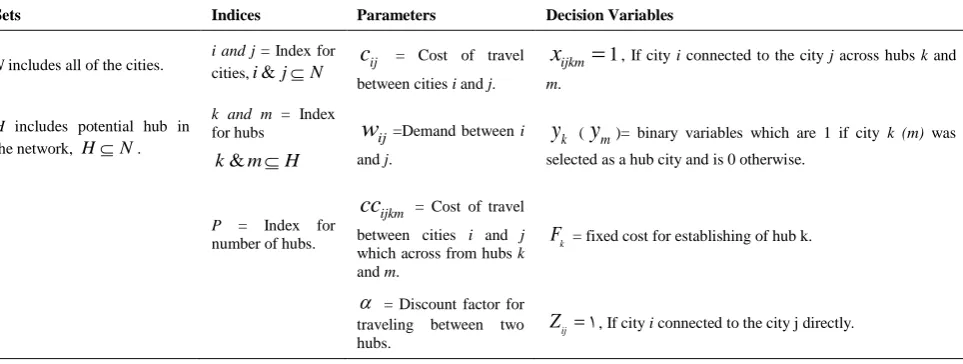
3.1 P-hub median problem After 1978 and simultaneous with liberalization in air industry of America, Hub network application became familiar for airlines. Before 1978, a network with the point to point links was main network in the world, because the all of the itineraries were determined by government and airlines had no option to select itineraries. After liberalization, the hub network was used by airlines that had drawn their own network according to the appropriate hubs. In this paper, according to the P-Hub median model, we select routes in the network. Table 2 presents characteristics of hub median problem. P-Hub median formulation is presented as follow [20]:
min k k ijkm ij ijkm ij ij ij
k i j k m i j
F y cc w x c w z
(7). : ij
ijkm1 , k m
S T z x i j i j (8)
, ,
ijkm m
k
x y i j m
(9), ,
ijkm k
m
x y i j k
i i
y p
(11), , ,
ijkm ik km mj
cc
c
c
c
i j k m
(12)
,
,
0.1
ijkm k ij
x
y
z
(13)Equation 7 as an objective function minimizes total cost of traveling on the network and hubs establishment
costs. Equation 8 guarantees that each two cities either have a direct link or a link via hubs. In Equation 9, if city m was not selected as a hub, then there was not any link via it. Equation 10 specifies same limitation of Equation 3 for city k. Equation 11 ensures that the number of selected hubs by the model be equal to P. Equation 12 computes cost of travelling between cities i
and j via hubs k and m. Equation 13 introduces binary variables.
TABLE 2. Characteristics of P-hub median problem
Sets Indices Parameters Decision Variables
N includes all of the cities. i and jcities,i = Index for &jN
c
ij = Cost of travel between cities i and j.1 ijkm
x
, If city i connected to the city j across hubs k andm.
H includes potential hub in the network, HN.
k and m = Index for hubs
&
k mH
ij
w
=Demand between iand j.
k
y
(y
m)= binary variables which are 1 if city k (m) was selected as a hub city and is 0 otherwise.P = Index for number of hubs.
ijkm
cc
= Cost of travel between cities i and jwhich across from hubs k
and m.
k
F = fixed cost for establishing of hub k.
= Discount factor for traveling between two
hubs. ij
Z 1, If city i connected to the city j directly.
Figure 1. Proposed steps for fleet assignment
According to the designed network by P-hub median model, redistributed demands are determined because of hub points stops, now the fleet assignment should apply in the constructed network.
3. 2. Proposed FAP model In this section, we assign proper airplanes at each fleet with proposed fleet assigned model, the notation and variables of the proposed model are described as follow:
Indices:
i and j = City index.
p = Fleet index.
k = Number of fleet in each type. Parameters:
ij
Z
: The strategy matrix of airline, airline determinates whether ij path must be served or not.ij
D : The distance between city i and city j.
ij
W : The demand between city i and city j.
p
C : Capacity of fleet p.,
S
p: Speed of fleet p.p
U : Maximum utilization time of fleet p per day.
p
L : cost of purchasing airplanes of fleet p.
p
FC : Fixed cost of fleet p for every flight.
p
VC : Variable cost of fleet p per kilometer.
pij
TC : Total flight cost in path ij
(
TC
pij
FC
p
VC
p
D
ij). Decision variables:pkij
x : A binary variable which it is 1 if airplane number
k of fleet p is assigned to route ij (from city i to city j), otherwise 0.
pk
pkij
a
: A binary variable and it is 1 if capacity of airplane number k of fleet p is enough to serve demand of routeij, otherwise 0. pkijn
f : A binary variable and it is 1 if airplane number k
of fleet p is traveled from i to j and also it has enough capacity to serve demand of route ij, otherwise 0.
pkij
b
: A binary variable and it is 1 if airplane number kof fleet p has enough time to serve demand of ij, otherwise 0. Note that each airplane has limited utilization time in every day.
pkijn
g
: A binary variable and it is 1 if airplane number kof fleet p traveled from i to j has enough time to serve demand of jn, otherwise 0.
pkijn
h
: A binary variable and it is 1 if airplane number kof fleet p traveled from i to j has enough capacity and time to serve demand of path jn, otherwise 0.
The variables g and h are binary variables which consider situation of an airplane to continue a route. According to the characteristics which are used for the model, the utilization time and capacity are two limitations for assigning an airplane. Hence, when an airplane traveled from city i to city j and then is scheduled to travel from city j to city n, it is necessary to check whether the airplane will have enough time and capacity. Variable g consider utilization time and variable h consider the available capacity for demand. If these variables get the value of zero, it means that the airplane has not enough time or capacity to continue the route, so the definition of variables g and h are correct.
pk
t
: A continuous variable which calculates total service time of airplane number k of fleet p.ij
r
: A continuous variable which calculates assigned capacity of fleet to route ij.According to the above mentioned definition, the objective function and constraints of the proposed model are given in the following equations.
ij pkij pij pk p
p k i j p k
Min
Z x TC
o L (14), , ,
pk pkij
o
x
p k i j
(15), &
pkij p ij
p k
x C
W
i j
i
j
(16),
ij
pk pkij
i j p
D
t x p k
S
(17),
&
ij pkij p
p k
r
x
C
i j
i
j
(18)
min
,
ij ij p p
r
W
C
i j
(19),
pk p
t
U
p k
(20)0
, , , , 1 .
ij p pkij
if W C
a p k i j i j
o w
(21)
1 0 & 1
, , , , ,
0 .
pkij ij
pkijn
if a x
f p k i j n i j n
o w (22) 0 , , , , 1 . ij p pk pkij p D if U t
b S p k i j i j
o w (23)
1 0 & 1
, , , , ,
0 .
pkij ij
pkijn
if b x
g p k i j n i j n o w
(24)
1 1 & 1
0 .
, , , , ,
pkijn pkijn pkijn
if f g h
o w p k i j n i j n
(25)
, , , ,
,
pkijn pkjnh
x
p k i j n
i
j
(26)
,
,
,
,
,
,
0,1
pkij pk pkij pkijn pkij pkijn pkijn
x
o
a
f
b
g
h
(27),
pk ij
t
r
R
(28)The objective function given in Equation 14 is a mixed integer linear equation consisting of two sub-functions. The first sub-function minimizes the total cost of assigning fleet to network and the second sub-function minimizes cost of fleet purchasing. Equation 15 computes number of airplanes for each fleet and saves it in
pk
o variable.
Equation 16 guarantees that demand between cities are served by airplanes. Equation 17 computes time of serving for each airplane. Equation 18 computes dedicated capacity of different airplanes for route ij. Equation 19 guarantees that devoted capacity to each path, be less than sum of the demand of the route and minimum capacity of the fleet, so the extra devoted capacity will be minimum.
21
a
pkij is an auxiliary variable to show that capacity of an airplane number k of fleet p is less than demand of the route ij or not. Based on Equation 22f
pkijn
1
ifpkij
a
0
andx
ij
1
. On the other hand, this equation guarantees that if the airplane number k of fleet ptraveled path ij and also it has not empty capacity (opportunity cost), then fpkijn1. Equation 23 ensures
0
pkijb
if ijp pk
p
D U t
S
. This inequality consider
whether the airplane number k of fleet p has enough time to travel path ij? The predefined flight time limit for airplanes of fleet p is
U
p. Also,t
pk is total traveled time of airplane number k of fleet p up to now. Hence, an airplane could travel path ij if summation oft
pk and needed time for travelling ij (which is ijp
D S
) would be
less than
p U .
According to the Equation 24, gpkijn1 if bpkij0
and
x
ij
1
. So, if the airplane number k of fleet ptraveled path ij and also it has enough time to travel path jn, then
g
pkijn
1
.Based on Equation 25 if
f
pkijn
1
andg
pkijn
1
then1
pkijnh
. This equation set hpkijn1 if the airplane number k of fleet p traveled path ij, and has enough time to travel path jn and also it has not any unused capacity on travel jn. Equation 26 guarantees ifh
pkijn
1
, then1
pkijn
x
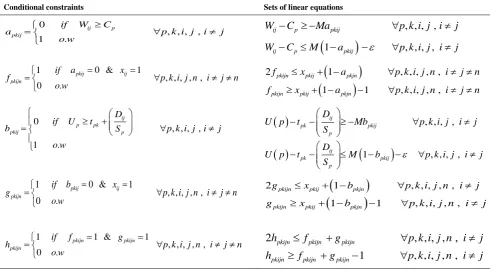
and it means that airplane number k from fleet p must travel from j to n. Equations 27 and 28 introduce binary and continuous variables.3. 3. linearization In the proposed model, there are some conditional equations which should be appeared in a linear form.
There are two types of conditional constraint in the model. First one has a format of 0
1 .
if b c a
o w
.
To linearize this constraint, we introduce two inequalities as
1
b c Ma
b c M a
. In these sets of
inequality, M is a big number and
is a very small one. By added two constraints conditional statements will be satisfied.The second conditional constraint has a format as
1 0 & 1
0 .
if b c
a
o w
. We introduce inequality
set as
2 1
1 1
a c b a c b
. Note that b and c are binary
variables. Again by added two mentioned constraints, conditional statement will be satisfied in a linear form. Table 4 presents the equations set for every constraint of the proposed model. As this table shows, for each conditional constraint of the proposed model, two linear equations have been introduced.
4. NUMERICAL EXAMPLE
In this section, we investigated a real data from air travel in Iran air network to predict the optimum basket of air plane for two next decades. According to the time series analysis of passenger movement, the traffic of Iran passenger will be doubled at the outlook 2036. The best time series model for Iran network with minimum MSE (Mean Squared Error) is ARIMA (1,0,0). According to this model, the total movement of Iran will be 50 millions in year 2036 (The employed data set will be available at:
be considered. As mentioned in the paper, after minimum cost, a critical consideration in planning air network is passenger satisfaction. Airlines should consider maximum hubs (to decrease cost of network)
and minimum hubs (to increase passenger satisfaction). So, authors proposed three hubs to consider all of the two concerns.
TABLE 4. Set of equations to linearize conditional constraints of the proposed model
Conditional constraints Sets of linear equations
0
, , , ,
1 .
ij p pkij
if W C
a p k i j i j
o w
, , , ,
ij p pkij
W
C
Ma
p k i j i
j
1
, , , ,ij p pkij
W C M a
p k i j i j1 0 & 1
, , , , ,
0 .
pkij ij
pkijn
if a x
f p k i j n i j n
o w
2fpkijnxpkij
1 apkjn
p k i j n, , , , , i j n
1
1 , , , , ,pkijn pkij pkjn
f x a p k i j n i j n
0 , , , , 1 . ij p pk pkij p D if U t
b S p k i j i j
o w
pk ij pkij , , , ,p
D
U p t Mb p k i j i j
S
pk ij
1 pkij
, , , ,p D
U p t M b p k i j i j
S
1 0 & 1
, , , , , 0 .
pkij ij
pkijn
if b x
g p k i j n i j n
o w
2gpkijn xpkij 1 bpkjn p k i j n, , , , , i j
1
1 , , , , ,pkijn pkij pkjn
g x b p k i j n i j
1 1 & 1
, , , , ,
0 .
pkijn pkijn
pkijn
if f g
h p k i j n i j n
o w
2
h
pkijn
f
pkijn
g
pkijn
p k i j n
, , , ,
,
i
j
1
, , , ,
,
pkijn pkijn pkijn
h
f
g
p k i j n
i
j
Figure 2. Plot of demand forecasting for Iran air travel at vision 2036
Figure 3. Cost of network versus number of hubs
TABLE6. Number of direct and indirect routes according to the number of hubs
Number of hubs Indirect routes Direct routes Total routes Proportion of Indirect routes
1 2 4690 4692 0.00
2 90 4602 4692 0.02
3 414 4278 4692 0.09
4 642 4050 4692 0.14
5 928 3764 4692 0.20
6 1370 3322 4692 0.29
7 1536 3156 4692 0.33
8 1746 2946 4692 0.37
9 2000 2692 4692 0.43
10 2172 2520 4692 0.46
11 2248 2444 4692 0.48
12 2336 2356 4692 0.50
13 2400 2292 4692 0.51
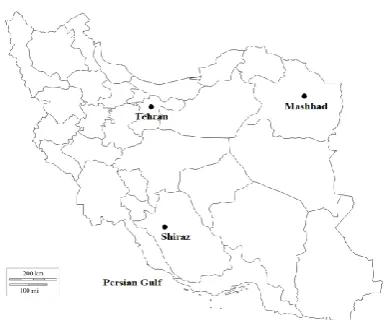
The selected hubs for Iran air networks are Tehran, Mashhad and Shiraz as presented in Figure 4. Now as a second step, the demand matrix should be redistributed according to the proposed hub network. After 24 25 26 27 28 29 30 31 32
1 2 3 4 5 6 7 8 9 10 11 12 13
redistributing demand between matrixes, we apply the proposed FLP model to select the appropriate number of the air plane. We introduce four types of fleet as shown
in Table 7. This fleet was extracted from standard category of famous aviation company.
TABLE 7. Attributes of fleet
Type 1 Type 2 Type 3 Type 4
Purchasing Cost ($) 4×10 7 108 25×10 7 4×10 8
Capacity 50 150 300 500
Speed (km/h) 400 500 600 700
Utilization Time (h) 8 8 8 8
Flight Fixed Cost ($) 1000 4000 10000 15000
Flight Variable Cost ($) 200 800 2000 3000
TABLE 8. Results of proposed model
Needed Time at Day Needed Number Needed number with passenger load Factor Number of Seats
Type 1 477.90 119.47 150 7500
Type 2 218.02 54.51 69 10312.5
Type 3 116.12 29.03 38 11250
Type 4 54.78 13.69 18 8750
Figure 4. Three Hubs selected for Iran air travel network at outlook 2036
According to the mentioned types of airplane in Table 7, the needed service time for each fleet type was calculated as Table 8. The cost of assigning proposed airplane basket to the network is 69.936.000.000 passenger-kilometer. The load factor is supposed to be 0.8 for each airplane. Load factor is percentage of the filled seats and measures the capacity utilization of airplanes.
According to proposed assignment, purchasing cost for airplanes basket is 29.6 billion dollars. The purchasing cost for current fleet of Iran is about 20 billion dollars. By doubling this cost for next two decades, by supposing current network and assigning method, the cost of purchasing needed fleet for vision
2036 will be 40 billion dollars. So, the proposed method could decrease the cost of purchasing airplanes about 10.4 billion dollars.
On the other hand, if the proposed network and proposed assignment model will be used in designing of Iran air network, the cost of investment for purchasing airplane will be decreased about 10.4 billion dollars. In addition of purchasingcost, other related costs such as crew, maintenance and so on will decreased. Tradeoff between passenger satisfaction and cost of network is an advantages of proposed network and considering fleet parameters is a critical key of proposed FAP which is important for airlines.
5. CONCLUSION
Adding other specification such as crew limitation makes the model more realistic. Also, considering time window in the model to make easy daily scheduling for airlines is an attractive future research direction.
6. REFERENCES
1. International civil aviation organization (ICAO), “Manual of air traffic forecasting”, 3th Edition, (2006).
2. Gu, Z., Johnson, E.L., Nemhauser, G.L. and Yinhua, W., "Some properties of the fleet assignment problem", Operations Research Letters, Vol. 15, No. 2, (1994), 59-71.
3. Salazar-González, J.J., "Approaches to solve the fleet-assignment, aircraft-routing, crew-pairing and crew-rostering problems of a regional carrier", Omega, Vol. 43, No., (2014), 71-82.
4. Abara, J., "Applying integer linear programming to the fleet assignment problem", Interfaces, Vol. 19, No. 4, (1989), 20-28. 5. Berge, M.E. and Hopperstad, C.A., "Demand driven dispatch: A method for dynamic aircraft capacity assignment, models and algorithms", Operations research, Vol. 41, No. 1, (1993), 153-168.
6. Hane, C.A., Barnhart, C., Johnson, E.L., Marsten, R.E., Nemhauser, G.L. and Sigismondi, G., "The fleet assignment problem: Solving a large-scale integer program", Mathematical Programming, Vol. 70, No. 1-3, (1995), 211-232.
7. Rushmeier, R.A. and Kontogiorgis, S.A., "Advances in the optimization of airline fleet assignment", Transportation science, Vol. 31, No. 2, (1997), 159-169.
8. Chung, T. and Chung, J., "Airline fleet assignment using genetic algorithms", in GECCO2002, 2002 Genetic and Evolutionary Computation Conference, New York, New York. Vol., No. Issue, (2002), 255.
9. Kliewer, G. and Tschöke, S., "A general parallel simulated annealing library and its application in airline industry", in Parallel and Distributed Processing Symposium, 2000. IPDPS 2000. Proceedings. 14th International, IEEE. Vol., No. Issue, (2000), 55-61.
10. Belanger, N., Desaulniers, G., Soumis, F. and Desrosiers, J., "Periodic airline fleet assignment with time windows, spacing constraints, and time dependent revenues", European Journal of Operational Research, Vol. 175, No. 3, (2006), 1754-1766. 11. Subramanian, R., Scheff, R.P., Quillinan, J.D., Wiper, D.S. and
Marsten, R.E., "Coldstart: Fleet assignment at delta air lines",
Interfaces, Vol. 24, No. 1, (1994), 104-120.
12. Barnhart, C., Belobaba, P. and Odoni, A.R., "Applications of operations research in the air transport industry", Transportation science, Vol. 37, No. 4, (2003), 368-391.
13. Cacchiani, V. and Salazar-González, J.-J., "A heuristic approach for an integrated fleet-assignment, aircraft-routing and crew-pairing problem", Electronic Notes in Discrete Mathematics, Vol. 41, No., (2013), 391-398.
14. Ozdemir, Y., Basligil, H. and Sarsenov, B., "A large scale integer linear programming to the daily fleet assignment problem: A case study in turkey", Procedia-Social and Behavioral Sciences, Vol. 62, No., (2012), 849-853.
15. Tavakkoli-Moghaddam, R., Sayarshadand, H. and ElMekkawy, T., "Solving a new multi-period mathematical model of the rail-car fleet size and rail-car utilization by simulated annealing",
International Journal of Engineering, Transactions A: Basics, Vol. 22, No. 1, (2009), 33-46.
16. Vaziri, M., "Taxonomy of global air transport", International Journal of Engineering, Vol. 6, No. 4147.
17. Bazargan, M., "Airline operations and scheduling", Ashgate Publishing, Ltd., (2012).
18. Gopalan, R. and Talluri, K.T., "Mathematical models in airline schedule planning: A survey", Annals of Operations Research, Vol. 76, No., (1998), 155-185.
19. Sherali, H.D., Bish, E.K. and Zhu, X., "Airline fleet assignment concepts, models, and algorithms", European Journal of Operational Research, Vol. 172, No. 1, (2006), 1-30.
20. Campbell, J.F., "Hub location and the p-hub median problem",
Operations research, Vol. 44, No. 6, (1996), 923-935. 21. Lohatepanont, M. and Barnhart, C., "Airline schedule planning:
Integrated models and algorithms for schedule design and fleet assignment", Transportation science, Vol. 38, No. 1, (2004), 19-32.
22. Barnhart, C., Boland, N.L., Clarke, L.W., Johnson, E.L., Nemhauser, G.L. and Shenoi, R.G., "Flight string models for aircraft fleeting and routing", Transportation science, Vol. 32, No. 3, (1998), 208-220.
23. Barnhart, C., Kniker, T.S. and Lohatepanont, M., "Itinerary-based airline fleet assignment", Transportation science, Vol. 36, No. 2, (2002), 199-217.
24. Yan, S. and Tseng, C.-H., "A passenger demand model for airline flight scheduling and fleet routing", Computers & Operations Research, Vol. 29, No. 11, (2002), 1559-1581. 25. Bélanger, N., Desaulniers, G., Soumis, F., Desrosiers, J. and
Lavigne, J., "Weekly airline fleet assignment with homogeneity", Transportation Research Part B: Methodological, Vol. 40, No. 4, (2006), 306-318.
A New Model for Fleet Assignment Problem, Case Study of Iran Air Network at
Vision 2036
A. A. Tofigha, M. Bashirib, M. Manteghic, M. Jalilid
aDepartment of Industrial Engineering, University of Amirkabir, Iran bDepartment of Industrial Engineering, University of Shahed, Iran cDepartment of Industrial Engineering, University of Maleke Ashtar, Iran dDepartment of Industrial Engineering, Material and energy research center, Iran
P A P E R I N F O
Paper history: Received 19 June 2015
Received in revised form 08 August 2015 Accepted 16 October 2015
Keywords:
Fleet Assignment Problem Airline planning Hub problem
ديكچ ه
( ناگوان صیصخت هلئسم FAP
کی زا بسانم عون نییعت ینعم هب ) .تسا ریسم ره هب صیصخت یارب )امیپاوه( ناگوان
ار ییاوه طوطخ هنیزه دناوت یم نآ بسانمان صاصتخا ور نیا زا و دور یم رامش هب نارگ رایسب عبنم کی ناونع هب امیپاوه
اصوصخ دریگ رارق رظندم دیاب ناگوان صیصخت هلئسم کی یدنب لومرف رد هک دراد دوجو یرایسب تاظحلام .دهد شیازفا
هب هک دهد یم هئارا طلتخم حیحص ددع یزیر همانرب زا دیدج یلدم هلاقم نیا .امیپاوه یاه یگژیو اب طبترم یاهرتماراپ
هباج هنیزه هک تسا یا هنوگ هب زاورپ ره هب بسانم ناگوان صیصخت لابند و دبای شهاک هکبش رد ناگوان تیلاعف و ییاج
تسد هب زاورپ ره یارب امیپاوه هنیهب دادعت اموزل رهش ود ره نایم یاضاقت هک دنک یم نیمضت هدمآ تسد هب لدم .دیآ
لاثم کی رد همادا رد .دشاب رتمک نآ یارب هدش هتفرگ رظن رد نیعم نامز زا هکبش رد امیپاوه ره تیلاعف نامز و دوش هدروآرب
قفا رد ییاوه ترفاسم یاضاقت ینیب شیپ اب ،یعقاو 6302
وه بسانم ناگوان ،ناریا رد یلخاد یاضاقت ششوپ یارب ییا
ییاوه ناگوان یارب هنیهب دبس کی هئارا اب یداهنشیپ لدم هک دهد یم ناشن شهوژپ نیا جیاتن .تسا هدش داهنشیپ ناریا
هرهب دناوت یم و هتشاد ناگوان دیرخ ای تخاس هنیزه رد یهجوت لباق شهاک تیلباق ،دوجوم تیعضو همادا هب تبسن ،ناریا
ر تعنص نیا یرو .دهد شیازفا یدایز نازیم هب ا