and Teaching English Vol. 1, No. 3, (2013), 139-168
The Application of Ellis’s Principles for
Effective Instructed Foreign Language Learning
in Iranian Language Institutes and High Schools
Mohammad Sadegh Bagheri Department of Foreign Languages Shiraz Branch, Islamic Azad University
Shiraz, Iran Marzieh Mehrnoush∗ [email protected]
Abstract. This study attempts to investigate Iranian EFL teachers’ perception of the application of Ellis’s (2005) principles for successful instructed language learning in their language classes. To this end, a group of EFL teachers comprising high school and private language institute teachers took part in the study. The required data were gath-ered through a self-completion questionnaire developed by Howard and Millar (2009). Qualitative analysis of data revealed the teachers’ per-ception of the principles, as well as the principles they perceived to be most important to them, and the challenges they faced in implement-ing the principles in their language classes. These constraints included lack of time, the context of learning, the large number of students in classes, the testing system of the educational system, and the nature and structure of the language books. Results of independent samples t-test also indicated that those teachers who taught in the private lan-guage institute had a higher perception of the principles and were thus more successful than high school teachers in implementing them in their language classes. Based on the findings of the study, a number of peda-gogical implications for language teachers and syllabus and curriculum developers are stated.
Keywords: Communicative language teaching, Ellis’s principles, ap-plication, Iranian EFL teachers
Received: September 2013; Accepted: November 2013 ∗
Corresponding author
1. Introduction
During the recent years, English teachers, especially teachers of English as a second language (ESL teachers), have tended to use communica-tive language teaching (CLT) approach in their classes. As English is considered as an international language all over the world and people use it for different purposes, the importance of English learning and teaching has increased significantly. Additionally, using the Internet has increased the importance of English. Littlewood (2007) emphasized the fact that some traditional methods of language teaching like Grammar Translation Method (GTM) and Audio-lingual Method (ALM) could not enable ESL learners to effectively communicate in English. Larsen-Freeman (2000) contends that through the CLT approach and the use of authentic materials and tasks, students’ communicative competence will be improved. Savignon (2001) emphasized that CLT can improve students’ competence in English by pushing them to speak fluently. Lit-tlewood (2007) mentioned that CLT is recognized as an effective lan-guage teaching method in which ESL learners can communicate with each other and this method of language teaching is much more effective than the traditional teaching methods such as GTM.
between what a CLT approach requires and the transmission-style edu-cational practices of many of these countries (Biggs, 1996; Butler, 2005; Campbell & Zhao, 1993). Learners’ traditional passivity in many Asian cultures, and their reservations about the need for communicative com-petence, are frequently reported to underpin students’ unwillingness to do small-group and pair activities, which are central to a communicative approach (Hu, 2002; Hui, 1997; Insull, 2001; Sun & Cheng, 2000). Re-searchers have explored alternatives to CLT for EFL instruction, and continue to examine the usefulness of the construct of method in second language teaching and learning contexts (Bax, 1997, 2003; Brown, 2002; Kumaravadivelu, 2001, 2006; Richards, 2001).
Proposed solutions to reported challenges include moves towards L2 teaching approaches that are context-specific, and which align more closely to existing practices as well as to the needs and realities of spe-cific EFL settings (Bax, 2003; Gyde & Doogan, 2004; Bjorning-Gyde, Doogan, & East, 2008; Breen, 2006; Johnson, 2006; Kumaravadi-velu, 2001, 2006). Frameworks for second language teaching along with general principles underpinning language teaching and learning have also been proposed as guidelines for teachers to apply as appropriate to their specific settings (Allwright, 2003; Brown, 2001, 2002; Ellis, 2005; Ku-maravadevelu, 2003, 2006; Lightbown, 2000). Among these is a set of general principles that Ellis (2005) proposed as the result of a review of a range of theoretical perspectives and empirical studies of instructed L2 acquisition that she undertook for the New Zealand Ministry of Ed-ucation. Ellis’s (2005) principles address the nature of L2 competence and the foci of instruction, and are offered to language curricula devel-opers and L2 teachers as a guide for a learning-centered pedagogy. As such, the present study explores Iranian EFL teachers’ perception of the application of Ellis’s principles for successful language learning.
respect to its classroom practices (Savignon & Wang, 2003; Wang & Savignon, 2001). Although there are several principles and frameworks (e.g. Krashen’s Monitor Model (Krashen, 1981) and Long’s Interaction Hypothesis (Long, 1996) helping EFL and ESL teachers overcome the challenges they encounter in implementing CLT (Allwright, 2003; El-lis, 2005; Richards, 2001), Ellis’s (2005) principles are considered as the most effective. Further, there seems to be a dearth of knowledge on the application of Ellis’s principles in EFL contexts in general and Iran EFL setting in particular. The present study thus investigates Iranian EFL teachers’ perception of the application of Ellis’s principles.
2. Research Questions
This study aims at investigating Iranian EFL teachers’ perception of the application of Ellis’s (2005) principles in their language classes. More specifically, the study seeks answers to the following research questions: 1. How do Iranian EFL teachers perceive the application of Ellis’s principles for successful instructed language learning in language classes? 2. Which of Ellis’s principles for successful language learning do Ira-nian EFL teachers consider to be the most important to try to use in their classes?
3. What constraints do Iranian EFL teachers perceive to impede attempts to implement Ellis’s principles?
4. How are the teachers of English language institutes and high schools different in applying Ellis’s principles?
3. Literature Review 3.1 Communicative language teaching
classroom environment, hoping that such engagement will help them initiate communication in out-of-classroom settings (Richards, 2006). According to Richards (2006), communicative language teaching sets as its goal the teaching of communicative competence. Communicative competence includes the following aspects of language knowledge:
1) Knowing how to use language for different purposes and functions 2) Knowing how to vary our use of language according to the setting and the participants (e.g., knowing when to use formal and informal speech or when to use language appropriately for written as opposed to spoken communication)
3) Knowing how to produce and understand different types of texts (e.g., narratives, reports, interviews, conversations)
4) Knowing how to maintain communication despite having limita-tions in one’s language knowledge (e.g., through using different kinds of communication strategies) With CLT began a movement away from tra-ditional lesson formats where the focus was on mastery of different items of grammar and practice through controlled activities such as memoriza-tion of dialogs and drills, and toward the use of pair work activities, role plays, group work activities and project work (Richards, 2006).
Principle 1: Instruction needs to ensure that learners develop both a rich repertoire of formulaic expressions and a rule-based competence
Proficiency in an L2 requires that learners acquire both a rich repertoire of formulaic expressions (e.g., I don’t know; I don’t understand; Can I have ?; What’s your name?; I’m very sorry; No, thank you.), which provides fluency, and a rule-based competence consisting of knowledge of specific grammatical rules, which caters to complexity and accuracy (Skehan, 1998). There is now widespread acceptance of the importance played by formulaic expressions in language use. Native speakers have shown to use a much larger number of formulaic expressions than even advanced L2 learners (Foster, 2001). Formulaic expressions may also serve as a basis for the later development of a rule-based competence. El-lis (1996), for example, has suggested that learners bootstrap their way to grammar by first internalizing and then analyzing fixed sequences.
Principle 2: Instruction needs to ensure that learners focus predomi-nantly on meaning
The term ‘focus on meaning’ is somewhat ambiguous. It is necessary to distinguish two different senses of this term. The first concerns the idea of semantic meaning (i.e. the meanings of lexical items or of spe-cific grammatical structures). This type of meaning is addressed in the oral-situational approach and in the notional-functional approach. The second sense of focus on meaning relates to pragmatic meaning (i.e. the highly contextualized meanings that arise in acts of communication). For the purpose of providing opportunities for students to attend to prag-matic meaning, a task-based (or, at least, a task-supported) approach to language teaching is required. It is important that instruction ensure opportunities for learners to focus on both types of meaning but it is pragmatic meaning that is crucial to language learning.
Principle 3: Instruction needs to ensure that learners also focus on form
Schmidt (1994), for example, has argued that there is no learning with-out conscious attention to form. Again, though, the term ‘focus on form’ is capable of more than one interpretation. First, it might refer to a general orientation to language as form. Schmidt (2001) dismisses this global attention hypothesis on the ground that learners need to attend to specific forms. Second, it might suggest that learners need to attend only to the graphic or phonetic instantiations of linguistic forms. How-ever, theorists such as Schmidt and Long argue that focus on form refers to form-function mapping (i.e. the correlation between a particular form and the meaning(s) it realizes in communication). Third, ‘focus on form’ might refer to awareness of some underlying, abstract rules.
Principle 4: Instruction needs to develop implicit knowledge of the L2 while not neglecting explicit knowledge
Implicit knowledge is procedural, is unconsciously attained and can only be expressed if it becomes explicit. It can be retrieved rapidly and eas-ily and is thus available for use in rapid, fluent communication. Most researchers contend that competence in an L2 is primarily a matter of implicit knowledge. Explicit knowledge “is the declarative and often anomalous knowledge of the phonological, lexical, grammatical, prag-matic and socio-critical features of an L2 together with the metalanguage for labeling this knowledge” (Ellis, 2004). It is acquired consciously, can be taught and verbalized, and is usually accessed through controlled processing when learners experience some kind of linguistic difficulty in the use of the L2. A distinction can be drawn between explicit knowl-edge as analyzed knowlknowl-edge and as metalingual explanation. The former involves a conscious awareness of how a structural feature works while the latter involves of knowledge of grammatical metalanguage and the ability to understand explanations of rules.
Principle 5: Instruction needs to take into account learners’ ‘built-in syllabus’
mastering each grammatical structure). This led researchers to suggest that learners had their own ‘built-in syllabus’ for learning grammar as implicit knowledge. Krashen (1981) famously argued that grammar in-struction played no role in the development of implicit knowledge (what he called ‘acquisition’), an argument based on the view that learners (including classroom learners) would automatically proceed along their built-in syllabus as long as they had access to comprehensible input and were sufficiently motivated. Grammar instruction could contribute only to explicit knowledge (‘learning’).
Principle 6: Successful language learning requires extensive L2 input Language learning, whether it occurs in a naturalistic or an instructed context, is a slow and labor-intensive process. Children acquiring their L1 take between two and five years to achieve full grammatical compe-tence, if exposed to enormous amounts of input. Ellis and Wells (1980) demonstrated that a substantial portion of the variance in speed of ac-quisition of children can be accounted for by the amount and the quality of input they receive. This applies to L2 acquisition as well. If learners do not receive exposure to the target language, they cannot acquire it. In general, the more exposure they receive, the more and the faster they will acquire the language. Krashen (1981, 1994) has adopted a very strong position on the importance of input. He points to studies that have revealed that length of residence in the country where the lan-guage is spoken is related to lanlan-guage proficiency and that have found positive correlations between the amount of reading reported and pro-ficiency/literacy. For Krashen, however, the input needs to made com-prehensible either by modifying it or by means of contextual props.
Principle 7: Successful language learning requires opportunities for out-put
(i.e. output where the learner is pushed to express messages clearly), con-stitutes one of the main reasons for incorporating tasks into a language program. Exercises (especially the more controlled type) typically re-sult in output that is limited in terms of length and complexity. It does not afford students opportunities for the kind of sustained out-put that theorists argue is necessary for interlanguage development. Re-search (e.g. Allen, Swain, Harley, & Cummins, 1990) has shown that extended talk of a clause or more in a classroom context is more likely to occur when students initiate interactions in the classroom and when they have to find their own words. This can be accomplished by asking learners to perform tasks that require both oral and written language.
Principle 8: The opportunity to interact in the L2 is central to devel-oping L2 proficiency
While it is useful to consider the relative contributions of input and output to acquisition, it is important to assert that both occur in oral interaction and that both computational and sociocultural theories of L2 acquisition have viewed social interaction as the matrix in which acquisition takes place. As Hatch (1978) famously put it “one learns how to do conversation, one learns how to interact verbally, and out of the interaction syntactic structures are developed” (p. 404). As such, interaction is not merely a means of automatizing existing linguistic re-sources but it also creates new rere-sources. According to the Interaction Hypothesis (Long, 1996), interaction fosters acquisition when a com-munication problem arises and learners are engaged in negotiating for meaning. The interactional modifications arising help to make input un-derstandable, offer corrective feedback, and push learners to modify their own output in uptake.
Principle 9: Instruction needs to take account of individual differences in learners
We have seen that although there are identifiable universal aspects of L2 acquisition, there is also considerable variability in the rate of learning and in the ultimate level of achievement. Learning will be more successful when:
learning.
2. The students are motivated. It is probably beyond the abilities of most teachers to design lessons involving the kind of matching in-struction employed in Wesche’s study. However, teachers can cater to variation in the nature of their students’ aptitude by adopting a flexi-ble teaching approach involving a variety of learning activities. They can also use simple learner-training materials (e.g. Ellis & Sinclair, 1989) de-signed to make students more aware of their own approaches to learning and to develop awareness of alternative approaches. The good language learner studies suggest that successful language learning requires a flex-ible approach to learning.
Principle 10: In assessing learners’ L2 proficiency, it is important to examine free as well as controlled production
Norris and Ortega’s (2000) meta-analysis of studies investigating form-focused instruction demonstrated that the extent of the effectiveness of instruction is contingent on the way in which it is measured. They illustrated four types of measurement: 1) Metalinguistic judgment, 2) Selected response (e.g. multiple choice), 3) Constrained constructed response, and 4) Free constructed response. They found that the mag-nitude of effect was greatest in the case of (2) and (3) and least in (4). Yet, arguably, it is (4) that constitutes the best measure of learners’ L2 proficiency, as it is this that corresponds most closely to the kind of language use found outside the classroom. The ability to get a multiple choice question right amounts to very little if the student is unable to use the target feature in actual communication.
tasks (i.e. tasks for which there is a single correct outcome). An example can be a Spot the Difference Task where learners are asked to interact in order to find a specified number of differences in two similar pictures. In this task, assessment consists of establishing whether they were able to successfully identify the differences.
With this in mind, the present study endeavors to explore whether Ellis’s (2005) principles would provide useful guidelines for English guage teachers in Iran as they attempt to implement CLT in their lan-guage classrooms. More specifically, the current study investigates Ira-nian EFL teachers’ perception of the applicability of these principles in their EFL context. Reviewing the related literature, one can notice the dearth of research in Iranian EFL environment. The present study is in fact an initial step in this regard that can shed more light into this issue and fill the gaps in the literature.
4. Method 4.1 Participants
Two groups of English language teachers took part in the study. The first group comprised twenty language teachers teaching at a private language institute in Shiraz, Iran. They were teaching elementary, intermediate, and advanced language courses to a large number of students. Their age ranged from 26 to 34. They were both males and females, which made it possible for the researchers to gather a variety of opinions on both genders. The second group of participants comprised twenty language teachers teaching in a number of high schools in Shiraz. Their age ranged from 28 to 45.
4.2 Instrument
to which they applied the principles in their English language classes, based on their frequency. In the third part of the questionnaire, teachers were given a number of open-ended questions with the aim to elicit more specific information and gain deeper understanding concerning their re-sponses to the second part of the questionnaire. The respondents were expected to clarify a number of points. They were, for instance, asked to indicate if any of the principles do not apply to their teaching situ-ation, but they would like to try them. Moreover, they were requested to illustrate what they thought of some of the benefits and challenges of applying Ellis’ (2005) principles. They were also asked to rank the princi-ples in terms of their degree of importance. These open-ended questions enabled the researcher of the present study to gather more in-depth data and further explanations regarding the principles. This part indeed pro-vided some qualitative data. By complementing quantitative data with the qualitative type, the researcher could display a complete picture of the issue under study (Creswell, 2007). In order to assess the reliability of the instruments, Cronbach alpha coefficient was used, which yielded a reliability of .71 for the questionnaire.
5. Results and Discussion 5.1 Research question one
The Application of Ellis’s Principles for Effective ... 151
Table 1. Language institute teachers’ perceptions of the application of Ellis’s principles
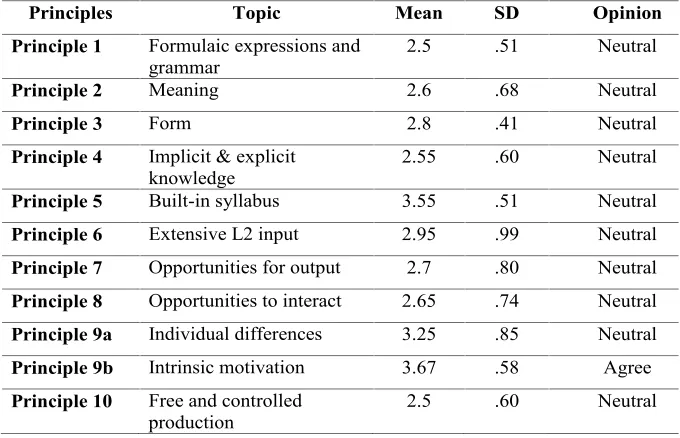
Table 2. High school teachers’ perceptions of the application of Ellis’s principles
176
177
5. Results and Discussion
5.1 Research Question One
The first research question of the study seeks Iranian EFL teachers’
perception of the application of Ellis’s principles in their language
classes.
1. How do Iranian EFL teachers perceive the application of Ellis’s
principles for successful instructed second language learning in Iranian
classes?
To answer this question, the data gathered from questionnaires were
subjected to descriptive statistics, the results of which are given
below. According to Mohammadi’s (2005) measurement scale, a mean
value of 1 to 2.3 expresses disagreement, 2.3 to 3.66 indicates neutral
opinion, and 3.66 to 5 represents agreement. Language institute and
high school teachers’ perceptions of the application of Ellis’s principles
are demonstrated in Tables 1 and 2 respectively.
Table 1. Language institute teachers’ perceptions of the application of
Ellis’s principles
�� ����������������������������������������������������������������������������������������� ������������������������������������������������������� �������������������������������������������������������������������������������������������� �������������������������� ���������������������� ������������������������������������������� �������������������������������������������������������������������������������������������������� ����� ��� �� ����������� ���������� ��������� ���������� ���� ����� ������� ���������� ����������� ��� ��� �������������������������������������������������������������� ��� � ������������� �������� ��������������������������������������������������������������������������������� ���������� ����� ���� �� ������� ����������� ������������������������� ������� ���� ��� ������� ����������� ������� � ��� ������� ����������� ���� ��� ��� ������� ����������� ������������������� ��������� ���� ��� ����� ����������� ����������������� ���� ��� ������� ����������� ������������������ ���� ��� �������� ����������� ������������������������ ��� ��� ������� ����������� ������������������������� ��� ��� ������� ������������ ���������������������� ���� ��� ������� ������������ �������������������� ��� ��� ������� ������������ ������������������� ���������� ���� ��� ����� 176The Application of Ellis’s Principles for Effective ...
177
M. Sadegh Bagheri and M. Mehrnoush
Table 2. High school teachers’ perceptions of the application of Ellis’s principles
Tables 1 and 2 illustrate Iranian EFL teachers’ perceptions of the application of Ellis’s principles in their foreign language classes. The tables illustrate whether the teachers agreed or disagreed or held a neutral opinion with regard to the principles. The number of questionnaire items corresponds to the number of principles. It is worth noting that principle nine has two items in the questionnaire. The following section is dedicated to a detailed analysis of the teachers’ responses to each principle.
Principle 1
The first principle concerned students’ learning the formulaic expressions of the language as well as grammatical forms. As can be seen in Table
�������� �������������������������������������������������������������������������� ���������� ����� ���� �� ������� ����������� ������������������������� ������� ��� ��� ������� ����������� ������� ��� ��� ������� ��������� � ���� ��� ��� ������� ����������� ������������������� ��������� ���� ��� ������� ����������� ����������������� ���� ��� ������� ����������� ������������������ ���� ��� ������� ����������� ������������������������ ��� ��� ������� ����������� ������������������������� ���� ��� ������� ������������ ���������������������� ���� ��� ������� ������������ �������������������� ���� ��� ����� ������������ ������������������� ���������� ��� ��� ������� ������ � ��� � ������������������������������������������������������������������������������������� ���������������������������������������������������������������������������������������������������� ����� �� �������� �������� ����� ������� ��� ���� ������������ ���� ������� �� �������������� ����� ������������ ��� ���� ������� ��� ������������ ��� ��� ������ ������� ����� ��������������� ���� ���� ������ �� ���� ��������������� ���� ���������� �������� ��� ���������� ��� �� ��������� ��������� ��� ���� ��������� ���������������������������� ����������� �������������������������������������������������������������������������������������������������� ��� ������������ ������� ��� ���� ��� ����� ��� ������ ����� ����� ��������� ���������� ���� ����� ������ ������������������������������������������������������������������������������������������������� ���� ����� ������� ��������� ���� ����� ���� ���� �������������� ������ ��� ����������� ��� ���� ����� ���� ���������������������������������������������������������������������������������� ����������������� ������� ������� ���� ������� ������� ������� ����� ���� ��������� ��� ���� ������������ ���� ���� ��� ���
The Application of Ellis’s Principles for Effective ... 151
Table 1. Language institute teachers’ perceptions of the application of Ellis’s principles
Tables 1 and 2 illustrate Iranian EFL teachers’ perceptions of the ap-plication of Ellis’s principles in their foreign language classes. The ta-bles illustrate whether the teachers agreed or disagreed or held a neutral opinion with regard to the principles. The number of questionnaire items corresponds to the number of principles. It is worth noting that principle nine has two items in the questionnaire. The following section is dedi-cated to a detailed analysis of the teachers’ responses to each principle.
Principle 1
The first principle concerned students’ learning the formulaic expres-sions of the language as well as grammatical forms. As can be seen in Table 4.3, both language institute and high school teachers held neu-tral beliefs regarding this principle. The mean values of the language institute and high school teachers are 3.65 and 2.5 respectively, which is indicative of the fact that language institute teachers apply this prin-ciple in their classes more frequently. However, in their study, Howard and Millar (2009) showed that the majority of the respondents (14 out of 15) reported that their students were already using both chunks of language and the grammatical knowledge.
Principle 2
The second principle concerns the significant role of meaning in language instruction. Results illustrate the fact that both groups of teachers had neutral beliefs with respect to this principle. The mean values of lan-guage institute and high school teachers’ responses to this principle are 3 and 2.6 respectively, which indicates the more importance of this princi-ple among language institute teachers. When learners focus on meaning, they develop both the skills needed for fluent communication and the vocabulary and grammar needed to use the language effectively (Ellis, 2008).
Principle 3
language institute teachers. This could be attributed to the nature of books taught in the language institute and the high schools where the required data were collected.
Principle 4
This principle asserts that instruction needs to focus on developing im-plicit knowledge of the second language while not neglecting exim-plicit knowledge, and that students’ implicit knowledge is developed through using communicative activities. This principle receives a high mean value (3.95) among language institute teachers but a low mean value (2.55) among high school teachers. The language institute teachers agreed with this principle; however, high school teachers had a neutral belief in this regard. This is while participants in Howard and Millar’s study (2009) reported that this principle is the most important principle for them to try to apply.
Principle 5
This principle, which concerns the importance of learners’ built-in syl-labus in language instruction, receives a relatively higher mean (3.55) from high school teachers than language institute teachers (3.45). This means this principle is more applicable in high schools than private lan-guage institutes. It could thus be concluded that the participants are aware of the fact that classroom instruction needs to support the natu-ral order in which language is acquired. Research has shown that learners follow a natural order and sequence of acquisition. In other words, they master grammatical structures in a relatively fixed and universal order, and they pass through a sequence of stages of acquisition en route to mastering each grammatical structure. In Howard and Millar’s (2009) study, it was shown that none of the respondents cited this principle as an important one to apply, as the textbook is already organized in that order. However, the problem that arises here is that it is difficult for teachers to discover learners’ built-in syllabus to make informed de-cisions about the order of presentation.
Principle 6
show that the private language institute teachers disagreed with this principle, arguing that their students do not have extensive opportuni-ties to practice their English. The high school teachers, however, had a neutral belief in this regard. Clearly, in the places where the data for the study were collected, students do not have enough opportunities to read and hear English. The fact is that in a language institute, students meet twice a week, which is surely not enough time for the learners to have adequate exposure to English language. The scenario is worse in high schools where students meet just once a week. Lack of exposure to language makes the process of language learning slow. Ellis and Wells (1980) demonstrated that a substantial portion of the variance in speed of acquisition of children can be accounted for by the amount and the quality of input they receive. The same is undoubtedly true of L2 ac-quisition. If learners do not receive exposure to the target language they cannot acquire it. In general, the more exposure they receive, the more and the faster they will learn.
Principle 7
Principle 8
The eighth principle asserts that students have many opportunities to interact in English during class time. This principle receives a higher mean value among language institute teachers (3.2) than high school ones (2.65). Results indicate that both groups of teachers had neutral opinions regarding this principle. According to the Interaction Hypoth-esis (Long, 1996), interaction fosters acquisition when a communication problem arises and learners are engaged in negotiating for meaning. How-ever, this does not happen in Iranian language setting for a number of reasons. The first reasons could be the nature of books being taught in language institutes and particularly in high schools, which are not communicative enough and do not provide students with extensive op-portunities to interact with each other. The story is more serious in high schools where students are less motivated to learn the language and see English language course as a subject similar to other courses they have. However, people who attend language institutes are consid-ered to be more motivated to learn the language as they have willingly selected to learn the language without the pressure of school, parents, or just for examination purposes.
Principle 9
students’ intrinsic motivation. Results demonstrate that the mean val-ues of the language institute and high school teachers are 3.1 and 3.67 respectively, which is indicative of the fact that high school teachers have a higher perception of this principle as compared to the language institute teachers. Moreover, results show that language institute teach-ers held a neutral belief of this principle, while the high school teachteach-ers agreed with it. Although it is true that there is very little a teacher can do to increase students’ intrinsic motivation, there are ways to en-hance such motivation. Dornyei (2001) makes the obvious point that the best motivational intervention is simply to improve the quality of teaching. He points to the need for “instructional clarity” by “explain-ing th“explain-ings simply” and “teach“explain-ing at a pace that is not too fast and not too slow”. Teachers also need to accept that it is their responsibility to ensure that their students stay motivated, and they should not complain that students do not bring any motivation to the classroom.
Principle 10
This final principle concerns language proficiency testing, which should include both free oral production and controlled production. This prin-ciple received the highest mean from language institute teachers (4.05), and the lowest from high school teachers (2.5). Results show that the language institute teachers agreed with this principle, while the high school teachers were neutral in this regard.
5.2 Research question two
The Application of Ellis’s Principles for Effective ... 157
Table 3. Teachers’ perception of the most important principles
It was found out that Principle Eight was the most important princi-ple for the participants of the study. This principrinci-ple stated that students need to have extensive opportunities to interact in English during class time. As can be seen in Table 3, of the forty individuals who partici-pated in the study, 26 teachers (65%) ranked it as number one and thus agreed that this principle is the most important to be applied in lan-guage classes. Clearly, teachers have acknowledged the important role of interaction and communicative activities in language classrooms. How-ever, there may not be ample opportunities for teachers to implement this principle in their language classrooms.
Another important principle, from the viewpoint of the participants of the present study, is Principle Seven, which asserts that learners need to perform many tasks that require both oral and written output. Ob-viously, the teachers are aware of the importance of providing ample opportunities for learners so that they can have extensive practice in the language classroom environment. To Ellis, (2008), creating oppor-tunities for learners to practice their language is one of the essential components of communicative language teaching.
The other important principles to the participants of the present study are items nine and ten. These two items are both related to Prin-ciple 9, which concerns teachers’ taking into account students’ differ-ent learning styles, and the importance of creating intrinsic motivation within language learners.
5.3 Research question three
The third research question of the study was also approached
qualita-��� qualita-���qualita-���qualita-����� �� qualita-���qualita-���� qualita-���qualita-���qualita-���� qualita-��� qualita-���qualita-����� qualita-��� ��� ����� �� ��������� ���������� �� ��� ���� ��������� ���������� �� ��� ����� ��� ���� ��������� ����� ��� ��� ���� ��������� ������� ��� ��� ��� ������������ �� ��� ������ ���� ��������� ������ ���� �������� ���� �� ���� ��������� ������������� �� �������� �� ������� ������ ����� ����� �� ��� �� ���� �� ����� �� �� ��� ����� ����������� ��� �������� ����� �� ��� ������ �� �������� ����� ������ �� �� ������ ��� ��� ���� ������ ���� ���� ��������� �� ��� ���� ��������� �� �� ������� �� ���� ����� �������� �������� �������� ���� ������������ ��� ��������� ���� �� ����������� ��� ������������� ���������� �� �������� ����������� ���� ����� ����� ��� ��� �� ����� ������������� ��� �������� �� ��������� ���� ��������� �� ����� �������� ����������� ������� ��������� ���������� ���� ��� ��������� �� ��� ������������ �� ��� ������� ������ �� ��������� ������ ����� ������� ���� �������� ���� �� ������� ���� ����� ���� ������� ���� ���� ��� ������� ������� ��� �������� ��� �������� ��� ����� �� ��� ���������� �� ��������� ����� ������������� ��� �������� �� ���� ���� ��� ���� ��������� �������� �� ��� �������� ��������� ������������ �� ������ ������� �������� ������ �������� ��� �������� �� �������� ����� �������� �� ��� �� ��� ��������� ���������� �� ������������� �������� ��������� ��� ����� ��������� ���������� �� ��� ������������ �� ��� ������� ����� ��� ����� ���� ��� ���� ����� ��� ����� ��� ���� ������� �� ����� ����� �� ����� �������� ��������� ������ ���� ������� ��������� ������ ��� �������� ������� ��� ��� ���������� �� �������� ��������� ���������� ������ �������� ��������� ��� �������� �������� ����� ��� ����� �������� �������� �� ��� ����� ��� ���� ���������� ��������
184
The Application of Ellis’s Principles for Effective ...
185
M. Sadegh Bagheri and M. Mehrnoush
3 illustrates the respondents’ perception on the most important principles.
It demonstrates the number of teachers who ranked the principles as the
most important ones.
Table 3.
Teachers’ perception of the most important principles
It was found out that Principle Eight was the most important principle
for the participants of the study. This principle stated that students need
to have extensive opportunities to interact in English during class time.
As can be seen in Table 3, of the forty individuals who participated in
the study, 26 teachers (65%) ranked it as number one and thus agreed
that this principle is the most important to be applied in language classes.
Clearly, teachers have acknowledged the important role of interaction and
communicative activities in language classrooms. However, there may
not be ample opportunities for teachers to implement this principle in
their language classrooms.
Another important principle, from the viewpoint of the participants
of the present study, is Principle Seven, which asserts that learners
need to perform many tasks that require both oral and written output.
Obviously, the teachers are aware of the importance of providing ample
opportunities for learners so that they can have extensive practice in the
language classroom environment. To Ellis, (2008), creating opportunities
for learners to practice their language is one of the essential components
of communicative language teaching.
�������������������������������������������������������������������������������������������������� ��� ���� ��� ������ ��������� ����� ��������� ���� ��������� ������ ��� ���� ������������ ����� ��������� �� �������������� ���������� ��� ��� ����������� ����� ��� ���� �������������� ������ ������ ����� ��� ����� ��� ����������� ��� ��� ������ ����� ���������� ������ ����� ����������� ����� ���������� ��� ���� ��� ������ ��� ����������������������������������������������������������������������������������������������� � ���������������������������������������������������������������������������������������������������� ����������������������������������������������������������������� ����� �� ����������������������������������������������������� ��������� ����� ������������������ ����������� ������������������������� �� ����������� ������������������������ �� ������������ ���������������������� �� ������������ �������������������� � ���������������������������������������������������������������������������������������������� ���� ������� ����� ���������� ������� ����� ��������� ����� ��� ����� ���������� �������������� ��� ��������� �� �������������������������������������������������� �� �������������������������������������������� ���������������������������������������������������������������������������������������������������� ���������� ��� ��� �������� ��� ��������� �������� ��������� ��������� ����� ������������� ���� ��������� ����������������������� ������������������������� ������������ ������������ ���������������������� ��������������������������������������������������������������������������������������������� ����������������������������������������������������������������������������������������� �� �������������������������������������������������������������������������������������������������� �������� �������� ����������� ���� ��������� ���� ������ ��� ���� ����������� ��� ���������� ����� �������������� ���� ��������� ��� ����� ����� ���� ����� ���������� ��������� ��� ���� ��������� ��������� ������������ ��������������������������������������������������������������������������������������� ��������������������������������������������������������������� ���� ������ ���������� ����������� ��� ���� ������������� ��� ���� �������� ������ ���� ����� ���� ��� �������������������������������������������������������������������������������������������������� ��� ����������� �� ������� ���������� ��� �������� ��� ��� ����� �� ��������� ���������� �� ��� ���� ��������� ���������� �� ��� ����� ��� ���� ��������� ����� ��� ��� ���� ��������� ������� ��� ��� ��� ������������ �� ��� ������ ���� ��������� ������ ���� �������� ���� �� ���� ��������� ������������� �� �������� �� ������� ������ ����� ����� �� ��� �� ���� �� ����� �� �� ��� ����� ����������� ��� �������� ����� �� ��� ������ �� �������� ����� ������ �� �� ������ ��� ��� ���� ������ ���� ���� ��������� �� ��� ���� ��������� �� �� ������� �� ���� ����� �������� �������� �������� ���� ������������ ��� ��������� ���� �� ����������� ��� ������������� ���������� �� �������� ����������� ���� ����� ����� ��� ��� �� ����� ������������� ��� �������� �� ��������� ���� ��������� �� ����� �������� ����������� ������� ��������� ���������� ���� ��� ��������� �� ��� ������������ �� ��� ������� ������ �� ��������� ������ ����� ������� ���� �������� ���� �� ������� ���� ����� ���� ������� ���� ���� ��� ������� ������� ��� �������� ��� �������� ��� ����� �� ��� ���������� �� ��������� ����� ������������� ��� �������� �� ���� ���� ��� ���� ��������� �������� �� ��� �������� ��������� ������������ �� ������ ������� �������� ������ �������� ��� �������� �� �������� ����� �������� �� ��� �� ��� ��������� ���������� �� ������������� �������� ��������� ��� ����� ��������� ���������� �� ��� ������������ �� ��� ������� ����� ��� ����� ���� ��� ���� ����� ��� ����� ��� ���� ������� �� ����� ����� �� ����� �������� ��������� ������ ���� ������� ��������� ������ ��� �������� ������� ��� ��� ���������� �� �������� ��������� ���������� ������ �������� ��������� ��� �������� �������� ����� ��� ����� �������� �������� �� ��� ����� ��� ���� ���������� �������� The Application of Ellis’s Principles for Effective ... 157
Table 3. Teachers’ perception of the most important principles
It was found out that Principle Eight was the most important princi-ple for the participants of the study. This principrinci-ple stated that students need to have extensive opportunities to interact in English during class time. As can be seen in Table 3, of the forty individuals who partici-pated in the study, 26 teachers (65%) ranked it as number one and thus agreed that this principle is the most important to be applied in lan-guage classes. Clearly, teachers have acknowledged the important role of interaction and communicative activities in language classrooms. How-ever, there may not be ample opportunities for teachers to implement this principle in their language classrooms.
Another important principle, from the viewpoint of the participants of the present study, is Principle Seven, which asserts that learners need to perform many tasks that require both oral and written output. Ob-viously, the teachers are aware of the importance of providing ample opportunities for learners so that they can have extensive practice in the language classroom environment. To Ellis, (2008), creating oppor-tunities for learners to practice their language is one of the essential components of communicative language teaching.
The other important principles to the participants of the present study are items nine and ten. These two items are both related to Prin-ciple 9, which concerns teachers’ taking into account students’ differ-ent learning styles, and the importance of creating intrinsic motivation within language learners.
5.3 Research question three
qualita-tively. In the questionnaire, one open-ended item asked the respondents to describe the constraints they perceived to impede attempts to imple-ment Ellis’s principles for successful instructed foreign language learning. Qualitative analysis of the results revealed a number of constraints and challenges in implementing the principles. Below is a description of these constraints.
Time constraint
One of the challenges in implementing Ellis’s principles, as indicated by the participants of the study, is time constraints. Some of respondents reported that they would like to implement most of these principles, but time limitation does not permit them to carry out the principles ef-fectively in language classrooms. Some of the respondents argued that although beneficial and effective, some of the principles cannot be put into practice in their language classrooms due to the tight schedule they are confronted with. Some of the statements made by teachers are as follows:
“The teachers are mostly on a tight schedule; therefore, just a little time in each session is allocated to speaking skill, and this is a disadvantage.” “This method requires a lot of time. These principles cannot be com-pletely met in classes where there is little time for students to interact.” “Unfortunately in our classes we don’t have enough time for all students to test their ability to read and write.”
Context of learning
Another issue raised by the respondents concerned the nature of the context of language learning in an EFL context like Iran. Teachers be-lieve that since students live in an EFL environment, they have no practice outside the class. As such, their language skills develop very slowly. Learners’ practicing the language is limited to what happens in language classroom, which is surely inadequate to develop learners’ language skills. Below are some of the teachers’ statements:
“Students do not have many opportunities to read, listen and speak English outside classes.”
outside class.”
Large classes
Another important challenge mentioned by the respondents is the na-ture of the classes they are supposed to teach. Some of the teachers complained that they are given classes in which the number of students is very high. This limits them from carrying out different types of com-municative activities, as such activities need more time.
“As it is normal to have overcrowded classes in Iran, it is really hard to do some of the principles.”
“In our crowded classes, some of the principles cannot be done. For example, how is it possible to take into account the learners’ individual differences in a class with thirty students?”
Educational system
The testing system that is prevalent in some educational contexts was another challenge raised by the participants of the study. Teachers re-ported that some of Ellis’s principles are ignored in our educational setting because our testing system is more product-oriented rather than process-oriented.
“From my experience, some of these principles are far-fetched, if not impossible to realize in the context of Iran. In practice most of these principles are overlooked by most teachers mostly because our education is product-oriented.”
It is worth noting that this problem seems to be more serious in high schools because of their nature, and the learners’ preoccupation to merely achieve an acceptable score at the end of the semester.
“In our schools, both teachers and students do not pay enough attention to improving communicative skills among learners. What is important to learners is to pass the course; it doesn’t matter how.”
Nature of language books
160 M. S. Bagheri and M. Mehrnoush
learners with communicative activities. They argued that the books fo-cus more on providing learners with lots of new words and grammatical rules without giving them much practice in how to use them in commu-nicative situations. This is regarded as a barrier in implementing Ellis’ principles, which focus on developing communicative abilities among language learners.
“Books are more grammar based. This does not give learners enough practice with their speaking.”
“Students in high school learn many words and grammar rules, but cannot practice them because the books are not communicative.”
5.4 Research question four
The fourth research question of the study seeks the difference between language teachers teaching in high schools and those teaching in the private language institute in terms of applying Ellis’s principles. In fact, teaching context, that is high school or private language institute, is the independent variable of the study, while the scores obtained from the questionnaires can be considered the dependent variable. To answer this question, an independent samples t-test was run to seek the difference between the two groups. The pertaining results are shown below.
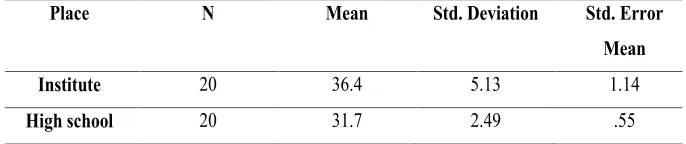
Table 4. Group statistics
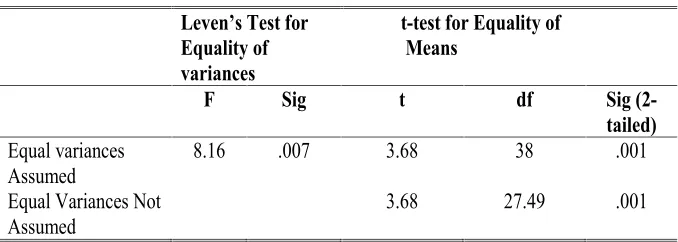
As can be seen in Table 4 above, the mean for language institute teachers is 36.4, which is higher than that of high school teachers, that is 31.7. This means there is a difference between the two groups, and that the language institute teachers have a better perception of Ellis’s principles than high school teachers do. To see whether the difference is statistically significant, an independent samples t-test was run. Results are illustrated in Table 5 below.
���
�� �� ������� ��� �� ����������������� ���� ������������� ����������� ���� ������ ���� ��� ����� ���
��� ���� �� ��������� �������� ���� ���� �� ��� ����� ��� �����������
����� ������� ������ ���� ���� �������� �� ��� �� ��� ���� �� ������
�������� ����������� ���� �� �������� �� � ������� �� ������������ ������
����������� ����� ����� �� ���������� ������������� ��������� �����
�������� ���������
� ����� ��� ���� ������� ������ ���� ���� ��� ���� �������� ������
�������� ���� ����� ���������
� �������� �� ���� ������ ����� ���� ����� ��� ������� ������ ���
������ �������� ���� ������� ��� ����� ��� ��� ��������������
��� �������� �������� ����
��� ������ �������� �������� �� ��� ����� ����� ��� ��������� �������
�������� �������� �������� �� ���� ������� ��� ����� �������� �� ���
������� �������� ��������� �� ����� �� �������� ������� ����������� ��
����� �������� �������� ���� �� ���� ������ �� ������� �������� ���������� ��
��� ����������� �������� �� ��� ������ ����� ��� ������ �������� ���� ���
�������������� ��� �� ���������� ��� ��������� ��������� �� ������ ����
��������� �� ����������� �������
�
����� ��� ��� �� ���� ��� ���������
������� ��� ��� ������� ��� ���������� ������� ��� ����� ������
����� ��
����� ����������
�� ��� �� ���� �� ����� � ������ ��� ���� ��� �������� ���������
�������� �� ����� ����� �� ������ ���� ���� �� ���� ������ ��������� ����
�� ����� ���� ����� ����� �� � ��������� ������� ��� ��� ������� ���
���� ��� �������� ��������� �������� ���� � ������ ���������� �� �������
���������� ���� ���� ������ �������� ��� �� ��� ������� ��� ��������� ��
������������� ����������� �� ����������� ������� ������ ��� ���� �������
��� ����������� �� ����� � ������
���
�� �� ������� ��� �� ����������������� ���� ������������� ����������� ���� ������ ���� ��� ����� ���
��� ���� �� ��������� �������� ���� ���� �� ��� ����� ��� �����������
����� ������� ������ ���� ���� �������� �� ��� �� ��� ���� �� ������
�������� ����������� ���� �� �������� �� � ������� �� ������������ ������
����������� ����� ����� �� ���������� ������������� ��������� �����
�������� ���������
� ����� ��� ���� ������� ������ ���� ���� ��� ���� �������� ������
�������� ���� ����� ���������
� �������� �� ���� ������ ����� ���� ����� ��� ������� ������ ���
������ �������� ���� ������� ��� ����� ��� ��� ��������������
��� �������� �������� ����
��� ������ �������� �������� �� ��� ����� ����� ��� ��������� �������
�������� �������� �������� �� ���� ������� ��� ����� �������� �� ���
������� �������� ��������� �� ����� �� �������� ������� ����������� ��
����� �������� �������� ���� �� ���� ������ �� ������� �������� ���������� ��
��� ����������� �������� �� ��� ������ ����� ��� ������ �������� ���� ���
�������������� ��� �� ���������� ��� ��������� ��������� �� ������ ����
��������� �� ����������� �������
�
����� ��� ��� �� ���� ��� ���������
������� ��� ��� ������� ��� ���������� ������� ��� ����� ������
����� ��
����� ����������
�� ��� �� ���� �� ����� � ������ ��� ���� ��� �������� ��������� ������
��� �� ����� ����� �� ������ ���� ���� �� ���� ������ ��������� ���� ��
����� ���� ����� ����� �� � ��������� ������� ��� ��� ������� ��� ����
��� �������� ��������� �������� ���� � ������ ���������� �� ������� �����
������ ���� ���� ������ �������� ��� �� ��� ������� ��� ��������� ��
������������� ����������� �� ����������� ������� ������ ��� ���� �������
��� ����������� �� ����� � ������