VOLUME NO. 5 (2015), ISSUE NO. 06 (JUNE) ISSN 2231-5756
A Monthly Double-Blind Peer Reviewed (Refereed/Juried) Open Access International e-Journal - Included in the International Serial Directories Indexed & Listed at:
VOLUME NO. 5 (2015), ISSUE NO. 06 (JUNE) ISSN 2231-5756
INTERNATIONAL JOURNAL OF RESEARCH IN COMMERCE, IT & MANAGEMENT
CONTENTS
Sr.
No.
TITLE & NAME OF THE AUTHOR (S)
Page
No.
1
.
A STUDY OF IMPLEMENTATION OF BI SOLUTIONS AT SELECTED BRANCHES OF BANKS IN RAJASTHAN
DR. AZIMUDDIN KHAN
1
2
.
ROLE OF WOMEN IN IT: TODAY & TOMORROW
DR. KIRAN ARORA
5
3
.
POWERS LANGUAGES AND TEACHERS FORGETFULNESS
DR. MIGUEL ALBERTO GONZÁLEZ GONZÁLEZ
7
4
.
AN ANALYSIS OF RURAL DEVELOPMENT THROUGH MNREGA IN DISTRICT MANDI OF HIMACHAL PRADESH
SANJAY KUMAR & DR. SHYAM LAL KAUSHAL
11
5
.
A DETAILED STUDY ON INDIAN CHILD LABOUR PROBLEMS AND PROSPECTS
DR. ALLA.JAGADEESH BABU
16
6
.
OCCUPATIONAL STRESS AMONG SOFTWARE EMPLOYEES: ROLE OF CORPORATE COMPANIES
NAGARAJ NAIK. M & DR. KODANDARAMA.
22
7
.
PERFORMANCE OF REGIONAL RURAL BANKS: WITH SPECIAL REFERENCE TO ANDHRA PRADESH
GRAMEENA VIKAS BANK, ANDHRA PRAGATHI GRAMEENA BANK AND DENA GUJARAT GRAMIN BANK
DR. S. SELVAKUMAR & S. PAVITHRA
26
8
.
AN EMPIRICAL ANALYSIS OF HEALTHCARE SPENDING IN INDIA: EVIDENCES FROM MAHARASHTRA AND
BIHAR
UPANANDA PANI & PRAVIN GANGADHAR JADHAV
31
9
.
CUSTOMER PERCEPTION IN INDIAN RETAIL INDUSTRY
MANOJ KUMAR SINGH
42
10
.
CONSUMER AWARENESS AND CONSUMER PROTECTION ACT: A CASE STUDY WITH SPECIAL REFERENCE TO
EAST DISTRICT OF SIKKIM
SANJAYA KUMAR SUBBA
45
11
.
A STUDY ON JOB SATISFACTION OF EMPLOYEES OF GOVERNMENT SCHOOLS AND PRIVATE SCHOOLS IN
JAGDALPUR
DR. ARUNA PILLAY
49
12
.
IMPACT OF BRAND IMAGE ON CONSUMER BUYING BEHAVIOR OF INSTANT FOOD PRODUCTS
S. KALPANA & HEMAVATHY RAMASUBBIAN
53
13
.
BPO INDUSTRY IN INDIA: TRENDS AND CHALLENGES
DR. SHRUTI GUPTA
56
14
.
DECODING THE ‘STARBUCKS’ FRENZY: A COMPARATIVE STUDY WITH CAFÉ COFFEE DAY
KHUSHBOO GUPTA
59
15
.
A STUDY ON HEALTH, SAFETY AND WELFARE MEASURES IN SIMPSON & CO. LTD, CHENNAI
RAJANI KUMARI & DR.R.ALAMELU
63
16
.
IMPACT OF SERVICE QUALITY ON CUSTOMER SATISFACTION OF PUBLIC AND PRIVATE SECTOR BANKS
BHOOMI PATEL
66
17
.
EMPOWERING WOMEN AT PANCHAYAT LEVELS THROUGH RESERVATION & EDUCATION: A SPECIAL
STUDY IN THE SAMASTIPUR DISTRICT OF BIHAR, INDIA
DR. SWETA
77
18
.
EFFECTIVENESS OF FORENSIC ACCOUNTING IN THE DETECTION AND PREVENTION OF FRAUD IN NIGERIA
ABU SEINI ODUDU & YUSUF MOHAMMED ALIYU
80
19
.
APPLICATION OF TOTAL QUALITY MANAGEMENT (TQM) TOOLS TO SOLID WASTE MANAGEMENT: THE
CASE OF MOMBASA MUNICIPAL COUNCIL
RIUNGU, IRENE KARIMI
86
20
.
STUDY ON TURMERIC PRODUCTION AND GROWTH IN ERODE DISTRICT
M.ANAND SHANKAR RAJA & SHENBAGAM KANNAPPAN
94
VOLUME NO. 5 (2015), ISSUE NO. 06 (JUNE) ISSN 2231-5756
CHIEF PATRON
PROF. K. K. AGGARWAL
Chairman, Malaviya National Institute of Technology, Jaipur
(An institute of National Importance & fully funded by Ministry of Human Resource Development, Government of India)
Chancellor, K. R. Mangalam University, Gurgaon
Chancellor, Lingaya’s University, Faridabad
Founder Vice-Chancellor (1998-2008), Guru Gobind Singh Indraprastha University, Delhi
Ex. Pro Vice-Chancellor, Guru Jambheshwar University, Hisar
FOUNDER PATRON
LATE SH. RAM BHAJAN AGGARWAL
Former State Minister for Home & Tourism, Government of Haryana
Former Vice-President, Dadri Education Society, Charkhi Dadri
Former President, Chinar Syntex Ltd. (Textile Mills), Bhiwani
FORMER CO-ORDINATOR
DR. S. GARG
Faculty, Shree Ram Institute of Business & Management, Urjani
ADVISORS
PROF. M. S. SENAM RAJU
Director A. C. D., School of Management Studies, I.G.N.O.U., New Delhi
PROF. M. N. SHARMA
Chairman, M.B.A., Haryana College of Technology & Management, Kaithal
PROF. S. L. MAHANDRU
Principal (Retd.), Maharaja Agrasen College, Jagadhri
EDITOR
PROF. R. K. SHARMA
Professor, Bharti Vidyapeeth University Institute of Management & Research, New Delhi
CO-EDITOR
DR. BHAVET
Faculty, Shree Ram Institute of Engineering & Technology, Urjani
EDITORIAL ADVISORY BOARD
DR. RAJESH MODI
Faculty, Yanbu Industrial College, Kingdom of Saudi Arabia
PROF. SANJIV MITTAL
University School of Management Studies, Guru Gobind Singh I. P. University, Delhi
PROF. ANIL K. SAINI
Chairperson (CRC), Guru Gobind Singh I. P. University, Delhi
DR. SAMBHAVNA
VOLUME NO. 5 (2015), ISSUE NO. 06 (JUNE) ISSN 2231-5756
INTERNATIONAL JOURNAL OF RESEARCH IN COMMERCE, IT & MANAGEMENT
DR. MOHENDER KUMAR GUPTA
Associate Professor, P. J. L. N. Government College, Faridabad
DR. SHIVAKUMAR DEENE
Asst. Professor, Dept. of Commerce, School of Business Studies, Central University of Karnataka, Gulbarga
ASSOCIATE EDITORS
PROF. NAWAB ALI KHAN
Department of Commerce, Aligarh Muslim University, Aligarh, U.P.
PROF. ABHAY BANSAL
Head, Department of Information Technology, Amity School of Engineering & Technology, Amity
University, Noida
PROF. A. SURYANARAYANA
Department of Business Management, Osmania University, Hyderabad
PROF. V. SELVAM
SSL, VIT University, Vellore
DR. PARDEEP AHLAWAT
Associate Professor, Institute of Management Studies & Research, Maharshi Dayanand University, Rohtak
DR. S. TABASSUM SULTANA
Associate Professor, Department of Business Management, Matrusri Institute of P.G. Studies, Hyderabad
SURJEET SINGH
Asst. Professor, Department of Computer Science, G. M. N. (P.G.) College, Ambala Cantt.
FORMER TECHNICAL ADVISOR
AMITA
Faculty, Government M. S., Mohali
FINANCIAL ADVISORS
DICKIN GOYAL
Advocate & Tax Adviser, Panchkula
NEENA
Investment Consultant, Chambaghat, Solan, Himachal Pradesh
LEGAL ADVISORS
JITENDER S. CHAHAL
Advocate, Punjab & Haryana High Court, Chandigarh U.T.
CHANDER BHUSHAN SHARMA
Advocate & Consultant, District Courts, Yamunanagar at Jagadhri
SUPERINTENDENT
VOLUME NO. 5 (2015), ISSUE NO. 06 (JUNE) ISSN 2231-5756
CALL FOR MANUSCRIPTS
We invite unpublished novel, original, empirical and high quality research work pertaining to recent developments & practices in the areas of Computer Science & Applications; Commerce; Business; Finance; Marketing; Human Resource Management; General Management; Banking; Economics; Tourism Administration & Management; Education; Law; Library & Information Science; Defence & Strategic Studies; Electronic Science; Corporate Governance; Industrial Relations; and emerging paradigms in allied subjects like Accounting; Accounting Information Systems; Accounting Theory & Practice; Auditing; Behavioral Accounting; Behavioral Economics; Corporate Finance; Cost Accounting; Econometrics; Economic Development; Economic History; Financial Institutions & Markets; Financial Services; Fiscal Policy; Government & Non Profit Accounting; Industrial Organization; International Economics & Trade; International Finance; Macro Economics; Micro Economics; Rural Economics; Co-operation; Demography: Development Planning; Development Studies; Applied Economics; Development Economics; Business Economics; Monetary Policy; Public Policy Economics; Real Estate; Regional Economics; Political Science; Continuing Education; Labour Welfare; Philosophy; Psychology; Sociology; Tax Accounting; Advertising & Promotion Management; Management Information Systems (MIS); Business Law; Public Responsibility & Ethics; Communication; Direct Marketing; E-Commerce; Global Business; Health Care Administration; Labour Relations & Human Resource Management; Marketing Research; Marketing Theory & Applications; Non-Profit Organizations; Office Administration/Management; Operations Research/Statistics; Organizational Behavior & Theory; Organizational Development; Production/Operations; International Relations; Human Rights & Duties; Public Administration; Population Studies; Purchasing/Materials Management; Retailing; Sales/Selling; Services; Small Business Entrepreneurship; Strategic Management Policy; Technology/Innovation; Tourism & Hospitality; Transportation Distribution; Algorithms; Artificial Intelligence; Compilers & Translation; Computer Aided Design (CAD); Computer Aided Manufacturing; Computer Graphics; Computer Organization & Architecture; Database Structures & Systems; Discrete Structures; Internet; Management Information Systems; Modeling & Simulation; Neural Systems/Neural Networks; Numerical Analysis/Scientific Computing; Object Oriented Programming; Operating Systems; Programming Languages; Robotics; Symbolic & Formal Logic; Web Design and emerging paradigms in allied subjects.
Anybody can submit the soft copy of unpublished novel; original; empirical and high quality research work/manuscript anytime in M.S. Word format
after preparing the same as per our GUIDELINES FOR SUBMISSION; at our email address i.e. [email protected] or online by clicking the link online
submission as given on our website (FOR ONLINE SUBMISSION, CLICK HERE).
GUIDELINES FOR SUBMISSION OF MANUSCRIPT
1. COVERING LETTER FOR SUBMISSION:
DATED: _____________
THE EDITOR
IJRCM
Subject: SUBMISSION OF MANUSCRIPT IN THE AREA OF .
(e.g. Finance/Mkt./HRM/General Mgt./Engineering/Economics/Computer/IT/ Education/Psychology/Law/Math/other, please specify)
DEAR SIR/MADAM
Please find my submission of manuscript entitled ‘___________________________________________’ for possible publication in one of your journals.
I hereby affirm that the contents of this manuscript are original. Furthermore, it has neither been published elsewhere in any language fully or partly, nor is it under review for publication elsewhere.
I affirm that all the co-authors of this manuscript have seen the submitted version of the manuscript and have agreed to their inclusion of names as co-authors.
Also, if my/our manuscript is accepted, I agree to comply with the formalities as given on the website of the journal. The Journal has discretion to publish our contribution in any of its journals.
NAME OF CORRESPONDING AUTHOR :
Designation :
Institution/College/University with full address & Pin Code : Residential address with Pin Code :
Mobile Number (s) with country ISD code : Is WhatsApp or Viber active on your above noted Mobile Number (Yes/No) :
Landline Number (s) with country ISD code :
E-mail Address :
Alternate E-mail Address :
VOLUME NO. 5 (2015), ISSUE NO. 06 (JUNE) ISSN 2231-5756
INTERNATIONAL JOURNAL OF RESEARCH IN COMMERCE, IT & MANAGEMENT
NOTES:
a) The whole manuscript has to be in ONE MS WORD FILE only, which will start from the covering letter, inside the manuscript. pdf. version is liable to be rejected without any consideration.
b) The sender is required to mention the following in the SUBJECT COLUMNof the mail:
New Manuscript for Review in the area of (e.g. Finance/Marketing/HRM/General Mgt./Engineering/Economics/Computer/IT/ Education/Psychology/Law/Math/other, please specify)
c) There is no need to give any text in the body of mail, except the cases where the author wishes to give any specific message
w.r.t. to the manuscript.
d) The total size of the file containing the manuscript is expected to be below 1000 KB.
e) Abstract alone will not be considered for review and the author is required to submit the complete manuscript in the first instance.
f) The journal gives acknowledgement w.r.t. the receipt of every email within twenty four hours and in case of non-receipt of
acknowledgment from the journal, w.r.t. the submission of manuscript, within two days of submission, the corresponding author is required to demand for the same by sending a separate mail to the journal.
g) The author (s) name or details should not appear anywhere on the body of the manuscript, except the covering letter and the cover page of the manuscript, in the manner as mentioned in the guidelines.
2. MANUSCRIPT TITLE: The title of the paper should be bold typed, centeredand fully capitalised.
3. AUTHOR NAME (S) & AFFILIATIONS: Author (s) name, designation, affiliation (s), address, mobile/landline number (s), and
email/alternate email address should be given underneath the title.
4. ACKNOWLEDGMENTS: Acknowledgements can be given to reviewers, guides, funding institutions, etc., if any.
5. ABSTRACT: Abstract should be in fully italicized text, ranging between 150 to 300 words. The abstract must be informative and explain the background, aims, methods, results & conclusion in a SINGLE PARA. Abbreviations must be mentioned in full.
6. KEYWORDS: Abstract must be followed by a list of keywords, subject to the maximum of five. These should be arranged in alphabetic order separated by commas and full stop at the end. All words of the keywords, including the first one should be in small letters, except special words e.g. name of the Countries, abbreviations.
7. JEL CODE: Provide the appropriate Journal of Economic Literature Classification System code (s). JEL codes are available at www.aeaweb.org/econlit/jelCodes.php, however, mentioning JEL Code is not mandatory.
8. MANUSCRIPT: Manuscript must be in BRITISH ENGLISH prepared on a standard A4 size PORTRAIT SETTING PAPER. It should be free from any errors i.e. grammatical, spelling or punctuation. It must be thoroughly edited at your end.
9. HEADINGS: All the headings must be bold-faced, aligned left and fully capitalised. Leave a blank line before each heading. 10. SUB-HEADINGS: All the sub-headings must be bold-faced, aligned left and fully capitalised.
11. MAIN TEXT:
THE MAIN TEXT SHOULD FOLLOW THE FOLLOWING SEQUENCE:
INTRODUCTION REVIEW OF LITERATURE
NEED/IMPORTANCE OF THE STUDY STATEMENT OF THE PROBLEM OBJECTIVES
HYPOTHESIS (ES)
RESEARCH METHODOLOGY RESULTS & DISCUSSION FINDINGS
RECOMMENDATIONS/SUGGESTIONS CONCLUSIONS
LIMITATIONS
SCOPE FOR FURTHER RESEARCH REFERENCES
APPENDIX/ANNEXURE
VOLUME NO. 5 (2015), ISSUE NO. 06 (JUNE) ISSN 2231-5756
12. FIGURES & TABLES: These should be simple, crystal CLEAR, centered, separately numbered & self explained, and titles must be above the table/figure. Sources of data should be mentioned below the table/figure. It should be ensured that the tables/figures are referred to from the main text.
13. EQUATIONS/FORMULAE: These should be consecutively numbered in parenthesis, horizontally centered with equation/formulae number placed at the right. The equation editor provided with standard versions of Microsoft Word should be utilised. If any other equation editor is utilised, author must confirm that these equations may be viewed and edited in versions of Microsoft Office that does not have the editor.
14. ACRONYMS: These should not be used in the abstract. The use of acronyms is elsewhere is acceptable. Acronyms should be defined on its first use in each section: Reserve Bank of India (RBI). Acronyms should be redefined on first use in subsequent sections.
15. REFERENCES: The list of all references should be alphabetically arranged. The author (s) should mention only the actually utilised
references in the preparation of manuscript and they are supposed to follow Harvard Style of Referencing. Also check to make sure
that everything that you are including in the reference section is duly cited in the paper. The author (s) are supposed to follow the references as per the following:
All works cited in the text (including sources for tables and figures) should be listed alphabetically.
Use (ed.) for one editor, and (ed.s) for multiple editors.
When listing two or more works by one author, use --- (20xx), such as after Kohl (1997), use --- (2001), etc, in chronologically ascending order.
Indicate (opening and closing) page numbers for articles in journals and for chapters in books.
The title of books and journals should be in italics. Double quotation marks are used for titles of journal articles, book chapters, dissertations, reports, working papers, unpublished material, etc.
For titles in a language other than English, provide an English translation in parenthesis.
Headers, footers, endnotes and footnotes should not be used in the document. However, you can mention short notes to elucidate
some specific point, which may be placed in number orders after the references.
PLEASE USE THE FOLLOWING FOR STYLE AND PUNCTUATION IN REFERENCES: BOOKS
Bowersox, Donald J., Closs, David J., (1996), "Logistical Management." Tata McGraw, Hill, New Delhi.
Hunker, H.L. and A.J. Wright (1963), "Factors of Industrial Location in Ohio" Ohio State University, Nigeria.
CONTRIBUTIONS TO BOOKS
Sharma T., Kwatra, G. (2008) Effectiveness of Social Advertising: A Study of Selected Campaigns, Corporate Social Responsibility, Edited by David Crowther & Nicholas Capaldi, Ashgate Research Companion to Corporate Social Responsibility, Chapter 15, pp 287-303.
JOURNAL AND OTHER ARTICLES
Schemenner, R.W., Huber, J.C. and Cook, R.L. (1987), "Geographic Differences and the Location of New Manufacturing Facilities," Journal of Urban Economics, Vol. 21, No. 1, pp. 83-104.
CONFERENCE PAPERS
Garg, Sambhav (2011): "Business Ethics" Paper presented at the Annual International Conference for the All India Management Association, New Delhi, India, 19–23
UNPUBLISHED DISSERTATIONS
Kumar S. (2011): "Customer Value: A Comparative Study of Rural and Urban Customers," Thesis, Kurukshetra University, Kurukshetra.
ONLINE RESOURCES
Always indicate the date that the source was accessed, as online resources are frequently updated or removed.
WEBSITES
VOLUME NO. 5 (2015), ISSUE NO. 06 (JUNE) ISSN 2231-5756
INTERNATIONAL JOURNAL OF RESEARCH IN COMMERCE, IT & MANAGEMENT
A STUDY OF IMPLEMENTATION OF BI SOLUTIONS AT SELECTED BRANCHES OF BANKS IN RAJASTHAN
DR. AZIMUDDIN KHAN
SR. MANAGER SYSTEMS
RAJASTHAN STATE MINES & MINERALS LIMITED
UDAIPUR
ABSTRACT
The decision can be improved with better quality of data, tools and technology, flexibility and sound judgments taking capability of decision makers. Business intelligence systems facilitate the decision makers to correct their intuition by taking advantage of analytical tools, which can test and verify intuition before applying it to the decision making process. Decision maker can also use predictive models to improve their decision making. Today’s competitive environment is forcing banks to reap the real benefits of business intelligence. A study has been made on 25 selected branches of Indian banks in the state of Rajasthan, to understand the impact of respondent’s characteristics on practices followed for BI Implementation. It is observed that the management commitment, data quality, and CBS implementation tops among all practices followed while implementing business intelligence in branches of banks. The importance about organizational and technological practices factor do not vary significantly among the qualification and age of respondents where as these factors significantly vary with experiences of employees. The young employees are more IT savvy and having better IT skills and user initiatives. The research is particularly useful for practitioners in the banking field.
KEYWORDS
Banking, BI Implementation, Business Intelligence, Decision Making, Management, Data Quality.
1. INTRODUCTION
he banking industry is becoming increasingly competitive with industry consolidation and convergence, to retain and attract asset of an aging population, complexity of financial instruments and markets are facing ever-changing regulatory requirements from both local and global bodies, making it more and more challenging for banks to sustain and generate profits. Banks have started the utilization of business intelligence with implementation of core banking system. Many banks have implemented the Customer Relationship Management software (CRM) to understand the needs of the customer. With a vast range of customers and customer needs, address the need for transparency, risk management, and stay ahead of the competition, banks need low-cost, innovative solutions that deliver a connected customer experience across all channels. Banks need to use all the tools at their disposal to manage challenges and ensure their own financial stability through intelligent business solutions.
The business intelligence software to report on, analyze, and monitor the vast branch data through a business intelligence architecture that helps branch to reduce costs, increase revenue, profit analysis by branch, pickup most profitable customers, services and locations, manage credit risk, standardize portfolio and credit analysis and maximize the value of information by giving 360-degree overview of financial and operational results.
2. REVIEW OF LITERATURE
A review of literature of various studies related to implementation of business intelligence solution in the banks and factors both technological and organizational plays important role in implementation of BI at branch level. Shari and Spyro (2004) stated that regardless of how impressive a business intelligence solution is, its true value lies in enabling an organization to improve its revenue stream, not just cost containment. The best way to justify the incurred costs is to leverage the technology to improve the business processes related to revenue generation, product development, customer acquisition or retention, cross-selling, inventory management and new markets. The true benefits of a business intelligence solution can be recognized when the decision-making capabilities are enabled throughout the organization. This means the management team can gauge how the company is performing.
Howson (2008, p2) stated that business intelligence can only provide business value when it is used effectively by people. There is a correlation between the effective use of business intelligence and company performance. Business intelligence provides the insight of business to the manager on more timely and flexible basis. When any particular metric is not where it should be, BI allows users to explore the underlying details to determine the reason. When BI is used in a company without a sound business strategy, performance will not improve.
IBA-Finsight (2007) special report suggests about the operational business intelligence in banking, it delivers information and insights to those manager that are involved in operational and transactional processes. While serving a customer at a counter, the executive can cross sell other product based on the information and analytics available from operational business intelligence system based on customers past transactions. The operational business intelligence reduces the time it takes for a line of business user or application to react to business issue or requirement. The data latency to data warehouse should be as small as possible to get operational analytics. As per report (2014) by Yes Bank, Indian private sector banks have made investments in Business Intelligence (BI) primarily around the consumer/retail segment of customers & not so much focused on corporate customers.
A report from EY and IDRBT (2014) says banks are realizing the need to use Business Intelligence and analytics to increase their business and differentiate the customer experience (a) to acquire new customers (b) service their existing ones better, (c) increase the savings of their existing customers through segmentation and by identifying and capitalizing on opportunities for cross-sell and up-sell, (d) improve retention and loyalty of customers, (e) monitor their portfolios more effectively, (f) implement efficient risk management controls to reduce credit- and fraud-related losses and (g) obtain insights on how they can enhance their products or product bundles to address the unique needs of their customers. In the absence of robust BI systems, banks struggle to answer the questions about unique customers (not just accounts), products per customer, services provided per customer, the cost of providing these services, the profitability of and demand for their products, etc
3. METHODOLOGY
A structured questionnaire was developed for collecting the data related to implementation of business intelligence solutions at branch level. The questionnaire seeks to extract responses from IT Manager/Branch Manager or In-charge of BI or Person who understood and utilizing business intelligence solutions at branch level. The branches of banks were selected within the geographic region of Rajasthan. They were identified through stratified judgment sampling.
TABLE 1: RESPONSE PATTERN OF BANKS AT BRANCH LEVEL
No. of Respondents Responses
Approached Respondents
Public Sector Banks 14 12 86%
Private & Foreign Banks 11 8 73%
Total 25 20 80%
VOLUME NO. 5 (2015), ISSUE NO. 06 (JUNE) ISSN 2231-5756 Implementation of business intelligence solutions in banks with the practices followed were categorized in term of organizational factors such as management commitment, effective steering committee, user initiative, availability of IT skills, analyst and training facilities, work culture, qualities of BI staff and implementation consultant, and partnership between IT and business. Banks which were established in 1994 and thereafter considered as new banks while banks which were established before 1994 were considered old banks. Public Sector Banks means any Government Sector Bank/Institute that goes public i.e. it issues its shares to general public. It also has a greater share of Government of India or Reserve Bank of India (more than 50%).
3.1 THE SAMPLE PROFILE
The data collected in the form of demographics from branches of the banks is having two categories; respondent information and organization information. A. RESPONDENTS’ PROFILE
The respondent information was described in the form of gender, age, qualification, experience in this bank, total banking experience, working at regional, zonal, project or head office, phone and email address. Table 2 provides a summary of respondent information.
TABLE 2: RESPONDENTS’ PROFILE AT BRANCHES
Criteria N %
Gender
Male 18 90%
Female 2 10%
Age (Year)
<30 1 5%
30-45 9 45%
>45 10 50%
Total Experience (Years)
Less Experience(<=10) 7 35%
Experience (>10) 13 65%
Present Bank Experience
Less Experience(<=10) 8 40%
Experience (>10) 12 60%
Qualification
Professional (MBA,MCA, BE, CAIIB) 13 65%
Post Graduate 4 20%
Graduate 3 15%
It is evident from the table that highest number (50%) of respondents belongs to age group of 45+ years where as 45% respondents in the age group 30-45 years and only 5% belongs to less than 30 yrs. The 65% respondents are professionally qualified and they had acquired the degree like MCA, MBA, BE or CAIIB qualified where as 20% are post graduates and only 15% are graduates. It is also clear from the table that respondents’ total banking experience is more (60%) in case 10+ years where as 40% are of less than 10+ years experience. The similar pattern is for present bank experience of respondents. The 90% of respondents are male and only 10% respondents are female.
As per table 3, the distribution of qualification over category of banks, It is clear that private and foreign banks are having 100% professionals where as public sector banks are having 41.7% professionals, 33.33% post graduate and 25% graduates. It is interesting to note that private and foreign banks are having 100% employees with less than 10 years of banking experience where as 100% public sector banks employees are at 10+ years.
TABLE 3: RESPONDENTS’ PROFILE WITH DISTRIBUTION OF CATEGORY OF BANK AT BRANCHES
Criteria Public Private & Foreign
N % N %
Total Experience (Years)
Less Experience(<=10) 0 0 7 87.5
Experience (>10) 12 100 1 12.5
Qualification
Professional (MBA,MCA, BE, CAIIB) 5 41.7 8 100.0
Post Graduate 4 33.3 0 0.0
Graduate 3 25.0 0 0.0
B. ORGANIZATIONS’ PROFILE
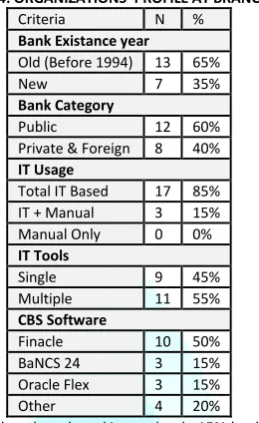
Researcher has collected the data from branches and profile of respondents’ bank is described in the form of inception year of bank, category, information technology uses, information technology tools, and Core Banking System (CBS) software. Table 5.3 provides a summary of organizations’ profile.
VOLUME NO. 5 (2015), ISSUE NO. 06 (JUNE) ISSN 2231-5756
INTERNATIONAL JOURNAL OF RESEARCH IN COMMERCE, IT & MANAGEMENT
TABLE 4: ORGANIZATIONS’ PROFILE AT BRANCHES
Criteria N %
Bank Existance year
Old (Before 1994) 13 65%
New 7 35%
Bank Category
Public 12 60%
Private & Foreign 8 40%
IT Usage
Total IT Based 17 85%
IT + Manual 3 15%
Manual Only 0 0%
IT Tools
Single 9 45%
Multiple 11 55%
CBS Software
Finacle 10 50%
BaNCS 24 3 15%
Oracle Flex 3 15%
Other 4 20%
Table 4 shows that 85% banks are using information technology based working and only 15% banks are having combination of information technology and manual working. Banks included in the study, 55% are using multiple software where as 45% using single software for all function. It is clear from the table that “Finacle” is used by 50% banks, BaNCS 24 by 15%, Oracle Flex is utilized by 15% banks and 20% banks are using other software for their core banking.
4. ANALYSIS OF APPLICABILITY OF BI IN BRANCHES
The instrument has been prepared to get the responses from the branches, about the questions related to business intelligence in banking including important practices, applicability of business intelligence in banks working, and financial benefits.
Responses were collected from branch head or operation head of the various banks on the various items by using 5-point rating scale of importance, where 1 = very poor, 2 = low, 3 = medium, 4 = high and 5 = very high. The respondents indicated the extent to which they attach importance on various factors.
4.1 IMPORTANCE ATTACHED TO THE PRACTICES FOLLOWED FOR BI IMPLEMENTATION
Table 5 shows the list of important practices followed by respondent’s banks to implement the business intelligence solutions, the mean score for each, standard deviation, co-efficient of variance (CV), and the results of One-Sample Kolmogorov-Smirnov Test for difference between means. The items on practices in the table are arranged in descending order according to their mean score level.
It is observed from the table 5 that the management commitment, data quality, and CBS implementation tops among all practices, and the mean score of 3.90 suggests that, it is given highest importance by respondents while implementing business intelligence in branches of banks. These results are in general similar to regional/zonal offices’ response.
It is informative to note that IT skills and User initiatives are given least importance (mean score 2.20 and 2.05). As most of the branches, do not have IT skilled (IT Manger) persons at branch level.
TABLE 5: DESCRIPTIVE STATISTICS OF PRACTICES FOLLOWED (BRANCH)
Practices Mean Score* Std. Deviation C.V. (%) Result @5%
Commitment 3.90 0.85 21.85 NS
Data Quality 3.90 0.79 20.21 NS
CBS Implementation 3.90 0.64 16.43 S
Query Response 3.40 0.82 24.14 NS
BI Operational 3.10 1.12 36.10 NS
Training Facility 2.95 0.69 23.27 S
DW Update time 2.85 1.35 47.32 NS
Complexity 2.80 1.06 37.73 NS
IT Skills 2.20 1.47 66.93 NS
User Initiative 2.05 0.94 46.07 NS
* Mean score is the average on 5-point interval scaleof importance
S=Mean importance score is significantly greater than that listed immediately below, based on One-Sample Kolmogorov-Smirnov Test NS=Mean importance score is not significantly greater than that listed immidiaely below, based on One-Sample Kolmogorov-Smirnov Test
CBS implementation has the lowest variation (CV=16.43%) in responses, which means that the responses are consistent on this practice and therefore mean score can be considered highly representative where as IT skills has the highest variation (CV=66.93%) which means that responses on these practice varied greatly and therefore it can be said that mean score is least representative.
The last column of table shows the results of One-Sample Kolmogorov-Smirnov Test for difference between means at 5% level of significance. As per test, Implementation of CBS, and Training facility found significant. It indicates there is almost certainly a true difference in these practices. All other than these two practices followed for implementation of business intelligence are statistically non significant.
4.2 INFLUENCE OF RESPONDENT’S CHARACTERISTICS
It is assumed that certain respondent’s characteristics such as age, qualification and experience may have influence on the important practices followed for business intelligence solution implementation.
The practices have been grouped into three factors; first is Organization factor which includes management commitment, user initiative, training facilities, and IT skills, second is Technological factor which includes data quality, complexity of BI solution, implementation of core banking system (CBS), ERP, CRM and SCM, Data warehouse update time and query response time. 1-5 point scores are summed to make these factors. For this, different null hypothesis have been formulated and tested by adopting One-Way ANOVA procedure. The hypotheses were tested at the significance level of 5%.
4.2.1 INFLUENCES OF AGE GROUP
In the respondent’s profile the age group has been discussed as three categories age<30, 30-45, and age >45 years. For analyzing the influence of age on important practice adopted for BI implementation, total four hypotheses have been formulated. The hypothesis is;
H01: There is no significant difference among the various groups of age with regards to their perception about the importance of the organizational factor for the
VOLUME NO. 5 (2015), ISSUE NO. 06 (JUNE) ISSN 2231-5756 Similarly null hypotheses were developed for perception about importance about financial, technological factors, aggregate practices with reference to age. All the hypotheses were tested by one-way ANOVA for difference between means at 5% level of significance. Table 6 displays mean scores, calculated F-value and results of the test.
TABLE 6: ONE-WAY ANOVA TEST FOR IMPORTANT PRACTICES V/S AGE AT BRANCH
Null hypotheses for Different practices Mean Scores Calculated F-Value Result @5% Age < 30 30-45 Age>45
H01: Organizational factor 16.00 12.56 9.30 6.150 S
H02: Technological factor 25.00 21.78 17.80 3.529 S
It is clear from the table that both hypotheses are rejected. This proves that the perception about the importance of the organizational, and technological practices factors vary significantly among the different age groups of respondents’ banks. The respondents who belong to <30 age group have higher mean score which proves that this group is more influential in following practices for implementing BI solutions.
4.2.2 INFLUENCES OF QUALIFICATION OF RESPONDENTS
In the respondent’s profile, qualification has been discussed as three categories professional, post graduate, and graduate. For analyzing the influence of qualification on important practice adopted for BI implementation, two hypotheses have been formulated.
TABLE 7: ONE-WAY ANOVA TEST FOR IMPORTANT PRACTICES V/S QUALIFICATION AT BRANCH
Null hypotheses for Different practices Mean Scores Calculated F-Value Result @5% Professional Post Graduate Graduate
H03: Organizational factor 12.15 8.75 9.67 2.647 NS
H04: Technological factor 21.15 18.50 16.67 1.763 NS
It is clear from the table 7 that both of hypotheses are accepted. This proves that the perception about the importance about organizational, and technological practices factor do not vary significantly among the qualification of respondents.
4.2.3 INFLUENCES OF EXPERIENCE
Researcher has categorized the banking experience in two categories for the purpose of analysis, respondents who are having total banking experience up to 10 years were considered as less experienced where as those who had more than 10 years of experience were considered as experienced. All the hypotheses were tested by t-test for difference between means at 5% level of significance. For understanding the influence of experience on important practices followed for BI implementation, two hypotheses have been framed.
TABLE 8: t-TEST FOR IMPORTANT PRACTICES V/S EXPERIENCE
Null hypotheses for Different practices Mean Scores Calculated t-Value Result @5% Experience <=10 Experience >10
H05: Organizational factor 13.86 9.62 3.879 S
H06: Technological factor 22.71 18.46 2.366 S
As per table 8, it is revealed that hypotheses H05 and H06 are rejected at 5% significance. This means that the there is significant difference between the less
experienced and experienced person with perception about the importance of the organizational and technological practices factor. The hypothesis H05 is
rejected because less experienced group respondents are more IT savvy and having better IT skills and user initiatives. The hypothesis H06 is rejected on ground
of higher data quality, CBS implementation, and operational BI is more adopted by less experience group as compared experienced group.
CONCLUSION
The implementation of business intelligence solution at branch level has become the need of an hour. The branch manager should utilize the available analytics for their day to day operations. The young bank professionals are more acceptable to the technology and hence can better use of available information for making right decision at right time to increase the profitability of branch.
REFERENCES
1. EY and IDRBT Report (2014), “technology in Banking”, Ernst and Young, 2014, p7.
2. Howson Cindi (2008), “Successful Business Intelligence: Secrets to making BI a Killer App”, The Mcgraw-Hill companies, NY, pp2-3,54-59.
3. IBA-Finsight (2007), “Operational Business Intelligence in Banking”, Special Report by IBA and Finsight, Finsight Media, pp9-14.
4. Shari Rogalski and Spyro Karakizis, 2004, “Business Intelligence Benefits: Don't Forget the Revenue!”, Information Management Magazine, January 2004,
p1.
VOLUME NO. 5 (2015), ISSUE NO. 06 (JUNE) ISSN 2231-5756
INTERNATIONAL JOURNAL OF RESEARCH IN COMMERCE, IT & MANAGEMENT
ROLE OF WOMEN IN IT: TODAY & TOMORROW
DR. KIRAN ARORA
PRINCIPAL
PCM S.D. COLLEGE FOR WOMEN
JALANDHAR
ABSTRACT
IT has brought a tremendous change in position of women and has uplifted their status in the society and has ended their socio-economic imprisonment besides making them aware of their rights. But a lot need to be done to empower women and technology has to be made women friendly that more and more women be freed from the feters of slavery. There is also a need to bridge the gulf between urban and rural women.
KEYWORDS
Role of women, IT.
INTRODUCTION
omen have been suffering since time immemorial. Every age was a dark age for the Fair-sex. Be it stone,vedic or modern. They have been exploited and their aspirations have been crushed under weight of customs and traditions. Their situation has not improved yet. They are still being exploited on one pretext or other. The patriarchal society has been responsible for the sorry state of affairs of women till date. They have always borne the brunt of war,riots,communal frenzy and natural calamities. Women have suffered in every age. Even the great writers have tried to run down women. This prejudice is deep rooted in the male psyche which considers women inferior to men. This male ego syndrome has still not recognized the strength of women and has not accorded the status they deserve. They are still being physically, sexually and mentally harassed. They are still on the margins of society and have not been able to create a niche for themselves in the male determined world. Their role is still confined to further the progeny, satisfy the base passion of men and look after the kids besides doing kitchen and household chores and if a woman dares break the male bastions, she is often mocked at besides being attacked for blowing the centuries old tradition to smitherns. Such a daring woman is either ostracized or killed in the name of family’s honours. Khap panchayat s perpetuates what is called Honour Killings.
IT AND ECONOMIC RESURGENCE OF WOMEN
But now the world has changed. Now, well educated urban women have successfully barged into the male bastion without facing much resistance from the opposite sex. IT has empowered women and has strengthened their social, economic and political status in the society. This has transformed and strengthened their socio, economic and political status in the society. This has transformed their dull and harsh life and has given wings to their aspirations. IT has made them economically self-reliant as it has opened vast vistas of job opportunity in the banking, commerce , trade ,retail and many other sectors that were hitherto supposed to be domain of men. This has given an economic boost to women and has empowered them in the family, society and outside anti-women world besides recognizing their talent in giving impetus to the economy of the country. Now the old and obsolete concept, that the women are intellectually orphan and cannot handle issues/jobs that call for mathematical and logical abilities, has got a big blow in the age of IT. Women have made their presence felt in every technology driven-sector be it banks, financial institutions, call centres, BPOs, KPOs and MNCs. Mrs. Nooi is the CEO of Pepsico and Mrs. Kochhar heads ICICI bank. Both these organisations are driven by beauty and brain. Kalpana Chawla and Sunita Williams are two other names whom technology gives much needed edge to create a niche for themselves. The liberalization of Indian economy coupled with IT revolution has opened floods of job opportunities for women. Now little and smart fingers run on mouse to tame the lion--- the lion of their economy. Now they run Banks, share market kiosks, internet café, tourism industry. This has built up their confidence and now they walk with their heads held high. Economic resurgence of women by IT has empowered women in social sector also.
IT AND SOCIAL EMPOWERMENT
IT has enabled women to network themselves socially on sites that espouse the cause of women besides giving them an opportunity to share their feelings with their gender through blogs, emails, chatting , sms etc. This exercise has made women aware of their rights and has strengthened them with the weapon of knowledge to stop injustice against them their class. Bharkha Dutt—the editor of NDTV writes blogs to sensitize massed towards issues concerning them and their country. Many women get linked to NGOs through technology to work for the welfare of others. Internet has brought women across the globe to talk about problems faced by their gender. This has made women aware of their physical, sexual and intellectual rights. IT has enabled the women to break the centuries old myths that women are for hearth and are inferior to men. Now a woman ceases to be the Eve of Milton’s Paradise Lost that can be easily seduced by Satan. Now she is a knowledgeable smart human being with a sharp brain to understand the machinations of evils forces. The credit goes to IT. IT has virtually ended social castration of women and has given a big blow to gender stereo type besides pushing the status of women op upper rung of social structure. Now women compete with men: rather surpass them. Many educated women farmers exploit technology to the hilt to know the annual weather forecast before sowing the seeds. They also used modern technology to get engaged in cooperative farming. The fashion designers surf internet to create new and innovative designs. Ritu Wears is an example of women’s success story.
IT AND WOMEN AWARENESS
The information galore has made women aware of a whole lot of issues the ignorance of which earlier played havoc with their lives. This includes right to conception, pregnancy, adoption and surrogacy. IT has thus made women politically strong and vigilant. Now they seek information from Internet and use the same against their exploiters. Now a contractor cannot exploit labours as technology comes to their aid. The use of technology in army has empowered women to rub shoulder with their male companions in combat zone, though their role is confined to logistics only. An educated Sarpanch these days rely on IT to introduce government schemes in her villages. The success of MNEGRA is a case in point. SMS is another mode that women use to espouse a cause.Women began an sms campaign against a cop who abused a budding teenager and drove her to death.
IT AND WOMEN DIGNITY
But there is another side of story also. IT has empowered urban and well educated women only. IT has so far not touched the lives of rural women. They still suffer. They are still being exploited. Another ugly aspect pf IT is that it has made women scape goats as female infanticide is a direct fallout of advanced technology. Another gory aspect of IT is that it has virtually put women body to public gaze. Pornography has gained momentum. So, is trafficking. IT has added a highly negative dimension to aspect of women’s personality. And this concerns development of scientific temper. They exploit technology to know what their zodiac signs say. This can mar their intellectual growth and put impediments in their way to success and emancipation. Last but not the least, it is imperative to mention here that IT has revolutionized the lives of women and has given a fillip to their structure. But a lot need to be done to bridge the gap between urban and rural women to free them from centuries old shackles.
VOLUME NO. 5 (2015), ISSUE NO. 06 (JUNE) ISSN 2231-5756
CONCLUSION
It can be logically concluded that IT has brought a tremendous change in position of women and has uplifted their status in the society and has ended their socio-economic imprisonment besides making them aware of their rights. But a lot need to be done to empower women and technology has to be made women friendly that more and more women be freed from the feters of slavery. There is also a need to bridge the gulf between urban and rural women.
REFERENCES
1. Paradise Lost by Milton
VOLUME NO. 5 (2015), ISSUE NO. 06 (JUNE) ISSN 2231-5756
INTERNATIONAL JOURNAL OF RESEARCH IN COMMERCE, IT & MANAGEMENT
POWERS LANGUAGES AND TEACHERS FORGETFULNESS
DR. MIGUEL ALBERTO GONZÁLEZ GONZÁLEZ
PROFESSOR
UNIVERSIDAD DE MANIZALES
COLOMBIA
ABSTRACT
This is a research around forgetfulness; the priority is to recognize the different scholar teachers’ oblivions in Eje Cafetero in Colombia (2012-2014). In that sense, the investigation looks at the impact of teachers’ forgetfulness in the students, the hypothesis is: many teachers forget to educate important things for life because they just care about disciplines. The main question is: what kinds of things teachers forget for life when they teach any field of knowledge? The method of this research is qualitative, through a hermeneutical analysis; also an interpretation under the quadrant, text, context, actors and authors is made. The devices are autobiographical lives made by five scholar teachers who write around their oblivions. Indeed, forgetfulness appears as a constant in human societies and becomes even more vigorous in societies such as the Colombian one, a country where violence coming from armed groups, drug traffickers and corrupted politicians is permanent, all of this situations impacting the academic communities. Elias (2001) society, as we know, is all of us; it is a lot of people together. Among many conclusions, professors forget to teach happiness, liberty, patient, how to live together, they even ignore to dialogue about political violence happening during this last two centuries and, in the same way, teachers forget to educate in many important necessary details in the quotidian life. Any teacher has power, but sometimes does not detect the languages of his own power; he also does not detect the languages coming from the powers, therefore, this leads to think that in the oblivion of teachers, the main one is not to be aware of how they replicate the forgetfulness that powers want to keep.
KEYWORDS
Teachers’ oblivions, memory process, powers languages, field of knowledge, educational hope.
INTRODUCTION
Illusions are dangerous and have no defects.Miguel Alberto Gonzalez González.
he danger is present not only in the perfection of the illusions but in its opposites, i.e., in denying them, not having them, running away from them, do not look for them, banishing them or discard the hope. Luckily, we can still live the hope that oblivion is a fainted memory. If teachers forget to teach? What do they forget? What kind of oblivion is that?
Thinking of powers languages is the way to see how those languages configure humanities. Any teacher has the power to generate languages of horror, honor, love, hate, illusions, and oblivions, however, they may also lead students to learn about scientific and quotidian life. An authentic pedagogic action is not to manufacture the person.
For Meirieu, if it recognizes the irreducible character of the decision to learn, if we accept that the learning is that through which a subject is constructed, is exceeded, modifies or contradicts the expectations of others about him, it is imperative that education escape the myth of manufacturing Meireiu (1998); therefore, to manufacture the subject is one of the major goals of power, that teachers sometimes forget, even some teachers forget that they can create monsters from oblivions.
There is a place in the memory for forgiveness, a struggle between memorizing and forgetting, for Ricoeur (2004), oblivion is first and massively perceived as an attack on the memory reliability. Memory, in this sense, is defined, at least in the first instance, as a struggle against forgetting. If school forgets its conservative mood, will there be a way for the renewal? It is where oblivion seems to be important, besides not all forgetfulness appears then, as problematic.
METHODOLOGY
This is a qualitative research, where five teachers described their forgetfulness through their life stories. In the autobiographical oversights they describe how they forget many important actions in their teaching life. To this, Ferrarotti (2011) says: The history of life is presented to me then, as a story of constraints that weigh on the individual –a set of conditions more or less relevant–, and at the same time as a complex of strategies, which brings into play the individual use of the good times, interstitial glimpses. That is, for releasing the story, in order to open an enclosed individual donated to collective.
There are many options to make the dialogues understandable, but the classical discipline concerned with the art of understanding texts is hermeneutics. Gadamer (1989) If my argument is correct, however, the real problem of hermeneutics is quite different from what one might expect. It points in the same direction in which my criticism of aesthetic consciousness has moved the problem of aesthetics.
For this research, a mobility hermeneutics is done, trying to go far away from the limits of the idea of cause and effect, but where there are connections between the individual and the collective life. Gadamer (1998) refers, hermeneutical reflection has developed a theory of prejudice, without impairing the sense of criticism of all the prejudices, that threatens knowledge production, does justice to the sense of understanding, which is premise of understanding. Since this possibility of not falling into the mere prejudice, discussion is accompanied by theoretical and actors that have addressed the issues around oblivion.
There is an important historic of this method, Dostal (2012) exposes, hermeneutics has a long history with roots in Greek and Hellenistic philosophy as well as in the Church fathers. It is to say, this an antique option of reality interpretation, but not out of novelty and importance.
As its known to interpret is to make action meaningful to others, not just or even necessarily within the terms used by the actors themselves. To explain is to account for action, not just or necessarily through reference to the actors’ intentions, Dei (1993).
QUESTION AND OBJECTIVE
Through this research the hypothesis is: many teachers forget to educate important things for life because they just care about disciplines. Although hypotheses are part of quantitative processes, it is not forbidden to think on this option on qualitative research
The main question is: what kinds of things teachers forget for life when they teach any field of knowledge?
Another inquiring that emerges is: If teachers forget to teach? What do they forget? What kinds of oblivions are those?
ADDRESSING THE THEORY OF OBLIVIONS
For Hindus, a non-Western culture, this issue is not minor, Indian literature uses images of shackles, chains and bondage, alternating with the forgetfulness, ignorance and sleep, to highlight the human condition, Eliade (1996). At this point, if what the author tells us is correct, we can link the oblivion of being human, and we can locate oblivion as an intrinsic characteristic of the human being and of his condition, even if it is read like a human need: forgetting to learn. In the Greek mythology, there is a place, or rather a space exclusively for forgetfulness, Lethe. The Lethe, one of the rivers of hell where the mortal souls were carried when they die, forced to drink from the calm waters of oblivion that erased their previous life memories. In this case, the dead has no memory, the spirit forgets his past.
VOLUME NO. 5 (2015), ISSUE NO. 06 (JUNE) ISSN 2231-5756 If oblivion is a fainted memory, then we can persist to rescue what lies somewhere in the mind or somewhere in the universe. Therefore, turning to the question: What have teachers forgotten to teach? The truth is that they have forgotten many things. There is nothing new except what has been forgotten, Pauwels (1994). Forgetting appears as a denial of knowledge, the forgotten and never remembered emerge as new.
Teachers are midwives and gatekeepers, working with human substance. In Plato's sense, they are midwives of knowledge to other humans, and gatekeepers because they are able to suggest a way out. What do teachers forget?, some of them forget about, not only children, but also students and community in general. There is critical forgetfulness, severe, as Celma (1981) says in the full swing of May 1968: The masters and teachers are truly an institution of sclerotic, a cohort of paralyzed. Teachers have forgotten even the existence of the children.
The neglecting of teaching practice is a problem of the teacher who does not respect himself. Freire (1975) says, How can I respect the curiosity of the students, if there is a lack of humility and true understanding of the role of ignorance in the pursuit of knowledge, as well as feeling afraid of revealing my ignorance?. Oblivion is not the same as ignorance, but there is an obligation to have some minimum knowledge to share with students, a demand for ethics, for the same loving attitude.
REMEMBERING THE OBLIVIONS. FORGETFULNESS: DECONSTRUCTING THE TEACHING PRACTICE
Remembering the oblivions is a paradox, how to remember what has been forgotten? What it is intended here, is to list some of the most dramatic forgetfulness of teaching practice, forgetting what has been deconstructed, but not necessarily to destroy the teaching act. Then, oblivion cannot be expressed in its entirety, but there are specific cases to explore such as when the teachers forget to teach freedom or human condition. Figure N. 1. Oblivions of teachers: in this research, the graph shows the main oblivions of teachers, González (2015b).
Teachers’ forgetfulness plotted here are part of the most notorious, but there are a variety of other dramatic aspects in the teaching practice to be visualized, which are shown throughout this investigation.
Another teacher asks, "Is it possible to teach freedom where freedom is itself enslaved and locked in the classroom?" The most aberrant, as opposed to an education that aims for the establishment of a free spirit in students, in most cases, it is the freedom a teacher has to impose his methods.
The fear of freedom, as effectively settled in education, is the birthplace of one of the great oversights of teachers: not taught to be free, because the same practice is an exercise of coercion. One of the teachers indicates: "The neglect of freedom, is a political forgiveness, that is, in the teaching act, being authoritarian and not giving freedom of thinking, and humiliating the student”
This revives the question, what is called freedom? "Perhaps, it is that which allows us to choose paths without a guide or one that allows us to explore life in an open risk" replies one of the teachers. We certainly need a freedom to rejoice learning spaces, to enjoy the joy of learning, but freedom in some classrooms is an appeased, repressed oversight.
Living freely is to respect and at the same time to decide, is to exercise a right, and as Fromm (2006) states, the freedom to express our thoughts means something only if we are able to have thoughts of our own, freedom of external authority constitutes a real victory only if intimate psychological conditions are such that allow us to establish our own individuality. Hence, when we do not teach and practice freedom, it is probably that we are forgetting to teach happiness.
SOME TEACHERS FORGET TO EDUCATE FOR HAPPINESS
"We're going to be teachers of oblivion, forgotten from now because we do not teach happiness", a teacher relates in his life story. This assertion is reflected in
the poem attributed to Borges (2009), we are the forgetting that we will be.
"How can we be aware of that we are happy or not? Can we teach someone to be happy?” A teacher says, "yes, we can give clues, but we do not know a special formula”. Do we make our students happy? Do we make people happy around us?
MANY TEACHERS FORGET TO TEACH AUDACITY TO CONFRONT FEARS
Teachers teach fear. "Sometimes, it's scary to be in the streets, also to look at someone else, the future itself, food generates fear, any noise produces fear; one of the most lucrative business of this time is fear", said one of the teachers; hence, the large insurance companies. Fear is obviously a big business. Through fear spirits are tamed, lives are impeded, minds are castrated. Fear is a great invention and very useful for power. Fear is an inseparable partner of ignorance, which
Oblivions of
teachers
Freedom
happiness
poetry
autonomy
risk
Audacy
Hope Collective
ethics Listening
Patience
Perseve-rance
VOLUME NO. 5 (2015), ISSUE NO. 06 (JUNE) ISSN 2231-5756
INTERNATIONAL JOURNAL OF RESEARCH IN COMMERCE, IT & MANAGEMENT
IN GENERAL, TEACHERS FORGET TO IMPART HOPE FOR TEACHING DISENCHANTMENT
The hope has been forgotten as a classroom theme to give way to disappointment, what are our stories of disenchantment? In the present circumstances, what are useful texts that encourage disappointment? The disappointment goes even beyond the cold and terse definition at dictionary can deliver, is more than the loss of illusion, is a vital denial, it is meanwhile, disagreement, a different reading, a creative possibility, or as most of the time, an insurmountable wall. A first disappointment appears with passivity and silence. "I have felt disenchanted of many things and I think that I teach that”, writes one of the teachers in his life story.
What do we forget with the disappointment? It is an invisible oversight, a disbelieving that the future is possible, that there is something beyond the borders that are giving us hope, not no go drifting, "Disenchantment is a matter of adult people, but some teachers teach students to become disenchanted", affirms one of the concerned teachers.
AN AVERAGE NUMBER OF TEACHERS FORGET TO EDUCATE TO BE AT RISK AND BEING ADRIFT
"Teachers do not teach to be drifting, we want to get to secure ports, stable heavens", writes one of the teachers, and insists "Our education, directed from above, prevents us from taking control, so we do not know where it goes. This gives us greater insecurity: we do not know the route and destination, but we are exempt from the responsibility to lead". Humanity seems to drift and that moves us together, where the first thing the teacher teaches to students is the fear; who under such conditions may accept drifting?
Going adrift north-less. Being adrift does not mean to hate what is stationary, but being at risk can immobilize humans. We like what is fixed, ordered worlds; the cosmos is our revenue, chaos is a threat, the apple we do not know how to confront because we have been taught to be and to remain within the order, not to bite the risk.
A MAJORITY OF TEACHERS FORGET TO TEACH THE AUTONOMY TO TEACH ENVY
The jealous is never jealous of what he sees, with what he imagines is enough. A very special kind of jealousy is the children or Cain complex, occurring after birth of a new sibling. The teacher will befall that kind of jealousy, when a new partner or when one of them stands out.
Many teachers are jealous and envious of some of their peers’ knowledge. Hence, these teachers can teach envy and jealousy, forgetting to teach admiration and respect for those who have a different or better and qualified knowledge than theirs.
To doubt from another is taught very early, a significant step to build hatred, to follow a path to jealousy, which warns Abad, he hates with all of his soul, and with all of the fidelity and constancy, that he really loves hatred, Abad (2006). This reference makes us think that we have good grounds to hate, decisions that seem to subjugate the pure idea of love.
OBLIVIONS PERSISTENCE
There are not just the previous forgetfulness, but there are also others which, like a mythological leak, places us in common scenarios, these can be linguistic and physical, a paradox to the fate of Sisyphus climbing rock, rolling it away, then falling soon to rescue it from oblivion, from abandonment. The forgetfulness of writing, listening, patience and ethical are part of the “mea culpa” school experience. In fact, for Professor Calvo (2008), teaching is astounding with a mystery. It could be asked, is oblivion a mystery? This is because with split memories with selective memories, with programmed memories, with industrial reports; thus, it is not uncommon to forget that we are human.
THE LISTENING FORGETFULNESS
Teachers forget to teach how to listen. There are too many men who are deaf or selective hearers, as quoted by Sophocles (2006) in Oedipus: You are good at talking, but I'm bad to listen. This would be a constant game, on one side, teacher speaks, and in the other, students do not listen or when the student talk the teacher does not listen. Huxley warns us that the words are there to explain the meaning of things, so that those who hear understand that meaning. Lenkersdorf (2008) We listen when we want, what we want, why do we only hear what we hear? We must always be aware of the reality that exists around us, listening can be the transformation of our life in the middle of deaf.
Teachers forget to educate students on how to be more secure with others, as González (2015a) says, some students are so insecure from who they are, from their shyness and even from their personal and intellectual relationship. Usually, teachers do not listen their students, do not hear their problems.
TACKING OCCLUSION
Who forewarns does not betray, it is said in the circles of love. If this is possible, it is also possible to warn about that the teaching practice is forgotten, at least does not betray the academic ceremony, because forgetting is an issue that demands its space.
In this last part, other small oversights that may have unexpected outcomes are mentioned, forgetting that appear in the life histories of teachers:
Separate space the time. The separation of time from space should not be seen as a unilinear development, in which there are no reversals or which is all-encompassing, Guidens (1990). Teachers forget that space and time when separated put in problems students to make connections with other human realities, and with other contexts.
Poetry is a matter of the past. It has been forgotten to teach the poetry of the city, in the possibilities of being recognized as citizen of creation, "We dare not make poetry in the classroom because we lose time," writes one of the teachers.
Uncritical readers. "To read the news beyond the headlines to identify the reality that hides in the country, the region and the world," said another teacher.
To memorize is demonized. "Many teachers have lost the memory of the facts, whether pleasant or not to leave them in books or documents, even if they have been manipulated by the powers languages”. Teachers do not want to teach students to have memory and learn how to make connections between past, present and future time.
There is an oblivion to teach ethic. No many teachers teach ethic conditions by empathize on the disciplines. "A permanently discussed ethics. Lawyers who know enough about rights, but nothing about ethics. The soccer player that simulates falling into the area waiting for a penalty that never was. The military or criminal who kills without mercy and left bodies without heads in the fields and leave children without parents.
It is forgotten to teach responsibility at public offices. "A public server who fails constantly with his work and yet religiously receives his salary. The worker who knows his business and yet must resign to a meager salary and be forever a pawn not owned his life and feel unable to react to the situation", writes another teacher.
It is forgotten to look at the body aesthetics with dignity. "The recognized model who has sex with a known offender in exchange for a generous check, or in my case the body has gone to another level since I could not lose weight" specifies a teacher in his life history.
There are not enough places for art in classroom. "Teachers forget to teach the art that extends creativity to confront oblivions. Some teachers do not like to participate in aesthetics to expand the world view, allowing the students to build autonomy and other way to communicate with the world," said a teacher; about this, Bourdieu (2002) exposes, as the intellectual gains autonomy, the artist states strongly increasing its claim to it, proclaiming his indifference towards the public.
VOLUME NO. 5 (2015), ISSUE NO. 06 (JUNE) ISSN 2231-5756 The world of entertainment and global screen within the classroom. "Some teachers forget to teach how to go beyond the sound of words, the world of the screens. It is forgotten to teach that past hurts us, the past that does not like us", says one of the teachers in his life story. There is an ashamed memory, a past which puts us in the unspeakable, the border between the speakable and the unspeakable, the confessable and the non-confessable separates, in our examples, a civil society underground collective memory PollaK (1989). Some clandestine and silenced memories.
The disloyalty and ingratitude are not questioned in the classroom. Many teachers forget to teach how to preserve friendships, to be loyal in the relationship with the other, which does not imply rampant acceptance of Manichaeism rigors.
Academic impatience and urgency of resolving the problems at high velocities. "A great number of teachers forget to teach patience to fall into certain careerism, where the Internet and other misused technologies have contributed more than enough", writes one of the teachers.
Justice as mere theoretical device. It is forgotten to teach justice for opt the revenge and hatred "I do not know, but I think we are teaching hatred", said one of the teachers; this confirms what Abad describes, cause we are an easy to forget what we love land. Abad (2006) life, here (in Colombia), has been turned into the worst terror.
The truths are imposed, are not discussed. Teachers forget to teach that true and false are dichotomous and Manichaean languages, languages that suit us and preclude, which are given in learning societies, as Zuleta (1995) noted, declaring as true what we like, and false what disturbs and anguishes us. Knowing is not getting to the truth.
The error is an abandoned dog to kick. Many teachers forget the error power. "As the success is enhanced, the error is ridiculed" relates one teacher; the horror of being wrong is close to the horror of being in vacuum.
Individual interests prevail over collective interests. Teachers forget to teach how to cooperate; instead, they insist on individualism, in particular success, in the subject as a leader who overrules any criteria.
Human been treated like a robot. Levels of education should follow some biological stages and demarcated, fixed steps. Many teachers forget to teach that life has no manuals.
Luckily, forgetfulness of teachers, at le