A b s t r a c t. Attachment ofE. colito soil particles affects bacteria transport in overland flow and in soil. The objective of this research was to investigate the existence of strain-dependent varia-tions in attachment of manure-borneE. coli to soil particles of different sizes using repetitive sequenced-based PCR techniques. Tyler clay loam soil was fractionated to obtain particles of coarse sand, medium sand, fine sand, silt, and clay sizes. The inoculum for attachment studies was produced by culturing aged manure. Serial dilutions of the fecal coliform suspension (102and 103CFU ml-1) were mixed with soil particle fractions. After incubation, soil-bacteria suspensions were centrifuged, and DNA was extracted from supernatants to be used for polymerase chain reaction (PCR) with ERIC primers. The DNA fingerprint analysis was done with pseudo-gel images from electrophoregrams using BioNumerics. Cluster analysis led to identification of five clusters with the simi-larity level within them higher than 80% and 17 clusters with the similarity level within them higher than 90%. The chi-square test was applied to test the hypothesis that the strain distribution among the clusters does not depend on adsorbent. This hypothesis could be rejected at 0.0001 probability level. The preferential attachment of different strains to particles of different size classes may be attributable to differences in both particle surface and bacteria surface properties. Because the attachment to mineral surfaces for pathogenicE. colistrains may be different from that for non-patho-genic strains, more information on attachment pathonon-patho-genicE. colito suspended solids in overland flow attachment needs to be col-lected, as the differences in attachment may result in differences in overland transport of pathogenic and non-pathogenicE. coli.
K e y w o r d s:Escherichia coli,attachment, soil texture, polymerase chain reaction, DNA fingerprint, pseudo-gel image
INTRODUCTION
Numerous watersheds in the U.S. are considered to be ‘impaired’ due to high levels of microbial contamination (EPA, 2005). The transport of manure-borne bacteria in
overland flow may be a significant cause of surface water contamination (Tyrrel and Quinton, 2003; Oliver et al., 2005). Experimental studies have indicated that overland flow can transport substantial amounts of fecal bacteria on steep pastoral land (Collinset al., 2005), grazed pastures (Thurston-Enriquez et al., 2005), or from grassland and crops on which cattle slurry was applied (Heinonen-Tanski and Uusi-Kämppä, 2001). Although there has rarely been a direct link identified between land application of manures and human illness, Currieroet al. (2001) have demonstrated statistically significant correlations between the increase in heavy rainfall events and waterborne disease outbreaks in the U.S. for the period 1948 to 1994.
One of the factors affecting microbial transport is at-tachment to soil particles. Once microorganisms are relea-sed from manure or feces, they can move freely in water or attached to suspended soil particles (Jeng et al., 2005; Hipseyet al., 2006). In untreated stormwater runoff, Schil-linger and Gannon (1985) reported that about 10~20% of the fecal coliform cells present were adsorbed to the suspended particles. A similar partitioning was found for bovine ma-nure-borne fecal coliforms in runoff from bare plots (unpublished data). Travel distances of particles in overland flows depend on particle size (Walker, 2001); particles of different sizes are known to differ in their settling velocity and therefore, their transport distances and deposition patterns (Krein and Schorer, 2000; Wu et al., 2004). Consequently, the transport of bacteria attached to soil particles will be similarly affected. After transport to surface waters, bacteria remain attached to soil or sediment. Geesey and Costerson (1979) found that typical surface water
Strain-dependent variations in attachment of
E. coli
to soil particles
of different sizes
Y.A. Pachepsky*, O. Yu, J.S. Karns, D.R. Shelton, A.K. Guber, and J.S. van Kessel
USDA-ARS Environmental Microbial Safety Laboratory, 10300 Baltimore Ave, Bldg. 173, BARC-EAST, Beltsville, MD 20705, USA
Received February 11, 2008; accepted February 24, 2008
© 2008 Institute of Agrophysics, Polish Academy of Sciences *Corresponding author’s e-mail: [email protected]
A
A
contained approximately 76% free-floating bacteria and 24% particle-associated bacteria attached to suspended sediments. As previously noted, since particles of different sizes differ in their settling velocity, the attached bacteria will also settle at the different rates.
If bacteria had comparable affinities for different sized soil/sediment particles, then the different settling rates would be irrelevant for microbial transport modeling. However, previous research indicates that microbial attachment is dependent on particle size. Fonteset al. (1991) observed that bacterial attachment was greater for smaller grain sizes (~330 µm) than for coarse-grained sand (~1000 µm). Jenget al. (2005), who studiedE. coliattachment to five sediment fractions in fresh stormwater and found that approximately 80% of attachedE. coliwere associated with the silt fraction, 18% with the clay fraction, and 2% with the sand fraction. Guberet al. (2007) investigated the attachment of fecal coli-forms to different sized soil particles, in the presence or ab-sence of dilute manure, and observed greater attachment to smal-ler soil particles, with the magnitude of the difference being strongly dependent on the soil type and the presence of manure. In addition to quantitative differences in affinity of manure-borne fecal coliforms for different sized soil ticles, the relative affinity of different species or strains, par-ticularly pathogenic strains, may vary. Previous research with pure cultures indicated that there were substantial differences in attachment between different genera, species, and strains of bacteria. For example, Otto et al. (1999) showed clear differences in the viscoelastic behavior of fimbriated and nonfimbriated cells attached to surfaces. However, we are unaware of any previous studies attempting to differentiate the relative extent of attachment to soil particles of mixed cultures of indigenous manure-borne enteric bacteria.
In theory, PCR probes specific for genes that regulate surface charge, hydrophobicity, or fimbria, could be used to investigate attachment of specific genotypes. However, there is insufficient genetic information to design such probes. Even in those instances where specific genes have been implicated in attachment, the extent of attachment is dependent on the expression of the gene products under the control of environmental variables, and not simply the presence or absence of the gene (Landini and Zehnder, 2002). Genetic fingerprinting techniques such as rep PCR, ribotyping, have previously been used to document strain-dependent variations in growth and survival ofE. coliin soil (Toppet al., 2003) and specific microbe-particle associa-tions (Sessitschet al., 2001). Although these techniques are typically used to track bacteria at a larger scale, they can also be applied to small scalein vitroexperiments.
The goal of this research was to investigate the existence of strain-dependent variation in attachment ofE. colito soil particles of different sizes using rep PCR techniques.
MATERIALS AND METHODS
Soil processing
Tyler clay loam from a dairy farm in Franklin county, Pennsylvania was dry-sieved and wet-sieved using U.S. standardized sieves #60, #120, #230. These sieves have 0.25 mm, 0.125 mm, and 0.063 mm mesh diameters, respecti-vely. Sand fractions remaining at these sieves are termed below sand60, sand120 and sand230. The sand fractions were air-dried on Petri dishes. Particles that passed through sieve #230 were clay and silt soil fractions. They were placed in a 1000 ml graduated cylinder with distilled water to separate silt and clay fractions by sedimentation. To re-move water from separated silt and clay fractions, the fractions were centrifuged in 250 ml Nalgene bottles for 15 min at 100 x g in a RC-5C Sorvall Centrifuge (Sorvall Instruments-DuPont, Wilmington, DE) and then oven-dried at 65°C overnight. A LA 930 Particle Size Analyzer (Horiba Instruments, Inc., Irvine, CA) was used to determine particle size distribution of the soil fractions. Organic matter content in particle fractions was the highest in sandy fractions (0.047, 0.046, and 0.047 g g-1in sand230, sand120, and sand60 fractions, respectively), the silt fraction had the lo-west organic matter content (0.028 g g-1), and the organic mat-ter content of the clay fraction was inmat-termediate (0.033 g g-1) between sand and silt fractions.
Fecal coliform preparation
A 4% manure suspension, composed of 100 parts distil-led water and 4 parts raw manure from the USDA Beltsville Agricultural Research Center dairy farm (Beltsville, Mary-land), was prepared in December 2005. After centrifugation for 15 min at 100 x g to remove large fecal particles, the manure supernatant was decanted and stored at 4°C. The manure suspension was stored until the fecal coliform content in manure decreased to <103CFU ml-1. The aged manure was cultured in a dilute yeast extract broth (0.01% w/v) at 37°C for 24 h with the goal of producing a uniform inoculum for attachment studies without selecting for any particular species or strains. The cultured cells were pelleted by centrifugal sedimentation at 6,000 x g for 10 min and the pellet was resuspended in DI water.
Soil-fecal coliform interactions
large soil particles and 50ml of the supernatant was spiral-plated on MacConkey Agar using an Autoplate 4000 (Spiral Biotech, Norwood, MA). The plates were incubated over-night at 44°C. Colonies were counted with a Q-count colony counter (Spiral Biotech, Norwood, MA). About 70 isolated colonies from supernatant from each soil fraction and from the originalE. colisuspensions were selected from plates with 102and 103concentrations and patched on Simmons citrate agar, Lennox L agar, and MacConkey agar plates with sterile toothpicks to confirm that the selected colonies were phenotypically E. coli. Fifty isolates for each soil fraction supernatant and 50 isolates representing theE. coli solution without soil (N = 300) were selected from the MacConkey plates with a toothpick. Each isolate was placed in 1.5 ml tubes containing 1 ml of l broth for growth overnight at 37°C. The tubes were centrifuged into pellets for two minutes at 16,000 x g in a microcentrifuge. The supernatants were removed with a suction pump and the pellets were placed in -20°C until ready for DNA extraction.
DNA extraction and PCR conditions
DNA extraction was performed for all 300 isolates using UltraClean Microbial DNA Isolation Kit (MoBio Laboratories, Carlsbad, CA) according to the protocol pro-vided by the manufacturer. The extracted DNA was placed in -20°C until used for polymerase chain reaction (PCR). Extracted DNA concentration was determined with the NanoDrop ND-1000 spectrophotometer (NanoDrop Tech-nologies, Wilmington, DE.). The rep-PCR was conducted using ERIC (enterobacterial repetitive intergenic consen-sus) primers. The final reaction mix for one sample (45ml) contained 32ml of distilled water, 5ml of 10x PCR buffer with 20 mM MgCl2(Idaho Technologies, Salt Lake City, UT), 1 ml of 10 mM deoxynucleoside triphosphate mix (Fisher Scientific, Pittsburgh, PA), 1 ml each of 50 mM ERIC1R and 2 primers (Sigma Genosys, The Woodlands, TX), and 5ml of enzyme mix. The enzyme mix contained equal amounts of 5 U KlenTaq (Ab Peptides, Inc., St. Louis, MO) and 0.22 mg TaqStart Antibody (Becton Dickerson, Franklin Lakes, NJ). After ten minutes of incubation at room temperature, the enzyme diluent (Idaho Technology, Salt Lake City, UT) was added to the enzyme and antibodies solution to a final volume of 5ml. Settings for the rep-PCR procedure on a PTC-200 thermocycler (MJ Research, Inc., Waltham, MA) were initial denaturation at 94°C for 2 min, 30 cycles of denaturation at 94°C for 1 minute, annealing (52°C, 1 min), extension (65°C, 8 min), and final extension (65°C, 16 min).
Fingerprint analyses
For DNA fingerprint analysis, a microfluidics LabChip DNA 7500 system in an Agilent BioAnalyzer 2100 (Agilent Technologies, Palo Alto, CA) was used according to the
company protocol. The BioAnalyzer program produced pseudo-gel images from electropherograms that could be exported as tiff files. The tiff files were imported into Bio-Numerics (version 2.5, Applied Maths, Kortrijk, Belgium) for normalization and cluster analysis. Upper and lower inter-nal markers from the normalization process in BioAinter-nalyzer were removed so that the samples were not artificially cluste-red based on chips. Pearson’s correlation with unweighted pair group with mathematical averages (UPGMA), 1% to-lerance level, and 1% optimization were used to cluster the E. coli DNA fingerprints. The maximum similarity level was determined at 80% for cluster differentiation. The chi-square test was applied to estimate the statistical signifi-cance of the effect of the adsorbent on the distribution of fingerprints among the clusters. The S-PLUS software was used to apply Kolmogorov-Smirnov test, chi-square test, and t-test
RESULTS
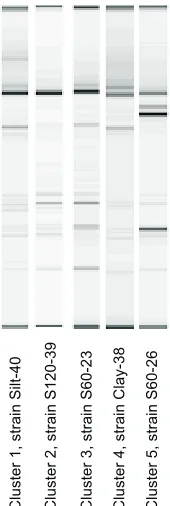
The extracted DNA concentrations (average±standard deviation, ngml-1) were 91.3±17.0, 89.5±20.5, 93.5±27.1, 89.1±17.6, 94.3±25.9 after interactions with sand60, sand120, sand230, silt and clay, respectively. The mean values according the t-test were not statistically different at the 0.05 significance level, and the hypothesis about the probability distribution functions of concentrations being the same could not be rejected at the 0.05 significance level. Representative electrophoregrams are shown in Fig. 1.After normalization, most fingerprints had a strong DNA band at around 1200 kbp and a fainter band around 220 kbp. Most of
Clust
er
1,
st
rain
S
ilt
-40
Clust
er
2,
st
rain
S
120-39
Clust
er
3,
st
rain
S
60-23
Clust
er
4,
st
rain
C
lay-38
Clust
er
5,
st
rain
S
60-26
the substantial differences could be observed between 300 and 500 kbp. Each isolate had a unique band pattern, although with a tolerance and optimization level of 1%, there were subgroups with percent similarities greater than 95%.
Cluster analysis with Bionumerics led to identification of five clusters with the similarity level within them higher than 80% and the number of fingerprints in each greater than 4. About 16% of fingerprints did not belong to either of these clusters and were labeled as ‘others’. Figure 2 shows the distribution of the strains among the clusters.
The five clusters differed both in their size and in the representation of strains isolated after interactions with different particle size fractions. Cluster 3 included 42% of strains isolated after the interaction with clay, whereas another 42% were found in clusters 1, 4, and 5. About 80% of strains isolated after the interaction with silt particles were in the Cluster 1. Strains isolated after the interaction with fine sand (sand230) were found only in Clusters 2, 3, and 5. Strains isolated after the interaction with medium sand (sand120) could be found only in Clusters 1, 2, and 3. Finally, 64% of strains isolated after interaction with the coarse sand (sand60) were in Clusters 1 and 3 with the rest evenly distributed among other clusters and 20% in the ‘others’ group. Strains isolated after interaction with different soil textural fractions were represented relatively evenly in the ‘others’ group.
The chi-square test was applied to test the hypothesis that strains distribution among the clusters does not depend on adsorbent. The hypothesis could be rejected at the 0.0001 probability level.
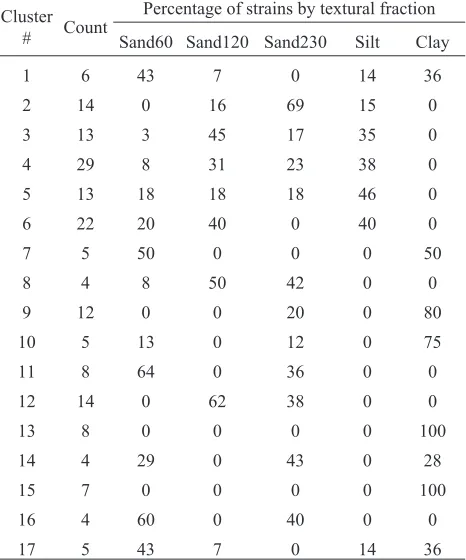
The change of the similarity level to 90% provided an ad-ditional insight about the effect of adsorbent on the genetic makeup of the E. coli populations after the attachment. Seventeen clusters were found at this similarity level (Table 1).
In these clusters, four clusters were ‘after sand’, and five were ‘after sand and silt’, two clusters were ‘after clay only’, and four clusters were ‘after clay or sand’. Bacteria remained after interactions with clay were not found in most of clusters containing bacteria remained in suspension after
Fig. 2.The Pearson correlation analysis, strain clusters with correlation within them larger than 80%, and counts by clusters ofE. coli strains remaining after interactions with soil particle fractions. Arrows show where strains were separated that had not entered the 80% clusters.
Cluster # Count
Percentage of strains by textural fraction
Sand60 Sand120 Sand230 Silt Clay
1 6 43 7 0 14 36
2 14 0 16 69 15 0
3 13 3 45 17 35 0
4 29 8 31 23 38 0
5 13 18 18 18 46 0
6 22 20 40 0 40 0
7 5 50 0 0 0 50
8 4 8 50 42 0 0
9 12 0 0 20 0 80
10 5 13 0 12 0 75
11 8 64 0 36 0 0
12 14 0 62 38 0 0
13 8 0 0 0 0 100
14 4 29 0 43 0 28
15 7 0 0 0 0 100
16 4 60 0 40 0 0
17 5 43 7 0 14 36
interaction with silt. The chi-square test was applied to test the hypothesis that the strains distribution among the clusters does not depend on adsorbent. The hypothesis could be rejected at 0.0001 probability level.
DISCUSSION
Expression of several genes has been correlated with the affinity ofE. colito various mineral surfaces (Smythet al., 1978; Landini and Zehdner, 2002; Yanget al., 2005). The preferential attachment of different strains to particles of different size classes may be attributable to differences in bacterial cell surface properties, including hydrophobicity (Stenstrom, 1989), bacteria polarity (Jones et al., 2003), surface lipopolysaccharides (Abu-Lail and Camesano, 2003, Walkeret al., 2004), formation of fimbriae (Ottoet al, 1999), motility (Genevauxet al., 2004), and growth stage (Chen and Strevett, 2001). Overall, genetic variations may cause differences in attachment of variousE. colistrains to the same mineral particle.
Different minerals are found in different textural fractions of soils and even within the smaller size ranges of the same textural fraction (Peinemannet al., 2000). Organic matter content was distinctly different in silt fraction compared with clay and sand fractions in this work. This might affect grouping of some strains after interactions with sand and clay particles (cluster 3 in Fig. 1 and clusters 8 to 16 in Table 1). Organic matter was reported to affect bacterial adhesion to soil. In general, differences in surface properties of particles of different sizes can also cause the strain speci-fic variations inE. coliattachment.
The preferential attachment of different strains to parti-cles of different size classes may be attributable to differen-ces in particle surface properties. For example, surface rough-ness of mineral particles (Shellenberger and Logan, 2002), surface charge (Harkeset al., 1991; Loweret al., 2000), pre-sence of organic and mineral coatings (Granthamet al., 1997; Mauriceet al., 1996) and humic acid (Parent and Velegod, 2004) have been observed to affect the attachment ofE. coli.
Recent reviews (Fergusonet al., 2003, Jamiesonet al., 2004) have highlighted a lack of quantitative understanding of the status of suspended bacteria in overland flow. It is not clear whether they are attached to soil or fecal particles, or move as unattached cells or bacterial aggregates. Because the attachment to mineral surfaces for pathogenicE. coli strains may be different from that for non-pathogenic strains (Smith, 1977; Smythet al., 1978), more information on attach-ment pathogenicE. colito suspended solids in overland flow attachment needs to be collected, as the differences in attach-ment may result in differences in overland transport of patho-genic and non-pathopatho-genicE. coli. Such information appears to be necessary for modeling fate and transport of manure-borneE. coliin environment.
CONCLUSION
DifferentE. colistrains exhibit the significantly diffe-rent affinity in attachment to diffediffe-rent soil tectural fractions. This indicates the possibility of significant differences in transport of pathogenic and non-pathogenic manure-borne E. colistrains in overland flow to water bodies.
ACKNOWLEDGEMENT
Manufacturer names are given for information only and do not constitute endorsement by the United States De-partment of Agriculture.
REFERENCES
Abu-Lail N.I. and Camesano T.A., 2003. Role of lipopoly-saccharides in the adhesion, retention, and transport of Escherichia coli JM109. Environ. Sci. Technol., 37, 2173-2183.
Chen G. and Strevett K.A., 2001. Impact of surface thermo-dynamics on bacterial transport. Environ. Microbiol., 3, 237-245.
Collins R., Elliott S., and Adams R., 2005.Overland flow deli-very of faecal bacteria to a headwater pastoral stream. J. Appl. Microbiol., 99, 126-132.
Curriero F.C., Patz J.A., Rose J.B., and Lele S., 2001.The asso-ciation between extreme precipitation and waterborne disease outbreaks in the United States, 1948-1994. Am. J. Public Health., 91, 1194-1199.
EPA, 2004.Potential environmental impacts of animal feeding operations. http://www.p2pays.org/ref/02/01249.htm. Ferguson C., de Roda Husman A.M., Altavilla N., Deere D.,
and Ashbolt N., 2003.Fate and transport of surface water pathogens in watersheds. Crit. Rev. Environ. Sci. Technol., 33, 299-361.
Fontes D.E., Mills A.L., Hornberger G.M., and Herman J.S., 1991.Physical and chemical factors influencing transport of microorganisms through porous media. Appl. Environ. Microbiol., 57, 2473-2481.
Geesey G.G. and Costerson J.W., 1979.Microbiology of a Northern River: bacterial distribution and relationship to suspended sediments and organic carbon. Can J. Microbiol., 25, 1058-1067.
Genevaux P., Bauda P., DuBow M.S., and OudegaB., 2004. Identification of Tn10 insertions in the rfaG, rfaP, and galU genes involved in lipopolysaccharide core biosynthesis that affectEscherichia coliadhesion. Arch. Microbiol., 172, 1-8. Grantham M.C., Dove P.M., and DiChristina T.J., 1997. Microbially catalyzed dissolution of iron and aluminum oxyhydroxide mineral surface coatings. Geochim. Cosmo-chim. Acta, 61, 4467-4477.
Guber A.K., Pachepsky Y.A., Shelton D.R., and Yu O., 2007. Effect of bovine manure on fecal coliform attachment to soil and soil particles of different sizes. Appl. Environ. Micro-biol., 73, 3363-3370.
Heinonen-Tanski H. and Uusi-Kämppä J., 2001.Runoff of fecal microorganisms and nutrients from perennial grass ley after application of slurry and mineral fertiliser. Water Sci. Technol., 43, 143-146.
Hipsey M.R., Brookes J.D., Regel R.H., Antenucci J.P., and Burch M.D., 2006.In situ evidence for the association of total coliforms and Escherichia coli with suspended inorganic particles in an Australian reservoir. J. Water Air Soil Pollut., 170, 191-209.
Jamieson R., Gordon R., Joy D., and Lee H., 2004.Assessing microbial pollution of rural surface waters: a review of current watershed scale modelling approaches. Agric. Water Manag., 70, 1-17.
Jeng H.C., England A.J., and Bradford H.B., 2005.Indicator organisms associated with stormwater suspended parti-cles and estuarine sediment. Part A: Toxic/Hazardous Substances Environ. Eng., J. Environ. Sci. Health. 40, 779-791.
Jones J.F., Feick J.D., Imoudu D., Chukwumah N., Vigeant M., and Velegol D., 2003.Oriented adhesion ofEscherichia coli to polystyrene particles. Appl. Environ. Microbiol., 69, 6515-6519.
Krein A. and Schorer M., 2000.Road runoff pollution by poly-cyclic aromatic hydrocarbons and its contribution to river sediments. Water Res., 34, 4110-4115.
Landini P. and Zehnder A.J.B., 2002.The global regulatoryhns gene negatively affects adhesion to solid surfaces by anaero-bically grownEscherichia coliby modulating expression of flagellar genes and lipopolysaccharide production. J. Bacte-riol., 184, 1522-1529.
Lower S.K., Tadanier C.J., and Hochella M.K., Jr., 2000. Measuring interfacial and adhesion forces between bacteria and mineral surfaces with biological force microscopy. Geochim. Cosmochim. Acta, 64, 3133-3139.
Maurice P., Forsythe J., Hersman L., and Sposito G., 1996. Application of atomic-force microscopy to studies of microbial interactions with hydrous Fe(III)-oxides. Chem. Geol., 132, 33-43.
Oliver D.M., Clegg C.D., Haygarth P.M., and Heathwaite A.M., 2005.Assessing the potential for pathogen tran-sfer from grassland soils to surface waters. Adv. Agron., 85, 125-180.
Otto K., Elwing H., and Hermansson M., 1999.Effect of ionic strength on initial interactions of Escherichia coli with surfaces, studied on-line by a novel quartz crystal micro-balance technique. J. Bacteriol., 181, 5210-5218.
Parent M.E. and Velegol D., 2004.E. coliadhesion to silica in the presence of humic acid. Coll. Surfaces B: Biointerfaces, 39, 45-51.
Peinemann N., Amiotti N.M., Zalba P., and Villamil M.B., 2000. Effect of clay minerals and organic matter on the cation exchange capacity of silt fractions. J. Plant Nutr. Soil Sci., 163, 47-52.
Schillinger J.E. and Gannon J.J., 1985.Bacterial adsorption and suspended particles in urban stormwater. J. Water Pollut. Control Fed.,57, 384-389.
Sessitsch A., Weilharter A., Gerzabek M.H., Kirchmann H., and Kandeler E., 2001.Microbial population structures in soil particle size fractions of a long-term fertilizer field experiment. Appl. Environ. Microbiol., 67, 4215-4224. Shellenberger K. and Logan B.E., 2002. Effect of molecular
scale roughness of glass beads on colloidal and bacterial deposition. Environ. Sci. Technol., 36, 184-189.
Smith H., 1977.Microbial surfaces in relation to pathogenicity. Bacteriol. Rev., 41, 475-500.
Smyth C.J., Johnsson P., Olsson E., Söderlind O., Rosengren J., Hjerten S., and Waldstrom T., 1978.Differences in hydrophobic surface characteristics of porcine enteropatho-genic Escherichia coli with or without K88 antigen as revealed by hydrophobic interaction chromatography. Infect. Immun., 22, 462-472.
Stenstrom A.T., 1989.Bacterial hydrophobicity, an overall para-meter for the measurement of adhesion potential to soil particles. Appl. Environ. Microbiol., 55, 142-147. Thurston-Enriquez J.A., Gilley J.E., and Eghball B., 2005.
Microbial quality of runoff following land application of cattle manure and swine slurry. J. Water Health, 3, 157-171. Topp E., Welsh M., Tien Y.-C., Dang A., Lazarovits G., Conn
K., and Zhu H., 2003. Strain-dependent variability in growth and survival ofEscherichia coliin agricultural soil. FEMS Microbiol. Ecol., 44, 303-308.
Tyrrel S.F. and Quinton J.N., 2003.Overland flow transport of pathogens from agricultural land receiving fecal wastes. J. Appl. Microbiol., 94, 87-93.
Walker D.J., 2001.Modelling sedimentation processes in a con-structed stormwater wetland. Sci. Total Environ., 266, 61-68. Walker S.L., Redman J.A., and Elimelech M., 2004.Role of cell
surface lipopolysaccharides (LPS) inEscherichia coliK12 adhesion and transport. Langmuir, 20, 7736-7746. Wu Q., Riise G., Lundekvam H., Mulder J., and Haugen L.E.,
2004. Influences of suspended particles on the runoff of pesticides from an agricultural field at Askim, SE-Norway. Environ. Geochem. Health, 26, 295-302.