A b s t r a c t. The organic carbon (OC) and total nitrogen (N) stocks (kg m-2) within the aggregates were estimated from the elemental concentrations and bulk density values. Soil aggregation by water-stable aggregates (WSA) showed significant (p£0.05) increase in the proportion of macroaggregates > 0.50 mm than aggregates < 0.50 mm with addition of the compost. Mean-weight diameter (MWD) was significantly higher in uncultivated forestland than cultivated land, whereas addition of compost to the cultivated land improved the stability of this soil over the control. The OC stocks (kg m-2) within the aggregates of cultivated land amended with pig-composted manure followed the pattern ob-served for the forestland ieOC was preferentially sequestered within the macroaggregates (> 0.25 mm) than microaggregate fraction (< 0.25 mm); while the distribution of N was relatively uniform within the aggregates. Application of the compost to the cultivated plots significantly improved total N stocks (kg m-2) over that observed for the forestland. The results also revealed that ap-plication of pig-composted manure improved the structural stabi-lity better at 10 Mg ha-1than 5 and 15 Mg ha-1rates. The C-N seque-stration in cultivated land was also higher than the baseline forestland with addition of 10 Mg ha-1manure over other rates. Overall, this study showed that application of compost at 10 Mg ha-1is adequate to improve the stability and enhanced C-N storage within this fragile tropical soil.
K e y w o r d s: greenhouse effect, sequestration, aggregate stability, compost, tillage
INTRODUCTION
Management practices influence carbon and nutrient dynamics in agricultural ecosystems. The major reason for the high degradation of most tropical soils is due to decline in their organic carbon contents; and the rate of such decline is often influenced by cultivation, soil type, and dominant mineralogy (Mbagwu and Piccolo, 1998), type and length of tillage (Balashovet al., 2010; Balesdentet al., 1988; Cambardella
and Elliot, 1992; Dalai and Mayer, 1987). The rate of soil organic carbon (SOC) loss upon conversion of natural eco-system to agricultural use is more drastic in the tropics than temperate regions (Lal, 2001; Stalenga and Kawalec, 2008).
Soil organic matter (SOM) consists of series of fractions from very active to stable pools; and there is a similarity in the dynamics of C and N among the labile SOM pools (Adesodunet al., 2005). Therefore, the amount of SOC and total N that exists in any given soil is determined by the ba-lance between rate of OC input and output (CO2) release into the atmosphere. Human activities in the last two centuries have elevated to an unprecedented levels the atmospheric concentration of CO2, CH4, N2O and other greenhouse gases, and this has led to large scale alterations in the global climate (Houghtonet al., 2001). Concerns about the rising atmospheric CO2levels have prompted considerable inte-rest in recent years regarding the sink potentials of soil orga-nic carbon. While CH4dynamics are closely linked to live-stock production practices and wetland agriculture such as rice production, CO2dynamics are related to energy use cy-cles and to soil management; while N2O dynamics are rela-ted to soil-nitrogen management (fertilizer-nitrogen).
Soil C sequestration through changes in land use and management is one of the important strategies to mitigate the global greenhouse effect. Important land uses and prac-tices with the potential to sequester SOC include conversion of cropland to pastoral and forest lands, conventional tillage to conservation tillage or no-tillage, and no manure use to regular addition of manure. However, food security needs for the world teeming population make conversion of cropland to forestland unsustainable. Therefore, increased food demands call for management of croplands to ensure food security and at the same time enhanced SOC sink within the soil to minimized atmospheric emission of CO2.
Carbon-nitrogen sequestration potentials and structural stability
of a tropical Alfisol as influenced by pig-composted manure
J.K. Adesodun* and O.E. Odejimi
Department of Soil Science and Land Management, University of Agriculture, PMB 2240, Abeokuta 110001, Ogun-State, Nigeria
Received February 28, 2010; accepted June 8, 2010
© 2010 Institute of Agrophysics, Polish Academy of Sciences *Corresponding author’s e-mail: [email protected]
A A
Agggrrroooppphhyhyysssiiicccsss
In this study, the SOC and total N values of adjacent forestland were considered as the baseline. Abid and Lal (2008) noted that using the current forestland as baseline in comparison with that in cultivated land is a good indicator of either the C source contribution to greenhouse effect by deforestation or the potential of SOC sequestration through reforestation of cultivated land. Therefore, this study esti-mated the C-N sequestration potentials and stability of a light-textured tropical Alfisol amended with different rates of pig-composted manure.
MATERIALS AND METHODS
Soil samples for this study were collected in 2008 at 0-20 cm depth from organic agriculture experimental farm located within the University of Agriculture, Abeokuta, Ogun-State (7.12°N and 3.23°E) with the aid of spade to maintain the soil relatively in its natural aggregates. The rainfall distribution for this area is bimodal with wet season from March to October and dry season from November to
February. The mean annual rainfall is about 1400 mm with the maximum in July. The mean annual minimum and maxi -mum temperature are 22.2 and 33.3°C, respectively. The to-tal land area of the site is 0.30 ha with 24 experimento-tal plots (6x10 m). The amendments on these plots were pig-composted manure applied at 0, 5, 10 and 15 Mg ha-1, and planted with two varieties of maizeZea mays ieTZESR-W (improved variety) and OHORI (local variety). These treat-ments were applied in the year 2005, 2006 and in 2007 while residual effect of these treatments was monitored in the year 2008. Soil samples were also collected from adjacent un-cultivated forest re-growth land to serve as base-line. Initial routine analysis of soil of this site was carried out in 2005 before the organic amendment was applied; and the results of this analysis are presented in Table 1.
The distribution of aggregates was estimated by the wet-sieving technique described in detail by Kemper and Rosenau (1986). In this procedure, 50 g of the < 5.66 mm aggregates were placed on the topmost of a nest of sieve of diameters 2, 1, 0.5 and 0.25 mm. The samples were pre-soaked in distilled water for 10 min before oscillating vertically in water 20 times (along 5 cm amplitude) at the rate of 15 stokes mm-1for 2 min. The resultant aggregates on each sieve were dried at 105°C for 24 h and weighed. The mass of < 0.25 mm fraction was obtained by difference between the initial sample weight and the sum of sample weights collected on the 2, 1, 0.5 and 0.25 mm sieve nest.
The percent water-stable aggregates (%WSA) on each of the following size ranges, 5.66-2.0, 2.0-1.0, 1.0-0.50, 0.50-0.25 and < 0.25 mm were then determined. Thus:
%WSA= (Ma+s-Ms/Mt- Ms) 100, (1)
where: Ma+sis the mass of the resistant aggregates plus
stone (g),Msthe mass of the stone fraction alone, andMtthe
total mass of the sieved soil (g).
The method of Van Bavel (1950) as modified by Kem-per and Rosenau (1986) was used to determine the mean weight diameter of wet-stable aggregates. Thus:
MDW X Wi i
i n
= å =1
, (2)
where: MWD is the mean weight diameter of wet-stable aggregates (mm),Xithe mean diameter of each size fraction (mm) andWithe proportion of the total sample weight (WSA) in the corresponding size fraction, after deducting the weight of stone (upon dispersion and passing through the same sieve) as indicated above, andn is the number of size fractions. Higher values ofMWDindicate the dominance of the less erodible, large aggregates of the soil (Piccoloet al., 1997).
Soil organic carbon and total nitrogen concentrations within the aggregate fractions of 5.66-2.0, 2.0-1.0, 1.0-0.50, 0.50-0.25 and < 0.25 mm of the cultivated and uncultivated (forest) land were measured. Theorganic carbon (OC) was determined by acid dichromate wet oxidation procedure as presented by Nelson and Sommers (1996); while total nitrogen was by micro-Kjeldahl method (Bremmer, 1996). Organic carbon and total N stocks (kg m-2) of the upper 20 cm were calculated using elemental concentration and bulk density equation described by Steffenset al. (2008) as:
ES=BD EC a10-6, (3)
where:ES– elemental stock (kg m-2),BD– bulk density (g cm-3),EC– elemental concentration (mg g-1), anda– area multiplier (20 cm depth 10 000 cm2= 200 000 cm3m-2).
Data was analyzed using the general analysis of va-riance procedure of GenStat Release 7.2 DE (2007), and significance was reported at 5% probability level.
Parameter Units Cultivated
land
Adjacent forestland Sand (2000-50mm)
Silt (50-2 mm) Clay (<2 mm)
g kg-1 g kg-1 g kg-1
752 80 168
772 40 188
Texture - Loamy sand Loamy sand
pH (H2O) 6.43 6.44
OC Total N
g kg-1 g kg-1
42 7.0
50 8.8 C:N
Ca Mg K Na
-cmol kg-1 cmol kg-1 cmol kg-1 cmol kg-1
6.00 0.52 0.73 0.60 1.17
5.70 0.46 0.15 0.73 1.11
RESULTS AND DISCUSSION
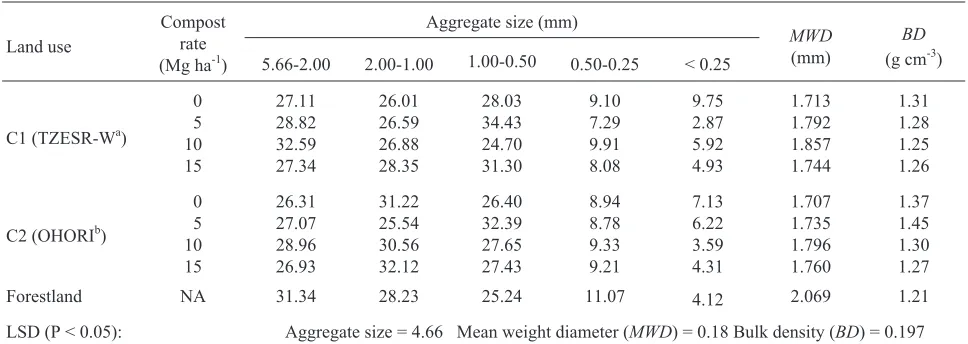
Soil aggregation represented by percent water-stable aggregates (%WSA) and mean-weight diameter (MWD) for cultivated plots previously planted with improved (TZESR-W) and local (OHORI) varieties of maize (Zea mays), and amen-ded with different rates of pig-composted manure are pre-sented in Table 2. Observation from these previously culti-vated plots were compared with the trend obtained in adja-cent forest re-growth land thereafter referred to as forest-land. The general trend indicated significant (p£0.05) in-crease in the proportion of large macroaggregates (>0.50 mm) compared with the small macroaggregates (0.50-0.25 mm) and the microaggregate (<0.25 mm) fractions in both pre-viously cultivated land amended with compost and adjacent baseline forestland. This showed that application of pig-composted manure improved the soil aggregation. In plots planted with TZESR-W (improved) maize variety, the pro-portion of 5.66-2.0 mm aggregate fraction was signifi-cantly higher in plots amended with 10 Mg ha-1 pig-com-posted manure than the control. Higher improvement was also observed at this rate (10 Mg ha-1) of compost for 5.66-2.0 and 0.50-0.25 mm aggregate fractions in plots planted with local (OHORI) maize variety. These observations are in agreement with Hatiet al. (2006) who noted that treat-ment where more organic matter was added either through farm yard manure or plant residues maintained higher fractions of larger aggregates but lower fraction of micro-aggregates.
The stability of intact water-stable aggregates (WSA) as determined by the mean-weight-diameter (MWD) was significantly (p£0.05) higher for the adjacent forestland (2.069 mm) than values obtained in the cultivated plots (Table 2). While there were no significant differences in the aggregate stability of soils of the cultivated plots, there was
increase inMWDwith addition of pig-composted manure than the control. The overall trend forMWDrelative to the land use followed forestland > cultivated land planted with TZESR-W (improved maize variety) > cultivated land planted with local (OHORI) maize variety. This observed trend could be due to higher residue and root action especially in un-cultivated or fallow system, as also reported by Filhoet al. (2002), and higher residues from improved maize varieties which normally influence formation and stabilization of soil aggregation.
Generally, this study revealed that addition of 10 Mg ha-1 pig-composted manure to this fragile tropical soil improved the aggregation better. Also, the results presented in Table 2 indicated that addition of manure above 10 Mg ha-1did not significantly influenced the aggregation and stability of this soil.
Organic carbon (OC) and total nitrogen (N) stocks within water-stable aggregates (WSA) of the top20 cm of the cul-tivated land amended with pig-composted manure and the adjacent uncultivated forestland were calculated from bulk densities and the elemental concentrations using Eq. (3). The distribution of carbon stocks within theWSA(Table 3) showed that OC was preferentially sequestered in the macro-aggregate fractions (>0.25mm) than in the microaggregates (< 0.25mm) with addition of the compost irrespective of application rates. The highest OC stocks were obtained in plots amended with 10 Mg ha-1manure. For example, 68.68 and 66.91 kg m-2OC were occluded within 5.66-2.0 mm aggregate fraction and 48.62 and 52.61 kg m-2 were obtained in microaggregate (< 0.25mm) fraction of plots planted with improved and local maize varieties respec-tively. Generally, OC stocks within the soil aggregates of cultivated land followed the pattern observed for the base-line forestland which showed significant (p£0.05) higher
Land use
Compost rate (Mg ha-1)
Aggregate size (mm)
MWD (mm)
BD (g cm-3) 5.66-2.00 2.00-1.00 1.00-0.50 0.50-0.25 < 0.25
C1 (TZESR-Wa)
0 5 10 15
27.11 28.82 32.59 27.34
26.01 26.59 26.88 28.35
28.03 34.43 24.70 31.30
9.10 7.29 9.91 8.08
9.75 2.87 5.92 4.93
1.713 1.792 1.857 1.744
1.31 1.28 1.25 1.26
C2 (OHORIb)
0 5 10 15
26.31 27.07 28.96 26.93
31.22 25.54 30.56 32.12
26.40 32.39 27.65 27.43
8.94 8.78 9.33 9.21
7.13 6.22 3.59 4.31
1.707 1.735 1.796 1.760
1.37 1.45 1.30 1.27
Forestland NA 31.34 28.23 25.24 11.07 4.12 2.069 1.21
LSD (P < 0.05): Aggregate size = 4.66 Mean weight diameter (MWD) = 0.18 Bulk density (BD) = 0.197 C1, C2 – cultivated land amended with pig-composted manure; NA – not applicable;aimproved maize variety;blocal maize variety.
OC within the larger aggregates fractions than the smaller aggregates. This study further showed higher accumulation of OC within the aggregates of soil amended with pig-composted manure over the baseline forest soils (Table 3). Application of the compost to cultivated land also improved total nitrogen stocks (kg m-2) within the soil aggregates over the values obtained from the adjacent forestland area (Table 4). However, overall distributions of the total nitrogen were relatively uniform within the aggregate fractions.
The preferential accumulation of OC within the macro-aggregates of this soil following application of composted-manure was earlier reported by Adesodun et al. (2005, 2007), Christensen (1986) and Dormaar (1983), Mbagwu
and Piccolo (1990). While these workers observed simila-rity in the distribution pattern of OC and N concentrations withinWSA, total N stocks (kg m-2) reported in this study did not follow this trend but was uniform within the aggregate fractions. However, application of pig-composted manure generally led to higher sequestration of C and N within the water-stable aggregates of this soil.
The potentials of pig-composted manure applied to the cultivated land to enhance carbon and nitrogen sequestration was estimated using the OC and N stocks from the adjacent forestland as baseline. Evaluation procedure of Tan and Lal (2005) was adoptediepositive difference between the OC and total N stocks for the cultivated land amended with Land use
Compost rate (Mg ha-1)
Aggregate size (mm)
5.66-2.00 2.00-1.00 1.00-0.50 0.50-0.25 < 0.25
C1 (TZESR-Wa)
0 5 10 15
56.77 64.77 69.68 62.39
45.59 64.51 68.64 67.50
11.44 50.26 53.65 47.52
45.50 43.52 42.90 60.90
38.43 37.38 48.62 46.82
C2 (OHORIb)
0 5 10 15
58.36 65.83 66.91 61.04
50.60 79.75 72.02 62.57
53.16 49.88 72.37 63.33
37.54 37.12 35.27 36.66
37.17 45.92 52.61 37.00
Forestland NA 58.80 58.92 37.44 32.40 24.00
LSD (P < 0.05): Treatments x aggregate size = 11.42 Explanations as in Table 2.
T a b l e 3.Aggregate size distribution (%WSA), stability (MWD) and bulk density (g cm-3) of the soil as influenced by different land use
Land use
Compost rate (Mg ha-1)
Aggregate size (mm)
5.66-2.00 2.00-1.00 1.00-0.50 0.50-0.25 < 0.25
C1 (TZESR-Wa)
0 5 10 15
2.73 2.99 2.96 2.98
2.82 2.92 3.06 3.02
2.91 2.94 3.07 3.05
2.96 2.94 3.13 3.00
2.74 2.87 2.99 2.85
C2 (OHORIb)
0 5 10 15
2.88 3.09 3.07 2.74
2.43 3.06 2.79 2.74
2.90 2.91 2.96 2.74
2.78 3.03 3.09 2.73
2.79 2.98 2.91 2.70
Forestland NA 1.83 1.84 1.85 1.94 1.70
LSD (P < 0.05): Treatments x aggregate size = 0.26 Explanations as in Table 2.
pigcomposted manure and the baseline forestland values re-present C and N sequestration. Therefore, OC and total N stocks levels for the cultivated land less than that of the baseline forestland were considered as C and N source con-tribution to the greenhouse effect.
Results in Table 5 showed that the average C sequestra-tion capacity in land previously cultivated with improved (TZESR-W) maize variety were higher in plots amended with 10 Mg ha-1compost (14.38 kg C m-2) and in plots amen-ded with 15 Mg ha-1manure (14.72 kg C m-2); while there was loss of 2.76 kg C m-2from the control. Average carbon sequestration in land planted with local maize (OHORI) variety were 163.4, 246.3, and 93.7% higher than the control with addition of 5, 10 and 15 Mg ha-1pig-composted manure respectively (Table 5). The trend within theWSArevealed that more OC were occluded within the macroaggregates 2.0-0.25 mm and the microaggregate fraction than the larger macroaggregate (5.66-2.0 mm) fraction. Whereas loss of OC, possibly to the atmosphere was observed in the control plots where no compost was applied. The implication of these observations was that carbon sequestration was enhan-ced with the application of pig-composted manure. Overall, the highest capacity to sequester OC by the manure was observed at the application rate of 10 Mg ha-1.
Nitrogen sequestration (Table 5) was also enhanced over the control with addition of pig-composted manure to this fragile tropical alfisol. The overall trend of N seque-stration was similar to that observed for OC showing that C-N sequestration was better at 10 Mg ha-1 rate of this composted manure. This indicated that application of this manure above 10 Mg ha-1 did not significantly enhanced C-N sequestration in this soil.
CONCLUSIONS
1. The potentials of pig-composted manure to enhance C-N sequestration and improve soil aggregate stability revealed significant increase in the proportion of aggregates > 0.50 mm than < 0.50 mm.
2. Higher soil stability as determined by mean-weight diameter (MWD) were observed at the rate of 10 Mg ha-1 compost than 0, 5 and 15 Mg ha-1compost, and in plots pre-viously planted with improved (TZESR-W) maize variety than the local (OHORI) variety.
3. Elemental stocks (kg m-2) of OC and N in cultivated land amended with 10 Mg ha-1 compost showed higher accumulation of these elements within the larger soil aggregates fractions (> 2.0 mm) than the baseline forestland. Land use
Compost rate (Mg ha-1)
Aggregate size (mm)
Mean 5.66-2.00 2.00-1.00 1.00-0.50 0.50-0.25 < 0.25
Organic carbon
C1 (TZESR-Wa)
0 5 10 15
-2.0 6.0 10.9 3.6
-13.3 5.6 9.7 8.6
-26.0 12.8 16.2 10.1
13.1 11.1 10.5 28.5
14.4 13.4 24.6 22.8
-2.76 9.78 14.38 14.72
C2 (OHORIb)
0 5 10 15
-0.4 7.0 8.1 2.2
-8.3 20.8 13.1 3.6
15.7 12.4 34.9 25.9
5.1 4.7 2.9 4.3
13.2 21.9 28.6 13.0
5.06 13.36 17.52 9.80 Total nitrogen
C1 (TZESR-Wa)
0 5 10 15
0.91 1.16 1.31 1.16
0.99 1.08 1.22 1.18
1.06 1.09 1.22 1.21
1.02 1.00 1.19 1.06
1.04 1.16 1.29 1.15
1.01 1.10 1.21 1.15
C2 (OHORIb)
0 5 10 15
1.05 1.27 1.24 0.92
0.59 1.22 0.96 0.91
1.06 1.06 1.12 0.90
0.83 1.08 1.15 0.78
1.08 1.27 1.21 1.00
0.92 1.18 1.14 0.90 LSD (P < 0.05): Treatments x aggregate size = 0.26
aValues = Difference between OC and N stock values (Tables 3 and 4) for baseline forestland and cultivated land amended with compost. In cultivated land, positive values = sequestration; negative values = C and N contribution to greenhouse effect;bimproved maize variety; c
local maize variety. Other explanations as in Table 2.
4. Generally, this study indicated that application of manure at 10 Mg ha-1was adequate to enhance C-N seque-stration and improve the stability of this fragile tropical soil.
REFERENCES
Abid M. and Lal R., 2008. Tillage and drainage impact on soil quality 1. Aggregate stability, carbon and nitrogen pools. Soil Till. Res., 100, 89-98.
Adesodun J.K., Adeyemi E.F., and Oyegoke C.O., 2007. Distri-bution of nutrient elements within water-stable aggregates of two tropical agro-ecological soils under different land uses. Soil Till. Res., 92, 190-197.
Adesodun J.K., Mbagwu J.S.C., and Oti N., 2005. Distribution of carbon, nitrogen and phosphorus in water-stable aggre-gates of an organic waste amended Ultisol in southern Nigeria. Bioresource Tech., 96, 509-516.
Balashov E., Kren J., and Prochazkova B., 2010.Influence of plant re-sidue management on microbial properties and water-table aggregates of agricultural soils. Int. Agrophysics, 24, 9-13.
Balesdent J., Wagner G.H., and Mariotti A., 1988. Soil organic mat-ter turnover in long-mat-term field experiments as revealed by car-bon13natural abundance. Soil Sci. Soc. Am. J., 52, 118-124.
Bremmer J.M., 1996. Nitrogen-Total. In: Methods of Soil Ana-lysis. (Ed. D.L. Sparks). ASA and SSSA Press, Madison, WI, USA.
Cambardella C.A. and Elliot E.T., 1992. Carbon and nitrogen dynamics of soil organic matter fractions from grassland soils. Soil Sci. Soc. Am. J., 58, 123-130.
Christensen B.T., 1986. Straw incorporation and soil organic matter in macroaggregates and particle size separates. J. Soil Sci., 37, 125-135.
Dala R.C. and Mayer R.J., 1987. Long-term trends in fertility of soils under continuous cultivation and cereal cropping in southern Queenland. Dynamics of nitrogen mineralization po-tentials and microbial biomass. Aust. J. Soil Res., 25, 461-472.
Dormaar J.F., 1983. Chemical properties of soil and water-stable aggregates after sixty seven years of cropping of spring wheat. Plant Soil, 75, 51-61.
Filho C.C., Lourenco A., Guimaraes M.F., and Fonseca I.C.B.,
2002. Aggregate stability under different soil management
systems in red Latosol in the state of Parana, Brazil. Soil Till. Res., 65, 45-51.
GenStat Release 7.2 DE,2007. Lawes Agricultural Trust. Rotham-sted Exp. Station, VSN Press, RothamRotham-sted, UK.
Hati K.M., Swarup A., Singh D., Misra A.K., and Ghosh P.K., 2006. Long-term continuous cropping, fertilization and manuring effects on physical properties and organic carbon content of a sandy loam soil. Aust. J. Soil Res., 44, 487-495. Houghton J.T., Ding D.J., Griggs D.J., Noguer M., van der
Linden P.J., and Xiaosu D., 2001. Climate Change 2001: The Scientific Basis. IPCC, Cambridge University Press, Cambridge, UK.
Kemper W.D. and Rosenau R.C., 1986. Aggregate stability and size distribution. In: Methods of Soil Analysis. (Ed. A. Klute), ASA Press, Madison, WI, USA.
Lal R., 2001.World cropland soils as a source or sink for atmospheric carbon. Adv. Agron., 71, 145-191.
Mbagwu J.S.C. and Piccolo A., 1990. Carbon, nitrogen and pho-sphorus concentration in aggregates of organic waste-amen-ded soils. Biol. Wastes, 31, 97-111.
Mbagwu J.S.C. and Piccolo A., 1998. Water-dispersible clay in aggregates of forest and cultivated soils in southern Nigeria in relation to organic matter constituents. In: Carbon and Nutrient Dynamics in Natural and Agricultural Eco-systems (Eds L. Bergstron, H. Kirchman). CAB Press, Wallingford, UK.
Nelson D.W. and Sommers L.E., 1996. Total carbon, organic carbon and organic matter. In: Methods of Soil Analysis. (Ed. D.L. Sparks). ASA and SSSA Press, Madison, WI, USA.
Piccolo A., Piettramellara G., and Mbagwu J.S.C., 1997. Use of humic substances as soil conditioners to increase aggregate stability. Geoderma, 75, 265-277.
Stalenga J. and Kawalec A., 2008.Emission of greenhouse gases and soil organic matter balance in different farming systems. Int. Agrophysics, 22, 287-290.
Steffens M., Kölbl A., Totsche K.U., and Kögel-Knabner I.,
2008. Grazing effects on soil chemical and physical
pro-perties in a semiarid steppe of Inner Mongolia (P.R. China). Geoderma, 143, 63-72.
Tan Z. and Lal R., 2005. Carbon sequestration potential estimates with changes in land use and tillage practice in Ohio, USA. Agric. Ecosystems Environ., 111, 140-152.