VOLUME NO.2(2012),ISSUE NO.4(APRIL) ISSN 2231-5756
A Monthly Double-Blind Peer Reviewed Refereed Open Access International e-Journal - Included in the International Serial Directories
Indexed & Listed at:
Ulrich's Periodicals Directory ©, ProQuest, U.S.A., EBSCO Publishing, U.S.A., Cabell’s Directories of Publishing Opportunities, U.S.A. as well as in Open J-Gage, India [link of the same is duly available at Inflibnet of University Grants Commission (U.G.C.)]
Registered & Listed at: Index Copernicus Publishers Panel, Poland
VOLUME NO.2(2012),ISSUE NO.4(APRIL) ISSN 2231-5756
CONTENTS
CONTENTS
CONTENTS
CONTENTS
Sr.
No.
TITLE & NAME OF THE AUTHOR (S)
Page No.
1. REVISITING TRAINING EVALUATION
SAJEET PRADHAN & DR. RABINDRA KUMAR PRADHAN
1
2. THE INFLUENCE OF AGE ON CONSUMER ACTIVISM DR. ANTHONY. A. IJEWERE
5
3. AN INVESTIGATION ON EMOTIONAL INTELLIGENCE OF STUDENTS WITH RESPECT TO STUDENT DEVELOPMENT MODEL AND ITS IMPLICATION ON EMOTIONAL LEARNING SYSTEM IN MALAYSIA
DR. VIMALA SANJEEVKUMAR
8
4. DETERMINANTS OF CHILD LABOUR IN AGRICULTURAL PRODUCTION IN OYO STATE-NIGERIA AJAO, A.O
14
5. ECONOMIC VALUE ADDED VS. ACCOUNTING RESIDUAL INCOME: WHICH ONE IS A BETTER CRITERION FOR MEASUREMENT OF CREATED SHAREHOLDERS VALUE?
MOHAMADREZA ABDOLI, MOHAMADREZA SHURVARZI & AKRAM DAVOODI FAROKHAD
18
6. ACTIVISM AMONG THE NIGERIA CONSUMERS DR. ANTHONY .A. IJEWERE
23
7. AN EVALUATIVE STUDY OF USE OF HIP HOP ARTISTS IN MOBILE TELECOMMUNICATIONS ADVERTISEMENTS: A STUDY OF AIRTEL SUBSCRIBERS IN SOUTHEASTERN NIGERIA
DR. CHINENYE NWABUEZE & EMMANUEL OKEKE
27
8. TELECOMMUNICATION, TECHNOLOGY & TRAINING (3TS) - A UNIQUE LEARNING MODEL FOR TELCOS AJAY KR VERMA, SUDHIR WARIER & LRK KRISHNAN
34
9. FUTURE CHALLENGES OF HRM IN CORPORATIONS OF U.K. IN THE GLOBAL VILLAGE CONTEXT DR. S. P. RATH, DR. BISWAJIT DAS, SATISH JAYARAM & SAMEER DIWANJI
44
10. PROS AND CONS OF BRAND IMAGE BUILDING THROUGH NON MASS MEDIA: A CONCEPTUAL FRAMEWORK WITH SPECIAL REFERENCE TO ORGANISED RETAIL IN INDIA
V.JYOTHIRMAI & DR. R. SIVA RAM PRASAD
47
11. FEEDBACK ON IMPLEMENTATION OF ONLINE PERFORMANCE MANAGEMENT SYSTEM - A MINI MIX MODEL M. S. R. SESHA GIRI & P. V. SARMA
52
12. PROBLEMS AND PROSPECTS OF SALES PROMOTION IN RURAL MARKETS OF FMCG SECTOR IN INDIA DR. S. LOURDU INITHA & DR. S. GOVINDARAJU
55
13. FUND GROUPING: A MATHEMATICAL MODEL – PUBLIC AND PRIVATE SECTOR MUTUAL FUNDS IN INDIA DR. K. P. SIVAKUMAR & DR. S. RAJAMOHAN
60
14. TESTING STATIONARITY OF BETA AND BETA REGRESSION TENDENCIES IN INDIAN STOCK MARKET DR. BAL KRISHAN & DR. REKHA GUPTA
65
15. AN EVALUATION OF FINANCES OF DEC OF SRI VENKATESWARA UNIVERSITY, TIRUPATI, A.P. DR. G. VENKATACHALAM & DR. P.MOHAN REDDY
69
16. COMPLIANCE OF POLLUTION CONTROL MEASURES AMONG INDUSTRIAL UNITS OF PUDUCHERRY S. BALAJI & DR. P. NATARAJAN
74
17. JOB SATISFACTION AMONG TEACHERS DR. SANDHYA MEHTA
77
18. MODELING AND MEASURING PRICE DISCOVERY IN COMMODITY MARKET DR. SUYASH N. BHATT
84
19. CORPORATE CARBON DISCLOSURE THROUGH SUSTAINABILITY REPORT - AN INDIAN EXPERIENCE DR. HEENA SUNIL OZA
90
20. A STUDY ON CONSUMER BEHAVIOR OF MOBILE PHONES FROM UNIVERCELL STORES IN KERALA J. RAMOLA PREMALATHA, DR. N. SUNDARAM & JIJOY JOSEPH
95
21. THE STOCHASTIC MODELLING AND RELIABILITY ANALYSIS OF A BATTERY PRODUCTION SYSTEM IN AN INDUSTRY DR. PAWAN KUMAR & ANKUSH BHARTI
98
22. A STUDY OF IMPACT OF E LEARNING ON UNIVERSITY STUDENTS DR. TUSHAR CHAUDHARI
103
23. EMOTIONAL INTELLIGENCE AMONG COLLEGE STUDENTS RUKMINI S. & VIJAYA U. PATIL
106
24. BOOTSTRAPPING: STARTING A BUSINESS ON A BUDGET SHABANA A. MEMON.
111
25. EMPLOYEE ENGAGEMENT WITH SELECTED FACTORS AT BSNL, HYDERABAD- AN EMPIRICAL STUDY P. LAKSHMI NARAYANAMMA
115
26. MERGERS AND ACQUISITIONS IN INDIAN INFORMATION TECHNOLOGY INDUSTRY AND ITS IMPACT ON SHAREHOLDERS’ WEALTH JAYANT KALGHATGI
118
27. PLASTIC CARD FRAUDS AND THE COUNTERMEASURES: TOWARDS A SAFER PAYMENT MECHANISM ANUPAMA SHARMA
122
28. A STUDY ON CAUSES OF JOB STRESS IN THE IT SECTOR OF BANGALORE SHERIL MICHAEL ALMEIDA
126
29. IMPACT OF TRADITIONAL MEDIA ON JUDICIAL OFFICERS DR. AMIT KUMAR SINGH & MILI SINGH
129
30. CUSTOMER RELATIONSHIP BUILDING THROUGH SOCIAL NETWORKING WEBSITES VIKRAM SINGH
133
VOLUME NO.2(2012),ISSUE NO.4(APRIL) ISSN 2231-5756
INTERNATIONAL JOURNAL OF RESEARCH IN COMMERCE, IT & MANAGEMENT
A Monthly Double-Blind Peer Reviewed Refereed Open Access International e-Journal - Included in the International Serial Directories
iii
CHIEF PATRON
CHIEF PATRON
CHIEF PATRON
CHIEF PATRON
PROF. K. K. AGGARWAL
Chancellor, Lingaya’s University, Delhi
Founder Vice-Chancellor, Guru Gobind Singh Indraprastha University, Delhi
Ex. Pro Vice-Chancellor, Guru Jambheshwar University, Hisar
PATRON
PATRON
PATRON
PATRON
SH. RAM BHAJAN AGGARWAL
Ex. State Minister for Home & Tourism, Government of Haryana
Vice-President, Dadri Education Society, Charkhi Dadri
President, Chinar Syntex Ltd. (Textile Mills), Bhiwani
CO
CO
CO
CO----ORDINATOR
ORDINATOR
ORDINATOR
ORDINATOR
AMITA
Faculty, Government M. S., Mohali
ADVISORS
ADVISORS
ADVISORS
ADVISORS
DR. PRIYA RANJAN TRIVEDI
Chancellor, The Global Open University, Nagaland
PROF. M. S. SENAM RAJU
Director A. C. D., School of Management Studies, I.G.N.O.U., New Delhi
PROF. M. N. SHARMA
Chairman, M.B.A., Haryana College of Technology & Management, Kaithal
PROF. S. L. MAHANDRU
Principal (Retd.), Maharaja Agrasen College, Jagadhri
EDITOR
EDITOR
EDITOR
EDITOR
PROF. R. K. SHARMA
Professor, Bharti Vidyapeeth University Institute of Management & Research, New Delhi
CO
CO
CO
CO----EDITOR
EDITOR
EDITOR
EDITOR
DR. BHAVET
Faculty, M. M. Institute of Management, Maharishi Markandeshwar University, Mullana, Ambala, Haryana
EDITORIAL ADVISORY BOARD
EDITORIAL ADVISORY BOARD
EDITORIAL ADVISORY BOARD
EDITORIAL ADVISORY BOARD
DR. RAJESH MODI
Faculty, Yanbu Industrial College, Kingdom of Saudi Arabia
PROF. SANJIV MITTAL
University School of Management Studies, Guru Gobind Singh I. P. University, Delhi
PROF. ANIL K. SAINI
Chairperson (CRC), Guru Gobind Singh I. P. University, Delhi
DR. SAMBHAVNA
Faculty, I.I.T.M., Delhi
DR. MOHENDER KUMAR GUPTA
VOLUME NO.2(2012),ISSUE NO.4(APRIL) ISSN 2231-5756
DR. SHIVAKUMAR DEENE
Asst. Professor, Dept. of Commerce, School of Business Studies, Central University of Karnataka, Gulbarga
MOHITA
Faculty, Yamuna Institute of Engineering & Technology, Village Gadholi, P. O. Gadhola, Yamunanagar
ASSOCIATE EDITORS
ASSOCIATE EDITORS
ASSOCIATE EDITORS
ASSOCIATE EDITORS
PROF. NAWAB ALI KHAN
Department of Commerce, Aligarh Muslim University, Aligarh, U.P.
PROF. ABHAY BANSAL
Head, Department of Information Technology, Amity School of Engineering & Technology, Amity University, Noida
PROF. A. SURYANARAYANA
Department of Business Management, Osmania University, Hyderabad
DR. ASHOK KUMAR
Head, Department of Electronics, D. A. V. College (Lahore), Ambala City
DR. SAMBHAV GARG
Faculty, M. M. Institute of Management, Maharishi Markandeshwar University, Mullana, Ambala, Haryana
PROF. V. SELVAM
SSL, VIT University, Vellore
DR. PARDEEP AHLAWAT
Reader, Institute of Management Studies & Research, Maharshi Dayanand University, Rohtak
S. TABASSUM SULTANA
Associate Professor, Department of Business Management, Matrusri Institute of P.G. Studies, Hyderabad
SURJEET SINGH
Asst. Professor, Department of Computer Science, G. M. N. (P.G.) College, Ambala Cantt.
TECHNICAL ADVISOR
TECHNICAL ADVISOR
TECHNICAL ADVISOR
TECHNICAL ADVISOR
AMITA
Faculty, Government H. S., Mohali
MOHITA
Faculty, Yamuna Institute of Engineering & Technology, Village Gadholi, P. O. Gadhola, Yamunanagar
FINANCIAL ADVISORS
FINANCIAL ADVISORS
FINANCIAL ADVISORS
FINANCIAL ADVISORS
DICKIN GOYAL
Advocate & Tax Adviser, Panchkula
NEENA
Investment Consultant, Chambaghat, Solan, Himachal Pradesh
LEGAL ADVISORS
LEGAL ADVISORS
LEGAL ADVISORS
LEGAL ADVISORS
JITENDER S. CHAHAL
Advocate, Punjab & Haryana High Court, Chandigarh U.T.
CHANDER BHUSHAN SHARMA
Advocate & Consultant, District Courts, Yamunanagar at Jagadhri
SUPERINTENDENT
SUPERINTENDENT
SUPERINTENDENT
SUPERINTENDENT
SURENDER KUMAR POONIA
VOLUME NO.2(2012),ISSUE NO.4(APRIL) ISSN 2231-5756
INTERNATIONAL JOURNAL OF RESEARCH IN COMMERCE, IT & MANAGEMENT
A Monthly Double-Blind Peer Reviewed Refereed Open Access International e-Journal - Included in the International Serial Directories
v
CALL FOR MANUSCRIPTS
CALL FOR MANUSCRIPTS
CALL FOR MANUSCRIPTS
CALL FOR MANUSCRIPTS
Weinvite unpublished novel, original, empirical and high quality research work pertaining to recent developments & practices in the area of Computer, Business, Finance, Marketing, Human Resource Management, General Management, Banking, Insurance, Corporate Governance and emerging paradigms in allied subjects like Accounting Education; Accounting Information Systems; Accounting Theory & Practice; Auditing; Behavioral Accounting; Behavioral Economics; Corporate Finance; Cost Accounting; Econometrics; Economic Development; Economic History; Financial Institutions & Markets; Financial Services; Fiscal Policy; Government & Non Profit Accounting; Industrial Organization; International Economics & Trade; International Finance; Macro Economics; Micro Economics; Monetary Policy; Portfolio & Security Analysis; Public Policy Economics; Real Estate; Regional Economics; Tax Accounting; Advertising & Promotion Management; Business Education; Management Information Systems (MIS); Business Law, Public Responsibility & Ethics; Communication; Direct Marketing; E-Commerce; Global Business; Health Care Administration; Labor Relations & Human Resource Management; Marketing Research; Marketing Theory & Applications; Non-Profit Organizations; Office Administration/Management; Operations Research/Statistics; Organizational Behavior & Theory; Organizational Development; Production/Operations; Public Administration; Purchasing/Materials Management; Retailing; Sales/Selling; Services; Small Business Entrepreneurship; Strategic Management Policy; Technology/Innovation; Tourism, Hospitality & Leisure; Transportation/Physical Distribution; Algorithms; Artificial Intelligence; Compilers & Translation; Computer Aided Design (CAD); Computer Aided Manufacturing; Computer Graphics; Computer Organization & Architecture; Database Structures & Systems; Digital Logic; Discrete Structures; Internet; Management Information Systems; Modeling & Simulation; Multimedia; Neural Systems/Neural Networks; Numerical Analysis/Scientific Computing; Object Oriented Programming; Operating Systems; Programming Languages; Robotics; Symbolic & Formal Logic and Web Design. The above mentioned tracks are only indicative, and not exhaustive.
Anybody can submit the soft copy of his/her manuscript anytime in M.S. Word format after preparing the same as per our submission guidelines duly available on our website under the heading guidelines for submission, at the email addresses: [email protected]or
GUIDELINES FOR SUBMISSION OF MANUSCRIPT
GUIDELINES FOR SUBMISSION OF MANUSCRIPT
GUIDELINES FOR SUBMISSION OF MANUSCRIPT
GUIDELINES FOR SUBMISSION OF MANUSCRIPT
1. COVERING LETTER FOR SUBMISSION:
DATED: _____________
THE EDITOR IJRCM
Subject: SUBMISSION OF MANUSCRIPT IN THE AREA OF .
(e.g. Finance/Marketing/HRM/General Management/Economics/Psychology/Law/Computer/IT/Engineering/Mathematics/other, please specify)
DEAR SIR/MADAM
Please find my submission of manuscript entitled ‘___________________________________________’ for possible publication in your journals.
I hereby affirm that the contents of this manuscript are original. Furthermore, it has neither been published elsewhere in any language fully or partly, nor is it under review for publication elsewhere.
I affirm that all the author (s) have seen and agreed to the submitted version of the manuscript and their inclusion of name (s) as co-author (s).
Also, if my/our manuscript is accepted, I/We agree to comply with the formalities as given on the website of the journal & you are free to publish our contribution in any of your journals.
NAME OF CORRESPONDING AUTHOR:
Designation:
Affiliation with full address, contact numbers & Pin Code: Residential address with Pin Code:
Mobile Number (s): Landline Number (s): E-mail Address: Alternate E-mail Address:
NOTES:
a) The whole manuscript is required to be in ONE MS WORD FILE only (pdf. version is liable to be rejected without any consideration), which will start from the covering letter, inside the manuscript.
b) The sender is required to mention the following in the SUBJECT COLUMN of the mail:
New Manuscript for Review in the area of (Finance/Marketing/HRM/General Management/Economics/Psychology/Law/Computer/IT/
Engineering/Mathematics/other, please specify)
c) There is no need to give any text in the body of mail, except the cases where the author wishes to give any specific message w.r.t. to the manuscript. d) The total size of the file containing the manuscript is required to be below 500 KB.
e) Abstract alone will not be considered for review, and the author is required to submit the complete manuscript in the first instance.
f) The journal gives acknowledgement w.r.t. the receipt of every email and in case of non-receipt of acknowledgment from the journal, w.r.t. the submission of manuscript, within two days of submission, the corresponding author is required to demand for the same by sending separate mail to the journal.
2. MANUSCRIPT TITLE: The title of the paper should be in a 12 point Calibri Font. It should be bold typed, centered and fully capitalised.
3. AUTHOR NAME (S) & AFFILIATIONS: The author (s) full name, designation, affiliation (s), address, mobile/landline numbers, and email/alternate email address should be in italic & 11-point Calibri Font. It must be centered underneath the title.
4. ABSTRACT: Abstract should be in fully italicized text, not exceeding 250 words. The abstract must be informative and explain the background, aims, methods,
VOLUME NO.2(2012),ISSUE NO.4(APRIL) ISSN 2231-5756
5. KEYWORDS: Abstract must be followed by a list of keywords, subject to the maximum of five. These should be arranged in alphabetic order separated by commas and full stops at the end.
6. MANUSCRIPT: Manuscript must be in BRITISH ENGLISH prepared on a standard A4 size PORTRAIT SETTING PAPER. It must be prepared on a single space and
single column with 1” margin set for top, bottom, left and right. It should be typed in 8 point Calibri Font with page numbers at the bottom and centre of every page. It should be free from grammatical, spelling and punctuation errors and must be thoroughly edited.
7. HEADINGS: All the headings should be in a 10 point Calibri Font. These must be bold-faced, aligned left and fully capitalised. Leave a blank line before each
heading.
8. SUB-HEADINGS: All the sub-headings should be in a 8 point Calibri Font. These must be bold-faced, aligned left and fully capitalised.
9. MAIN TEXT: The main text should follow the following sequence:
INTRODUCTION REVIEW OF LITERATURE
NEED/IMPORTANCE OF THE STUDY STATEMENT OF THE PROBLEM OBJECTIVES
HYPOTHESES
RESEARCH METHODOLOGY RESULTS & DISCUSSION FINDINGS
RECOMMENDATIONS/SUGGESTIONS CONCLUSIONS
SCOPE FOR FURTHER RESEARCH ACKNOWLEDGMENTS REFERENCES APPENDIX/ANNEXURE
It should be in a 8 point Calibri Font, single spaced and justified. The manuscript should preferably not exceed 5000 WORDS.
10. FIGURES &TABLES: These should be simple, crystal clear, centered, separately numbered & self explained, and titles must be above the table/figure. Sources of data should be mentioned below the table/figure. It should be ensured that the tables/figures are referred to from the main text.
11. EQUATIONS: These should be consecutively numbered in parentheses, horizontally centered with equation number placed at the right.
12. REFERENCES: The list of all references should be alphabetically arranged. The author (s) should mention only the actually utilised references in the preparation
of manuscript and they are supposed to follow Harvard Style of Referencing. The author (s) are supposed to follow the references as per the following:
•
All works cited in the text (including sources for tables and figures) should be listed alphabetically.•
Use (ed.) for one editor, and (ed.s) for multiple editors.•
When listing two or more works by one author, use --- (20xx), such as after Kohl (1997), use --- (2001), etc, in chronologically ascending order.•
Indicate (opening and closing) page numbers for articles in journals and for chapters in books.•
The title of books and journals should be in italics. Double quotation marks are used for titles of journal articles, book chapters, dissertations, reports, working papers, unpublished material, etc.•
For titles in a language other than English, provide an English translation in parentheses.•
The location of endnotes within the text should be indicated by superscript numbers.PLEASE USE THE FOLLOWING FOR STYLE AND PUNCTUATION IN REFERENCES: BOOKS
•
Bowersox, Donald J., Closs, David J., (1996), "Logistical Management." Tata McGraw, Hill, New Delhi.•
Hunker, H.L. and A.J. Wright (1963), "Factors of Industrial Location in Ohio" Ohio State University, Nigeria.CONTRIBUTIONS TO BOOKS
•
Sharma T., Kwatra, G. (2008) Effectiveness of Social Advertising: A Study of Selected Campaigns, Corporate Social Responsibility, Edited by David Crowther & Nicholas Capaldi, Ashgate Research Companion to Corporate Social Responsibility, Chapter 15, pp 287-303.JOURNAL AND OTHER ARTICLES
•
Schemenner, R.W., Huber, J.C. and Cook, R.L. (1987), "Geographic Differences and the Location of New Manufacturing Facilities," Journal of Urban Economics, Vol. 21, No. 1, pp. 83-104.CONFERENCE PAPERS
•
Garg, Sambhav (2011): "Business Ethics" Paper presented at the Annual International Conference for the All India Management Association, New Delhi, India, 19–22 June.UNPUBLISHED DISSERTATIONS AND THESES
•
Kumar S. (2011): "Customer Value: A Comparative Study of Rural and Urban Customers," Thesis, Kurukshetra University, Kurukshetra.ONLINE RESOURCES
•
Always indicate the date that the source was accessed, as online resources are frequently updated or removed.WEBSITE
VOLUME NO.2(2012),ISSUE NO.4(APRIL)
INTERNATIONAL JOURNAL OF RESEARCH IN COMMERCE
A Monthly Double-Blind Peer Reviewed Refereed Open Access International e
TELECOMMUNICATION, TECHNOLOGY & TRAINING
DEPUTY GENERAL MANAG
RELIANCE COMMUNICATI
ASSISTANT GENERAL MA
RELIANCE COMMUNICATI
SENIOR VICE PRESIDEN
RELIANCE COMMUNICATI
The liberalization of the telecom industry opened the do
Major Indian telecom operators have deployed numerous cutting edge technologies like GSM, GPRS, Enhanced Data Rates for GSM E 1X, Evolution for Data Only(EVDO), Universal Mobile Telecommunications System (UMTS) /High Speed Packet Access (HSPA), Long Term
Next Generation Network, Synchronous Digital Hierarchy, Dense Wavelength Division Multiplexing, Metro Ethernet etc on their network in order to offer services ranging from basic voice telephony to video calling, gaming, m
system and industry were not ready for this intellectual influx. The Indian telecom industry, the third largest in the world,
of falling revenues and non-availability of sufficiently trained technical manpower. This has been coupled with a high rate of attrition. Operators are putting efforts to make world class network. In such a scenario competency building through training has an important role to play in
performance and hence its revenues. This paper presents a unique training model (3Ts) that can be used by telcos for meeting competency requirements. This paper is based on primary research data compiled over a span
primary variable – training, 3Ts model and its effectiveness on competency development in the telecommunication industry.
KEYWORDS
3Ts, Distance Learning, Network Learning Center, Self Learning Module, SLM.
1.0
INTRODUCTION
he Indian Telecommunications network is the third largest in the world and the second largest among the emerging economies of sector has been one of the fastest growing sectors in the Indian econo
brought down tariffs as well as simplification of policy environment that has promoted healthy competition among various play
industry prompted the government to allow more players on the field. The liberal policies of the government and the extensive need for communication c a conducive business environment contributing to the growth of the industry. The number of telephone subscribers in India in
December 2010 to 846.32 million at the end of March 2011. The telecom technology has evolved significantly over the last deca innovations that have changed the face and architecture of the telecom
broadband network, spread over large geographical area through terrestrial, submarine and satellite links, with a scalable an MPLS enabled CORE data network, certified MEN network (e.g. MEF forum), integrated BSS
connectivity provided over fibre. The network is generally organized around four major domains as highlighted in the figure 1
FIGURE 1
Wireless
T
INTERNATIONAL JOURNAL OF RESEARCH IN COMMERCE, IT
Blind Peer Reviewed Refereed Open Access International e-Journal - Included in the International Serial Directories
ECHNOLOGY & TRAINING (3TS) - A UNIQUE LEARNING MO
AJAY KR VERMA
DEPUTY GENERAL MANAGER & LEAD TRAINER, NETWORK LEARNING CENT
RELIANCE COMMUNICATIONS LIMITED
NAVI MUMBAI
SUDHIR WARIER
ASSISTANT GENERAL MANAGER & LEAD, NETWORK LEARNING CEN
RELIANCE COMMUNICATIONS LIMITED
NAVI MUMBAI
LRK KRISHNAN
SENIOR VICE PRESIDENT & HEAD HR NETWORK GROUP & LEARNING CEN
RELIANCE COMMUNICATIONS LIMITED
NAVI MUMBAI
ABSTRACT
The liberalization of the telecom industry opened the doors to the state-of-the-art technologies and equipments that were deployed by the private incumbents. Major Indian telecom operators have deployed numerous cutting edge technologies like GSM, GPRS, Enhanced Data Rates for GSM E
Evolution for Data Only(EVDO), Universal Mobile Telecommunications System (UMTS) /High Speed Packet Access (HSPA), Long Term
Synchronous Digital Hierarchy, Dense Wavelength Division Multiplexing, Metro Ethernet etc on their network in order to offer services ranging from basic voice telephony to video calling, gaming, m-Commerce, Internet etc. This resulted in a huge knowledge gap as the Indian educational system and industry were not ready for this intellectual influx. The Indian telecom industry, the third largest in the world,
ntly trained technical manpower. This has been coupled with a high rate of attrition. Operators are putting efforts to make world class network. In such a scenario competency building through training has an important role to play in
performance and hence its revenues. This paper presents a unique training model (3Ts) that can be used by telcos for meeting
competency requirements. This paper is based on primary research data compiled over a span of one year and attempts to unravel the co training, 3Ts model and its effectiveness on competency development in the telecommunication industry.
Learning Module, SLM.
he Indian Telecommunications network is the third largest in the world and the second largest among the emerging economies of
sector has been one of the fastest growing sectors in the Indian economy in the past 4 years. This has been witnessed due to strong competition that has brought down tariffs as well as simplification of policy environment that has promoted healthy competition among various play
ernment to allow more players on the field. The liberal policies of the government and the extensive need for communication c a conducive business environment contributing to the growth of the industry. The number of telephone subscribers in India in
December 2010 to 846.32 million at the end of March 2011. The telecom technology has evolved significantly over the last deca
innovations that have changed the face and architecture of the telecommunication network. The modern day telecom network is a convergence ready broadband network, spread over large geographical area through terrestrial, submarine and satellite links, with a scalable an
network, certified MEN network (e.g. MEF forum), integrated BSS-OSS to support complex suite of services with end connectivity provided over fibre. The network is generally organized around four major domains as highlighted in the figure 1
FIGURE 1 – TELECOM NETWORK – PRIMARY DOMAINS
Telecom
Network
TransportCore
Telemedia Wireless
ISSN 2231-5756
& MANAGEMENT
Included in the International Serial Directories
34
A UNIQUE LEARNING MODEL FOR TELCOS
ETWORK LEARNING CENTER
NETWORK LEARNING CENTER
GROUP & LEARNING CENTER
art technologies and equipments that were deployed by the private incumbents. Major Indian telecom operators have deployed numerous cutting edge technologies like GSM, GPRS, Enhanced Data Rates for GSM Evolution (EDGE), CDMA2000 Evolution for Data Only(EVDO), Universal Mobile Telecommunications System (UMTS) /High Speed Packet Access (HSPA), Long Term Evolution (LTE), WiMAX, Synchronous Digital Hierarchy, Dense Wavelength Division Multiplexing, Metro Ethernet etc on their network in order to offer a host of nowledge gap as the Indian educational is facing a tumultuous time on account ntly trained technical manpower. This has been coupled with a high rate of attrition. Operators are putting efforts to make world class network. In such a scenario competency building through training has an important role to play in increasing organizational performance and hence its revenues. This paper presents a unique training model (3Ts) that can be used by telcos for meeting their current and future workforce of one year and attempts to unravel the co-relation between the training, 3Ts model and its effectiveness on competency development in the telecommunication industry.
VOLUME NO.2(2012),ISSUE NO.4(APRIL) ISSN 2231-5756 The technologies deployed include Plesiochronous Digital Hierarchy (PDH), Synchronous Digital Hierarchy (SDH), Dense Wavelength Division Multiplexing (DWDM), Optical Transport Network (OTN), Microwave, VSAT and Optical Burst Switching (OBS) on the transport domain, 2G to 3G, GSM to UMTS, CDMA to HSD in the Wireless domain, Switching to Routing, IP to MPLS, TDM to NGN Soft Switch, Utilities, OSS and many more. The services provided includes POTS, PRI, Leased line, VoIP, HSD, Video Calling, Ethernet Leased Lines, L3-VPN, Mobile TV, Mobile broadband on 3G, etc.
The Reliance Communications (RCOM) Network group is tasked with planning, deployment, monitoring, operation and maintenance of overall telecom network. The primary network functions include Planning & Engineering, Installation & Commissioning, Provisioning & Fault Management, Operation, Maintenance, Administration & Performance (OMAP), Quality and other Support functions.
Network Learning & Development function is generally tasked with the responsibility of ensuring the readiness of the organizational manpower to quickly adapt to the technological advancements, in consonance with the business requirements while maintaining high learning standards. The Network Learning Center (NLC), an ISO 9001:2008 certified entity of a leading integrated telecom player, was established in the year 2002 with an expectation to build a world class learning facility that could support the technology training demands of the present and the future. Over the past nine years, NLC has trained & certified more than 56,000 employees through instructor led trainings as well as distance learning programs. In addition over 61,000 employees were certified using proprietary self learning methodologies. The NLC portfolio comprises of over 220 Instructor Led Training (ILT) courses and 92 Self Learning Modules (SLM) on cutting edge telecom equipment, technologies and services in the domains and functions listed in the previous section. The NLC lead trainers (Subject Matter Experts – SME) are functionally aligned to the domain experts. NLC takes responsibility in mentoring new recruits through comprehensive induction program, field & on the job training in the first year of their professional careers.
2.0
RESEARCH PROBLEM
India has more than 885 million telephone users1. On an average more than 11.4 million mobile subscribers are added per month. Huge subscriber addition brings challenges not only from within but also from other network providers too, in maintaining good service quality. Operators deploy Operation Support System (OSS) and Business Support System (BSS) to automate processes and effectively manage telecom equipments, services & customers. These processes and managed technologies necessitate availability of competent and skilled professionals. The Indian telecom industry is facing a tumultuous time on account of falling revenues and non-availability of sufficiently trained technical manpower, which has been coupled with a high rate of attrition. In order to keep operating expenses under control, telecos deploy optimal number of professionals to manage huge networks while satisfying established Key Performance Indices (KPIs). Studies (NASSCOM-McKinsey report, 2005) have revealed that only about 25% of total engineering graduates passing out of colleges/universities are possessing skill sets relevant to the telecom industry. To compound matters, university engineering syllabus does not change very often to keep pace with technological advancements. Thus the quality of technical manpower available in telecom industry is not up to the mark and cannot handle current and future challenges of the modern day telecom network. With the advancement of technologies to speed up communication across the globe changing customer perceptions, telecom engineers are finding it hard to integrate, interwork and interoperate the network elements. Continuous network expansions, additions of millions of customers in the network, changing market dynamics, fierce competition, backend OSS & BSS process automation, demands highly professional, experienced, capable employees in telecom sector. Employee high level of engagement along with learning builds confidence and capability to address challenges & KPI effectively
and efficiently.[1]Training on telecommunication technologies gives leverage to a corporate on doing strategic planning, data security, offering competitive B2B
& B2C solutions, efficient network operation and management. [2]
New age training requirements cannot be fulfilled merely by conventional classroom training. A paradigm shift is required in training need identification, equipping trainers (SMEs) with sufficient skills and knowledge, course design & development and delivery. It is thus conclusively established that continuous learning and skill updation is mandatory to the various stakeholders in the telecom domain – the individuals as well as teams/organizations.
The following list summarizes the key problems:
1. A multi skilled workforce is required for efficient operations of the modern telecom networks and meeting all Key Performance Indices (KPIs).
2. Training on telecommunication technologies enables a telco in achieving better strategic planning, data security while offering competitive B2B & B2C solutions and resulting in efficient network operations and management.
3. Training requirements cannot be fulfilled merely by conventional classroom training. A paradigm shift is needed in training need identification, equipping
trainers (SMEs) with sufficient skills and knowledge, course design & development and delivery.
3.0
LITERATURE SURVEY
Literature survey was undertaken to study the subject in hand. The key works that were highly pertinent to the research problem have been reproduced in this section. The study of literature validated the research solution.
BOOK [3]
NAIDU SOM, E-Learning - A Guidebook of Principles, Procedures and Practices, 2nd Revised Edition, CEMCA, 2006, Commonwealth Educational Media Center for Asia (CEMCA)
This guidebook systematically helps to approach employees’ engagement with e-learning, irrespective of the educational sector or level within which it is applied. The content of this guidebook highlights issues in relation to e-learning. Besides the great deal of resources in this guidebook, its unique feature is the opportunity it offers us to “tell a story” about our experiences in relation to the issue or subject under discussion. Telling a story enables us to pause and reflect upon, and share our experiences or connect with others in a meaningful way. Various types or modalities of e-learning activity defined are:
1. Individualized self-paced e-learning online refers to situations where an individual learner is accessing learning resources such as course content online via
an Intranet or the Internet. A typical example of this is a learner studying alone on the Internet or a local network.
2. Individualized self-paced e-learning offline refers to situations where an individual learner is using learning resources such as a computer-assisted learning
package offline (i.e. accessing downloaded course content).
3. Group-based e-learning synchronously refers to situations where groups of learners are working together in real time via an Intranet or the Internet.
4. Group-based e-learning asynchronously refers to situations where groups of learners are working over an Intranet or the Internet where exchanges among
participants occur includes on-line discussions via electronic mailing lists and text-based conferencing within learning managements systems.
This recommended e-learning practices mentioned in the book validates the NLC philosophy of blended learning. The NLC learning model is in consonance with the e-learning framework outlined in the book.
RESEARCH PAPER [4]
Deb Sagarmay, Effective Distance Learning in Developing Countries Using Mobile and Multimedia Technology, International Journal of Multimedia and Ubiquitous Engineering, Vol. 6, No. 2, April, 2011
This paper highlights the problems restricting the widespread use of e-Learning. These include the lack of proper management and infrastructure. This is despite the developments in the field of multimedia technologies and internet networks, which have contributed to immense improvements in the standard of learning as well as distance learning in the developed world.
The NLC model works around the common problems and succeeds in deploying modern technologies to deliver effective training interventions. RESEARCH STUDY [5]
Barbara Means, et. al., Evaluation of Evidence-Based Practices in Online Learning: A Meta-Analysis and Review of Online Learning Studies, Revised September 2010, U.S. Department of Education, Office of Planning, Evaluation, and Policy Development Policy and Program Studies Service
VOLUME NO.2(2012),ISSUE NO.4(APRIL)
INTERNATIONAL JOURNAL OF RESEARCH IN COMMERCE
A Monthly Double-Blind Peer Reviewed Refereed Open Access International e
This paper presents the analysis of a systematic search of the research literature from 1996 through July 2008, identifying more than a thousand empirical studies of online learning. Analysts screened these studies to find those that (a) contrasted an online to a face
outcomes, (c) used a rigorous research design, and (d) provided adequate information to calculate an effect size. Paper addre
1. How does the effectiveness of online learning compare with that of
2. Does supplementing face-to-face instruction with online instruction enhance learning?
3. What practices are associated with more effective online learning?
4. What conditions influence the effectiveness of online learning?
The self learning aspect of the NLC model is derived based on the findings of the above study. NLC incorporating the recommendations study chat sessions to improve the effectiveness of the training interventions.
4.0
3Ts LEARNING MODEL
Change appears to be the only constant in the field of information and communication technologies. Telcos are required to cope with field of transmission, data, laser and semiconductor technologies. Academics and educators need to adapt
while grappling with the effective educational delivery mechanism.
3Ts (Telecommunication, Technology and Training) Blended Learning Model (Figure 2) is a cost effective learning solution, dev experience in delivering learning solutions for over a decade, as compared to conventional & virtual classroom techniques. It learning and mandatory certification mechanism, thereby increasing its effectivenes
learning and is an amalgamation of online learning, virtual learning, distributed learning, networked or web
includes hands-on experience on live equipments in training labs that can be accessed locally as well as remotely over Intranet/Internet. Trainers pro guidance and evaluation to individual participants during practical sessions. 3Ts model facilitates balances learning w
managing huge multi service global networks within specified quality levels. On an average 20900 trainee mandays were imparte 2008. During the same period on an average more than 5800
figure 3 below.
FIGURE 3
To maintain a world class network, telecom operators must ensure the technical capabilities of its employees through suitable nonstop additions of new equipments during network expansions and in the era of fast changing te
of the latest developments in their respective domains. NLC strives to fulfil this responsibility by systematically capturing
the network employees have the required Knowledge, Skills & Attributes (KSA) essential to operate and manage network efficiently. The telecom industry requires skilled manpower and organizational learning builds them for long
their own learning, as they begin to form a powerful knowledge base.
13226
0
2000
4000
6000
8000
10000
12000
14000
16000
18000
2009
T
ra
in
e
e
M
a
n
d
a
y
s
Trainee Mandays
INTERNATIONAL JOURNAL OF RESEARCH IN COMMERCE, IT
Blind Peer Reviewed Refereed Open Access International e-Journal - Included in the International Serial Directories
systematic search of the research literature from 1996 through July 2008, identifying more than a thousand empirical studies of online learning. Analysts screened these studies to find those that (a) contrasted an online to a face-to-face condition, (b) me
outcomes, (c) used a rigorous research design, and (d) provided adequate information to calculate an effect size. Paper addre How does the effectiveness of online learning compare with that of face-to-face instruction?
face instruction with online instruction enhance learning? What practices are associated with more effective online learning?
What conditions influence the effectiveness of online learning?
ning aspect of the NLC model is derived based on the findings of the above study. NLC incorporating the recommendations study chat sessions to improve the effectiveness of the training interventions.
appears to be the only constant in the field of information and communication technologies. Telcos are required to cope with
field of transmission, data, laser and semiconductor technologies. Academics and educators need to adapt to the complex telecom technologies and processes while grappling with the effective educational delivery mechanism.
3Ts (Telecommunication, Technology and Training) Blended Learning Model (Figure 2) is a cost effective learning solution, dev experience in delivering learning solutions for over a decade, as compared to conventional & virtual classroom techniques. It
learning and mandatory certification mechanism, thereby increasing its effectiveness and creating a learning organization. The model goes beyond traditional e learning and is an amalgamation of online learning, virtual learning, distributed learning, networked or web-based learning techniques. 3Ts training model
nce on live equipments in training labs that can be accessed locally as well as remotely over Intranet/Internet. Trainers pro
guidance and evaluation to individual participants during practical sessions. 3Ts model facilitates balances learning while developing proficiencies required in managing huge multi service global networks within specified quality levels. On an average 20900 trainee mandays were imparte
2008. During the same period on an average more than 5800 employees were trained. The training delivery highlights from 2009 are graphically presented in the
FIGURE 2 – 3TS BLENDED LEARNING MODEL
FIGURE 3 – TRAINEE MANDAYS IMPARTED BY NLC
To maintain a world class network, telecom operators must ensure the technical capabilities of its employees through suitable
nonstop additions of new equipments during network expansions and in the era of fast changing technology, it becomes essential to keep all employees abreast of the latest developments in their respective domains. NLC strives to fulfil this responsibility by systematically capturing training requirements and ensuring that e required Knowledge, Skills & Attributes (KSA) essential to operate and manage network efficiently. The telecom industry requires skilled manpower and organizational learning builds them for long-term competitive advantage. Formal training helps them to r
their own learning, as they begin to form a powerful knowledge base.
13694
2010
Year
Trainee Mandays
Linear (Trainee Mandays)
ISSN 2231-5756
& MANAGEMENT
Included in the International Serial Directories
36
systematic search of the research literature from 1996 through July 2008, identifying more than a thousand empiricalface condition, (b) measured student learning outcomes, (c) used a rigorous research design, and (d) provided adequate information to calculate an effect size. Paper addresses four research questions:
ning aspect of the NLC model is derived based on the findings of the above study. NLC incorporating the recommendations study of on-line/off-line
appears to be the only constant in the field of information and communication technologies. Telcos are required to cope with such rapid changes in the to the complex telecom technologies and processes
3Ts (Telecommunication, Technology and Training) Blended Learning Model (Figure 2) is a cost effective learning solution, developed by leveraging NLC’s experience in delivering learning solutions for over a decade, as compared to conventional & virtual classroom techniques. It is tempered with a voluntary self s and creating a learning organization. The model goes beyond traditional
e-based learning techniques. 3Ts training model nce on live equipments in training labs that can be accessed locally as well as remotely over Intranet/Internet. Trainers provide online hile developing proficiencies required in managing huge multi service global networks within specified quality levels. On an average 20900 trainee mandays were imparted during the period of 2002 to employees were trained. The training delivery highlights from 2009 are graphically presented in the
To maintain a world class network, telecom operators must ensure the technical capabilities of its employees through suitable training interventions. There are chnology, it becomes essential to keep all employees abreast training requirements and ensuring that e required Knowledge, Skills & Attributes (KSA) essential to operate and manage network efficiently. The telecom industry term competitive advantage. Formal training helps them to relate and connect with
16095
VOLUME NO.2(2012),ISSUE NO.4(APRIL) ISSN 2231-5756 SELF LEARNING MODULES
Self Learning Modules (SLMs) are learning solutions designed for participants to facilitate anywhere, anytime and on demand learning. SLMs are animated audio-video presentations that offer a flexible learning option to employees. SLM duration is typically between 30 minutes to 60 minutes and are based on generic topics ranging from technology or product overview to specialized topics including Operation & Maintenance of telecom equipments, demonstration of maintenance activities etc. An advanced version of an SLM, Interactive SLM (iSLM) offers real time experience to the learners simulating live scenarios. These modules help an employee optimizing their time spent in learning and contribute to improved productivity and operating efficiency.
SLMs were introduced in the year 2008 to provide fast track learning opportunities and 100% certification of engineers working in the field. A set of authoring tools were used to introduce required animations, relevant video clips and other documents into the presentations. Concepts and information are conveyed using simple audio visual explanation and even using vernacular languages. The benefits of these innovations were further extended to various other groups of employees of the network.
This research study indicates that the SLMs improve the understanding of core concepts while simplifying the efforts to assimilate complex topics. Self Learning provides learning control and helps them prepare for subsequent in-class discussions, improves understanding and retention. The benefit summary is as enumerated below:
1. “Must know technical know-how” is passed on as a set of procedure to follow.
2. It is available to participants before he/she attends formal training.
3. It can be referred any time after the training.
4. Fast deployment as compared to conventional classroom training, which has limited seats to accommodate at given point of time.
5. Learner gets the control over pace.
6. Interactive SLMs (iSLM) help simulate the real on-line feel of working on live telecom network elements.
7. The SLMs improves understanding and help improving network performance indices.
8. It reduces queue time (conventional classroom) for learning.
INTERACTIVE SLM(iSLM)
Online integrated interactive self learning activities designed to simulate classroom instructor lead training experience. iSLM (Interactive Self Learning Module) are a series of interactive, self-paced learning modules delivered completely online. They are a convenient, flexible and cost-effective way to train new employees, or to increase the skill levels of existing staff. It is intended for engineers working at Network Operation Center (NOC), as system operators, Network administrators, Field staff, Installation and commissioning to manage, maintain and monitor telecom network.
The acquisition of knowledge, which is the new global power, is a lifelong experience, not a collection of facts or skills. With knowledge expanding exponentially, existing technologies are becoming fast obsolete. In order to continue to gain expertise & stay ahead of competition NLC has designed iSLM. The iSLM consists of two series - Foundation and Intermediate. Each series is divided into short, objective centric and focused modules of 30 or 60 minutes each. iSLM leverages the power of multimedia technologies to overcome the limitations of time, distance and resources. iSLMs can provide convenience and control to individuals and groups at their pace enabling just-in-time solution. Integration of variety of technologies has made it possible to develop an iSLM - A highly interactive medium of pedagogy.
Engaging learners is very important for high level of information retention. A computer simulation or demo stimulates learning and interaction as in the real world while allowing participants to test their concepts prior to engaging a live network. SLMs and iSLMs enriches conventional learning interventions adding Videos, Audio clips, charts, diagrams, widgets, self assessment ensuring higher employee interaction, engagement and learning. It helps in meeting the different styles of learning basically Kinaesthetic, Auditory and Visual.
NLC measures effectiveness of SLMs through certification, which is elaborated in next section. The corporate mantra is Voluntary Self Learning & Mandatory Certification.
EMPLOYEE CERTIFICATION
Technology roles within the Network group require specific skill sets and qualifications. Employees acquire these skills through training when they move to the respective roles. At the end of each classroom or distance learning through audio/video conference, a validation and feedback is taken to assess the effectiveness of the program as well as evaluate the learning’s of the participants. Online Certification through the administered objective questions is the preferred method to assess the acquired skills through the NLC learning model. Percentage of employees with relevant certifications is a reliable method for the capability estimation of groups. The certification increases individual & team performance as a whole, and helps in quick and reliable solutions to prevalent network operational issues.
Organizations focused on driving growth, managing complex and sophisticated telecom equipments, offering multitude of diverse technological services and solutions requires certified task-force on technology and telecom equipments. Focus on training & certification helps in improving network operation and maintenance by reducing downtime and thereby increasing network availability to its customers. This translates onto improved services quality higher network usage and hence higher revenues.
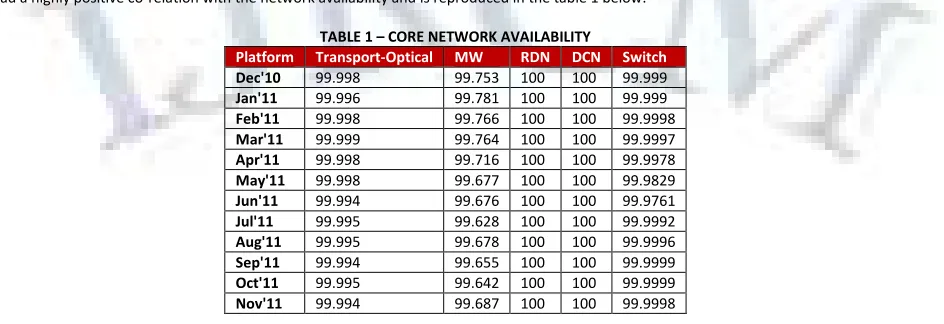
NLC has made all SLMs, course material and other reference document online. Employees are encouraged to learn and participate in Certification programs. Offering full featured distance learning methodology has eliminated the need for travel and provides work-life balance. NLC often conducts field training in areas where the network performance is poor or faults are high. A telecom network is heavily dependent on optical fibre backbone, which is often laid along main roads. In developing countries like India with a high level of infrastructure building activities, the incidence of fibre cuts are very high. This affects a multitude of services like voice, Internet, Data, IPTV, Video calls which are dependent on the optical backbone. Field engineers must be proficient in conceptual as well as practical aspects of fibre ducting, trenching and splicing techniques. Field trainings help an employee to get a real stock of the situation and learn maintenance techniques right at the site. In the month of January 2011 (an illustration), series of field trainings were conducted on fibre & utility. The effect of this training program had a highly positive co-relation with the network availability and is reproduced in the table 1 below:
TABLE 1 – CORE NETWORK AVAILABILITY
Platform Transport-Optical MW RDN DCN Switch
Dec'10 99.998 99.753 100 100 99.999
Jan'11 99.996 99.781 100 100 99.999
Feb'11 99.998 99.766 100 100 99.9998
Mar'11 99.999 99.764 100 100 99.9997
Apr'11 99.998 99.716 100 100 99.9978
May'11 99.998 99.677 100 100 99.9829
Jun'11 99.994 99.676 100 100 99.9761
Jul'11 99.995 99.628 100 100 99.9992
Aug'11 99.995 99.678 100 100 99.9996
Sep'11 99.994 99.655 100 100 99.9999
Oct'11 99.995 99.642 100 100 99.9999
VOLUME NO.2(2012),ISSUE NO.4(APRIL) ISSN 2231-5756
INTERNATIONAL JOURNAL OF RESEARCH IN COMMERCE, IT & MANAGEMENT
A Monthly Double-Blind Peer Reviewed Refereed Open Access International e-Journal - Included in the International Serial Directories
38
5.0
RESEARCH METHODOLOGY
This section outlines the methodology adopted for this research. 5.1 RESEARCH OBJECTIVES
The broad objective of this research is to analyze the impact & effectiveness of Self Learning Modules in the telecom industry. The specific objectives include:
1. To establish the impact of SLM on Employee Competence
2. To measure the effectiveness of SLMs on telecom technology training
5.2 HYPOTHESIS
Hypothesis for this research is as below:
H1: Organizational Self Learning initiatives have a positive impact on employee competency development.
H2: Self Learning Module is an optimal solution for telcos (in terms of cost and time)
5.3 SAMPLING DESIGN
Sample data for analysis was collected from NLC database for the period 2010-2011. Over this period, NLC has logged over 13000 certifications in all four network domains. The certification drive covered over 7000 employees spread across India. The certifications held during September and October 2011 was included as a part of this study.
5.4 DATA COLLECTION
The primary data for this research is extracted from the NLC Management Information System (MIS) database. This reflects the training delivery, course development, customer feedback, employee evaluation, training needs analysis data maintained in standardized International Organization for Standardization (ISO) compliant format by the NLC. The network performance is extracted from the standardize reports collated by the operation team. The employee performance data is collected from HR MIS and SAP-HR respectively.
5.5 DATA ANALYSIS, INTERPRETATION AND HYPOTHESIS TESTING
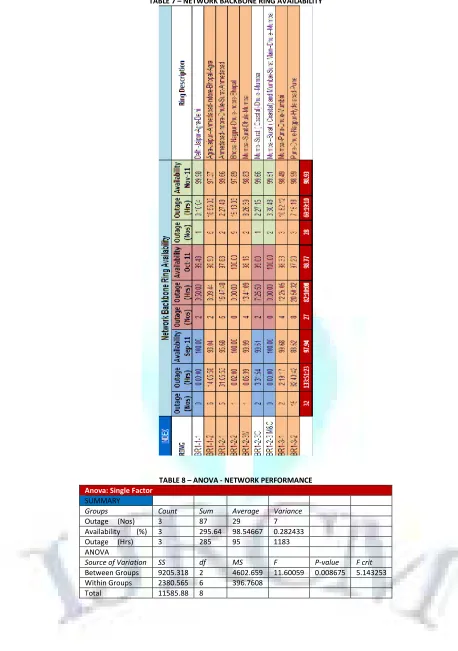
It is observed that most of the network issues can be traced to the Fibre & Utility, Fixed Access & Transport domains. The faults in these domains have the most impact on customer satisfaction, experience and revenues. The faults also take longer to be corrected given the extent of the network size (over 1,90,000 Kms of terrestrial network). Identification of the exact location and the extent of fibre cuts is a tedious & time consuming effort. Self learning modules and certification help the employees to build understanding on best practices of optical fibre ducting, trenching, splicing etc. The SLMs on utilities including power supplies, batteries, ACs and DG sets help in efficient utility management at telephone equipment convergence sites.
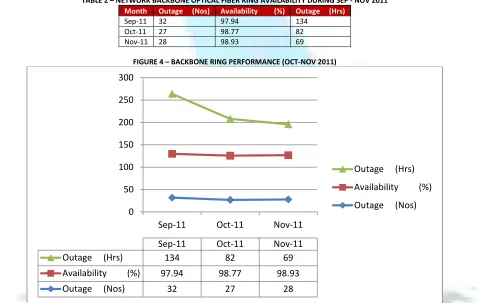
TABLE 2 – NETWORK BACKBONE OPTICAL FIBER RING AVAILABILITY DURING SEP - NOV 2011
Month Outage (Nos) Availability (%) Outage (Hrs)
Sep-11 32 97.94 134
Oct-11 27 98.77 82
Nov-11 28 98.93 69
FIGURE 4 – BACKBONE RING PERFORMANCE (OCT-NOV 2011)
Table 1 & 2 depicts the sustained level of backbone network and optical ring availability over a period of three months. Though fibre cut is mostly because of external factors, the skill sets developed through trainings and SLM helps constructively reduce the mean time to repair faults (MTTR) and reduce splicing losses. This is evident from a cursory look at the statistics provided in the figure 4 above.
0
50
100
150
200
250
300
Sep-11
Oct-11
Nov-11
Sep-11
Oct-11
Nov-11
Outage (Hrs)
134
82
69
Availability (%)
97.94
98.77
98.93
Outage (Nos)
32
27
28
Outage (Hrs)
Availability (%)
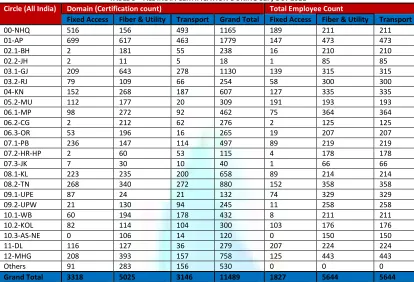
VOLUME NO.2(2012),ISSUE NO.4(APRIL) ISSN 2231-5756 TABLE 3 – ALL INDIA CERTIFICATION DURING SEP/OCT 2011
Circle (All India) Domain (Certification count) Total Employee Count
Fixed Access Fiber & Utility Transport Grand Total Fixed Access Fiber & Utility Transport
00-NHQ 516 156 493 1165 189 211 211
01-AP 699 617 463 1779 147 473 473
02.1-BH 2 181 55 238 16 210 210
02.2-JH 2 11 5 18 1 85 85
03.1-GJ 209 643 278 1130 139 315 315
03.2-RJ 79 109 66 254 58 300 300
04-KN 152 268 187 607 127 335 335
05.2-MU 112 177 20 309 191 193 193
06.1-MP 98 272 92 462 75 364 364
06.2-CG 2 212 62 276 2 125 125
06.3-OR 53 196 16 265 19 207 207
07.1-PB 236 147 114 497 89 219 219
07.2-HR-HP 2 60 53 115 4 178 178
07.3-JK 7 30 10 40 1 66 66
08.1-KL 223 235 200 658 89 214 214
08.2-TN 268 340 272 880 152 358 358
09.1-UPE 87 24 21 132 74 329 329
09.2-UPW 21 130 94 245 11 258 258
10.1-WB 60 194 178 432 8 211 211
10.2-KOL 82 114 104 300 103 176 176
10.3-AS-NE 0 106 14 120 0 150 150
11-DL 116 127 36 279 207 224 224
12-MHG 208 393 157 758 125 443 443
Others 91 283 156 530 0 0 0
Grand Total 3318 5025 3146 11489 1827 5644 5644
The pan-India SLM certification data during the period Sep/Oct 2011 on Wireless, Fixed Access, Transport Network and Data Networks is presented in the table 3 above. In over 45 days of certification camp held in two phases, 1827 Fixed Access employees have completed 3318 certification exams, 5644 employees of Fibre & Utility and Transport have completed 5025 and 3146 certifications respectively. The large number of SLM based technology certifications had an important bearing on the employee competency development and network availability and performance.
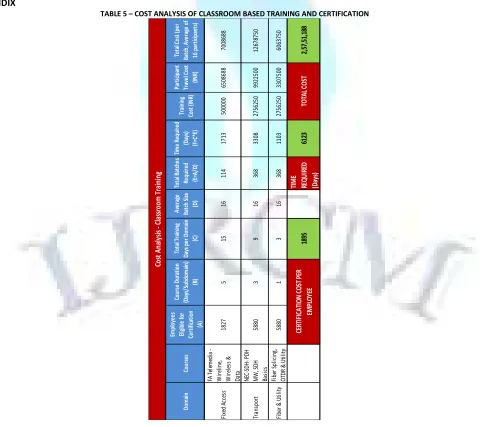
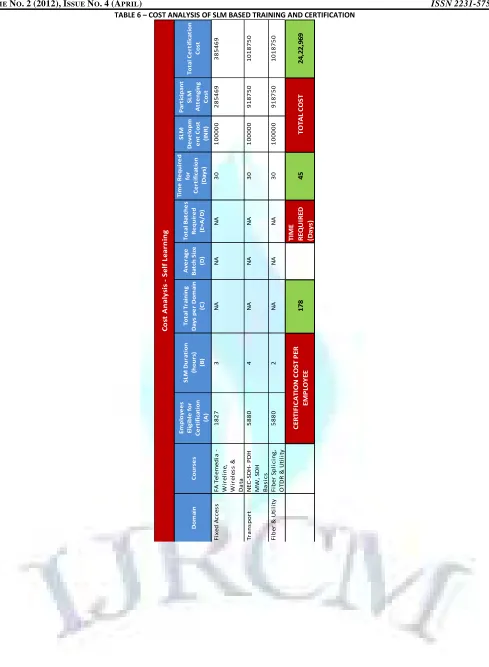
The summary of the cost benefit analysis of conventional as well as the 3T training model is provided in the table 4 below. The table highlighting the detailed breakup of the costs is included within the appendix.
TABLE 4 – COST EFFECTIVENESS OF SLM BASED CERTIFICATION
S.N Parameters Training Mode
Classroom Self Learning
1 Employees to Train 13587 13587
2 Per Employee Certification Cost (INR) 1895 178
3 Total Certification Time (Days) 6123 45
4 Total Cost (INR) 19303300 300000
The key inferences of this research study are as follows;
1. The certification cost per employee using the 3T model is Rs. 178 as compared to Rs 1895 by conventional method.
2. Time required to build workforce competencies through the 3T model of learning is only 45 days for against 6123 days for classroom training.
3. The Anova of the network performance data (Table 2) resulted in a p factor of 0.008. The hypothesis H2 thus stands proved.
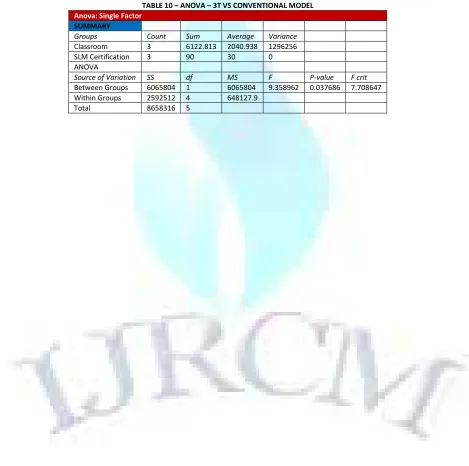
4. The Anova of the certification data P Value is less than 0.05, hence hypothesis H2 stands accepted.
7.0
KEY FINDINGS
1. Telecom operators require multi-skilled manpower to manage & operate complex networks. Skill development is time bound and has limited shelf life these days.
2. Timely certification of all concerned team members across all geographies improves organization competency & productivity.
3. SLM and E-Learning are cost-effective ways to deliver telecom training to the employees.
4. SLM based learning drastically reduces training delivery time & cost as compared to conventional training.
5. iSLM helps employees master complex skills requiring a high level of psycho-motor skills.
6. SLM based learning creates better work-life balance and adopts adult learning techniques.
7. There are no disruption to operation & maintenance on account of training nominations, with the use of the prescribed 3Ts method of learning.
8. Higher commitment to learning is accomplished through certification.
9. Flexi place, time for learning is inbuilt in the learning methodologies.
10. Continuous training and retraining is possible through this method.
8.0
SCOPE FOR FURTHER STUDY
1. Effectiveness of 3Ts method of training through SLM can be measured and validated via online chat for resolving technical queries.
2. Research on ROI for 3Ts method of training through SLM can be measured with respect to telecom network performance & employee performance.
9.0
CONCLUSION
1. The study conclusively establishes the positive impact & effectiveness of Self Learning Modules in the technology intensive telecom domain. The use of self
learning modules has a significant impact on building of employee competence.
2. 3Ts method of learning optimally manages cost of learning and certification for ROI.
VOLUME NO.2(2012),ISSUE NO.4(APRIL) ISSN 2231-5756
INTERNATIONAL JOURNAL OF RESEARCH IN COMMERCE, IT & MANAGEMENT
A Monthly Double-Blind Peer Reviewed Refereed Open Access International e-Journal - Included in the International Serial Directories
40
10.0
THEORETICAL, PRACTICAL IMPLICATIONS & LIMITATIONS OF THE STUDY
3Ts Blended learning model is designed to provide telcom engineers a holistic learning framework and helps in reducing technology knowledge gaps while resulting in improved customer satisfaction, increased revenue, reduced subscriber churn and improved network availability and service quality. Network Learning Center (NLC) has applied it in grooming fresh engineers, right from their induction. 3Ts blended learning programs for fresh graduates at NLC covers 360 degrees of learning, including classroom training, SLM, Certification, mentoring, coaching, on-the-job training, field visits, presentations, soft skill, job rotation etc. NLC offers many aspects of learning, such as building awareness to various compliances, Self Learning & Certification program etc. The validity of this model is to be empirically validated across multiple organizations within the industry and can form the basis of similar models straddling the entire service industry value chain.
The efficiency of this model has been tested for trainings suitable to the fresh recruits and frontline operational staff. The model has to be tested for efficacy of learning delivery across all organizational roles including leadership and middle management. The model should also encompass behavioural and soft skill training programmes.
REFERENCES
1. Cushing Anderson, Impact of Training on Network Administration: Certification Leads to Operational Productivity
2. Thalheimer, W. (2003, January). The learning benefits of questions. Retrieved November 31, 2003, from
http://www.work-learning.com/ma/PP_WP003.asp
3. NAIDU SOM, E-Learning - A Guidebook of Principles, Procedures and Practices, 2nd Revised Edition, CEMCA, 2006, Commonwealth Educational Media
Center for Asia (CEMCA)
4. Deb Sagarmay, Effective Distance Learning in Developing Countries Using Mobile and Multimedia Technology, International Journal of Multimedia and
Ubiquitous Engineering, Vol. 6, No. 2, April, 2011
5. Barbara Means, et. al., Evaluation of Evidence-Based Practices in Online Learning: A Meta-Analysis and Review of Online Learning Studies, Revised
September 2010, U.S. Department of Education, Office of Planning, Evaluation, and Policy Development Policy and Program Studies Service
6. Newell E. Chiesl, Indiana State University, DESIGNING INTERACTIVE SELF-LEARNING MODULES USING MACROMEDIA DIRECTOR, Developments in Business
Simulation and Experiential Learning, Volume 28, 2001
7. NAIDU SOM, E-Learning - A Guidebook of Principles, Procedures and Practices, 2nd Revised Edition, CEMCA, 2006, Commonwealth Educational Media
Center for Asia (CEMCA)
8. Deb Sagarmay, Effective Distance Learning in Developing Countries Using Mobile and Multimedia Technology, International Journal of Multimedia and
Ubiquitous Engineering, Vol. 6, No. 2, April, 2011
9. Barbara Means, et. al., Evaluation of Evidence-Based Practices in Online Learning: A Meta-Analysis and Review of Online Learning Studies, Revised
September 2010, U.S. Department of Education, Office of Planning, Evaluation, and Policy Development Policy and Program Studies Service
APPENDIX
TABLE 5 – COST ANALYSIS OF CLASSROOM BASED TRAINING AND CERTIFICATION
VOLUME NO.2(2012),ISSUE NO.4(APRIL) ISSN 2231-5756 TABLE 6 – COST ANALYSIS OF SLM BASED TRAINING AND CERTIFICATION
VOLUME NO.2(2012),ISSUE NO.4(APRIL) ISSN 2231-5756
INTERNATIONAL JOURNAL OF RESEARCH IN COMMERCE, IT & MANAGEMENT
A Monthly Double-Blind Peer Reviewed Refereed Open Access International e-Journal - Included in the International Serial Directories
42
TABLE 7 – NETWORK BACKBONE RING AVAILABILITYTABLE 8 – ANOVA - NETWORK PERFORMANCE Anova: Single Factor
SUMMARY
Groups Count Sum Average Variance
Outage (Nos) 3 87 29 7
Availability (%) 3 295.64 98.54667 0.282433
Outage (Hrs) 3 285 95 1183
ANOVA
Source of Variation SS df MS F P-value F crit
Between Groups 9205.318 2 4602.659 11.60059 0.008675 5.143253
Within Groups 2380.565 6 396.7608
VOLUME NO.2(2012),ISSUE NO.4(APRIL) ISSN 2231-5756 TABLE 9 –DESCRIPTIVE STATISTICS OF CERTIFICATION DATA
Fixed Access Fiber& Utility Transport
Mean 138.5416667 209.375 131.0833
Standard Error 34.39007794 32.92970183 27.24672
Median 89 179 93
Mode 2 #N/A #N/A
Standard Deviation 168.4762863 161.3219337 133.4811
Sample Variance 28384.25906 26024.7663 17817.21
Kurtosis 5.102388102 2.327527482 2.171422
Skewness 2.138676239 1.477333337 1.564548
Range 699 632 488
Minimum 0 11 5
Maximum 699 643 493
Sum 3325 5025 3146
Count 24 24 24
Largest(1) 699 643 493
Smallest(1) 0 11 5
Confidence Level (95.0%) 71.14129605 68.12027791 56.36413
TABLE 10 – ANOVA – 3T VS CONVENTIONAL MODEL Anova: Single Factor
SUMMARY
Groups Count Sum Average Variance
Classroom 3 6122.813 2040.938 1296256
SLM Certification 3 90 30 0
ANOVA
Source of Variation SS df MS F P-value F crit
Between Groups 6065804 1 6065804 9.358962 0.037686 7.708647
Within Groups 2592512 4 648127.9
VOLUME NO.2(2012),ISSUE NO.4(APRIL) ISSN 2231-5756
INTERNATIONAL JOURNAL OF RESEARCH IN COMMERCE, IT & MANAGEMENT
A Monthly Double-Blind Peer Reviewed Refereed Open Access International e-Journal - Included in the International Serial Directories
44
REQUEST FOR FEEDBACK
Dear Readers
At the very outset, International Journal of Research in Commerce, IT and Management (IJRCM)
acknowledges & appreciates your efforts in showing interest in our present issue under your kind perusal.
I would like to request you to supply your critical comments and suggestions about the material published
in this issue as well as on the journal as a whole, on our E-mails i.e.
or
for further improvements in the interest of research.
If you have any queries please feel free to contact us on our E-mail
.
I am sure that your feedback and deliberations would make future issues better – a result of our joint
effort.
Looking forward an appropriate consideration.
With sincere regards
Thanking you profoundly
Academically yours
Sd/-