A Monthly Double-Blind Peer Reviewed Refereed Open Access International e-Journal - Included in the International Serial Directories Indexed & Listed at:
Ulrich's Periodicals Directory ©, ProQuest, U.S.A., EBSCO Publishing, U.S.A., Index Copernicus Publishers Panel, Poland, Open J-Gage, India [link of the same is duly available at Inflibnet of University Grants Commission (U.G.C.)]
VOLUME NO.2(2012),ISSUE NO.3(MARCH) ISSN2231-5756
CONTENTS
CONTENTS
CONTENTS
CONTENTS
Sr.No.
TITLE & NAME OF THE AUTHOR (S)
Page No.
1. BRAND THEOLOGY: CONDITIONING AND CONFIGURING CONSUMER BEHAVIOUR ANM FARUKH
1 2. IMPACT OF EMPLOYEE SATISFACTION AND UNION – MANAGEMENT RELATION ON ENHANCED CUSTOMER SATISFACTION- REGRESSION
ANALYSIS: A STUDY OF ANDHRA PRADESH STATE ROAD TRANSPORT CORPORATION (A.P.S.R.T.C) A. R. VIJAYA CHANDRAN, DR. MOHAMMED ABBAS ALI & DR. V. M. PRASAD
5
3. A STUDY OF THE ATTITUDE OF THE YOUTH TOWARDS ADOPTION OF INTERNET ENTERPRENEUERSHIP IN NIGERIA DR. I C NWAIZUGBO & V N O AGHARA
7 4. THE IMPACT OF SMALL BUSINESS MANAGEMENT ON SOCIETAL MARKETING PRACTICES IN LAGOS MEGA CITY, NIGERIA
DR. HALIRU BALA
11 5. IMPACT OF HUMAN ERROR IN MAINTENANCE MANAGEMENT AND MINIMIZING METHODOLOGY
N. K. K. PRASANNA & TUSHAR N. DESAI
15 6. INTERPERSONAL RELATIONSHIP-AN ATTEMPT AT QUANTIFYING IT
T K PARAMESWARAN NAIR
21 7. PERFORMANCE APPRAISAL SYSTEM IN TEXTILE INDUSTRY WITH SPECIAL REFERENCE TO TIRUPUR- AN EXPLORATORY STUDY
DR. S. KUPPUSAMY, E.DEEPA & M. STELLA
27 8. MANAGERIAL PERCEPTION TOWARDS INDUSTRIAL SUBSIDY AND ITS IMPACT ON INDUSTRIALIZATION IN UTTRAKHAND: AN EMPIRICAL
STUDY
DR. D S CHAUBEY, SIDHESWAR PATRA & PRAVEEN KUKRETI
33
9. EMPLOYEE’S DISSONANCE TOWARDS SAFETY, HEALTH AND ENVIRONMENT (SHE) IN CONFECTIONERY INDUSTRY DR.MU.SUBRAHMANIAN & P. RENGANATHAN
40 10. ACCEPTANCE AND USAGE OF MANAGEMENT INFORMATION SYSTEM (MIS) IN SMALL SCALE INDUSTRIES
C.G. RAMACHANDRA & T.R. SRINIVAS
43 11. DEVELOPING RIGHT HUMAN EQUATION BY SELF KNOWLEDGE FOR CHANGE MANAGEMENT: LEARNING FROM INDIAN MYTHOLOGY
DR. K. V. ALIAS. BALAJI, DR. M.SIVAGNANASUNDARAM & BIDYANAND JHA
47 12. A STUDY ON WORK- LIFE BALANCE AMONG WOMEN TEACHERS WORKING IN SELF-FINANCING ENGINEERING INSTITUTIONS
S.PATTU MEENAKSHI & DR. K. RAVICHANDRAN
51 13. THE EFFECT OF TEAM PROCESS AND KEY COMPENSATION FACTORS WHILE MOTIVATING HIGH PERFORMANCE IN PHARMACEUTICAL
SALES TEAMS DR. SURENDRA KUMAR
56
14. SUPPLY CHAIN MANAGEMENT IN TWO WHEELER INDUSTRY - A STUDY ON HERO HONDA AND BAJAJ AUTO SUPPLY CHAIN PRACTICES R.VENKATESHWAR RAO.
61 15. OPTIMUM PERFORMANCE OF TURMERIC EXTRACTION FIRMS: AN INPUT-OUTPUT ANALYSIS
V.ABIRAMI & DR. HANSA LYSANDER MANOHAR
67 16. ANALYSIS OF PERSISTENCY IN THE MONTHLY COIMBATORE RAINFALL
TAMIL SELVI .S & SAMUEL SELVARAJ. R
71 17. PROS AND CONS OF IMPLEMENTING EMPLOYEE EMPOWERMENT IN SERVICE SECTOR- A META ANALYSIS OF RESEARCH LITERATURE
ELIZABETH GEORGE & DR. ZAKKARIYA K.A.
73 18. STUDY OF CONSUMER AWARENESS ABOUT E-BANKING SERVICES AND ITS APPLICATION IN SELECT AREA OF PUNE CITY
KRISHNA MOHAN SHARMA & VINEETA DEOLIA
77 19. CSR – A NEW ROLE ENTRUSTED TO EDUCATIONAL INSTITUTIONS
PRAGATI CHAUHAN & YOGITA SHARMA
80 20. A STUDY ON EFFECTIVENESS OF CAPITAL STRUCTURE AMONG SELECTED PRIVATE TEXTILE COMPANIES IN INDIA
VIVEK SUBRAMANIAM
84 21. IMPACT OF GLOBAL FINANCIAL CRISIS ON BUSINESS CYCLES IN DEVELOPING ASIA AND THE DECOUPLING HYPOTHESIS
DR. RAVI SINGLA
91 22. SYSTEMATIC RISK AND RETURN ANALYSIS IN SECURITY MARKET
NIVEDHITA.J & REVATHI.P
97 23. ASSETS FORMATION AND BUSINESS IN PUNJAB NATIONAL BANK: A CASE STUDY
NAMITA MAINI
102 24. GOVERNANCE AND RESPONSIBILITY - A JOINT VENTURE (WITH SPECIAL REFERENCE TO TATA)
RADHAKRISHNA MISHRA & MALAVIKA PATTNAIK
105 25. FACTORS EFFECTING READING DECISION OF PRINT ADVERTISEMENT: AN EXPLORATORY AND EXPERIMENTAL STUDY
ANUPAMA SUNDAR & JATIN PANDEY
108 26. WORKING CAPITAL MANAGEMENT AND PROFITABILITY –A CASE STUDY OF BALRAMPUR CHINNI MILLS LIMITED
DR. P. C. NARWARE
111 27. ROLE OF ICT MICRO ENTERPRISES ON WOMEN DEVELOPMENT IN KERALA
DR. C.S. SIVA PRAKASH
115 28. ENTREPRENEURSHIP AMONG RURAL WOMEN -A STUDY IN ANDHRA PRADESH
DR. NANU LUNAVATH
122 29. BUSINESS EXCELLENCE MODELS: QUANTIFYING THE IMPLEMENTATION AND MATURITY LEVEL – A STATISTICAL APPROACH
RUCHIK GANDHI & JUBIN MEHTA
130 30. STUDENT’S ATTITUDE TOWARDS APPLICATION OF STATISTICS: A STUDY OF UNIVERSITY OF JAMMU
ANJU THAPA & ANKUSH BHARTI
135
INTERNATIONAL JOURNAL OF RESEARCH IN COMMERCE, IT & MANAGEMENT
CHIEF PATRON
CHIEF PATRON
CHIEF PATRON
CHIEF PATRON
PROF. K. K. AGGARWAL
Chancellor, Lingaya’s University, Delhi
Founder Vice-Chancellor, Guru Gobind Singh Indraprastha University, Delhi
Ex. Pro Vice-Chancellor, Guru Jambheshwar University, Hisar
PATRON
PATRON
PATRON
PATRON
SH. RAM BHAJAN AGGARWAL
Ex. State Minister for Home & Tourism, Government of Haryana
Vice-President, Dadri Education Society, Charkhi Dadri
President, Chinar Syntex Ltd. (Textile Mills), Bhiwani
CO
CO
CO
CO----ORDINATOR
ORDINATOR
ORDINATOR
ORDINATOR
AMITA
Faculty, Government M. S., Mohali
ADVISORS
ADVISORS
ADVISORS
ADVISORS
DR. PRIYA RANJAN TRIVEDI
Chancellor, The Global Open University, Nagaland
PROF. M. S. SENAM RAJU
Director A. C. D., School of Management Studies, I.G.N.O.U., New Delhi
PROF. M. N. SHARMA
Chairman, M.B.A., Haryana College of Technology & Management, Kaithal
PROF. S. L. MAHANDRU
Principal (Retd.), Maharaja Agrasen College, Jagadhri
EDITOR
EDITOR
EDITOR
EDITOR
PROF. R. K. SHARMA
Professor, Bharti Vidyapeeth University Institute of Management & Research, New Delhi
CO
CO
CO
CO----EDITOR
EDITOR
EDITOR
EDITOR
DR. BHAVET
Faculty, M. M. Institute of Management, Maharishi Markandeshwar University, Mullana, Ambala, Haryana
EDITORIAL ADVISORY BOARD
EDITORIAL ADVISORY BOARD
EDITORIAL ADVISORY BOARD
EDITORIAL ADVISORY BOARD
DR. RAJESH MODI
Faculty, Yanbu Industrial College, Kingdom of Saudi Arabia
PROF. SANJIV MITTAL
University School of Management Studies, Guru Gobind Singh I. P. University, Delhi
PROF. ANIL K. SAINI
Chairperson (CRC), Guru Gobind Singh I. P. University, Delhi
DR. SAMBHAVNA
Faculty, I.I.T.M., Delhi
DR. MOHENDER KUMAR GUPTA
VOLUME NO.2(2012),ISSUE NO.3(MARCH) ISSN2231-5756
DR. SHIVAKUMAR DEENE
Asst. Professor, Dept. of Commerce, School of Business Studies, Central University of Karnataka, Gulbarga
MOHITA
Faculty, Yamuna Institute of Engineering & Technology, Village Gadholi, P. O. Gadhola, Yamunanagar
ASSOCIATE EDITORS
ASSOCIATE EDITORS
ASSOCIATE EDITORS
ASSOCIATE EDITORS
PROF. NAWAB ALI KHAN
Department of Commerce, Aligarh Muslim University, Aligarh, U.P.
PROF. ABHAY BANSAL
Head, Department of Information Technology, Amity School of Engineering & Technology, Amity University, Noida
PROF. A. SURYANARAYANA
Department of Business Management, Osmania University, Hyderabad
DR. ASHOK KUMAR
Head, Department of Electronics, D. A. V. College (Lahore), Ambala City
DR. SAMBHAV GARG
Faculty, M. M. Institute of Management, Maharishi Markandeshwar University, Mullana, Ambala, Haryana
PROF. V. SELVAM
SSL, VIT University, Vellore
DR. PARDEEP AHLAWAT
Reader, Institute of Management Studies & Research, Maharshi Dayanand University, Rohtak
S. TABASSUM SULTANA
Associate Professor, Department of Business Management, Matrusri Institute of P.G. Studies, Hyderabad
SURJEET SINGH
Asst. Professor, Department of Computer Science, G. M. N. (P.G.) College, Ambala Cantt.
TECHNICAL ADVISOR
TECHNICAL ADVISOR
TECHNICAL ADVISOR
TECHNICAL ADVISOR
AMITA
Faculty, Government H. S., Mohali
MOHITA
Faculty, Yamuna Institute of Engineering & Technology, Village Gadholi, P. O. Gadhola, Yamunanagar
FINANCIAL ADVISORS
FINANCIAL ADVISORS
FINANCIAL ADVISORS
FINANCIAL ADVISORS
DICKIN GOYAL
Advocate & Tax Adviser, Panchkula
NEENA
Investment Consultant, Chambaghat, Solan, Himachal Pradesh
LEGAL ADVISORS
LEGAL ADVISORS
LEGAL ADVISORS
LEGAL ADVISORS
JITENDER S. CHAHAL
Advocate, Punjab & Haryana High Court, Chandigarh U.T.
CHANDER BHUSHAN SHARMA
Advocate & Consultant, District Courts, Yamunanagar at Jagadhri
SUPERINTENDENT
SUPERINTENDENT
SUPERINTENDENT
SUPERINTENDENT
SURENDER KUMAR POONIA
INTERNATIONAL JOURNAL OF RESEARCH IN COMMERCE, IT & MANAGEMENT
CALL FOR MANUSCRIPTS
CALL FOR MANUSCRIPTS
CALL FOR MANUSCRIPTS
CALL FOR MANUSCRIPTS
Weinvite unpublished novel, original, empirical and high quality research work pertaining to recent developments & practices in the area of Computer, Business, Finance, Marketing, Human Resource Management, General Management, Banking, Insurance, Corporate Governance and emerging paradigms in allied subjects like Accounting Education; Accounting Information Systems; Accounting Theory & Practice; Auditing; Behavioral Accounting; Behavioral Economics; Corporate Finance; Cost Accounting; Econometrics; Economic Development; Economic History; Financial Institutions & Markets; Financial Services; Fiscal Policy; Government & Non Profit Accounting; Industrial Organization; International Economics & Trade; International Finance; Macro Economics; Micro Economics; Monetary Policy; Portfolio & Security Analysis; Public Policy Economics; Real Estate; Regional Economics; Tax Accounting; Advertising & Promotion Management; Business Education; Management Information Systems (MIS); Business Law, Public Responsibility & Ethics; Communication; Direct Marketing; E-Commerce; Global Business; Health Care Administration; Labor Relations & Human Resource Management; Marketing Research; Marketing Theory & Applications; Non-Profit Organizations; Office Administration/Management; Operations Research/Statistics; Organizational Behavior & Theory; Organizational Development; Production/Operations; Public Administration; Purchasing/Materials Management; Retailing; Sales/Selling; Services; Small Business Entrepreneurship; Strategic Management Policy; Technology/Innovation; Tourism, Hospitality & Leisure; Transportation/Physical Distribution; Algorithms; Artificial Intelligence; Compilers & Translation; Computer Aided Design (CAD); Computer Aided Manufacturing; Computer Graphics; Computer Organization & Architecture; Database Structures & Systems; Digital Logic; Discrete Structures; Internet; Management Information Systems; Modeling & Simulation; Multimedia; Neural Systems/Neural Networks; Numerical Analysis/Scientific Computing; Object Oriented Programming; Operating Systems; Programming Languages; Robotics; Symbolic & Formal Logic and Web Design. The above mentioned tracks are only indicative, and not exhaustive.
Anybody can submit the soft copy of his/her manuscript anytime in M.S. Word format after preparing the same as per our submission guidelines duly available on our website under the heading guidelines for submission, at the email addresses: [email protected]or
GUIDELINES FOR SUBMISSION OF MANUSCRIP
GUIDELINES FOR SUBMISSION OF MANUSCRIP
GUIDELINES FOR SUBMISSION OF MANUSCRIP
GUIDELINES FOR SUBMISSION OF MANUSCRIPT
T
T
T
1. COVERING LETTER FOR SUBMISSION:
DATED: _____________ THE EDITOR
IJRCM
Subject: SUBMISSION OF MANUSCRIPT IN THE AREA OF .
(e.g. Finance/Marketing/HRM/General Management/Economics/Psychology/Law/Computer/IT/Engineering/Mathematics/other, please specify)
DEAR SIR/MADAM
Please find my submission of manuscript entitled ‘___________________________________________’ for possible publication in your journals.
I hereby affirm that the contents of this manuscript are original. Furthermore, it has neither been published elsewhere in any language fully or partly, nor is it under review for publication elsewhere.
I affirm that all the author (s) have seen and agreed to the submitted version of the manuscript and their inclusion of name (s) as co-author (s).
Also, if my/our manuscript is accepted, I/We agree to comply with the formalities as given on the website of the journal & you are free to publish our contribution in any of your journals.
NAME OF CORRESPONDING AUTHOR: Designation:
Affiliation with full address, contact numbers & Pin Code: Residential address with Pin Code:
Mobile Number (s): Landline Number (s): E-mail Address: Alternate E-mail Address:
NOTES:
a) The whole manuscript is required to be in ONE MS WORD FILE only (pdf. version is liable to be rejected without any consideration), which will start from the covering letter, inside the manuscript.
b) The sender is required to mention the following in the SUBJECT COLUMN of the mail:
New Manuscript for Review in the area of (Finance/Marketing/HRM/General Management/Economics/Psychology/Law/Computer/IT/ Engineering/Mathematics/other, please specify)
c) There is no need to give any text in the body of mail, except the cases where the author wishes to give any specific message w.r.t. to the manuscript. d) The total size of the file containing the manuscript is required to be below 500 KB.
e) Abstract alone will not be considered for review, and the author is required to submit the complete manuscript in the first instance.
f) The journal gives acknowledgement w.r.t. the receipt of every email and in case of non-receipt of acknowledgment from the journal, w.r.t. the submission of manuscript, within two days of submission, the corresponding author is required to demand for the same by sending separate mail to the journal.
2. MANUSCRIPT TITLE: The title of the paper should be in a 12 point Calibri Font. It should be bold typed, centered and fully capitalised.
3. AUTHOR NAME (S) & AFFILIATIONS: The author (s) full name, designation, affiliation (s), address, mobile/landline numbers, and email/alternate email address should be in italic & 11-point Calibri Font. It must be centered underneath the title.
VOLUME NO.2(2012),ISSUE NO.3(MARCH) ISSN2231-5756 5. KEYWORDS: Abstract must be followed by a list of keywords, subject to the maximum of five. These should be arranged in alphabetic order separated by
commas and full stops at the end.
6. MANUSCRIPT: Manuscript must be in BRITISH ENGLISH prepared on a standard A4 size PORTRAIT SETTING PAPER. It must be prepared on a single space and single column with 1” margin set for top, bottom, left and right. It should be typed in 8 point Calibri Font with page numbers at the bottom and centre of every page. It should be free from grammatical, spelling and punctuation errors and must be thoroughly edited.
7. HEADINGS: All the headings should be in a 10 point Calibri Font. These must be bold-faced, aligned left and fully capitalised. Leave a blank line before each heading.
8. SUB-HEADINGS: All the sub-headings should be in a 8 point Calibri Font. These must be bold-faced, aligned left and fully capitalised.
9. MAIN TEXT: The main text should follow the following sequence:
INTRODUCTION
REVIEW OF LITERATURE
NEED/IMPORTANCE OF THE STUDY
STATEMENT OF THE PROBLEM
OBJECTIVES
HYPOTHESES
RESEARCH METHODOLOGY
RESULTS & DISCUSSION
FINDINGS
RECOMMENDATIONS/SUGGESTIONS
CONCLUSIONS
SCOPE FOR FURTHER RESEARCH
ACKNOWLEDGMENTS
REFERENCES
APPENDIX/ANNEXURE
It should be in a 8 point Calibri Font, single spaced and justified. The manuscript should preferably not exceed 5000 WORDS.
10. FIGURES &TABLES: These should be simple, centered, separately numbered & self explained, and titles must be above the table/figure. Sources of data should be mentioned below the table/figure. It should be ensured that the tables/figures are referred to from the main text.
11. EQUATIONS: These should be consecutively numbered in parentheses, horizontally centered with equation number placed at the right.
12. REFERENCES: The list of all references should be alphabetically arranged. The author (s) should mention only the actually utilised references in the preparation of manuscript and they are supposed to follow Harvard Style of Referencing. The author (s) are supposed to follow the references as per the following:
•
All works cited in the text (including sources for tables and figures) should be listed alphabetically.•
Use (ed.) for one editor, and (ed.s) for multiple editors.•
When listing two or more works by one author, use --- (20xx), such as after Kohl (1997), use --- (2001), etc, in chronologically ascending order.•
Indicate (opening and closing) page numbers for articles in journals and for chapters in books.•
The title of books and journals should be in italics. Double quotation marks are used for titles of journal articles, book chapters, dissertations, reports, working papers, unpublished material, etc.•
For titles in a language other than English, provide an English translation in parentheses.•
The location of endnotes within the text should be indicated by superscript numbers.PLEASE USE THE FOLLOWING FOR STYLE AND PUNCTUATION IN REFERENCES: BOOKS
•
Bowersox, Donald J., Closs, David J., (1996), "Logistical Management." Tata McGraw, Hill, New Delhi.•
Hunker, H.L. and A.J. Wright (1963), "Factors of Industrial Location in Ohio" Ohio State University, Nigeria.CONTRIBUTIONS TO BOOKS
•
Sharma T., Kwatra, G. (2008) Effectiveness of Social Advertising: A Study of Selected Campaigns, Corporate Social Responsibility, Edited by David Crowther & Nicholas Capaldi, Ashgate Research Companion to Corporate Social Responsibility, Chapter 15, pp 287-303.JOURNAL AND OTHER ARTICLES
•
Schemenner, R.W., Huber, J.C. and Cook, R.L. (1987), "Geographic Differences and the Location of New Manufacturing Facilities," Journal of Urban Economics, Vol. 21, No. 1, pp. 83-104.CONFERENCE PAPERS
•
Garg, Sambhav (2011): "Business Ethics" Paper presented at the Annual International Conference for the All India Management Association, New Delhi, India, 19–22 June.UNPUBLISHED DISSERTATIONS AND THESES
•
Kumar S. (2011): "Customer Value: A Comparative Study of Rural and Urban Customers," Thesis, Kurukshetra University, Kurukshetra.ONLINE RESOURCES
•
Always indicate the date that the source was accessed, as online resources are frequently updated or removed.WEBSITE
INTERNATIONAL JOURNAL OF RESEARCH IN COMMERCE, IT & MANAGEMENT
STUDY OF CONSUMER AWARENESS ABOUT E-BANKING SERVICES AND ITS APPLICATION IN SELECT AREA
OF PUNE CITY
KRISHNA MOHAN SHARMA
ASST. PROFESSOR
DR. D. Y PATIL INSTITUTE OF MANAGEMENT
AMBI
VINEETA DEOLIA
TRAINER-SOFT SKILLS
BARLOTA NAGAR
ABSTRACT
The study find that the E-banking is growing but as far as online banking is concerned there are few users (27%) who use online banking due to possibility of online fraud while ATM banking and Mobile banking are preferred options in e-banking.
KEYWORDS
E-banking, Customer satisfaction, PCMC.
INTRODUCTION
- Banking is a new banking system in banking industry and getting popularity in Indian scenario. The E -banking channel is both an informative and a transactional medium. However, E -banking has not been well understood by Indian customers in India. The growth of technology has changed the payment systems world over during the past two decades. More and more innovations are being introduced in both cash payment systems and non-cash payment systems. With the introduction and implementation of recent technology in banking, electronic devices are making the job of cash payment as well as non-cash payments easy and efficient. The introduction of Automatic Teller machines (ATMs) and the plastic Cards (Credit Cards) has given the banking customers the facility of round the clock (24 hours) banking. (Nath, 2005), Malhotra and Singh (2007) carried out a study to know the E -banking adoption by the banks in India. The study reveals that larger banks or banks with younger age, private ownership and lower branch intensity possess high probability of adoption of this new technology. E - Banking provides an opportunity for those customers who are familiar with internet facility while majority of customers are not having internet facility at their home or nearby their residence which creates the limitations for the development of e-banking in Indian perspective. Researcher observed that even educated people do not prefer to use banking. There are various electronic payment systems such as ATMS, Credit Cards, Debit Card. E-banking can provide speedier, faster and reliable services to the customers for which they are relatively happy. E-E-banking services not only can create new competitive advantages, it can improve its relationships with customers (Nupur, 2010). The purpose of this research is to understand the impact of variables. This research paper is an attempt to know the awareness level and confidence level of users in E-banking Services in select area of Pune City.
LITERATURE REVIEW
Growth of Electronic banking in a country depends on many factors, such as success of internet access, new online banking features, household growth of internet usage, legal and regulatory framework. E-banking can offer speedier, quicker and dependable services to the customers for which they may be relatively satisfied than that of manual system of banking.( Nupur,2010). Pikkarainen, Karjaluoto, and Pahnila, (2004) defines internet banking as an „internet portal, through which customers can use different kinds of banking services ranging from bill payment to making investments‟. With the exception of cash withdrawals, internet banking gives customers access to almost any type of banking transaction at the click of a mouse (De Young, 2001). Banks use online banking as it is one of the cheapest delivery channels for banking products (Pikkarainen et al., 2004) . Such service also saves the time and money of the bank with an added benefit of minimizing the likelihood of committing errors by bank tellers (Jayawardhena, 2000). E-banking is defined as the automated delivery of new and traditional banking products and services directly to customers through electronic, interactive communication channels. E-banking includes the systems that enable financial institution customers, individuals or businesses, to access accounts, transact business, or obtain information on financial products and services through a public or private network, including the Internet.( Vasanthakumari, H,2010). In the extant literature, the most cited attributes that influences the use of e-banking are: convenience of usage (Venkatesh and Davis, 1996), Perceived ease of use and credibility, cost reduction are key factors.
OBJECTIVES OF THE STUDY
• To know the awareness level of E-banking in PCMC area of Pune City
• To analyze the customer satisfaction level in PCMC.
• To know the problems in e-banking operation faced by customers.
• To know the customers suggestions about new required features.
RESEARCH METHODOLOGY
The study is mainly based on the primary data source and the secondary also. For general concept development about the short survey in primary sources and questionnaire used for collecting data about the customer satisfaction in e-banking in PCMC area.
SAMPLING METHODOLOGY
Researcher was intended to know the satisfaction and awareness level towards e-banking at PCMC area. Data is collected by adopting survey method and by visiting various banks like HDFC/ICICI Bank/Central Bank/ Axis Bank where customers were visiting for banking. Researcher collected the data from 243 respondents. The customers were selected by adopting convenience sampling method. A total of 243 useful questionnaires were entered in the data analysis. Cross tabulations, Multiple Regression and discriminate analyses were the main statistical tools employed.
REFERENCE PERIOD
1st Aug 2011-15th Oct.2011
QUESTIONNAIRE DESIGN AND SCALE
The respondents responded to questions under each variable on five point Likert Scale with “Strongly agree” dictating the highest level of satisfaction, “Strongly disagree” as the highest level of dissatisfaction
HYPOTHESIS
H1: The quality of e–banking services offered by banks has significant influence on its customer. H2: overall satisfaction with online banking services are positively related to online systems attributes.
VOLUME NO.2(2012),ISSUE NO.3(MARCH) ISSN2231-5756
H3: Satisfied customers use more online banking features than less satisfied customers.
EMPIRICAL RESULTS
The sample comprises more male (66%) than female. The majority of the respondents (66%) are in the 22 - 38 years old category. Access to the Internet is mainly at work (33%) or home .Researchers observed that normally even educated respondents feel fear to use on line banking due to possibility of fraud. Only 27% have been using the Internet for banking purposes for more than two years and almost half of the respondents use Internet banking daily or at least three times per week. 36.5%) customers use phone banking while majority of users prefer to use ATM as safe mode of transition. Finally, overall 74.4 percent declared to be strongly satisfied but reported the low frequency of ATM points in their area as well as 25.6 % customers’ findings revealed that they received short money during transition and their problems were solved after lot of trouble.
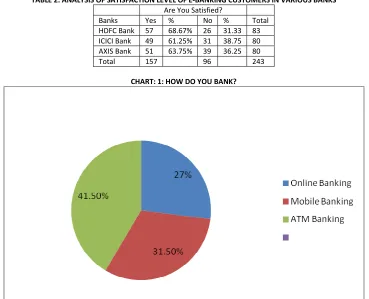
Our results show that despite the level of satisfaction with internet banking, customers prefer to use multiple banking options like Mobile banking & ATM banking. Researcher observed that In PCMC area percentage of internet banking users are only 27%, Mobile users were only 31.5 % and majority of users (41.5%)prefer to use ATM banking facility and feel it safe rather than other options.
Researchers were intended to know the purpose of on line banking and it is observed that normally customer prefer (100%) to use this facility for checking balance of their account, 41.6% to transfer the funds from their own account to another account but still they do not want to take the risk for transferring the fund in the account of another person due to fear of online fraud and percentage of online users were also recorded very low (27%). To pay various bills like telephone and electric bill 39.4% prefer to use online banking while only 19% customers prefer to use for shopping purpose.
Researchers further observed and recorded that majority of customers 41. 5% prefer to use ATM mode for requesting cheque book, card payment and other purpose.
HYPOTHESIS TESTING
HYPOTHESIS 1
The three banks selected for the study are: HDFC, ICICI and AXIS Bank. The survey as shown in Table 1 revealed that 68.67% customers were satisfied with HDFC, 63.75% from AXIS while 61.25 were satisfied with ICICI Bank during e-banking.
The Chi–Square analysis was employed to test the hypothesis at 95%, 3 degree of freedom. The result of the analysis as shown in Table 1 revealed that the quality of e–banking services offered by banks have significant influence on their customers. The calculated Chi–Square = 72.3 is greater than the tabulated Chi-Square at 95% confidence level and 3 degree of freedom = 7.815.
Therefore, we accept our Null hypothesis that there is significant difference and reject the alternative hypothesis that there is no significant difference. The quality of e-banking services in terms of effective delivery, reliability, easy access and low fee charges significantly influence customers’ choice of banks and patronage.
HYPOTHESIS 2 & 3
To test the hypotheses, Researchers applied multiple regressions with the overall satisfaction measure as dependent variable and customer service and online systems attributes as independent variables. The main effects of customer service and online systems attributes are predicted by hypotheses 1 and 2. Both customer services (H1) and online systems (H2) attributes have statistically significant effect on overall satisfaction. More specifically, courtesy, timeliness and product and services offered are all statistically significant (p = < .05).
Findings reveal that not all customer service and online systems features motivate and enhance the satisfaction it differs from customers to customers as per their needs.
For analyzing H3 Researcher had applied discriminate analysis and findings reveals no significant differences at p= or < .05. This leads to conclude that H3 is rejected. For testing this hypothesis collected data were divided between satisfied and dissatisfied customers. Researchers analyzed that 189 customers were satisfied while 54 respondents were dissatisfied.
Researchers conclude that customers are having multiple banking options and they are still not mentally prepared for frequent uses of online banking facility. Researchers further observed that customers were dissatisfied with time consumed by banks for resolving their complaint.
CONCLUSION
Researchers conclude that E-banking is growing but as far as online banking is concerned there are very few users (27%) who use online banking due to possibility of online fraud while ATM banking and Mobile banking are preferred options in e-banking.
REFERENCES
1. DeYoung, J. 2001 „The Internet's place in the banking industry‟, Chicago Fed Letter, No.163, pp.1-4
2. Hernan E. Riquelme, Hernan , Khalid A. Mekkaoui and Rosa E. Rios, Internet Banking Customer Satisfaction and Online Service Attributes, Journal of
Internet Banking and Commerce, August 2009, vol. 14, no.2.
3. Jayawardhena, C., & Foley, P. 2000. Changes in the Internet banking sector – The case of internet banking in UK, Internet Research. Electronic Networking
Applications and Policy, 10(1), 19-30.
4. Malhotra, P. and Singh, B. (2007) ‘Determinants of internet banking adoption by banks in India’, Internet Research, Vol. 17, No. 3, pp.323–339.
5. Nath Onkar(2005), Principle of Banking, Macmillan India Ltd, P. No.320
6. Nupur Jannatul Mawa (2010), “E-Banking and Customers’ Satisfaction in Bangladesh: An Analysis International Review of Business Research Papers Volume
6. Number 4. September 2010. Pp. 145 – 156
7. Pikkarainen, T., Pikkarainen, K., Karjaluoto, H., & Pahnila, S. 2004. Consumer acceptance of online banking: An extension of the technology acceptance
model. Internet Research, 14(3), 224–235.
8. Vasanthakumari H & Rani Sheela S(2010), Role of E – Banking Services in the banking sector, SRM Digest, 2010, p.no. 43
9. Venkatesh V and Davis F D (1996), “A Model of the Antecedents of Perceived Ease of Use: Development and Test”, Decision Sciences, Vol. 27, No. 3, pp.
451-81.
10. Gbadeyan R. A., Customers Preference for E-Banking Services: A Case Study of selected Banks in Sierra Leone, Australian Journal of Business and
Management Research Vol.1 No.4 [108-116] | July-2011.
APPENDIX
TABLE NO. 1: CHI –SQUARE TEST FOR HYPOTHESIS-1 Value Df Asymp.sig.( 2-sided)
Pearson Chi-Square 76.241 3 .000
Likelihood Ratio 75.321 3 .000
Linear by Linear Association 14.293 1 .000
INTERNATIONAL JOURNAL OF RESEARCH IN COMMERCE, IT & MANAGEMENT
TABLE 2: ANALYSIS OF SATISFACTION LEVEL OF E-BANKING CUSTOMERS IN VARIOUS BANKSAre You Satisfied?
Banks Yes % No % Total
HDFC Bank 57 68.67% 26 31.33 83
ICICI Bank 49 61.25% 31 38.75 80
AXIS Bank 51 63.75% 39 36.25 80
Total 157 96 243
CHART: 1: HOW DO YOU BANK?
Researcher were interested to know the preferred banking mode of customers and it was observed that majority of customers prefer to bank through ATM mode and only 27% customers use online banking facilities.
CHART NO. 2: ANALYSIS OF CUSTOMER USAGES DURING ON-LINE BANKING
VOLUME NO.2(2012),ISSUE NO.3(MARCH) ISSN2231-5756
REQUEST FOR FEEDBACK
Dear Readers
At the very outset, International Journal of Research in Commerce, IT and Management (IJRCM)
acknowledges & appreciates your efforts in showing interest in our present issue under your kind perusal.
I would like to request you to supply your critical comments and suggestions about the material published
in this issue as well as on the journal as a whole, on our E-mails i.e.
or
for further improvements in the interest of research.
If you have any queries please feel free to contact us on our E-mail
.
I am sure that your feedback and deliberations would make future issues better – a result of our joint
effort.
Looking forward an appropriate consideration.
With sincere regards
Thanking you profoundly
Academically yours
Sd/-