University of Bolton
UBIR: University of Bolton Institutional Repository
Psychology: Journal Articles (Peer-Reviewed)
Psychology
1998
Psychological characteristics of students taking
programming-oriented and applications-oriented
computing courses
John P. Charlton
University of Bolton, [email protected]
Paul E. Birkett
University of Bolton, [email protected]
This Article is brought to you for free and open access by the Psychology at UBIR: University of Bolton Institutional Repository. It has been accepted for inclusion in Psychology: Journal Articles (Peer-Reviewed) by an authorized administrator of UBIR: University of Bolton Institutional Repository. For more information, please [email protected].
Digital Commons Citation
Charlton, John P. and Birkett, Paul E.. "Psychological characteristics of students taking programming-oriented and applications-oriented computing courses." (1998).Psychology: Journal Articles (Peer-Reviewed).Paper 8.
Psychological Characteristics of Students Taking
Programming-Oriented and Applications-Oriented Computing Courses
JOHN P. CHARLTON and PAUL E. BIRKETT
Division of Psychology & Biology,
Bolton Institute of Higher Education,
ABSTRACT
The characteristics of students taking programming-oriented and applications-oriented higher
education courses are compared. Relative to the latter students, the former students' personalities are
shown to be of a more schizoid nature, this providing an explanation of these students' greater
computer engagement, programming experience and computing aptitude, at least as far as males are
concerned. The extent to which programming experience is accumulated by females is concluded to
be a major factor explaining the greater gender imbalance in enrolment on the programming-oriented
course.
Psychometric measures are found to be useful over and above cheaper, more easily obtainable,
information in discriminating between the two types of student. However, psychometric measures are
not found useful in increasing the association between correctness of course classification subsequent
to Discriminant Function Analysis and success/failure on the courses.
Finally, the same set of characteristics, involving among other things, greater involvement in
computing, is found to be associated with success irrespective of course.
INTRODUCTION
Much has been written on gender differences concerning participation in programming-oriented and
applications-oriented computing activities [1,2,3,4,5,6]. However, there have been few investigations
of other psychological factors which might explain why individuals are differentially drawn towards
these two areas of computing. From a theoretical standpoint, such studies are useful in testing
psychological theory and in advancing the work on gender differences. In a more applied vein, such
students unsure of which type of computing course they should follow, and also in helping reduce
institutional financial losses associated with course wastage rates. With respect to this latter point, it
can be calculated that, on average, the loss in fees attributable to student dropout / failure for the two
courses considered in the present study amounts to the equivalent of $437,286 per yearly intake.
There is therefore considerable incentive to investigate ways in which such losses can be ameliorated.
The present study aimed to assess whether certain characteristics distinguish students taking
programming-oriented and applications-oriented computing courses. Also investigated was the matter
of whether students whose profiles were more typical of students taking the type of course other than
that actually studied were less likely to successfully complete courses than those possessing
characteristics similar to their course colleagues. Towards these ends, students enrolling in higher
education Computing (programming-oriented) and Business Information Technology (BIT -
applications-oriented) courses were contrasted.
One of the main distinctions which can be drawn between the nature of programming and
applications courses concerns a focus upon computing itself as compared with the use of computing
as a tool used towards other ends [1]. Given this, and the likelihood that, because of its
computing-centered nature, more highly computer involved individuals would enroll in the Computing course,
much of the rationale for the present study stemmed from the assumption that students taking the
Computing and BIT courses would be more and less akin to Shotton's [7] computer dependents
respectively. Hence, the first factor considered as possibly differentiating the two types of student was
computer engagement as measured by the Computer Apathy and Anxiety Scale [8]. Here, individuals
are placed along a continuum running from extreme apathy towards computer usage at one end, to a
great desire to use computers at the other. Further justification for the idea of greater Computing
student computer engagement came from work on graduate business administration students, showing
increasing importance of computing in a person's life to be positively related to previous
programming experience, but not to previous applications experience [9]. It is important to
engagement and addiction imply a high degree of computer usage and involvement, the former is not
conceived by the current authors as being pathological (i.e. it does not have negative consequences for
the individual, whereas the latter does). In this respect, high computer engagement is considered to be
broadly similar to Shotton’s conception of computer dependency, however the term “dependency”
denotes some form of reliance [10], therefore the present authors prefer to avoid usage of this term.
It was further assumed that the Computing course, with its emphasis on programming (an activity
often associated with mathematics - [11]), would be more likely to appeal to individuals with a liking
for sciences. On the other hand, the assumption was made that the BIT course, with its emphasis on
applying computers to business problems, would be more attractive to individuals with a greater
orientation towards business and the arts. Here, work from the 1960s showed programmers employed
in scientific domains to be highly interested in scientific and aesthetic issues, but programmers
employed in more business-oriented spheres to be more interested in business issues [12]. Thus, while
these observations concerned programmers, this supports the suggestion that individuals interested in
business computing are not highly oriented towards science. All this led to the inclusion of number of
arts and science subjects previously studied as possible distinguishing variables in the study.
The arts/science dichotomy also suggested other differences, psychologists having previously
proposed many cognitive and personality differences between individuals differing in arts/science
orientation. For example, the 16 Personality Factor Questionnaire (16PF), a commonly used measure
of normal (i.e. non-clinical) personality traits, often reveals undergraduates studying arts and sciences
to be relatively tender-minded and tough-minded respectively [13,14] (tender-minded individuals are
relatively emotionally sensitive, optimistic, insecure and display a preference for reason over force
[10,15], while tough-minded individuals are typically self-reliant and materialistic [10,16]). Also,
scientists tend to have theoretical and economic values, whereas arts specialists tend to have aesthetic
and social values [14]. Consistent with all this, individuals scoring low on the 16PF second-order
tough-poise factor are characterized as being warm, sentimental and having a liking for drama and art,
keeping their feelings under control [16]. (Note that, according to Cattell, the 16 primary factors
measured by the 16PF provide a detailed measure of the whole of the normal personality sphere.
These primary factors, which are inter-correlated, can be combined into five broader second-order
factors using equations involving sums of primary factors’ weighted scores. The primary
tender-minded – tough-tender-minded dimension is highly implicated in calculation of the second-order tough-poise
factor.)
The above paints science-oriented individuals as less socially inclined than those with a bent towards
the arts, and this is supported by findings showing programmers to be object-centered, rather than
person-centered [12]. Research also shows that programmers and individuals in allied occupations
such as systems analysts tend towards introversion [17]. Additionally, Shotton's work on computer
dependent individuals concluded that such individuals are likely to be introverted, possibly viewing
the computer as a friend, rather than simply as a tool [7]. For such reasons, she cited introversion as a
likely major reason as to why her computer dependents became involved with computers. So, the
more scientific, programming-oriented, nature of the Computing course, led to the assumption that
Computing students should exhibit greater introversion than BIT students.
The previously mentioned portraits of arts-oriented and science-oriented individuals as
tender-minded and tough-tender-minded respectively are also consistent with findings of high tough-poise in
computer dependents, such individuals also exhibiting highly independent personalities [7], this latter
second-order 16PF dimension contrasting radical, strong self-willed (independent) individuals with
those of a more subdued nature [18]. These observations suggested the hypotheses that Computing
students should be more independent, and higher in tough-poise than BIT students.
Together, the introverted, independent and non-emotional (high tough-poise) personality
characteristics of Shotton's computer dependents constituted schizoid personalities (the term schizoid
should not be confused with schizophrenic, in contrast to the latter, the former does not imply any
kind of clinical problem, but simply denotes a type of individual who dissociates emotional from
emotional involvement leads to greater absorption in intellectual matters, intellectual arguments often
being used as a form a defense in emotional situations. We might therefore expect schizoid
individuals to have sharply honed intellectual skills, and indeed Shotton's computer dependents were
found to be highly intelligent [7]. From this, it will be apparent that Computing students were
expected to outperform BIT students on the intellectual measure used in the present study.
Among the explanations forwarded for the previously mentioned individual differences in personality
are neurophysiological theories (e.g. Eysenck's theory of introversion-extraversion [19]) and
psychoanalytic theories (e.g. the idea that computer dependents' schizoid personalities are attributable
to insecurity resulting from parental affection being contingent upon achievement [7]). However,
detailed consideration of the etiology of differences presently considered lies beyond the scope of this
paper.
Two final factors considered in the study were computing experience and gender. Firstly, because of
the differing emphases of the two courses, it was expected that Computing and BIT students would
have previously used greater numbers of programming languages and applications packages
respectively.
A large gender imbalance favoring males is usually found for programming courses, the imbalance
being much reduced or even reversed to some extent for applications courses [2,3,5]. Thus, it has
been concluded that females might not avoid computers per se, but rather that they might avoid
specializing in computing [3]. This situation has been attributed to social conditioning and the
negative evaluation of programming because of its perceived connection with mathematics
[20,21,22]. Such factors are among those which have been cited as responsible for the “we can, but I
can't” paradox: females' perceptions that while they lack the competence themselves to study
programming, this does not apply to females generally [e.g. 2]. Additionally, using computers as
general-purpose information processing tools is often looked upon more favorably by females than
using computers for exclusively computing-related purposes, since they see such usage as equipping
previously associated with high computer engagement/dependency, are found more often in males
than females [7]. For all these reasons the literature suggested that gender would be a useful indicator
of course membership in the present study, it being expected that the gender imbalance favoring
males would be greater for the Computing course than for the BIT course.
A last point to note is that, from a practical point of view, it was useful to contrast the classificatory
utility of biographical and attitudinal data which was easy and cheap to obtain with that of less
convenient and more expensive psychometric personality and aptitudinal measures. This aspect of the
study took note of comments recognizing that the use of time consuming measures in advising
students as to choice of computing courses is often unrealistic for the purposes of giving day-to-day
advice [23]. Hence, a two stage analytical procedure was adopted, testing whether psychometric
measures offered any utility over and above biographical and attitudinal data in classifying students as
to course membership. The utility of the classification schemes was then tested by relating correctness
of classification to success/failure in obtaining qualifications.
METHOD
Design
The main part of the study tested whether a combination of certain variables could be usefully used to
classify students according to course. Towards this end, hierarchical Discriminant Function Analysis
(DFA) was used, gender, computer engagement score, number of programming languages and
applications packages previously used, number of arts GCSEs and number of science GCSEs being
entered at a first stage (GCSEs are certificates awarded in the UK at age 16 on the completion of
compulsory education). At a second stage, computing aptitude and extraversion were entered as
further independent variables in the prediction of the course membership (Computing versus BIT)
Subsequent to the above, the utility of the classificatory scheme was assessed by testing whether
students mis-classified by the DFA had a greater tendency to be unsuccessful than those correctly
classified. Here, analyses were performed for the Computing and BIT students and both stages of the
DFA separately. Hence, four 2x2 chi-square tests of association were performed in analyses where
Classification (correct or incorrect) and Outcome (success or failure in obtaining the course
qualification) were the variables of interest.
It was not reasonable to include tough-poise and independence in the DFA since these 16PF
second-order factors are not statistically independent of extraversion (they are calculated from the same
primary data). Therefore two independent samples t-tests were conducted to test the hypotheses
involving the independence and tough-poise data.
Respondents
Data was acquired from two years' intakes of the Higher National Diploma (HND) Computing and
BIT courses run by Bolton Institute (HNDs are sub-degree, vocationally-oriented, qualifications
awarded in the UK).
There were 69 males and 10 females enrolling in the Computing course. Of these, 54 (68% - 46
males and 8 females) yielded full data sets. These students were in the age range 18 - 44 (mean=
21.94 years, SD=5.51 years).
Of the 39 males and 25 females enrolling in the BIT course, 42 (66%), provided full data sets (24
males and 18 females). Here, ages ranged from 18 to 51 (mean=22.17 years, SD=7.98 years).
Students yielding full data sets were found to be representative of the course intakes in terms of
Materials
Information on gender, number of programming languages and applications packages previously
used, and number of arts and science GCSEs was collected by means of a biographical questionnaire.
Computer engagement data was collected using the Computer Apathy and Anxiety Scale (CAAS -
[8]). This data consisted of reversed polarity scores on the Engagement-Apathy subscale, higher
scores indicating greater computer engagement.
Aptitude and personality data were obtained by means of the Computer Programmer Aptitude
Battery (CPAB - [24]) and the 16PF [18] respectively.
The CPAB was used in place of a more general measure of intellectual aptitude because of its
usefulness within the wider context of the research program of which the present study was part. Use
of the CPAB as an indicator of general academic aptitude was justified since the manual reveals
CPAB performance to be highly correlated with that on the Thurstone Test of Mental Alertness [24],
which has been categorized as a test of academic intelligence [25]. Indeed, on balance, the manual
shows the CPAB – Thurstone relationship to be greater than that between CPAB scores and those on
the IBM Programmer Aptitude Test.
All three personality indices considered were second-order 16PF factors. Since it was desirable to
calculate both sexes' second-order 16PF indices from the same equations, extraversion was calculated
using the sexes combined equation of Krug and Johns [26]. However, it was necessary to use the
older equations of Cattell and colleagues [18] for calculation of the independence and tough-poise
indices, since Krug and Johns did not provide equations for the sexes combined for these factors.
High scores on the personality factors indicated increasing extraversion, independence and
tough-poise respectively.
Educational qualifications required for entry to the two courses were identical. Each course lasted for
two years, assessment being by coursework and examination.
The Computing course emphasized the process of computing itself (for example, the course included
training in C++ and COBOL programming, systems analysis and design, and computer systems
architecture). This course aimed to equip students with the skills needed to obtain employment as
computer programmers, programmer analysts or systems analysts.
The BIT course emphasized the applications to which computers can be put (including training in
data processing and information systems, business operations and environments, the development of
business systems and the use of software packages). This course aimed to train students to develop,
monitor and support applications of information technology in business environments, in order to gain
employment in areas such as end-user support, installation and support of computer packages on
networks, and development of office automation.
Procedure
In the final month before the start of the courses, students were mailed copies of the CAAS and
biographical questionnaire, and asked to return these by reply-paid post.
Administration of the CPAB and 16PF took place during induction weeks, students taking each
course completing the instruments in different testing sessions. The instruments were administered
according to the instructions provided in the manuals, and on different days in order to avoid student
fatigue.
Discriminant Function Analysis
Using Wilks' lambda as a basis for obtaining F values, the six predictors in the first stage of the DFA
(number of arts GCSEs, number of science GCSEs, gender, computer engagement score, number of
programming languages previously used, and number of applications packages previously used)
enabled a significant separation of the two courses (F6,89=5.642, p=.0001). With prior probabilities
calculated according to sample sizes, 67.71% of students were correctly classified as to their course
membership (see Table 1). This result was roughly 17 percentage points better than the approximate
51% correct classification rate expected by chance.
--- INSERT TABLE 1 HERE ---
Subsequent to the second stage of the DFA, with computing aptitude and extraversion also entered,
separation of groups was again significant (F8,87=5.20, p<.0001). Here, 78.13% of cases were
correctly classified (see Table 2), this being around 27 percentage points greater than the approximate
51% chance level..
--- INSERT TABLE 2 HERE ---
McNemar's repeated-measures chi-square test for cases changing in correctness of classification
between the DFA's two stages [27] showed that the approximate 10 percentage point increase in
correct classification resulting from the addition of the psychometric data in stage two constituted a
significant improvement on the number of correct classifications yielded by stage one
--- INSERT TABLE 3 HERE ---
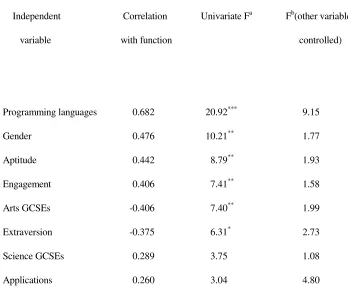
Considering only loadings in excess of +/-0.33 to interpret functions [27], correlations between
predictors and the discriminant function obtained (see Table 3), showed that number of programming
languages previously used, followed (in descending order of magnitude) by gender, aptitude,
computer engagement, number of Arts GCSEs and extraversion were the most useful variables
differentiating the Computing and BIT students. Number of Science GCSEs and number of
applications packages previously used were not particularly useful in predicting group membership.
The univariate F statistics reflected this situation, the latter two variables being the only two upon
which the two groups did not significantly differ.
The means in Table 4 show that, relative to BIT students, Computing students had experience of
using more programming languages, had greater computing aptitude, were more engaged with
computers, had fewer Arts GCSEs, and were more introverted, all these differences being as
predicted. Note that, while the two groups did not differ significantly on applications package usage,
the difference in means was in the opposite direction to that predicted, Computing students' usage
being higher.
--- INSERT TABLE 4 HERE ---
The significant univariate F for gender reflected the greater imbalance, favoring males, in the
Computing group (85.2% versus 14.8%) as compared to that in the BIT group (57.1% versus 42.9%).
The second set of F statistics in Table 3 show that with all other independent variables controlled,
and alpha set at 0.005 to control Type I error rate, no single variable made a significantly unique
The Association Between Classification and Performance
In testing whether correctly classified students were more likely to be successful than those classified
incorrectly, final year referrals and deferrals were excluded from analyses because of uncertainty as to
their success/failure, hence the slightly lower sample sizes compared to the DFA.
Classification and Performance of Computing Students
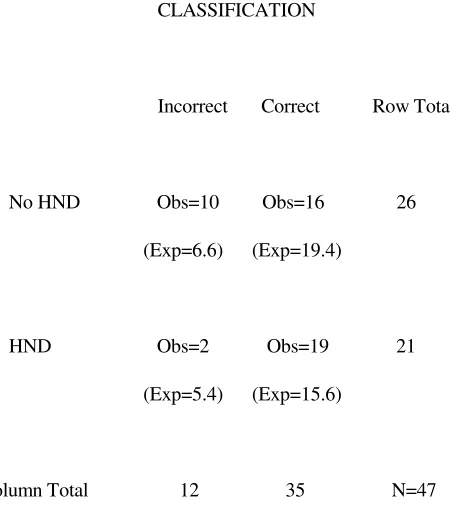
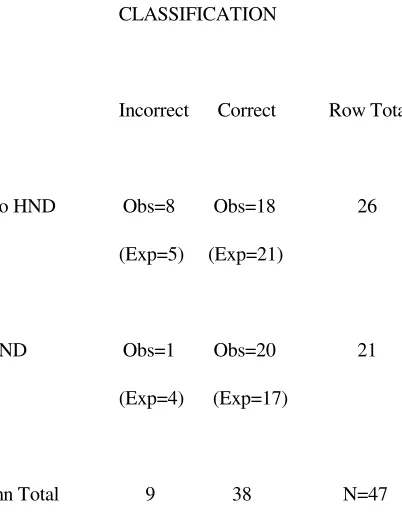
The chi-square contingency tables for analyses based upon classifications for Computing students
subsequent to the first and second stages of the DFA are presented as Tables 5 and 6. The values of
chi-square associated with these contingency tables were 5.12 (df=1, p<.05) and 5.08 (df=1, p<.05)
respectively. (The sample size in Table 6 was high enough for the low expected frequency in the
Incorrect-HND cell to be unproblematic [28].)
--- INSERT TABLE 5 HERE ---
Comparison of observed and expected frequencies results in the conclusion that for both stages there
were significant associations, whereby, as hypothesized, Computing students incorrectly classified as
BIT students were more likely to fail to obtain an HND than those correctly classified . Note that the
utility of the classification function resulting from stage two, where more information was used, was
slightly worse than that resulting from stage one.
--- INSERT TABLE 6 HERE ---
The directions of the differences in observed and expected frequencies in the two chi-square analyses
for BIT students were directly opposed to those for the Computing students reported above, it being
evident from Tables 7 and 8 that, if anything, mis-classification was associated with achieving the
HND qualification. Here, the association was significant for the first stage of the DFA
(chi-square=5.30, df=1, p<.05), but not the second stage (chi-square=1.81, df=1, p>.05).
--- INSERT TABLE 7 HERE ---
--- INSERT TABLE 8 HERE ---
Contrary to the hypothesis then, mis-classification of BIT students as Computing students tended to
be associated with success on the BIT course, the association being significant for classifications
based upon DFA stage one, but not stage two.
Personality Differences not Included in the DFA
For hypotheses tested outside the DFA, Course (Computing versus BIT) served as an independent
variable in separate independent samples t-tests where tough-poise and independence were dependent
variables.
--- INSERT TABLE 9 HERE ---
Reference to the means and t-test results in Table 9 shows that Computing students exhibited
While, as was hypothesized, the tough-poise mean for Computing students was greater than that for
BIT students, the difference between the means was non-significant. Therefore it was concluded that
DISCUSSION
From a theoretical perspective, one of the most interesting findings of the present study revolved
around confirmation of the idea that, relative to non-oriented students,
programming-oriented students exhibit more schizoid personalities, in terms of greater introversion and (for males at
least) independence. This portrays the former individuals as relatively aloof, having a tendency to
plough their own furrow in life. However, with respect to the suggested lesser emotionality of the
Computing students, the evidence was insubstantial as far as differences in the schizoid characteristic
of tough-poise were concerned.
The finding for introversion was consistent with the idea that the Computing students were more
likely to have object-centered, rather than person-centered, interests. It is this which is likely to
explain their greater computer involvement, as indicated by their greater computer engagement and
programming experience. (This greater involvement though, did not extend to greater applications
experience where no difference was identified. Because of the nature of their course, BIT students
were hypothesized as having the advantage here. However, the fact that greater BIT student
experience was not present in an area of computing where this might have been expected, adds some
support to the notion that Computing students were more computer involved.)
With the exception of the null tough-poise result, the present link between schizoid personality traits
and computer involvement supports Shotton's findings for her computer dependents [7]. While
schizoid characteristics are typical of science-oriented individuals more generally, present findings
concerning previous academic study were only partially consistent with this, and with the assumption
that Computing and BIT students would be more science-oriented and arts-oriented respectively.
Here, while Computing students had studied fewer arts disciplines, there was no reliable difference in
number of science disciplines previously studied, albeit that the difference in means was in the
predicted direction.
Computing students also explain these students' superior aptitude test performance, these less
outgoing individuals' intellectual skills being better developed by virtue of the greater emphasis they
place on intellectual considerations at the expense of social considerations.
From an applied perspective, it was found possible to distinguish between members of the two
courses using easily obtainable information: as discussed above, members of the Computing course
had previously used a greater number of computer programming languages, were more highly
computer engaged and had fewer arts GCSEs, these students were also more likely to be male.
Introduction of psychometric data allowed an even clearer distinction to be drawn, Computing
students having better computing aptitude and being more introverted. En masse, these distinctions
were found to be useful in predicting which students would ultimately obtain the HND qualification.
But instead of students correctly classified as belonging to the Computing and BIT courses being
more likely to receive their respective HNDs than those incorrectly classified, as was originally
envisaged, it was students who were classified as being members of the Computing course,
irrespective of whether this was true, who were proportionately more likely to obtain their award.
Given that addition of the more expensive aptitudinal and personality data did not increase the utility
of the DFA classification process as a predictor of course outcomes, one reason why BIT students
mis-classified as belonging to the Computing course fared better than their correctly classified
colleagues appears to have been their greater computer involvement (high engagement and greater
programming experience). Hence, it seems as though degree of immersion in the computing culture
was particularly important in determining success across the two courses.
The fact that gender was a predictor of course membership is consistent with findings of greater
female take-up of applications-oriented than programming-oriented courses, resulting from females'
interest in computers as information processing tools rather than being interested in computing as an
end in itself [1,3]. In the present study there were more than seven times as many males as females
taking the Computing course, but only one and a half times as many males taking the BIT course. The
maintenance of networks, probably explains why, while the imbalance in favor of males was
diminished, the gender asymmetry was nevertheless substantial. Note also that this more technical
content of the BIT course probably explains why BIT students incorrectly classified as Computing
students (and who were more computer involved than their course colleagues) performed particularly
well on the BIT course.
The DFA statistics showed Gender as having the second highest univariate F. However, controlling
for other variables resulted in a large drop in F, the adjusted F value for Gender being the second
lowest value. This suggests that gender differences on other variables carry most of the discriminatory
information afforded by explicitly including gender in an analysis of this type. Indeed, classification
statistics for an informal seven variable DFA excluding gender as an independent variable (not
shown) were the same in all respects as those for the eight variable DFA reported.
The observation that variables other than gender are capable of explaining gender differences in
course enrollment implies that the potentially controversial step of including gender in a predictive
formula for advising students as to course choice is avoidable. On the other hand, though politically
more acceptable, using all the other independent variables considered in the analysis apart from
gender would still perpetuate gender differences in course membership since gender would obviously
be a covariate.
It would have been useful to be able to compare females enrolling upon the Computing and BIT
courses as a means towards identifying reasons for the greater gender imbalance on the former course.
But, unfortunately, this very imbalance meant that the Computing female cohort was too small for any
significant results to be yielded. For example, while differences in female Computing and BIT student
means for extraversion, engagement and number of arts GCSEs studied were consistent with and
bigger than those for the Computing and BIT groups overall, 95% confidence intervals for these
means were found to overlap. Though slightly diminished, inter-female differences in means for
number of programming languages, number of applications packages previously used and number of
observations, some speculative discussion is useful. (Gender-specific descriptive statistics are
provided in an appendix.)
Although the difference in programming experience between females taking the two courses was
smaller than the overall difference across the courses as a whole, it is important to observe that the
majority of BIT females (77.3%) had no programming experience, whereas Computing females
having no programming experience were in the minority (37.5%). Together with greater Computing
female computer engagement, this suggests that, on the whole, Computing females were likely to be
more deeply involved in the computer culture than BIT females: programming is a computing activity
which is at a more profound level than the learning and use of most applications packages, and it
should be noted that the difference in number of applications packages previously used by females
taking the two courses was minimal. Such differences are likely to have played a major part in
females' course choice.
Despite our previous emphasis upon the schizoid personality construct as a major explanation of
differences between students taking the two courses, it appears that such considerations might apply
primarily to the males constituting the majority on each course. For females, while Computing
students were more introverted than BIT females, they did not exhibit greater independence or
tough-poise (both stereotypically masculine traits [16,29,30]). So, Computing females did not appear to
possess personality traits associated with the greater social confidence which might be suspected
characteristic of females enrolling on a course involving stereotypically male subject matter and
where females are in a small minority. While such an idea is intuitively appealing then, on the present
limited data, there appears to be no evidence that greater social confidence allowed Computing
females to become exceptions to the “we can, but I can't” phenomenon referred to by authors such as
Chen [2].
Although Computing females displayed a greater depth of involvement in the computing culture,
there was no strong evidence that they had a greater scientific bent in terms of number of science
Putting the findings on programming experience and the study of arts together, it is of course possible
that BIT females' relative lack of programming experience and their preference for the BIT course
over the Computing course, were not causally related (indeed, the correlational nature of the study
means that it would be incorrect to infer causal explanations for any of the present results). Rather,
given their greater propensity for studying more verbally oriented, less technical, disciplines, a
common antecedent explanation of these females' course choice and lack of programming experience
could be that they simply did not want to engage in programming. After all, we have previously noted
that females are more likely than males to view computers as tools towards non-computing ends,
rather than see computing as an end in itself [1]. In the terms of Temple and Lips [3] this would imply
a Subjective Choice explanation of BIT females' course choice, involving their attraction away from
programming-oriented computing towards areas they find more appealing, possibly because of social
conditioning. This contrasts with an explanation concerning self-perceived deficiencies in experience
and ability, resulting in the choice of an applications-oriented course (here we should note that, with
respect to aptitude, BIT females' performance was actually stronger). Such a conclusion is also
consistent with the suggestion of Durndell and colleagues that the “we can, but I can't” phenomenon
be re-phrased “we can, but I don't want to” [31].
Conclusions
The present study shows that students taking programming-oriented and applications-oriented
computing courses differ in a number of psychological characteristics, many of these, for males at
least, being connected with a greater or lesser degree of schizoid demeanor. One suspects that the
more schizoid, highly computer involved, students' relationships with computers and computing are
often of a qualitatively different nature compared to the relationship enjoyed by other members of
in a pleasurable, non-goal-oriented state while programming [32]. It would be interesting to see
whether qualitative approaches such as personal construct technique [33] or discourse analysis [34],
would be successful in elucidating the nature of other qualitative differences in the approach to
computing of highly computer involved individuals relative to less involved individuals.
Despite attempts at rectifying the situation, there are still large gender imbalances in computing
course enrollment, these being particularly pronounced for courses emphasizing programming. The
fact that the picture with respect to course classification altered little when gender was not included as
a discriminating variable, indicates that other variables presently considered, the most prominent of
which is likely to be previous programming experience, are implicated in explaining gender
differences in computing course choice. Structural equation modeling would constitute one possible
way of disentangling the structure of relationships whereby gender and other factors interact in
explaining differences in choice. Meanwhile, the present results suggest that gender asymmetries in
programming-oriented higher education courses, and ultimately in programming-related employment,
might be addressed by providing female schoolchildren with as much encouragement, and as many
opportunities, as possible to engage in programming activities, so as to give those females who are
interested in programming every chance of overcoming the cultural barriers which lie in their way.
Also, granted the positive benefits which dissociating computing from mathematics seem to have (e.g.
the work of Stockdale cited by Siann and colleagues [35]), it is probable that teaching of
programming in a non-mathematical context would be particularly helpful in stimulating female
interest. The preliminary evidence that Computing and BIT females differed little in terms of
tough-poise and independence is important here, since if possession of a relatively masculine personality
were a substantial reason as to why certain females accumulate more programming experience than
others, then increasing female programming opportunities might have little effect in diminishing
experiential gender imbalances. However, the present evidence suggests that this is not the case.
It was found possible to differentiate students taking the two courses according to their profiles on the
of the study which sought to provide information to assist tutors in their role as advisors to potential
students as to type of course which might prove most suitable, was compromised by the observation
that it was students classified as belonging to the Computing course who were more likely to succeed
irrespective of course actually followed. Thus, the attributes associated with success were the same for
both courses, depth of involvement in computing seeming to be an important factor here.
In practical terms then, assuming generalizability of the present results, it would seem possible to
reduce student wastage on both types of course by taking into account the present biographical and
attitudinal factors during the student recruitment process. If institutional loss of income resulting from
withdrawing students’ failure to take-up places in the second-year of the present courses alone is
considered, rough calculations, involving both students who would have been incorrectly rejected and
those who were incorrectly accepted according to the present classificatory results, reveal that a net
institutional loss of the equivalent of $163, 525 would have been avoided. Although such a sum is
obviously based upon statistics tailored to the present samples, and a certain amount of shrinkage
would be expected for other samples, this emphasizes the important financial implications of the
present type of work. Findings from further work identifying factors which are useful both in advising
students whether to follow a programming-oriented or a non-programming-oriented course and at the
same time predictive of success or failure on the course recommended, would obviously be more
useful still. In the meantime, it is useful to bear in mind the observation that psychometric tests offered
no advantage over and above biographical and attitudinal data in predicting student success (although
such information was useful in distinguishing students opting for different types of course). Such a
finding suggests that psychometric testing, and its associated logistical problems and financial costs,
may be unnecessary in attempts to select students who will be ultimately successful on computing
courses in general.
Gender-Specific Descriptive Statistics
--- INSERT APPENDIX 1a HERE ---
--- INSERT APPENDIX 1b HERE ---
_______________________
ACKNOWLEDGEMENT
The authors would like to thank Dr. Ian Christensen of the University of Manchester for acting as
external consultant on this project.
REFERENCES
1. M.E. Lockheed, Women, Girls, and Computers: A First Look at the Evidence, Sex Roles, 13:3/4,
pp.115-122, 1985.
2. M. Chen, Gender and Computers: The Beneficial Effects of Experience on Attitudes, Journal of
Educational Computing Research, 2:3, pp.265-282, 1986.
3. L. Temple and H.M. Lips, Gender Differences and Similarities in Attitudes Toward Computers,
Computers in Human Behaviour, 5:4, pp.215-226, 1989.
4. S. Turkle and S. Papert, Epistomological Pluralism: Styles and Voices Within the Computer
and E. Murchie-Beyma (eds.), International Society for Technology in Education, Eugene, 1992.
5. T. Busch, Gender Differences in Self-Efficacy and Attitudes Toward Computers, Journal of
6. T. Jones and V.A. Clarke, Diversity as a Determinant of Attitudes: A Possible Explanation of the
Apparent Advantage of Single-Sex Settings, Journal of Educational Computing Research, 12:1,
pp.51-64, 1995.
7. M.A. Shotton, Computer Addiction?: A Study of Computer Dependency, Taylor and Francis,
London, 1989.
8. J.P. Charlton and P.E. Birkett, The Development and Validation of the Computer Apathy and
Anxiety Scale. Journal of Educational Computing Research, 13:1, pp.41-59, 1995.
9. G.R. Foxall and S. Bhate, S. Psychology of Computer Use: XIX. Extent of Computer Use:
Relationships with Adaptive-Innovative Cognitive Style and Personal Involvement in Computing,
Perceptual and Motor Skills, 72, pp.195-202, 1992.
10. A.S. Reber, The Penguin Dictionary of Psychology, Penguin, Harmondsworth, 1985.
11. J.P. Charlton, The Influence of Cognitive and Affective Factors on the Acquisition of a First
Computer Programming Language, Unpublished M.Phil. thesis, Bolton Institute of Higher
Education, 1992.
12. W.M. Cannon and D.K. Perry, A Vocational Interest Scale for Computer Programmers,
Proceedings of the Fourth Annual Computer Personnel Research Conference of the ACM,
pp.61-82, 1966.
13. P. Saville and S. Blinkhorn, British Undergraduate Norms to the 16PF (Forms A & B), NFER,
14. N. Entwistle, Styles of Learning and Teaching, Fulton, London, 1983.
15. S.E. Krug, Interpreting 16PF Profile Patterns, Institute for Personality and Ability Testing,
Champaign, 1981.
16. P. Kline, Personality: The Psychometric View, Routledge, London, 1993.
17. K.E. Pocius, Personality Factors in Human-Computer Interaction: A Review of the Literature,
Computers in Human Behavior, 7, pp.103-135, 1991.
18. R.B. Cattell, H.W. Eber and M.M.Tatsuoka, Handbook for the 16PF, Institute for Personality and
Ability Testing, Champaign, 1970.
19. H.J. Eysenck, The Biological Basis of Personality, C.C.Thomas, Springfield, 1967.
20. I.T. Miura, The Relationship of Computer Self-Efficacy Expectations to Computer Interest and
Course Enrollment in College, Sex Roles, 16:5/6, pp.303-311, 1987.
21. M.H. Mohamedali, D.J. Messer and B.(C).Fletcher, Factors Affecting Microcomputer Use and
Programming Ability of Secondary School Children, Journal of Computer Assisted Learning, 3,
pp.224-239, 1987.
23. P.W. Oman, Identifying Student Characteristics Influencing Success in Introductory Computer
Science Courses, AEDS Journal, 19:Winter/Spring, pp.226-233, 1986.
24. Science Research Associates, Computer Programmer Aptitude Battery Examiner's Manual,
Science Research Associates, Chicago, 1985.
25. L.R. Aiken, Psychological Testing and Assessment (sixth edition), Allyn and Bacon, Boston,
1988.
26. S.E. Krug and E.F. Johns, A Large Scale Cross-Validation of Second-Order Personality Structure
Defined by the 16PF, Psychological Reports, 59, pp.683-693, 1986.
27. B.G. Tabachnick and L.S. Fidell, Using Multivariate Statistics (third edition), HarperCollins,
New York, 1996.
28. G.A. Ferguson, Statistical Analysis in Psychology and Education (fifth edition), McGraw-Hill,
Singapore, 1988.
29. E.J. Phares, Introduction to Personality (third edition), HarperCollins, New York, 1991.
30. F.L. Geis, Self-Fulfilling Prophecies: A Social Psychological View of Gender, in The Psychology
of Gender, A.E. Beall and R.J. Sternberg (eds.), Guilford, New York, 1993.
31. A. Durndell, P. Glissov and G. Siann, Gender and Computing: Persisting Differences.
32. P. Glissov, Social and Motivational Aspects of Secondary School Pupils' Computer Use, with
Particular Reference to the Gender Issue. Unpublished PhD thesis, Glasgow Polytechnic, 1992.
33. G.A. Kelly, The Psychology of Personal Constructs, vol 1, Norton, New York, 1955.
34. J. Potter and M. Wetherell, Discourse and Social Psychology: Beyond Attitudes and Behaviour,
Sage, London, 1987.
35. G. Siann, A. Durndell, H. Macleod and P. Glissov, Stereotyping in Relation to the Gender Gap in
Table 1. Number and percentage of cases classified as belonging to each group after the initial stage
of the DFA.
Predicted Group
Computing BIT
Actual Group
Computing (n=54) 39 (72.2%) 15 (27.8%)
BIT (n=42) 16 (38.1%) 26 (61.9%)
Table 2. Number and percentage of cases classified as belonging to each group after the second
stage of the DFA.
Predicted Group
Computing BIT
Actual Group
Computing (n=54) 44 (81.5%) 10 (18.5%)
BIT (n=42) 11 (26.2%) 31 (73.8%)
Table 3. Correlations of variables with the discriminant function, and F statistics for group
differences.
Independent Correlation Univariate Fa Fb(other variables
variable with function controlled)
Programming languages 0.682 20.92*** 9.15
Gender 0.476 10.21** 1.77
Aptitude 0.442 8.79** 1.93
Engagement 0.406 7.41** 1.58
Arts GCSEs -0.406 7.40** 1.99
Extraversion -0.375 6.31* 2.73
Science GCSEs 0.289 3.75 1.08
Applications 0.260 3.04 4.80
a
Alpha=0.05 - *p<.025, **p<.01, ***p<.001 (df=1,94).
b
Alpha=0.005 (see below) p>0.005 (df=1,86) in all cases.
Table 4. Raw score descriptive statistics for discriminating variables.
Computing (n=54) BIT (n=42)
Mean SD Mean SD
Independent Variable
Programming language (No) 2.13 1.80 0.71 0.99
Aptitude (%) 63.85 18.20 53.90 13.48
Engagement (%) 76.40 11.45 70.15 10.81
Arts GCSEs (No) 2.68 1.21 3.42 1.47
Extraversion (Sten) 5.48 1.90 6.53 2.18
Science GCSEs (No) 3.50 1.38 2.95 1.36
Applications (No) 6.63 4.78 5.02 4.62
Table 5. Contingency between Computing student classification and outcome for stage one of the
DFA.
CLASSIFICATION
Incorrect Correct Row Total
No HND Obs=10 Obs=16 26
(Exp=6.6) (Exp=19.4)
OUTCOME
HND Obs=2 Obs=19 21
(Exp=5.4) (Exp=15.6)
Column Total 12 35 N=47
Table 6. Contingency between Computing student classification and outcome for stage two of the
DFA.
CLASSIFICATION
Incorrect Correct Row Total
No HND Obs=8 Obs=18 26
(Exp=5) (Exp=21)
OUTCOME
HND Obs=1 Obs=20 21
(Exp=4) (Exp=17)
Column Total 9 38 N=47
Table 7. Contingency between BIT student classification and outcome for stage one of the DFA.
CLASSIFICATION
Incorrect Correct Row Total
No HND Obs=5 Obs=17 22
(Exp=8.6) (Exp=13.4)
OUTCOME
HND Obs=11 Obs=8 19
(Exp=7.4) (Exp=11.6)
Column Total 16 25 N=41
Table 8. Contingency between BIT student classification and outcome for stage two of the DFA.
CLASSIFICATION
Incorrect Correct Row Total
No HND Obs=4 Obs=18 22
(Exp=5.9) (Exp=16.1)
OUTCOME
HND Obs=7 Obs=12 19
(Exp=5.1) (Exp=13.9)
Column Total 11 30 N=41
Table 9. Independent t-test results for course differences on personality variables not included in the
DFA (descriptive statistics are Sten scores).
Computing (n=54) BIT (n=42) t-test
Mean SD Mean SD t df
Tough-poise 6.85 1.69 6.37 1.85 1.32 94
Independence 5.56 1.80 4.83 1.72 2.02* 94
*
p<.05 - one-tailed
Appendix 1a - Descriptive Statistics for Males
Computing (n=46) BIT (n=24)
Mean SD Mean SD
Programming languages (No) 2.30 1.82 0.96 1.12
Aptitude (%) 67.22 16.80 54.63 11.70
Engagement (%) 77.22 11.84 72.95 10.40
Arts GCSEs (No) 2.65 1.06 2.96 1.40
Extraversion (Sten) 5.42 1.90 6.17 2.28
Science GCSEs (No) 3.50 1.39 2.75 1.48
Applications (No) 7.46 5.37 6.83 4.97
Independence (Sten) 5.81 1.74 5.09 1.83
Tough-poise (Sten) 7.08 1.61 6.75 1.88
Appendix 1b - Descriptive Statistics for Females
Computing (n=8) BIT (n=18)
Mean SD Mean SD
Programming languages (No) 1.13 1.36 0.39 0.70
Aptitude (%) 44.50 13.84 52.94 15.85
Engagement (%) 71.73 7.89 66.41 10.47
Arts GCSEs (No) 2.88 1.96 4.06 1.35
Extraversion (Sten) 5.83 2.02 7.00 1.99
Science GCSEs (No) 3.50 1.41 3.22 1.17
Applications (No) 3.13 2.42 2.61 2.70
Independence (Sten) 4.12 1.51 4.47 1.53
Tough-poise (Sten) 5.54 1.59 5.87 1.73