Please cite this article as: M. H. Sangdani, A. R. Tavakolpour-Saleh, Parameters Identification of an Experimental Vision-based Target Tracker Robot Using Genetic Algorithm, International Journal of Engineering (IJE), IJE TRANSACTIONS C: Aspects Vol. 31, No. 3, (March 2018) 480-486
International Journal of Engineering
J o u r n a l H o m e p a g e : w w w . i j e . i rParameters Identification of an Experimental Vision-based Target Tracker Robot
Using Genetic Algorithm
M. H. Sangdani, A. R. Tavakolpour-Saleh*
Department of Mechanical and Aerospace Engineering, Shiraz University of Technology, Shiraz, Iran
P A P E R I N F O
Paper history:
Received 11 September 2017
Received in revised form 24 September 2017 Accepted 12 October 2017
Keywords:
Parameter Identification Target Tracker Robot Genetic Algorithm
A B S T R A C T
In this paper, the uncertain dynamic parameters of an experimental target tracker robot are identified through the application of genetic algorithm. The considered serial robot is a two-degree-of-freedom dynamic system with two revolute joints in which damping coefficients and inertia terms are uncertain. First, dynamic equations governing the robot system are extracted and then, simulated numerically. Next, an open-loop experiment with finite duration step inputs is implemented on the experimental setup to collect practical output data. Accordingly, a desired objective function is defined as the sum of discrepancy between the experimental and simulated output data. Subsequently, a genetic algorithm is employed to explore the best damping coefficients and inertia terms of the simulation scheme so as to minimize the presented cost function and taking into account the same input data for both simulation and experiment. Finally, the simulated output data based on the identified robot parameters reveal an acceptable agreement with the measured outputs through which validity of the identification scheme is affirmed.
doi: 10.5829/ije.2018.31.03c.11
NOMENCLATURE
𝑏𝜃 Damping coefficient of the base (kgs-1) R Distance between center of the robot base and the barrel joint (m)
𝑏𝛼 Damping coefficient of the barrel (kgs-1) T Torque (N.m)
D Dissipation function u Distance between camera and barrel joint (m)
𝐸𝑘 Kinetic energy (J) £ Lagrangian
𝐸𝑝 Potential energy (J) θ Base rotational angle of the base (radian)
g Gravitational acceleration (ms-2) θ
𝑠 Simulated base angle
𝐽𝜃 Base inertia (kgm-2) θ𝑒 Experimental base angle
𝐽𝛼 Barrel inertia (kgm-2) 𝛼 Barrel rotational angle (radian) l Length of barrel (m) 𝛼𝑠 Simulated barrel angle m Mass of barrel (kg) 𝛼𝑒 Experimental barrel angle
𝑚́ Mass of camera (kg) 𝜌 Mass of unit length (kgm-1 )
1. INTRODUCTION1
The success of controllers design highly depends on the adjacency of estimated parameters of the dynamic system to their real values. As a result, parameters identification of a dynamic system plays a key role in the proper design of the control systems. Wu et al. [1]
*Corresponding Author’s Email: [email protected] (A. R. Tavakolpour-Saleh)
state-delay state space models with unknown parameters. They developed a least squares algorithm to estimate the system parameter vectors. Brunot et al. [3] considered three methods based on the least square method and compared them experimentally for physical parameter identification of a one-degree-of-freedom electromechanical system that operates in the closed loop. More details on the least square method can be found in [4, 5]. Another identification method is known
as maximum likelihood. Maximum likelihood
estimation method is a class of important approaches for dynamical system identification and have been utilized in many works [6, 7]. However, for complex nonlinear systems, the traditional approaches do not have efficient and accurate identification results. With the development of the optimization theory, some new intelligent algorithms have been rapidly developed and widely used, such as genetic algorithm, ant colony algorithm, particle swarm algorithm and so on. Chang [8] applied a real-coded genetic algorithm to the system identification and control of a class of nonlinear systems. First, a real-coded GA was utilized to identify the unknown system and then, according to the estimated system model an optimal off-line PID controller is optimally tunned using the real-coded GA. The identification of a simple time-delay system, namely, first-order-plus-dead-time was investigated in [9]. West et al. [10] applied a genetic algorithm to estimate parameters of a 7-DOF robot manipulator. They used an output error system identification framework for the developed model of the Hydrolek arm. Sharifzadeh et al. [11] used a genetic algorithm for parameters identification problem. They obtained the optimum values of uncertain parameters of the inverse dynamic and friction models by a white-box identification approach based on genetic algorithm. Tavakolpour-Saleh et al. [12] applied a modified genetic algorithm to identify a flexible system for the purpose of active vibration control. The presented results clearly demonstrated the effectiveness of modified GA in the vibration control application. Zare and Tavakolpour- Saleh [13] proposed a novel frequency-based design approach of the free piston Stirling engines using Genetic algorithm. In this work, the optimum values of design parameters i.e. mass and spring stiffness of the power and displacer pistons and the cross-sectional area of the displacer rod were obtained using GA. Other intelligent methods like gravitational search algorithm [14], particle swarm algorithm [15], ant colony algorithm [16], bee colony algorithm [17] and Gray wolf algorithm [18] were also utilized for parameters identification.
Brancati et al. [19] described a methodology for the calculation of inertia parameters. Their methodology was based on the rigid-body complete motion equation. They used a least-square optimization to identify 10
inertia parameters starting from the experimental data acquired during both, static and dynamic tests. Lopez et al. [20] developed an adaptive controller to estimate the inertia tensor of underactuated Quad-rotor mini-aircraft. The proposed control scheme used a parameter estimation approach issued from gradient type algorithm. Naghipour [21] studied the various frequency domain methods to estimate drag and inertia coefficients. Zhao et al. [22] proposed a method based on curve fitting of acceleration power spectral density for damping parameters identification of a cabin suspension system for heavy duty trunk. The sine signal
was used widely in the signal processing,
communication, system analysis, and system
identification. Xu [23] proposed a damping parameter estimation algorithm for dynamical systems based on the sine frequency response. The proposed method was an iterative estimation scheme.
The main contribution of this paper is on parameters identification of an experimental vision-based tracker robot. The tracker robot is a 2-DOF dynamic system consisting of a base and a barrel. In this article, a genetic algorithm approach is proposed to estimate the inertia terms and damping coefficients of the base and the barrel of the robot as uncertain parameters. First, the dynamic equations of the robot were found using the Euler-Lagrange method. Then, the model of the robot was simulated in the MATLAB/Simulink. Next, an open-loop test was performed on the experimental rig. A specified voltage was applied to the base and the barrel of the robot and the desired data were picked up through data acquisition system. Then, an identification scheme based on GA was introduced to achieve the inertia terms and damping coefficients. Finally, for validating the identification approach, the output data from simulation and experimental work were compared.
2. ROBOT DYNAMICS
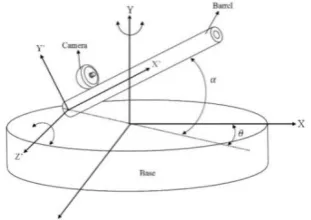
The considered robot was a 2-DOF system with two rotary motions. It consists of a base and a barrel as shown in Figure 1.
The base rotates around its axis and the barrel rotates around the axis along its joint which is parallel to the base.
The dynamic equations governing the robot system are obtained using the Euler-Lagrange method. In this approach, total energy of the system including potential and kinetic energies must first be calculated. The principal equations of this technique are as follows [24]:
£ = 𝐸𝑘− 𝐸P (1)
D(𝑞̇) =1
2𝑐𝑞̇
2 (2)
𝑑 𝑑𝑡(
𝜕£ 𝜕𝑞̇i) +
𝜕𝐷 𝜕𝑞̇i−
𝜕£
𝜕𝑞i= ∑ 𝑇external
(3)
Calculating potential and kinetic energies of the robot links, the Lagrangian defined by Equation (1) can be acquired. Substituting the obtained Lagrangian into Equation (3), the final dynamic equations governing the robot system are obtained as:
𝑇𝐵𝑎𝑠𝑒= (𝐽𝜃+ (𝑚 + 𝑚́)𝑅2− (𝑚 + 2𝑚́𝑢)𝑅 cos 𝛼 +
𝐽𝛼cos2𝛼)𝜃̈+((𝑚𝑙 + 2𝑚́𝑢)𝑅𝛼̇ sin 𝛼 −
2𝐽𝛼𝛼̇ cos 𝛼 sin 𝛼 + 𝑏𝜃)𝜃̇
(4)
𝑇𝐵𝑎𝑟𝑟𝑒𝑙= 𝐽𝛼𝛼̈ − (
1
2(𝑚𝑙 + 2𝑚́𝑢)𝑅 sin 𝛼 −
𝐽𝛼cos 𝛼 sin 𝛼) 𝜃̇2 +𝑏𝛼𝛼̇ + 𝑚𝑔2𝑙cos 𝛼 + 𝑚́𝑔𝑢 cos 𝛼
(5)
As can be seen, Equations (4) and (5) are coupled nonlinear differential equations.
As mentioned earlier, the inertia terms (𝐽𝜃, 𝐽𝛼) and
damping coefficients (𝑏𝜃, 𝑏𝛼) are unknown and
consequently, the paper aims at presenting an identification approach based on experimental data so as to achieve the mentioned uncertain parameters.
3.MODELING OF ACTUATORS
In this work, two DC-gear motors with a power amplifier are used as robot actuators. In order to obtaining an accurate model of the robot, a mathematical model of the actuators for the base and the barrel must be extracted. For this purpose, an experiment is done and the result of the experiment is demonstrated in Table 1. At last the mathematical model of actuators is obtained through experimental results. The input of the actuators is voltage and the output is DC-gear motor torque.
According to Table 1, proposed mathematical model of the actuators is presented in Equation (6).
(6) {
𝑇 = 0.1(𝑣 − 1.68) 𝑣 ≥ 1.68 𝑇 = 0.1(𝑣 + 1.68) 𝑣 ≤ −1.68 𝑇 = 0 − 1.68 < 𝑣 < 1.68
TABLE 1. Experimental results of actuator model
Voltage (v) Torque (N.m)
3.6 0.1176
2.4 0.0882
1.68 0
-1.68 0
-2.4 -0.0882 -3.6 -0.1176
4.EXPERIMENTAL OPEN LOOP TEST
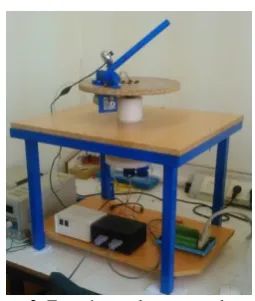
Figure 2 shows the constructed visual target tracker robot considered in this investigation. For parameters identification, an open-loop test is first implemented on the experimental setup. Figure 3 depicts a schematic block diagram of the open-loop robotic system.
First, a two-level finite duration step input voltage as shown in Figure 4 is applied to the DC-motor of the robot base while the input voltage to the barrel DC motor is kept at zero level. Then, the variations of the base angle as the output data are collected in terms of degree using data acquisition system. Figure 5 demonstrates the robot base response corresponding to the applied voltage. Afterwards, the DC-motor of the barrel is excited by the considered input voltage (See Figure 4) while the base motor voltage was low. The output data pertaining to the barrel angle is represented in Figure 6.
Figure 2. Experimental target tracker robot
Figure 4. A two-level finite duration step input voltage
Figure 5. The base rotational angle obtained from experiment
Figure 6. The barrel rotational angle obtained from
experiment
5. PARAMETERS IDENTIFICATION PROCEDURE
In this section, a brief explanation on genetic algorithm is presented and then, the identification procedure is described. At last, the validity of the identification scheme is verified.
5. 1. Genetic Algorithm GAis a meta-heuristic
algorithm inspired by the process of natural selection where the strongest members will survive and reproduce. In the GA, a set of solutions which called population are first generated. Each solution is named as chromosomes. The process begins with creating a random population of potential solutions which are evaluated by a fitness function. The strongest member
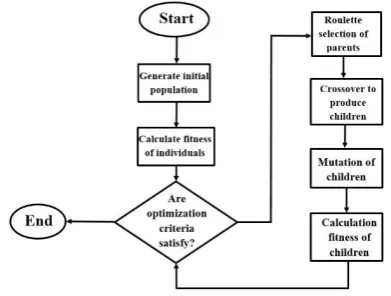
of that population is found with a weighted roulette wheel selection method. In the next step, two random parent chromosomes are selected and combined to form two new chromosomes. This step is known as crossover. There are many methods for crossover, for example, by combining the front half of one parent with the end half of the other parent. Mutation is the final stage, where single elements may be randomly changed to create a more versatile population. The process then starts again with the new population and repeats until the desired criteria are satisfied [10]. Figure 7 shows the flowchart of GA procedure.
5. 2. Parameters Identification The procedure of identification is initiated with an experimental test. First, the experimental open loop test is carried out and the angles of the base and the barrel are measured as seen in Figures 5 and 6. As described later, these data are used in the proposed genetic algorithm-based identification scheme. Then, the open loop test is implemented within the simulation environment. For this purpose, Equations (4) and (5) are simulated using MATLAB/Simulink according to the mechanical parameters of the target tracker robot described in section 4. The values of known parameters are given in Table 2.
Figure 7. Flowchart of genetic algorithm
TABLE 2. The mechanical parameters of visual target tracker
robot
Mechanical Parameters Value
M 0.9456 (kg)
D 0.32 (m)
R 0.09 (m)
m 0.043 (kg)
𝑚́ 0.103 (kg)
l 0.26 (m)
Because the equations of the robot are coupled, the uncertain parameters must be estimated simultaneously. Accordingly, a genetic algorithm-based optimization scheme was organized such that both open loop test in the simulation for the base and the barrel are run at the same time. The inputs of the genetic algorithm are the inertias and damping coefficients of the base and the barrel. First, the algorithm considers random values for the mentioned parameters. Then, the open loop simulation is executed for both sections of the robot and the output angles of the base and the barrel are acquired. In the next step, the sum of the errors between the experimental and simulation tests is proposed as a cost function. The genetic algorithm is thus utilized to achieve minimum value of the sum of the errors between experimental and simulation tests. Figure 8 shows the procedure of optimization scheme. It is important to note that the applied input voltage to the model of the robot in the Simulink environment is the same as Figure 4.
The proposed cost function in this paper for parameters identification (denoted by F) is as follow: 𝐹(𝐽𝜃, 𝐽𝛼, 𝑏𝜃, 𝑏𝛼) = ∑𝑛𝑘=1(|𝜃𝑠(𝑘) − 𝜃𝑒(𝑘)| +
|𝛼𝑠(𝑘) − 𝛼𝑒(𝑘)|)
(7)
where, 𝜃𝑠, 𝜃𝑒, 𝛼𝑠, 𝛼𝑒, and kare the simulated base angle,
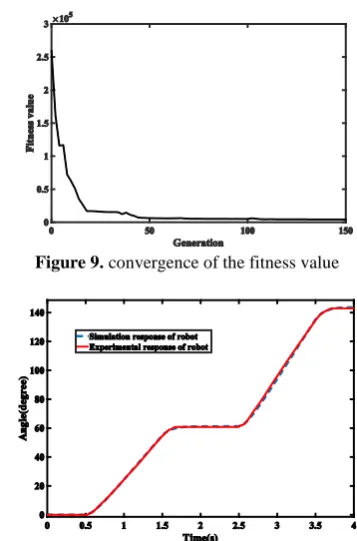
experimental base angle, simulated barrel angle, experimental barrel angle, and time step respectively. In addition, the uncertain parameters (𝐽𝜃,𝐽𝛼,𝑏𝜃,𝑏𝛼) are defined as the chromosomes of GA. The rest of GA parameters and operators are given in Table 3. Figure 9 demonstrates the convergence of the fitness value using the proposed GA. The parameters identification is also done via particle swarm optimization (PSO) algorithm as an alternative to GA for comparison purposes. Finally, the estimated mentioned parameters by both proposed optimization algorithms are found and reported in Table 4.
The performance of the algorithm is evaluated by the value of cost function.
TABLE 3. Parameters of the genetic algorithm
Parameters Type/Value
Population size 20 Selection strategy Stochastic uniform Mutation Constraint dependent Crossover Scattered
TABLE 4. Identified parameters
Parameters PSO GA
𝐽𝜃 0.11 0.117
𝐽𝛼 0.1 0.1
𝑏𝜃 1.925 1.9
𝑏𝛼 1.471 1.495
According to the defined cost function, the algorithm that finds the lowest value of the cost function has a better performance. The average values of cost function after 10 executions for both GA and PSO approaches are presented in Table 5.
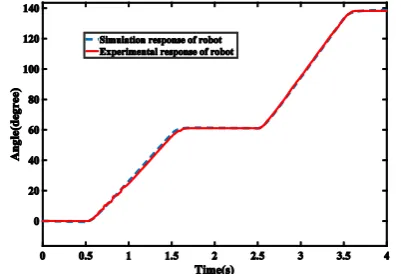
As seen in Table 5, performance of the genetic algorithm is better than that of the PSO algorithm according to the obtained value of the average cost function.
For better comparison, the simulation response of the robot based on the identified values of the uncertain parameters (see Table 4) and experimental data for both base and barrel angles are represented respectively in Figures 10 and 11.
TABLE 5. Comparison of the average cost function value for
both optimization methods after 10 executions
PSO GA
8496.2 4194.63
Figure 8. Flowchart of the identification scheme using GA
Figure 9. convergence of the fitness value
Figure 10. Comparison between simulation response of the
Figure 11. Comparison between simulation response of the robot with obtained parameters and experimental response for the barrel angle
Figures 12 and 13 show the error between simulation and experimental results for the base and the barrel, respectively.
Figure 12. Error between simulation and experimental results
of the base
Figure 13. Error between simulation and experimental results
of the base
6. CONCLUSION
This paper presented a genetic algorithm approach for parameters identification of a visual tracker robot. Two parameters which can’t be obtain without experimental work are inertia and damping coefficient. For this reason, this work proposed a method for identifying the true values of these parameters. The identification procedure was done through an open loop test. The open loop test was done in both simulation and experimental environment. After that, a cost function was proposed and the genetic algorithm was run for parameters identification. At the end, the values of the base and the barrel inertia and damping coefficient were obtained 0.117, 0.1, 1.9 and 1.495 respectively. Finally, according to the presented results, a good agreement between simulation and experimental open loop tests was seen with obtained parameters.
7. REFERENCES
1. Wu, J., Wang, J. and You, Z., "An overview of dynamic parameter identification of robots", Robotics and Computer-Integrated Manufacturing, Vol. 26, No. 5, (2010), 414-419. 2. Gu, Y. and Ding, R., "A least squares identification algorithm
for a state space model with multi-state delays", Applied Mathematics Letters, Vol. 26, No. 7, (2013), 748-753. 3. Brunot, M., Janot, A., Carrillo, F., Garnier, H., Vandanjon, P.-O.
and Gautier, M., "Physical parameter identification of a one-degree-of-freedom electromechanical system operating in closed loop", IFAC-PapersOnLine, Vol. 48, No. 28, (2015), 823-828. 4. Jubien, A., Gautier, M. and Janot, A., "Dynamic identification of
the kuka lwr robot using motor torques and joint torque sensors data", IFAC Proceedings Volumes, Vol. 47, No. 3, (2014), 8391-8396.
5. Bayani, H., Masouleh, M.T. and Kalhor, A., "An experimental study on the vision-based control and identification of planar cable-driven parallel robots", Robotics and Autonomous Systems, Vol. 75, (2016), 187-202.
6. Wang, W., Ding, F. and Dai, J., "Maximum likelihood least squares identification for systems with autoregressive moving average noise", Applied Mathematical Modelling, Vol. 36, No. 5, (2012), 1842-1853.
7. El-Kafafy, M., Peeters, B., Guillaume, P. and De Troyer, T., "Constrained maximum likelihood modal parameter identification applied to structural dynamics", Mechanical Systems and Signal Processing, Vol. 72, (2016), 567-589. 8. Chang, W.-D., "Nonlinear system identification and control
using a real-coded genetic algorithm", Applied Mathematical Modelling, Vol. 31, No. 3, (2007), 541-550.
9. Yang, Z. and Seested, G.T., "Time-delay system identification using genetic algorithm–part one: Precise fopdt model estimation", IFAC Proceedings Volumes, Vol. 46, No. 20, (2013), 561-567.
10. West, C., Montazeri, A., Monk, S.D. and Taylor, C.J., "A genetic algorithm approach for parameter optimization of a 7dof robotic manipulator", IFAC-PapersOnLine, Vol. 49, No. 12, (2016), 1261-1266.
dynamic identification of an over-constrained 3-dof decoupled parallel mechanism", Mechanism and Machine Theory, Vol. 116, (2017), 178-202.
12. Tavakolpour, A.R., Darus, I.Z.M., Tokhi, O. and Mailah, M., "Genetic algorithm-based identification of transfer function parameters for a rectangular flexible plate system", Engineering Applications of Artificial Intelligence, Vol. 23, No. 8, (2010), 1388-1397.
13. Zare, S. and Tavakolpour-Saleh, A., "Frequency-based design of a free piston stirling engine using genetic algorithm", Energy, Vol. 109, (2016), 466-480.
14. Li, C. and Zhou, J., "Parameters identification of hydraulic turbine governing system using improved gravitational search algorithm", Energy Conversion and Management, Vol. 52, No. 1, (2011), 374-381.
15. Sedighizadeh, M. and Kashani, M.F., "A tribe particle swarm optimization for parameter identification of proton exchange membrane fuel cell", International Journal of Engineering-Transactions A: Basics, Vol. 28, No. 1, (2014), 16-25. 16. Sitarz, P. and Powałka, B., "Modal parameters estimation using
ant colony optimisation algorithm", Mechanical Systems and Signal Processing, Vol. 76, (2016), 531-554.
17. Ding, L., Wu, H., Yao, Y. and Yang, Y., "Dynamic model identification for 6-dof industrial robots", Journal of Robotics, Vol. 2015, (2015), 9-15.
18. Tavakolpour-Saleh, A., Zare, S. and Badjian, H., "Multi-objective optimization of stirling heat engine using gray wolf optimization algorithm", International Journal of Engineering-Transactions C: Aspects, Vol. 30, No. 6, (2017), 321-329. 19. Brancati, R., Russo, R. and Savino, S., "Method and equipment
for inertia parameter identification", Mechanical Systems and Signal Processing, Vol. 24, No. 1, (2010), 29-40.
20. Lopéz, R., Gonzalez, I., Flores, J., Ordaz, J., Salazar, S. and Lozano, R., "Real time parameter identification of the inertia tensor for a quad-rotor mini-aircraft using adaptive control",
IFAC Proceedings Volumes, Vol. 46, No. 30, (2013), 32-37. 21. Naghipour, M., "Large scale experiments data analysis for
estimation of hydrodynamic force coefficients", International Journal of Engineering-Transactions A: Basics, Vol. 16, No. 1, (2002), 29-35.
22. Zhao, L., Zhou, C. and Yu, Y., "Damping parameters identification of cabin suspension system for heavy duty truck based on curve fitting", Shock and Vibration, Vol. 2016, (2016).
23. Xu, L., "The damping iterative parameter identification method for dynamical systems based on the sine signal measurement",
Signal Processing, Vol. 120, (2016), 660-667.
24. Preumont, A., "Mechatronics: Dynamics of electromechanical and piezoelectric systems, Springer Science & Business Media, Vol. 136, (2006).
Parameters Identification of an Experimental Vision-based Target Tracker Robot
Using Genetic Algorithm
M. H. Sangdani, A. R. Tavakolpour-Saleh
Department of Mechanical and Aerospace Engineering, Shiraz University of Technology, Shiraz, Iran
P A P E R I N F O
Paper history:
Received 11 September 2017
Received in revised form 24 September 2017 Accepted 12 October 2017
Keywords:
Parameter Identification Target Tracker Robot Genetic Algorithm
ديكچ ه
جیاتن اب بایدر تابر کی یکیمانید یاهرتماراپ نیمخت یارب کیتنژ متیروگلا زا هلاقم نیا رد بش هی و یزاس آ یهاگشیامز هدافتسا هدش یشخرچ تکرح ود زا هک دراد یدازآ هجرد ود بایدر تابر .تسا کشت لی .تسا هدش هب تروص دنور ،یلک فراعتم اسانش لماش تابر یی لدم
زاس ،یهاگشیامزآ یحارط ،ی هداد
رادرب ت ،لانگیس شزادرپ ،ی ابتعا و هداد نیمخ
یجنس ر
تسه ادتبا ،دنور نیا ساسا رب . بلتم کنیلومیس همانرب رد و هدش هبساحم تابر یکیمانید تلاداعم
بش ی ه .تسا هدش یزاس
یارب هلحرم عمج یارب سپس .تسا هدش هتخاس و یحارط تابر ،دعب گ تروص زاب هقلح شیامزآ ،هداد یروآ
سا هتفر رد .ت
یارب .تسا هدش هتفرگ راک هب کیتنژ متیروگلا ،اهرتماراپ ییاسانش یارب شهوژپ نیا کی ،راک نیا
ورو د کی ی لدم هب ناس
یم لامعا تابر دوخ و تابر یجورخ نیب فلاتخا .دوش
اه هب ناونع کیتنژ متیروگلا هنیزه عبات د
م هتفرگ رظن ر ی
.دوش
راک هب کیتنژ متیروگلا ،تیاهنرد هتفرگ
هدش م یم نیمخت ار اهرتماراپ بسانم ریداق .دنز
اهن ًاتی یبطت ،جیاتن بوخ یلیخ ق ار ی
نیب هیبش جیاتن و یهاگشیامزآ جیاتن یم ناشن ،هدمآ تسدب یاهرتماراپ اب یزاس
.دهد doi: 10.5829/ije.2018.31.03c.11