A Monthly Double-Blind Peer Reviewed (Refereed/Juried) Open Access International e-Journal - Included in the International Serial Directories
Indexed & Listed at:
VOLUME NO.4(2014),ISSUE NO.04(APRIL) ISSN 2231-5756
INTERNATIONAL JOURNAL OF RESEARCH IN COMMERCE, IT & MANAGEMENT
CONTENTS
Sr.
No.
TITLE & NAME OF THE AUTHOR (S)
Page
No.
1
.
ENCOMPASSING KANO’S MODEL TO AUGMENT CUSTOMER EXPERIENCE FOR THE
INDIAN DTH INDUSTRY
DR. SUJATA JOSHI, DR. SANJAY BHATIA, ARNAB MAJUMDAR & ARCHIT MALHOTRA
1
2
.
WOMEN AND CHILD TRAFFICKING
ARJUMAND BANO & DR. SANJAY BAIJAL
7
3
.
OBSTACLES IN GROWTH OF ENTREPRENEURSHIP
MOHAN BHAGWAT BHOSALE & DR. SARANG SHANKAR BHOLA
12
4
.
A STUDY OF CONSUMERS' ATTITUDES AND PURCHASE INTENTIONS TOWARDS
ENVIRONMENTAL: FRIENDLY PRODUCTS IN FMCG SECTOR IN INDIA
DR. NAMITA RAJPUT, RUCHIKA KAURA & AKANKSHA KHANNA
14
5
.
INDIAN COMMODITY DERIVATIVE MARKET: A STUDY OF PRICE TRENDS IN THE
INTERNATIONAL MARKET
GIRISHA H.J, VISHWANATH C.R & MARIGOWDA K.T
20
6
.
A STUDY ON INFORMATION TECHNOLOGY IN THE CURRENT BUSINESS FRAMEWORK
PRADEEP KUMAR, RUCHI SHARMA & SUNITA PRAJAPATI
22
7
.
A STUDY ON THE DEVELOPMENT OF ONLINE MICRO-LENDING COMMUNITY IN NORTH
BENGAL
DIPANJAN MOITRA & SANMOY MALLICK
26
8
.
TRANSACTIONAL ANALYSIS: THEORY OF PERSONALITY AND INTER PERSONAL
BEHAVIOUR
VAJINDER PAL SINGH & AMIT KUMAR JAIN
32
9
.
SOCIO-ECONOMIC BACKGROUND OF MANAGEMENT STUDENTS OF PUBLIC AND
PRIVATE INSTITUTIONS IN DELHI
VIJETA BANWARI
37
10
.
TAX STRUCTURE IN INDIA AND EFFECT ON CORPORATES & INDIVIDUAL CUSTOMERS
ABHISHEK JHA
43
11
.
MERGERS AND ACQUISITIONS IN INDIAN PHARMACEUTICAL INDUSTRY: A CASE STUDY
ON MATRIX LAB
DR. SURESH CHANDRA DAS, POOJA PATTANAYAK & BHAGYASHREE PATTNAIK
46
12
.
IMPACT OF ACHIEVEMENT MOTIVATION UPON ACADEMIC ACHIEVEMENT AND
SOCIO-ECONOMIC STATUS
DR. SAIMA SIDDIQI
50
13
.
EXPLORATORY ANALYSIS ON THE TRENDS AND ISSUES RELATED TO STANDARDIZING
FINANCIAL REPORTING IN ETHIOPIAN BANKING SECTOR
MATEWOS KEBEDE & ABIY GETAHUN
53
14
.
CHANGING CUSTOMER BEHAVIOR-TIME TO RETHINK BY THE INSURANCE PROVIDERS
PURTI BATRA
57
15
.
EXAMINING EMPLOYEES PERFORMANCE APPRAISAL ISSUES AND CHALLENGES IN BANKS
OF PAKISTAN: COMPARATIVE STUDY OF PRIVATE AND PUBLIC BANKS OF PUNJAB
PAKISTAN
SYEDA NUDRAT SAMEEN, SHAHID NAWAZ, MUHAMMED NAWAZ & MUHAMMAD IRFAN
SHAKOOR
60
CHIEF PATRON
PROF. K. K. AGGARWAL
Chairman, Malaviya National Institute of Technology, Jaipur
(An institute of National Importance & fully funded by Ministry of Human Resource Development, Government of India)
Chancellor, K. R. Mangalam University, Gurgaon
Chancellor, Lingaya’s University, Faridabad
Founder Vice-Chancellor (1998-2008), Guru Gobind Singh Indraprastha University, Delhi
Ex. Pro Vice-Chancellor, Guru Jambheshwar University, Hisar
FOUNDER PATRON
LATE SH. RAM BHAJAN AGGARWAL
Former State Minister for Home & Tourism, Government of Haryana
Former Vice-President, Dadri Education Society, Charkhi Dadri
Former President, Chinar Syntex Ltd. (Textile Mills), Bhiwani
CO-ORDINATOR
AMITA
Faculty, Government M. S., Mohali
ADVISORS
DR. PRIYA RANJAN TRIVEDI
Chancellor, The Global Open University, Nagaland
PROF. M. S. SENAM RAJU
Director A. C. D., School of Management Studies, I.G.N.O.U., New Delhi
PROF. M. N. SHARMA
Chairman, M.B.A., Haryana College of Technology & Management, Kaithal
PROF. S. L. MAHANDRU
Principal (Retd.), Maharaja Agrasen College, Jagadhri
EDITOR
PROF. R. K. SHARMA
Professor, Bharti Vidyapeeth University Institute of Management & Research, New Delhi
CO-EDITOR
DR. BHAVET
Faculty, Shree Ram Institute of Business & Management, Urjani
EDITORIAL ADVISORY BOARD
DR. RAJESH MODI
Faculty, Yanbu Industrial College, Kingdom of Saudi Arabia
PROF. SANJIV MITTAL
University School of Management Studies, Guru Gobind Singh I. P. University, Delhi
PROF. ANIL K. SAINI
VOLUME NO.4(2014),ISSUE NO.04(APRIL) ISSN 2231-5756
INTERNATIONAL JOURNAL OF RESEARCH IN COMMERCE, IT & MANAGEMENT
DR. SAMBHAVNA
Faculty, I.I.T.M., Delhi
DR. MOHENDER KUMAR GUPTA
Associate Professor, P. J. L. N. Government College, Faridabad
DR. SHIVAKUMAR DEENE
Asst. Professor, Dept. of Commerce, School of Business Studies, Central University of Karnataka, Gulbarga
ASSOCIATE EDITORS
PROF. NAWAB ALI KHAN
Department of Commerce, Aligarh Muslim University, Aligarh, U.P.
PROF. ABHAY BANSAL
Head, Department of Information Technology, Amity School of Engineering & Technology, Amity
University, Noida
PROF. A. SURYANARAYANA
Department of Business Management, Osmania University, Hyderabad
DR. SAMBHAV GARG
Faculty, Shree Ram Institute of Business & Management, Urjani
PROF. V. SELVAM
SSL, VIT University, Vellore
DR. PARDEEP AHLAWAT
Associate Professor, Institute of Management Studies & Research, Maharshi Dayanand University, Rohtak
DR. S. TABASSUM SULTANA
Associate Professor, Department of Business Management, Matrusri Institute of P.G. Studies, Hyderabad
SURJEET SINGH
Asst. Professor, Department of Computer Science, G. M. N. (P.G.) College, Ambala Cantt.
TECHNICAL ADVISOR
AMITA
Faculty, Government M. S., Mohali
FINANCIAL ADVISORS
DICKIN GOYAL
Advocate & Tax Adviser, Panchkula
NEENA
Investment Consultant, Chambaghat, Solan, Himachal Pradesh
LEGAL ADVISORS
JITENDER S. CHAHAL
Advocate, Punjab & Haryana High Court, Chandigarh U.T.
CHANDER BHUSHAN SHARMA
Advocate & Consultant, District Courts, Yamunanagar at Jagadhri
SUPERINTENDENT
CALL FOR MANUSCRIPTS
We invite unpublished novel, original, empirical and high quality research work pertaining to recent developments & practices in the areas of Computer Science & Applications; Commerce; Business; Finance; Marketing; Human Resource Management; General Management; Banking; Economics; Tourism Administration & Management; Education; Law; Library & Information Science; Defence & Strategic Studies; Electronic Science; Corporate Governance; Industrial Relations; and emerging paradigms in allied subjects like Accounting; Accounting Information Systems; Accounting Theory & Practice; Auditing; Behavioral Accounting; Behavioral Economics; Corporate Finance; Cost Accounting; Econometrics; Economic Development; Economic History; Financial Institutions & Markets; Financial Services; Fiscal Policy; Government & Non Profit Accounting; Industrial Organization; International Economics & Trade; International Finance; Macro Economics; Micro Economics; Rural Economics; Co-operation; Demography: Development Planning; Development Studies; Applied Economics; Development Economics; Business Economics; Monetary Policy; Public Policy Economics; Real Estate; Regional Economics; Political Science; Continuing Education; Labour Welfare; Philosophy; Psychology; Sociology; Tax Accounting; Advertising & Promotion Management; Management Information Systems (MIS); Business Law; Public Responsibility & Ethics; Communication; Direct Marketing; E-Commerce; Global Business; Health Care Administration; Labour Relations & Human Resource Management; Marketing Research; Marketing Theory & Applications; Non-Profit Organizations; Office Administration/Management; Operations Research/Statistics; Organizational Behavior & Theory; Organizational Development; Production/Operations; International Relations; Human Rights & Duties; Public Administration; Population Studies; Purchasing/Materials Management; Retailing; Sales/Selling; Services; Small Business Entrepreneurship; Strategic Management Policy; Technology/Innovation; Tourism & Hospitality; Transportation Distribution; Algorithms; Artificial Intelligence; Compilers & Translation; Computer Aided Design (CAD); Computer Aided Manufacturing; Computer Graphics; Computer Organization & Architecture; Database Structures & Systems; Discrete Structures; Internet; Management Information Systems; Modeling & Simulation; Neural Systems/Neural Networks; Numerical Analysis/Scientific Computing; Object Oriented Programming; Operating Systems; Programming Languages; Robotics; Symbolic & Formal Logic; Web Design and emerging paradigms in allied subjects.
Anybody can submit the soft copy of unpublished novel; original; empirical and high quality research work/manuscriptanytime in M.S. Word format
after preparing the same as per our GUIDELINES FOR SUBMISSION; at our email address i.e. [email protected] or online by clicking the link online submission as given on our website (FOR ONLINE SUBMISSION, CLICK HERE).
GUIDELINES FOR SUBMISSION OF MANUSCRIPT
1. COVERING LETTER FOR SUBMISSION:
DATED: _____________
THE EDITOR
IJRCM
Subject: SUBMISSION OF MANUSCRIPT IN THE AREA OF.
(e.g. Finance/Marketing/HRM/General Management/Economics/Psychology/Law/Computer/IT/Engineering/Mathematics/other, please specify)
DEAR SIR/MADAM
Please find my submission of manuscript entitled ‘___________________________________________’ for possible publication in your journals.
I hereby affirm that the contents of this manuscript are original. Furthermore, it has neither been published elsewhere in any language fully or partly, nor is it under review for publication elsewhere.
I affirm that all the author (s) have seen and agreed to the submitted version of the manuscript and their inclusion of name (s) as co-author (s).
Also, if my/our manuscript is accepted, I/We agree to comply with the formalities as given on the website of the journal & you are free to publish our contribution in any of your journals.
NAME OF CORRESPONDING AUTHOR: Designation:
Affiliation with full address, contact numbers & Pin Code: Residential address with Pin Code:
Mobile Number (s): Landline Number (s): E-mail Address: Alternate E-mail Address:
NOTES:
a) The whole manuscript is required to be in ONE MS WORD FILE only (pdf. version is liable to be rejected without any consideration), which will start from
the covering letter, inside the manuscript.
b) The sender is required to mentionthe following in the SUBJECT COLUMN of the mail:
New Manuscript for Review in the area of (Finance/Marketing/HRM/General Management/Economics/Psychology/Law/Computer/IT/ Engineering/Mathematics/other, please specify)
c) There is no need to give any text in the body of mail, except the cases where the author wishes to give any specific message w.r.t. to the manuscript. d) The total size of the file containing the manuscript is required to be below 500 KB.
e) Abstract alone will not be considered for review, and the author is required to submit the complete manuscript in the first instance.
f) The journal gives acknowledgement w.r.t. the receipt of every email and in case of non-receipt of acknowledgment from the journal, w.r.t. the submission
of manuscript, within two days of submission, the corresponding author is required to demand for the same by sending separate mail to the journal.
2. MANUSCRIPT TITLE: The title of the paper should be in a 12 point Calibri Font. It should be bold typed, centered and fully capitalised.
3. AUTHOR NAME (S) & AFFILIATIONS: The author (s) full name, designation, affiliation (s), address, mobile/landline numbers, and email/alternate email address should be in italic & 11-point Calibri Font. It must be centered underneath the title.
VOLUME NO.4(2014),ISSUE NO.04(APRIL) ISSN 2231-5756
INTERNATIONAL JOURNAL OF RESEARCH IN COMMERCE, IT & MANAGEMENT
5. KEYWORDS: Abstract must be followed by a list of keywords, subject to the maximum of five. These should be arranged in alphabetic order separated bycommas and full stops at the end.
6. MANUSCRIPT: Manuscript must be in BRITISH ENGLISH prepared on a standard A4 size PORTRAIT SETTING PAPER. It must be prepared on a single space and single column with 1” margin set for top, bottom, left and right. It should be typed in 8 point Calibri Font with page numbers at the bottom and centre of every page. It should be free from grammatical, spelling and punctuation errors and must be thoroughly edited.
7. HEADINGS: All the headings should be in a 10 point Calibri Font. These must be bold-faced, aligned left and fully capitalised. Leave a blank line before each heading.
8. SUB-HEADINGS: All the sub-headings should be in a 8 point Calibri Font. These must be bold-faced, aligned left and fully capitalised.
9. MAIN TEXT: The main text should follow the following sequence:
INTRODUCTION REVIEW OF LITERATURE
NEED/IMPORTANCE OF THE STUDY STATEMENT OF THE PROBLEM OBJECTIVES
HYPOTHESES
RESEARCH METHODOLOGY RESULTS & DISCUSSION FINDINGS
RECOMMENDATIONS/SUGGESTIONS CONCLUSIONS
SCOPE FOR FURTHER RESEARCH ACKNOWLEDGMENTS REFERENCES APPENDIX/ANNEXURE
It should be in a 8 point Calibri Font, single spaced and justified. The manuscript should preferably not exceed 5000 WORDS.
10. FIGURES &TABLES: These should be simple, crystal clear, centered, separately numbered & self explained, and titles must be above the table/figure. Sources of data should be mentioned below the table/figure. It should be ensured that the tables/figures are referred to from the main text.
11. EQUATIONS:These should be consecutively numbered in parentheses, horizontally centered with equation number placed at the right.
12. REFERENCES: The list of all references should be alphabetically arranged. The author (s) should mention only the actually utilised references in the preparation of manuscript and they are supposed to follow Harvard Style of Referencing. The author (s) are supposed to follow the references as per the following:
•
All works cited in the text (including sources for tables and figures) should be listed alphabetically.•
Use (ed.) for one editor, and (ed.s) for multiple editors.•
When listing two or more works by one author, use --- (20xx), such as after Kohl (1997), use --- (2001), etc, in chronologically ascending order.•
Indicate (opening and closing) page numbers for articles in journals and for chapters in books.•
The title of books and journals should be in italics. Double quotation marks are used for titles of journal articles, book chapters, dissertations, reports, workingpapers, unpublished material, etc.
•
For titles in a language other than English, provide an English translation in parentheses.•
The location of endnotes within the text should be indicated by superscript numbers.PLEASE USE THE FOLLOWING FOR STYLE AND PUNCTUATION IN REFERENCES: BOOKS
•
Bowersox, Donald J., Closs, David J., (1996), "Logistical Management." Tata McGraw, Hill, New Delhi.•
Hunker, H.L. and A.J. Wright (1963), "Factors of Industrial Location in Ohio" Ohio State University, Nigeria.CONTRIBUTIONS TO BOOKS
•
Sharma T., Kwatra, G. (2008) Effectiveness of Social Advertising: A Study of Selected Campaigns, Corporate Social Responsibility, Edited by David Crowther &Nicholas Capaldi, Ashgate Research Companion to Corporate Social Responsibility, Chapter 15, pp 287-303.
JOURNAL AND OTHER ARTICLES
•
Schemenner, R.W., Huber, J.C. and Cook, R.L. (1987), "Geographic Differences and the Location of New Manufacturing Facilities," Journal of Urban Economics,Vol. 21, No. 1, pp. 83-104.
CONFERENCE PAPERS
•
Garg, Sambhav (2011): "Business Ethics" Paper presented at the Annual International Conference for the All India Management Association, New Delhi, India,19–22 June.
UNPUBLISHED DISSERTATIONS AND THESES
•
Kumar S. (2011): "Customer Value: A Comparative Study of Rural and Urban Customers," Thesis, Kurukshetra University, Kurukshetra.ONLINE RESOURCES
•
Always indicate the date that the source was accessed, as online resources are frequently updated or removed.WEBSITES
TRANSACTIONAL ANALYSIS: THEORY OF PERSONALITY AND INTER PERSONAL BEHAVIOUR
VAJINDER PAL SINGH
ASST. PROFESSOR
D.A.V. COLLEGE
JALANDHAR
AMIT KUMAR JAIN
ASST. PROFESSOR
D.A.V. COLLEGE
JALANDHAR
ABSTRACT
Transactional analysis is a theory of personality and relationship based on the study of specific ego states, a theory of social interaction or interpersonal communication and a system of group or individual psychotherapy used a tool for personal growth and personal change. In addition to the analysis of the interactions between individuals, Transactional Analysis also involves the identification of the ego statesbehind each and every transaction. According to Eric Berne, people interact with each other from one of the three psychological positions, or behavioural patterns, known as ego states. Thus, ego states are a person’s way of thinking, feeling, and behaving at any time. These ego states are, Parent, Adult and Child ego states. Eric Berne first developed his ideas at a time when psychotherapy and counselling usually followed the ‘medical method’, whereby therapist, like doctors, where considered to be the experts with all the learning and skill. This paper is a conceptual paper, through this paper researcher focuses on to give brief introduction about Transactional analysis and relates how transactional analysis helpful in business to study the personality. Transactional analysis is used in management, communications training, and organizational analysis to improve working relationships, problem-solving, and organizational efficiency. In fact, transactional analysis can use in any field in which there is a need for understanding individuals, relationships, and communication. Behavioural scientists recommend the use of Transactional Analysis to understand inter-personal relations in the organization. Transactional analysis help Managers in resolving conflicts, Improving interpersonal Communication in organisation, Developing Positive thinking, Organisational Development, Creating life position which is more desirable, and in tracing the Theory of Leadership.
KEYWORDS
Ego States, Life Positions, Personality, Transactional Analysis.
INTRODUCTION
hen People interact with each other, there results a social transaction. The analysis of Social Transaction is known as Transaction Analysis. Transactional Analysis is the study of human moves, which people make while dealing with other. This is a method of analysis and understanding of interpersonal behaviour Transactional analysis is a way of inquiring into what goes on between people and inside people in order to help them make change. Transactional analysis was originally developed by the Eric Berne in 1950, who was trained as a Freudian psychoanalyst and psychiatrist. He observed in his patients that often it was as if several different people were inside each person. He also observed that these various ‘selves’ transmitted with people in different ways. Later on, its application to ordinary interactions was popularized by Berne, Harries, and Jongeward. The theory outlines how we have developed and treats ourselves, how we relate and communicate with others, and offers suggestions and interventions which will enable us to change and grow.
REVIEW OF LITERATURE
Transactional analysis was developed by Berne (1957). It is both a theory of personality including theories of child development and psychopathology, which form the basis of a theory of psychotherapy, and also a theory of communication for understanding groups and organisations (Berne, 1963, 1966). It is used primarily as a therapeutic tool though it also has relevance for facilitating a deeper understanding of behaviours which affect relationships in a wide range of settings (Heyer, 1979). Transactional analysis has roots in psycho analysis but also cognitive behaviourist and humanist traditions, essentially combining some tenets of cognitive behaviourism and psychoanalytic insight “Within a Humanist value system” (Clarkson & Gilbert, 1988). TA developed both theoretically and practically during the decades since Berne’s early work, such that by the 1970s there were three recognised schools of TA: the Classical School, the Redecision School and the Cathexis School (Barnes, 1977); and until 2001 all qualifying accredited TA practitioners were required to be familiar with the principles and practice of all three Schools. Over the past four decades TA has developed further, specifically within the last decade to reflect the influence of debates in the psychotherapeutic community at large, and particularly the impact of work in neuroscience on psychotherapy. This impact re-ignites the long-standing debate over the epistemological location of TA; specifically whether or not it might be situated within a scientific epistemology, as Berne hoped. (This possibly relates to psychology and psychotherapy’s need to be perceived as scientific and thus achieve ontological security in acceptance by a „proper‟ research community.) A useful categorisation of current thinking and practice in TA is offered by Tudor (2007) wherein he identifies seven traditions giving the focus, theories and methods and external influences to each. Nonetheless, despite such categorisation it is a truism to state that TA is complex and certainly, the wide variation in traditions and resulting practices of TA makes general evaluation challenging. However, central to all traditions in TA are key concepts which offer a starting point for appraisal. First, is the emphasis on the contractual method – the commitment between therapist and client to a well-defined course of action “regarding their roles in achieving clearly stated objectives” (Nelson-Jones, 1982). Next is the central theoretical concept of Ego states. TA is based on a model of three categories of ego states – Parent, Adult and Child, a theory of social interaction based on a model of transactions between the ego states, and a concept of a life script wherein the origins of the client’s problems reside. The premise is that the transactions engaged in by people stimulate the acquisition of „psychological disturbance and the psychological games they play then reinforce that disturbance and distress. TA also highlights the dynamic inter-action between client and therapist, and the need for the therapist to be fully conversant with the ego state they are employing in the transactional process. Methods used for identifying ego states have ranged from intuitive, and thus subjective, assessments of behavioural and linguistic indicators (Klein, 1980: Solomon, 2003: Steere, 1981) to the use of projective tests (Turner, 1988) and the development of instruments which empirically measure ego state functions (Heyer, 1979, Thorne & Fargo, 1980, Doelker & Griffiths 1984). However it is noted (Loffredo & Harrington, 2008) that there has been little published literature on measures of ego states since the early 1980s. Therefore, this review is largely concerned with work between the 1970s and mid 80s.
A popular method for identifying ego states is the Egogram (Dusay, 1972), which presents an individual’s ego state energy distribution in the form of bar charts of five ego state functions (Nurturing Parent, Critical Parent, Adult, Free Child and Adapted Child). The Egogram is constructed (by either the practitioner or client) with a strong reliance on feeling and intuitive judgement about behaviours indicative of a specific ego state (Dusay, 1972). In defence of the client making a self- assessment, Dusay (1977) found high levels of concurrence when the Egogram was used with clients in group settings (Dusay, 1977). Also, Heyer (1979) suggests that most clients can be „trained‟ to judge the ego states they are employing. However distorted perceptions can result when a client is under pressure, when they use too much or too little Adult state, and when they have a lack of understanding of the attributes of the states (Dusay, 1977). Thus,
VOLUME NO.4(2014),ISSUE NO.04(APRIL) ISSN 2231-5756
INTERNATIONAL JOURNAL OF RESEARCH IN COMMERCE, IT & MANAGEMENT
arguably, the measure is highly subjective and has low reliability due to the inherent differences in the ability of individuals to correctly identify ego states (Heyer, 1979).
OBJECTIVE OF THE STUDY
Primary Objective of this Paper is to give brief introduction about Transactional analysis, and thereafter researcher tries to relate Transactional analysis with business organisation environment, how it helps manager to dealing with human resource.
TRANSACTIONAL ANALYSIS
Transactional Analysis is underpinned by the philosophy that: • people can change
• we all have a right to be in the world and be accepted EGO STATES- BASIS OF TRANSACTIONAL ANALYSIS
According to Berne, people interact with each other from one of the three psychological positions, or behavioural patterns, known as ego states. In addition to the analysis of the interactions between individuals, Transactional Analysis also involves the identification of the ego states behind each and every transaction. Berne defined an ego state as “a consistent pattern of feeling and experience directly related to a corresponding consistent pattern of behaviour. In one counselling session, Berne treated a 35 year old lawyer. During the session, the lawyer (a male) said “I’m not really a lawyer; I’m just a little boy.” But outside the confines of Dr. Berne’s office, this patient was a successful, hard-charging, attorney. Later, in their sessions, the lawyer would frequently ask Dr. Berne if he was talking “to the lawyer or the little boy.” Berne was intrigued by this, as he was seeing a single individual display two “states of being.” Berne began referring to these two states as “Adult” and “Child.” Later, Berne identified a third state, one that seemed to represent what the patient had observed in his parents when he was small. Berne referred to this as “parent.” As Berne then turned to his other patients, he began to observe that these three ego states were present in all of them. As Berne gained confidence in this theory, he went on to introduce these in a 1957 paper – one year before he published his seminal paper introducing Transactional Analysis.
Berne ultimately defined the three ego states as: Parent, Adult, and Child
Parent Ego State (Tough Concept of Life)
Behaviours, thoughts and feeling copied from parents or parent figures
PARENTS
Adult Ego State (Thought Concept of Life)
Behaviours, thought and feelings which are direct responses to the here and now ADULT
Child Ego State (Felt Concept of Life)
Behaviours, thought and feeling replayed from childhood
CHILD
Parent Ego State: Parent ego state is a part of somebody’s personality which a person catches from parents. Here the word parent includes anybody which influences our behaviour like teacher, role model, friends etc. Parent ego is foundation for any person attitude, all emotional behaviour. Characteristics of a person acting with the parent ego include being over protective, distant, dogmatic, indispensable and upright. Physical and verbal clues that someone is acting with the parent ego include the wagging finger to show displeasure, reference to lows and rules, and reliance on ways that were successful in the past. There can be two types of parent ego states nurturing and critical.
FIG.1
Parent Ego State
Nurturing Parent ego state
Reflects nurturing behaviour not only towards children but also to other
people in interaction.
.
Critical Parent ego state
Shows critical and evaluative behaviour in interaction with others.
Each individual has his unique parent ego state which is likely to be a mixture of helpfulness and hurtfulness.
Adult Ego State: Adult Ego state is a part of somebody’s personality that is based on somebody’s experiences. Adult ego of a person is originated after carefully analysis of various situations. Adult ego state is based upon reasoning, seeking and providing information. Person interacting with adult ego views people as equal, worthy, and responsible human beings. It is based on rationality. The adult is characterized by logical thinking and reasoning. This ego state can be identified by verbal and physical signs which include thoughtful concentration and factual discussion.
Child Ego State: Child Ego state is a natural part of somebody’s personality. Child ego state reflects early childhood conditions and experience perceived by individuals in their early years of life, that is, before the social birth of an individual say, up to the age of five years. Characteristics of child ego include creativity, conformity, depression, anxiety dependence, fear, and hate. Physical and verbal clues that person is acting in the child ego are silent compliance, attention seeking, temper tan trumps, giggling and nervousness. The child ego is characterized by non-logical and immediate actions which result in immediate satisfaction.
FIG.2
Child Ego State
Natural Child State
Adaptive Child State
.
Rebellion Child State
i) Natural Child: Natural child ego is the part of somebody’s personality which is by natural in the human being. The natural child is affectionate, impulsive, and sensuous and does what come naturally. However, he is also fearful, self-indulgent, self-centered and aggressive and may emerge in many unpleasant roles. ii) Adaptive Child: Adaptive Child ego is a part of somebody’s personality which is ready to adopt new things. The adaptive child is the trained one and he is likely to what parents insist on, and sometimes learns to feel not O.K. The adopted child when overtly inhibited, often becomes the troubled part of the personality.
iii) Rebellion Child: Rebellion Child ego is a part of somebody’s personality which is full of fear, jealous and frustration. The rebellion child experiences anger, fear and frustration.
TRANSACTIONAL ANALYSIS- LIFE POSITIONS
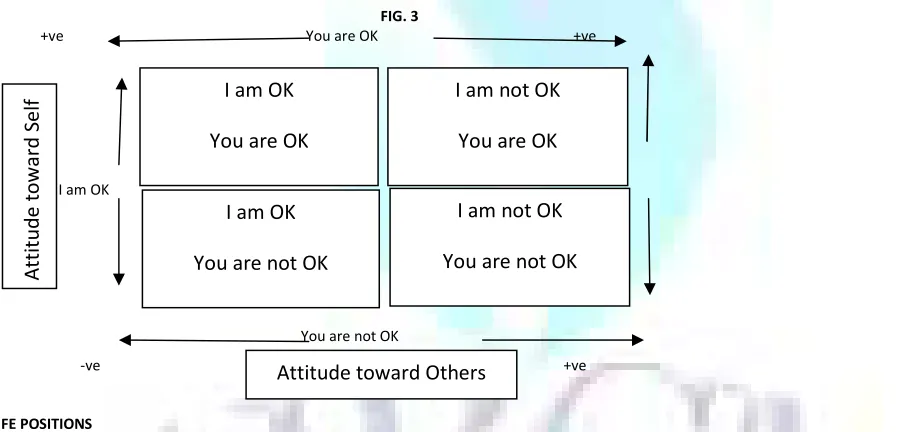
Life positions are basic beliefs about self and others, which are used to justify decisions and behaviour. Social Transaction occurs when two or more people come into contact with each other. So people always have assumption about him and other. Such assumptions are tied into their identity, sense of worth, and perceptions of other people. This tends to remain with the person for lifetime unless major experiences occur to change it. Such positions are called life positions. It stem from a combination of two view-points i.e. attitude towards myself and attitude towards others. Either a positive response (OK) or a negative response (not OK) result in four possible life positions as shown in figure below:
FIG. 3
+ve You are OK +ve
I am OK
You are not OK
-ve +ve
LIFE POSITIONS
1. I am OK, You are OK: This appears to be an ideal life position. People having these feeling has positive outlook towards life. Whatever they do in his, there is positive result always. People having this type of life position, they have complete confidence on others.
2. I am Ok, You are not OK: This position is taken by people who feel victimized or persecuted. They blame others for their miseries. This is the case of aggrieved person with an attitude that whatever they do is right. There is more negative experience in their life as compared to positive experiences. This is a distrustful life position.
3. I am not OK, You are OK: This position is common to persons who feel powerlessness in comparison to others. It is based on one’s feelings about oneself. Individuals who feel a clear distinction between themselves and the people around them, who could do many things that the individuals could not do, hold this life position.
4. I am not OK, You are not OK: This is a desperate life position. This position is taken by those people who lose interest in living. They feel that life is not worth living at all. In extreme cases, they commit suicide or homicide.
Example shows Transactional Analysis of an adult, a parent and a child:
TABLE 1
TA OF THE NOT OK AND OK ATTITUDES
As a Parent As a Adult As a Child
Not OK OK Not OK OK Not OK OK
Dictator Do it my way Supportive Informed critic Computer Always testing Communicator Offering alternatives Milk toast Scatterbrain Negotiator Innovator
I am OK
You are OK
I am not OK
You are OK
I am OK
You are not OK
I am not OK
You are not OK
Attitude toward Others
VOLUME NO.4(2014),ISSUE NO.04(APRIL) ISSN 2231-5756
INTERNATIONAL JOURNAL OF RESEARCH IN COMMERCE, IT & MANAGEMENT
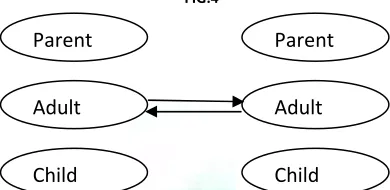
SOME EXAMPLES OF TRANSACTIONAL ANALYSIS IN WORKPLACEUse of complementary Transactions: Complementary Transaction require in every organisation for successful communication. Complementary transaction involves one person initiating a conversation in one of the three ego states, such as parent-to-child, and the respondent sending a reply back to the sending ego state, such as child-to-adult.
FIG.4
For example, a supervisor communicates in the parent-to-child ego when he reprimands an employee for being late. If the employee responds by apologizing and saying it won't happen again, the employee is in the child-to-parent ego state and the result is a complementary transaction. Consider two co-workers evaluating a failed project. If one person sends an adult-to-adult message of "Let's figure out what went wrong," a complementary adult-to-adult response from the other would be "Yes, let's get to work and find out what happened.
USE OF CROSSED TRANSACTION
Crossed transactions can take place between a supervisor and employees or between employees themselves. When crossed transactions occur, a break in communication likely results unless one person shifts his response to a complementary ego state. This may happen when the receiver forms the wrong impression about the sender's message or responds in an ego state differently than what you might expect. For example, a manager in the adult-to-adult state might rationally ask an employee about a mistake in a report the employee composed. A crossed transaction occurs if the employee responds using the child-to-parent ego and complains, "Why are you always criticizing my work?"
FIG.5
USE OF STROKING
An important part of transactional analysis is the concept of stroking. Humans have a continual need for strokes, which can be understood as simple units of interpersonal recognition. Managers and supervisors can create a positive work environment and positive relationships with employees by giving constant strokes. Examples include verbal praise of an employee, compliments or positive feedback about a project. Strokes can also be physical, such as a handshake or pat on the back. Negative work attitudes may ensue if employees experience negative strokes, such as constant criticism from an overbearing boss.
TRANSACTIONAL GAMES
Psychological 'games' played at work are often a series of repeated transactions. The game may make sense at some superficial level, but in the end, it's typically about strengthening someone else's psychological position or avoidance. For example, "Passing the Buck" often occurs in organizations that pass important decisions on up to different hierarchical levels of management. Another example is "The Blame Game," an attempt to shift responsibility from one person or group to another. A boss may play the "Why Don't You/Yes But" game when he calls a meeting to get suggestions on some issue, but then puts down each suggestion offered by the employees only to point out that his solution is the best answer.
HOW TRANSACTION ANALYSIS HELPFUL FOR MANAGERS IN DEALING WITH HUMAN RESOURCE
1. Transaction analysis and conflict resolution: There are several natural connections between transactional analysis and the approaches to resolving conflict. Transactional analysis helps to a management to adopt various strategies while any conflict arises in organisation. The Parent ego state may lead to the use of a forcing strategy, while the Child state may smooth over conflicts or try to avoid them. The “I am OK – You are OK” person is more likely to seek a win-win outcome, applying the Adult ego state and a confrontational strategy. When there is crossed transaction in organisation it leads to conflict in organisation. Transaction analysis suggests the various strategies to management to deal with conflicting situation.
TABLE 2: PROBABLE RELATIONSHIPS OF LIFE POSITIONS WITH CONFLICT RESOLUTION STRATEGIES AND BEHAVIOUR
Life Position Conflict Resolution Strategy Probable Behaviour
I am OK- You are OK. Confronting Self assured
I am Ok - You are not OK. Forcing Aggressive
I am not OK - you are OK. Smoothing Non-assertiveness
I am not OK - You are not Ok. Avoidance Non-assertiveness
2. Improved interpersonal Communication: Transactional analysis help in improving interpersonal communication. Transactional analysis helps a manager to understand their personality and know why people respond to him in particular way. With the Transactional analysis the manager can understand the crosses transaction and try to convert it into complementary transaction to improve interpersonal communication.
3. Developing Positive thinking: Transactional analysis is applied to bring positive actions from people because TA brings positive approach towards life and hence positive actions. TA brings a clear change from negative feelings – confusion, defeat, fear, frustration, loneliness, pessimism, and suppression – to positive feelings – clear thinking, victory, achievement, courage, gratification, decision, friendship, optimism, and fulfilment
4. Motivation: TA can be applied in motivation where it helps in satisfying human needs through complementary transactions and positive strokes. Managers can enrich jobs for people by helping them to engage in kinds of activities that give them more positive strokes. It emphasizes strokes from the intrinsic value of the work, rather than depending entirely on strokes from outside. Transactional analysis motivates people to work in a systematic manner which give them positive strokes.
5. Organisational Development: Organization development applied a humanistic value system to work behaviour and a reorientation of man’s thinking and behaviour towards his work organization. The major goal of organization development is to fight the past in the present in order to choose freely the future. TA can help in organization development process. Transactional analysis help a manager in identify undesirable ego state and convert them into desirable one. Like crossed and ulterior transaction are undesirable in organisation, so transactional analysis help manager to convert it in desirable one.
Parent
Parent
Adult
Adult
Child
Child
Parent
Parent
Adult
Adult
6. Help in creating life position which is more desirable: Transactional analysis help in knowing various life position and shift from undesirable one to desirable one.
7. Trace the Theory of Leadership: Transactional analysis helps in trace the theory of leadership. Transactional analysis shows the ego state of leader by using management grid of leadership.
TABLE 3
Leadership Style Ego state
Nine ,One Style (9,1 style) I am Ok, You are not Ok One, Nine Style (1,9 style) I am not Ok, You are Ok Nine ,Nine Style (9,9 style) I am Ok, You are Ok One ,One Style (1,1 style) I am not Ok, You are not Ok
CONCLUSION
Earlier Transactional analysis is considered as a philosophy, medical science. But today transactional analysis considered as a theory of Personality, a model of communication and study of human behaviour i.e. why he responds to situation in a particular way. Human resource is an important asset for any business organisation, therefore managing human resource is the difficult task for H.R manager. Transactional analysis helps manager to study the human behaviour and personality and communicate according to the betterment of organisation.
REFERENCES
1. Berne, E. (1957). Ego states in psychotherapy. The American Journal of Psychotherapy, 11, pp293-309. 2. Berne, E. (1961). Transactional Analysis in Psychotherapy. New York, Bantam Books.
3. Berne, E., 2009. Transactional Analysis in Psychotherapy.. Igal Meirovich.
4. Berne, E., 2011. Games People Play: The Psychology of Human Relationshi,Tantor Ebook.
5. Clarkson & M. Gilbert (1988). Berne’s original model of ego states: Some theoretical considerations. Transactional Analysis Journal, Vol. 18, No 1, January, pp 20-29.
6. Graham Barnes, M. B., 1977. Transactional analysis after Eric Berne: teachings and practices of three TA schools. 1 ed. s.l.:Harper's College Press. 7. Harris, T. A., 2013. I'm Ok, You're Ok. s.l.:Random House.
8. Heather Fowlie, C. S., 2011. Relational Transactional Analysis: Principles in Practice. 1 ed. s.l.:Karnac Books. 9. Helena Hargaden, C. S., 2002. Transactional Analysis: A Relational Perspective. 1 ed. s.l.:Brunner-Routledge. 10. James Harris Morrison, J. J. O., 2007. Practical transactional analysis in management. 1 ed. s.l.:Addison-Wesley Pub.. 11. Lapworth, P. & Sills, C., 2011. An Introduction to Transactional Analysis. 3rd ed. s.l.:Sage Publisher.
12. S. Fayyaz Ahmad, N. A. G. &. J. A. D., 2008. Organisational Behaviour. 1 ed. s.l.:Atlantic Publishers & Dist. 13. Solomon, C., 2003. Transactional Analysis Theory: the Basics. Transactional analysis Journal, pp. 15-22. 14. Stewart, I., 2013. Transactional analysis councling in action. 4th ed. s.l.:Sage Publisher.
15. Stewart, Ian and Joines, Vann. TA Today: A New Introduction to Transactional Analysis. Lifespace Publishing, Chapel Hill, North Carolina. 1987. 16. Tudor, K., 2002. Transactional Analysis Approaches to Brief Therapy: What Do You Say Between Saying Hello and Goodbye?. 1 ed. s.l.:SAGE. WEBSITES
17. http://managementpocketbooks.wordpress.com/2013/06/25/transactional-analysis-for-managers/ 18. http://smallbusiness.chron.com/examples-transactional-analysis-workplace-12560.html
19. http://www.businessballs.com/transactionalanalysis.htm 20. http://www.ericberne.com/transactional-analysis/ 21. http://www.goodtherapy.org/transactional-analysis.html
22. http://www.lifepositive.com/mind/psychology/transactional-analysis/harmonious-relationships.asp 23. http://www.ncbi.nlm.nih.gov/pmc/articles/PMC1959225/
24. http://www.usataa.org/about-usataa/transactional-analysis
VOLUME NO.4(2014),ISSUE NO.04(APRIL) ISSN 2231-5756
INTERNATIONAL JOURNAL OF RESEARCH IN COMMERCE, IT & MANAGEMENT
REQUEST FOR FEEDBACK
Dear Readers
At the very outset, International Journal of Research in Commerce, IT & Management (IJRCM)
acknowledges & appreciates your efforts in showing interest in our present issue under your kind perusal.
I would like to request you tosupply your critical comments and suggestions about the material published
in this issue as well as on the journal as a whole, on our E-mail
for further
improvements in the interest of research.
If youhave any queries please feel free to contact us on our E-mail
.
I am sure that your feedback and deliberations would make future issues better – a result of our joint
effort.
Looking forward an appropriate consideration.
With sincere regards
Thanking you profoundly
Academically yours
Sd/-
Co-ordinator
DISCLAIMER