Copyright © Universal Multidisciplinary Research Institute Pvt Ltd
94
South -Asian Journal of Multidisciplinary Studies (SAJMS) ISSN:2349-7858:SJIF:2.246:Volume 3 Issue 5
ISSUES AND CHALLENGES OF HIGHER EDUCATION IN
INDIA: AN OVERVIEW
Dr. Khirod Kr. Phukan, Assistant Professor, Dept. of Economics, Madhabdev College ID: [email protected]
Introduction
Higher education has been obviously playing a speculative role in the development of
human beings including all spheres of life in all dimensions. Higher education is the most
powerful tool to build the knowledge based society for the future. Education system in India can
be dated centuries back to the age of Budha, but there has infect been substantial improvement in
the higher education in both quantitative and qualitative terms. It is need to be viewed as a long
term social investment for the promotion of economic growth, cultural development, social
cohesion, equity and justice. There has been a phenomenal growth of higher education in India
since independence. There were only 20 university and 500 colleges at the time of independence.
According to All India Survey on Higher Education (AISHE), 2012-13, there were 665
universities, 35829 colleges in India. Presently, India’s higher education system is the largest in
the world in terms of number of institutions and is often cited as one of the main contribution in
the economic improvement in India. In spite of having phenomenal growth in higher education
sector , it has been facing many challenges such as financial and management, access, equity,
relevance and reorientation of policies and programmes for laying emphasis and values, ethics
and quality of higher education together with the assessment of institution and their
accreditation. In this paper an attempt has been made to analyze the development and present
scenario of higher education in India, some issues and challenges of higher education in India
and also try to point out some relevant recommendation to meet the challenges especially in
teaching tools and techniques.
Objectives
The objectives of this paper are following.
A) To analyze the present scenario of higher education in India.
B) To analyze the some key issues and challenges of higher education in India.
Copyright © Universal Multidisciplinary Research Institute Pvt Ltd
95
South -Asian Journal of Multidisciplinary Studies (SAJMS) ISSN:2349-7858:SJIF:2.246:Volume 3 Issue 5
Methodology
In this paper researcher has intended to examine the Indian higher education related to
issues and challenges of India based on secondary data. The data has been collected from the
official website of MHRD, University Grant Commission, Govt. of India and other related
research papers, books, journals, news papers and also published work related to these affairs of
statement.
Growth of Higher Education in India
After getting independence especially from the initiation of five year plan, Govt. of India
have been formulated number of plane programme for the over- all development of Indian
economy, culture as well as society. In association with these programmes, improvement of
education was given one of the factors to some extent. Moreover, in India education has been a
joint responsibility between the Central and State Government. The Central Government can
pass nationally-binding legislation for higher education and is the final accreditation authority. It
is to be mentioned here that the responsibility of higher education is lies within the Ministry of
Human Resource Development.
It is already mentioned that there has been a phenomenal growth in the higher education
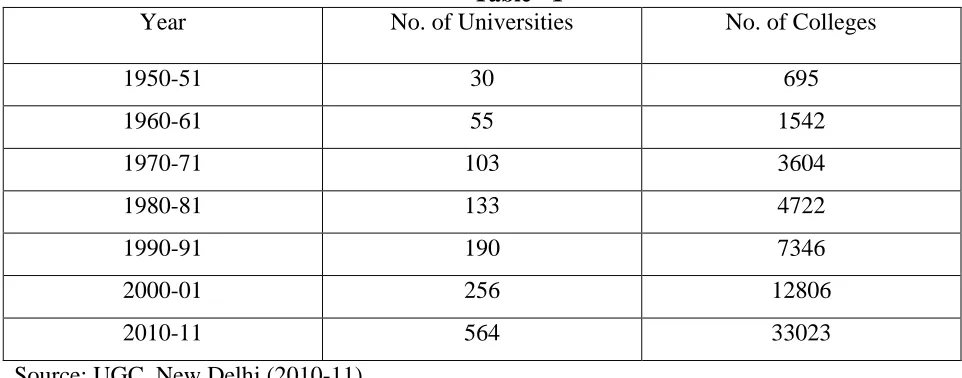
system and a virtual explosion of Universities and Colleges. The table no. 1 shows that in the
year 1950-51 the country had just 30 University and 695 colleges which was increased to 190
and 7346 university and colleges respectfully. It is also observed that the number of university
and colleges in the year increased to 564 and 33023 and in the year 2013-14 704 university and
more than 36000 colleges.
Table - 1
Year No. of Universities No. of Colleges
1950-51 30 695
1960-61 55 1542
1970-71 103 3604
1980-81 133 4722
1990-91 190 7346
2000-01 256 12806
2010-11 564 33023
Copyright © Universal Multidisciplinary Research Institute Pvt Ltd
96
South -Asian Journal of Multidisciplinary Studies (SAJMS) ISSN:2349-7858:SJIF:2.246:Volume 3 Issue 5
Present Scenario of Higher Education in India
Higher Education System in India compare to developing / developed countries needs
substantial improvement. The percentage of students taking higher education is hardly about 13
percent, whereas the same is varying between 28 to 90 percent across the world. The lowest
percent being 28 percent and the same is as high as 90 percent in developed countries.
At one end we claim that India would rank 3rd among all countries by 2020 in education.
If we observe overall ranking of relevant institutions it’s seen that in the year 2000, out of 500
there were 2 Indian Universities / Institutes were featured in the list, and 1 institution from
China. Now almost after a decade in 2010 the tables have changed with only 1 institution from
India being featured and 32 institutions are featured from China.
It categorically spells out, how much we are lagging behind in terms of overall % of
higher educational institutions, number of students pursuing higher education. We are not only
beaten in by the developing and developed countries in terms of GDP, Exchange of foreign
currency but also in terms of number of students pursuing higher education.
Budget allocation by Govt. of India as per 2012 plan is about 6 percent, which is not
going to be adequate, and therefore allocation must be made appropriately, i.e. minimum 10
percent in order to improve the scenario. Basic education must reach to maximum number of
children from different strata of the society so that they are eligible to pursue higher education.
Though higher education system has been change to a great extent in India,it is observed
that there are no universities in Andaman & Nicobar Island, Dadar & Nagar Haveli, Daman &
Diu and Lakshadweep. The maximum numbers of universities are in Uttar Pradesh by 59 nos.,
followed by Tamil Nadu with 56 nos. and Andhra with 47 universities. The teacher – student
ratio in higher education is 23 and there are 23 colleges per lakh population in India. So far
employment is concerned, there is only 10-15 percent employed of regular graduate of Arts,
Commerce and Science and 25 percent employed of technical education sector in India
Copyright © Universal Multidisciplinary Research Institute Pvt Ltd
97
South -Asian Journal of Multidisciplinary Studies (SAJMS) ISSN:2349-7858:SJIF:2.246:Volume 3 Issue 5
Issues and Challenges
Though there has been a drastic change in higher education sector since independence,
higher education system in India has bought several pertinent issues. In present scenario of
higher education in India following issues and challenges are observed.
a) Gross Enrolment Ratio (GER): GER in India is very low compare to other developed and
developing countries in the world. By the end of the year 2020, it is expected the GER
will be increased to 30 percent.
b) Inclusion Education: It includes inequity in educational development. Large number of
population remaining illiterate, rural urban, inter - state, inter-caste, gender disparities
and disparities among the occupational groups.
c) Quality of Higher educational Institutions: Below standard.
d) Relevant Education
e) Research and Development
f) Shortage of Faculty
g) Student Teacher Ratio
h) Drop-out Ratio in UG level especially in 1st Semeter
i) Poor Quality of Library (Most of the rural based colleges)
j) In Adequate Physical Infrastructure
k) Lack of Innovative Outlook
l) Inadequate Funds
m) Lack of Job Guaranteed Course
n) Globalization Issues
o) One of the most challenging parts of the higher education is to use of IT in this field. In
modern time without using of IT, education is incomplete in deferent level of higher
education. But, there is a major problem with maximum universities in general and
colleges in rural areas in particular in India which is unable to use IT due to financial
Copyright © Universal Multidisciplinary Research Institute Pvt Ltd
98
South -Asian Journal of Multidisciplinary Studies (SAJMS) ISSN:2349-7858:SJIF:2.246:Volume 3 Issue 5
Recommendations
a) Need to change the attitude and introduce the new courses as per demand of industrial,
service and agricultural sector.
b) The system of examination should be adequate.
c) There should be an environment for Research and Development for the teacher as well as
students.
d) There should be a co-ordination between job and education which will increase GER in
higher education and also universities and colleges should introduced job oriented
courses.
e) To improve the higher education scenario more fund is utmost necessary for which
Government should take especial step.
f) The Central and State Government should develop a separate infrastructural fund for
educational institutes to provide better infrastructural facilities to the educational
institutes.
g) Modern tools and techniques should be used for proper presentation of subject matter
before the students to create a good teaching and learning environment may.
h) There should be maintained a optimum teacher- students ratio for better output from the
education system.
i) In the era of globalization, equal importance should be attached to the inflow and outflow
of quality education resources.
j) There is a need of review, revision and development of curriculum of prevailing system
of syllabi of the universities.
k) Curriculum should also include sports, hobby classes, vocational skills development
program, employability enhancement & soft skills development programs,
entrepreneurship development modules, specialization wise clubs and committees of
students, practical assignments related to their field, industry interface related modules
such as internships, industry visits, guest - lectures / workshops / seminars, participation
in summits, management quiz etc. with evaluation / monitoring system so as to ensure
Copyright © Universal Multidisciplinary Research Institute Pvt Ltd
99
South -Asian Journal of Multidisciplinary Studies (SAJMS) ISSN:2349-7858:SJIF:2.246:Volume 3 Issue 5
l) Special emphasis must be given to communication and presentation skills, especially for
students coming from rural background / remote locations and that for students studies in
vernacular languages, so that they can perform well in the corporate world, across the
globe.
m) Institutions should also inculcate multitasking abilities amongst students, foreign
languages, advanced IT knowledge so that they can perform better in the chosen field.
Student exchange, cultural exchange should be encouraged and various ways and means
should be found to enhance students interest level & participation.
Conclusion
Although higher education in India has expanded very rapidly in last six decades after
independence, but still it is not equally assessable to all. Though there are number of colleges
and universities established in India, quality education imparted is not up to date. Our higher
education system has not been able to change its organizational structure and form. It has also
not been possible to maintain uniform standards of education or ensure that education imparted is
relevant to our present needs. Under the circumstances, it is necessary that we need to implement
the reforms in higher education system and also bring forth new factors of production, basically
knowledge, skill and technology which will move the country in a dynamic way. It is also true
that higher education is too costly for the government to provide higher education to all the
people in the country and spend on technology and innovation related to the education system. It
is expected, after introduction of RUSA in India, higher education system will explore in such a
way that India can compete with other countries of the world so far higher education is
concerned.
References
1.
Arora, G. L. (2002), Teachers and Their Teaching: Need for New Perspectives, NewDelhi, Ravi Books.
2.
Annual Report (2010-11), MHRD, Government of India, New DelhiCopyright © Universal Multidisciplinary Research Institute Pvt Ltd
100
South -Asian Journal of Multidisciplinary Studies (SAJMS) ISSN:2349-7858:SJIF:2.246:Volume 3 Issue 5
4.
Pannikar, K. N. & Nair, M. B. (2012), Globalization and Higher Educationin India,Delhi, pearson
5.
Pethe, A. (…..), Some Essay on Higher Education in India, Dept. of Economics,University of Mumbai
6.
Srinivas, G. (2009), New Challenges in Higher Education, University News, Vol. 47, No.10, March 09-15, 2009.
7.
UGC, Higher Education in India: Strategies and Schemes during XIth Plan Period(2007-2012) for Universities and Colleges.