TO CITE THIS ARTICLE PLEASE INCLUDE ALL OF THE FOLLOWING DETAILS:
Kumar, Ashwani. (2012). Indian Social Studies Curriculum in Transition: Effects of a Paradigm Shift in Curriculum Discourse.Transnational Curriculum Inquiry 9 (1)
http://nitinat.library.ubc.ca/ojs/index.php/tci <access date>
Effects of a Paradigm Shift in Curriculum
Discourse
Ashwani Kumar
1Mount Saint Vincent University, Canada
Introduction
In recent times, and especially since 2004, India has undergone a major curriculum
reform under the leadership of Professor Krishna Kumar,2 who served as the Director of the
National Council of Educational Research and Training (NCERT)3 from September 2006 to
March 2010. The directorship of NCERT is a highly political post and is determined by the
political party in power. The ascendance of Krishna Kumar to the post of NCERT’s directorship was not merely a recognition of his renowned scholarship; it also happened because the ruling party––the right wing Bhartiya Janta Party (BJP) and the coalition, National Democratic Alliance (NDA) that it led––lost the 2003 national election to the Congress Party, which was supported by left wing parties. The outcome was the formation of a relatively progressive alliance known as the United Progressive Alliance (UPA) that appointed Krishna Kumar as the new Director of the NCERT.
Notably, during the rule of NDA, J. S. Rajput was the Director of NCERT. During
Rajput’s ‘regime,’ NCERT produced what is known as the National Curriculum Framework
(NCF) 2000––a document that outlined the basis of the curriculum, pedagogy, and assessment of K-12 education in India. The NCF 2000 reduced education to the level of information acquisition
and served as a means to propagate Hindu ideology. The NCF 2000 misrepresented history by
overemphasizing Hindu fundamentalism, promoting communalism and national chauvinism, and undermining minority groups’ historical experiences and contribution to the making of the nation of India. It also uncritically appreciated neo-liberalism and globalisation (see Habib, 2005; Lall, 2009) and imposed traditional authorities and hierarchies and thereby negatively influenced social mobility of disadvantaged people (Subaramaniam, 2003).
According to Professor Anil Sadgopal (2005a), a radical Indian educator, NCF 2000
adopted a “secretive approach where the entire writing process was restricted a 6-member team that operated under the chairpersonship of the then NCERT Director Prof. J.S. Rajput” (p. 25). Sadgopal reports that during the preparation of NCF 2000, “the then NCERT Director refused to even reveal the names of the team members engaged in the task of drafting the curriculum
framework lest they are disturbed!” (p. 28). Thus, NCF 2000, Sadgopal argues, was
characterized by a “lack of transparency, participation, and democratic consultation ... [which] contributed to the dubious credibility of the document during the years that followed its release
“Intelligence Quotient (IQ), Emotional Quotient (EQ) and Spiritual Quotient (SQ) for curricular planning and evaluating children without any scientific basis whatsoever” (p. 29).
In view of Teesta Setalvad (2005, para. 8), a radical Indian journalist, by means of NCF 2000 BJP led government sought “blatant distortions and even hatreds ... for not simply narrow political gain but to enable a slow insidious reconstruction in the public mind and public domain of what India is and what it should be. Exclusions and denials of rights and liberties of religious minorities, Dalits, tribals and all women were a singular part of that agenda.”
Marrie Lall (2009), in her essay “Globalization and the Fundamentalization of Curricula: Lessons from India,” argues that:
[NCF 2000] was heavily based on the Hindutva ideological agenda ... to ‘Indianize, nationalize and spiritualize’ [India]. The discursive implications of this slogan are enormous––‘Indianize’: India is not really Indian, it needs to be ‘Indianized.’ It is not a proper nation, because it contains too many un-Indian elements, so it needs to be nationalized, involving a purging of all foreign elements from the curriculum (Sharma, 2002). These include British legacies as well as aspects of Indian culture that are seen as having been introduced by the Mogul invaders. ‘Spiritualize’: India has no soul and the foreign non-Hindu elements (as opposed to the consumerism advanced by economic
globalization) have taken away its soul. The new policy engendered a massive textbook4
revision that justified an anti-minority outlook. In these textbooks Muslims are homogenized, described as invariably antagonistic, perpetual aggressors and violators of the sacred Hindu land, women, cows, and temples. (p. 168)
Lall outlines the ways, based on relevant documents and texts, in which BJP attempted fundamentalization of education in various spheres and levels, which include: replacing key officials in the central government’s education department, National Council of Educational Research and Training; writing and publication of school history textbooks that primarily asserts, without scholarly evidence, Hindu cultural superiority vis-à-vis other cultures and demonizes Islam in particular; providing support to the establishment of a large number of schools by Rashtriya Swayamsevak Sangh (RSS)––a cultural organization that was set up in 1925 to promote India as a Hindu nation where minority religious group would be subordinate to Hindus; and intimidating authors and publishers of books critical of Hindutva ideology. Based on her study of the works of Varadarajan (2004), Lall believes that the case of India under BJP rule, characterized by promotion of religious nationalism through educational means, represent a “state-controlled discursive mechanism ... to contain and deflect potential dysfunctionalities produced by the effects of globalization in societies” (p. 176).
Due to the apparent problematic nature of NCF 2000, NCERT produced another
document––National Curriculum Framework (NCF) 20055––under the leadership of Professor
Krishna Kumar. NCF 2005 represents a complete break and a paradigm shift from the NCF 2000 in many critical ways. Most significantly, it has been developed through an elaborate process of what William Reid (2006) calls “curriculum deliberation.” Never before had curriculum development happened on such a large scale in terms of the number of people involved in its creation from diverse social spectra including education professors, discipline experts, school teachers, educational NGO’s, psychologists, and policy experts, among others. This process of curriculum deliberation continued for years and has produced one of the most progressive curriculum documents in India. This, however, is not to say that NCF 2005 is a perfect document
Transnational Curriculum Inquiry 9 (1) 2012 http://nitinat.library.ubc.ca/ojs/index.php/tci
its critics (Sadgopal, 2005a; Setalvad, 2005; Thapar, 2005) for being the result of hard work by people who would like to see India moving on the path of democracy, justice, peace, and secularism.
Notably, this paradigm shift in the Indian curriculum discourse has influenced all school disciplines including social studies education. The objective of this article is to explain how such a paradigmatic change on India’s educational landscape represents, with particular reference to social studies, a shift from “traditional social studies” (Leming, 1994) to “critical social studies” or “social studies for social change” (Hursh & Ross, 2000). Undoubtedly, changes at the level of curriculum documents and textbooks are extremely significant and represent the level of thought, understanding, and intentions of curriculum planners. Nevertheless, “curriculum as document” does not necessarily translate itself into “curriculum as experience” (Cornbleth, 1990). Thus, in the empirical section of this paper, in addition to doing a comparative content analysis of the National Curriculum Frameworks of 2000 and 2005, I will also report the results of a short study wherein I analyse the perceptions of three teachers about such a paradigm shift and the problems and challenges that they encounter in implementing the new curriculum.
Theoretical Framework
The social studies we see in schools is normally treated as a way of providing mere informational knowledge to the students about their country and the world in terms of social, political, economic, and geographical phenomena without any serious engagement with social conflicts and problems. Social conflicts and problems––such as racial and gender discrimination, conflicting political ideologies, competing economic systems, poverty, and inequality––are social, political, economic, historical, and geographical in their origin and impact and, therefore, should ideally be addressed as part of social studies curriculum and teaching in schools; however, this does not seem to be the case in India (Kumar, 1996; Kumar, 2007; Lall, 2009) nor
is it in North America (Hursh & Ross, 2000; Orlowski, 2001; Osborne, 2000; Ross, 2006).6 The
policies, curriculum frameworks, pedagogic practices, and evaluation procedures that present social studies as accepted or received general knowledge, have deprived social studies of its essential role in developing critical thinking and reflexivity among teachers and students about the conflict-ridden realities of a world torn apart along political, economic, religious, and racial lines.
When social studies does not give attention to the conflicts and problems of society, it serves the hegemonic power nexus and assists in the reproduction of the existing social order. Social studies education that is governed by traditional approach does not create opportunities for raising controversial issues. Instead, it shows its faith in the established social and economic order and thereby develops tendencies to comply and conform among teachers and students rather than encouraging them to develop critical and transformative thoughts and actions. As we
shall see later, the social studies component of National Curriculum Framework 2000
encourages traditional social studies approach and thereby perpetuates status quo.
what Leming (1994) terms as “traditional social studies instruction (TSSI)” (also see Leming, Ellington, & Porter-Magee, 2003; Ravich, 1990; Schlesinger, 1991).
Leming (1994) believes that the main purpose of social studies teaching is the mastery of social science content in classrooms. Leming also rejects the critique of traditional social studies instruction offered by critical social educators (e.g., Cuban, 1991; McNeil, 1988; Newmann, 1991) arguing that the traditional mode of social studies is the result of the acceptance by social studies teachers themselves who are mainly concerned with memorization of prescribed content
and students’ performance on tests (Ross, 2006).7
Leming’s description of TSSI dismisses the issues of world hunger, poverty, capitalism, racism, sexism, and casteism as potential organizing themes because social studies instruction based on these themes represent “particular ideological perspectives” (Ross, 2000). Leming’s TSSI approach presumes social studies instruction to be objective, neutral, and apolitical. Leming’s TSSI is, however, no less ideological than the social studies instruction organized around themes of multiculturalism, antiracism, and internationalism (Ross 2000, 2006). Being neutral does not mean the absence of a stance; the ideology of neutrality is a stance in favour of the status quo. TSSI is based on a “doctrine of inevitability” wherein the existing social, political, and economic orders are accepted without critical analysis and examination (Ross 2000).
The epistemological premise behind TSSI is the “spectatorial theory of knowledge” (Ross, 2000). In the spectatorial epistemological stance, the knowers’ (in this case, social studies teachers and students) primary task is the construction of a mental image corresponding to an ordered and absolute external world with minimum subjective interference. The “spectator knowing” in TSSI leads to “spectator citizenship” (Ross, 2000) and “spectator democracy” (Ross, 2006). In spectator citizenship, the goal of the citizens is to adapt and conform to the status quo and interests of the socially powerful rather than having the aim to transform and reconstruct society. Spectator citizenship reflects a “failure of social studies educators to
interrogate the meaning of words such as democracy, capitalism, freedom of speech, and
equality” (Ross, 2000, p. 55). In spectator democracy, a specialized class of experts identify what the common interests are and then think and plan accordingly (Ross, 2006).
TSSI promotes spectator citizenship and democracy by situating students outside the knowledge construction process as passive recipients of pre-packaged information and by teaching a conception of democracy that is almost always equated with elections and voting rather than preparing students to possess the knowledge, values, and skills needed for active participation in society. Thus, TSSI, along with other “ideological apparatuses” of the state (Althuser, 1971) such as media and government policies, ensures that the “population remain passive, ignorant, and apathetic” (Ross, 2000, p. 56; Emphasis added). Moreover, TSSI focuses more on implementing curriculum standards and responding to high-stakes tests with little or no consideration to the “social reconstructionist” vision of the future (as espoused by George S. Counts, Harold Rugg, Theodore Brameld, and John Dewey) to develop a more socially just world (Ross, 2006; Vinson, 2006). In a nutshell, “TSSI gives students the instruments to trace
[and accept] the lines drawn by others, rather than opportunities to examine those lines and
consider how they might be redrawn” (Ross, 2000, p. 57; Emphasis added).8
Transnational Curriculum Inquiry 9 (1) 2012 http://nitinat.library.ubc.ca/ojs/index.php/tci
making social studies education a meaningful and creative experience for teachers and students.9
As we shall see later, National Curriculum Framework 2005 and its social studies component
uphold the basic ideas that form the backbone of critical social studies.
Critical social studies rejects the prevailing paradigm of social studies education, which is currently involved in the process of the reproduction of social reality. CSS is an attempt through which students and teachers, instead of accepting the status quo or taken for granted assumptions or what Ross (2000) calls “lines as drawn,” critically examine and engage in the dynamic social reality and contribute towards its reconstruction for a more democratic and just world (Hursh & Ross, 2000). In CSS, the notion of active learner and the development of higher order thinking skills with an emphasis on issues of antiracism, gender equality, multiculturalism, and social criticism occupy the central place (Ross, 2006). CSS does not claim that there is a determinative set of principles that social studies instruction needs to fulfil; such principles might have the danger of reducing CSS to TSSI in its actual practice. Thus, CSS recognizes the contextual specificities of the classroom and the social milieu in which the classroom is situated rather than some universalistic conceptions (Noffke, 2000). In this manner, CSS would encourage students and teachers to engage in the conflicts and problems of their own local community and understand how these conflicts and problems are related to the larger political and economic structures. Thus, CSS rejects the spectatorial theory of knowledge discussed above and draws upon the experiential and critical approaches outlined in the works of John Dewey and Paulo
Freire.10 In the rest of this section, I will discuss the ways in which Dewey’s and Freire’s ideas
can contribute to the conceptualization of critical social studies.
John Dewey’s (1916) alternative to the spectatorial theory of knowledge is the experiential and constructivist ways of learning and knowing. Instead of a sharp division between subject and object in the TSSI, a Deweyean approach to critical social studies argues for a “tridimensional paradigm”––inquirer, subject matter, and objective (Ross, 2000). In this organization, human beings examine and analyze subject matter, which is reconstructed and co-constructed with reference to the goals, interests, and the perspectives of the inquirers rather than something given, fixed, and determinative, as in TSSI. Thus, Dewey’s theory of knowledge: rejects TSSI’s focus on a singular vision of the world and allows for the multiple ways of knowing and constructing reality; affirms the role of experiential learning where the learner is active and not simply passively absorbing the facts; treats doubts, uncertainty, and confusion in the everyday experience of human beings as problematic situations that provide impetus for thinking and doing rather than some kind of hurdle in the way of constructing a “clear” picture of the world (Ross, 2000).
democratic community of inquirers, reflective thinkers, and interactive practitioners (Ross, 2006). Critical social studies education, influenced by Deweyean thought, can never have the purpose of inculcating among students the tendency to comply and conform to existing patterns of society; CSS instead intends to contribute towards developing the abilities to question, understand, analyze, and transform social reality.
Dewey’s work can certainly be regarded as the beginning of a critical turn in education
where subjective experience, reflective thinking, child-centred activities, knowledge construction, and the individual-society interface were combined together for an education that intends to create a democratic world; however, it is the pioneering work of Brazilian educator Paulo Freire, which led to the development of critical theory and pedagogy tradition in education, which further informs the notion of critical social studies as well as the conceptual underpinnings behind National Curriculum Framework 2005.
Critical pedagogy intends to develop the capacity of thinking in a way that does not blindly conform to or accept the givens of society. Critical pedagogy encourages children to question, analyze, denaturalize, decontextualize, and deconstruct accepted belief systems–– political ideologies, religious superstitions and orthodoxies, socio-economic exploitation based on racial discrimination, gender inequalities, and income divides––that have deeply permeated our consciousness. Critical pedagogy’s objective is social transformation, which is not possible if the givens of society are taken for granted or remain unquestioned. In the absence of critical pedagogy, education is simply subject to the pressures of the dominant political, economic, and cultural forces and serves as a passive agent of reproduction of the existing social reality. Critical pedagogy tradition is developed by the works of Paulo Freire (Freire, 1973 1996a, 1996b, 1998), Henri Giroux (1981, 1983, 1989), and Peter McLaren (1994) among others, and finds its roots in the Critical Theory School/Frankfurt School developed by philosophers like Adorno (1973),
Habermas (1968), Horkheimer (1972), and Marcuse (1964), among others.11 For the purpose of
brevity, I would like to discuss Paulo Freire’s theory of education (which forms the core of critical pedagogy), and the way it may strengthen the theorization of critical social studies.
Paulo Freire, since the publication of his landmark Pedagogy of the Oppressed (1973),
has contributed immensely to the theory and practice of education. He has developed a radical theory of education and revolution. The ultimate goal of Freire’s theory is the disappearance of “oppressor-oppressed contradictions” from the society. This ultimate goal is to be achieved
through the revolutionary process of conscientization––the development of “critical
Transnational Curriculum Inquiry 9 (1) 2012 http://nitinat.library.ubc.ca/ojs/index.php/tci
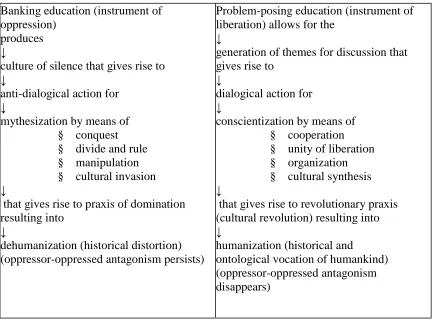
Figure 1: Freire’s Dialectical Theory of Education
Banking education (instrument of oppression)
produces ↓
culture of silence that gives rise to ↓
anti-dialogical action for ↓
mythesization by means of § conquest § divide and rule § manipulation § cultural invasion ↓
that gives rise to praxis of domination resulting into
↓
dehumanization (historical distortion) (oppressor-oppressed antagonism persists)
Problem-posing education (instrument of liberation) allows for the
↓
generation of themes for discussion that gives rise to
↓
dialogical action for ↓
conscientization by means of § cooperation § unity of liberation § organization § cultural synthesis ↓
that gives rise to revolutionary praxis (cultural revolution) resulting into ↓
humanization (historical and
ontological vocation of humankind) (oppressor-oppressed antagonism disappears)
According to Freire, one of the most significant and basic elements in the relationship between oppressor and oppressed at all levels of society is “prescription,” which represents impositions of one individual’s choice upon another, transforming the consciousness of the person prescribed into one that conforms and complies with the prescriber’s consciousness. The oppressed, having internalized the image of the oppressor and adopted his guidelines, are fearful of freedom. When applied to educational systems, prescription gives rise to authoritarian education systems, which Freire creatively termed as “banking education” that works as an “instrument of oppression.” In such a system, Freire elaborates, teachers are the subjects and students are the objects of teaching where the former deposits information in the latter’s mind. Students, without resistance, mechanically receive, memorize, and reproduce this information. Thus, in this system there is no interaction, cross-questioning or dialogue. This transfer of information becomes an instrument of oppression that inhibits authentic thinking, inquiry, creativity, and dialogue, which are essential for an individual to be truly human. Such an educational practice can only produce conformists and mediocre people who would further this oppressive reality instead of critical and authentic thinkers who would transform oppressive reality to create a humanized world.
kept “submerged” in a situation in which critical awareness and response through dialogical encounter is practically impossible. The oppressors (teachers) perpetuate a culture of silence
through their “anti-dialogical actions” directed at “mythicization” or “indoctrination” of
oppressed people (students). In this oppressive system, there is no place for dialogue with the oppressed about their life and problems; their critical consciousness is never awakened. Such anti-dialogical actions produce “praxis of domination” where all reflection and action, theory and practice are directed at dominating the oppressed and maintaining the status quo (“possessive or oppressive consciousness”). Obviously such praxis, carried out through anti-dialogical actions aiming at “mythicization” of the oppressed, is dehumanizing in nature. In my understanding, Freire’s description of banking education is similar to what Leming (1994) termed the “traditional social studies instruction,” as discussed above, and it forms the basic thinking behind National Curriculum Framework 2000 as I will explain later.
The alternative that Freire suggests is “problem-posing education” as an “instrument of liberation.” Problem-posing education proposes a democratic relationship between teachers and students in which both are simultaneously teachers and students. The democratization of the content and method of teaching incites inquiry, creativity, and critical thinking, which brings about the emergence of consciousness and constant unveiling of reality through discussion on themes that matter (in the context of social studies education, the themes that pertain to the conflicts and problems of society such as racism, casteism, nationalism, neoliberalism, and capitalism). Obviously, such education has to be “dialogical” (conversational) in nature that promotes freedom of expression without any oppression and encourages “cooperation,” “unity,” “organization,” and “synthesis” among diverse groups and ways of thinking. Undoubtedly, Freire’s theorization of problem-posing education provides the foundation of critical social studies, as discussed above, which in turn, provides support to the social studies component of National Curriculum Framework 2005.
Research Questions
In the present study I have explored the following research questions:
In what ways do the National Curriculum Frameworks of 2000 and 2005 differ from
each other with particular reference to their guidelines for social studies curriculum?
How do social studies teachers perceive and conceptualize the paradigm shift as a result of NCF 2005 and theorize their classroom practice? What are the major problems and challenges that these teachers face in implementing the new curriculum?
In order to explore these research questions, I have focused on two aspects. First, I have
conducted a comparative analysis of NCFs 2000 and 2005 with references to their specific
guidelines for social studies curriculum and teaching. Second, I have reported the results of semi-structured interviews and a focus-group discussion with three secondary social studies schoolteachers regarding their perceptions of recent curriculum reforms.
Comparative Analysis of the NCF of 2000 and 2005
The nature of curriculum determines to a large extent the nature of pedagogy and evaluation (see Bernstein, 1973). Curriculum that seeks to develop critical consciousness of
students will give rise to critical and dialogical pedagogy aimed at problematizing the givens of
Transnational Curriculum Inquiry 9 (1) 2012 http://nitinat.library.ubc.ca/ojs/index.php/tci
dialogical, facilitate an unproblematized transaction of knowledge, cultivate a culture of silence in the classroom, and expect unreflexive, rote-memorized, and pre-decided responses from the students.
In this section, I have attempted a comparative content analysis of the National
Curriculum Frameworks of 2000 and 2005 with reference to their guidelines for social science (social studies in North America) to understand the extent to which they differ from each other in terms of their objectives and epistemological framework. As part of my analysis, I carefully studied NCFs 2000 and 2005 with special reference to their guidelines for social studies. Based on my study, I identified the main objectives of these frameworks and the epistemological perspective that guided their conceptualization. I then conducted an individual analysis of the
identified objectives and epistemological framework of each NCF separately to understand their
basic thrust. Then, I drew comparisons between them regarding their objectives and
epistemology.12 Thus, I have employed two criteria to do the comparative analysis: Objectives of
teaching social science and proposed/implicit epistemological framework.
Objectives of Teaching Social Science
Objectives are one of the most significant elements of curriculum documents because they bear upon the epistemological framework, content, pedagogic practices, and evaluation procedures. They explain the purpose behind curriculum formation: What does the curriculum want teaching material (e.g., textbooks) to be like? What does it expect of teachers and students? What does it expected of the teaching-learning process?
Objectives of teaching social sciences in NCF 2000
Social Science in NCF 2000 aims to develop an understanding in children about “human environment in its totality” (p. 62). There is no explanation as to what it means by “human
environment” and how it can be understood in its “totality.” NCF 2000 further emphasizes the
development of a “broader perspective” and an “empirical, reasonable and humane outlook” (p. 62). However, it fails to provide any explanation of these terms (which belong to three different strands of thought, namely, empiricism, rationalism, and humanism) or even a clarification of how these diverse strands will be combined in the curriculum, pedagogy, and evaluation.
Moreover, NCF 2000 sees social science as merely a subject of general knowledge and
utility to make students skillful in contributing to society (p. 62). It places no emphasis on developing a critical perception of social reality ridden with innumerable conflicts and problems.
Thus, NCF lacks in providing social science with a normative outlook, which may have the
purpose to work for a peaceful and just society. The NCF 2000 also intends to develop the skills of “critical thinking,” “reading,” and “interpreting tables, diagrams, and map,” “cooperating with others,” and “responding to others problems” (p. 62). Here, the last two phrases represent values to be nurtured and the first three are skills. There is no explanation for how these values and
skills come together. Besides, NCF 2000 doesn’t provide any explanation for what it means by
“critical thinking” and why reading and interpretation of tables and diagrams are essential in social science when mathematics is available as a school subject and what kind of data is being considered for interpretation. The meaning of “critical thinking” seems to be confined to the mere development of cognitive skills rather than the critical examination of oppressive social reality for social change, as articulated in the critical pedagogy tradition.13 Overemphasis on
skills gives NCF 2000 a positivistic and utilitarian orientation and confines it within the
NCF 2000 also has objectives that are simply meant for the uncritical glorification of India (e.g., promote a “humane and national perspective and inculcate a sense of pride in the country and in being an Indian” and “strengthen the national identity and develop an appreciation for cultural heritage,” (p. 62)).14
Such objectives may be seen as the root causes behind developing nationalistic and chauvinistic attitudes. This doesn’t mean one should not be proud of one’s country but the latter should not come at the cost of suppressing a critical understanding of the conflicts and problems of a nation, which is essential if rigid social structures and practices are to give way to a democratic society. NCF 2000 also desires to “promote communal harmony and social cohesion” (p. 62). However, this is merely a statement without an explanation of how
to bring about desired harmony and cohesion; NCF 2000 develops no argument on what brings
disharmony and disintegration to promote critical awareness among students. On the whole, the
objectives of teaching social science in the NCF 2000 epitomize Leming’s traditional social
studies instruction (TSSI).
Objectives of teaching social sciences in NCF 2005
The social science component of NCF 2005 has the basic aim of developing a knowledge base for a just and peaceful society:
Social science encompasses diverse concerns of society, and includes a wide range of content drawn from the disciplines of history, geography, political science, economics, sociology and anthropology. Social Science perspectives and knowledge are indispensable to building the knowledge base for a just and peaceful society. (p. 50) One NCF 2005 objective, which calls for “raising students’ awareness” (p. 50), links the curriculum to those perspectives in education (for example critical social studies, as discussed in the theoretical framework), which see education as a process of developing critical awareness
among students about their social reality to view curriculum as an agent of social change. NCF
2005 also aims to develop “social, cultural, and analytical skills” (p. 50) with a view to helping children to adjust to an increasingly interdependent social reality rather than arousing a sense of dangerous nationalism.
Moreover, NCF 2005’s objective of developing understanding of “concepts and the
ability to analyze sociopolitical realities rather than on mere retention of information without comprehension” (p. 50) is a departure from the traditional or the common sense perception of social science as the storehouse of information that needs to be rote-memorized and reproduced in exams. According to NCF 2005:
It is believed that the social sciences merely transmit information and are text centered. Therefore, the content needs to focus on a conceptual understanding rather than lining up facts to be memorized for examinations. Reiterating the recommendations of Learning Without Burden (1993), emphasis has to be laid on developing concepts and the ability to analyze sociopolitical realities rather than on the mere retention of information without comprehension. (p. 50)
The emphasis on conceptual clarity and comprehension of sociopolitical reality stands in sharp contrast to NCF 2000, which emphasizes mere information acquisition and cognitive skills.
NCF 2005 is also a serious effort in making education a process of social change and democratization. It lays stress on the normative dimensions of social science by considering the development of “human values, namely, freedom, trust, mutual respect and respect for diversity”
(p. 51), which are essential for and the basis of a peaceful and just society.15 NCF 2000 doesn’t
Transnational Curriculum Inquiry 9 (1) 2012 http://nitinat.library.ubc.ca/ojs/index.php/tci
education.
Finally, NCF 2005 also stresses upon the need to incorporate “relevant local content” (p. 50) so that the teaching-learning process not only respects the plurality of our society but also
makes learning relevant for all by not putting restrictions via a uniform curriculum framework.16
Thus, NCF 2005 is a framework or guideline in the real sense of the term rather than being a
straight-jacketed document, resulting in textbooks that need to be considered sacrosanct and
memorized for exams. It is a significant development when put in comparison with NCF 2000
that hardly makes any reference to local culture and plurality. The objectives of teaching social science in NCF 2005 explicitly incorporates the ideas of critical social studies.
Epistemological Framework
Epistemological framework explains how curriculum views knowledge: Which knowledge is considered worthwhile for students? How is that knowledge selected? How is that selected knowledge to be taught in the classroom? And, how will such knowledge be evaluated? Thus, an epistemological framework provides broader perspective on the selection of knowledge in terms of textbooks and other teaching materials, pedagogic methods, and procedures of evaluation.
Epistemological framework of NCF 2000
NCF 2000 doesn’t have a well-defined epistemological framework. However, there are certain points mentioned in the document in a rather disjointed fashion that demands critical
scrutiny. NCF 2000 employs certain phrases and words such as “interrelatedness of ideas and
comprehensibility,” “process of learning and thinking,” “meaningful learning experiences,” and “from simple to complex” (p. 63). The preceding ideas, which are clearly drawn from constructivist approaches of education, remain unexplained. Moreover, one of the points seems
to suggest that the textbooks developed in line with NCF 2000 would give emphasis to
theme/issue-based organization of the curriculum material17; in reality NCF 2000 adopted strict
disciplinary divisions among the contributory subjects of social science. Finally, NCF 2000
reduces the objective of learning to the mere acquisition of “basic competencies and skills” (p. 63).
Epistemological framework of NCF 2005
NCF 2005 has outlined major “epistemological shifts”(see Position Paper on National Focus Group on Teaching of Social Sciences 2005, p. 3-4) for the social science curriculum.
First of all, NCF 2005 recognizes the suitability of social science for rigorous inquiry and
distinctness of its method(s). This is a clear departure from the common sense perception that social science is “unscientific” or not rigorous:
to those of the natural and physical sciences. (p. 2)
NCF 2005 takes a midway position between the pure disciplines versus integrated discipline debate in social science. It recognizes the boundaries of all disciplines and suggests identifying a few themes, which are “culturally relevant” and in accordance with the cognitive
capacities of children, that can be studied in an integrated fashion. The Position Paper on
National Focus Group on Teaching of Social Sciences, 2005 shows its concerns for interrelationship among disciplines:
The disciplines that make up the social sciences, namely, history, geography, political science, and economics, have distinct methodologies that often justify the preservation of boundaries. The boundaries of disciplines need to be opened up, and a plurality of approaches applied to understand a given phenomenon. For an enabling curriculum, certain themes that facilitate interdisciplinary thinking are required. These themes should be culturally relevant, and concepts introduced bearing in mind the age of the child. There is a need to select themes where different disciplinary approaches can facilitate an in-depth and multiple understanding. However, not all themes can be discussed in an interdisciplinary manner. A careful selection of a few themes needs to be made, as well as having separate chapters relating to different disciplines. (p. 3) NCF 2005 is also a departure from the chronic conception of textbooks as sacrosanct and the cul-de-sac of learning. It sees textbooks as a means of “opening up avenues for further
inquiry” (p. 3). This concern of NCF 2005 is also reflected in social science textbooks where
considerable space is provided through projects, fieldwork, in-text and end-text questions, and real life narratives so that teaching and learning may go beyond the textual material. According to Batra (2005, p. 4350):
While recommending the need to move away from a ‘textbook culture’ (where the textbook is seen as the only source of legitimate knowledge) towards a plurality of
locally produced text materials, the NCF 2005 makes an important argument in
favor of bridging gaps between the lived experiences of children and formal school
knowledge.
NCF 2005 also makes an attempt to link the local with the global via the national. It emphasizes the learning of history with reference to local ways of seeing national events and links the history of India with developments in other parts of the world. Such an approach has the capacity to broaden students’ minds for accommodating and assimilating multiple perspectives
looking at historical events and processes (p. 3). Thus, the NCF 2005 and its social science
section are not based on what Ross (2000), drawing upon Dewey (1916), calls “spectatorial theory of knowledge”––the epistemological foundation of traditional social studies instruction––
where reality is singular and fixed. On the contrary, in NCF 2005 social science intends to
encourage multiple ways of knowing and, thus, best fit with the theoretical assumptions of critical social studies.
Transnational Curriculum Inquiry 9 (1) 2012 http://nitinat.library.ubc.ca/ojs/index.php/tci
NCF 2005 also shows its concern with developing a gender sensitive curriculum that incorporates the perspective of women to make the curriculum egalitarian instead of being
patriarchal. According to the Position Paper on National Focus Group on Teaching of Social
Sciences, 2005:
Gender concerns have been addressed within the social sciences by including women as ‘examples.’ For instance, in history the discussion on women is often limited to including Rani Lakshmibai, Sarojini Niadu, and some others in chapters on India’s freedom struggle. But ‘gendering’ the curriculum is not limited to increasing the number of references to individual women. Rather, what is crucial is the need to make the perspectives of women integral to the discussion of any historical event and contemporary concerns. This shift requires an epistemic shift from the patriarchal frame within which social studies is currently conceptualized. (p. 4)
Finally, NCF 2005 also represents a shift from being developmental to become normative in its orientation (see comparative analysis of the objectives of NCFs 2000 and 2005 above).
In a nutshell, NCF 2005 represents a great paradigm shift; it is for the first time that issues of epistemology, which are core to any educational process, have been raised. As discussed earlier in this article, NCF 2000 lacked an epistemological framework and, thereby, a perspective on the entire educational process––the nature of textual material and other teaching and learning resources, pedagogic devices, and assessment procedures.
It may appear to the readers, not only to those who are not familiar with Indian political and educational landscape, but also to the Indians who believe in right-wing conservative Hindu nationalist ideology and are supportive of neoliberalism and globalization, that my comparative
analysis of the National Curriculum Frameworks of 2000 and 2005 with reference to social
studies is lop-sided, that is to say, biased in favor of National Curriculum Framework 2005. The analysis may appear lop-sided not because of any deliberate intention on my part, but due
entirely to the content of these curriculum documents. NCF 2000 and Bhartiya Janta Party’s
educational policies received heavy criticism from all quarters of critical educational scholarship for being a tool in the hands of a right-wing party who wanted to propagate Hindu ideology and neoliberal reforms (Kumar, 2001; Lall, 2009; Nanda; 2005; Roy 2003; Setalvad, 2005; Sharma; 2002; Subarmaniam; 2003; Taneja, 2003). Undoubtedly, NCF 2005 is also not free of infirmities.
While there also exists criticisms of NCF 2005 from theoretical, political, and methodological
perspectives (Apte, 2005; Sadgopal, 2005a; Setalvad, 2005; Thapar, 2005; Verma, 2005 )18, I,
who was a social studies schoolteacher when this study was conducted, became particularly interested in critically evaluating the challenges and opportunities that social studies component
of NCF 2005 presented to teachers in their everyday classrooms. Thus, in the next section, I
discuss the perceptions of three social studies teachers regarding the changes in the social studies curriculum and its influence on their classroom teaching.
Interviews and a Focus-Group Discussion with Three Social Studies Teachers
Curriculum is what actually unfolds in the living reality of the classroom (Cornbleth, 1990). And this unfolding of curriculum depends on the perceptions of teachers as well as the factors that shape those perceptions. In this section, I present findings from three in-depth semi-structured interviews and a focus-group discussion with three secondary social studies teachers,namely, Reshma Mihir, Bhairavi Tandon, and Kanta Kapoor19 of Dilip Singh Public School,20
where the language of instruction and examination is English.21 I conducted three formal
three teachers together for the purpose of this short study. As a brief introduction, Reshma Mihir is the senior-most teacher of Economics in Dilip Singh Public School. She teaches classes (grades in North America) 10, 11, and 12. Bhairavi Tandon is a senior Commerce teacher in the school. She joined school in 2006 and was requested to teach Economics to grades 9 and 10. Kanta Kapoor is a senior History teacher, but for little more than a year she has also been teaching Political Science.
It is important to point out that in my interviews and discussion with teachers, I gave considerable emphasis to eliciting responses about the differences between the old and new
textbooks,22 developed by the NCERT in line with the perspectives of NCFs of 2000 and 2005
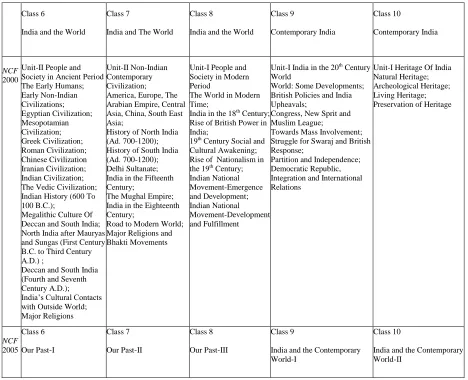
(see Appendix that contains three tables showing the social science content sequence from grade
6-10 in NCFs 2000 and 2005). This focus was warranted because most teachers in India get to
know about changes in curriculum discourse through changes in the textbooks––their Bible in
classroom.23 Hardly, any of the teachers I interviewed had looked at the NCFs of 2000 and 2005;
their opinion about the curriculum change and its impact on their classroom teaching is based on the changes in the content and organization of the textbooks. None of these teachers went through any professional development workshops or seminars about new curriculum changes prior to this interview. However, they had some idea of the national level curriculum change because of the media and changes in the textbooks.
The three perspectives that influenced my understanding of the role of teachers vis-à-vis curriculum include “curriculum as a praxis” (Grundy, 1982), “curriculum as contextualized social process” (Cornbleth, 1990), and “teacher personal theorizing” (Chant, 2009; Ross, Cornett, & McCutheon, 1992; Ross, 1994).
In the perspective which view curriculum as praxis, teachers play a central role vis-à-vis curriculum; their role is not just confined to the implementation of the documents but is a creative and reflective engagement in classroom situations where the curriculum is actually created through interaction and participation. In this view, curriculum is a social process and knowledge is socially constructed and subject to criticism, multiple interpretations, and reconstruction (Grundy, 1982).
While Grundy gives importance to social criticism along with personal reflection, the idea that curriculum and teaching in classrooms are subject to tremendous influence by social context is well developed by Cornbleth (1990). Cornbleth views curriculum as a “contextualized social process.” Her perspective on curriculum is influenced by critical theory and pedagogy that have the purposes of “engendering enlightenment and empowerment that can foster personal and social emancipation from various forms of domination” (Corrnbleth, 1990, p. 3). Nevertheless, Cornbleth does not limit her conception to the theoretical argument of the influence of social context on society; rather, she considers her approach to curriculum theoretical as well as experiential. For Cornbleth, curriculum is what actually happens in classrooms. Curriculum, for her, is a social process comprised of the interactions of students, teachers, knowledge, and milieu. This kind of curriculum conceptualization, which can be termed “curriculum practice” or “curriculum-in-use,” is diametrically opposite to the conceptions of “curriculum as document.” In this perspective, a teacher’s association with curriculum depends on the structural context (established roles and relationships, shared beliefs, and norms at several levels from individual classrooms to the national level education system) and socio-cultural context (environment beyond the education system including demographic, social, political, ideological, and economic conditions).
Transnational Curriculum Inquiry 9 (1) 2012 http://nitinat.library.ubc.ca/ojs/index.php/tci
2009; Ross, 1994; Ross, Cornett, & McCutheon, 1992) argue that teachers’ personal and practical theories (e.g., the ways teachers perceive curriculum and theorize their practice) have considerable influence on their classroom instruction. The findings in this area also illustrate that teachers live in the real world and tend to develop context-bound theories of curriculum and teaching, contrasted with universal and theoretical principles (e.g., as espoused in India’s National Curriculum Frameworks). Thus, teachers’ theories of teaching significantly determine the quality of the curriculum enacted in their classrooms.
Below I discuss in detail the concerns of the three social studies teachers who I interviewed and conducted a focus-group discussion with regarding their experiences of recent curriculum reforms in India.
What do Teachers Like about the New Social Science Textbooks?
Of the three teachers I interviewed and conducted discussion with, Kanta seems to have really liked the new books of History and Political Science. She recognizes the importance of “alternative perspectives,” offered in the new textbook of History to understand India’s freedom struggle. According to her, for example, the Non-Cooperation Movement had previously been taught from a “singular” perspective, but now the inclusion of the responses of various social groups and regions who participated in the movement (in other words, multiple ways of imagining reality) has received considerable importance. The new book explains in detail why Non-Cooperation started and why it was taken back rather than merely appreciating it uncritically. Besides, the freedom struggle has been viewed “critically” by pointing to various problems associated with it. The new History book has also introduced many new topics that catch children’s attention such as the History of Cricket. She points out that the old textbook was simply an exercise in “rote-memorization” where students had to learn “various dates of historical significance and roles of various leaders.”
What about the lack of “direct material”?
According to Reshma, the old textbook of Economics was better because it provided “direct material,” in the form of definitions, reasons, characteristics, positives and negatives etc., which can “answer all questions” given in the book and in the Central Board of Secondary
Examinations (CBSE).24 She argues that although the new books are “child friendly” because
they contain photographs and case studies, they lack “basic knowledge” or factual content needed to “reproduce answers in the exams.”
To support her points, Reshma further argues that the chapter titled “Globalization and the Indian Economy” in the new book (NCERT Textbook of Economics for Class 10, pp. 54-73, 2007) is a misnomer as this chapter “only talks about MNCs.” The chapter “does not give even a passing reference to liberalization and privatization and history of India’s economic policy.” She asserts that the chapter “Towards Liberalization and Globalization” in the old book (NCERT
Social Science Textbook Contemporary India for Class 9, 2000) “treated liberalization and
globalization in a better way than the new book because the former had direct content for the purpose of examinations” (Reshma emphasized these words).Bhairavi also asserts, like Reshma, that the “new book has made no reference to liberalization as part of globalization and only focuses upon MNCs.” She argues that the new book also does not explain, “how India actually facilitated globalization” and what are the “negatives and positives of globalization.”
Reshma, however, acknowledges that, “overall learning will be higher if we teach through the new books. She acknowledges that “children seem happy” with the new books because of colored pages, ample number of examples, narratives, and case studies. However, she also feels that examples are good but not sufficient, and “we need to tell students about formal institutions and their policies in a very structured and direct way.” She also remarks in the end that new books “do encourage students to explore” while the old books only emphasized “rote-memorization, which is what is expected in exams” (Reshma emphasized these words). Kanta also shares her concern that “if the pattern of the examination is not revised then these books might create considerable problems.” In that case, “teachers will be required to provide notes to the students.” Even Bhairavi argues, “if exams continue to be on the same track [based on memorization of the textbooks] these books might even create trouble.” Bhairavi further explains that the new book is “good for top 10% students” but for an average student it is very difficult to understand and “put that understanding on paper in exams.” Moreover, it is “difficult to get 90 to 100% marks” because the mode of assessment, as the nature of the book suggests, will be “subjective” and an example can be viewed in many ways and students and teachers might not think alike. This might jeopardize students’ final grades.
What Problems do Teachers Face in the Classroom?
Transnational Curriculum Inquiry 9 (1) 2012 http://nitinat.library.ubc.ca/ojs/index.php/tci
Moreover, Kanta feels that the children do face problems with the new books because they “do not have background to study history and civics in this fashion.” For example, students study about ancient, medieval, and modern India in grades 6, 7 and 8 respectively and in grade 9 they are introduced to the history of the contemporary world, which breaks the continuity. As well, the books for grades 9 and 10 do not have any relation to the previous grades. However, she acknowledges that the “books for grades 9 and 10 show continuity between them” because what students study in grade 9 also gets reflected in grade 10.
Additionally, although Kanta finds no problem in teaching with the new history book, as she has a strong background in history, she emphasizes that it is “very difficult to teach from this book for someone who does not have background of history especially where a teacher is teaching all the subjects”––which is a common feature of the government schools in India.
Do Teachers have Enough Time?
Teachers argue that new book requires “more efforts” on the part of the teachers.
Bhairavi stresses that “due to the arrival of the new books we [the teachers] will have to give
notes from the old books to meet the requirements of the exams” (Emphasis added). This will create burden on teachers, she explains further, and on the school because we have to provide photocopied notes to the students. If the school does not provide such facilities then teachers will have to dictate notes in the class. This would require a lot of time and teachers are just given 2-3
periods (80-120 minutes) per week.25 This would require children to buy and study two books––
old and new––that would add to their burden.
Teachers also raise the issue of “less number of periods available per week.” Teachers report that the content of the new book arouses many questions in children’s minds and makes it difficult for them to balance “satisfying” students’ curiosity and “completing the syllabus” on time. Besides, there are many questions in the new book for which “no answer can be found in the book itself; the old book, on the contrary, contains almost 100% of the answers.”
What do Teachers Expect?
In spite of the aforementioned challenges teachers still feel that with certain changes they will be able to do justice with the new curriculum. For the new books to be successful, Reshma
suggests that the “examination system needs to be changed.”26
Teachers also show their frustration due to “frequent curriculum change” in the wake of shuffles in political power. They expect new books to stay for at least two-three years to allow them to “adjust and build up their own ways of teaching.” Bhairavi feels that if the CBSE follows the pattern of new NCERT books for designing “exam papers” then teachers should have proper guidelines so that they may “prepare students for the exams, as their teaching is based on the patterns of previous years’ exam papers.” She argues that the topics of the old and new books are almost the same, but the new books contains case studies, and those who prepare exam papers might think that children have understood the concepts and ask a “direct” question. Thus, “we will also have to provide students with theoretical matter.”
Teachers also feel that those who write NCERT books are “too educated” and write textbooks from their own level, which does not connect with teachers and children. Bhairavi suggests that schoolteachers should be involved in textbook writing because ultimately “they have to teach” (Bhaiaravi emphasized these words).
“professional growth.” Teachers believe that “earlier books promoted rote-memorization” of the facts but now teachers and students have been provided with plenty of “case studies” to explain things in a better and more interesting way. In the absence of these case studies, teachers produce “crammers not learners.” Teachers recognize that earlier children would “sleep in social studies classes” but now they are very “alert” as they get the opportunity to know and engage with “what is actually happening in the world.” Teachers also stress that there should be a balance in the number of photographs, case studies, narratives, and theoretical content in the textbooks. Teachers also demand more time during the week along with professional training and help to implement new curriculum initiatives. Professor Romila Thapar’s (2005, p. 57) important statement summarizes teachers concerns in this manner:
Textbooks should certainly be child-friendly but it is equally necessary that the schoolteacher should be made child-friendly. It is not enough to encourage participative discussions between teachers and students in class. An extensive programme of familiarising schoolteachers both with changes in the methods and concepts of the social sciences and with child-centred pedagogy will help. Without this, there will be no essential change in either the approach to the subject or the pedagogy. Children will still be required to memorise sections of the new or old textbook and reproduce these for the exam. Instant workshops for history teachers are not going to make a dent. Teachers need a more intensive exposure if they are to understand the concepts of the social sciences, the changes in data and methods that disciplines such as history have undergone in the last fifty years, and to realise the significance of critical enquiry to education, which is said to be the aim of the NCF.
It is important for me to acknowledge that my interview data in no way represents the vast pluralism of India’s educational, socio-cultural, and economic landscape. The teachers who participated in my research teach in a privileged, private school, which is attended mainly by children from middle class families. The purpose of incorporating these interviews, thus, was not to generalize, but to understand social studies teachers’ perceptions, which, in turn, allowed me to situate my documentary analysis in a real life context. Although my interview data is fairly limited, it is informative and revealing. One important inference that can easily be drawn is that if the teachers of a private and privileged school are facing problems in implementing the recent curricular changes, empirical studies of government schools are likely to show serious challenges faced by teachers, students, administrators, and parents in understanding the implications of new curriculum and executing it successfully on the ground. The following arguments support this assertion.
As already discussed in this article, NCF 2005 heavily draws on the philosophy of
constructivism. Constructivism is a school of thought that grew out of the contributions of John Dewey, Jean Piaget, and Lev Vygotsky among others. According to constructivist philosophy, the child is the centre of the educational process. The teacher, instead of being a transmitter of the knowledge, is a facilitator who creates situations whereby students construct knowledge through experience and experimentation rather than teacher-centered textbook instruction. For constructivism to become operational on the ground several considerations are essential: fewer students per teacher, large instructional spaces in schools and classrooms, ample resources (e.g., well-equipped library, audio-visual media, instruments etc.), highly trained and knowledgeable teachers, and parents with sufficient income and educational background, among others.
Transnational Curriculum Inquiry 9 (1) 2012 http://nitinat.library.ubc.ca/ojs/index.php/tci
in India, because of her social, historical, economic, and political contexts, which include massive population size, poverty, malnutrition, underdeveloped school infrastructure, and poorly trained teachers. My interviews clearly show that the new curriculum reforms have not been taken positively in entirety even by the teachers of a privileged school; it is not difficult to imagine the extent to which this reform is likely to create challenges for the government schools, which have poor infrastructure and poorly trained teachers, and which are understaffed and are attended by children whose parents are neither educated nor free to spend time with their children and help them with their studies.
Although limited in its scope, the empirical part of my study supplements my documentary analysis. Moreover, my study also has the potential to open (and not only with reference to social studies) avenues for scholars to carry out further research, which may focus on one or more of the following possibilities: Comparative analysis of the social studies
textbooks developed in line with the perspectives of NCFs 2000 and 2005; classroom
observation in both private and public schools to understand the challenges posed by the new curriculum changes for teachers and students; interviews and focus-group discussions with government and private schoolteachers, students, parents, and administrators to understand, analyze, and compare their perceptions of the recent curriculum changes; interviews with curriculum planners and textbook writers to understand their perceptions of new curriculum and the factors that shape such perceptions; and tracing the history of social science curriculum framework in India to see how it has changed over a period of time and what factors have been responsible for the changes.
Conclusion
This study reveals that the NCF 2005 and the new NCERT textbooks of social science
represent a paradigm shift in the way social science is viewed in Indian schools. NCF 2005
argues for a social science that is epistemologically and pedagogically experiential, critical, and constructive and, thereby, provides space for teachers and students to engage in dialogue by questioning, analyzing, and deconstructing social reality with its conflicts and problems. The NCF 2005 and new social studies textbooks prepared in its perspective are certainly influenced by and are an important contribution to critical social studies, as discussed in this article.
However, curriculum is what unfolds in the living reality of the classroom (Cornbleth, 1990). Interviews and a focus-group discussion with teachers of a private and privileged school clearly reveal that although teachers appreciate the new textbooks for being child-centered, creative, and interactive, they are also concerned about the challenges they face while implementing the new curriculum in their classrooms. The lack of adequate time and training for teachers, paucity of resources, and textbook and exam oriented system poses serious challenges for teachers to adopt constructivist and critical pedagogy expected by the new textbooks.
Significantly, interviews with three teachers of a private and privileged school helped me
infer a critical contradiction between NCF 2005 and India’s social reality. NCF 2005 quite
hard to imagine that if the teachers of a private school are encountering problems in implementing the curriculum, the new textbooks will certainly create academic and practical
challenges for the teachers and students of government schools. By not attending to India’s
socio-economic, historical and political reality, Setalvad (2005, para. 9) thinks:
NCF 2005 has consciously avoided the critical issues of structural denials to large sections of our population any form of education ... that have not simply been perpetuated over the last 58 years but have sharply grown through the years after 1992 with the withdrawal of the State from its basic Constitutional Mandate––to ensure UEE [Universalization of Elementary Education] to each and every Indian child, regardless of gender, caste or community.
Irfan Habib (2005) supports and strengthens Setalvad’s arguments further:
In spite of NCF-2005's repeated statements that its scheme is to help children of rural and poorer backgrounds, almost every proposal it makes is only practical––if at al––for elite schools. Its insistence on ‘individualized attention’ to be given to children (2.4.4, p.19), or multiplicity of subject choices (3.9.4, pp.63-64; 3.10.4, p. 66), or two levels (Standard/ Higher) of teaching, are all possible only for highly privileged schools. (p. 11)
If the NCF 2005 and the new textbooks developed in accordance with its guidelines are to be successful in achieving their objective of raising students’ critical awareness of their social reality to bring about a peaceful and just society, then intervention is needed in the following spheres: the system of examination, pre-service and in-service teacher education programs, and infrastructure development.
First of all, examinations in the form of high-stakes testing need to be abandoned at the national level for the apparent psychological stress on students, teachers, and parents and their
sheer utilitarianism.27 Moreover, the term “examination,” (which is directly handed down from
British colonial practices and continues to exert its influence on the Indian education system even today) should give way to “assessment” in the curriculum lexicon as well as in classrooms. Assessment of students’ learning should happen through diverse ways depending on the subject, context, resources, and the cognitive abilities and interests of students. Assessment should have the purpose of helping students understand rather than reproduce in order to receive a certificate. Assessment procedures should incorporate critical reflection, thinking, and inquiry as their central features, and relieve teachers and students of rote-memorization of facts (Mathison & Fragnoli, 2006). The incorporation of right assessment procedures will eradicate the unnecessary conflicts between the NCF 2005 and the national level examination systems (see Thapar, 2005).
Second, while changes in curriculum documents and textbooks are essential, it is the teachers and their pedagogic practices that give life to the curriculum in real classroom situations. Thus, curriculum reform should not remain confined to producing documents and textbooks; it should also be concomitant with the rich academic and professional training of the pre- and in-service teachers. In an important article, “Voice and Agency of Teachers: Missing Link in the National Curriculum Framework 2005,” Professor Poonam Batra (2005) discusses the complexities of the landscape of teacher education in India that presents serious challenges to
the success of NCF 2005. Batra (2005, p. 4347) points out that most schoolteachers across the