Optimization of Process Parameters of Wax
Pattern in the Investment Casting Process by
using Different Form of Waxes
Er. Keshav Kamboj
Assistant Professor
Department of Mechanical Engineering
Dev Raj Institute of Management and Technology, Ferozepur- 152001, Punjab, India
Abstract
Investment casting is one of the oldest manufacturing processes, dating back thousands of years, in which molten metal is poured into an expendable ceramic mold. The mold is formed by using a wax pattern - a disposable piece in the shape of the desired part. The pattern is surrounded, or "invested", into ceramic slurry that hardens into the mold. Investment casting is often referred to as "lost-wax casting" because the wax pattern is melted out of the mold after it has been formed. Investment casting requires the use of a metal die, wax, ceramic slurry, furnace, molten metal, and any machines needed for sand-blasting, cutting, or grinding. In the present study, an attempt has been made to produce a wax blend which could offer minimum linear and volumetric shrinkage and better surface finish. Experiments were conducted with different types of waxes namely Paraffin wax, Bees wax, Carnabua wax and Microcrystalline wax by varying their proportions. In each case, properties of wax pattern like surface finish, percentage linear and volumetric shrinkage were determined. An attempt was made to find out the set of input parameters, which could offer a set of ideal properties ofthe wax blend, using Taguchi method. The set of input parameters suggested by Taguchi method was experimentally verified and found to offer the set of desired optimal properties of the wax blend pattern.
Keywords: Investment Casting, Linear Shrinkage, Surface Finish, Taguchi Method, Volumetric Shrinkage, Wax Blend _______________________________________________________________________________________________________
I. INTRODUCTION
Investment casting (also known as ‘lost wax casting’ or ‘precision casting’) has been a widely used process for centuries. It is known for its ability to produce components of excellent surface finish, dimensional accuracy and complex shapes. It is especially useful for making castings of complex and near-net shape geometry, where machining may not be possible or too wasteful.
It is also considered to be the most ancient process of making art castings. Technological advances have also made it to be the most modern and versatile one among all the metal casting processes. [1]
Investment Casting is the: [2]
One of the oldest known metal-forming techniques.
Today high-technology waxes, refractory material and specialist alloys are used.
Casting alloys the production of components with accuracy, repeatability, versatility and integrity in a variety of metals and high-performance alloys.
Utilized it when complex detail, undercut or non-machinable features and accurate parts are required. A pattern wax must have the following characteristics: [3]
It should be resistant to breakage.
It should have lowest possible thermal expansion so that it can form a pattern with the highest dimensional accuracy. Its melting point is not much higher than the ambient temperature so that the expansion during the injection and the energy
consumption can be minimized.
After the injection, it should solidify in the mold in a short while. This improves the cycle time in the die
It should have a low viscosity when melted to simplify its injection and, flow into and fill the thinnest sections of the die. It should be released from the mold easily after formation.
It should have very low ash content so that it does not leave any ash inside the ceramic shell.
II. LITERATURE REVIEW
Li Y.M. and Li R.D. et al. (2001) studied the effect of process variables on micro porosity and mechanical properties in an investment cast aluminium alloy and concluded that low shell and low pouring temperatures generally produced high mechanical properties. [4]
Gebelin and Jolly et al. (2003) explained that the accuracy of the wax patterns used has a direct effect on the accuracy of the final cast part. They also concluded that, it is usual for the investment caster to use precision-machined full – metal dies for producing wax patterns when large numbers of highly accurate components are required. [5]
Tascyogylu et al. (2004) found that waxes are the complex mixtures of many compounds including natural or synthetic wax, solid fillers and even water. They made tests like penetration, specific gravity, viscosity to determine quality of the wax mixture. [6]
Singh et al. (2006) recommended that the variables namely, wax injection temperature, holding time, die temperature and injection time highly influence the quality of a cast part. They found that the percentage deviation of the pattern dimension increased as the injection temperature was increased. [7]
Nikhil Yadav et al. (2011) have made an attempt to produce a wax blend of paraffin wax, china wax, carnauba wax and montan wax by varying their proportion which could offer a better surface finish. [8]
III. PROBLEM FORMULATION
In the present study, an attempt has been made to produce a wax blend which could offer minimum linear and volumetric shrinkage and better surface finish. Experiments were conducted with different types of waxes namely Paraffin wax, Bees wax, Carnabua wax and Microcrystalline wax varying their proportions. In each case properties of wax pattern like surface roughness and percentage shrinkage (linear/volumetric) were determined. Using the data obtained from the experiments an attempt is made to find out the set of input parameters, which could offer a set of ideal properties of the wax blend. Taguchi method was used to optimize the process parameters.
Steps to be performed:
Selection of different wax blends for pattern making.
Experimental determination of the wax blends behaviour under different process parameters. Experimental determination of shrinkage (linear/volumetric) and surface roughness of wax blend patterns produced.
Selection of best wax blend.
Optimization of process parameters by Taguchi method.
Introduction about Waxes [9]
Paraffin wax
Paraffin is a class of aliphatic hydrocarbons characterized by straight or branched carbon chains, generic formula C nH2n+2.
Bees Wax
Bees wax is a natural wax produced in the bee hive of honey bees of the genus Apis. It is mainly esters of fatty acids and various long chain alcohols. Beeswax has a high melting point range, of 62 to 64 °C (144 to 147 °F).
Carnauba wax
This wax (known as "queen of waxes") is secreted by leaves of a Brasilian palm tree (Copernicia prunifera cerifera), about 100 g for one tree in a year. It contains mainly fatty esters (80-85%), free alcohols (10-15%), acids (3-6%) and hydrocarbons (1-3%). One of the properties of carnauba wax is that, it gives better dimensional accuracy.
Microcrystalline wax
These are a type of wax produced by de-oiling petrolatum, as part of the petroleum refining process. In contrast to the more familiar paraffin wax which contains mostly un-branched alkanes, microcrystalline wax contains a higher percentage of branched hydrocarbons and naphthenic hydrocarbons.
Table - 1 Properties of Wax
Wax Density (gm/cm3) Melting Point (oC) Volumetric Shrinkage (%) Flash Point (%)
Paraffin Wax 0.78 64 6.20 275
Bees Wax 0.97 65 7.25 204.4
Carnauba Wax 0.99 87 4.20 300
Microcrystalline Wax 0.79 78 6.90 280
IV. EXPERIMENTAL PROCEDURE
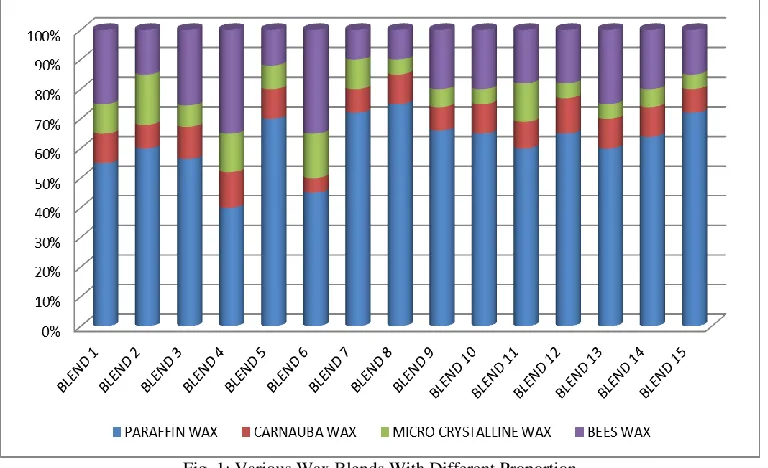
In this case we have taken a metal die in which 15 wax patterns of 100 gram each are produced. The wax used for producing the patterns is a mixture of paraffin wax, carnauba wax, micro-crystalline wax and bees wax.
The different wax mix hence obtained was poured into the die to form the respective wax pattern. Different binders like zircon floor, colliadle silica, sodium silicate, hoss powder and plaster of paris were used to from the shell over the wax pattern. De-waxing was done to form the mould cavity. The mould was subjected to different experimental conditions while doing the casting as per the Taguchi design of experiments.
Fig. 1: Various Wax Blends With Different Proportion
There are two main shrinkage allowances to be considered: the die-to-wax shrinkage and the casting solidification shrinkage. Then the following defects are considered after making the pattern:
Linear Shrinkage
We can directly calculate the linear shrinkage by taking the difference between the standard dimension of the die and the dimension that we get from the pattern.
Volumetric Shrinkage
Volumetric shrinkage can be find out as follow [9]: 1) Firstly make the die leak proof.
2) After that fill the water in the die cavity and measure the volume of the water that will give the volume of the die. 3) Fill the water in the measuring flask and take the initial reading then place the wax pattern in the measuring flask. 4) Now the volume of the water rises that is final volume.
5) Take the difference of the final volume and the initial volume it will give the volume of the pattern. 6) Now the volumetric shrinkage is find out as
(Volume of the die – volume other pattern)/ volume of the die * 100
All experiment is done to find out the best possible result and we find the value of linear shrinkage and volumetric shrinkage.
Selection of best wax injection parameters
The selection of best wax injection parameters was carried out on the basis of minimum surface roughness. The surface roughness was measured by using MITUTOYO SJ-201 P measuring instrument.
Taguchi Technique
From the experiments conducted, each wax blend under different set of process parameters exhibited different properties. Hence, an attempt is made to determine the optimum set of process parameters using Taguchi method. It is one of the most important tool for studying the effect of various input process parameters.
Table – 2 Process Parameters
Process Parameters Levels
L1 L2 L3
Injection Temperature (oC) 66 68 70
Die Temperature (oC) 44 46 48
Injection Force (N) 450 500 550
Holding Time (Min.) 9 10 11
V. RESULTS AND DISCUSSION
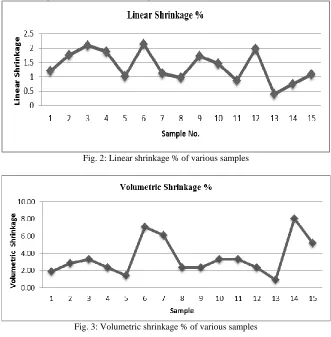
After calculating the linear shrinkage we found the following result as shown in the table below.
Fig. 2: Linear shrinkage % of various samples
Fig. 3: Volumetric shrinkage % of various samples
On the basis of experimental observations made on Wax Patttern (Pilot Experiment) following conclusions can be drawn: Shrinkage affected by the type of wax used and was sensitive to the site at which dimensional measurements were
performed.
Micro-crystalline wax affects its role in linear shrinkage as well as volumetric shrinkage. More the amount of micro-crystalline wax is used more is the linear and volumetric shrinkage.
There is a significance effect of wax temperature, initial die temperature and ambient temperature on final wax pattern. Types of wax also effect the defect produces in the wax pattern.
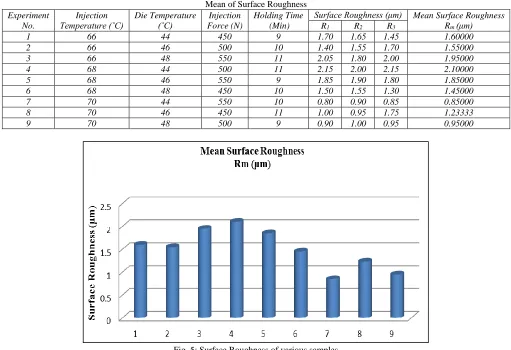
The surface roughness was measured on different points on the wax pattern. Then the average value of surface roughness is calculated.
Table - 3
Mean of Surface Roughness Experiment
No.
Injection Temperature (˚C)
Die Temperature (˚C)
Injection Force (N)
Holding Time (Min)
Surface Roughness (μm) Mean Surface Roughness Rm (μm)
R1 R2 R3
1 66 44 450 9 1.70 1.65 1.45 1.60000
2 66 46 500 10 1.40 1.55 1.70 1.55000
3 66 48 550 11 2.05 1.80 2.00 1.95000
4 68 44 500 11 2.15 2.00 2.15 2.10000
5 68 46 550 9 1.85 1.90 1.80 1.85000
6 68 48 450 10 1.50 1.55 1.30 1.45000
7 70 44 550 10 0.80 0.90 0.85 0.85000
8 70 46 450 11 1.00 0.95 1.75 1.23333
9 70 48 500 9 0.90 1.00 0.95 0.95000
Fig. 5: Surface Roughness of various samples
Figure 5 shows the variation in surface roughness with the change in input factors i.e. Injection temperature, die temperature, injection pressure and holding time. X-axis represents the Surface Roughness and Y-axis represents the various samples.
VI. CONCLUSION
As from the experiment it clear that on the basis of linear shrinkage and volumetric shrinkage sample blend no. 13 with proportion of 60 % paraffin wax, 25 % bee wax, 5 % Microcrystalline wax, 10% Carnauba wax has been obtained.
Nine more patterns are prepared by using this blend with same proportion and surface roughness is measured for the selection of best wax injection parameters.
From Fig. 5 it is cleared that the best wax injection parameters are injection temperature = 70˚C, die temperature = 44˚C, injection force = 550 N, holding time = 10 min.
REFERENCES
[1] Saroj Rani Pattnaik, D. Benny Karunakar, PK Jha, Journals of Material Processing Technology 212 (2012) 2332-2348. ‘Development in investment casting process- A review.
[2] Emrati Kumari (2008AMD3240) Investment Casting, Indian Institute of Technology, Delhi.
[3] Omkar Bemblage and D. Benny Karunakar (2011) July 6 - 8, 2011, A Study on the Blended Wax Patterns in Investment Casting Process.
[4] Y.M.Li, R.D.Li, Effect of process variables on micro porosity and mechanical properties in an investment cast aluminium alloy, Science and Technology of Advanced Materials 2(2001) 277-280.
[5] J.C. Gebelin and M.R. Jolly, “Modeling of the investment casting process”, Journal of Material Processing Technology, vol. 135, 2003, pp 291 – 300. [6] S. Tascyoglu, B. Inem, and N. Akar, “Conversion of an investment casting sprue wax to a pattern wax by the modification of its properties”, Materials and
Design, vol. 25, 2004, pp 499 – 505.
[7] B. Singh, P. Kumar, B.K. Mishra, 2006. Experimental investigation of wax blends in investment casting process. Indian Foundry Journal 52 (3), 29–36. [8] Nikhil Yadav, Jitendra Kr.Katiyar, Nitu Singh and Vijay Kr. Pal (2011), “Investigating the Effects of Varying Proportions of waxes in wax mix on Surface
Roughness and Optimization by Taguchi Method“, Applied Mechanics and Materials, Vol. 110, pp 627-631.