Vol. 4, No. 2, 2014, 88-95
ISSN: 2320 –3242 (P), 2320 –3250 (online) Published on 20 June 2014
www.researchmathsci.org
88
International Journal of
A Note on Fuzzy Labeling
A.Nagoor Gani1 and D.Rajalaxmi (a) subahashini2 1P.G. & Research Department of Mathematics, Jamal Mohamed College, Trichy, India 2
Department of Mathematics, Saranathan College of Engineering, Trichy, India E-mail: [email protected], [email protected]
Received 5 May 2014; accepted 15 May 2014
Abstract. The concept of fuzzy magic labeling is introduced.Fuzzy magic labeling for some graphs like path, cycle and star graph are defined. It is proved that, every fuzzy magic graph is a fuzzy labeling graph, but the converse is not true. And we show that the removal of a fuzzy bridge from a fuzzy magic graph G, such that G* is a cycle with odd number of nodes is a fuzzy magic graph.And also some properties related to fuzzy bridge and fuzzy cut node have been discussed.
Keywords: Fuzzy labelling, Fuzzy magic labelling, fuzzy bridge and fuzzy cut node AMS mathematics Subject Classification (2010): 03E72, 05C72, 05C78
1. Introduction
Fuzzy is a newly emerging mathematical frame work to exemplify the phenomenon of uncertainty in real life tribulations. It was introduced by Zadeh in 1965, and the concepts were pioneered by various independent researches viz; Rosenfeld [10], Yeh and Bang [18] during 1970’s. Bhattacharya has established the connectivity concepts between fuzzy cut nodes and fuzzy bridges titled “Some remarks on fuzzy graphs” [1]. Several fuzzy analogs of graph theoretic concepts such as paths, cycles and connectedness were explored by them. There are many problems, which can be solved with the help of the fuzzy graphs.
Though it is very young, it has been growing fast and has numerous applications in various fields. Further, research on fuzzy graphs has been witnessing an exponential growth; both within mathematics and in its applications in science and Technology. A fuzzy graph is the generalisation of the crisp graph. Therefore it is natural that many properties are similar to crisp graph and also it deviates at many places.
A Note on Fuzzy Labeling
89
Kotzig and Rosa [3] defined a magic labeling to be a total labeling in which the labels are the integers from 1 to|VG| |EG|. The sum of labels on an edge and its two endpoints is constant. Recently HikoeEnomoto [2] et al., introduced the name super edge magic for magic labeling in the sense of Kotzig and Rosa, with the added property that the v vertices receive the smaller labels. Many other researchers have investigated different forms of magic graphs. For example see Selvam Avadayappan [12] et al., A.A.G.Ngurah [9] et al.Trenkler [16].
In this paper, section 1.1 contains basic definitions and in section 1.2 a new concept of fuzzy magic labeling has been introduced and also fuzzystar graph is defined. In section 2 fuzzy magic labeling for some graphs like path, cycle and star are defined. In section 3, some properties and results with fuzzy bridge and fuzzy cut nodes are discussed. The graphs which are considered in this paper are finite and connected.
All basic definitions and symbols are followed as in [4, 6, 7,15, 17].
1.1. Preliminaries
Let U and V be two sets. Then ρ is said to be a fuzzy relation from U into V if ρ is a fuzzy set of U×V.A fuzzy graph G = (σ, µ) is a pair of functions σ: V → [0, 1] and µ: V×V → [0, 1], where for all u, v V, we have µ (u, v) ≤ σ (u) Λ σ (v).A pathP in a fuzzy graph is a sequence of distinct nodes v1, v2, ....,vn such thatµ (vi, vi+1) >0; 1≤ i ≤ n; here n ≥ 1 is
called the length of the pathP. The consecutive pairs (vi, vi+1) are called the edge of the
path.A path P is called a cycle if v1=vn andn ≥ 3. The strength of a path P is defined as
n Λ i=1
µ (vi, vi+1).Let G :( σ, µ) be a fuzzy graph. The degree of a vertex v is defined as
d(v) = ∑u≠vµ (v, u)
uV
.Let G :( σ, µ) be a fuzzy graph. The strong degree of a node v is
defined as the sum of membership values of all strong edges incident at v. It is denoted by ds(v). Also if Ns (v) denote the set of all strong neighbours of v, then ds(v) =
∑ µ (v, u).An edge is called a fuzzy bridge of G if its removal reduces the strength of connectedness between some pair of nodes in G.A node is a fuzzy cut node of G = (σ, µ) if removal of it reduces the strength of connectedness between some other pair of nodes.
1.2. Fuzzy labeling
Definition 1.2.1. [8] A graph G = (σ, µ) is said to be a fuzzy labeling graph, if σ: V → [0, 1] and µ: V×V → [0, 1] is bijective such that the membership value of edges and vertices are distinct and µ (u, v) < σ (u) Λ σ (v) for all u, v V.
Example 1.
Figure1: A fuzzy labeling graph
90
Definition 1.2.2. A fuzzy labeling graph is said to be a fuzzy magic graph if σ (u) + µ (u, v) +σ (v) has a same value for all u, v V which is denoted asmo(G).
Example 2.
Figure 2: A fuzzy magic path graph. mo(P) = 0.13.
In Fig. 2 σ(V1) +µ(V1, V2) + σ(V2) = 0.07+0.01+0.05 = 0.13, for all V1, V2 .
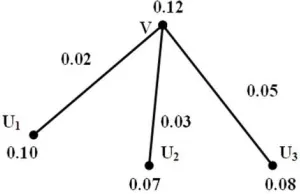
Definition1 2.3. A star in a fuzzy graph consist of two node setsV and U with |V|= 1 and
|U|> 1, such thatµ (v, ui) > 0 and µ (ui, ui+1) = 0, 1≤ i ≤ n. It is denoted by S1, n..
Example3.
Figure 3: Afuzzy star graph
Definition 1.2.4. [8] The fuzzy labeling graph H= (τ, ρ) is called a fuzzy labeling subgraph of G= (σ, µ) ifτ(u) σ(u) for all u V andρ, , , for all u, v V.
2. Main Results
Proposition 2.1. EverypathP is a fuzzy magic graph.
Proof: Let P be a path with length n ≥ 1 and v1,v2,... vn&v1v2, v2v3, ...,vn-1vn are the nodes
and edges of P.Let z→ (0, 1] such that one can choose z = 0.1 if n ≤ 4 and z = 0.01 if n ≥ 5. if the length of the path P is odd, then the fuzzy labeling is defined as follows.
σ(v2i-1) = (2n+2 i) z, 1 ≤ i ≤
σ(v2i) = Min (v2i-1) /1 ≤ i ≤
n1
2 i (z), 1 ≤ i ≤
µ(vn-i+2, vn+1-i) = Max ! /1 # $ 1%
Min σ! /1 # $ 1% (i 1)z, 1 ≤ i ≤ n
Case (i) i is even
A Note on Fuzzy Labeling
91 mo(P) = σ(vi) +µ (vi, vi+1) +σ(vi+1)
= σ(v2x) + µ (v2x, v2x+1) + σ(v2x+1)
= Min σ(v2i-1) /1 ≤ i ≤ n1
2 x (z) + Max σ(vi) /1 ≤ i ≤ n+1%
Min σ(vi) /1 ≤ i ≤ n+1% (n 2x) z + (2n x+1) z
= Min σ(v
2i-1) /1 ≤ i ≤
n+1
2 + Max σ(vi) /1 ≤ i ≤ n+1%-Min σ(vi) / 1 ≤ i ≤ n+1% + (n+1)z
Case (ii) i is odd
Then i = 2x+1for any positive integer x For each edge vi, vi+1
mo(P)= σ(vi) + µ (vi, vi+1) + σ(vi+1)
= σ(v2x+1) + µ (v2x+1, v2x+2) +σ(v2x+2)
= (2n-x+1)z+Max σ(vi) /1 ≤ i ≤ n+1%- Min σ(vi) /1 ≤ i ≤ n+1%- (n-2x-1) +Min σ(v
2i-1) /1 ≤ i ≤
n1
2 - (x +1)z
= Min σ(v
2i-1) /1 ≤ i ≤
n1
2 + Max σ(vi) /1 ≤ i ≤ n+1%- Min σ(vi) / 1 ≤ i ≤ n+1% + (n+1)z.
If the length of the path P is even then it has the following labeling. σ(v2i) = (2n2-i) z, 1 ≤ i ≤
n
2
σ(v2i-1) = Min σ(v2i) /1 ≤ i ≤
n
2-i (z), 1 ≤ i ≤
n+2
2
µ(vn-i+2,vn-i+1) = Max σ(vi) /1 ≤ i ≤ n1%
- Min σ(vi) /1 ≤ i ≤ n1%- (i-1)z, 1 ≤ i ≤ n Case (iii) i is even
Then i = 2x for any positive integer x For each edge vi, vi+1
mo(P)=σ(vi) + µ (vi, vi+1) + σ(vi+1)
= σ(v2x) +µ (v2x, v2x+1) + σ(v2x+1)
= (2n+2-x)z+ Max σ(vi) /1 ≤ i ≤ n1%- Min σ(vi) /1 ≤ i ≤ n1%- (n-2x) z+Minσ(v2i) /1 ≤ i ≤n
2-(x+1)z
= Minσ(v2i) / 1 ≤ i ≤n
2 + Max σ(vi) /1 ≤ i ≤ n1%-Min σ(vi) / 1 ≤ i ≤ n1% + (n+1)z
Case (iv) i is odd
Then i = 2x+1 for any positive integer x For each edge vi, vi+1
mo(P) =σ(vi) +µ (vi, vi+1) + σ(vi+1)
= σ(v2x+1) +µ (v2x+1, v2x+2) +σ(v2x+2)
= Min σ(v2i) /1 ≤ i ≤ n
2- (x+1)z (n 2x 1) z
+ Max σ(vi) /1 ≤ i ≤ n1%- Min σ(vi) /1 ≤ i ≤ n1% + (2n x+1)z
= Min σ(v2i) /1 ≤ i ≤ n
92
Therefore in both the cases the magic value mo(P) is same and unique. Thus P is fuzzy magic graph.
Proposition 2.2. Every graph G, such that G* is a cycle with odd number of nodes is a fuzzy magic graph.
Proof: LetG* be a cycle with odd number of nodes and v1,v2,... vn& v1v2, v2v3, ...,vnv1 be the nodes and edges of Cn.Let z → (0, 1] such that one can choose z = 0.1 if n ≤ 3 and z = 0.01 if n ≥ 4. The fuzzy labeling is defined as follows.
σ(v2i) = (2n+1-i) z, 1 ≤ i ≤
n-1 2
σ(v2i-1) = Min σ(v2i) /1 ≤ i ≤ n
-1
2-i (z), 1 ≤ # ≤
n+1 2
µ(v1,vn) = Max σ(vi) /1 ≤ i ≤ n%
µ(vn-i+1,vn-i) = µ (v1,vn) -i (z), 1 ≤ i ≤ n-1
Case (i) i is even
Then i = 2xfor any positive integer x For each edge vi, vi+1
mo(Cn)=σ(vi) + µ (vi, vi+1) + σ(vi+1)
= σ(v2x) + µ (v2x,v2x+1) + σ(v2x+1)
= (2n+1-x) z+ 1
2Max σ(vi) /1 ≤ i ≤ n%- (n-2x) z + Min σ(v2i) /1 ≤ i ≤
n-1
2- (x+1)z
= 1
2Max σ(vi) /1 ≤ i ≤ n%+ Min σ(v2i) /1 ≤ i ≤
n-1
2 +n (z)
Case (ii) i is odd
Then i = 2x+1 for any positive integer x For each edge vi, vi+1
mo(Cn)= σ(vi) +µ (vi, vi+1) + σ(vi+1)
= σ(v2x+1) +µ (v2x+1, v2x+2) +σ(v2x+2)
= Min σ(v2i) /1 ≤ i ≤
n-1
2- (x+1)z+ 1
2Max σ(vi) /1 ≤ i ≤ n%- (n-2x-1) z+ (2n-x) z = 1
2Max σ(vi) /1 ≤ i ≤ n%+ Min σ(v2i) /1 ≤ i ≤
n-1
2 + n (z)
Therefore from above cases G is a fuzzy magic graph if it has odd number of nodes.
Proposition 2.3. For any n ≥ 2, star S1,nis a fuzzy magic graph.
Proof: Let S1,n* be a star graph with v,u1,u2, ..., un as nodes and vu1,vu2, ..., vun as edges. Let z → (0, 1] such that one can choose z = 0.1 if n ≤ 4 and z = 0.01 if n ≥ 5. Such a fuzzy labeling is defined as follows.
σ(ui) = [2(n+1) -i] z, 1 ≤ i ≤ n
σ(v) = Min σ(ui) /1 ≤ i ≤ n%- z
µ(v, un-i) = Max σui, σv/1≤ i ≤ n%-Min σui, σ(v)/1≤ i ≤ n% - i (z), 0 ≤ i ≤ n-1.
Case (i) i is even
Then i = 2x for any positive integer x For each edge v,ui
mo(S1, n) =σ(v) + µ (v,ui) + σ(ui)
= σv) +µ (v,u2x) + σ(u2x)
A Note on Fuzzy Labeling
93
- Min σui,σ(v)/1≤ i ≤ n%–($-2,) z + [2(n+1) - 2x z
= Min σ(ui) /1 ≤ i ≤ n% + Max σui, σv/1≤ i ≤ n%
Min σ
ui, σ(v)/1≤ i ≤ n% + (n+1) z
Case (ii) i is odd
Then i = 2x+1for any positive integer x For each edge v,ui
mo(S1, n) =σ(v) +µ (v,ui) +σ(ui)
= σ(v) + µ (v, u2x+1) +σ(u2x+2)
= Min σ(ui) /1 ≤ i ≤ n%- z + Max σui, σv/1≤ i ≤ n% Min σui, σ(v)/1≤ i ≤ n%- (n 2x 1)z + [2(n x)] z
= Min σ(ui) /1 ≤ i ≤ n% + Max σui, σv/1≤ i ≤ n% -Min σui,σ(v)/1≤ i ≤ n% + (n+1) z.
From the above cases one can easily verify that all star graphs are fuzzy magic graphs.
Remark 1. One can observe the same labeling holds good if we choose the value of z as 0.03, 0.05 etc for the proposition 2.3, 2.4 and 2.5.
Remark 2.
(i) If G is a fuzzy magic graph, then d(u) ≠ d(v) for any pair of nodes u and v. (ii) For any fuzzy magic graph, 0 ≤ ds(v) ≤ d(v).
(iii) Sum of the degree of all nodes in a fuzzy magic graph is equal to twice the sum of membership values of all edges.(i.e.) ∑ni=1d (vi) = 2 ∑u≠vµ (u, v).
(iv) Sum of strong degree of all nodes in a fuzzy magic graph is equal to twice the sum of the membership values of all strong arcs in G
i.e. ∑ni=1ds(vi) = 2∑uNs(v) µ(v, u)
3. Properties of fuzzy magic graphs
Proposition 3.1. Every fuzzy magic graph is a fuzzy labeling graph, but the converse is not true.
Proof: This is immediate from the definition 1.2.2.
Proposition 3.2. For every fuzzy magic graph G, there exists atleast one fuzzy bridge. Proof: Let Gbe a fuzzy magic graph, such that there exist only one edge µ(x,y) with maximum value, since µ is bijective. Now we claim that µ(x,y) is a fuzzy bridge. If we remove the edge (x,y) fromG, then in its subgraph we’ve-. (x, y) < µ (x,y), which implies (x, y) is a fuzzy bridge.
Proposition 3.3. Removal of a fuzzy cut node from a fuzzy magic graph G, such that G* is a path is also a fuzzy magic graph.
94
Proposition 3.4. Removal of a fuzzy bridge from a fuzzy magic graph G, such that G* is a cycle with odd number of nodesis a fuzzy magic graph.
Proof: Since G is a fuzzy magic graph with odd number of nodes. We can choose any path, say (u, v) then there must be at least one fuzzy bridge, whose removal from Gwill result as a path of odd or even length. By proposition 2.1, the removal of a fuzzy bridge from a fuzzy magic graph G is also a fuzzy magic graph.
Remark 3.
(i) Removal of a fuzzy cut node from the fuzzy magic graph G such that G* is a cycle with odd number of nodesis also a fuzzy magic graph.
(ii) For all fuzzy magic graph G, such that G*is a cycle with odd number of nodes, there exist at least one pair of nodes u and v such that ds(u)= ds(v).
4. Concluding remarks
In this paper, the concept of fuzzy labeling and fuzzy magic labeling has been introduced. As it is a new one, much more work could be done to find many fuzzy magic graphs and also many properties could be derived. The remaining work will be discussed in the forthcoming papers.
REFERENCES
1. P.Bhattacharya, Some remarks on fuzzy graphs, Pattern Recognition Letters, 6 (1987)297-302.
2. H.Enomoto, A.S.Llado, T.Nakamigawa and G.Ringel, Super edge –magic graph, SUT Journal of Mathematics, 34(2) (1998) 105-109.
3. A.Kotzig and A.Rosa, Magic valuations of finite graph, Canad. Math. Bull., 13 (1970) 451-461.
4. J.N.Mordeson and P.S.Nair, Fuzzy Graphs and Fuzzy Hypergraphs, Physica-Verlag, Heidelberg 2000.
5. A.Nagoorgani and V.T. Chandrasekaran, Domination in fuzzy graph, Advances in Fuzzy Sets and Systems, 1(1) (2006) 17-26.
6. A.Nagoorgani and V.T. Chandrasekaran, A First Look at Fuzzy Graph Theory, Allied Publishers Pvt. Ltd, 2010.
7. A.Nagoorgani and J.Malarvizhi, Isomorphism on fuzzy graphs, World Academy of Science, Engineering and Technology, 2(4) (2008) 11-28.
8. A.Nagoorgani and D.Rajalaxmi(a) subahashini, Properties of fuzzy labeling graph, Applied Mathematical Sciences, 6 (70) (2012) 3461–3466.
9. A.A.G. Ngurah, A.N.M Salman, L.Susilowati, Super magic labelings of graphs, Discrete Mathematics, 310 (2010) 1293 – 1300.
10. A. Rosenfeld, Fuzzy Graph, In: L.A. Zadeh, K.S. Fu and M.Shimura, Editors, Fuzzy Sets and their Applications to Cognitive and Decision Process, Academic Press, New York (1975) 77-95.
11. J.Sedlacek, Theory of graphs and its applications, Smolenice Symposium (Prague, 1964),163-164, problem 27.
12. S.Avadayappan and Jayanthi P., Super magic strength of a graph, Indian Journal of Pure and Applied Mathematics, 32 (11) (2001) 1621-1630.
A Note on Fuzzy Labeling
95
14. B.M.Stewart, Super magic complete graphs, Can. J.Math., 19 (1966) 427 – 438. 15. Sunil Mathew and M.S.Sunitha, Node connectivity and arc connectivity of a fuzzy
graph, Information Sciences, 180(4) (2010) 519 – 531.
16. M.Trenkler, Some results on magic graphs, in “Graphs and other combinatoria topics” Proc. Of the 3rd Czechoskovak Symp., Prague, 1983, edited by M.Fieldler, Textezur Mathematik Band, 59 (1983), Leipzig, 328-332.
17. W.D.Wallis, Magic graph, Aust Math Soc. Gazette, 28, 2001.