doi:10.5681/rdme.2012.015 http://journals.tbzmed.ac.ir/rdme
*Corresponding authors: Nida Abdollahi, Email: [email protected]
Introduction
Comparison of Knowledge and Performance between Faculty Members
and PhD Students in Personal Information Management: Presenting
an Instructional Model based on Lifelong Learning
Leila Abdolahi1, Iman Tahamtan1, Behnam Abdollahi2, Nida Abdollahi3*
1School of Health Management and Information Sciences, Tehran University of Medical Sciences, Tehran, Iran 2Department of Language, School of English Literature, University of Kurdistan, Sanandaj, Iran
3Department of Instructional Technology, University of Farhangian-Pardis Bentolhoda Sadr, Sanandaj, Iran
A RT I C L E I N F O A B S T R A C T
Article Type:
Research Article
Article History: Received: 14 Aug. 2012 Revised: 28 Aug. 2012 Accepted: 02 Sep. 2012 ePublished: 25 Dec. 2012 Keywords:
Personal information management Instructional method Faculty members PhD students Lifelong learning
Introduction: Health care professionals deal with a large amount of information as they usually have various educational, scientific, clinical and administrative responsibilities. In this study we tried to investigate the knowledge of Iranian faculty members and PhD candidates of Tehran University of Medical Sciences about Personal Information Management (PIM) in order to present an instructional model to improve PIM skills. Methods: We conducted semi-structured interviews with a purposive snowball sample of 40 Iranian faculty members and PhD candidates of Tehran University of Medical Sciences. We used N8 to codify and analysis interview concepts. Results:Participants had little knowledge about how to manage their personal information. The use of PIM was in low rate among participants. Faculty members were more successful in organizing and retrieving personal information; while PhD candidates were more skilled in acquiring and keeping personal information. Conclusion:PIM is the missing link in the medical education in which various spectrums of instructional techniques is needed for the prosper implementation and usage of PIM in the medical field. We suggested an instructional model based on learning theories to educate and improve participants’ knowledge and skills in PIM.
Today, people in various fields, especially in health, deal with a large amount of information in printed and electronic formats. Sometimes, because of the large amount of information kept at home or workstation, it is hard to find this information which has been searched and kept before.1 We cannot solely rely on our memory
to retrieve this information and it is essential to use some techniques and tools to organize and keep this information in the right place to retrieve later.2 Therefore, health care
professionals use various methods and tools such as Personal Information Management (PIM) techniques to access and keep new and up to date information in order to improve their knowledge and job performances.1
PIM are such activities that people perform to acquire, organize, maintain and retrieve information for every day personal and professional activities.1 PIM gives us
the opportunity to have the information we need in the right place and in the right format. We then can use this
information intelligently, with the least time-consuming way to do our works.3
Many previous studies have investigated PIM in various aspects. For example Bruce investigated Information behavior that kept found things found. Participants in this study used a range of methods to keep and organize information that they founded on WEB. The keeping methods most regularly used were making a Bookmark or Favorite, search again to re-access, enter the URL directly; sending e-mail to others, access through another Website, print out the Web page; and sending e-mails.4
Jones suggested that most people relied largely on a pocket diary as their main method of storing, organizing and retrieving information. Participants in this study used to-do list, colander and address books, pocket diaries, desk diaries, and personal organizers to manage personal information.5 He also investigated the methods people used
print-out, and paste URL in documents were used to organize web information.6
Barreau indicated that participants named files for easy retrieval, rarely grouped similar items into folders and subdirectories and leaved most documents without a specific order. They used search engines to find things, but they rarely used a search engine to find information in their personal work space.7 Bergman indicated that users classified their information according to projects more than to formats. Participants stored information in different folders including documents, e-mail and web favorites.8
Crystal indicated that students collected and managed a diverse array of information using many different media and formats. The information types managed by participants included analog, digital and cognitive information.9 Majid
investigated perceptions of university students of Internet services for managing their personal information. This study showed that email addresses, bookmarks, personal text documents and photos were the most frequently stored information. Over forty five percent of students used file/ folder names and tag/label descriptions to represent the content of their information. One- half of the students sometimes encountered problems in retrieving the stored items and only a small number of the students used online storage for maintaining personal information.10
The printed and electronic information overload was the reason that extensive studies were carried out about PIM throughout the world. However, In Iran little research has been done about Personal Information Management of healthcare professionals. Furthermore, previous studies presented little information about how to solve PIM limitations and barriers and how to improve PIM skills. Therefore we decided to carry out current research to study the use of PIM by faculty members and PhD candidates of TUMS in order to suggest an instructional model based on lifelong learning to improve PIM skills among participants. In late 1997, the Commission for a Nation of Lifelong Learners defined lifelong learning as:11
“a continuously supportive process which stimulates and empowers individuals...to acquire all the knowledge, values, skills and understanding they will require throughout their lifetimes...and to apply them with confidence, creativity, and enjoyment in all roles, circumstances, and environments.”
In lifelong learning, learners can use a variety of activities to move forward. For example, they can observe how colleagues manage their personal information and discuss with them. They would also be able to look up information about PIM from various resources and learn PIM skills from trial and error.12
Current study would give us the opportunity to build on previous research, to know more about PIM usage among healthcare professionals and to present an instructional model based on lifelong learning in order to improve PIM skills among Iranian population.
Methods
We adopted a qualitative approach to investigate the personal information management by faculty members and PhD candidates of Tehran University of Medical Sciences (TUMS) in 2012. In current study personal information included both personal and professional information such as daily news, personal photos, patients’ data, students’ homework, etc.
Setting
It is suggested that the site of study or the research population must be selected according to the research questions.13 We therefore selected Tehran University of
Medical Sciences which is the largest and most highly ranked medical university in Iran as the site of the study.
Participants
The sampling method we used; was purposive snowball sampling. Therefore we continued data collection until the data saturation was reached.13 After we reached
data saturation, in which no new data emerged from the interviews and the main concepts were identified, we continued data collection with interviewing some more participants to ensure this was the case. A broad age range and various specialties participated (totally 20 faculty members and 20 PhD candidates) in this study.
Data collection protocol
Interviews with participants who consented to take part in the study were carried out face-to-face by the main researcher in mutually agreed venues. All interviews were carried out in the offices of participants or departments at mutually agreed dates and times. We recorded the interviews using an audio tape recording with participants’ permission.
Data analysis
We adopted a qualitative approach to the research as mentioned before. Therefore, we used transcribed interviews and used NVivo, qualitative data analysis software to code and analyze the data.
Results
Twenty faculty members and twenty PhD candidates, thirteen women (32.5 %) and twenty seven men (67.5 %) participated in this study. Age average of faculty members was 40 and PhD candidates 32 years old.
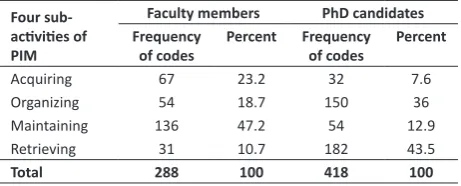
organizing and retrieving codes was higher among PhD candidates, while acquiring and maintaining had a higher frequency among faculty members.
Four sub-activities of PIM
Faculty members PhD candidates Frequency
of codes Percent Frequency of codes Percent
Acquiring 67 23.2 32 7.6
Organizing 54 18.7 150 36
Maintaining 136 47.2 54 12.9
Retrieving 31 10.7 182 43.5
Total 288 100 418 100
Table 1. Sub-activities of PIM and frequency of codes among faculty members and PhD candidates
Acquiring information
Participants used various information resources for acquiring personal information including printed materials (books, journals and etc.) and electronic resources (web sites, search engines, electronic journals, electronic discussion groups and etc.). Both PhD candidates and faculty members usually used electronic resources to access information needs. Among printed resources, PhD candidates usually used dissertations and journals, while faculty members used textbooks.
Organizing information
Participants organized personal information based on subject, type of file, (vocal, pictorial, and text), file/ folder name and date of file/folder creation. However in both groups, there were some participants who did not organize personal information and leaved information items unorganized. To organize personal information, PhD candidates used folder name with sub-folders which were organized with subject, while faculty members used subject with sub-folders organized with name. Faculty members had fewer difficulties in organizing personal information as they were more experienced than PhD candidates. Furthermore, PhD candidates in higher grades were more successful in organizing personal information.
Maintaining information
The tools used for maintaining personal information included; personal computers, flash memories, E-mail, CD, external hard, diskette, Bookmarks, favorites and calendars. Faculty members were to some extent unfamiliar with maintaining tools and did not use a unique tool with a high storage capacity to maintain personal information. They usually used various tools with low storage capacities to maintain personal information which caused some difficulties for them. For instance they had to look for information needs among different tools in a time-consuming process and sometimes they could not retrieve this information later. Most faculty members maintained
invaluable and in usable information and did not omit this information. PhD candidates usually used external hard and faculty members used PCs to maintain personal information. E-mail was the second main used tool among both groups.
Information retrieval
The final step in the PIM process was personal information retrieval in which participants usually encountered with difficulties. Participants retrieved personal information based on the subject, the location where information where maintained in and file/folder name. Both groups usually used the subject to find stored information. Participants usually failed to retrieve personal information because of the improper information organization. Therefore they left the information retrieval step and tried to acquire the information again. This means they tried to look for the information again in the information resources and where they had once found the information before. However, Faculty members were more skilled in retrieving personal information than PhD candidates as they were more successful in organizing personal information.
Discussion
As interviews showed, the use of PIM was in a low rate among both faculty members and PhD candidates and the main reason was the unfamiliarity of participants with PIM techniques. PhD candidates usually used dissertation and journals to access and keep up with the newest information in various fields. They were more skilled in acquiring information from electronic resources than faculty members. The reason was that they participated in search workshops and some of them took some courses about searching in electronic resources such as databases during Master of Science period. Faculty members were more skilled and successful in organizing and retrieving personal information; while PhD candidates were more skilled in collecting and keeping personal information. Faculty members dealt with a larger amount of information than PhD candidates; however they could not maintain this information in an appropriate manner. They used various tools to maintain personal information as they did not know the useful techniques and tools for maintaining information.
As indicated, participants who were more experienced in organizing information were more successful in information retrieval. Therefore if they properly organized information, they could easier and faster retrieve the information when needed later.
Current study indicated that participants used various methods to maintain and organize information. Previous studies also indicated that a range of methods was used to keep and organize information.4,7 In current study
information, while Majid showed that only one-half of participants in his study had problems in retrieving stored items.10 Findings of current and previous studies revealed
that the problems individuals encountered when managing personal information was due to their unfamiliarity with PIM techniques and lack of PIM skills.
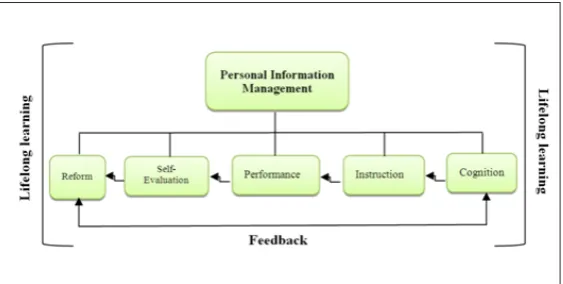
Presently, there are no university courses on PIM in most countries and even in Iran. On the other hand educating PIM skills is essential among healthcare professionals. Therefore, we suggest that healthcare professionals, particularly students and faculty members at University of Medical Sciences involve in a lifelong learning process. To eliminate the problems mentioned before, we presented an instructional model based on lifelong learning which can be seen in figure 1. This can be used to improve knowledge and the performances of participants in managing personal information.
As this model shows the first step is to make participants familiar and informed with PIM and its benefits in various aspects of their personal and professional activities. This would make them interested in the use of PIM and to participate in instructional workshops about PIM or to look up information about PIM. In continues training workshops and classes they can learn the four sub-activities of PIM including, acquiring, organizing, maintaining, retrieving and the proper methods of using and managing personal information. They will also learn all kind of printed and electronic information resources, how to use PIM tools, the limitations and barriers of PIM tools usage. In continues lifelong learning they can discuss with others and share experiences. After they learn PIM theoretical and practical concepts, they can practice PIM in the real world to evaluate their PIM skills. Self-evaluation which is not an end product will help them to know their strengths and weaknesses. Furthermore, participants in lifelong learning would be able to decide if the gained PIM knowledge and skills were satisfactory or not. In the next step participants should try to decrease
their weaknesses and to improve their PIM knowledge and skills. In the feedback step necessary reforms is returned to the whole model in order to solve problems of each step. These steps can be proposed as a practical plan to improve participants’ skills in managing their personal information. This instructional model can be effective when it is based on lifelong learning and it means continued support of person inPIM learning process.
This is important for busy people such as healthcare professionals who deal with a large amount of information to use modern PIM technologies and effective techniques for improving the efficiency of information to get things done. The effective use of PIM tools needs health managers’ attention to implement necessary PIM technologies in health settings such as Medical Universities, hospitals and healthcare centers. Medical education authorities should pay attention to organize some workshops and university courses for better implementation of PIM techniques among Iranian population. Furthermore, Universities of Medical Sciences should promote PIM lifelong learning in their graduates as a central part of their role.
Further research should be done to investigate the influential factors that affect healthcare professionals, faculty members and students of higher education attitudes to be continuing lifelong learners of PIM activities and to investigate the suggested model In Universities of Medical Sciences and health settings to know whether this is useful or not.
Acknowledgment
We would like to thank all of the participants who provided us with the opportunity to interview them.
Competing interests
Authors declared no competing interests.
References
1. Boardman J. Improving tools support for personal information management [Thesis]. Londen: Imperial College London;2004.
2. Abdolahi L. Use of Personal Information Managment tools by faculty members of Tehran Univercity of Medical Scinces [Master thesis]. Tehran: Tehran Univercity of Medical Scinces;2011. [Persian] 3. Teevan J, Jones W, Bederson BB. Personal
Information Management. Communications of the ACM 2006;49:40-3.
4. Bruce H, Jones W, Dumais S. Information behaviour that keeps found things found. Information Research 2004;10:207.
5. Jones SR, Thomas PJ. Empirical assessment of individuals’ Personal Information Management systems. Behaviour and Information Technology 1997;16:158-160.
6. Jones W, Dumais S, Bruce H, editors. Once Found, What Then? A Study of "Keeping" Behaviors in the Personal Use of Web Information. Proceedings of the ASIST Annual Meeting 2002;39(1):391-402. 7. Barreau D. The Persistence of Behavior and Form in
the Organization of Personal Information. JASIST 2008;59:307-17.
8. Bergman O, Beyth-Marom R, Nachmias R. The User-Subjective Approach to Personal Information Management Systems Design: Evidence and Implementations. JASIST 2008;59:235-46.
9. Crystal AJ. Design research For Personal Information Management systems to support undergraduate students [Thesis]. Chapel Hill: University of North Carolina;2008.
10. Majid S, San MM, Tun STN, Zar T. Using Internet Services for Personal Information Management. 2nd International Symposium on Information Management in the Changing World; 2010 September 22-24. Ankara: Hacettepe University; 2010. pp. 110-19.
11. Collins J. Lifelong Learning in the 21st Century and Beyond. Radiographics 2009;29:613-22.
12. Candy P, Crebert G, Leary J. Developing lifelong learners through undergraduate education, Report No 28. Canberra: National Board of Employment, Education and Training, Australian Government Publishing;1994.