From Population Dynamics
to Partial Differential
Equations
Michael Kerckhove
Differential equation models for population dynamics are now standard fare in single-variable calculus. Building on these ordinary differential equation (ODE) models provides the opportunity for a meaningful and intuitive introduction to partial differential equations (PDEs). This article illustrates PDE models for location-dependent carrying capacities, migrations, and the dispersion of a population. The PDE models themselves are built from the logistic equation with location-dependent parameters, the traveling wave equation, and the diffusion equation. The approach presented here is suitable for a single lecture, reading assignment, and exercise set in multivariable calculus. Interactive examples accompany the text and the article is designed for use as a CDF document in which some of the input can remain hidden.
‡
Introduction: Ordinary Differential Equations and
Population Dynamics
The ordinary differential equations with which students are most familiar are the equa-tions for exponential and logistic population growth (see [1], for example). Historically, Thomas Malthus initiated the mathematical treatment of population dynamics [2]. His in-vestigations into the consequences of exponential growth in human populations coupled with linear growth in agricultural production led him to a pessimistic view of the eventual fate of humankind, involving misery and starvation.
Pierre-Francois Verhulst and others considered how to model factors that might retard exponential growth, among which the roles of disease and famine had been suggested already by Malthus. In his 1838 paper [3], Verhulst transformed the discussion into a math-ematical model by writing
(1)
y£=m y- jHyL.
Here m y corresponds to exponential growth and the term -jHyL corresponds to the effect of obstacles that slow the growth rate and that depend on the population size y. A simple
form for the obstacle term is jHyL=k y2, and setting m=k A yields the factored form (2)
y£=k yHA-yL,
the form we use in this article. Verhulst solved this equation; showed how it led, in the long run, to a bounded population size; and used actual population data to calculate the size of the limiting population for Belgium according to the model. He termed the graph of the solution the logistic curve: the word logistic has its origins in the Greek “logistikē”—the art of calculating—and Verhulst was the first to be able to calculate the ef-fects of obstacles on the growth of human populations.
The logistic equation is especially useful for introducing ideas involving the qualitative be-havior of solutions, in particular the notion of a stable equilibrium. We now write the rele-vant ODE as
(3)
y£=k yHA-yL; k,A>0,yH0L= y0¥0.
In the logistic model, yHtL is the population size at time t. Using the terminology of popula-tion dynamics, the parameters in this model are the growth constant, k, which controls the rate of population growth near y=0; the carrying capacity, A, which limits the eventual size of the population; and the initial population size y0. DSolve gives an explicit for-mula for the solution to the corresponding initial value problem.
odeLogistic=D@y@tD, tD== k y@tD HA-y@tDL; yLogistic=
y@tD ê. First@QuietüDSolve@8odeLogistic, y@0D== y0<, y, tDD
A‰A k ty0
A-y0+ ‰A k ty0
The usual textbook formula for the solution divides both numerator and denominator by
eA k t to obtain yHtL= A yo
y0+HA-y0Le-A k t. From this simplified formula it is easy to check that yH0L=y0 and that limtضyHtL=A for y0¹≠0.
The built-in Mathematica function Manipulate lets you vary the parameters k, A, and
y0 interactively to see the effect of varying those parameters graphically. Equilibrium solu-tions for the model (values of y for which y£=0) occur at y=0 and y=A. The carrying capacity A is indicated by the dashed horizontal line (slope zero) in the figure, while the so-lution curve is purple. The initial value y0 is the height of the curve at its intersection with the y axis. How would you describe the effect of varying the growth constant k?
Manipulate@
Plot@8carryingCapacity,
yLogisticê.8kØgrowthConstant, AØcarryingCapacity, y0ØinitialPopulation<<,
8t, 0, 600<, PlotRange ->8-.3, 2<, AxesOrigin ->80, 0<, AxesLabelØ8t, y<,
TicksØ888150, " "<, 8300, " "<, 8450, " "<, 8600, " "<<,
88.6, " "<, 81.2, " "<, 81.8, " "<<<,
PlotStyle Ø8Dashed, Thick<, PlotLabel ->"Logistic Growth", EpilogØ
8Text@Row@8Style@"y", ItalicD, " = ", Style@"A", ItalicD, "\nstable"<D,830, carryingCapacity+.15<D,
Text@Row@8Style@"y", ItalicD, " = 0\n unstable"<D,
830, -.15<D< D,
88growthConstant, 0.01, "growth constant k"<, 0.01, 0.2, .001, AppearanceØ"Labeled"<,
88carryingCapacity, 1, "carrying capacity A"<, 0.5, 1.5, .001, AppearanceØ"Labeled"<,
88initialPopulation, 0.1, "initial population y0"<,
0.01, 1.9, .001, AppearanceØ"Labeled"<, SaveDefinitionsØTrueD
growth constant k 0.01
carrying capacity A 1
initial population y0 0.1
t y Logistic Growth
y=A
stable
The equilibrium solution y= A is stable, since whenever y0>0, limtضyHtL= A. (However, yHtL=A for some time t only if y0= A, and hence yHtL=A for all times t.) Since solution curves starting near y=0 do not satisfy limtضyHtL=0, this equilibrium so-lution is not stable. This information can be captured in a “phase diagram,” shown in the next section. The diagram visually condenses the claims just made: solution curves di-verge away from y=0 and converge toward y= A. Use the sliders above to verify these claims, based on the plots of the various solution curves. Since this article is primarily con-cerned with the shapes of solution curves for the differential equations models we study, graphs do not include units on the axes.
‡
A Key Concept: The Time Evolution of a Spatial Profile
Curve
Now consider the case of a population that is spread out along a narrow strip of land or sea, which we will think of as a line. An initial study of the population might result in a function u0HxL giving the size of the population at location x along the strip. But popula-tion size is a dynamic quantity, so we should really employ a funcpopula-tion of two variables, time and location, in our attempt to model its evolution. Thus, the population size at time t
and location x is uHt,xL with uH0,xL=u0HxL recording the observed initial population distribution.
We model the time evolution of the population using the partial differential equation
(4)
¶∂u
¶∂t =k uHAHxL-uL; k,AHxL>0, uH0,xL=u0HxL¥0.
This is just a modification of the logistic equation in which the carrying capacity A now de-pends on location AHxL. This allows the new model to account for environmental condi-tions that vary from place to place. The function u=uHt,xL is now the unknown function that solves the PDE. In this setting, the role of the initial value, formerly played by the number y0, is being played by the function uH0, xL=u0HxL. Essentially, what we have is a separate initial value problem at each location.
We will call the graph of uH0,xL the initial profile curve. Think of uHt,xL for a given value of t as the profile curve for the population at time t. Its graph shows how the total popula-tion is distributed along the line. The left-hand side of our PDE gives the time rate of change of the function uHt,xL, and we will interpret the right-hand side as the rule govern-ing the time evolution of the initial profile curve uH0,xL. This idea, the time evolution of a profile curve, is crucial to what follows.
Here is an example that illustrates this point of view. The location-dependent carrying ca-pacity is given by the function AHxL=300+100 cosJ2p
50 xN, and the growth constant is k=0.04. Plots of AHxL and u0HxL are shown below.
GraphicsRowB:
PlotB3+CosB2p
50 xF, 8x, 0, 100<, PlotRangeØ80, 4.5<, TicksØ88825, " "<, 850, " "<, 875, " "<, 8100, " "<<,
881.5, " "<, 83, " "<, 84.5, " "<<<,
PlotLabelØRow@8"Carrying Capacity ", HoldForm@A@xDD<DF, PlotB 3
+CosA2px
50 E
1+ExpA3+CosA2px
50 EE
, 8x, 0, 100<, PlotRangeØ80, 4.5<,
TicksØ88825, " "<, 850, " "<, 875, " "<, 8100, " "<<,
881.5, " "<, 83, " "<, 84.5, " "<<<, PlotLabelØ"Initial Population u0HxL"F
>, ImageSizeØ8400, 150<F
Carrying CapacityAHxL Initial Populationu0HxL
ModuleB8u<, uLogistic=
u@t, xD ê. First@
QuietüDSolve@8D@u@t, xD, tDãk u@t, xD HA-u@t, xDL H*logistc PDE *L, u@0, xDãu0<, u@t, xD,8t, x<DD; ManipulateBPlotB:3+CosB2px
50 F H* carrying capacity *L, uLogisticê.:kØ0.04, AØ3+CosB2px
50 F, u0Ø 3+CosA
2px 50 E
1+ExpA3+CosA250pxEE
, tØtime>>, 8x, 0, 100<, AxesLabelØ8x, Style@"u", ItalicD<, PlotRangeØ80, 4.5<,
PlotStyleØ8Dashed, Automatic<,
TicksØ88825, " "<, 850, " "<, 875, " "<, 8100, " "<<,
881.5, " "<, 83, " "<, 84.5, " "<<<F,
8time, 0, 100<, SaveDefinitionsØTrue, ControlTypeØTriggerF F
time
x u
Here is a thought experiment: suppose we were to change the initial population curve, leav-ing the carryleav-ing capacity at each location x the same; would you expect the new initial pro-file curve to evolve to AHxL? Can you explain why this is so?
Here is a thought experiment: suppose we were to change the initial population curve, leav-ing the carryleav-ing capacity at each location x the same; would you expect the new initial pro-file curve to evolve to AHxL? Can you explain why this is so?
Another thought experiment: what would be the effect of a larger value of k on the time it takes for the initial population to approach equilibrium?
Once again, we can summarize the investigation with a “phase diagram.”
ModuleB8A, plt, offset, arrows, lbl<,
A@x_D:=3+CosB2p
50 xF;
plt=Plot@A@xD, 8x, 0, 100<D; offset=.2;
arrows=Graphics@
8Table@[email protected],
Arrow@88x, A@xD+4 offset<, 8x, A@xD+offset<<D<,
8x, 5, 95, 18<D,
Table@[email protected],
Arrow@88x, A@xD-4 offset<, 8x, A@xD-offset<<D<,
8x, 5, 95, 18<D,
8Gray,
Table@[email protected],
Arrow@88x, 0+offset<, 8x, 0+4 offset<<D<,
8x, 5, 95, 18<D<,
8Gray,
Table@[email protected],
Arrow@88x, 0-offset<, 8x, 0-4 offset<<D<,
8x, 5, 95, 18<D<<D;
lbl=Graphics@Text@HoldForm@A@xDD, 8105, 4<DD; Show@8plt, arrows, lbl<, AxesLabelØ8x, u<,
PlotRangeØ880, 110<, 8-1, 5<<, AxesOriginØ80, 0<, TicksØ88825, " "<, 850, " "<, 875, " "<, 8100, " "<<,
881.5, " "<, 83, " "<, 84.5, " "<<<, PlotLabelØ
AHxL
x u
Stability of Equilibria for ¶∂u
¶∂t ‡k uHAHxL-uL
As before, the diagram indicates the equilibrium solutions, which are the curves along which ¶∂¶∂u
t is zero at every point. These are graphs of the functions uHt,xL=0 and
uHt,xL= AHxL. The arrows indicate that if u0HxL>0 at every location x, then limtضuHx,tL= AHxL, so that AHxL can be termed a stable equilibrium for this PDE.
A final note: another variation of logistic growth is given by ¶∂u
¶∂t =kHxLuHA-uL, where the carrying capacity is constant, but the growth constant k, that is, the speed with which the initial population approaches the equilibrium population, depends on location.
‡
Migrating Populations
In the previous example, the time evolution of the profile curve was governed by a right-hand side that involved only the values of the function uHt,xL. The next PDE we consider has the time evolution at location x governed by the slope of the profile curve at x. The simplest equation of this type has the time rate of change of u proportional to its slope,
¶∂u
¶∂t = -c
¶∂u
¶∂x, with uH0,xL=u0HxL.
We can interpret the solution to this PDE in terms of a migratory population with the pa-rameter c controlling the speed of the migration as shown in the output from Manipulate displayed below (use the “speed” buttons to vary c). Data for the migra-tion of gray whales along the California coastline would provide a real-life example of the phenomenon we are modeling. In the graphic, it is best to use the “Reset” button before changing the speed.
Module@8U<, UMigration=
U@t, xD ê.
First@DSolve@8D@U@t, xD, tDã -c D@U@t, xD, xD H* migration PDE *L,
U@0, xDãPDF@NormalDistribution@25, 6D, xD<, U@t, xD, 8t, x<DD;
Manipulate@Plot@UMigration ê.8c ->speed, t->time<,
8x, 0, 100<, AxesLabelØ8x, u<,
TicksØ88825, " "<, 850, " "<, 875, " "<, 8100, " "<<,
88.02, " "<, 8.04, " "<, 8.06, " "<<<, PlotLabelØ
Row@8"Migrating Population\n", HoldForm@D@u, tD = -c D@u, xDD<DD,
88speed, 10, "speed c"<, 810, 50<<,
88time, 0, "time t"<, 0, 1<,
ControlTypeØ8SetterBar, Trigger<, SaveDefinitionsØTrueD D
speed c 10 50
time t
x u
Migrating Population
¶∂u
¶∂t = -c
¶∂u
¶∂x
DSolve gives the following formula for the solution to the PDE ¶∂¶∂u t = -c
¶∂u
DSolve gives the following formula for the solution to the PDE ¶∂u ¶∂t = -c
¶∂u
¶∂x, which we might call the migration equation. As usual, the initial population profile is uH0,xL=u0HxL.
Module@8u<,
pdeMigration=D@u@t, xD, tDã -c D@u@t, xD, xD; uMigrationSoln@c_, u0_D@t_, x_D:=
u@t, xD ê.
First@DSolve@8pdeMigration, u@0, xDãu0@xD<, u@t, xD,
8t, x<DD;
Row@8"u@t,xD = ", uMigrationSoln@c, u0D@t, xD<D D
u@t,xD = u0@-c t+xD
You may have seen in previous courses how changing fHxL to fHx-aL changes the graph. Consider the y value y0= fH0L on the graph of fHxL; this same y value occurs on the graph of fHx-aL, but now it occurs at x=a, since y0= fH0L= fHa-aL. Likewise, you see that y1= fHx1L= fHHx1+aL-aL, so that the same y value, y1, that occurred at x1 along the graph of fHxL will occur along the graph of fHx-aL at input value x1+a. Since this rela-tionship holds for every x1, we conclude that the graph of fHx-aL is a horizontal trans-lation of the graph of fHxL to the right by a units. In our setting, u0Hx-c tL gives a graph that is the graph of u0HxL displaced to the right by c t units. Note how displacement = speedµtime.
An application of the chain rule shows that u0Hx-c tL satisfies the migration equation for any initial population distribution u0. This model also applies to the familiar stadium wave and is commonly referred to as the traveling wave equation. Jean le Rond d’Alembert first introduced PDEs for waves and methods for solving them in his study of vibrating strings [4]. In fluid dynamics, ¶∂u
¶∂t = -c
¶∂u
¶∂x is a simplified version of the transport equation that models how dissolved solids travel along with a current.
·
Seasonal Migration
The migration of gray whales is seasonal, ranging from the southern Baja peninsula near the Tropic of Cancer to the Chukchi Sea north of the Arctic Circle [5]. To model the peri-odic nature of the whales’ migration, we can translate the initial graph using a periperi-odic function to obtain uHt,xL=u0Hx-AsinHc tLL. Now uHt,xL satisfies the periodic migration equation
(5)
¶∂u
¶∂t = -A ccosHc tL
¶∂u
¶∂x;uH0, xL=u0HxL¥0,
with u0HxL as the initial profile curve. You can see how the factor -A ccosHc tL comes from the chain rule. The parameter c still governs the speed of the migration; can you pre-dict the feature of the graph that is related to the parameter A?
ModuleB8U<, USeasonal=
U@t, xD ê. First@
DSolve@
8D@U@t, xD, tDã
-A c Cos@c tDD@U@t, xDH* seasonal PDE *L, xD H* seasonal PDE *L,
U@0, xDãPDF@NormalDistribution@50, 6D, xD<, U@t, xD, 8t, x<DD;
ManipulateB
Plot@USeasonalê.8AØamplitude, c->speed, t->time<,
8x, 0, 100<,
AxesLabelØ8x, u<, PlotLabelØRow@8"Seasonal Migration\n", HoldFormüD@u, tD, " = ", -A c Cos@c tD,
HoldFormüD@u, xD<D,
TicksØ88825, " "<, 850, " "<, 875, " "<, 8100, " "<<,
88.02, " "<, 8.04, " "<, 8.06, " "<<<D,
88amplitude, 10, "A"<, 810, 30<<,
88speed, 10, "speed c"<, 810, 20<<,
:8time, 0, "time t"<, 0, 2 p 10>,
ControlType->8SetterBar, SetterBar, Trigger<, SaveDefinitionsØTrueF
A 10 30
speed c 10 20
time t
x u
Seasonal Migration
¶∂u
¶∂t = -A ccosHc tL
¶∂u
¶∂x
‡
Dispersion
In response to overcrowding in one location, a population may disperse over a wider area. A model is provided by making the time evolution of the population graph proportional to the concavity of the graph. To see why this works, recall that a local maximum is character-ized via the second derivative test as occurring where the tangent line is horizontal and the graph is concave down (negative second derivative). Thus, the model stipulates that near a local maximum, the future population will decrease. We write the dispersion equation as
(6)
¶∂u
¶∂t = d
¶∂2u
¶∂x2; d>0,
and refer to the proportionality constant d as the dispersion coefficient. The graph of the so-called fundamental solution to this equation,
(7)
uHt,xL= 1
4pd t
exp -x
2
4d t ,
is a bell-shaped curve whose standard deviation increases as time moves forward, starting from some time t0>0.
This verifies that this function solves the dispersion equation.
dispersionEquation=D@u, tDãd D@u, x, xD; u@t_, x_D:= 1
4pd t
ExpB -x
2
4 d tF; dispersionEquationê.8uØu@t, xD<
True
The larger the dispersion coefficient, the faster the dispersion takes place; use the buttons for the dispersion coefficient and the plus and minus buttons for time to show that the graph with dispersion coefficient 5 at time 20 is identical to the graph with dispersion coef-ficient 20 at time 5.
uDispersion@d_D@t_, x_D:= 20
4pd t
ExpB-Hx-50L
2
4 d t F; Manipulate@Plot@uDispersion@dD@t, xD, 8x, 0, 100<,
PlotRange->80, 2.75<, AxesLabelØ8x, u<,
TicksØ88825, " "<, 850, " "<, 875, " "<, 8100, " "<<,
88.8, " "<, 81.6, " "<, 82.4, " "<<<D,
88d, 5, "dispersion coefficient d"<, 85, 20<<,
88t, 1, "time t"<, 1, 100, AppearanceØ"Open",
AppearanceElementsØ8"InputField", "StepLeftButton", "PlayPauseButton", "StepRightButton"<<,
dispersion coefficient d 5 20
time t
1
x u
In these graphs, the total population is represented by the area under the curve and does not change. As time moves forward, the dispersion process leads to a population that is, for practical purposes, uniformly distributed. In chemistry, our dispersion equation is called the diffusion equation: the concentration of dye in a liquid diffuses toward a uni-form concentration over time. The origins of this equation are in the study of how heat dis-sipates from a source. Joseph Fourier began circulating results on the mathematics of heat conduction in 1807, when the heat equation was born. He published a treatise on the sub-ject in 1822 [6].
‡
Combined Models
For a population that disperses as it migrates, we can combine the two previous models via the advection-dispersion equation
(8)
¶∂u
¶∂t =d
¶∂2u ¶∂x2 -c
¶∂u
¶∂x; d>0.
As you might expect, a fundamental solution involves replacing x by x-c t:
(9)
uHx,tL= 1
4pd t
exp -Hx-c tL
2
4d t .
Use the “Reset and Play” button to see how the initial data evolves.
uAdvectionDispersion@c_, d_D@t_, x_D:=
20 4pd t
ExpB-Hx-20-c tL
2
4 d t F;
Manipulate@Plot@uAdvectionDispersion@5, 10D@t, xD,
8x, 0, 100<, PlotRangeØ80, 2<, AxesLabelØ8x, u<,
TicksØ88825, " "<, 850, " "<, 875, " "<, 8100, " "<<,
88.6, " "<, 81.2, " "<, 81.8, " "<<<D,
88t, 1, "time t"<, 1, 10<, ControlTypeØTrigger, SaveDefinitionsØTrueD
time t
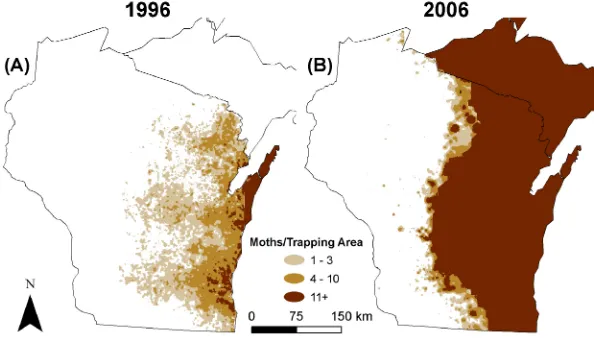
A more interesting combined model can be employed in the study of invasive species. The figure below shows data related to the spread of gypsy moths in Wisconsin over a ten-year period from 1996 to 2006 [7].
The darkest regions on the maps represent 11 or more moths per trapping area, which we will take as the statewide carrying capacity. We let x represent the distance from the Mis-sissippi River on the western edge of the state, with the total distance to Lake Michigan roughly 180 miles. We combine dispersion with logistic growth to obtain the PDE
(10)
¶∂u
¶∂t =d
¶∂2u ¶∂x2
+k uHA-uL; d,k,A>0.
This equation is solved numerically (think of applying Euler’s method to the entire profile curve), and the time evolution of the initial profile curve is plotted below.
Module@8U, f<,
f@t_, x_, AA_, kk_D:=
AA 30ê H30+HAA-30LExp@-AA kkHx-144LDL; solnFK@kk_, AA_, dd_D:=
NDSolve@
8D@U@t, xD, tDãk U@t, xD HA-U@t, xDL+d D@U@t, xD, x, xD H* Fisher–Kolmogorov PDE *L ê.8kØkk, AØAA, dØdd<, U@0, xDãf@0, x, AA, kkD, U@t, 0Dãf@t, 0, AA, kkD,
U@t, 180Dãf@t, 180, AA, kkD<, U,8x, 0, 180<,
8t, 1, 10<D;
UFisherKolmogorov=Uê. First@[email protected], 100, 8DD; Manipulate@Plot@UFisherKolmogorov@t, xD, 8x, 0, 180<,
PlotRangeØ80, 100<, AxesLabelØ8x, u<,
TicksØ88845, " "<, 890, " "<,8135, " "<, 8180, "180"<<,
8833, " "<, 866, " "<, 8100, "11"<<<D,
88t, 1, "time t"<, 1, 10<, ControlTypeØTrigger, SaveDefinitionsØTrueDD
time t
180 x 11
u
You can see that the model does not fit the data precisely: the “edges” of the gypsy moth population shown on the two maps are not as uniformly sharp as the model would predict. Biological systems are complicated, particularly because an element of randomness may come into play. Still, the concept of a model that includes dispersion and logistic growth, a variant of the Fisher–Kolmogorov equation, seems to capture most of the essential fea-tures of the gypsy moth data.
Finally, note that the total gypsy moth population is not constant, as it would be under a dispersion-only model. Here the growth term k uHA-uL on the right-hand side of the equa-tion overcomes dispersion, and as time moves forward, the populaequa-tion spreads across the whole state, while its size approaches the carrying capacity A at each location.
‡
Summary
‡
References
[1] J. Stewart, Calculus: Concepts and Contexts, 4th ed., Belmont, CA: Brooks/Cole, 2009.
[2] T. Malthus. An Essay on the Principle of Population, London: J. Johnson, 1798.
[3] P.-F. Verhulst, “Notice sur la loi que la population poursuit dans son accroissement,” Corre-spondance mathématique et physique, 10, 1838 pp. 113–121.
books.google.com/books?hl=fr&id=8GsEAAAAYAAJ&jtp=113# v=onepage&q&f=false.
[4] J. dʼAlembert, “Recherches sur la courbe que forme une corde tendue mise en vibration,” His-toire de lʼAcadémie royale des sciences et belles-lettres de Berlin, 3, 1747 pp. 214–219. www.math.jussieu.fr/~daubin/cours/Textes/Dalembert-HAB-1746-TFA.pdf.
[5] Ocean Institute. “Whales of the World.” (Sep 2, 2011) www.ocean-institute.org/visitor/gray_whale.html.
[6] J. Fourier, Théorie analytique de la chaleur, Paris: F. Didot, 1822.
[7] P. Tobin and L. Blackburn, “Long-Distance Dispersal of the Gypsy Moth (Lepidoptera: Ly-mantriidae) Facilitated Its Initial Invasion of Wisconsin,” Environmental Entomology, 37(1), 2008 pp. 87–93. Figure used with permission of the authors.
www.treesearch.fs.fed.us/pubs/14617.
[8] W. Strauss, Partial Differential Equations: An Introduction, 2nd ed., Hoboken, NJ: John Wiley & Sons, 2009.
[9] E. Holmes, M. Lewis, J. Banks, and R. Veit, “Partial Differential Equations in Ecology: Spatial Interactions and Population Dynamics,” Ecology, 75(1), 1994 pp. 17–29.
www.esajournals.org/doi/abs/10.2307/1939378.
M. Kerckhove, “From Population Dynamics to Partial Differential Equations,” The Mathematica Journal, 2012.
dx.doi.org/doi:10.3888/tmj.14-9.
About the Author
Michael Kerckhove is an associate professor of mathematics at the University of Rich-mond. This article grew out of a desire to introduce PDEs, particularly the diffusion equa-tion, in the context of cell signaling early in the second semester of our Integrated Quantita-tive Science course, iqscience.richmond.edu.
Michael Kerckhove
Department of Mathematics University of Richmond 28 Westhampton Way Richmond, VA 23173 [email protected]