Correlations of Biomechanical Characteristics with Ball Speed in Penalty Corner Push-In
Effects of Specific Training and Cross Training on the Development of Skill Performance
Variables of the Inter Collegiate Male Hockey Players
Poovaiah, N.K1 & Dr.M.Govindaraj2
1Research scholar, Department of Physical Education, Karpagam Academy of Higher Education, Karpagam University, Coimbatore, Tamilnadu, India. 2Faculty, Dept. Physical Education, Karpagam Academy of Higher Education, Karpagam University, Coimbatore, Tamilnadu, India.
Received 30th June 2017, Accepted 5th August 2017
Abstract
The purpose of the study was to find out the effects of specific training and cross training on the development of Dribble, Hitting and Pushing of the inter-collegiate male hockey players. Forty five inter collegiate hockey players were selected as subjects from Bengaluru region at random to achieve the purpose of the study. Their ages ranged from 18-21 years. (The selected variables of skill performance are also analyzed by using the appropriate statistical tools). The composed data on the criterion measures are treated by dribble and Hitting test and Dribble and Pushing test. The collected data are statistically analyzed by the ‘t’ ratio and one way analysis of variance test and the level of significance for the study is 0.05 level. The results reveal that there is a significant difference in the skill performances of the inter-collegiate male hockey players.
Keywords: Cross Training, Specific Training, Dribble, Hitting and Pushing.
© Copy Right, IJRRAS, 2017. All Rights Reserved.
Introduction
The sport of field hockey or just “hockey,” as it‟s known in most of the 112 countries it is played is widely considered one of the top six sports in the world. A game that started with a simple stick and ball has become one of the most popular sports in the world. Its popularity continues to grow on a global spectrum. Field hockey is a multiple high intensity activity sport with a multidirectional nature. The ability to change direction quickly while maintaining balance without loss of speed is therefore a significant physical component required for effective performance in field hockey. Hockey players need high level of technical skills such as being able to dribble without losing running speed. For a technically good player, dribbling is essentially an automatic process, and the better players distinguish themselves by their running speed while dribbling the ball (Reilly and Bretherton, 1986).
Objectives of the Study
1. To find out whether the cross training would significantly improve the skill performances of the inter-collegiate male Hockey players.
2. To find out whether the Specific training would significantly improve the skill performances of the inter-collegiate male Hockey players.
Methodology
The present study was to establish the effects of specific training and cross training on the skill development of the inter-collegiate male hockey players. To attain the purpose of the study 45 male hockey players were chosen and they were randomly allocated in to three equivalent groups. Experimental group 1 (N=15) carry out Cross Training (CTG), experimental group 2 (N=15) carry out Specific Training (STG) and finally control group (N=15) did not undergo any specific training (CG). The experimental groups participated in designated training schedule for the period of 12 weeks, five days in a week. The study variables including dribbling and Hitting and dribbling and Pushing were also analyzed. The data was analyzed by using „t‟ ratio to find out the mean difference from pre test to post test. Analysis of co variance and Scheffee‟s post hoc test were applied for the study.
International
Journal of Recent Research and Applied Studies
Poovaiah et al. 2017 ISSN: 2349 – 4891
Analysis of Data and Interpretation
Table 1
The mean losses / gains between pre and post test values of specific training on dribbling and hitting and dribbling and pushing of the inter collegiate male hockey players
Variables Test Mean Std.
Deviation S.E.M M.D „t‟ value
Dribbling and Hitting in Seconds
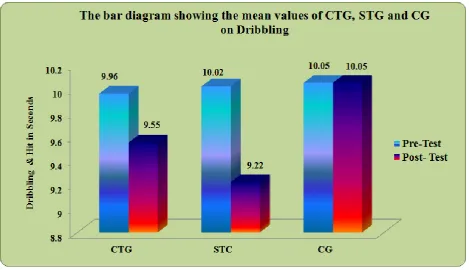
Pre-Test 9.96 0.35
0.06 0.41 6.70*
Post- Test 9.55 0.35
Dribbling and Pushingin Seconds
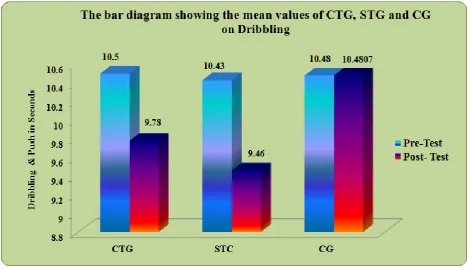
Pre-Test 10.50 0.66
0.09 0.71 7.38*
Post- Test 9.78 0.38
*Significance at 0.05 levels (2.09)
The table 1 shows the results of „t‟ value of Dribbling and Hitting (6.70) and Dribbling and Pushing(7.38). The obtained tabulated t value is 2.09which has statistically significant differences at the 95 % confidential level, D.F. (1,14). It is found that the
results is statistically significant at 0.05 level of confidence. It is observed that the mean gains and losses get from pre and post test show a significant improvement in Dribbling and Hitting (0.41 p< 0.05), Strength (0.71 p< 0.05).
Table 2
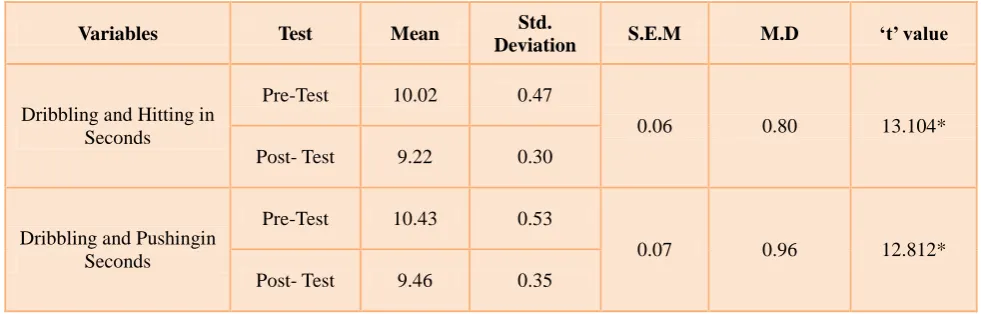
The mean losses / gains between pre and post test values of cross training on dribbling and hitting and dribbling and pushing of the inter collegiate male hockey players
Variables Test Mean Std.
Deviation S.E.M M.D ‘t’ value
Dribbling and Hitting in Seconds
Pre-Test 10.02 0.47
0.06 0.80 13.104*
Post- Test 9.22 0.30
Dribbling and Pushingin Seconds
Pre-Test 10.43 0.53
0.07 0.96 12.812*
Post- Test 9.46 0.35
*Significance at 0.05 levels (2.09)
The table 2shows the results of „t‟ value of Dribbling and Hitting (13.10) and Dribbling and Pushing (12.81). The obtained tabulated t value is 2.09which has the statistically significant differences at the 95 % confidential level, D.F. (1,14). It is found that the result
Table 3
The mean losses / gains between pre and post test values of control group on dribbling and hitting and dribbling and pushing of the inter collegiate male hockey players
Variables Test Mean Std.
Deviation S.E.M M.D ‘t’ value
Dribbling and Hitting in Seconds
Pre-Test 10.05 0.40
0.006 0.006 1.000
Post- Test 10.05 0.38
Dribbling and Pushingin Seconds
Pre-Test 10.48 0.38
0.006 0.006 1.000
Post- Test 10.48 0.38
*Significance at 0.05 levels (2.09)
The Table 3 shows the results of „t‟ value of Dribbling and Hitting (1.00) and Dribbling and Pushing(1.00). The obtained tabulated t value is 2.09which has the statistically significant differences at the 95 % confidential level, D.F. (1, 14). It is found that
Poovaiah et al. 2017 ISSN: 2349 – 4891
Table 4
Analysis of variance on pre - test means values among CTG, STG and CG on skill performance variables of the inter collegiate male hockey players
Variables Source of
Variance
Sum of
Squares DF
Mean
Square F Sig.
Dribbling and Hitting in Seconds
Between 0.061 2 0.03
0.179 0.837
Within 7.124 42 0.17
Dribbling and Pushingin Seconds
Between 0.031 2 0.016
0.054 0.948
Within 12.282 42 0.292
*Significance at 0.05 levels (3.16)
The table 4 views that the obtained „F‟ value for the CTG, STGand CGonDribbling and Hitting(0.179) and Dribbling and Pushing(0.054). The obtained tabulated f value is 3.16 which is statistically not
Table 5
Analysis of variance on post- test means values among CTG, STG and cg on skill performance of the inter collegiate male hockey players
Variables Source of
Variance
Sum of
Squares DF
Mean
Square F Sig.
Dribbling and Hitting in Seconds
Between 5.244 2 2.622
21.091 0.00
Within 5.222 42 0.124
Dribbling and Pushingin Seconds
Between 8.028 2 4.014
28.010 0.00
Within 6.019 42 0.143
*Significance at 0.05 levels (3.16)
The table 5 views that the obtained „F‟ value for the CTG, STG and CG on Dribbling and Hitting (21.09), and Dribbling and Pushing(28.01).The obtained tabulated f value is 3.16 which is statistically the
significant differences at the 95 % confidential level and the degrees of freedom (2, 42). It is found that the result statistically shows significant difference. So the treatment is successful.
Table 6
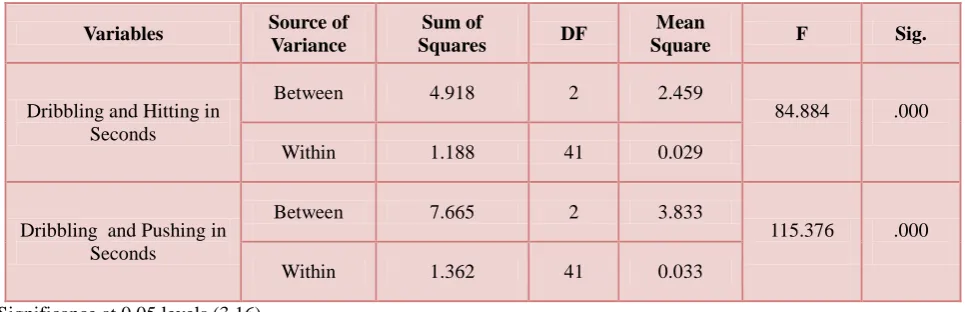
Analysis of covariance on adjusted post -test means values among CTG, STG and CG on skill performance of the inter collegiate male hockey players
Variables Source of
Variance
Sum of
Squares DF
Mean
Square F Sig.
Dribbling and Hitting in Seconds
Between 4.918 2 2.459
84.884 .000
Within 1.188 41 0.029
Dribbling and Pushing in Seconds
Between 7.665 2 3.833
115.376 .000
Within 1.362 41 0.033
*Significance at 0.05 levels (3.16)
The Table 6 views that the obtained „F‟ value for the CTG, STG and CG on skill performance Variables of Dribbling and Hitting (84.88), and Dribbling and Pushing(115.37).The obtained tabulated „f‟ value is
Poovaiah et al. 2017 ISSN: 2349 – 4891
Table 7
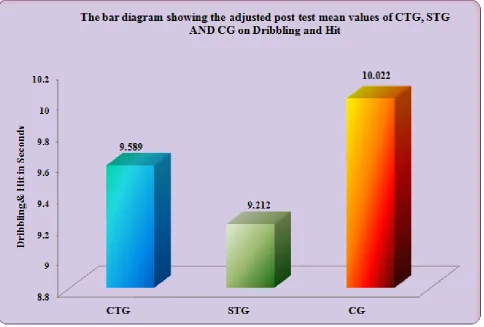
The scheffe’s post hoc test for the differences between adjusted post test means of CTG, STG and CG on dribbling and hitting
CTG STG CG Mean Differences Confidence
Interval Value
9.589 9.212 -
0.377
0.18
9.589 -
10.022
0.433
0.18
- 9.212
10.022
0.810
0.18
* Significant at 0.05 level of confidence
The Table 7 shows the adjusted post hoc test mean values of CTG group, STG group and CG. The mean difference required for the confidential interval is to be significant at0.18. To Compare the CTG group and STG group, the mean difference between the two groups is 0.377. Hence, STG group shows the better improvement on Dribbling and Hitting. To compare the CTG group and CG, the mean differences between the two groups
Table 8
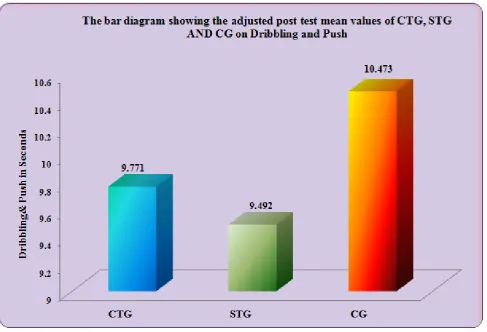
The scheffe’s post hoc test for the differences between adjusted post test means of CTG, STG and CG on dribbling and pushing
CTG STG CG Mean Differences Confidence
Interval Value
9.771 9.492 -
0.279
0.19
9.771 -
10.473
0.702
0.19
- 9.492
10.473
0.981
0.19
* Significant at 0.05 level of confidence
The Table 8 shows the adjusted post hoc test mean values of CTG group, STG group and CG. The mean difference required for the confidential interval is to be significant at 0.19. To Compare the CTG group and STG group, the mean difference between the two groups is 0.279. Hence, STG group shows better improvement on Dribbling and Pushing. To compare the CTG group and CG, the mean differences between the two groups
Poovaiah et al. 2017 ISSN: 2349 – 4891
Result of the Study
1. The present study showed the results that the Specific Training significantly improved Dribbling, Hitting and Pushing among the male inter-collegiate hockey players.
2. The present study showed the results that the Cross Training significantly improved Dribbling, Hitting and Pushing among the male inter-collegiate hockey players.
3. The present study showed the results that the Specific Training significantly improved Dribbling, Hitting and Pushing among the male
inter-collegiate hockey players.
4. The present study showed the results that the Cross Training significantly improved Dribbling, Hitting and Pushing among the male inter-collegiate hockey players.
Conclusion
1. It was established that the Specific Training significantly enhanced Dribbling, Hitting and Pushing among the male inter-collegiate hockey players.
2. It was established that the Cross Training significantly enhanced Dribbling, Hitting and Pushing among the male inter-collegiate hockey players.
3. It was established that the Cross Training significantly enhanced Dribbling, Hitting and Pushing better than the control group among the male inter-collegiate hockey players.
4. It was established that the Specific Training significantly enhanced Dribbling, Hitting and Pushing better than the Cross Training and control group among the male inter-collegiate hockey players.
Reference
1. S.Suthakar and Dr.A.Pushingparajan, Effects of Silambam and Karate with Yogic Training on Agility and Arm Explosive Power of Collegiate Male Students., International Journal of Innovative Research and Development|| ISSN 2278–0211. 2. R.Ashokkumar Dr.S.Suthakar, K.M.Ashokkumar,
2016. An Effective Approach through Strength, Endurance and Skill Training Program Combinations on Muscular Strength and Endurance and Explosive Power of Male Basketball Players., International Journal of Innovative Research and Development., 5,4,218-220.
3. R. Ashok Kumar K. Babu, S. Suthakar, 2016. Effects of Volleyball Specific Resistance Training and Skill Training Packages on the Development of Leg Explosive Power and Speed on the Higher Secondary Level School Boys,2016/3, international journal of innovative research and development, 5, 4,231-235.
4. Dr.S.Suthakar Venkatachalapathi G, 2016. Analysis of physical growth on specific fitness training
among tribal and non-tribal school boys, 2016/10/27, International Journal of Physical Education, Sports and Health3,6, 137-142.
5. Dr. S. Suthakar, NayakDarshanaHabbu, 2016. Effects of the Combination of Plyometric and Specific Training with Skill Training in the Development of Anaerobic Capacity, Leg Explosive Power and Over All Playing Ability of the Volleyball Players, 2016/8, International Journal of Recent Research and Applied Studies, 3, 8(19), 83-87.
6. Dr. S. Suthakar Muniraju M. G, 2016.Effects of the Short Term Resistance and Regular Resistance Training in the Development of Lower Body Strength, Leg Explosive Power and Shooting Ability on the Male Basketball Players, International Journal of Recent Research and Applied Studies, 3, 8,(12), 51-54.
7. Dr.S.Suthakar Muniraju, M. G, 2016.Effects of the Short Term Resistance and Regular Resistance Training in the Development of Muscular Strength Endurance, Upper Body Strength and Passing Ability of the Male Basketball Players, 2016/8, International Journal of Recent Research and Applied Studies, 3,8,(13),55-59.