Poa magellensis
(Poaceae), a new species from
Central Apennine (Italy)
Fabio Conti1, Luciano Di Martino2, Fabrizio Bartolucci1
1 Scuola di Bioscienze e Medicina Veterinaria, Università di Camerino – Centro Ricerche Floristiche dell’Ap-pennino, Parco Nazionale del Gran Sasso e Monti della Laga, San Colombo, 67021 Barisciano (L’Aquila), Italy 2 Ufficio Monitoraggio e Conservazione della Biodiversità vegetale, Parco Nazionale Majella, Via Badia 28, 67039 Sulmona (L’Aquila), Italy
Corresponding author: Fabrizio Bartolucci ([email protected])
Academic editor: M. Nobis | Received 8 January 2020 | Accepted 12 February 2020 | Published 3 April 2020
Citation: Conti F, Di Martino L, Bartolucci F (2020) Poa magellensis (Poaceae), a new species from Central Apennine (Italy). PhytoKeys 144: 113–124. https://doi.org/10.3897/phytokeys.144.49971
Abstract
A new species, Poa magellensissp. nov., is described and illustrated based on collections from the Ma-jella Mountains in Central Apennine, Italy. It is morphologically similar to P. ligulata Boiss., but can be distinguished by green leaves, the basal ones adaxially lightly scabrous or sparsely hairy, longer ligules particularly in the upper leaves, panicles denser with primary branches sub-erect to erect, glumes with broader scarious margin, more acute glumes and lemmas, lemmas and paleas longer, rachilla hairy, cal-luses usually with a crown of hairs or shortly webbed, caryopses longer. A distribution map of the species is also presented.
Keywords
Abruzzo, endemic, Italy, Majella National Park, new species, Poa, Poaceae
Introduction
The genus Poa L. (Poaceae, Pooideae, Poeae, Poinae), one of the largest genera of grasses, has a cosmopolitan distribution, principally in temperate regions of both hemispheres and in mountainous regions of the tropics (Soreng et al. 2017;
Peter-http://phytokeys.pensoft.net
Copyright Fabio Conti et al. This is an open access article distributed under the terms of the Creative Commons Attribution License (CC BY 4.0), which permits unrestricted use, distribution, and reproduction in any medium, provided the original author and source are credited.
Fabio Conti et al. / PhytoKeys 144: 113–124 (2020)
114
son and Soreng 2018). It is a monophyletic genus and comprises approximately 550 annual and perennial species (Soreng 1990; Gillespie et al. 2007, 2008; Soreng et al. 2017). Based on molecular phylogenetic studies, Poa has been divided into five subgenera: P. subg. Ochlopoa (Asch. & Graebn.) Hyl., P. subg. Poa, P. subg.
Pseu-dopoa (K.Koch) Stapf, P. subg. Stenopoa (Dumort.) Soreng & L.J.Gillespie and P.
subg. Sylvestres (V.L.Marsh ex Soreng) Soreng & L.J.Gillespie (Gillespie et al. 2007, 2008; Soreng et al. 2010; Giussani et al. 2016). As concerns Italy, the genus Poa is represented by 29 taxa (species and subspecies) (Bartolucci et al. 2018). Recently, two other species have been added to the flora of Italy: P. jubata A.Kern. (Brullo et al. 2019) and P. ligulata Boiss. (Conti et al. 2019). This latter taxon belonging to
P. subg. Ochlopoa sect. Alpinae (Hegetschw. ex Nyman) Stapf, occurs in Spain and NW Africa (Buschmann 1942; Ortega-Olivencia and Devesa 2018) and recorded in France (Greuter and Raus 2005) by mistake (Tison and de Foucault 2014). Its recent discovery in Central Apennine was considered as a confirmation for Italy; in fact, this species had already been collected by G. Rigo in Central Apennine on Majella Mountains “Iter in Aprutio anno 1905. Poa magellensis mihi, proxima P. ligulata Bss.
In pascuis alpinis di M. Amaro, calc. 2600 m, Jul. exeunte G. Rigo ” (BP). Buschmann
(1942) quoted the specimen preserved at BP and listed P. magellensis Rigo in sched.
(this name was never validly published) as a doubtful synonym of P. ligulata and re-garded the collecting site of the specimen doubtful. After this record the species was no longer reported for Italy until the discovery by Conti et al. (2019). The specimen traced in BP and others collected by us in Majella were provisionally attributed to
P. ligulata (Conti et al. 2019). Indeed, on the basis of a preliminary morphological
analysis, the population from Majella showed peculiar features that led us to compare it with those from Spain and Morocco referable to P. ligulata.
Materials and methods
Taxonomy
Poa magellensis F.Conti & Bartolucci, sp. nov. urn:lsid:ipni.org:names:77208269-1
Figs 1–3
Type. Italy. Abruzzo, Fara S. Martino (Chieti), Majella, M. Acquaviva (WGS84 42°06'11.1"N, 14°07'55.9"E), 2720 m, pendii rupestri, 30 Jul. 2019, F. Conti, L. Di
Martino & V. Di Cecco s.n. (holotype: APP 65502; isotype: APP 65501).
Diagnosis.Poa magellensis differs from P. ligulata by: basal leaves adaxially lightly scabrous or sparsely hairy vs glabrous, longer ligules particularly in the upper leaves (2.5)4–6.9(9) vs. (1.8)2–5(6) mm long, panicles denser with primary branches sub-erect to sub-erect, glumes with broader scarious margin 0.1–0.4(0.5) vs. 0–0.2 mm wide, more acute glumes and lemmas, longer lemmas (2.7)2.9–3.5(3.6) vs. (2.1)2.3–2.9(3) mm long, longer paleas (2.2)2.5–3.1(3.2) vs. 2–2.8(3) mm long, rachilla hairy vs gla-brous, calluses usually with a crown of hairs or shortly webbed vs glagla-brous, longer caryopses 1.7–2.2 vs. 1.4–1.7 mm long.
Description. Perennials; without horizontal or downward tending cataphyllous shoots, densely tufted, bicolour, green and white because of the brightness of large exerted ligules; tillers erect or ascending, intravaginal. Culms 20–150 mm tall, 0.25– 0.5 mm in diameter, erect to ascending slender, terete, smooth, weakly sulcate, nodes (1)2 exerted, thickened at the base with old leaf-sheaths. Leaves green, leaves-sheaths
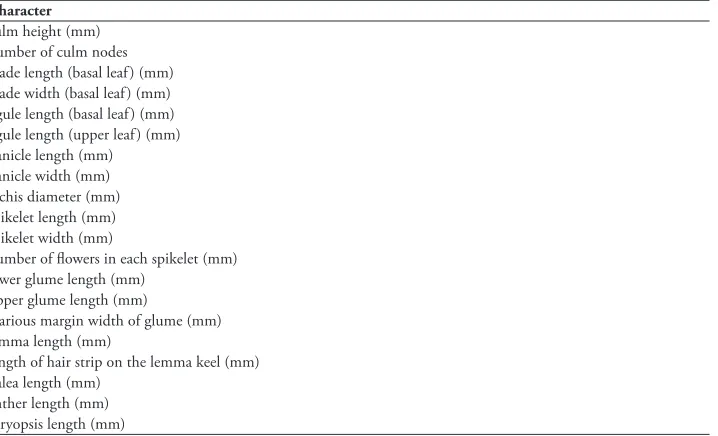
Table 1. Morphological quantitative characters studied.
Character
culm height (mm) number of culm nodes blade length (basal leaf) (mm) blade width (basal leaf) (mm) ligule length (basal leaf) (mm) ligule length (upper leaf) (mm) panicle length (mm) panicle width (mm) rachis diameter (mm) spikelet length (mm) spikelet width (mm)
number of flowers in each spikelet (mm) lower glume length (mm)
upper glume length (mm)
scarious margin width of glume (mm) lemma length (mm)
length of hair strip on the lemma keel (mm) palea length (mm)
Fabio Conti et al. / PhytoKeys 144: 113–124 (2020)
116
Figure 2. Poa magellensis F.Conti & Bartolucci, sp. nov. A habit B spikelet without glumes C palea
D glumes E ligules.
Fabio Conti et al. / PhytoKeys 144: 113–124 (2020)
118
(2.5)4–6.9(9) mm long. Panicles compact, narrowly ellipsoid, (11)11.6–22.4(23) mm long, 5–10(13) mm wide, dense, with 3–7 nodes, rachis with 1–2(–3) branches per node; primary branches sub-erect to erect, sulcate or few-angled, scabrous 0.1–0.3 mm in diameter, longest branches up to 5 mm, with 1–3 spikelets, pedicels 0.1–4 mm.
Spikelets 3.2–5(5.4) mm long, (1.3)1.4–3.2(3.5) wide, laterally compressed; bulbifery
absent, violaceous and green, not pruinose, florets 2–4(5); rachilla hairy to sparsely hairy. Glumes subequal (1–)3 veined, not reaching lemma apices, lanceolate, with scari-ous margin 0.1–0.4(0.5) mm, glabrscari-ous, distinctly keeled, keels moderately scabrscari-ous in the distal part, apices sharply-acute; lower glumes (2.1)2.2–3.3(3.4) mm long; upper glumes (2.4)2.5–3.6 mm long; calluses with a crown of hairs (0.1–0.3 mm) or shortly webbed; lemmas (2.7)2.9–3.5(3.6) mm long, 1–5 weakly veined, lanceolate, violaceous or sometimes green, with scarious margin broader in the distal part, distinctly keeled, keels short villous in proximal part (1–2 mm), scaberulous along distal keel and sparse-ly in the upper sides, apices acute; paleas (2.2)2.5–3.1(3.2) mm long, scabrous along the keels, between keels glabrous. Anthers 1–2 mm long. Caryopses 1.7–2.2 mm long.
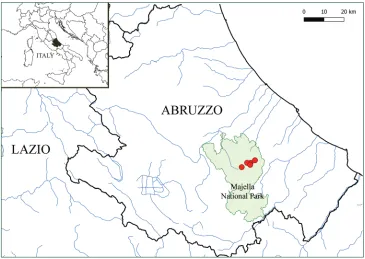
Distribution and habitat. Poa magellensis is endemic to Majella Mountains (Mt. Amaro, Mt. Focalone, Mt. Acquaviva, between Mt. Focalone and Mt. Acquaviva, Cima delle Murelle) in Central Apennine (Italy). It grows on limestone rocky slopes from 2200 up to 2730 m a.s.l. (Fig. 4).
Phenology. Flowering in July, fruiting July to August.
Chromosome number. A single population (Majella, Cima delle Murelle) of P.
magellensis is resulted diploid with 2n = 14 chromosomes (Astuti et al. 2019 under the
name P. ligulata).
Conservation status. The populations of P. magellenis are included in NATU-RA 2000 network within the Site of Community Interest “IT140203 Majella” in the Majella National Park. The extent of occurrence (EOO) is 6.86 km2 calculated with
minimum convex hull polygon in QGIS and area of occupancy (AOO) is 16 km2
cal-culated with a 2×2 km cell fixed grid. The species occurs in only one location (defini-tion according to IUCN 2019), but the popula(defini-tion is not declining, and there are no extreme fluctuations. According to IUCN criterion B (2019) we propose to include P.
magellensis in the following category: Near Threatened (NT).
Etymology. The specific epithet of the new species is derived from the type local-ity, Magella Mountains (currently Majella Mountains).
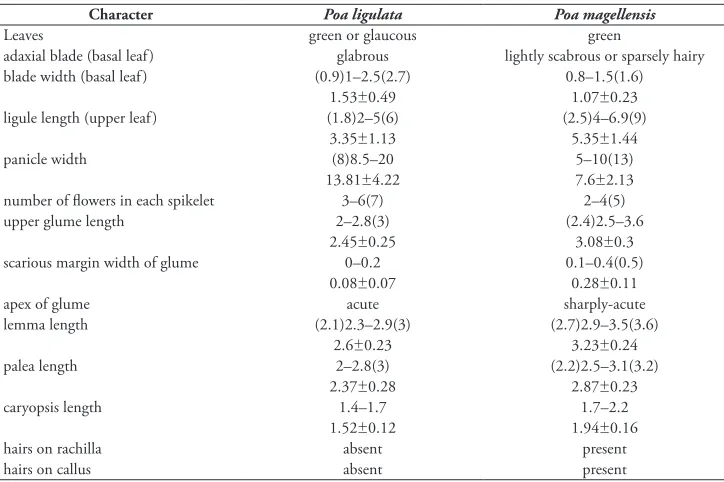
Taxonomic notes. The new species P. magellensis is similar to P. ligulata but can be distinguished by several characters as shown in Table 2.
Additional specimens examined. Poa magellensis F.Conti & Bartolucci (para-types): Italy. Abruzzo: in pascuis alpinis di M. Amaro, calc., m. 2600, Jul exeunte, G.
Rigo s.n. [Iter in Aprutio anno 1905] (BP); Majella, sotto l’anfiteatro delle Murelle e
il Fusco, verso il Blockhaus, Pennapiedimonte (Chieti), pendii rupestri, 2250–2500 m, 04 Aug. 1991, F. Conti s.n. (APP 12455); Majella, dal Blockhaus al Focalone, Caramanico Terme (Pescara), pendii rupestri, 2350 m, 30 Jul. 2009, F. Conti, L.
Gubellini & R. Soldati s.n. (APP 59356); salendo a Cima delle Murelle in loc. La
Carozza, Pennapiedimonte (Chieti), rupi e pendii rupestri, 2300 m, 02 Sep. 2011,
Pen-Fabio Conti et al. / PhytoKeys 144: 113–124 (2020)
120
Figure 4. Map showing distribution of Poa magellensis F.Conti & Bartolucci, sp. nov. in Central Apen-nine, Abruzzo (Italy).
napiedimonte (Chieti), pendii rupestri, 2250 m, 17 Jul. 2019, F. Conti & L. Di
Martino s.n. (APP 65242, 65243, 65244, 65245, 65246, 65247, 65248, 65249,
65250, 65251, 65252, 65254, 65253, 65255). Poa ligulata Boiss.: Morocco. c38 km from Chefchaouen, 14 km above Bab Taza on track to Djbel Talamssemtane (35°9'N, 5°12'W), forest of Abies maroccana and Cedrus atlantica, on limestone, 1765–1900 m, 26 Jun. 1992, Achhal et al. n. 64.2260 [Optima Iter Mediterraneum V] (APP 45892; SALA 144759); Tanger-Tétouan: Bab Taza, pr. Refugio del Jbel Lakraa, 35°8'11,7"N, 5°8'13,6"W, 1693–2000 m, substrato calizo dolomitico, 16 Jun. 2008, S. Andrés et al. n. AQ2695 (SALA 159115); Spain. Aznattin W. (Macizo de Magina pr. Jaén) 1710 m. riscas, 20 Jun. 1926, Cuatrecasas s.n. (BC-70613); Carceles in decliv. NW, rupestr. 1950 m. alt., 17 Jun. 1826, Cuatrecasas s.n. (BC-70612); Sierra Tejeda, Málaga, 10 Jun. 1919, Gros s.n. (BC-70615); Cadiz: Grazal-ema, 30 Jun. 1925, Font i Quer & Gros s.n. (BC-914825); Baetica: in graminosis l. Cerrecillos del Sabinal dicto, montis Sierra de Gador (Almeria), ad 2000 m alt., 27 May 1921, Gros n. 108 [Flora Iberica selecta Cent. II] (BC-86523,BC-61436, BC-86524); ibidem, Gros s.n. (BC-70614); Cerro de la Laguna, Sierra de Cazorla, 1550 m, (J) WG0295, in locis lapidosis cacuminalis, 25 May 1981, A.M. Hernández s.n. (BC-641787); Teruel: Palomar de Arroyos, port de Sant Just, entre Escucha i Palomar de Attoyos, UTM 30T 687830 4515699, 1486 m, 02 Jun. 2010, S. Pyke
XK 74, alt 1850 m, pastizal subnitrófilo de alta montaña, Festuco-Pojon ligulatae
Rivas Goday & Rivas Martínez, 01 Jun. 1985, M. Costa et al. n. 13853 (SALA 83393); La Rioja: Turruncún, Sierra de Préjano, Peña Isasa, 30T WM7068, 1450 m, en crestones y pequeñas repisas con suelo esquelético, caracterizando los céspedes xerofiticos del Festuco-Pojon ligulatae Rivas Goday & Rivas Martínez 1966, 29 Jun. 1988, Amich, Fdez. Diez & Sanchez Rodriguez n. 97 [Exsiccata Selecta Flora Ibericae] (SALA 83963, 45290); Villafeliz de Babia (León), 20 May 1983, J. Andrés & Fllamas s.n. (SALA 68424); Granada: Sierra Nevada, Puerto de la Ragua, suelos pedregosos, 17 Jul. 1971, Ladero & E. Valdés s.n. (SALA 64021); Valporqueto (Espagne, prov León, Cordillera Cantábrica), alt. 1250 m, pâturages pierreux dans la zone subalpine cantabrique, fissures et replats des rochers calcaires, communautés du Festuco-Pojon
ligulatae, 06 Jul. 1980, J.M. Losa Quintana n. 11026 (SALA 70101); Segovia:
Nav-ares de las Cuevas, Peñacuero, 08 Jun. 1985, Rico, T. Romero & Sánchez Rodriguez s.n. (SALA 49384); Pastizales pedregosos en el Cerro de San Cristobal, Grazalema (Cádiz), Jun. 1961, Borja s.n. (SALA 1747); Ciudad encantada (Cuenca), 13 May 1977, Fernández Diez, Rico, Amich & Sánchez s.n. (SALA 11599); Guadalajara: Saú-ca, 30T WL 4041, 1150 m, páramo calizo con Genista pumila, 22 Jun. 1987, L.
Villar & P. Montserrat s.n. (SALA 125139); Cádiz, Grazalema base del Cerro de San
Cristobal, 23 May 1966, E.F. Galiano s.n. (SALA 22260); Teruel: nacimiento del rio
Table 2. Comparison of the key features of Poa ligulata and P. magellensis. Quantitative continuous char-acters are expressed in mm and are reported as mean ± standard deviation and 10−90 percentiles (extreme values in brackets). For quantitative discrete cardinal characters, 10−90 percentiles are given (extreme values in brackets).
Character Poa ligulata Poa magellensis
Leaves green or glaucous green
adaxial blade (basal leaf) glabrous lightly scabrous or sparsely hairy blade width (basal leaf) (0.9)1–2.5(2.7) 0.8–1.5(1.6)
1.53±0.49 1.07±0.23 ligule length (upper leaf) (1.8)2–5(6) (2.5)4–6.9(9)
3.35±1.13 5.35±1.44
panicle width (8)8.5–20 5–10(13)
13.81±4.22 7.6±2.13 number of flowers in each spikelet 3–6(7) 2–4(5) upper glume length 2–2.8(3) (2.4)2.5–3.6
2.45±0.25 3.08±0.3 scarious margin width of glume 0–0.2 0.1–0.4(0.5)
0.08±0.07 0.28±0.11
apex of glume acute sharply-acute
lemma length (2.1)2.3–2.9(3) (2.7)2.9–3.5(3.6) 2.6±0.23 3.23±0.24 palea length 2–2.8(3) (2.2)2.5–3.1(3.2)
2.37±0.28 2.87±0.23
caryopsis length 1.4–1.7 1.7–2.2
1.52±0.12 1.94±0.16
hairs on rachilla absent present
Fabio Conti et al. / PhytoKeys 144: 113–124 (2020)
122
Tajo, 15 Jun. 1982, Rico & Sánchez s.n. (SALA 32128); León: Ponferrada, Peñalba de Santiago, en calizas, 25 Jun. 1984, S. Castroviejo, J.L. Fernández Alonso, Gonzalo
& Valdes s.n. (SALA 103309); Prado Martín, Penyagolosa prov. Castellón, 1550 m,
Poo-Festucetum hystricis, 20 Jun. 1980, I. Soriano s.n. (SALA 71015); Granada: Sierra
Nevada, Barranco de San Juan, en suelos pedregosos, 3200 m, 10 Jul. 1980, M.
La-dero, López-Guadalupe & Molero (SALA 61347); Castellon: El Toro (L’Alt Palància),
la Halmarja, 30S XK82, 1500 m, patizales ralos de Minuartio-Pojon, 18 May 1984,
A. Aguilella n. 15828 (SALA 90109); Segovia: villar de Sobrepeña, Cerro del
Val-demuela, 15 May 1983, T. Romero s.n. (SALA 40608); Segovia; Sepúlveda, 01 Jun. 1986, X. Giraldez & T. Romero s.n. (SALA 41703); Segovia: Prádena, Peña Corva, 02 Jun. 1984, T. Romero s.n. (SALA 40607); Burgos: Hontorio de la Cantera, 30T VM 4769, 950 m, frecuente, encinar, calizas de cantera subterraneas, 16 May 2004,
J.L.B. Alonso s.n. (SALA 124549); Cadiz: Sierra de Grazalema, 12 Jun. 1976, A.M.
Hernandez s.n. (SALA 31879).
Key to identification of species of Poa sect. Alpinae in Europe (from Ed-mondson 1980 modified)
1 Lemma hairy between veins ...2
– Lemma glabrous between veins ...4
2 Culm below the panicle 0.7–1 mm in diameter; leaves 4–10 cm long; lower cauline and basal leaves with a short, ± truncate ligule; panicle ± pyramidal ...P. alpina – Culm below the panicle 0.2–0.5 mm in diameter; leaves (1.5)2.5–6 cm long;
cauline and basal leaves with an elongate, acute ligule; panicle ± ovoid ...3
3 Leaves 2–4.5 mm wide, flat to weakly folded ...P. badensis – Leaves 1.5–2.5 mm wide, canaliculate to strongly folded ...P. molinerii 4 Stem (15)20–30(40) cm; panicle 3.5–5 cm, ellipsoid-oblong ...P. media – Stem 3.5–20(30) cm; panicle 1–5 cm, ellipsoid, ovoid to pyramidal ...5
5 Ligule of the basal leaves 1–2 mm, hyaline ...6
– Ligule of the basal leaves 2.5–12 mm, milky white ...7
6 Lemma callus glabrous ...P. thessala – Lemma callus woolly ...P. pumila 7 Leaves green, adaxially lightly scabrous or sparsely hairy, ligule of the upper
Acknowledgements
We wish to thank our friends Valter Di Cecco, Aurelio Manzi, Leonardo Gubellini and Rossano Soldati for accompanying us on field activities, Ana Ortega-Olivencia (Badajoz) for sending us the preview of the description of Poa ligulata from her treatment of Poa
for Flora Iberica. Many thanks are also due to Directors and Curators of APP, BC, SALA and to Zoltán Barina (Budapest) for sending a digital image of the herbarium specimen kept in BP. This work was funded by the National Park of Majella and supported by the “Progetto di Ricerca di Rilevante Interesse Nazionale” (PRIN) “PLAN.T.S. 2.0 – to-wards a renaissance of PLANt Taxonomy and Systematics” led by the University of Pisa, under the grant number 2017JW4HZK (Principal Investigator: Lorenzo Peruzzi).
References
Astuti G, Bartolucci F, Bernardo L, Conti F, Peruzzi L (2019) Chromosome numbers for the Ital-ian flora: 8. ItalItal-ian Botanist 8: 117–121. https://doi.org/10.3897/italianbotanist.8.49156
Bartolucci F, Peruzzi L, Galasso G, Albano A, Alessandrini A, Ardenghi NMG, Astuti G, Bac-chetta G, Ballelli S, Banfi E, Barberis G, Bernardo L, Bouvet D, Bovio M, Cecchi L, Di Pi-etro R, Domina G, Fascetti S, Fenu G, Festi F, Foggi B, Gallo L, Gottschlich G, Gubellini L, Iamonico D, Iberite M, Jiménez-Mejías P, Lattanzi E, Marchetti D, Martinetto E, Ma-sin RR, Medagli P, Passalacqua NG, Peccenini S, Pennesi R, Pierini B, Poldini L, Prosser F, Raimondo FM, Roma-Marzio F, Rosati L, Santangelo A, Scoppola A, Scortegagna S, Selvaggi A, Selvi F, Soldano A, Stinca A, Wagensommer RP, Wilhalm T, Conti F (2018) An updated checklist of the vascular flora native to Italy. Plant Biosystems 152(2): 179–303.
https://doi.org/10.1080/11263504.2017.1419996
Brullo S, Brullo C, Cambria S, Giusso del Galdo G, Minissale P, Salmeri C, Beccarisi L, Veronico G, Tomaselli V (2019) Poa jubata (Poaceae), a rare Balkan species, first record for the Italian flora. Acta Botanica Croatica 78(2): 147–154. https://doi.org/10.2478/botcro-2019-0020
Buschmann A (1942) Zur Klärung des Formenkreises um Poa badensis Haenke. Österreichis-che. Botanicheskii Zhurnal 91: 81–130. https://doi.org/10.1007/BF01255305
Conti F, Ciaschetti G, Di Martino L, Bartolucci F (2019) An annotated checklist of the vas-cular flora of Majella National Park (Central Italy). Phytotaxa 412(1): 1–90. https://doi. org/10.11646/phytotaxa.412.1.1
Edmondson JR (1980) Poa L. In: Tutin TG, Heywood VH, Burges NA, Moore DM, Valen-tine DH, Walters SM (Eds) Flora Europaea (Vol. 5). Cambridge University Press, Cam-bridge, 159–167.
Gillespie LJ, Archambault A, Soreng RJ (2007) Phylogeny of Poa (Poaceae) based on trnT-trnF
sequence data: Major clades and basal relationships. Aliso 23(1): 420–434. https://doi. org/10.5642/aliso.20072301.33
Fabio Conti et al. / PhytoKeys 144: 113–124 (2020)
124
Giussani LM, Gillespie LJ, Scataglini MA, Negritto MA, Anton AM, Soreng RJ (2016) Breed-ing system diversification and evolution in American Poa supersect. Homalopoa (Poaceae: Poeae: Poinae). Annals of Botany 118(2): 281–303. https://doi.org/10.1093/aob/mcw108
Greuter W, Raus T [Eds.] (2005) Med-Checklist Notulae, 23. Willdenowia 35(1): 55–64. htt-ps://doi.org/10.3372/wi.35.35103
IUCN (2019) Guidelines for Using the IUCN Red List Categories and Criteria. Version 14. Prepared by the Standards and Petitions Subcommittee, Cambridge. https://www.iucn-redlist.org/resources/redlistguidelines [accessed 11 February 2020]
Ortega-Olivencia A, Devesa JA (2018) Updated checklist of Poa in the Iberian Peninsula and Balearic Islands. PhytoKeys 103: 27–60. https://doi.org/10.3897/phytokeys.103.26029
Peterson PM, Soreng RJ (2018) Poa laegaardiana, a new species from Ecuador (Poaceae, Pooideae, Poeae, Poinae). PhytoKeys 100: 141–147. https://doi.org/10.3897/phytok-eys.100.25387
Soreng R (1990) Chloroplast-DNA phylogenetics and biogeography in a reticulating group: Study in Poa. American Journal of Botany 77(11): 1383–1400. https://doi. org/10.1002/j.1537-2197.1990.tb12549.x
Soreng RJ, Bull RD, Gillespie LJ (2010) Phylogeny and reticulation in Poa based on plastid
trnTLF and nrITS sequences with attention to diploids. In: Seberg O, Petersen G, Barfod AS, Davis JI (Eds) Diversity, Phylogeny, and Evolution in the Monocotyledons. Aarhus University Press, Aarhus, 619–644.
Soreng RJ, Peterson PM, Romaschenko K, Davidse G, Teisher JK, Clark LG, Barberá P, Gillespie LJ, Zuloaga FO (2017) A worldwide phylogenetic classification of the Poaceae (Gramineae) II: An update and a comparison of two 2015 classifications. Journal of Sys-tematics and Evolution 55(4): 259–290. https://doi.org/10.1111/jse.12262
Thiers B (2019) Index Herbariorum: A global directory of public herbaria and associated staff. New York Botanical Garden’s Virtual Herbarium. http://sweetgum.nybg.org/science/ih/
[accessed 29 November 2019]