Simulating the Impact of Shared, Autonomous
Vehicles on Urban Mobility - A Case Study of Milan
Sabina Alazzawi, Mathias Hummel, Pascal Kordt,
Thorsten Sickenberger, Christian Wieseotte, Oliver Wohak
d-fine, An der Hauptwache 7, 60313 Frankfurt, Germany [email protected]
Abstract
Recent technological advances in vehicle automation and connectivity have furthered the development of a wide range of innovative mobility concepts such as autonomous driving, on-demand services and electric mobility. Our study aimed at investigating the interplay of these concepts to efficiently reduce vehicle counts in urban environments, thereby reducing congestion levels and creating new public spaces to promote the quality of live in urban cities. For analysis, we implemented the aforementioned factors by introducing the concept of robo-taxis as an autonomous and shared mobility service. Using SUMO as the simulation framework, custom functionalities such as ride sharing, autonomous driving and advanced data processing were implemented as python methods via, and around, the TraCI interface. A passenger origin-destination matrix for our region of interest in Milan was derived from publically available mobile phone usage data and used for route input. Key evaluation parameters were the density-flow relationship, particulate-matter emissions, and person waiting-times. Based on these parameters, the critical transition rate from private cars to robo-taxis to reach a free-flow state was calculated. Our simulations show, that a transition rate of about 50% is required to achieve a significant reduction of traffic congestion levels in peak hours as indicated by mean travel times and vehicle flux. Assuming peak-shaving, e.g. through dynamic pricing promised by digitalization, of about 10%, the threshold transition rate drops to 30%. Based on these findings, we propose that introducing a robo-taxi fleet of 9500 vehicles, centered around mid-size 6 seaters, can solve traffic congestion and emission problems in Milan.
1
Introduction
On-demand mobility services, autonomous driving, dynamic pricing algorithms and vehicle electrification will change the way people experience mobility in urban environments. Smart cities based on data-driven and algorithm-based technologies will become a global trend over the next
Volume 2, 2018, Pages 94–110
decade. Thereby, the development of sustainable future mobility services is one of the major topics that will impact urban living.
Metropolitan areas experience a sustained growth and are estimated to be home for 60% of the world’s population by 2030 (United Nations, Department of Economic and Social Affiars, Population Division, 2014). Megacities with more than 10 million inhabitants arise and mobility is already breaking down in many large cities, leading to congested streets, high emissions, traffic accidents, overstrained public transport and the lack of parking space for residents. In recent years, innovations in technology and digitalization have had a great impact on designing sustainable mobility concepts to counteract this trend. Urban developers count on the integration of on-demand mobility services, autonomous driving vehicle electrification, and dynamic pricing systems into urban mobility.
Autonomous vehicles are expected to reduce traffic accidents and facilitate everyday life for persons with reduced mobility such as elderly or handicapped people. In combination with car-to-car and car-to-infrastructure communication, higher traffic efficiency, lower pollution and lower costs can be achieved. The list of benefits is clearly not exhausted by these examples. But why is it taking so long to finally make use of the benefits self-driving cars offer? The answer is simple: A cultural change is necessary in order to accept the changes of new mobility concepts in a digitalized city by both, the people living in urban areas as well as the responsible public authorities. From an implementation perspective, the necessary infrastructure requires charging stations, car-to-infrastructure communication and, as long as there is a mixture of self-driving and conventional vehicles on the roads, appropriate arrangements to ensure seamless integration.
On-demand mobility services have grown in recent years, particularly important is one-way car- and bike-sharing that gives users more flexibility in cities. Among younger generations the importance of owning a car decreases and there is openness towards car-sharing and even peer-to-peer car sharing concepts (Ballus-Armet, Shaheen, Conts, & Weinzimmer, 2014). Today, the average occupation of a private car is 1.3 persons, leading to many more vehicles on the road than actually necessary (Ferguson, 1997). In addition, an average private car today is used only a few hours a day and parked the rest of the day. Economically, this results in a disproportionate amount of space required for parking in cities. One of the most promising ideas to counteract this problem is the combination of on-demand services with autonomous vehicles, which we call “robo-taxis”. If the robo-taxis themselves and the service behind are well designed, shared and autonomous robo-taxis can become more convenient than private cars, paving the way for a significant reduction of vehicles on the road.
We performed a study that included the analysis of traffic count data, mobile phone data to analyze mobility demand, and also congestion data. This data was combined with extensive simulations of conventional (classical) cars and self-driving robo-taxis, taking Milan as an exemplary city.
Our results can be summarized in four main conclusions:
1. Free traffic flow achievable with 30% shared robo-taxis and 10% peak-shaving: A 30% rate of users switching from cars to robo-taxis in combination with a decrease in peak demand by 10% can resolve city-wide congestion.
2. Peak demand reduction achievable through smart incentives: Smart incentive strategies that reach consumers are the key in order to shift mobility demand from peak-times to off-peak times. This will balance the mobility demand throughout the day.
3. 6 seater vehicle as core component of robo-taxi fleet: To serve the dynamic, urban travel routes, medium size 6 seaters should be used as the core component. Smaller capsules (individual) and larger robo-busses (long distance) will complement the fleet.
In summary, on-demand mobility services, autonomous driving and vehicle electrification are expected to have a huge impact on urban mobility. Already today, robo-taxis and on-demand ride pooling concepts are being designed and developed by a few innovative start-ups, e.g. Navya SAS or Easymile SAS, as well as by the established automobile companies themselves. Complementing these game-changing concepts with suitable incentives and the necessary infrastructure, we believe it is possible to achieve significant changes, which manifest themselves achieving quality goals of free traffic flow, reduced parking space, reallocation of public space and the reduction of emissions.
The structure of the paper is as follows: First, we highlight the current traffic situation in Milan and how the city is trying to counteract congestion and emissions. In a next step, we formulate our vision on the key game changers, which we believe will enable innovative mobility concepts such as the robo-taxi. Before then quantifying the impact of a robo-taxi introduction in Milan in more detail, we present our data and simulation framework that is used for the analysis. Based on our simulations we propose robo-taxi related quick wins and next implementation steps that should be pursued by the city in order to reach emission standards, remove congestions and make the city more livable overall. Last but not least, we look ahead and propose future research steps.
2
The Case of Milan
Milan is the second-most populated Italian city, with 1.35 million inhabitants (about 7,400 habitants per km²) and about 3.2 million in its metropolitan area (about 2,000 inhabitants per km²) (Istituto Nazionale di Statistica, 2016). Every day 850,000 people enter Milan and 270,000 exit the city – resulting in a total of 5.3 million trips per day. Although most people use public transport to get around Milan (57% of all trips in Milan are taken by public transport, 30% by cars, 7% by motorbike and 6% by bicycle), the city still has one of the highest European rates of car ownership (50.5 cars every 100 inhabitants) compared to London (31), Berlin (29) or Paris (25), and also one of the highest concentrations of particulate matter among large European cities (AMAT, 2017).
It is for these critical reasons that Milan has just adopted the Sustainable Urban Mobility Plan (SUMP) for a more efficient mobility based on sustainability, inclusion and innovation. By combining urban development, innovation and sustainability, and putting the policy focus on environment and life quality, the city of Milan is committed to make the city more livable, safe and accessible, ensuring social equity and sustainable mobility. The initiative aims at reshaping Milan’s overall mobility infrastructure over the next 10 years, redefining the boundaries of the metropolitan city and serving large suburban areas. The plan is based on the goal of true balance between mobility demand, quality of life, environmental and health protection.
Measures like road pricing, enhancing public transport, and boosting shared mobility are the key actions of the city’s strategy to improve livableness and wellbeing of citizens and city users. The congestion charge (Area C) implemented in Milan has already proven to effectively reduce the traffic in the city center by 30%.
Additionally, as stated in the plan, pushing shared mobility was recognized as a crucial driver that contributes to the reduction of private car traffic in the city. For that reason, citizens and city users have seen an increasing number of alternatives to private cars in a very short time: nearly 3,000 shared cars (27% fully electric) with more than 600,000 subscribers, 4,650 bikes (among which 1,000 e-bikes), including both a traditional station-based bike sharing system with almost 60,000 yearly subscribers and also 12,000 free-floating shared bikes since October 2017, and 100 fully electric shared scooters are currently circulating in Milan (AMAT, 2017).
ambitious goal set by the city of Milan, which is a better integration of all available mobility systems. The SUMP dedicates a whole paragraph on fares integration through innovative solutions that are next to be implemented by the city of Milan. This will also be done in form of the so called “Mobility As A Service” (MaaS) solution, where every mode of transport (public transport, bike, taxi, demand-responsive transport including autonomous vehicles and shared mobility services) is available in only one mobile app. The MAAS is the new frontier through which the city of Milan is laying the foundation to offer new, smart and affordable mobility services to its citizens and city users.
3
Vision on the Key Game Changers
Within the wide range of evolving new technologies, four key factors have been identified that play the role of fundamental game changers for urban mobility: On-demand mobility services, autonomous driving, electric mobility and dynamic pricing.
1. On-demand mobility services such as car-sharing, bike-sharing, taxi-sharing or mobile apps for public transport have become increasingly more popular over the last years. Their main advantage is the reliable availability of a service without the need for a long-term investment and their spread has already led to lower car ownership within younger generations. On-demand mobility services are attacking the necessity of a privately owned car, effectively reducing the number of cars in a city.
2. A second important factor is the development and substantial progress towards autonomous driving. This innovative technology based on artificial intelligence and fleet learning will not only assist the driver but also enable new driverless mobility systems, resulting in a new mobility experience, improved traffic efficiency, and reduced traffic-related accidents. 3. The significant progress in the development of battery capacity as well as the expected
availability of charging infrastructure will enable electric mobility to be a future choice of power. Electric mobility will have a significant improvement on local CO2 and particle matter emissions as well as noise emissions.
4. The possibility of dynamic pricing becomes more practicable, i.e., adjustments of prices for the use of mobility services based on the current traffic density. These dynamic pricing concepts are already used in public transport with off-peak prices, but will become even more relevant for new on-demand mobility services in order to flatten out peak demands – also known as “peak-shaving”.
4
Data Sources and Simulation Model
Using the open-source simulation software SUMO (Krajzewicz, Erdmann, Bieker, & Behrisch, 2012) we built a generic simulation tool that can be used to run simulations on any city network given the necessary map and travel-route data. Here we explain the data sources, input and simulation approach. In addition to the standard SUMO functionality, we implemented and included a custom robo-taxi TraCI module.
The goal in our approach is to use real-world input data for Milan, including the street network, the time-dependent origin–destination (OD) matrix and traffic volumes to calibrate our simulations. Simulation results should be benchmarked against measured travel times (or velocities). These requirements are met by combining four different data sources.
4.1
Combined Data Sources
Street maps of the city of Milan form the basis of close-to-reality simulations. We use OpenStreetMap for this purpose (Open Street Map Foundation, 2017). After generating the map in the web editor then they can be exported into an OSM file, which can subsequently be imported into SUMO using the NETCONVERT tool (NETCONVERT, 2017) provided as part of the package. The maps contain information such as the number of lanes in a street, speed restrictions and the traffic direction. They do not contain information on traffic lights. Traffic light coupling is optimized within the SUMO simulation.
Mobile phone usage data is our main source for predicting mobility demand in form of a time-dependent OD matrix. We use data that was published as part of the Telecom Italia Big Data Challenge 2014 (Telecom Italia, 2014) and that comprises usage data for two months (November and December 2013). A thorough statistical analysis of the data has been provided by (Manfredini, Pucci, Secchi, & Vitelli, 2015) and can serve as an overview. In intervals of ten minutes the activity of mobile phone usage is recorded in terms of incoming/outgoing calls and SMS and in terms of internet usage. The latter records 1 unit for every new connection, every closed connection, every 5 MB and every 15 minutes, whichever occurs first. Spatially, Milan is split into 100 × 100 grid areas, each of the size of 235 m × 235 m.
For our approach we assume a correlation between internet usage and the number of people in a certain area. We thus obtain maps showing the relative movement of people with time. As an example, at 5 am in the morning of a work day there are still many people in the surroundings of the city (i.e., at home), while at 10 am there is a high concentration at the outer city ring, where many office buildings are located. The resulting density maps can be used as the boundary conditions for our simulation, providing the initial and the final distribution of people and thus the demand for mobility. Note that this data only provides relative densities, not the total number of people. For a calibration to the total numbers we combine the relative densities with traffic count data.
The Agenzia Mobilità Ambiente e Territorio (AMAT) recorded traffic count data (AMAT detector data, 2017) using video and manual analysis during the years 2014 and 2015. At each counting station the number of vehicles passing in each direction within a certain time span is recorded. Similar counts can be done within SUMO simulations, allowing to go from the relative movements (mobile phone usage data) to realistic numbers of vehicles. The last data set we use is travel time data. It does not enter our simulations as an input but is used to evaluate the classical simulations (i.e., the ones not using autonomous driving and robo-taxis) against real-world data. Travel time data is obtained using the Google Maps Distance Matrix API (Google Maps API, 2017), which allows to access real-time traffic data. We defined an 8.3 km test route along Viale Fulvio Testi, which leads from the North into the city center. Between October 12th and October 24th 2017 we recorded several partial coverages of inbound and outbound real-time travel data, each with a five minutes interval. Figure 1 shows the inbound travel duration on Viale Fulvio Testi along an 8.3 km route. Values have been recorded in 5 minute intervals for several days, iteratively extracting them from the Google Maps Distance Matrix API. A substantial peak is observed for the morning rush hour as the values range from about 12 minutes at night to more than 28 minutes at the peak time. This translates to average velocities from about 18 km/h up to 42 km/h. We thus observe a reduction in speed of a factor of about 2.3. For completeness, Figure 2 shows a similar behavior for the outbound rush-hour in the afternoon between 5pm and 7pm.
4.2
SUMO Simulation Toolbox
To establish an efficient simulation environment, we configured a customized toolbox to dynamically run and analyze simulations. For our simulations, the open-source software package for the Simulation of Urban Mobility (SUMO) served as a framework to provide a basic vehicle interaction model and real-time simulation interface. For the purpose of this study, custom functionalities such as ride sharing, autonomous driving and advanced data processing had to be developed and implemented via Powershell and Python. Our self-developed toolbox allows fast access to different tools within the SUMO environment, as well as to the underlying map and route data.
The toolbox was setup via Powershell and can be described through different processing steps. First, we call the NETCONVERT tool to load an underlying (map) network, i.e. from the open source maps files. In a second step, we use the processed mobile phone data to create distribution files for different time periods, which are then used to create trips via the integrated ‘randomTrips’ tool (SUMO tool randomTrips.py, 2017). To model the trips, two different kinds of distributions are necessary. The distribution of starting points is depicted in a sources file, while corresponding distribution of end points is contained in a sinks file. Comparing this to the morning rush hour in Milan, higher source densities will be in the suburbs of the city, while higher sink densities will be in the center of the city. This effectively will create a surplus of routes leading into the city, compared to out of the city. As they are time dependent, the set of distribution files is created for well-defined time periods. Accordingly, in the afternoon more sources will be at the center of the city, while the sinks are then in the suburbs. As an additional feature, the resulting trips can be generated for classical cars, as well as for passengers of robo-taxis. The former create vehicles in the simulation, while the latter create person objects.
After creating and also validating the trips, all created trips are merged and, together with the underlying map, formulated into a SUMO configuration file. In our simulation we also use standard detectors that are integrated via additional files. These are used to track global parameters, but also road specific details such as occupancy or average velocity. The additional files are also referenced by the configuration file. The final simulation is then performed by the Traffic Control Interface (TraCI) (DLR, 2017). TraCI allows for full access while running the traffic simulation, and is used to implement the robo-taxi functionality, as well as provide additional output such as person waiting times, in a well processesable format.
4.3
Robo-Taxi Simulation Model
Based on the previously mentioned quality goals of the city of Milan, a joint model for robo-taxis and private traffic was developed. By accessing the simulations at each simulation step via the TraCI interface, each vehicle and person could be distinctly steered. A distribution value used in the simulation classified the ratio of robo-taxis in the simulation. Hence, it was possible to run simulations on the spectrum from fully classical to an only robo-taxi simulation, including mixtures in between. Differences between the two travel modes were implemented by assuming an average of 1.3 passengers in a private car, whereas robo-taxis had a predefined maximum capacity for passengers, i.e. 6 seats. In addition, robo-taxis never left the simulation, allowed to continue driving without any passengers on board and adapt to the current traffic situation more frequently. A matching algorithm derived from the stable marriage algorithm for unequal sets (McVitie & Wilson, 1970) was implemented to pair passengers to a robo-taxi nearby and with an already similar route. Based on our algorithms and implementations, the robo-taxi adapts its route to pick-up or drop-off additional passengers. Unoccupied robo-taxis are designed to reroute to areas of high mobility demand, whereas occupied robo-taxis drive the passengers to their destination and pick up new passengers.
The implementation of the robo-taxi algorithm is based on a state-chart framework (Figure 3) describing the different status of persons and vehicles. Persons with a mobility demand, once created in the simulation, start of being unassigned. As soon as a robo-taxi has been matched through the algorithm, the status of the person changes to assigned, and afterwards to driving once the robo-taxi actually arrives. Persons that have reached their destination, and have no further mobility demand are removed from the system. In analogy, the state chart also considers transitions for the robo-taxis. Starting of unassigned, the status changes to assigned as soon as the first passenger is matched. If the robo-taxi is already driving a passenger, the status is set to occupied. As robo-taxis do not leave the simulation, the status can alter continuously.
simulations for different robo-taxi capacities and with different mobility demands, thus analyzing the sensitivity to changes in input setting for both robo-taxis and classic vehicle settings. In general, we split the simulation into two parts. First, we used an initialization phase as a warm up for the system, introducing a certain number of vehicles and/or persons into the simulation. In a second step, we started the deployment of the actual vehicles and person trips. For the latter stages, we implemented csv-exports, both from the standard SUMO xml-outputs, as well as from our customized output parameters.
In our simulations, the fundamental mechanism to reduce the number of vehicles, and thereby traffic, was an efficient utilization of the available transport capacity. This is strongly correlated to the effectivity of the matching algorithm. The stable marriage algorithm is sophisticated enough to serve the purpose of a proof-of-concept model, but leaves room for improvement. In the following our results are discussed in more detail.
5
Simulation Results for Milan
Shared robo-taxis can be the solution to traffic congestion in Milan. By combining smart pricing strategies to achieve peak-shaving of 10%, a 33% acceptance rate among current car users and 9,500 robo-taxis as an on-demand mobility service, the number of vehicles can be reduced by at least 30%, eliminating congestions. In this context smart pricing implies dynamic pricing strategies, made possible through data digitization, depending on, and matching the mobility supply and demand. Through such pricing, incentives can be provided to the people to induce the peak shaving mobility demand shifts. Powered electrically, the introduction of the robo-taxi fleet, centered on comfortable six-seaters, could also lower PM emissions to a level of 40% below the threshold, even at peak times. Using the traffic data for Milan, our simulations focus on the commuting traffic into downtown along Viale Fulvio Testi, coming in from Parco Nord Milano and the Sesto San Giovanni area in the north.
Currently over 2,500 vehicles commute into the city via Viale Fulvio Testi between 8 and 9 a.m. during a regular week day (AMAT detector data, 2017). These masses are too much for the road
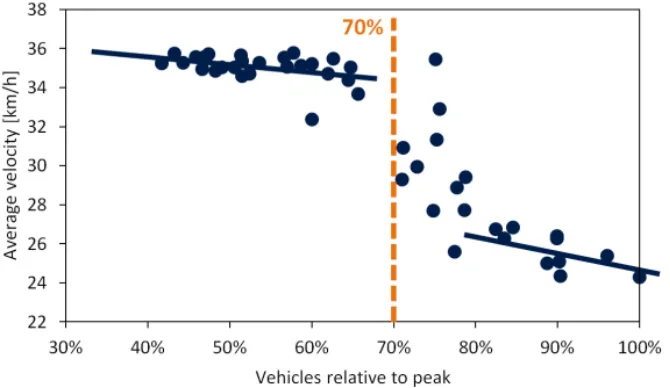
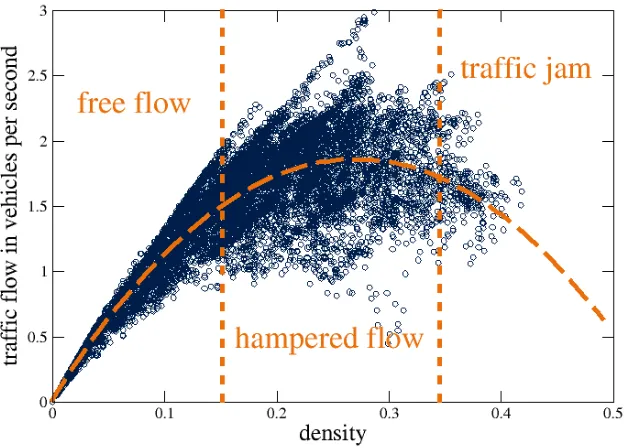
infrastructure, causing congestion and delays. The average travel time at the peak hour is more than doubled compared to free traffic flow at off-peak times (Figures 1 and 2). Considering that the existing infrastructure cannot easily be changed, the primary adjustment factor to eliminate the delay peaks is the number of driving vehicles. Using the real-world detector data (Figure 7) to calibrate our classical simulations we reproduced the critical densities that cause a breakdown of the traffic and a transition from the free-flowing state into a congested traffic state. An analysis of the average velocity of the commuting vehicles indicates the critical transition to be at a level of 70% of vehicles relative to the peak. In other words, free flowing traffic can be achieved with 30% less vehicles at peak time, see Figure 4 and Figure 5.
A required 30% reduction of the vehicles at peak demand for free traffic flow effectively means that almost 50% of the commuters, respecting passenger car and utilization ratios, have to switch to the robo-taxis mobility service*. Considering that one third of car users are not emotionally attached to a private vehicle, but open to other forms of (shared) mobility services, this number is rather high. Assuming that it is likely to achieve a transition rate of only one third, there would be the need for complementing measures: if the overall demand at peak times is decreased by 10%, then switching rate of one third becomes sufficient†. Accordingly, we propose that “peak-shaving” measures are mandatory to reach free flowing traffic and should be implemented through smart pricing strategies.
* These numbers are computed as follows: 13% of vehicles are freight vehicles, which we assume will remain unchanged.
Out of 87% passenger vehicles a certain percentage x of users switches. If there are on average 1.3 persons in a private car and 5 in a robo-taxi, then the fraction of vehicles on the road is given as: vehicle fraction = 0.13 + 0.87*1.3/5*x + 0.87*(1-x). For a vehicle fraction of 0.7 (30% reduction) x is roughly 46%.
† Peak shaving of 10% means that the equation above changes to vehicle fraction = 0.9*[0.13 + 0.87*1.3/5*x +
0.87*(1-x)]. Solving here for a vehicle fraction of 0.7 gives x = 34%, i.e., roughly one third of the users has to switch.
Smart incentive strategies are key in order to shift mobility demand from peak-times to off-peak times and balance the mobility demand throughout the day. With 10% peak-shaving, free traffic flow will be reached with an adaption rate of 33% robo-taxis users. Peak-shaving measures for urban transportation intend to decrease the peak mobility demand by promoting shifts to off-peak travel times. Effectively implemented such measures balance out the overall mobility demand throughout the day, becoming an important contributor to the success of future mobility services.
As previously mentioned, peak-shaving measures will reduce the required robo-taxi user rate – allowing for a quicker and more feasible transition to free-flowing traffic. Additionally, the effects of these measures have a high impact on the required robo-taxi fleet size and the associated costs (service, maintenance, electricity, …). The lower the peak demand, the fewer robo-taxis are required to ensure constant mobility service coverage. By also reducing the gap between the minimum and maximum mobility demand, the utilization of the robo-taxis throughout the day is balanced, increasing the effectiveness of each individual robo-taxi. In the case of Milan smart pricing strategies should be part of the Mobility as a Service (MaaS) application, adjusting prices for all modes of transport throughout the day to balance demand effectively.
Milan currently has the highest rate of car ownership per inhabitant of the largest European cities at 50.5%. As a result, parking spaces are scarce and emission levels are critical. Shared robo-taxis solve both of these problems and increase the quality of life in Milan. Particulate matter emissions are reduced to a level 40% below thresholds and parking areas are freed, such that they can be transformed into valuable public space.
AMAT monitors particulate matter emissions at various spots throughout Milan. At peak times the PM emissions are over 100 µg/m³, and in the past the regulatory threshold of 40 µg/m³ per day has been breached frequently (particulate emissions were exceeded in Milan on 125 days in 2007) (AMAT detector data, 2017). Different measures have been taken by the city to address the traffic and emissions problems already. Shared robo-taxis would help to improve further: As it can be seen in Figure 6, our simulations confirm the expected general linear relationship between vehicle densities and PM-emissions. Assuming a 33% acceptance rate and 10% peak-shaving to reduce the total amount of vehicles by 30%, already human-controlled shared taxis running on a combustion engine
Figure 7: Traffic sensors operated by AMAT count the number of vehicles on the Viale Fulvio Testi
could decrease PM-emissions by 30%. Taking into account, that the introduced robo-taxis will most likely be powered electrically, this rate extends to a range from 35% to 40%. Further considering the optimized driving behavior and efficiency achieved by future autonomously driving robo-taxis, the emissions rate should be further decreased. We expect emissions to be at least 40% below current thresholds once shared robo-taxis form a well-accepted mode of transport.
As a second benefit, improving the quality of life, robo-taxis negate the necessity of a privately owned vehicle within the metropolitan area. Ideally, the adaptation of the on-demand mobility service ultimately reduces the number of privately owned cars in the city. Parking spots at the side of the road, or even whole parking garages, could be transformed into greenspaces, children’s playgrounds, coffee bars etc. Already today the area gains through the introduction of robo-taxis have to be taken into account by city planners for the infrastructure of tomorrow.
Our analysis suggest that 9,500 robo-taxis are needed as on-demand mobility service to serve all of Milan and to free up traffic congestion. The robo-taxi fleet should be centered on a six-seater vehicle as the core component.
Currently Milan has approximately 850,000 rush-hour commuters every day, of which around 315,000 are travelling in a private vehicle. With 1.3 persons per car, 240,000 individual vehicles are entering the city every day. In order to determine the required number of robo-taxis to meet this demand, the average utilization of a robo-taxi needs to be known.
Different robo-taxi sizes can be applied to different use-cases. The larger the robo-taxi the more likely are increased waiting times and increased travel times due to deviations from optimal routes. A robo-taxi with 20 or more seats can be useful for long-distance trips, but might not be the optimal choice for short to medium trips within a metropolitan city, where flexibility and speed is crucial. One- or two-seater robo-taxis are ideal to allow full flexibility for the individual user. While we expect these robo-taxis to play a relevant role in the future of autonomous mobility, they do not achieve the required vehicle reduction for free traffic flow at this time and do not provide efficiency gains when implemented as human-controlled taxis immediately – these are simply the taxis of today. Such smaller robo-taxis require a decongested traffic situation in which autonomous one/two-seater vehicles do not negatively impact the overall traffic flow. In order to reach such a state we propose to center the robo-taxi fleet around six-seater vehicles as the core component. Six-seater vehicles combine the features of smaller and larger robo-taxis, allowing for enough flexibility to keep delay times during travel at acceptable levels, but also combining the routes of multiple users to effectively reduce the overall vehicle numbers. Our estimation is that this size will keep extra times for detours below a level of 10 minutes at an average speed of 25 km/h, see Figure 8: Using assumptions for user acceptance values, the average occupancy of a robo-taxi will be 5 peopleFigure 8. Considering the dynamics of the pick-ups and drop-offs, it is unlikely that the robo-taxi will be completely full at all times. Rather, we expect the six-seater robo-taxis to offer an average utilization of five passengers. Assuming an average utilization of five passengers per robo-taxi during rush hour we expect 9,500 robo-taxis to cover the peak mobility demand.
Waiting times for robo-taxis will be lower than the current delay due to parking-related traffic (Figure 9). In combination with user-friendly design and on-board services, this will simplify the transition to on-demand mobility services.
Introducing 9,500 six-seater human-controlled robo-taxis as an on-demand mobility service in Milan could immediately solve the traffic problems of today. If 10% peak-shaving is achieved through smart pricing strategies, a 33% user rate of robo-taxis – supported by low waiting times and user friendly on-board design and services – would ensure free flowing traffic and emissions well below thresholds. Further operational efficiency will be achieved in the future due to the introduction of autonomous vehicles.
Figure 8: Using assumptions for user acceptance values, the average occupancy of a robo-taxi will be 5 people
6
Our Ideas to Bring Robo-Taxis Alive
Robo-taxis will have a great impact on our daily lives of tomorrow but already impact the city planners and policy makers of today. To ensure optimal utilization of the vast infrastructural possibilities and to allow for a smooth transition, we highlight “quick wins” and their short-term implementation.
We have shown that traffic and emissions problems of today’s urban environments can be significantly improved if 30% to 45% of the commuters switch to robo-taxis. This implies that the feasibility of the robo-taxi approach will greatly depend on three main aspects:
1. The most important requirement is a wide-spread acceptance and adaption of “shared” robo-taxis as a beneficial alternative to both public transport and private cars.
2. Additionally, the cost-benefit ratio reflecting the implementation costs for the city on the one hand but also the opportunities of free flowing traffic and freed public space have to ensure an economic value.
3. As a third aspect, the technical feasibility implies that both autonomous vehicles and the regulatory framework will be in place to allow for the robo-taxi implementation.
Since an overnight transition to city-wide, fully autonomous robo-taxi mobility services is not feasible, we propose a step-wise implementation of short-term goals. The success of robo-taxis greatly depends on the public acceptance, the economic cost-benefit ratio for the city as well as the technical feasibility. “Robo-taxis” driven by a classical driver already present most of the benefits and allow for an immediate implementation.
1. Use human-controlled “robo”-taxis and benefit from the new mobility concept right now: Do not wait until autonomous driving technology is ready. Instead, we see human-controlled shared taxis with algorithmic route optimization as a concept that can bridge the time until the autonomous technology is ready. An app-controlled service, where a shared taxi can be called on-demand, would already offer the same service and a high percentage of the benefits as robo-taxis and most importantly can be implemented immediately.
2. Create a mobile app to understand the mobility demand: For cities it is crucial that they understand the origin-destination-matrix of the commuters, and that the mobility services are custom designed to meet the given demand. Create an mobile app as single entry point to various mobility sharing services such as bikes, e-bikes, public busses and robo-taxis. And use that app to track and understand the mobility demand (i.e., like the MaaS application planned for Milan).
3. Test the social aspects already on human-controlled shared taxis: best interior layout, size and willingness to wait: Human-controlled shared taxis allow for testing the public acceptance as well as for finding the fitting measures for incentives to motivate a transition to this mobility service. Assuming acceptance, such an offer will already create traffic and parking relief to the greatest extent. The enormous time spent in a traffic-jam or looking for a parking spot will dissolve and this time saving will outweigh the time waiting until the robo-taxi arrives. Autonomous robo-robo-taxis will then only further increase the efficiency from an operational view.
time of arrival. In that sense, the “waiting time” is transformed into additional productive time or leisure time.
5. Implement clever pricing strategies to motivate your citizens to use shared on-demand mobility: To facilitate the service, cities should think about incentives to motivate the public to use shared (robo)-taxis over a private car today. From a pricing perspective this is achieved by minimizing the cost of the (robo)-taxi service due to ride sharing, while at the same time introducing further road and parking charges for private vehicles. Also, waiting times should be attractive, so that within the city they do not have to wait longer for a robo-taxi than for other, existing means of public transport.
6. Think about the economic value and alternative usage of newly free urban space: Additionally, we suggest that city planners consider the future effects of on-demand shared mobility services in their infrastructural planning today. Starting from the implementation of human-controlled robo-taxis, both road space and parking spaces will be freed up and can be transformed into public space.
7. Reshape the city’s infrastructure by installing decentralized e-charging stations and robo-taxi depots: Electric charging stations have to be installed throughout the city to run the human-controlled robo-taxis as well as the autonomous robo-taxis.
8. Looking further ahead service depots will need to be built up for the autonomous robo-taxis. Since there are peaks in the demand, there will be times (e.g. at night) at which only few robo-taxis are needed to match the mobility demand. The extra robo-taxis will drive to the depots for parking, service and maintenance, such as charging and cleaning. These depots should be placed strategically, where they are close enough to high demand areas, but do not take away quality public space.
9. Start a survey and design game-theoretic toy games to test the acceptance of the robo-taxi approach: Surveys will help to understand the acceptance and incentives will allow to increase the acceptance. To successfully introduce the concept of robo-taxis surveys should be conducted, asking for the opinion, constraints in usage and acceptance of the robo-taxi approach. Especially concerns of the public about safety, liability and ethics concerning autonomous vehicles need to be assessed.
10. Create “pilot areas” where robo-taxis complement existing mobility services: Based on the survey results robo-taxis could first be introduced in an area with a high acceptance, complementing existing mobility services. From there on the availability of the service can be spread a promoted further.
11. Establish a competition on the best robo-taxi layout covering 2, 6 or 8 passengers: The acceptance of the robo-taxi usage will also depend on the layout. We propose to establish a competition and include interior designers to find a layout that guarantees privacy for users and optimizes space usage at the same time. As an example, to guarantee privacy each seat might have a separate door, a smart position with relation to other seats and noise cancelling technology.
While robo-taxis are the mobility concept of the near future, human-controlled shared taxis and accompanying measures can already be implemented today. Cities will benefit from this immediately and can appropriately shape their future.
7
Conclusion
Using the SUMO simulation framework and enhancing the surrounding functionality, we showed that the introduction of 9.500 robo-taxis in Milan can free congestions and drastically reduce emissions. In this study we extended the existing SUMO functionality and afterwards applied the enhanced framework to analyze prospects of shared and autonomous robo-taxis, particularly focusing on Milan. We were able to show that traffic congestions can be removed by introducing robo-taxis, along with some peak-shaving measures, as well as emissions drastically reduced.
Our approach built on the existing simulation functionalities in SUMO, such as NETCONVERT and randomTrips, but additionally added some enhanced features. The important technical extensions can be categorized into TraCI extensions on the one hand and interfaces for real-world data input on the other hand. The extensions to TraCI became necessary in order to be able to simulate shared, autonomous vehicles. Using TraCI as the interface to access simulations in SUMO during discrete time steps, we implemented a custom functionality to assign passengers to vehicles and to generate optimized, shared routes for different passengers. In order to apply the scenario of shared robo-taxis to Milan and to ensure realistic conditions, we also implemented a data interface. Raw input of mobile phone usage data was translated into an origin-destination matrix, describing the time-dependent mobility demand. The overall process was controlled by a custom built automation toolbox that allowed for dynamic simulation runs.
With these new tools at hand, we simulated conventional traffic in Milan, calibrated it to AMAT traffic counts and Google maps travel time data, and subsequently analyzed the room for improvement given by autonomous, shared vehicles. We identified shared-robo taxis as a concept that can, if implemented well, offer a superior service level compared to private cars and reduce the number of vehicles in the city at the same time. This vehicle reduction helps to cut down emissions far enough to ensure they are below the threshold and also to establish free traffic flow, removing all traffic congestion. We showed that these goals can be reached with a feasible number of 9.500 vehicles for Milan, accompanied by smart pricing incentives to motivate users to switch from private cars to robo-taxis and balancing the distribution along mobility modes.
Our study is an initiative to provide some first aspects of autonomous and shared vehicles using a simulation-based approach and allows for further considerations. On the one hand, the interaction of the robo-taxis and the inhabitants of Milan needs to be included in order to analyze acceptance/utilization ratios and to challenge some of the assumptions. On the other hand, the technical analysis can be expanded: The impact of different matching algorithms can be studied, especially door-to-door vs. virtual-stop based route matching should be analyzed. Moreover, the robo-taxis concept would need a charging infrastructure and parking depots, strategically placed within the city or possibly even outside of the city center. A further analysis of these ‘second order’ aspects should also be studied in more detail in future research.
Acknowledgement
AMAT), and Roberto Porta (Mobility expert, AMAT) for sharing their visions on urban mobility with us, and for valuable and fruitful discussions on our robo-taxi approach and the simulation results.
References
AMAT. (2017, 11). Interview on the current traffic situation in Milan with Valentino Sevino and Roberto Porta. (O. Wohak, Interviewer)
AMAT detector data. (2017). Available at http://monitoraggiscout.trecode.webfactional.com (Accessed at 09.10.2017).
Ballus-Armet, I., Shaheen, S., Conts, K., & Weinzimmer, D. (2014). Peer-to-Peer Carsharing.
Journal of the Transportation Reserach Board.
DLR. (2017). Traffic Control Interface (TraCI) for SUMO. Available at http://www.sumo.dlr.de/userdoc/TraCI/Interfacing_TraCI_from_Python.html (Accessed at 15.04.2017).
Ferguson, E. (1997). The rise and fall of the American carpool. Transporation, 349–376.
Google Maps API. (2017). Available at:
https://developers.google.com/maps/documentation/distance-matrix (Accessed at 25.05.2017). Istituto Nazionale di Statistica. (2016). Available at http://www.istat.it (Accessed at 07.12.2017). Krajzewicz, D., Erdmann, J., Bieker, L., & Behrisch, M. (2012). Recent Development and Applications of SUMO - Simulation of Urban MObility. International Journal On Advances in Systems and Measurements, 128-138.
Manfredini, F., Pucci, P., Secchi, P., & Vitelli, V. (2015). Treelet Decomposition of Mobile Phone Data for Deriving City Usage and Mobility Pattern in the Milan Urban Region. In A. Paganoni, & P. Secchi, Advances in Complex Data Modeling and Computational Methods in Statistics (pp. 133-147).
McVitie, D., & Wilson, L. (1970). Stable marriage assignment for unequal sets. BIT Numerical Mathematics, 295-309.
NETCONVERT. (2017). Available at http://sumo.dlr.de/wiki/NETCONVERT (Accessed at 20.05.2017). Retrieved 02 17, 2018, from http://sumo.dlr.de/wiki/NETCONVERT
Open Street Map Foundation. (2017). Available at
https://www.openstreetmap.org/#map=6/51.330/10.453 (Accessed at 20.04.2017).
SUMO tool randomTrips.py. (2017). Available at: http://sumo.dlr.de/wiki/Tools/Trip (Accessed at 20.05.2017).
Telecom Italia. (2014). Big Data Challenge. Available at
http://www.telecomitalia.com/tit/en/innovazione/archivio/big-data-challenge-vincitori/infografica-dataset-2014.html (Accessed at 20.04.2017).