Copyright © The Author(s).All Rights Reserved. Published by American Research Institute for Policy Development DOI: 10.15640/arms.v7n2a3 URL: https://doi.org/10.15640/arms.v7n2a3
Rule-following in Traffic: A Case Study for Cuernavaca, Morelos (Mexico).
Sergio Sedano Jiménez
1, Javier Ferrero Berlanga
2& Gabriel Dorantes Argandar
3Abstract
Rule-following us a variable that has been related to other factors relevant to the study of driver aggression. This study aims to create and validate an inventory that is able to evaluate said variable in the city of Cuernavaca, Morelos (Mexico). Using a two-phase methodology, this study produces a 10-item Likert scale that satisfies optimal levels of adjustment, which implies that it is valid for use in said city. These two phases satisfy requirements for content validation and construct validation. The Rule-Following Inventory will be of use for research in Traffic Psychology, allowing future research to be carried out.
Keywords: Rule-Following, Traffic Psychology, Road Aggression, Driver Aggression, Aggressive Behavior.
Introduction
According to Hinojosa-Reyes, Jiménez-Sánchez, Hernández-Hernández, & Campos-Alanís (2012), Mexico has one of the highest mortality rates derived from traffic accidents in the world. Traffic accidents are the main cause of death among people between the ages of 15 and 29, around two million teenagers suffer injuries because of accidents of this nature; the annual rate is 20,000 deceases and 700,000 individuals that require hospital care, as well as 40,000 individuals whose injuries resulted in a permanent handicap (Cervantes-Trejo, 2009). The city of Cuernavaca is a very particular setting. It is Morelos’s state capital, has 338,650 inhabitants, and an average of 3.6 inhabitants per household, which results in around 90,000 families (INEGI, 2010). Demographic growth in Cuernavaca has seen very dramatic modifications in the last 20 years or so (INEGI, 2012), due to people migrating from rural areas to more urban settings, which has caused population density to sky-rocket (COESPO, 2010). Additionally, during the year 2013, 416 homicides and 115 kidnappings were registered in this area (Peña-González y Ramírez-Pérez, 2015).
Rules are the parameters through which individuals learn to differentiate acceptable behavior from that which is not acceptable. Rule-Following is the tendency an individual has to maintain behavior within the restrictions established by them (Dorantes-Argandar, 2016). In Traffic, rules regulate behavior that is carried out in order to operate a motor vehicle, and that which is carried out to interact with other vehicles and drivers in the real world. Whatever the factors that guide and motivate behavior, these are based in the belief that each individual’s behavior my produce the desired effects; otherwise there is little motivation in carrying out actions, which in turn results in a low probability of success if difficulties appear (Bandura & Locke, 2003). This suggests a strong implication of personality variables, such as self-esteem and rule-following during real-time behavior. Therefore, those that behave in such a manner that results in others suffering are different than those that only make mistakes or that are only incapable of carrying out a task, such as driving an automobile (Hennesy y Wiesenthal, 2002). Additionally, those individuals that are more inclined to not follow the rules have a higher tendency to accept benefits that result of others being harmed, but also have lower levels of anger and are more likely to endorse aggressive behavior (Bailey, Lennon, & Watson, 2016). Rule-following plays an important role in mental calculations that individuals make while handling the risk of having a traffic accident (Xu, Li, & Jiang, 2014).
1 Centro de Investigación Transdisciplinar en Psicología (CITPsi), Universidad Autónoma del Estado de Morelos
2 Facultad de Psicología, Universidad de Valencia
3 Facultad de Psicología, Universidad Autónoma del Estado de Morelos, Av. Universidad 1001. Col. Chamilpa.
Because Traffic Dynamics are based in principles of cooperation and social interaction, as well as prescriptive rules that underline courtesy, self-control, and respect for the rights of others, carrying out actions that are hostile in nature and that have sensation-seeking and/or the imposing of one’s will, must be positively associated to aggressive behavior (Harris et al., 2014).
The tendency to not respect rules is acquired during development and is characterized by mischief, smoking, drinking, school issues and vandalism, and is accentuated during adulthood through social issues such as stalking, aggression, theft, rape and murder (Lan, Abdullah, & Roslan, 2010). The tendency to not follow rules is associated to delinquent and antisocial behavior (Mann et al., 2017; Vannucci, Nocentini, Chiorri, & Menesini, 2014). This study posits the idea of Rule-Following as a psychological construct that can be measured from a quantitative methodology. This is why its main goal is to develop a scale that is valid in content and construct (Cohen & Swerdlik, 2009)that evaluates this variable. Other studies in the same city have followed the procedure here presented (Dorantes-Argandar, 2018; Dorantes-(Dorantes-Argandar, Cerda-Macedo, Tortosa-Gil, & Ferrero Berlanga, 2015; Dorantes-Argandar & Ferrero-Berlanga, 2016; Dorantes Argandar, Tortosa Gil, & Ferrero Berlanga, 2016). For this purpose, an inicial study will be carried out to determine which rules are the least followed in Traffic by drivers, and from these a scale will be constructed in order to generate statistical information that may allow the scale’s validation. This will allow determining which individuals follow the most rules.
Method
This research bares a quantitative, non-experimental, transversal, ex post facto design which is of an instrumental nature (Montero & León, 2007). This study presents only two of the 5 steps a thorough validation should endure (Cohen & Swerdlik, 2009), although the procedure here replicated has been reported to yield more than adequate levels of adjustment (Dorantes-Argandar, 2017, 2018b; Dorantes-Argandar et al., 2015; Dorantes-Argandar & Ferrero-Berlanga, 2016; Dorantes Argandar et al., 2016; Gabriel Dorantes Argandar et al., 2012).
Procedure
A data recollection effort was carried out in the city of Cuernavaca, through a research team that was generated for this purpose, in a 3 month period during the first half of 2019. The database that such effort yielded was processed through the SPSS v. 21 and AMOS Graphics v. 20. Participants were selected through a non-probabilistic effort by a team that was selected from Psychology students and supervised by the research team. Said students consulted with friends, class-mates, fellow workers, family members and other known individuals until a quota was reached.
Participants – Phase 1
102 individuals were approached (50% women, age mean = 29.6, std. dev. = 10.6) by the research team. A pen and paper format was provided, which sought 3 main answers to the question “Which are the traffic rules that are least respected?” Which provided the 20 most frequent responses. Said responses were in turn constituted into items that gave shape to a scale, which was then used to carry out Phase 2.
Participants – Phase 2
The sample comprised for Phase 2 was constituted by 1132 individuals, from which 722 were men (58.7%). The mean of age was 32.8 years old (std. dev. = 3.2). Most frequent occupations were student (27.9%), employee (11.6), and sales (4.5%). Inclusion criteria were restricted to living within the municipal limits of the city of Cuernavaca, and having a driver’s license. All the people that did not meet inclusion criteria were excluded from the study.
Instrument
Table 1.Factor Loadings for the Rule Following in Traffic Inventory.
Factor
1 2
Circular en sentido contrario. .908
Conducir bajo los efectos del alcohol y/o las drogas. .888
Realizar vueltas prohibidas. .875
Estacionarse indebidamente u obstruyendo el paso. .846
Utilizar el teléfono celular mientras conduce. .700
Utilizar las direccionales para indicar que va a dar vuelta. .748
Respetar los semáforos en rojo. .669
Utilizar el cinturón de seguridad. .657
Respetar las vías peatonales. .637
Tener todos los documentos en regla (licencia, tarjeta de circulación, etc.) .606
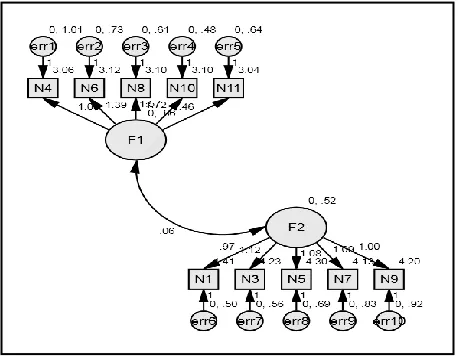
This factorial structure was then analyzed through a confirmatory factorial analysis (CFA) carried out on the same sample. Said analysis is presented in Figure 1.
Figure 1.Confirmatory Factorial Analysis for the Rule Following in Traffic Inventory.
The CFA carried out reached minimum levels (X² = 152.37 gl = 26 p ≤ .001), and its levels of adjustment reached an optimum level (CFI = .98 TLI = .96 RMSEA = .01)(Escobedo-Portillo, Hernández-Gómez, Estebané-Ortega, & Martínez-Moreno, 2016; Ruiz, Pardo, & Martín, 2010). This instrument also has a good level of internal consistency (α = .8), which altogether allows a confident use of the instrument in the city of Cuernavaca, Morelos (Mexico). The first factor, which was named “Operation Rules” yielded a α = .76, while the second factor was denominated “Circulation Rules” and yielded a α = .75).
Discussion
Villarreal-González, Sánchez-Sosa, Veiga, & Moral Arroyo, 2011), amogst many others. Many replication studies are expected to follow in Mexico and other countries (Bartels et al., 2003; Burt et al., 2015; Haavind, 2003; Maneiro, Gómez-Fraguela, Cutrín, & Romero, 2017; Reef et al., 2010).
Limitations
This study’s main limitation is that it is carried out in a single city. Although Cuernavaca is the capital of Morelos State, results cannot be generalized beyond its limits. Complimentary studies that provide solid information regarding this phenomenon in other cities and other countries is warranted. Another limitation is that the methodology is circumscribed to only 2 of the five steps required in instrument validation (Cohen & Swerdlik, 2009), which requires further validation of the instrument. Another limitation is the sample acquiring method, which was not probabilistic in nature. Although sample size justifies not having a purely random procedure, it is true that all other procedures are secondary in nature. Future studies must seek more representative samples.
References
Arnau-Sabatés, L., Sala-Roca, J., & Jariot-Garcia, M. (2012). Emotional abilities as predictors of risky driving behavior among a cohort of middle aged drivers. Accident Analysis & Prevention (Vol. 45).
https://doi.org/10.1016/j.aap.2011.07.021
Babakhani, N. (2011). The effects of social skills training on self- esteem and aggression male adolescents. Procedia - Social and Behavioral Sciences, 30, 1565–1570. https://doi.org/10.1016/j.sbspro.2011.10.304
Bailey, S., Lennon, A., & Watson, B. (2016). Getting mad may not mean getting even: The influence of drivers’ ethical ideologies on driving anger and related behaviour. Transportation Research Part F: Traffic Psychology and Behaviour, 36, 104–116. https://doi.org/10.1016/j.trf.2015.11.004
Bandura, A., & Locke, E. a. (2003). Negative self-efficacy and goal effects revisited. The Journal of Applied Psychology, 88(1), 87–99. https://doi.org/10.1037/0021-9010.88.1.87
Bartels, M., Hudziak, J. J., Van den Oord, E. J. C. G., Van Beijsterveldt, C. E. M., Rietveld, M. J. H., & Boomsma, D. I. (2003). Co-occurrence of aggressive behavior and rule-breaking behavior at age 12: Multi-rater analyses. Behavior Genetics, 33(5), 607–621. https://doi.org/10.1023/A:1025787019702
Burt, S. A., Rescorla, L. A., Achenbach, T. M., Ivanova, M. Y., Almqvist, F., Begovac, I., … Verhulst, F. C. (2015). The association between aggressive and non-aggressive antisocial problems as measured with the Achenbach System of Empirically Based Assessment: A study of 27,861 parent–adolescent dyads from 25 societies. Personality and Individual Differences, 85, 86–92. https://doi.org/10.1016/j.paid.2015.04.036
Cœugnet, S., Naveteur, J., Antoine, P., & Anceaux, F. (2013). Time pressure and driving: Work, emotions and risks. Transportation Research Part F: Traffic Psychology and Behaviour, 20, 39–51.
https://doi.org/10.1016/j.trf.2013.05.002
Cohen, R. J., & Swerdlik, M. (2009). Psychological Testing and Assessment: An Introduction to Tests and Measurement (7th ed.). McGraw-Hill.
Constantinou, E., Panayiotou, G., Konstantinou, N., Loutsiou-Ladd, A., & Kapardis, A. (2011). Risky and aggressive driving in young adults: Personality matters. Accident Analysis & Prevention, 43(4), 1323–1331. https://doi.org/10.1016/j.aap.2011.02.002
Dorantes-Argandar, G. (2016). Manual de Supervivencia Vial (1st ed.). Cuernavaca: Editorial UAEM.
Dorantes-Argandar, G. (2017). El uso prolongado de videojuegos violentos influye en la percepción de la violencia de adultos jóvenes. Psiencia Revista Latinoamericana de Ciencia Psicologica, 9(2). Retrieved from http://www.redalyc.org/pdf/3331/333152922002.pdf
Dorantes-Argandar, G. (2018a). Validación de un Inventario de Comportamientos Agresivos en el Tránsito. Revista Internacional de Psicología, 16(1), 1–57.
Dorantes-Argandar, G., Cerda-Macedo, E. A., Tortosa-Gil, F., & Ferrero Berlanga, J. (2015). Agresividad vial como predictor del estrés y del comportamiento prosocial, y su influencia en la siniestralidad de vehículos particulares en México. Ansiedad y Estrés, 21(3), 207–217.
Dorantes-Argandar, G., & Ferrero-Berlanga, J. (2016). Impulsivity and Aggressive Driving as mediators between Self-Esteem and Stress in Mexican drivers. Journal Of Psychology & Behavioral Science, 4(2), 131–141. https://doi.org/10.15640/jpbs.v4n2a12
Dorantes-Argandar, G., Tortosa-Gil, F., & Ferrero-Berlanga, J. (2016). Measuring situations that stress Mexicans while driving. Transportation Research Part F: Traffic Psychology and Behaviour, 37, 154–161.
https://doi.org/10.1016/j.trf.2015.12.014
Escobedo-Portillo, M. T., Hernández-Gómez, J. A., Estebané-Ortega, V., & Martínez-Moreno, G. (2016). Modelos de Ecuaciones Estructurales : Características , Fases , Construcción , Aplicación y Resultados. Ciencia & Trabajo, 18(55), 16–22.
Haavind, H. (2003). Masculinity by rule-breaking: cultural contestations in the transitional move from being a child to being a young male. Nora: Nordic Journal of Women’s Studies, 11(2), 89–100.
https://doi.org/10.1080/08038740310002941
Hair, J. F., Anderson, R. E., Tatham, R. L., Black, W. C., & Cano, D. (1999). Análisis Multivariante. Análisis Multivariante (5th ed.). Madrid: Prentice Hall.
Harris, P. B., Houston, J. M., Vazquez, J. A., Smither, J. A., Harms, A., Dahlke, J. A., & Sachau, D. A. (2014). The Prosocial and Aggressive Driving Inventory (PADI): A self-report measure of safe and unsafe driving behaviors. Accident Analysis and Prevention, 72, 1–8. https://doi.org/10.1016/j.aap.2014.05.023
Hinojosa-Reyes, R., Jiménez-Sánchez, P. L., Hernández-Hernández, V., & Campos Alanís, J. (2012). Siniestralidad Por Accidentes De Tránsito En México: Una Aproximación Desde El Análisis Espacial. Geografía y Sistemas de Información Geográfica, 4(4), 291–309.
Lan, K. L., Abdullah, M. C., & Roslan, S. (2010). Understanding Media Violence and the Development of Aggressive Behaviour of School Children. Procedia - Social and Behavioral Sciences, 7, 522–527.
https://doi.org/10.1016/j.sbspro.2010.10.070
Maneiro, L., Gómez-Fraguela, J. A., Cutrín, O., & Romero, E. (2017). Impulsivity traits as correlates of antisocial behaviour in adolescents. Personality and Individual Differences, 104, 417–422.
https://doi.org/10.1016/j.paid.2016.08.045
Mann, F. D., Engelhardt, L., Briley, D. A., Grotzinger, A. D., Patterson, M. W., Tackett, J. L., … Harden, K. P. (2017). Sensation seeking and impulsive traits as personality endophenotypes for antisocial behavior: Evidence from two independent samples. Personality and Individual Differences, 105, 30–39. https://doi.org/10.1016/j.paid.2016.09.018
Montero, I., & León, O. G. (2007). A guide for naming research studies in Psychology 1. International Journal of Clinical and Health Psychology, 7(3), 847–862. https://doi.org/ISSN 1697-2600
Reef, J., Diamantopoulou, S., Van Meurs, I., Verhulst, F., & Van Der Ende, J. (2010). Predicting adult emotional and behavioral problems from externalizing problem trajectories in a 24-year longitudinal study. European Child and Adolescent Psychiatry, 19(7), 577–585. https://doi.org/10.1007/s00787-010-0088-6
Ruiz, M. A., Pardo, A., & Martín, S. (2010). Modelo de escuaciones estructurales. Papeles Del Psicólogo, 31(1), 34–45. Retrieved from www.redalyc.org/articulo.oa?id=77812441004
Vannucci, M., Nocentini, A., Chiorri, C., & Menesini, E. (2014). Brief report: Violent false memories and engagement in aggressive and delinquent behavior: An investigation in adolescents. Journal of Adolescence (Vol. 37). https://doi.org/10.1016/j.adolescence.2014.09.007
Villarreal-González, M. E., Sánchez-Sosa, J. C., Veiga, F. H., & Moral Arroyo, G. del. (2011). Contextos de Desarrollo, Malestar Psicológico, Autoestima Social y Violencia Escolar desde una Perspectiva de Género en Adolescentes Mexicanos. Psychosocial Intervention, 20(2), 171–181.
https://doi.org/10.5093/in2011v20n2a5
Xu, Y., Li, Y., & Jiang, L. (2014). The effects of situational factors and impulsiveness on drivers’ intentions to violate traffic rules: Difference of driving experience. Accident Analysis & Prevention, 62, 54–62.