Medical Journal of the Islamic Republic of Iran (MJIRI)
Med J Islam Repub Iran. 2017(3 Jul);31.36. https://doi.org/10.14196/mjiri.31.36
______________________________
Corresponding author: Dr Yones Lotfi, [email protected]
1.Department of Audiology, University of Social Welfare and Rehabilitation Sciences,
Tehran & Musculoskeletal RehabilitationResearch Center, Ahvaz Jundishapur University of Medical Sciences, Ahvaz,Iran.
2. Department of Audiology, University of Social Welfare and Rehabilitation Sciences,
Tehran, Iran.
3.Department of Otolaryngology and Head and Neck Surgery, School of Medicine,
Iran University of Medical sciences, Tehran, Iran.
4. Department of Biostatistics, University of Social Welfare and Rehabilitation
Scienc-es, Tehran, Iran.
5. Department of Biomedical Engineering, Science and Research Branch, Islamic Azad
University, Tehran, Iran.
↑What is “already known” in this topic:
There is a body of evidence suggesting overall positive effects of localization training programs in speech-in-noise perception. Nevertheless, there are not programs training focused in Enve-lope-based inter-aural time difference localization training especially.
→What this article adds:
Envelope-based inter-aural time difference localization training was helpful in localization ability and speech-in-noise percep-tion. Present study confirms this novel training program.
Envelope-based inter-aural time difference localization
training to improve speech-in-noise perception in the
elderly
Maryam Delphi1, Yones Lotfi2*, Abdollah Moossavi3, Enayatollah Bakhshi4, Maryam Banimostafa5
Received: 17 Sep 2016 Published 3 Jul 2017
Abstract
Background: Many elderly individuals complain of difficulty in understanding speech in noise despite having normal hearing thresholds. According to previous studies, auditory training leads to improvement in speech-in-noise perception, but these studies did not consider the etiology, so their results cannot be generalized. The present study aimed at investigating the effectiveness of envelope-based interaural time difference (ITD ENV) localization training on improving ITD threshold and speech-in-noise perception. Methods: Thirty-two elderly males aged 55 to 65 years with clinically diagnosed normal hearing at 250-2000 Hertz, who suffered from speech-in-noise perception difficulty participated in this study. These individuals were randomly divided into training and control groups: 16 elderlies in the experimental group received envelope-based interaural time difference localization training in 9 sessions, but 16 matched elderlies in the control group did not receive any training. The ITD ENV threshold and spatial word recognition score (WRS) in noise were analyzed before and after the localization training.
Results: Findings demonstrated that following the training program, the interaural time difference envelope threshold and spatial word recognition score (WRS) in noise were improved significantly in the experimental group (p≤ 0.001). Moreover, a significant difference was detected in interaural time difference envelope threshold and spatial word recognition score (WRS) in noise (p≤ 0.001) before and after the training in the experimental group.
Conclusion: The results of the present study revealed the effectiveness of envelope- based interaural time difference localization training in localization ability and speech in noise perception in the elderlies with normal hearing up to 2000 Hz who suffered from speech-in-noise perception difficulty.
Keywords: Interaural Time Difference, Training, Speech-in-Noise Perception, Localization
Copyright© Iran University of Medical Sciences
Cite this article as:Delphi M, Lotfi Y, Moossavi A, Bakhshi E, Banimostafa M. Envelope-based inter-aural time difference localization training to improve speech-in-noise perception in the elderly. Med J Islam Repub Iran. 2017 (3 Jul);31:36. https://doi.org/10.14196/mjiri.31.36
Introduction
Many elderly individuals, despite having normal hear-ing thresholds, complain of difficulty understandhear-ing speech in noise. Speech-in-noise perception difficulty is one of the disabling consequences of hearing impairment with severe impact on communication (1). One of the rea-sons for speech perception difficulty, especially in envi-ronments with multiple sources of sound, is localization
difficulties or spatial processing disorders (SPDs) (2, 3). Localization of sound is the first cue for segregating the target auditory data from the non-target ones, and it is one of the important auditory functions for perception follow-ing target speech in noisy situations (4, 5). Researchers have emphasized that in normal individuals, sound locali-zation improves the signal to noise ratio for about 2-3 dBs,
Utilizing ITE ENV localization training to improve speech-in-noise perception
and therefore, contribute to better comprehension of con-versations in noisy environments (4, 6, 7) .
Sound localization is frequency specific, ie, sounds with lower frequencies than 1,500 Hz are localized by interau-ral time difference (ITD), while interauinterau-ral level difference (ILD) is used for higher frequency sounds; and spectral cues contribute to sound localization (8). Speech is a modulated signal that contains 2 different types of ITDs: ITD fine structure and ITD envelope (9). The latter means at higher frequencies, the envelope, a slow modulation (low frequency) of the carrier frequency, can transmit the ITD information, which is known as ITD in the envelope (ITD ENV) (10). Interaction of ITD ENV and ITD FS is still a controversial issue (9, 10). Previous studies on lo-calization by ITD ENV have used stimuli that were lim-ited to frequencies above the phase-locking range, leading to poor localization. Thus, such studies concluded that ITD ENV was not an important cue in localization (11). Recent studies have shown that ITD ENV information begins to overcome in binaural performance near and be-low the frequency at which ITD for fine structure becomes an ambiguous cue to spatial hearing (800 Hz for hu-mans)(9, 11) . Moreover, ITD ENV plays a more essential role in spatial hearing and speech-in-noise perception (10, 11). ITD ENV processing includes the interaction of exci-tation and inhibition in lateral superior olive (LSO) (12). Wright et al. proposed that this balancing in LSO is more plastic than coincidence detection in medial superior olive (MSO) (12).
Localization, like other auditory skills, is affected by ag-ing. Aging process can cause an increment in temporal jitter, resulting in binaural masking level difference (BMLDs)(13) reduction, elevated ITD and ILD threshold, and difficulty understanding speech in noise (2, 14-16).
Localization training is caused by brain plasticity and leads to improving speech perception in noise (17, 18). Moreover, some studies have confirmed the role of ITD ENV in sound localization(10, 11), but no study has cused on ITD ENV-based localization training. we fo-cused on localization training based on ITD ENV in the elderly because LSO that tuned to ITD ENV is more plas-tic than MSO, and also the ITD discrimination ability, localization, and temporal envelope information were reduced in the elderly compared to normal individuals (1, 2). It is hypothesized that ITD ENV- based localization training may change the elderly’s ability to use spatial clues for segregating target speech from competing sig-nals/noise and improve their speech in noise perception. Therefore, the present study aimed at investigating the effect of ITD ENV-based localization training in speech in noise perception in the elderly.
Methods
Participants
The study population was selected consecutively among the elderly males presented to Ahwaz audiology clinics over a 9-month-period from June 2015 to February 2015. In this study, 46 elderly males with speech in noise per-ception compliant were visited; 32 elderly males aged 55 to 65 years were selected based on inclusion criteria. All
participants complained of difficulty for perception of speech in noisy conditions, and using the Persian version of the temporal jitter test, we found that their word dis-crimination score was lower than 56% (19). According to the result of temporal jitter test in 2011, the mean±SD of word discrimination score in 0dB signal to noise ratios was 65.93±9.60 in young adults (19). The participants’ auditory thresholds were below 20 dB at 250–2000Hz frequency range and less than 40 dB at 4–8KH. Pure tone average difference was less than 5 dBHL between the 2 ears. All participants had normal IQs and were right hand-ed. Their otoscopic and tympanometric results were also normal, and none of them had a history of neurologic dis-ease or injury, or did not participate in any other training programs during the ITD ENV-based localization training. Fourteen elderly males were excluded because they had hearing loss or did not meet other inclusion criteria. Moreover, 32 elderlies who met the inclusion criteria were randomly divided into 2 groups according to the random number table produced by SPSS 21 software. Sixteen elderlies were placed in the experimental group ( They received training for sound localization based on ITD ENV) (mean±SD age of 60.50±2.52 years), and 16 elderlies in the control group that received no training (mean±SD age of 60.18±1.51 years). All the above inclu-sion criteria were the same for the 2 groups.
The present study had two parts. First, it evaluated the ability to localize ITD ENV and spatial word recognition score (WRS) in noise in the elderlies before the training; and second, it investigated these two after the training.
Part 1: Evaluation ITD ENV Threshold
Measurement of the ITD ENV threshold was based on the identification of the auditory stimulus direction from the midline to the left and to the right with a change in the ITD (10, 20). The Persian nonword “bamâsh” was select-ed as the oral stimulus from the list of disyllabic Persian nonword (8). The advantage of nonwords are their similar-ity to natural signal, but they are meaningless and reduce the effect of meaning in localization (21). Duration of the stimulus was 1.5 seconds and had a rise-decay time of 25 milliseconds. The overall level of presentation for both ears was 70 decibels (20).
A constant-stimulus two-interval forced-choice (2 IFC) paradigm was utilized to measure ITD ENV threshold (22-24). In this method, the participants are requested to indicate whether the second interval was displaced from the midline by pressing the button. The percentage of cor-rect responses was calculated for each ITD ENV value and displayed as psychometric function. 2IFC directly estimates the psychometric function. A 75% correct point criterion was used as the threshold (23-27).
The first interval contained a reference stimulus with 0µs ITD ENV, while the second interval contained the target stimulus with different ITD ENV values (10, 24). The percentage of correct left/right discriminations was calculated as a function of ITD ENV (10, 24). The range of ITD ENV was 10 µs to 100 µs in 10 µs steps within the range of 100 µs to 350 µs, and the steps were 50 µs. Two
blocks were presented, consisting of 30 repetitions for each ITD ENV value. Each block consisted of 15 repeti-tions of each ITD ENV value that were organized in 3 subblocks contenting 5 randomize sequence (28).
Spatial Word Recognition Score (WRS) in Noise Spatial WRS in noise included delivering monosyllabic Persian words (29) to ears through the headphones in 7 different spatial locations at 0, -30, +30, -60, +60, -90, and +90 azimuth degrees by changing interaural time differ-ence in the presdiffer-ence of white noise with a signal to noise ratio of 0 dB (30). Five monosyllabic words were present-ed in each spatial location, and the participant’s task was to repeat them (30). The percentage of correctly localized spatial WRS in noise was calculated.
Part 2: Training
The experimental group was trained for formal localiza-tion skills in a course of 9 sessions using disyllabic non-words with different ITD ENV values (12). The partici-pants were asked to respond by showing the direction of the sound in the right or left side (24). Each ITD was fre-quently presented to the individuals so that they could identify it properly. The ITD ENV training program began for each participant at 20 milliseconds above the ITD ENV threshold that was obtained in the evaluation part so that localization would be attainable for the participants (31). Each training step was delivered to the individual 10 times. If the presented ITD could correctly localize the source, it would then be reduced in 10 millisecond steps. In the case of no improvement in new ITD ENV, the pre-vious ITD ENV was practiced again. To investigate the effectiveness of the training program, ITD ENV threshold and spatial WRS in noise was obtained post training.
This study was approved by the ethics committee of the University of Social Welfare and Rehabilitation Sciences (code IR.USWR.REC.1394.3).
Statistical Analysis
Statistical analysis was conducted using SPSS software
(Version 21). The Shapiro-Wilk test was used to verify the normal distribution of the data, which showed the abnor-mal distribution of data in spatial WRS and the mean of ITD ENV thresholds (p ≤0.001) in both groups. The Wil-coxon test was conducted to compare spatial WRS and ITD ENV thresholds pre- and post-training. The 2 groups were compared using Mann-Whitney test to show the training effects. Significance level was et at 0.05 (5%), with confidence interval of 95%.
The participant’ consents were obtained before the tests, and they could quit the program at any time. The control group had the option to participate in the training program after the completion of this research.
Results
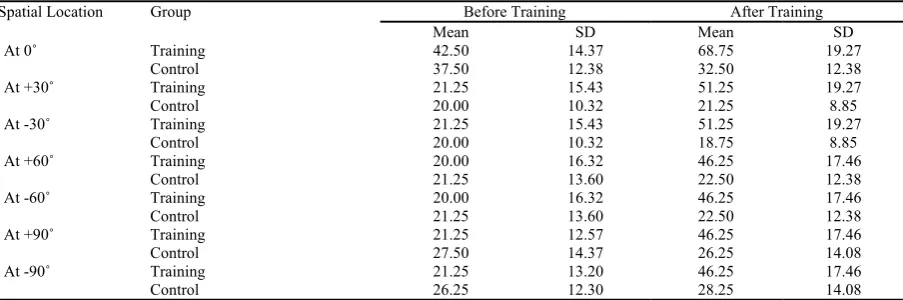
Tables 1 and 2 demonstrate the mean scores and the standard deviation for ITD ENV thresholds and spatial WRS in the 2 groups before and after the auditory locali-zation training.
Wilcoxon test was conducted to compare the results within each group. A significant difference was found in ITD ENV threshold before and after training in the train-ing group (p≤ 0.001); no difference was observed in the control group. Also, a significant improvement was ob-served in Spatial WRS in noise in the experimental group (p≤ 0.001), but no significant changes were observed in ITD ENV thresholds (p= 0.180), and spatial WRS (p=0.102 at 0° azimuth, 0.564 at +30° azimuth, 0.234 at -90° azimuth and 0.317 for other spatial locations) after the training in the control group.
Mann-Whitney test was used to investigate the effec-tiveness of the training on ITD ENV thresholds and spatial WRS in noise. The results revealed a significant differ-ence in ITD ENV threshold between the 2 groups. In other words, the ITD ENV threshold performance in the exper-imental group was improved significantly (p≤ 0.001). Moreover, a significant difference was found between the 2 groups in spatial WRS in noise (p≤ 0.001).
Figure 1 displays the psychometric function for the
Table 1.Descriptive Statistics of ITD ENV Threshold (µs) in the Two Groups Before and After Training
Group Before Tining After Training
Mean SD Mean SD
Experimental 130.00 51.12 92.50 44.49
Control 136.25 53.89 133.75 53.27
Table 2.Percentage of Spatial WRS (word Recognition Score) in Noise at 7 Spatial Locations in the Two Groups Before and After Training
Spatial Location Group Before Training After Training
Mean SD Mean SD
At 0˚ Training 42.50 14.37 68.75 19.27
Control 37.50 12.38 32.50 12.38
At +30˚ Training 21.25 15.43 51.25 19.27
Control 20.00 10.32 21.25 8.85
At -30˚ Training 21.25 15.43 51.25 19.27
Control 20.00 10.32 18.75 8.85
At +60˚ Training 20.00 16.32 46.25 17.46
Control 21.25 13.60 22.50 12.38
At -60˚ Training 20.00 16.32 46.25 17.46
Control 21.25 13.60 22.50 12.38
At +90˚ Training 21.25 12.57 46.25 17.46
Control 27.50 14.37 26.25 14.08
At -90˚ Training 21.25 13.20 46.25 17.46
Control 26.25 12.30 28.25 14.08
Utilizing ITE ENV localization training to improve speech-in-noise perception
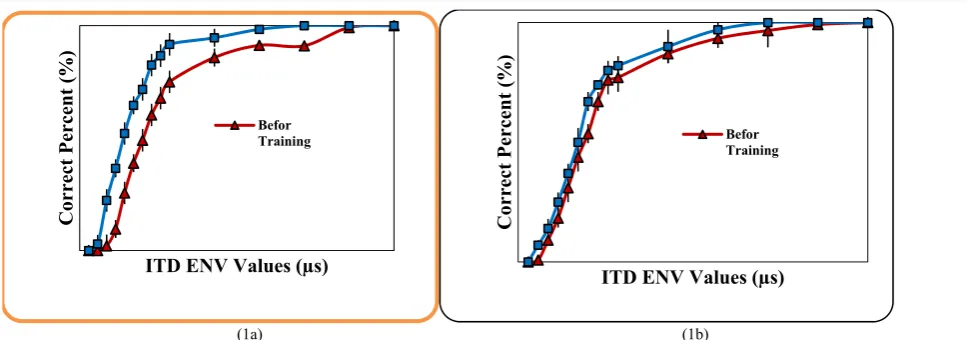
mean of ITD ENVs in the experimental (1a) and control (1b) groups before and after training. The psychometric function represents the percentage of correct responses as the function of ITD ENV localization. Figure 1a demon-strates the improvement of ITD ENV threshold in the ex-perimental group, but figure 1b shows that the ITD ENV threshold did not change in the control group. In the psy-chometric function, the threshold was estimated to be at the 75% probability level for correct points (25-27). The percentage of the correct responses increased with the increment of ITD ENV, and all individuals had lower ITD ENV threshold after training.
Discussion
Elderlies with difficulty in speech perception in noise were recruited and trained with ITD ENV-based localiza-tion; and finally, the possible changes in ITD ENV threshold and spatial WRS in noise were tracked.
Prior to the training program, the mean of ITD ENV thresholds were 130 and 136 microseconds for the exper-imental and control groups, respectively. These values were higher than those of the Laback’s study (22) who found the mean of ITD ENV threshold of 56 microsec-onds for young participants with normal hearing. This threshold rise can be attributed to the binaural hearing disorder in the elderlies. This is in agreement with find-ings by Grose, who believed that age-related factors con-tribute to a weaker binaural processing and a higher ITD threshold among the elderlies compared to those of young individuals (14). In a similar study, Dobreva et al. indicat-ed a deterioration of auditory spatial cues in sound locali-zation with age advancement (16). Age-related changes, independent of hearing threshold, leads to a reduction in temporal coding and spatial separation cues such as ITD (32). It seems that these age-related changes reduced the effectiveness of temporal envelope information on spatial segregation and sound localization (33, 34). This reduc-tion may be due to prolonged neural refractory times, loss of myelin integrity, decreased brain connectivity, and def-icits in spectro-temporal processing (35).
The spatial WRS in noise in different locations was found to be from 20% to 42.50% before training. This finding was supported by Jaffary et al. who found that the
mean score for speech-in-noise perception in elderly and young individuals was 45% and 65%, respectively (19). Many previous studies have confirmed speech in noise perception difficulty in elderlies (13, 19, 36, 37). It ap-pears that reduction in localization and spatial processing skills is one of the leading causes of difficulty in speech in noise perception in the elderly (38, 39).
After ITD-ENV based localization training, the ITD ENV threshold and spatial WRS in noise was significantly improved in the experimental group. The control group did not show any significant changes. Because we only used lateralization based on ITD-ENV training, these im-provements could be attributed to the training method. The observed influence of ITD ENV training in improving localization and spatial WRS in noise is consistent with previous behavioral studies, which commonly showed the effectiveness of localization training (12, 17, 18, 40, 41). Kawashima et al. found that ITD ENV has a positive in-fluence on localization and confirmed its contribution to the plasticity of auditory localization (40). Other previous studies also investigated the effectiveness of localization rehabilitation programs. In a study by Wright et al. the ITD differentiation threshold of 32 listeners was assessed before and after the completion of ITD training. They con-firmed that ITD training leads to an improvement in ITD discrimination (12). Our results are in accordance with theirs as they indicated that ITD ENV training leads to improving ITD ENV threshold. Study of Kuk et al. indi-cated that the laboratory-based and home-based localiza-tion training programs had positive effects on localizalocaliza-tion ability (18). Also, Tyler et al. found that spatial auditory rehabilitation can improve localization and speech in noise perception (17). The study by Cameron et al. showed an improvement of 10 decibels in speech perception thresh-old in listening in spatialized noise (LISN) after the train-ing program (41). Findtrain-ings of the current study were in line with all the mentioned studies. According to Kumpik’s study, spatial hearing plasticity is considerable during the developmental period. This plasticity remains in adulthood (42). Our result also hints to probable presence of localization plasticity in an old age. It appears relearning is caused reweighting in localization circuits and new spatial maps (42).
(1a) (1b)
Fig. 1.Psychometric functions displayed the mean of percent correct performance as a function of ITD ENVs in the experimental (1a) and control
(1b) groups before and after training. The error bars represent ±2 standard error of the mean.
Correct
P
ercent (%
)
ITD ENV Values (µs) Befor Training
Correct
P
ercent (%
)
ITD ENV Values (µs) Befor Training
In the present study, no difference was observed be-tween ITD ENV thresholds before and after training at 10, 20, 300, and 350 microseconds because none of the partic-ipants could differentiate 10 and 20 microsecond ITD ENV before and after the training. However, all partici-pants could identify ITD ENV at 300 and 350 microsec-onds prior to and following the training. The percentage of correct identification of ITD ENV increased with the in-crease in ITD ENV (Fig. 1).
Our findings showed the effectiveness of ITD ENV-based localization on spatial WRS in noise after 9 sessions of training. Moreover, because the ITD ENV-based local-ization training program resulted in improving speech-in-noise perception, its effectiveness might have been limited only to the training stimulus and thus could not be gener-alized to other stimuli.
The constant-stimulus two-interval forced-choice (2 IFC) paradigm was used to estimate the ITD ENV thresh-old. An advantage of this method is an estimation of the participants guessing behavior by inserting blank trials in pretest schedule. The disadvantage of constant-stimulus 2 IFC is the significant amount of time required to obtain sufficient data points to display the psychometric function (43).
Finally, this study was conducted with a small sample size and in a short period of 9 sessions. Thus, further in-vestigation with larger sample size and longer duration will help generalize the findings of this study. We did not use an age-matched valid memory test in our inclusion criteria, which made it a scientific limitation for our study. Furthermore, to evaluate the long- term effects of the training, follow up studies in intervals of several months after training should be planned.
Conclusion
Our findings revealed that elderly with normal hearing sensitivity up to 2,000 Hz and a speech-in-noise difficulty could benefit from the ITD ENV training program. This training improved localization ability and speech in noise perception. According to the current study, it seems that plasticity of localization and spatial hearing is still main-tained in old age. This study may indicate a potential for future training programs for the elderly to help them over-come speech in noise difficulties.
Acknowledgments
The authors of this paper are thankful to Dr. Mehrkian, S and Bakhit, M for their useful comments. In addition, they gratefully acknowledge the cooperation of all partici-pants in this study. This study was supported by Universi-ty of Social Welfare and Rehabilitation Sciences.
Financial Support
This research received no specific grant from any fund-ing agency, commercial or not-for-profit sectors.
Conflict of Interests
The authors declare that they have no competing interests.
References
1. Murphy DR, Daneman M, Schneider BA. Why do older adults have difficulty following conversations? Psychol Aging. 2006;21(1):49. 2. Glyde H, Hickson L, Cameron S, Dillon H. Problems Hearing in Noise
in Older Adults A Review of Spatial Processing Disorder. Trends in Amplif. 2011;15(3):116-26.
3. Cameron S, Dillon H, Newall P. The listening in spatialized noise test: an auditory processing disorder study. J Am Acad Audio. 2006;17(5):306-20.
4. Delphi M, Abdolahi FZ, Tyler R, Bakhit M, Saki N, Nazeri AR. Validity and reliability of the Persian version of spatial hearing questionnaire. MJIIRI. 2015;29:231.
5. Devore S, Ihlefeld A, Hancock K, Shinn-Cunningham B, Delgutte B. Accurate sound localization in reverberant environments is mediated by robust encoding of spatial cues in the auditory midbrain. Neuron. 2009;62(1):123-34.
6. Ramsden JD, Papsin BC, Leung R, James A, Gordon KA. Bilateral simultaneous cochlear implantation in children: our first 50 cases. Laryngoscope. 2009 Dec;119(12):2444-8.
7. Noble W, Gatehouse S. Effects of bilateral versus unilateral hearing aid fitting on abilities measured by the Speech, Spatial, and Qualities of Hearing Scale (SSQ). Int J Audio. 2006 Mar;45(3):172-81. 8. Moossavi A, Khavarghazalani B, Lotfi Y, Mehrkian S, Bakhshi E,
Mahmoodi Bakhtiari B. Validity and reliability of a non-sense syllable test for evaluating phonological working memory in Persian speaking children. Audiology. 2014;23(4):31-9.
9. Moossavi A, Delphi M. Spatial Hearing: Models, And Functions. AJUMS 2014;10(2):346-57.
10. Majdak P, Laback B, Baumgartner W-D. Effects of interaural time differences in fine structure and envelope on lateral discrimination in electric hearinga). J Acoust Soc Am. 2006;120(4):2190-201.
11. Joris PX, Van de Sande B, Louage DH, Van der Heijden M. Binaural and cochlear disparities. Proc Natl Acad Sci. 2006;103(34):12917-22. 12. Wright BA, Zhang Y. A review of learning with normal and altered
sound-localization cues in human adults: Revisión del aprendizaje en adultos con claves de localización sonora normales o alteradas. Int. J. Audio. 2006;45(1):92-8.
13. Pichora-Fuller MK, Schneider BA, MacDonald E, Pass HE, Brown S. Temporal jitter disrupts speech intelligibility: A simulation of auditory aging. Hear Res. 2007;223(1):114-21.
14. Grose JH, Mamo SK. Processing of temporal fine structure as a function of age. Ear Hear. 2010;31(6):755.
15. Ross B, Fujioka T, Tremblay KL, Picton TW. Aging in binaural hearing begins in mid-life: evidence from cortical auditory-evoked responses to changes in interaural phase. J Neurosci. 2007;27(42):11172-8.
16. Dobreva MS, O'Neill WE, Paige GD. Influence of aging on human sound localization. J Neurophysiol. 2011;105(5):2471-86.
17. Tyler RS, Witt SA, Dunn CC, Wang W. Initial development of a spatially separated speech-in-noise and localization training program. J Am Acad Audio. 2010 Jun;21(6):390-403.
18. Kuk F, Keenan DM, Lau C, Crose B, Schumacher J. Evaluation of a localization training program for hearing impaired listeners. Ear Hear. 2014;35(6):652-66.
19. Jafari Z, Omidvar S, Jafarlou F, Kamali M. The Effect of age on speech temporal resolution among elderly people. Adv Cog Sci. 2011;13(3):55-64.
20. Brughera A, Dunai L, Hartmann WM. Human interaural time difference thresholds for sine tones: the high-frequency limit. The J Acoust Soc Am
. 2013;133(5):2839-55.
21. Moore DR, Ferguson MA, Edmondson-Jones AM, Ratib S, Riley A. Nature of auditory processing disorder in children. Pediatrics. 2010 Aug;126(2):e382-90.
22. Laback B, Pok S-M, Baumgartner W-D, Deutsch WA, Schmid K. Sensitivity to interaural level and envelope time differences of two bilateral cochlear implant listeners using clinical sound processors. Ear Hear. 2004;25(5):488-500.
23. Keating P, Nodal FR, Gananandan K, Schulz AL, King AJ. Behavioral sensitivity to broadband binaural localization cues in the ferret. JARO. 2013 Aug;14(4):561-72.
24. Majdak P, Laback B. Effects of center frequency and rate on the sensitivity to interaural delay in high-frequency click trains. J Acoust Soc Am. 2009 Jun;125(6):3903-13.
Utilizing ITE ENV localization training to improve speech-in-noise perception
25. Barthelmé S, Mamassian P. A flexible Bayesian method for adaptive measurement in psychophysics. arXiv preprint arXiv:08090387. 2008. 26. Ulrich R, Miller J. Threshold estimation in two-alternative forced-choice (2AFC) tasks: The Spearman-Kärber method. Percep Psycho. 2004;66(3):517-33.
27. Zwislocki JJ, Relkin EM. On a psychophysical transformed-rule up and down method converging on a 75% level of correct responses. Proc Natl Acad Sci. 2001;98(8):4811-4.
28. Delphi M, Lotfi Y, Moosavi A,Bakhshi E, Banimostafa M. Reliabil-ity of interaural time difference-based Localization training in Elderly with Speech in Noise Perception Disorder. IJMS. 2017. (In press). 29. Delphi M, Jarollahi F, Tahaie SA, Modarresi Y, Kamali M.
Evaluating Mosleh monosylabic word lists in adults with noise-induced hearing loss. Bimonth Audio Teh Uni Med Sci. 2013;22(3):14-22.
30. Lotfi Y, Moosavi A, Abdollahi FZ, Bakhshi E, Sadjedi H. Effects of an Auditory Lateralization Training in Children Suspected to Central Auditory Processing Disorder. J Audio Oto. 2016;20(2):102-8. 31. Chermak GD, Musiek FE. Handbook of Central Auditory Processing
Disorder, Volume II: Comprehensive Intervention: Plural Publishing; 2013.
32. Gallun FJ, Diedesch AC, Kampel SD, Jakien KM. Independent impacts of age and hearing loss on spatial release in a complex auditory environment. Front Neuro. 2013;7.
33. Besser J, Festen JM, Goverts ST, Kramer SE, Pichora-Fuller MK. Speech-in-speech listening on the LiSN-S test by older adults with good audiograms depends on cognition and hearing acuity at high frequencies. Ear Hear. 2015;36(1):24-41.
34. Grose JH, Mamo SK, Hall JW, 3rd. Age effects in temporal envelope processing: speech unmasking and auditory steady state responses. Ear Hear. 2009;30(5):568-75.
35. Anderson S, Kraus N. Auditory Training: Evidence for Neural Plasticity in Older Adults. SIG 6 Perspectives on Hearing and Hearing Disorders: Res Diagnos. 2013;17(1):37-57.
36. Fonseca CB, Iorio MC. [Application of the lateralization sound test in elderly individuals]. Pro-fono. 2006 May-Aug;18(2):197-206. 37. Glyde H, Hickson L, Cameron S, Dillon H. Problems hearing in
noise in older adults: a review of spatial processing disorder. Trends Amplif. 2011 Sep;15(3):116-26.
38. Fostick L, Ben-Artzi E, Babkoff H. Aging and speech perception: Beyond hearing threshold and cognitive ability. J Basic Clin Physiol Pharma. 2013;24(3):175-83.
39. Gosselin PA, Gagne J-P. Older adults expend more listening effort than young adults recognizing speech in noise. J Speech Lang Hear. 2011;54(3):944-58.
40. Kawashima T, Sato T. Adaptation in sound localization processing induced by interaural time difference in amplitude envelope at high frequencies. PloS one. 2012;7(7):e41328.
41. Cameron S, Dillon H. Development of the listening in spatialized noise-sentences test (LISN-S). Ear Hear. 2007;28(2):196-211. 42. Kumpik DP, Kacelnik O, King AJ. Adaptive reweighting of auditory
localization cues in response to chronic unilateral earplugging in humans. J Neuro. 2010;30(14):4883-94.
43. Hurley RM, HurleyA. Psychoacoustic Considerations and Implica-tions for the Diagnosis of Central Auditory Processing Disorder. In:Musiek FE, Chermak GD. Handbook of Central Auditory Processing Disorder, Volume I: Auditory Neuroscience and Diagnosis: Plural Publishing; 2013.pp.16.