Volume 3, Special Issue 1, ICSTSD 2016
A Secure Encryption approch for Texual Data
Transmission
Anagha P.Zele
Student of Master of Engineering (Computer Science & Engineering)
Raisoni College of Engineering and Management Amravati, India
anaghazele12@ gmail.com
Prof. Nitin R.Chopde
Assitant prof of ( Computer Science & Engineering) Raisoni College of Engineering and Management
Amravati, India [email protected]
Prof. Dinesh S. Datar
Assistant prof of (Information technology) Raisoni College of Engineering and Management
Amravati, India [email protected]
Abstract
-
Secure data transfer is the most important concern in today’s world. Data in transit is always in danger of getting compromised Communication of information over the Internet is rapidly increasing due to the availability of the Internet and increase in transmission speed. However, confidentiality, data security, reliability issues regarding to data transmission such as , data loss are becoming serious concerns. To fulfill the need of secure transmission of text data, we proposed algorithm in this paper. Secure data transfer is the most important concern in today’s world. Data in transit is always in danger of getting compromised. In proposed algorithm we are Hide the confidential data and compress it without any loss of data .we propose new technique which use to transfer confidential textual data over network .Keywords—component; formatting; style; styling; insert (key words)
I. INTRODUCTION (HEADING 1)
With the advent of the Internet, computer users started to distribute, share, and transmit their private data online in a complete overt manner .In this proposed methodology we are taking an input as carrier text then encrypt that carrier text using Simplified-DES algorithm and sample that carrier encrypted text and hiding our secrect binary or confidential data in encrypted carrier text. Then generate the stego text and stego key after that we are compress the key and text by using lossless compression technique. Then we are extracting a secret data by taking encrypted carrier sample and stego key.
Simplified-Data Encryption Standard (S-DES) is a reduced adaptation of the Data Encryption Standard (DES) algorithm. It was designed as a test block cipher for learning
about modern cryptanalytic techniques such as linear cryptanalysis, differential cryptanalysis and linear-differential cryptanalysis. It is a variation of basic DES [1], then we are hiding the secret text in carrier text. Four types of carrier generally used in steganography are audio, video, text and images. Hiding information in text is the most important method of Steganography. The method was to hide a secret message in every nth letter of every word of a text message. After booming of Internet and different type of digital file formats it has decreased in importance [2].The carriers may be plain text, webpage text or binary file.the size of stego key is same as the stego text.
Communication of information over the Internet is rapidly increasing due to the progression of higher availability of the Internet and the increase in bandwidth transmission speed. However, reliability issues regarding to data transmission such as confidentiality, data security and data loss are becoming serious concern.
Nowadays, the world witnesses a huge demand on storing or transmitting large volumes of data that are available in electronic form. This massive amount of data not only needs high capacity storage devices, but also requires long time to be transferred over the network. To save storage space and transfer time, intensive works and researches have been conducted to exploit the redundancy available in a given data. This redundancy can be removed using modern variants of compression techniques[3]. Organization of paper
II. LITERATURE SURVEY
Volume 3, Special Issue 1, ICSTSD 2016 loss less data over internet .using proposed hiding
technique and compression technique[1]
In this paper the Indra Raj Sharma andVipin Gupta proposed the performance in terms of delay, power and
area of DES and Simplified DES analysed using Cadence Encounter RTL Compiler. The design analysis of Simplified DES shows leakage power is 568nW and Transition power is 169186.883nW, so the total power is 169755.035nW, the delay is 3422ps and dies area 1468μm2 on 130nm Process Technology. It is more satisfactory options for both algorithm in terms of utilization and the speed of execution[13]
In this paper the Rajashekarappa, and Dr. K M SunjivSoyjaudah proposed The SDES is a simple encryption algorithm, this is a promising method and can be adopted to handle other complex block ciphers like DES and AES[6]
In this paper, the Vimalathithan.Rand Dr.M.L.Valarmathi proposed the Genetic Algorithm for the cryptanalysisof Simplified Data Encryption Standard is presented. Thetime complexity of the proposed approach has beenreduced drastically when compared to the Brute-Forceattack. Though SDES is a simple encryption algorithm,this is a promising method and can be adopted to handleother complex block ciphers like DES and AES. The costfunction used here can be applied for other block ciphers also.[3]
In this paper the RupaliGawade, PriyankaShetye, VaibhaviBhosale and P N. Sawantdesai proposed the Steganography is a fascinating and effective method ofhiding data that has been used throughout history.Methods that can be employed to uncover such devious
tactics, but the first step are awareness that such methods even exist. There are many good reasons as well to use this type of data hiding, including watermarking or a moresecure central storage method for such things as passwords, or key processes. Regardless, the technology is easy to use and difficult to detect.[18]
In this Paper the Sheelu proposed Steganography not only prevents others from knowing the hidden information, but it also prevents others from thinking that the information even exists. If a Steganography method causes someone to suspect there is a secret information in a carrier medium, then the method has failed. Different file formats can be used as carrier in Steganography. Embedding secret information in an audio file is usually a more difficult process than embedding messages in other media. Audio Steganography methods can embed messages in WAV, AU, and even MP3 sound files. As we will hide 4 bits of secret information in each byte of the carrier. This will enhance the capacity of carrier and carrier will conceal a large amount of secret information[12]
In this paper the SouvikBhattacharyya ,PabakIndu , SanjanaDutta , AyanBiswas and GautamSanyal
presented a novel approach of English text steganography method which is the improved version of the CALP. Stego text is generated by mapping each two bit of the binary sequence of the secret message through small texture/pattern changes of some alphabets of the cover text in order to achieve high level of security the CALP method generates the stego text with minimum or zero degradation as both the Jaro score and Correlation-coefficient value is very high.[4]
In this paper the ChintanDhanani and KrunalPanchal presents the stegnography techniques , because of increasing amount of security threats protection of data is required. Steganography provides security of information by hiding it in carrier. This survey paper includes the classification of steganography techniques and techniques that already been implemented to hide information in web documents. Data hidden in the web document is less suspicious in compare of other carriers because HTML WebPages are now a routine part of everyone‟s life and html document contains the considerable number of tags, attributes & other elements in which data can be hidden. We can hide information in HTML, CSS, XML, JavaScript etc. So we have more options to secure the information.[17]
In this paper the P. N. Kulkarni and P. C. Pandey proposed Multi-band frequency compression is a speech processingtechnique for improving speech intelligibility under adverse listening conditions. For use in this processing, three frequency-mapping schemes, i.e. sample-to-sample mapping, mapping by superimposition of spectral samples, and segment mapping schemes were investigated. Segment-mapping scheme achieved desired compression retaining the spectral distribution of energy, and without introducing irregular variations. The scheme needs to be further evaluated using different test materials, larger number of subjects, and different listening conditions.[1]
In this paper the Hamid Mirvaziri, KasmiranJumariMahamod Ismail and ZurinaMohdHanapi proposed the MRVLK is efficiently implemented and resistedagainst known attacks because of changing the key andblock size in each round where the key generation is anindependent process and time variant so it is reliable,fast, complex and hard enough to resists againstexisting attacks and can implement where there arespeed and memory constraints. Differential related keyattack is based on key relation so there is no chance ofgaining the key by using this method.[4]
III. PROPOSED METHODOLOGY
Our proposed scheme is initially encrypt the original data and hide the secured data into the original data to provide the
Volume 3, Special Issue 1, ICSTSD 2016 key size .The proposed model has been depicted in Fig.1 to
demonstrate its flow
FIGURE 1.DFD FOR DATA ENCRYPTION
In these proposed system we are securely transfer data from one person to another By using cryptography, steganography, compression in our proposed system we are first taking the carrier text as input then we are encrypt that using S-DES algorithm. Then we are convert the encrypted carrier to binary form then we are choose the secrete text and secrete text we are also convert to the binary form then we are generate key that key is position key of secrete text. That key same size of the secrete text size. Then we are hide the secrecte text into carrier text.then we compress the secrete text and key.we save that compress key and decrypted text.
FIGURE 2. DFD FOR DATA EXTRACTION
In Data extraction Module we are taking as input that save decrypted stego text and saved compress key using that two input we are getting our hidden secrete data
IV. IMPLEMENTATION OF ALGORITHM
A. Proposed Data Hiding algorithm
Step 1: Start
Step2: Select carrier text
Step3: convert carrier text to binary text Step4: Segment carrier Binary text Step5: Insert secret Text
Step 6: convert secret text to binary text Step 7: Generate Key
Count (key)=count of(secret binary bits) Step 8: for i=1to count (key)
Read S(Key) Read Sbinary(i)
Locate Sbinary(i) into S(key)
Add position of Sbinary(i) at to position of key Step 9: End
Step10: Stop
B. Proposed Compression algorithm
Step1: Start
Step2: input position key , i=5,freq=5
Step3: Segment position key to group of I bits Count freq of i bits
If count freq > freq add to mapping table Else
If count freq > freq-1 Add to mapping table
Else
If count freq> freq-2 Add to mapping table End
End End Step 4: Stop
C. Proposed data Extraction algorithm
Step 1: Start
Step2: Input stego text
Volume 3, Special Issue 1, ICSTSD 2016 Step4: Decompress key
Step5: Input Key
Step6: for i=1 to length(key) Read sample S[key];k=k++; Convert to binary
Read position from decompress key Add to extract data
end
Step7: convert extracted data to Ascii Step8: Stop
V. Result Analysis
In this section we are discuss about result analysis. We collect the result of our proposed system on some parameters like time, ratio and maintaining security. We implement the proposed secure textual data transmission, in which we model three entities as separate programs. Data encryption which protect our data from third party, data hiding which maintain our confidential data secrecy, data compression for saving time and memory in transmission. Evaluation of the proposed system focuses Secure transmission using cryptography and steganography.
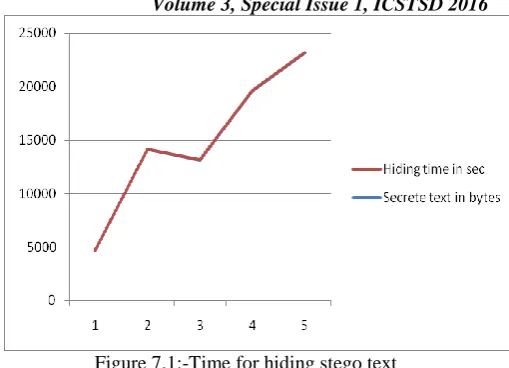
In this first table of result analysis we meet our objective of confidentiality in result we prove that we are maintaining the confidentiality of our secrete data . and also we are hide the large amount of data within small amount of data. And if our stego text size large our hiding time is also increse
Table 7.1:- Time for hiding the Stego text
Carrier text in bytes
Secrete text in bytes
Hiding time in sec
24 14146 29.88
6 4666 10.61
18 13112 28
20 19583 41
36 23147 49
Figure 7.1:-Time for hiding stego text
In this table we meet our objective which is maintaining the security in this table we compare our encrypted algorithm with others algorithm.and shows how our proposed system is more secure.
Table7.2:-Comparison among different security technique
Name of
security Scheme
Maximum Key Length
Can prevent Sniffer and Chosen
Sniffer Attack
AES 32 Bytes False
DES 8 Bytes False
Tripple DES 24 Bytes False
Blowfish 56 Bytes False
RSA 128 Bytes False
SDES 10 Bits True (for
extraction we need decrypted stego text stego key and mapping
table) Carrier sampling
In this table we calculate the ratio of compression text and compare our proposed compression ratio with existing Huffman compression technique. And in this result our compression ratio is better than Huffman technique.
Table 7.3:- compression ration in percentage
Text Size
(Bytes)
HUFF in
Percentage (%)
Proposed in
Percentage(%)
4666 33.80 34.40
13112 33.52 41.50
14146 32.71 89.20
19583 31.46 91.19
Volume 3, Special Issue 1, ICSTSD 2016
Figure 7.2:- percentage of data compression
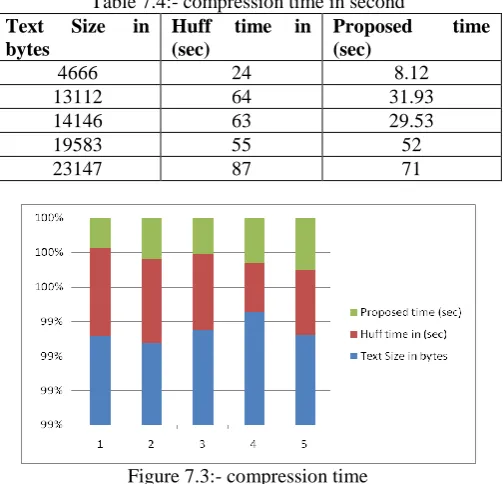
In this table we are compare our compression time with existing Huffman compression time. In this result our time to compress the text is less than the existing. Hence our proposed compression algorithm is better than existing
Table 7.4:- compression time in second
Text Size in bytes
Huff time in (sec)
Proposed time (sec)
4666 24 8.12
13112 64 31.93
14146 63 29.53
19583 55 52
23147 87 71
Figure 7.3:- compression time
In this table we shows the lossless compression this also an our one objective in this table see how much data we hide that same amount of data we extracted .
Table 7.5 :-Lossless compression
Hided Data in (bytes)
Extracted data in (bytes)
Same or not
4666 4666 Same
13112 13112 Same
14146 14146 Same
19583 19583 Same
23147 23147 Same
Figure 7.4:- lossless compression
References
[1] Shiladitya Bhattacharjee1, Lukman Bin Ab. Rahim2, Izzatdin B A Aziz, “ A Secure Transmission Scheme for Textual Data with Least Overhead”, 978-1-4799-2361-8/14/$31.00 ©2014 IEEE.
[2] SoumyenduDas,Subhendu Das, “Steganography and Steganalysis: Different Approaches”.
[3] RoopamBamal, Dr.V.P Singh Kaushal, “STEGANOGRAPHY: A MODERN DAY ART AND SCIENCE FOR DATA HIDING”, International Journal of Latest Research in Science and Technology ISSN (Online):2278-5299Volume 2,Issue 4 :Page No.9-14, July - August (2013).
[4] MissSayaliS.Khadse, Prof.Dhananjay M. Dakhane, “An Immune Transposal Pattern for Text Data with Least Overhead”, International Journal of Advanced Research in Computer Science and Software EngineeringVolume 5, Issue 4, April 2015 ISSN: 2277 128X.
[5] Souvik Bhattacharyya, PabakIndu2 ,SanjanaDutta , Ayan Biswas4and GautamSanyal,”
Text Steganography using CALP with High Embedding CapacitySouvik”, Journal of Global Research in Computer Science Volume 2, No. 5, May 2011.
Volume 3, Special Issue 1, ICSTSD 2016 [7] P. N. Kulkarni and P. C. Pandey, “Frequency
Mapping for Multi-band Frequency Compression for Improving Speech Intelligibility”, Proc. 14th National Conference on Communications 2008 (NCC 2008), Bombay, India.
[8] ChintanDhanani, KrunalPanchal, ”Steganography using web documents as a carrier: A Survey”, Steganography using web documents as a carrier: A Survey | ISSN: 2321-9939.
[9] Rajashekarappa, Dr. K M SunjivSoyjaudah, “Comparative Cryptanalysis of Simplified-Data Encryption Standard Using Tabu Search and Simulated Annealing Methods” , International Journal of Engineering Research and Development e-ISSN: 2278-067X, p-ISSN : 2278-800X, www.ijerd.com Volume 5, Issue 3 (December 2012), PP. 07-12 7.
[10]Sheelu, “ Enhancement of Data Hiding Capacity in Audio Steganography” , IOSR Journal of Computer Engineering (IOSR-JCE) e-ISSN: 2278-0661, p- ISSN: 2278-8727Volume 13, Issue 3 (Jul. - Aug. 2013), PP 30-35.
[11]RupaliGawade, PriyankaShetye, VaibhaviBhosale, P N. Sawantdesai, “Data Hiding Using Steganography For Network Security”, International Journal of Advanced Research in Computer and Communication EngineeringVol. 3, Issue 2, February 2014.
[12]Alaa R. Alameldeen and David A. Wood, “Frequent Pattern Compression: A Significance-Based Compression Scheme for L2 Caches”, Technical Report 1500, Computer Sciences Dept., UW-Madison, April 2004.