Volume 66, 2019, Pages 52–59
Proceedings of 6th International OM-NeT++ Community Summit 2019
DoS Protection through Credit Based Metering
-Simulation-Based Evaluation for Time-Sensitive
Networking in Cars
Philipp Meyer, Timo H¨
ackel, Franz Korf, and Thomas C. Schmidt
Department of Computer Science
Hamburg University of Applied Sciences, Germany
{philipp.meyer, timo.haeckel, franz.Korf, t.schmidt}@haw-hamburg.de
Abstract
Ethernet is the most promising solution to reduce complexity and enhance the band-width in the next generation in-car networks. Dedicated Ethernet protocols enable the real-time aspects in such networks. One promising candidate is the IEEE 802.1Q Time-Sensitive Networking protocol suite. Common Ethernet technologies, however, increases the vulnerability of the car infrastructure as they widen the attack surface for many com-ponents. In this paper proposes an IEEE 802.1Qci based algorithm that on the one hand, protects against DoS attacks by metering incoming Ethernet frames. On the other hand, it adapts to the behavior of the Credit Based Shaping algorithm, which was standardized for Audio/Video Bridging, the predecessor of Time-Sensitive Networking. A simulation of this proposed Credit Based Metering algorithm evaluates the concept.
1
Introduction
In today’s vehicles, a multitude of sensors, actors, and electronic control units (ECUs) are used to enable enhanced performance, comfort, and safety through advanced driver assistance systems. Even autonomous driving will be realized in future generations. These additions result in complex communication over different proprietary bus technologies in multiple domains.
Ethernet technologies are used to set up efficient and straightforward communication in future generations. Real-time Ethernet protocols enable the compliance of communication requirements and enhance the reliability of Standard Ethernet. Promising candidates are the Time-Sensitive Networking (TSN) protocols by the IEEE (https://1.ieee802.org/tsn/).
The main focus of those protocols is Quality of Service guarantees. The integration of future cars in the IoT context opens its systems to global communication. These online capabilities and the domain interconnection increases the attack surface of safety-critical functions like brakes and the motor control units. Attacks could manipulate driving characteristics and could provide fatal consequences for vehicle and passengers.
This work provides a simulation-based evaluation of IEEE 802.1Qci with a Credit Based Meter (CBM) algorithm concept. This concept enforces the reserved bandwidth of a stream and is one solution to protect network nodes from Denial of Service (DoS) attacks. IEEE 802.1Qci and the CBM concept are implemented in the OMNeT++ environment to enable evaluations. This paper is organized as follows: Section2presents previous and related work. In Section 3, the developed simulation environment, and the credit based metering are shown. Section 4 presents a case study followed by an evaluation of the implemented simulation models and concepts. The paper closes with a conclusion and outlook in section5.
2
Background & Related Work
Flow Meters Stream Gates
Stream Filters
Gate ID 1
Gate ID 2
Gate ID P
Queueing Meter ID 1
Meter ID 2
Meter ID Q Stream ID 1
Gate ID 1 Meter ID 1
Stream ID 2 Gate ID 1 Meter ID 2
Stream ID N Gate ID 2 Meter ID 2 Ingress
Figure 1: IEEE 802.1Qci per-stream filtering and policing
The on-board network of a vehicle is a highly distributed system defined by its electronic control units (ECUs). At present, proprietary bus technologies (CAN, MOST, FlexRay) enable the com-munication of control units.
Future development will lead to a stepwise transition towards flat, switched Ethernet networks [6]. Such networks have to support simultane-ous transmission of messages with dif-ferent priorities to maintain safe time-critical communication. Real-time Eth-ernet protocols are used to guarantee the different quality of service classes.
The Time-Sensitive Networking (TSN) [5] real-time Ethernet standard is a collection of protocols which adapts to network requirements of cyber-physical systems. Domains for this protocol suite are, for example, industrial control facilities or in-car networks.
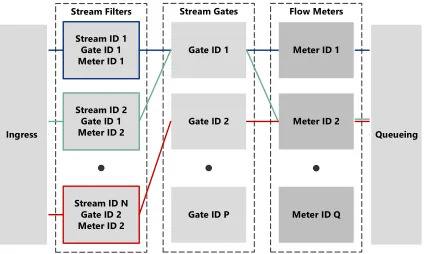
The focus in this work is the sub-standard IEEE 802.1Qci [4]. It describes an ingress control through per-stream filtering and policing. Figure1shows the structure of the filtering and policing specification. The shown mechanism has an instance after each port ingress of a TSN networking device. The result is that all ingress traffic is filtered. There are three stages an incoming frame has to pass through before it is queued. The first stage consists of a set of stream filters. They configure which gates and meters are responsible for handling frames of a specific stream id. Secondly, there are stream gates. Those have one of the two states ”OPEN” or ”CLOSED”. This state can change based on a static defined schedule based on a system-wide clock. If the gate is ”CLOSED”, the frame will be dropped. If the responsible gate is in the state ”OPEN”, the frame will be handled by the responsible flow meter. The flow meters stage contain unique algorithms to assert if a message is allowed. After the meter allows a frame, it gets queued in the network node for subsequent forwarding or processing. This work presents a meter concept called Credit Based Meter (CBM) (See section3).
Miller and Valasek [9] described in detail how to obtain control over an unaltered passenger vehicle. They gained control over safety-critical elements like engines and brakes over a remote cellular connection of the infotainment system. The infotainment system is part of the inter-nal CAN-based communication infrastructure, and CAN buses in this infrastructure contain virtually no security measures. At this point, the authors used reverse engineering to get infor-mation over the communication between in-car control units. In the next step CAN messages are forwarded over the infotainment system into the internal communication which is received and processed by the control units.
In consequence, security measures must be included in future automotive communication systems. Simulations of in-car networks [11] are an essential method to study the behavior of such systems in detail. This work presents one solution for protecting the in-car communication from DoS attacks and analyses it in the simulator. In those scenarios, a compromised stream is used to burst frames into networking devices to overload there capabilities. The result could be lost or delayed frames of not compromised streams.
3
Credit Based Metering
R-RA
0
BE Frame
Stream Frame
Ing
re
ss
CBM Cred
it
First incoming Stream Frame
Stream
Frame StreamFrame
t1 t2 t3 t4 t5 t6
Best Effort delays Stream Stream Frame receiving not allowed
Third incoming Stream Frame CBM Stat
e
R-RA R-RF
Figure 2: Credit Based Metering state machine The Credit Based Meter (CBM) is an
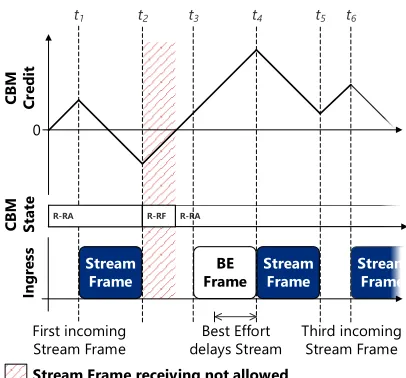
ingress counterpart for the Credit Based Shaper (CBS) egress behavior defined in IEEE 802.1Qbv [3]. In general, a CBM is based on a credit value manipulated by two different gradients called ”idleslope” and ”sendslope”. Frame reception is allowed when the credit is greater or equal to zero. When the credit is lower than zero, an incoming frame will be dis-carded.
idleslope=RB (1)
sendslope=RB−B (2)
These gradients are composed of an accumulated reserved bandwidth (RB) of the streams passing the meter and a total bandwidth (B) of the port (See equation1and2).
Additionally, the CBM contains a maximum burst size parameter (Burstmax) configuring the maximum count of frames that are allowed in an incoming stream burst. This is used in combination with the sending duration (Tduration) of one frame. Tduration is composed of the frame size (F Sstream), the port bandwidth (B) and the Ethernet inter frame gap (Tif g) to calculate the maximum credit value (Creditmax) of the CBM shown in equations3 and4.
Tduration=
F Sstream
B +Tif g (3)
Creditmax=|sendslope| ∗Tduration∗(Burstmax−1) (4)
The CBM has two states. They are ”RUNNING RECEIVING ALLOWED” (R-RA) and ”RUNNING RECEIVING FORBIDDEN” (R-RF). When the CBM starts the state is R-RA and the credit is set to zero. The credit starts to increases according toidleslope till the first frame is incoming or the credit reaches the maximum (Creditmax).
In the R-RA state, the credit is decreased by ”sendslope” for the receiving duration of a frame. When the frame is queued the credit increases again with ”idleslope”. If the credit is greater or equal to zero, a new frame reception is allowed, and the credit decreases again by
”sendslope”. When the credit reaches the maximum, it stays on this value until a frame is
incoming.
If the credit is lower than 0, the state will be switched to R-RF. In R-RF each incoming frame will be deleted. Simultaneously, the credit increases with ”idleslope”. The state is changed back to R-RA when the credit reaches 0.
In figure2, an example of the CBM algorithm behavior is shown. Firstly, the state is R-RA and the credit is 0 and increases according to ”idleslope” until the first frame arrives (see t1
in figure 2). The credit decreases by ”sendslope” for the duration of the frame (t2 in figure
2). Now the state is changed to R-RF and the credit increases by ”idleslope” till it reaches 0. The state changes to R-RA, and the credit increases further until the next frame arrives. This is delayed by an incoming best effort (BE) frame (t3 in figure2). The next frame arrives
and the credit is decreased again (t4 tot5 in figure2). The credit increases till the third frame
receiving starts (t6 in figure 2). So again the credit decreases by ”sendslope” until the end of
the transmission duration.
The performance of the CBM is dependent on Burstmax. A target configuration of this parameter is as low as possible and still supports a valid worst-case scenario. On the one side, this is because of the counterpart CBS. The valid maximum frame burst of a stream that is produced by a CBS algorithm egress is dependent on its specific worst-case scenario. On the other side, an attack creating a maximum frame burst could not harm the network because it is designed to support the worst-case traffic workload.
There are different ways to determine a minimalBurstmaxvalue. One example is analyzing the worst-case burst behavior for each streams output port (Burstout). Burstmax has to be calculated, as shown in equation5to allow one closeup frame following the burst.
Burstmax=Burstout+ 1 (5)
Another example of determining aBurstmaxvalue is by simulating different configurations to find one that fits the requirements.
4
Case Study
This section evaluates the integration of the Credit Based Meter algorithm inside IEEE 802.1Qci. This is done by using the OMNeT++ (https://omnetpp.org/) simulation environment with INET (https://inet.omnetpp.org/) and our CoRE4INET framework. CoRE4INET enables in-car network simulations [7] and the simulations of TSN features [8]. For this work, the CoRE4INET is extended with IEEE 802.1Qci and CBM implementations.
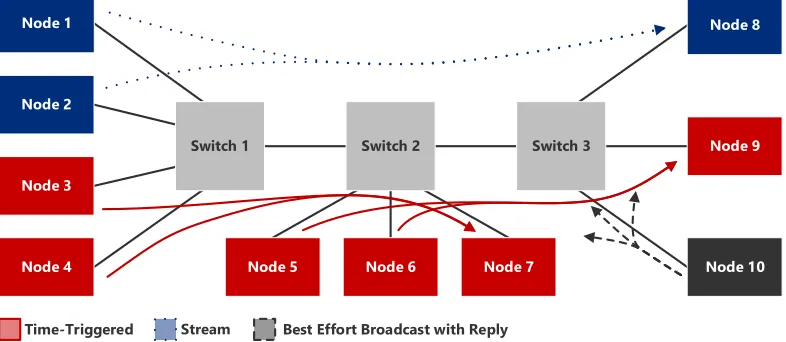
The chosen topology is known from previous work [8] and is designed to create critical links with multiple concurrent traffic. Figure3 shows this topology. In this topology, time-triggered traffic is based on TDMA with the highest priority. Two configurations are simulated. The first is a configuration with active CBM filtering. The second one emplaces a compromised ”Node 1” into the simulation, which is spamming a DoS attack into the network.
Time-Triggered Stream Best Effort Broadcast with Reply Node 1
Node 2
Node 3
Node 4
Switch 1 Switch 2 Switch 3
Node 10 Node 9 Node 8
Node 6 Node 7
Node 5
Figure 3: Simulation Topology
• All links are configured with a bandwidth of 100 Mbit/s.
• ”Node 1” and ”Node 2” are the sources of ”Stream 1” and ”Stream 2” with ”Node 8” as its destination. Both streams have a reserved route with an individual bandwidth of 25 Mbit/s. Each stream is passing a CBM on all devices and gates are ”OPEN”.
• Full-size time-triggered frames are generated by ”Node 3”, ”Node 4”, ”Node 5” and ”Node 6”. The first two are received by ”Node 7” and the latter by ”Node 9”. In all switches, a gap of 123µs is configured to allow intermediate frame bursts.
• For extra background traffic ”Node 10” is broadcasting full-size best-effort Ethernet frames. All nodes are replying by sending a full-size best-effort frame back to ”Node 10”.
The worst-case output stream burst sizes (Burstout) are known in this base configuration. They are 2 for ”Node 1” and ”Node 2” and, because of the concurrent TDMA traffic 4 for ”Switch 1” and ”Switch 2”. Therefore theBurstmax value for CBM filtering in ”Switch 1” is 3 for both input ports and 5 for the input metering in ”Switch 2” and ”Switch 3” (See equation 5in section 3).
The results shown in this section are a selection of results generated by the simulations. All shown simulation results are based on 10 seconds duration runs.
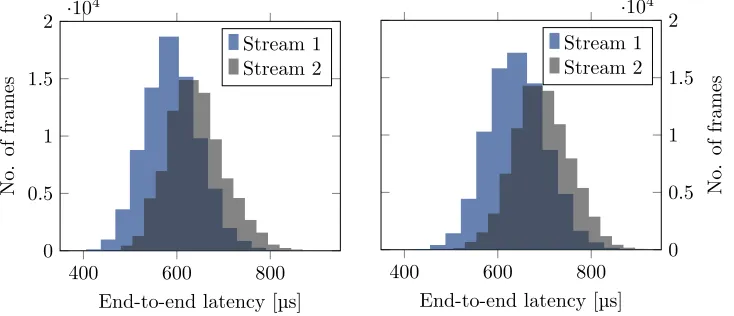
The first result set (Figure 4 and 5) presents and compares the end-to-end latency of the streams in both configurations. Due to the assumption that valid packets are not influenced by the CBM, these latencies are expected to be nearly the same.
400 600 800 0
0.5 1 1.5
2 ·10
4
End-to-end latency [µs]
No.
of
frames
Stream 1 Stream 2
Figure 4: End-to-end latency of frames per stream without attack
400 600 800
0 0.5 1 1.5 2 ·104
End-to-end latency [µs]
No.
of
frames
Stream 1 Stream 2
Figure 5: End-to-end latency of frames per stream during an attack
10 20 30 40 50 60
10 20 30 40 50 60
Input bandwidth [Mbit/s]
Output bandwidth [Mbit / s] 0 0.5 1 ·104
No. of frames dropp ed p er second Bandwidth relationship Frames dropped
Figure 6: Impact of CBM on Stream 1 in Switch 1 Figure 5 shows the end-to-end
latency of the streams in a configu-ration where ”Node 1” is corrupted. All nodes and switches are using CBM ingress control again. The dif-ference is that ”Node 1” is generat-ing the ”Stream 1” packets in an in-valid pattern. This is done by spam-ming subsequent frames.
The comparison shows no signif-icant differences between the config-urations. This demonstrates that CBM is successfully enforcing the correct behavior. This is done by removing all ”Stream 1” frames of the corrupted source that would ex-cel the reserved bandwidth. There-fore ”Stream 2” is not affected by ”Node 1” spamming.
Figure 6 presents output bandwidth size and number of frames dropped in the CBM in ”Switch 1” for ”Stream 1” produced by eight simulation runs. For each run, the input bandwidth produced by ”Node 1” is incremented. The reserved bandwidth of 25 Mbit/s is fixed. It is expected that the output would not cross this reserved bandwidth value.
The result reflects the wanted CBM behavior. No frame is dropped, and the output band-width is the same as the input bandband-width until the input size overshoots the reserved bandband-width of 25 Mbit/s. At this point, the number of frames dropped increases as a function of the input bandwidth. Because each frame, which would exceed the reserved bandwidth, will be dropped by the CBM.
output bandwidth never exceeds the reserved bandwidth over time, it allows short crossings like its counterpart CBS.
−1,000 0 1,000 2,000 3,000 4,000 5,000
Creditmax
Credit
v
alue
F
rame on
ingress
146.5 146.625 146.75 146.875 147 0
10 20 30 40 50
Simulation time [ms]
Bandwidth
[Mbit
/
s]
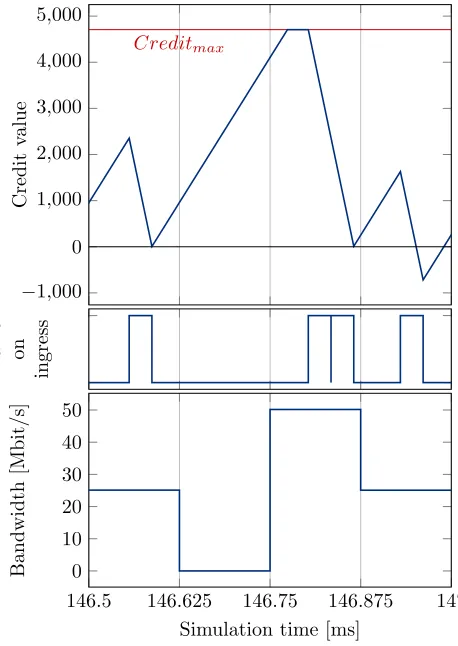
Figure 7: Section of CBM credit, frame, and bandwidth Because no frame is received
be-tween 146.625 ms and 146.75 ms the credit increases as a function of this duration. This continues until it reaches its maximum, which is de-pendent onBurstmax.
In this case, theBurstmaxvalue is 3. This results in a Creditmax value of ca. 4650. The correspond-ing equation6shows the calculation of thisCreditmax value.
Next, a continuous burst of 3 frames would be allowed. In this case, just two subsequent packages are incoming. This results in a zoomed in bandwidth of 50 Mbit/s between 146.75 ms and 146.875 ms.
This shows that the reserved bandwidth could be overshoot mas-sively for shorter periods. This is dependent on the configuration of
Burstmax. From this also follows
that Burstmax value has no
influ-ence on the over-time bandwidth re-striction. Buffer sizes have to sup-port the Burstmax values to guar-antee that they did not overflow.
The CBM enforces this upper barrier. For a configured network,
the maximum latencies could be calculated and are valid even if a malfunction or attack re-sults in an invalid behavior of individual network participants. This protects the integrity and availability of the in-car communication system.
Creditmax=|sendslope| ∗Tduration∗(Burstmax−1)
≈75 Mbit/s∗31µs∗(3−1) = 4650 (6)
5
Conclusion & Outlook
restrictions, but the credit boundary limits the bandwidth over an extended period. This limit is the same as the reserved bandwidth. The maximum burst parameter has to be as low as possible to gain the best performance. However, it still must allow the valid worst-case scenario of a specific input port. This trade-off between performance and worst-case estimation has to be considered.
In future work, the compatibility with other TSN traffic shaper concepts will be evaluated. Furthermore combined operation of different ingress control mechanisms will be simulated. In addition, the benefits of the ingress control metrics for anomaly detection will be analyzed.
Our simulation models and the extensions in this work are published atsim.core-rg.de.
Acknowledgments
This work is funded by the German Federal Ministry of Education and Research (BMBF) within the SecVI project.
References
[1] Stephen Checkoway, Damon Mccoy, Brian Kantor, Danny Anderson, Hovav Shacham, Stefan Savage, Karl Koscher, Alexei Czeskis, Franziska Roesner, and Tadayoshi Kohno. Comprehensive
Experimental Analyses of Automotive Attack Surfaces. USENIX Security, 2011.
[2] K. Iehira, H. Inoue, and K. Ishida. Spoofing attack using bus-off attacks against a specific ecu
of the can bus. In2018 15th IEEE Annual Consumer Communications Networking Conference
(CCNC), pages 1–4, Jan 2018.
[3] Institute of Electrical and Electronics Engineers. IEEE Standard for Local and metropolitan area networks – Bridges and Bridged Networks - Amendment 25: Enhancements for Scheduled Traffic. Standard, IEEE, March 2016.
[4] Institute of Electrical and Electronics Engineers. IEEE Standard for Local and metropolitan
area networks–Bridges and Bridged Networks–Amendment 28: Per-Stream Filtering and Policing. Standard, IEEE, September 2017.
[5] Institute of Electrical and Electronics Engineers. IEEE Standard for Local and Metropolitan Area Network–Bridges and Bridged Networks. Standard, IEEE, July 2018.
[6] Kirsten Matheus and Thomas K¨onigseder. Automotive Ethernet. Cambridge University Press,
Cambridge, United Kingdom, January 2015.
[7] Philipp Meyer, Franz Korf, Till Steinbach, and Thomas C Schmidt. Simulation of mixed critical
in-vehicular networks. InRecent Advances in Network Simulation, pages 317–345. Springer, 2019.
[8] Philipp Meyer, Till Steinbach, Franz Korf, and Thomas C. Schmidt. Extending IEEE 802.1
AVB with Time-triggered Scheduling: A Simulation Study of the Coexistence of Synchronous
and Asynchronous Traffic. In2013 IEEE Vehicular Networking Conference (VNC), pages 47–54,
Piscataway, NJ, USA, December 2013. IEEE Press.
[9] Charlie Miller and Chris Valasek. Remote exploitation of an unaltered passenger vehicle. Black
Hat USA, 2015:91, 2015.
[10] Syed Rizvi, Jonathan Willett, Donte Perino, Tyler Vasbinder, and Seth Marasco. Protecting an
automobile network using distributed firewall system. InProceedings of the Second International
Conference on Internet of Things, Data and Cloud Computing, ICC ’17, pages 174:1–174:6, New York, NY, USA, 2017. ACM.
[11] Till Steinbach, Hermand Dieumo Kenfack, Franz Korf, and Thomas C. Schmidt. An Extension of the OMNeT++ INET Framework for Simulating Real-time Ethernet with High Accuracy. In