Federalism and Australia’s National Health
and Health Insurance System
1
A Podger
2MANAgeMeNt
PrActIce
Abstract
While health reform in Australia has been marked by piecemeal, incremental changes, the overall trend to increasing Commonwealth involvement has not been accidental or driven by power-hungry centralists: it has been shaped by broader national and international developments including technological change and the maturing of our nation and its place internationally, and by a widespread desire for a national universal health insurance system. In many respects the Australian health system performs well, but the emerging challenges demand a more integrated, patient-oriented system. This is likely to require a further shift towards the Commonwealth in terms of financial responsibility, as the national insurer. But it also requires close cooperation with the States, who could play a firmer role in service delivery and in supporting regional planning and coordination. The likelihood of sharing overall responsibility for the health system also suggests there is a need to involve the States more fully in processes for setting national policies.
This article draws heavily on a lecture presented at the Australian National University in October 2015. It includes an overview of Australia’s evolving federal arrangements and the context within which the current Federalism Review is being conducted. It suggests Australia will not return to ‘coordinate federalism’ with clearly distinct responsibilities, and that greater priority should be given to improving how we manage shared responsibilities.
There is a long history of Commonwealth involvement in health, and future reform should build on that rather than try to reverse direction. While critical of the proposals from the Commission of Audit and in the 2014 Budget, the lecture welcomed the more pragmatic approaches that seemed to be emerging from the Federalism Review discussion papers and contributions from some Premiers which could promote more sensible measures to improve both the effectiveness and the financial sustainability of Australia’s health and health insurance system.
The Commonwealth’s new political leadership in 2015 seemed interested in such measures and in moving away from the Abbott Government’s approach. But the legacy of that approach severely damaged the Turnbull Government in the 2016 federal election as it gave traction to Labor’s ‘Mediscare’ campaign. In addition to resetting the federalism debate as it affects health, the Turnbull Government now needs to articulate the principles of Medicare and to clarify the role of the private sector, including private health insurance, in Australia’s universal health insurance system. Labor also needs to address more honestly the role of the private sector and develop a more coherent policy itself.
Abbreviations: COAG – Council of Australian
Governments; NHHRC – National Health and Hospitals Reform Commission; PHI – Private Health Insurance; VFI – Vertical Fiscal Imbalance.
Key words: Medicare; federalism; health insurance;
health outcomes; roles and responsibilities; coordinated care; private health insurance.
Andrew Podger
Honorary Professor of Public Policy Australian National University
Canberra, Autralian Capital Territory, Australia
Correspondence:
1 This article draws heavily on the 2015 Australian National University – Order of Australia Association Lecture delivered at ANU on 12 October 2015.
Background
The future of Australia’s federal system, and in particular how it deals with health and health insurance, is an issue that would benefit from less ideological debate and more informed public discussion and engagement focused on health outcomes. Perhaps Australia’s relatively new political leadership will be more willing than in the recent past to promote such public engagement despite the complexity and sensitivity of the issues involved.
Federalism and the subsidiarity principle
The subsidiarity principle emerged in Europe in the middle ages as the Catholic Church grappled with managing its vast empire. In essence, the principle is that responsibilities should be managed at the lowest or most local level where the public interests concerned are shared. Higher level intervention may only be justified if there are genuine interests beyond the local community to be considered. A corollary of the principle often mentioned in debates today is that each level of government should be responsible for the revenues needed to pay for its responsibilities, or vertical fiscal balance (VFI), though this corollary comes at the expense of preventing horizontal fiscal equity – the capacity to redistribute revenue from rich localities to poor ones.
The subsidiarity principle has several benefits including responsiveness to local conditions and preferences, a check on central power and potential efficiency gains as each local community weighs up the costs and benefits of government. Federal systems differ from decentralised government in that the sub-national governments have sovereignty and not just delegated authority. Thus they apply the principle of subsidiarity in a way that involves much more autonomy including the making of laws and the power to negotiate with other governments including the national government, rather than be ruled or over-ruled by the centre.
There are many forms of federations. Ours was originally a ‘coordinate federation’ where responsibilities are distinguished and each government is able to exercise sovereignty over its areas of responsibility. This was done in Australia with minimalist powers given to the Commonwealth, the outcome of the negotiations amongst the six colonies anxious not to cede too many of their powers to the new fledgling national government. The States retained almost all of their broad ranging powers under their own constitutions, but any law they pass that is inconsistent with a Commonwealth law (under the powers specified in its Constitution) is invalid. In effect, all the other powers remain with the States. Canada’s constitution
uses the reverse arrangement to achieve the same end: it specifies the powers of the provinces leaving the rest to the national government. Germany has a rather different approach where most policy responsibility lies with the national government but most administrative responsibility lies with the states (or Bundeslander).
These descriptions, however, greatly simplify the institutional arrangements involved including the design of the legislature, the structure and authority of the judiciary, the administrative arrangements and the inter-governmental machinery. The institutional arrangements reflect each country’s history, geography and culture. The descriptions also fail to reveal the dynamic nature of any federal system as it adjusts to changing social, economic and technological circumstances.
the Australian federation
Our federation was forged out of the history of separate British colonial settlements each operating under delegated British authority in a huge country with immense distances between capitals. Despite the geography, there was and remains a remarkable degree of homogeneity amongst the non-Indigenous populations of the States. Under the Constitution, until 1967, the Indigenous population was seen as a matter for the States and the federation was not driven by the need to assuage any other different ethnic or religious or language groups, or by vast differences in income and wealth.
This may help to explain why the Australian Senate, unlike the Canadian Senate, never operated as a States house but, from the beginning, operated on a party basis. Party distinctions have always been seen as more significant than state differences.
The Australian experience of increasing national power is not unique, though it has gone further than in many other federations. Most developed nations now face the challenge of highly mobile populations and capital requiring the national government to collect most revenue. Most also have economies that are not only more nationally integrated but also have substantial interaction internationally requiring national governments to take more responsibility for economic regulation, transport and communications. Modern communications technology and population mobility are also widening people’s contacts and associations, weakening some local cleavages and strengthening national and international orientations. All these forces have been increasing the role of national governments, but not necessarily removing responsibilities from sub-national governments: a common trend is an increase in shared responsibilities with the challenge of managing such responsibilities well and ensuring proper accountability.
Former conservative Prime Minister John Howard referred to his experience as an Australian politician with his fingers on the public pulse, including through his regular talk-back radio appearances, of voters today identifying far more with being Australian than belonging to a particular State or region, and of expecting the national government to address their concerns. [1, p.101]
Nevertheless, there is a real danger of the national government taking undue advantage of its revenue-raising capacity to meddle in matters that are not the business of those beyond each State. Also, of course, States may well meddle excessively in matters better managed by more local communities.
Federation review
The Government embarked on a Review of the Federation in 2014 working closely with the States in the process. The Review did not get off to a good start however with the Commission of Audit pressing for each jurisdiction to be ‘sovereign in its own sphere of responsibility’, the 2014 Budget unilaterally withdrawing promised funds to the States for hospitals and education, and the Review terms of reference repeating the simplistic line about ‘sovereignty in its own sphere’. [2] Fortunately, the discussion papers produced by Commonwealth officials convey more of the nuances of the issues and challenges Australia actually faces. (See in particular Department of Prime Minister and Cabinet, 2014b.) [3] They offer options not only for a significant shift of responsibilities back to the States but also some serious
options that would shift some responsibilities further to the Commonwealth. Most importantly, they give a great deal of attention to the challenge of better managing the growing range of shared responsibilities. They also include a more considered assessment of the oft-quoted concern about VFI – the sharp differences between revenues and expenditures that necessitate large transfers from the Commonwealth to the States. In doing so, the papers clarify that increasing State expenditure responsibilities would exacerbate the problem and therefore require an even bigger shift to the States’ revenue raising responsibility if VFI were to be reduced.
Commonwealth political leaders are yet to respond seriously to the substance of the issues and options raised. Fortunately, there have been some signs of more leadership at the State level, particularly from New South Wales, assisted by some very capable State civil servants (some being refugees from the Commonwealth). [4]
Despite claims by the Commonwealth that tax reform must deliver lower, simpler and more efficient tax, the premiers take the view that we will almost certainly need more revenues to pay for the services the community wants, whether delivered by the States or the Commonwealth. There are always ways to deliver government services more efficiently and we do need to limit government expenditure to what the community and the economy can afford but, as we become an older society, and as we become wealthier and health becomes increasingly important to us, it is inevitable that we will want to spend more on health and related services and that this is likely to involve more public as well as more private spending.
Just as a shared approach to tax reform is needed, a shared approach to expenditure reform is needed, and the outcome is unlikely to involve a total split of responsibilities establishing ‘sovereignty’ over revenue collections or expenditure policies. This is not to suggest no room for reform, but to suggest greater priority be given to improving how we manage shared responsibilities and focus more on achieving better health and education and housing outcomes, and a more efficient economy, rather than wasting effort on trying to re-establish a federation suited to 1901.
Health reform
Long history of Commonwealth involvement
Commonwealth involvement in health goes back to federation with the Constitution specifying that power relating to quarantine was concurrently enjoyed by the Commonwealth. It was based on this power that the Commonwealth first established a Department of Health in 1921 following strong encouragement by the Rockefeller Foundation concerned about the influenza pandemic after the First World War. Communicable disease was identified as a major concern that could not be managed by the States on their own, but nor could it be managed by the Commonwealth without involving health service providers across the country. By that time, the Commonwealth was also extensively involved in health care through the Constitution’s defence power, providing support for war veterans and their dependants under the repatriation system.
Until after the Second World War, the Commonwealth focused on public health and health and medical research (and war veterans) but, in line with the war-time compact to expand social services after the privations of the war (developed largely by a Parliamentary Committee), interest turned to developing a national health insurance system complementing the national social security system that began with the introduction of age pensions in 1909. [5-7, 8] The 1946 Constitutional change gave the Commonwealth new powers including to provide ‘medical and dental services (but not so as to authorise any form of civil conscription)’ and ‘pharmaceutical, sickness and hospital benefits’.
The Chifley Government then enacted the National Health Service Act but it was never fully implemented. Instead, the Menzies Government implemented what became known as the Page Plan through regulations under Chifley’s legislation involving the first Pharmaceutical Benefits Scheme and a Pensioners Medical Service (which included grants to the States for hospital care), and then hospital benefits and a Medical Benefits Scheme both based on voluntary private health insurance.
Under Menzies, the Commonwealth also entered the field of residential aged care, funding charitable organisations to provide nursing home and hostel care for eligible older Australians. And it operated large repatriation hospitals in every State.
By the time of the Whitlam Government, the Commonwealth was already dominant in the areas of non-hospital aged care, medical benefits and pharmaceutical benefits, and was involved with hospitals through funding to the States, hospital benefits for privately insured Australians and
the direct operation of repatriation hospitals. Despite the public controversies surrounding the original Medibank proposals, Medibank did not represent a massive extension of Commonwealth involvement; it did, however, radically shift the health insurance system from subsidised voluntary private insurance to a universal public insurance approach. Whitlam kept an insurance model, despite some Labor colleagues pressing for a British-style National Health Service, and he chose not to take over responsibility for hospitals but to greatly increase grants to the States on condition that hospital services for all public patients would be free.
Debates about universal health insurance continued throughout the 1970s and 1980s and into the 1990s, through a series of Medibank schemes under the Fraser Government that wound back universal insurance, the resurrection of the original scheme by the Hawke Government under the name ‘Medicare’, and promises by the conservative Opposition to abolish Medicare and to rely again on private health insurance. In 1996, however, John Howard promised to ‘maintain Medicare in its entirety’ and the scheme has had considerable bipartisan support ever since.
Indeed, for the most part the Howard Government initiatives built on the Hawke/Keating developments including in particular the strengthening of primary healthcare, moving away from just paying medical benefits to re-shaping general practice encouraging computerisation, bigger practices, incentives for better treatment of the chronically ill and improved immunisation and other screening. Bulk-billing in fact increased, services for Indigenous Australians continued to be extended and services in rural and remote areas improved. The Commonwealth also greatly extended its support of aged care beyond residential care, encouraging ‘ageing in place’, and establishing stronger quality controls.
The Commonwealth became more interested in health outcomes and the effectiveness of the health services it was funding, not just in health financing and insurance. Its agreements with the States on hospital funding began to identify performance and to promote increased efficiency and, working with the States, it began to take a direct interest in quality and safety. By then, the Commonwealth had withdrawn from directly managing its repatriation hospitals but had developed sophisticated approaches to purchasing hospital services for veterans from both State and private hospital providers.
of bitter debate about the best approach to health insurance, but also to highlight the scale of Commonwealth involvement and the lack of any sense of public opposition to the Commonwealth widening its interest in healthcare services. While he may not have handled the situation well, Kevin Rudd gained considerable public support in 2007 for his suggestion (or threat) that the Commonwealth take full financial responsibility for public hospital services. To the extent there was concern about the Commonwealth involvement, it was about unnecessary bureaucratic processes, too many small programs each with its own rules, and the lack of a clear overall strategy.
Blurred accountabilities, however, remain a major problem as our history of piecemeal developments has left the Australian system with a very confusing division of responsibilities and funding arrangements that has resulted in the so-called ‘blame game’. But there is no evidence of public support for transferring responsibilities away from the Commonwealth to the States.
So what are the practical problems with current arrangements, and where might future reform take us?
Changing demand on the health system
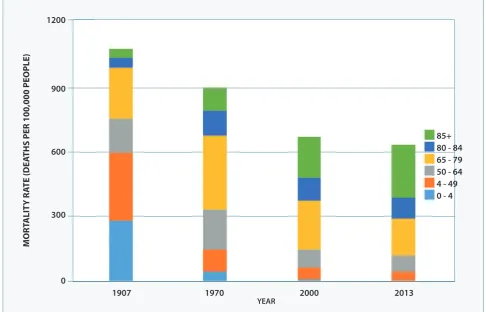
In many respects our biggest challenges are the flipside of our successes. Life expectancy has increased steadily at a remarkable pace – around one extra year of life every four years. Most of the increase is in years of healthy living, with the average period of incapacity declining as a proportion of our lives. Whereas the increase in life expectancy over most of the last century was the result of reductions in mortality amongst children and then amongst those up to middle age – meaning many more people reached age 50 or more – the increase in life expectancy since about 1970 has been driven more by reductions in mortality at older ages – meaning people having reached age 50 live longer. This trend is continuing. Since 1970, mortality rates amongst those aged 50 to 64 and amongst those aged 65 to 79 have steadily fallen. We all have to die sometime so the rates for those over 80 have increased, but now the rates for those aged 80 to 84 are actually falling. Projections suggest rates for those aged 80 to 89 may soon start to decline, with only rates for over 90s increasing.
Figure 1: Changes in Mortality Rates 1907 to 2013, Australia
Source: Australian Institute of Health and Welfare, 2016a [9]
85+ 80 - 84 65 - 79 50 - 64 4 - 49 0 - 4
1907 1970 2000 2013
YEAR
1200
900
600
300
0
M
ort
A
lI
ty
r
Ate
(D
eA
tHS P
er
100,000 P
eo
Ple
The downside of this remarkable success is that we have many more frail old people now and more with chronic illnesses such as heart disease, cancer and diabetes even while average years of healthy living are increasing at least as fast as life expectancy. Modern technology also means large numbers of people with chronic conditions are able to live comfortably and even independently, fully participating in society. But they, and those with more debilitating conditions, most often rely on a mix of services and medicines. So demand on our health system has shifted dramatically from people requiring episodic care via occasional visits to the GP or to a hospital or finally to support in an aged care home, to the chronically ill and frail aged needing a mix of support from GPs, specialists, hospital visits for surgery, physiotherapy, psychology, dialysis and so on. The Australian Institute of Health and Welfare estimates the chronically ill now represent about 80 per cent of the burden of disease. [10, p.54] Not all of the shift is age-related, with increasing concern about obesity in particular raising the risks of chronic illness at young as well as older ages. The yawning gap between Indigenous and non-Indigenous health demonstrates that there remain serious failures to address, but evidence suggests that these too require a holistic approach to health service delivery rather than reliance on separate service providers.
This demand shift that has been underway for over thirty years now has exacerbated the boundary problems that have long existed in our health system, problems that were already more serious in Australia because of the unique division of responsibilities between the Commonwealth and the States, and between public and private health insurance arrangements.
The challenge is to shift the architecture of the system away from an emphasis on the different types of providers and products – GPs, specialists, pharmaceuticals, hospitals, aged care facilities – to a focus on patients according to their particular health needs.
Measures being taken
Considerable effort has been made to move in this direction over the last twenty five years. The gradual strengthening of general practice and encouragement of better management of chronically ill patients has begun to widen the healthcare services available, improve coordination and promote more continuity of care. The developing role of regional primary health organisations, despite some unfortunate politicking and unnecessary disruptions, has the potential to facilitate better links between hospitals and primary healthcare and
to lead to useful initiatives such as better out-of-hours GP services and other measures to reduce pressure on emergency rooms. This seems to have been most successful where partnerships have been forged between the organisations and the regional hospital networks managed by the States.
The increasing role of aged care packages is also ensuring a more careful approach to responding to healthcare needs, offering services appropriate to individual needs and allowing more choice about where people may live. The packages also have the potential to reduce demand on hospitals.
There have been major investments into information systems and there are signs of improving information exchange between GPs, specialists and hospitals. The goal of a single electronic health record is still a long way off, but we should not ignore the improvements that have been made.
Further steps are on the agenda, amongst them the MBS Review Taskforce which is examining the list of medical services on the MBS and the Primary Health Care Advisory Group which recently identified further opportunities to reform primary healthcare focusing on the management of people with complex and chronic disease. [11,12] A tantalising possibility identified by the Advisory Group is to shift further from reliance on fee-for-service (which encourages more services) to other forms of funding for the chronically ill to promote continuity and coordination of care and better health outcomes. [12, p.9]
More recent developments and options
In 2004 John Howard asked me to conduct a review into the delivery of health and aged care services. I reported in 2005 (the report has never been made public) recommending a package of incremental reforms, most of which he and his health minister, Tony Abbott, accepted, including to widen Commonwealth involvement in aged care, invest further in primary healthcare and invest further in information technology; I also recommended strengthening regional health service planning and coordination but that idea was not pursued at the time. In the longer term, I suggested, the Commonwealth should consider taking full financial responsibility for the health and aged care system based on a regional framework, advising that this was indeed viable but also noting the scale and risks involved in such a reform The Prime Minister and Health Minister agreed that in principle the Commonwealth having full financial responsibility made considerable sense, but in view of the risks involved in any transition they decided to focus attention on the incremental measures I had recommended. These, I had emphasised, were designed in part to make it easier sometime in the future to consider again this more radical structural reform.
When he came into power in 2007, Kevin Rudd flirted, as mentioned, with the idea of a full financial takeover but he ended up pursuing a less radical (but by no means modest) set of reforms. He established the National Health and Hospitals Reform Commission, (NHHRC) which recommended in 2009 substantial structural changes. [14] These included the Commonwealth taking full financial responsibility for primary healthcare, Indigenous health and aged care, sharing directly the risks associated with hospital financing to reduce any incentives to cost shift, and establishing a firmer regional planning framework building on the Divisions of GPs; but the report fell short of recommending a full Commonwealth financial takeover. The report also identified an even more radical option for more careful study, that would allow individuals to select their own insurer or healthcare manager to manage their Medicare health service entitlements in exchange for receiving their assessed Medicare risk-related premium, a ‘managed competition’ option they named ‘Medicare Select’. In this model, people would either charge their medical, pharmaceutical and hospital costs to Medicare as most do now, or to their chosen insurer or healthcare manager which the Government would pay via an assessed Medicare-equivalent premium (and which might charge an additional premium for additional coverage). The payment of Medicare
premiums to funds would replace the PHI rebate and the Medicare surcharge exemption for PHI members.
Rudd did not pursue Medicare Select but he did propose going somewhat further than the NHHRC Report’s main recommendations, in particular increasing Commonwealth financial involvement in hospital financing in exchange for a share of GST revenue as well as widening the Commonwealth’s role in primary health and aged care. This was clearly a bridge too far at the time and the subsequent Gillard Government negotiated a deal that confined itself to some but not all of the Bennett Report measures. Gillard retained the proposed regional primary healthcare organisations (unfortunately named ‘Medicare Locals’ by Rudd), relying on these to work with State regional hospital networks and new regional aged care arrangements to soften boundaries between primary and acute care and between aged care and hospitals. This complemented the most expensive measure in the deal, the Commonwealth agreeing to share directly the risks associated with hospital services by replacing block grants to the States with payments directly to hospital networks for a fixed share of the ‘efficient price’, whatever the level of demand.
The Abbott Government’s approach was confusing. While promising not to cut health spending, Abbott had foreshadowed concerns about both spending levels and the role played by the Medicare Locals, the latter reflecting criticism by some GPs that their role in primary healthcare was being undermined. There was some basis to this criticism and the very name, ‘Medicare Locals’, suggested they would deliver services directly rather than focus on planning and commissioning existing providers to fill gaps. The Government abolished the organisations and replaced them with so-called Primary Health Networks; hopefully, these will be able to draw on the often positive experience and expertise of those involved in the former Medicare Locals (and the GP Divisions before that), and not have to reinvent the wheel entirely.
of block grants indexed to prices. The terms of reference for the Review of the Federation released later included similar language, seemingly hinting that there might be a further shift of responsibilities to the States and a firm separation of responsibilities within the health system. [15]
Next steps
Fortunately, the bureaucrats responsible for preparing discussion papers for the Review were able to convince their political masters to allow other approaches to be canvassed, ones that start by addressing the issues from the perspective of more effective and efficient health services and improved health outcomes. Of the five options identified in the paper prepared for the June 2015 Council of Australian Governments (COAG) Retreat, only one involved a significant transfer of responsibility to the States (via full responsibility for public hospitals). [3] Two options involve more sharing of responsibilities (for care packages for the chronically ill and for regional purchasing agencies) and two involve transferring more responsibility to the Commonwealth (via a new hospital benefit and via a health purchasing agency).
There was no sign of support amongst Premiers for the first option, but comments by South Australian Premier Weatherill suggested there may well be support for the option of a Commonwealth hospital benefit. This could build on the Rudd/Gillard initiative for the Commonwealth to share the risk of growth in hospital episodes, at least to some proportion of the efficient price. This is already promoting greater efficiency in public hospitals and, if taken further, could also promote greater cost effectiveness in the health system as a whole. It could for example make it easier to introduce the option of shared funding of care packages for the chronically ill, managing this at the regional level between the States’ local hospital networks and the Primary Health Networks, and reducing the current emphasis on fee-for-service for GPs through whole-of-care funding for registered chronically ill patients.
In other words, future reform that would actually improve the health system is most likely to involve more Commonwealth financial involvement, not less, and probably more shared responsibilities not fewer. The danger, however, is that this will continue or increase the blurring of accountability and mean the blame game will continue.
An approach that would limit this risk is to clarify respective roles within areas of shared responsibility, and to reform the way in which national policies are established when
responsibility is shared. In particular, the Commonwealth might continue to increase its share of financial responsibility playing the role of the national health insurer, while the States might increase their role in service delivery. To promote greater integration of services on the ground and more patient-oriented care, States need to continue to strengthen local and regional capacity for planning and coordination (working with the regional Primary Health Networks) and for local delivery (in the case of public hospitals). This transformation has been underway for some time now, and may take more time to complete, but it would be unfortunate if we were to reverse the process. It has been contributing to improvements in the health system and, if well handled, could also contribute to improvements in the federation and in expenditure control.
Reforming the way national policies are established when responsibility is shared, means giving the States a genuine place at the table. It also means constraining the capacity of the Commonwealth to impose additional rules and processes that may limit local flexibility and innovation. Recent experience, not just under the current government, has been in sharp contrast with such an approach. Hopefully the atmosphere of cooperation that seemed to surround the COAG retreat in June 2015, combined with the change in the leadership of the Commonwealth Government, is the beginning of a more cooperative style.
Private health insurance and Medicare
The role of private health insurance (PHI) in our national health and health insurance system may also have significant implications for federal relationships. Regulation and support for has been a Commonwealth responsibility since the early 1950s under the Page Plan.
Government policy tends to focus simply on the level of PHI membership; it rarely focuses on the more important issues of efficiency and effectiveness of the insurance and the services covered, and the ease for consumers to decide on their cover and how to use it.
There are two main options for making our approach coherent and user friendly. The first is to remove any government support for PHI and to allow it to play a residual role to the universal health insurer, Medicare, where people may choose to opt out at their own expense. The second is the Medicare Select approach where Medicare can be managed by PHI funds (or other health management organisations), people being able to choose to direct their Medicare risk-rated premium to their preferred fund. The funds could charge extra to cover more services or particular service providers, but must cover at least those otherwise met by Medicare. This article does not canvass the relative merits of these two options, but notes that either would make more sense than current arrangements. Several other observations are relevant to federal responsibilities and to possible policy directions for the two major parties. The first is that the second approach could only be implemented if the Commonwealth had full financial responsibility for Medicare and could appropriate the money for the risk-rated premium vouchers to be passed on to the nominated PHI funds. Proponents of a greater role for PHI need to appreciate that that almost certainly implies a greater role for the Commonwealth in funding the national health insurance system. The Medicare Select approach is mentioned in the COAG discussion paper but is not included in the list of options for reform at this time because of its complexity, but it remains a serious model for future consideration.
The second point is the lack of a coherent approach by either side of politics at the moment. Labor’s ‘Mediscare’ campaign in the 2016 federal election accusing the Turnbull Government of planning to privatise Medicare does them no credit. Medicare is an insurance scheme not a national health system like the United Kingdom’s; health services are delivered by both the private and the public sector and, to some extent, Medicare’s health insurance has been delivered in part by the private sector as well. Parts of the payment system such as its IT support have long been outsourced. Moreover, Labor continues to support subsidies for PHI via both the PHI rebate and the Medicare levy surcharge exemption. Its means testing of the PHI rebate was also a sleight of hand; high income earners with PHI paid more tax through the loss of the rebate and those without PHI paid more tax through the increased levy surcharge, so that the
measure was just a messy tax increase that in fact increased subsidies for PHI and reduced transparency.
The Coalition’s apparently unconditional support of PHI, on the other hand, allows critics to doubt its commitment to Medicare. Labor’s ‘Mediscare’ campaign gained traction for this reason, and because of the measures pursued in Abbott’s 2014 budget. Complaints about Labor’s tactics might have more credibility if the Turnbull Government articulated the Medicare principles it is committed to, and moved to clarify the role it sees for the private sector consistent with those principles.
The Canadians have demonstrated the value of articulating the principles behind Medicare. Our principles may differ a little from Canada’s and we may not need to follow Canada’s practice of putting them into legislation. We should however look to explore our system’s principles through COAG in order to gain a shared Commonwealth and State view, and to debate them in the Parliament. The key principles in my view are:
1. Universal coverage: that all Australians should have access to health services according to their health needs; 2. Equitable financing: that the health system should be
funded according to people’s capacity to pay;
3. Efficiency and effectiveness: that government support for the system should be based on cost effectiveness in terms of health outcomes; and
4. Consumer and provider satisfaction: that the system should be oriented to patients and consumers, providing safe, high quality and convenient healthcare, while also respecting the professionalism of those providing the services.
Expenditure control
Another critical issue is the growing total cost of Australia’s health system and the risk that we are not achieving value for money. How can we improve efficiency and cost effectiveness, and are there implications here also for the most appropriate federal arrangement?
Health insurance, like any insurance arrangement, presents the risk of ‘moral hazard’: the fact that a third party – the insurer – must pay for a service provides an incentive for both the insured person and the service provider to press the envelope and oversupply. This may involve increasing the price, adding extras to the service, exaggerating the event that gave rise to the insurance claim and so on. Insurers try to contain the problem by imposing copayments or by limiting eligible service providers or by having their own inspectors assess the damage or by requiring service providers to compete; they also look to reward behaviour which reduces risks. Moral hazard is much harder to handle in the case of health insurance.
While there are no doubt cases of conscious exploitation, more commonly the problem arises because doctors really do want the very best for their patients and they view any attempt by the insurer to constrain the service as placing in jeopardy the doctor-patient relationship. It is also clear that information asymmetry (the reliance of patients on their doctors’ advice) and the limited level of competition amongst doctors allows some doctors to charge substantial fees reducing the value of the insurance product.
Health economists emphasise the importance of supply side measures in controlling expenditure and addressing value for money, and not just demand side measures (health economists also emphasise investment in preventative measure to reduce demand and not just co-payments). Allocative inefficiency has also long been a concern and the increasing level of chronic illness increases this risk as too much may be spent on hospitalisations and not enough on GPs and allied health support, or on preventive measures and early detection of illness.
Let me touch on each of these aspects of cost control and achieving best value for money. First, the issue of co-payments as a form of demand-side control. The Commission of Audit and the 2014 Budget proposal to introduce a GP co-payment was widely criticised for being unfair. In my view, the proposal was deeply flawed not because it was unfair but because it was unlikely to have much effect on efficiency, and because it failed to address the need to develop a more coherent system-wide approach to co-payments
and safety nets that might constrain over-servicing while guaranteeing maximum total out-of-pocket expenses and preserving good access to cost-effective primary healthcare. We have an extensive system of co-payments and safety nets applying to prescription drugs, a haphazard system of copayments for GP and specialist visits and no co-payments for public patients in hospitals. Achieving a coherent system that is not based on each service but on each patient’s total Medicare services and expenses will remain hard while we have separate funding arrangements.
Second, the issue of supply-side measures. Australia was a pioneer in introducing cost effectiveness rules for listing and pricing pharmaceuticals on the PBS. As the Grattan Institute has observed, however, we could apply the rules more firmly, in particular making more use of generic drugs and using their prices as benchmarks for relevant new products. [17] Australia also broke new ground when it imposed similar cost-effectiveness rules to new MBS services. The current MBS Review Task Force is rightly now examining all the existing services on the schedule to see whether they are justified and whether the price reflects their effectiveness. The Grattan Institute has also identified several cases where evidence reveals that the medical service subsidised by Medicare is not only not cost-effective, but is not effective at all and is possibly unsafe. [18] As with the PBS process, this review needs – and has – firm clinical leadership but also economic input. As mentioned earlier, the Primary Health Care Advisory Group also advocated reducing the MBS reliance on fee-for-service (which tends to encourage over-servicing).
The process of identifying ‘efficient prices’ for public hospital episodes is already driving efficiency gains, building on those from the earlier introduction of case-mix financing. The 2014 Budget measure to return to Commonwealth block-funding for State public hospitals may have reduced the Commonwealth’s Forward Estimates but only by shifting the costs to the States. In jeopardising the development of efficient pricing across our public hospitals it could also undermine moves to improve efficiency (and cost savings) in the system as a whole.
Thirdly, however, we need to do more to address allocative efficiency, not just efficiency within each of our major programs. A surprising weakness in our national health insurance system has been the failure to act as an insurer – to link existing data across the system and to analyse it to identify financial and health risks, and to identify the additional data we need to identify both health needs and health outcomes, and to track people over time. Such data would not only help the managers of our insurance system but also provide valuable feedback to clinicians and data for researchers. Some progress is now being made but we have a long way to go. The emerging regional health system arrangements also offer the potential to support better allocation of resources. The Primary Health Networks may have small budgets, but they have the flexibility to ensure they are used to fill gaps and to improve important connections that could reduce hospitalisations and ensure more cost-effective care. Linking data could also allow each region to identify the costs of healthcare services to its population, allowing comparisons to be made against benchmark costs given the known health risks, and against clinically ideal patterns of service utilisation. This could guide not only the regional primary health and hospital networks but also officials at the State and Commonwealth level in considering allocations of funds between regions.
Returning to my overall theme of the health system’s federal arrangements, there is little evidence to suggest that returning more responsibility to the States would promote greater efficiency. There is a strong case for a more integrated approach and continuing to move towards the Commonwealth being the national insurer, so long as the Commonwealth does more to act as an insurer and to pursue supply-side cost effectiveness measures and establish a more coherent system of demand-side controls. There is also a strong case for regional flexibility and capacity to influence the allocation of funds.
conclusion
Australia’s approach to federalism has been described as ‘pragmatic’. [19] While that is not entirely a positive description, encompassing as it does occasional ‘opportunist’ political game-playing, it is preferable to ideologically or theoretically driven approaches. The reform process that began in 2014 could be given a more positive, pragmatic flavour, focusing on tangible improvements in public services and increased efficiency, rather than ideological considerations. There were signs last year of a greater focus on particular areas of public services – health, education
and housing – and on how changes in federal arrangements might improve their effectiveness and efficiency.
While health reform in Australia has been marked by piecemeal, incremental changes, the overall trend to increasing Commonwealth involvement I would argue has not been accidental or driven by power-hungry centralists: it has been shaped by broader national and international developments including technological change and the maturing of our nation and its place internationally, and by a widespread desire for a national universal health insurance system.
In many respects the Australian health system performs well, but the emerging challenges demand a more integrated, patient-oriented system. This is likely to require a further shift towards the Commonwealth in terms of financial responsibility, as the national insurer. But it also requires close cooperation with the States, who could play a firmer role in service delivery and in supporting regional planning and coordination. A clearer distinction between roles (for example, funder versus provider), seems a more sensible basis for reform discussion than an attempt to fully separate responsibilities within the health system.
The likelihood of sharing overall responsibility for the health system also suggests there is a need to involve the States more fully in processes for setting national policies. A good start to this might be made if the Turnbull Government suggested to COAG some core Medicare principles that might guide future reforms and avoid the misleading political rhetoric that undermined constructive debate in the 2016 election.
references
1. Hollander R. John Howard, Economic Liberalism, Social Conservatism, and Australian Federalism. Australian Journal of Politics and History. 2008;53(1):85-103.
2. National Commission of Audit. Towards Responsible Government, The Report of the National Commission of Audit, Canberra: Australian Government; 2014.
3. Commonwealth Department of Prime Minister and Cabinet, 2014b. Roles and Responsibilities in Health. Issues Paper 3, Reform of the Federation White Paper. Canberra.
4. Australian Politics. COAG Discussions focus on Terrorism, Federation and Taxation [accessed 3 Nov 2016]. Available from: www.
australianpolitics.com/2014/10/10/coag-meeting-communique- press-conference.html
5. Joint Parliamentary Committee on Social Security. Sixth Interim Report: A comprehensive health scheme. Canberra; 1943. 6. Joint Parliamentary Committee on Social Security. Seventh Interim
Report: Commonwealth hospital scheme, hospitalisation, consolidation of social legislation Canberra; 1944.
8. Herscovitch A, Stanton D. History of Social Security in Australia. Family Matters. 2008;80:51-60.
9. Australian Institute of Health and Welfare. General Record of the Incidence of Mortality Workbooks 2016a, [accessed 15 August 2016]. Available from: www.aihw.gov.au
10. Australian Institute of Health and Welfare. Australia’s health 2016. Canberra: AIHW; 2016b.
11. Commonwealth Department of Health. Medicare Benefits Schedule Review Taskforce, Interim Report to the Minister for Health. Canberra; DoH; 2016.
12. Commonwealth Department of Health. Better Outcomes for People with Chronic and Complex Conditions, Report of the Primary Health Care Taskforce. Canberra: DoH; 2015b. 13. Commonwealth Department of Health and Aged Care. The
Australian Coordinated Care Trials: final technical national evaluation report on the first round of trials. Canberra: AGPS; 2001. 14. National Health and Hospitals Reform Commission. A healthier
future for all Australians, Final Report. Canberra.
15. Commonwealth Department of Prime Minister and Cabinet. A Federation for the Future, Issues Paper 1, Reform of the Federation White Paper. Canberra; 2014a.
16. Commonwealth Department of Health. Private Health Insurance Consultations 2015-16, [accessed 3 Nov 2016]. Available from: www.health.gov.au
17. Grattan Institute. Premium Policy? Getting better value from the PBS [accessed 3 Nov 2016]. Melbourne; 2015a. Available from: www.grattan.edu.au
18. Grattan Institute. Questionable care: avoiding ineffective treatment [accessed 3 Nov 2016]. Melbourne; 2015b. Available from: www. grattan.edu.au