ISSN: 2334-2986 (Print), 2334-2994 (Online) Copyright © The Author(s). All Rights Reserved. Published by American Research Institute for Policy Development DOI: 10.15640/jea.v4n2a16 URL: https://doi.org/10.15640/jea.v4n2a16
Road Safety Audit from Design Point of View at the Western Balkan Countries
Esat Gashi1, Micaël Tille2, Gjynejt Mustafa3
Abstract
Road accidents are caused by a combination of factors although relationships between accidents and those factors causing them, or contributing to the causes, are not well understood. The interaction between road, vehicle and the road user obscures the determination of accident causes. In qualitative terms, it is a well-known fact that physical features of a road network, together with the traffic volumes on that network are the main explanatory factors of the mean number of accidents happening on that network. Western Balkan Countries (WBC) countries are among the “worst road safety performers in Europe” based on road fatalities per population. Even though each country has incorporated in to own national law, strategies and targets for implementation of RSA and RSI for new road projects including the existing roads network, in reality not much is happening. The objective of this paper is the comprehensive presentation of the current road safety conditions from the design point of view in Western Balkan Countries in particular to the road network of Albania and Kosovo as these two countries are leading with the number of accidents with fatalities. As a case study was taken one section of recently constructed dual carriageway in Kosovo where were noticed significant omissions of design in relation to the road safety as well as some of the road sections in these two countries where in road design it was not considered from the safety aspect.
Keywords: road design, road safety obligation, road safety audit, Western Balkan, accidents,
1. Introduction
Worldwide, the improvement of road safety is attracting more and more interest as road accidents have become one of the major causes of death in many countries, in particularly for young peoples, and road safety is regarded as an issue of public health. In an area where road safety standards as well as rules and regulations vary widely, the European Union sees approximately 30,000 fatalities and 1.7 million injuries from road accidents each year. Specifically, in 2012, more than 28,000 fatalities and about 1.4 million injuries occurred in more than 1.1 million car accidents in the European Union (EU) (CARE, 2014).
At this period, the number of road fatalities per million of population in almost all EU countries of the South East regions was higher than the respective EU average. This shows that road accidents arecommon serious problem for the countries of South-East Europe and common action should be taken in order to improve road safety in this wider part of Europe and not only in particular countries.
1Corresponding Author: e-mail:[email protected] ; cell: +377 44 503 271; fax +381 38 545 516 2Micaël Tille, bpa – Swiss Council for Accident Prevention.
Although the analysis of road accidents per country may reveal differences and special characteristics that formulate the final road safety performance of each country, there are also common key road safety factors, such as road infrastructure management and road user behavior that may as well need to be explored in order to improve road safety in this part of Europe. Moreover, knowledge and experience gained in countries of the central and northern Europe that perform well in road safety, should be exploited and further developed.
Situation in Western Balkan Countries WBC4 regarding the road safety issue is more dramatic than other countries of SEE, low public awareness, outdated infrastructure standards and vehicles as well as poor training for drivers are the main contributing factors the high rate of road accidents.
Out of 6 member countries Albania and Kosovo are leading with road accidents and fatalities, even though investments in road sector from year 2000 were significant. With increasing number of the vehicles in to the road network in these two countries number of accidents is increased to that level that public institutions urged to adopt road safety strategies in line with best practices of EU countries. In to the road strategy were listed 7 objectives as a paramount of reducing the number of accidents in to these two countries in period 2015 – 2020,
Improve education and training of road users Increase enforcement of road rules
Safer road infrastructure Safer vehicles
Promote the use of modern technology to increase road safety (ITS) Improve emergency and post-injuries services
Protect vulnerable road users
Further to the Road strategy objectives, Albania and Kosovo undertaken in their road law and in their road traffic law certain regulations that shall ensure particular road safety measures order initially to reduce number of accidents which is amongst highest in Europe. In this paperwork it has been emphasized the importance of road safety audit during the design stage as a tool for reducing the accidents caused by improper road design from safety point of view.
2.0 Road safety situation in Western Balkan Countries
Western Balkan (SEE) is an area comprising of 6 countries which are pretending to become members of the European Union (EU) for decades or for few years. This diversity is also reflected on the current road safety situation in this region. The examination of road fatalities per million population shows that the highest rates of fatalities are found in the non EU members of the SEE. Fatalities per population in these countries range from 7 fatalities in Kosovo, followed up by Macedonia with7.9 and reaching the ceiling with Albania with 12.7 fatalities per 100 000, rather fatalities per 100 000 vehicles ranks Western Balkan Countries (Albania, Macedonia and Kosovo) as countries with highest fatal accidents.
Figure 1: Fatalities per 100 000 inhabitants in Western Balkan Countries
Figure 2: Fatalities per 100 000 vehicles in Western Balkan Countries
0 2 4 6 8 10 12 14
Denmark Switzerland United Kingdom Ireland Iceland Germany Austria France Kosovo Czech Republic Makedonija Portugal Serbia Slovakia Montenegro Albania
Fatalities per 100 000 inhabitants
0 20 40 60 80 100
Denmark United Kingdom Iceland France Czech Republic Portugal Montenegro Makedonija
The most important conclusion is that the fatalities per population rate, in almost every WBC country, is higher than the average EU rate. Based on data from CARE, the EU average rate of fatalities caused by road accidents in 2012 was 51rather in Western Balkan Countries was 60.2. As you can see from the below table the highest rates of accidents at the WBC was at the period 2006-2008 than this rate was decreasing at all six member countries, for instance Albania in 2006 total number of fatalities caused by road accidents was 398 rather in 2014 is decreased in 219 and in Kosovo from 178 is decreased in 2014 in 127 fatalities see below graph.
Figure 3: Number of fatalities of Western Balkan Countries
3.0Road Safety Legislation, Policy And Institutional Capacity Western Balkan Region
The existing road safety legislation, policy and institutional capacity in the WBC revealed important similarities among the partner countries. Similarities are identified mainly on issues related to institutional organization, coordination and stakeholders’ involvement as well as policy formulation and adoption while policy implementation and funding, monitoring and evaluation, scientific support and information and capacity building are issues addressed in various ways.
Each country prepared the road safety strategy in line with recommendations of the EC Road Safety Audit 2008/96/EC aiming to prepare the solid foundation for the improvement of road safety. Road safety strategies, visions, missions and goals are approved went through parliament for or are in plan for adaptation in order to start with the implementation. Albania already declared year 2020 as a target for reducing the fatalities between 40-50% of 2010 caused fatal accidents. The taken steps started to give preliminary results already at the end of 2014 by decreasing number of fatal accidents in very optimistic figure of 264 from 378 in 2008. Kosovo is planning in 2016 to start implementing the road safety strategy which was adopted at the end of 2015 aiming reducing the fatalities below 100 on the first year of implementation.
4.0 Road Safety Audit as a Paramount for Reducing the Road Accidents
As in any system, design characteristics determine to a large extent the safety characteristics of the road traffic system. Accidents, as they happen, are to a large extent built-in. If, for instance, two lane rural roads allow and are designed for overtaking at speeds of around 80 km/h, the overtaking accident with differential speeds of around 120 km/h is bound to happen. By means of ergonomic road design, improved vehicle performance and driver training one may, to a certain extent, reduce the relative frequency of such accidents. But, since this is an especially difficult task placing high demands on the driver, it would be next to impossible to reduce such relative frequency to values approaching zero.
Effective safety control, therefore, should be exercised in stages of planning and design rather than after the fact on the basis of implemented designs that have already been demonstrated to be unsafe.Many infrastructural plans and projects are characterized by a basic compromise between mobility purposes and safety requirements. This compromises centers most of the time around driving speeds. Apart from requirements concerning traffic flow and volumes, mobility purposes demand relatively high speeds in order to realize acceptable travel times. At the same time, any increase in speed constitutes a progressive increase in energy built-up, of which the uncontrolled release progressively increases the probability of injury. Where ever traffic participants interact, either with each other orwith obstacles in the immediate environment, safety purposes essentially require low (differential) speeds. The basic task is therefore, to design in such a way that on the one hand high speed may be realized for at least part of the road network, and on the other hand interactions, encounters, conflicts etc. are then controlled in such a way that, if negotiated unsuccessfully, the corresponding accident does not result in major injury or death.
The conflicting requirements from the points of view of mobility and safety, then, have to be combined in a road design that is understood by all drivers and other traffic participants, accepted and observed, and at the same time constitute an acceptable task load. Design is here interpreted as a combination of physical road environment (geometry of carriageway, surface, road side, etc.), visual aids (signing and marking, etc.) and rules and regulations as applied and signaled.
Speeding,
Drink-driving,
The use of mobile phones while driving,
Aggressive driving,
Lack of compliance to traffic rules,
Insufficient driver training etc,
Figure 4: Road design correlation with mobility, human tolerances and drivers behavior
A poor design or non-adequate design parameters of some road design like design speed at the intersections, unsafe cross section, carriageway to wide ore too narrow , insufficient drainage in transition zones, lack of alignment consistency regarding the curve design, missing of climbing at steep gradients etc, may cause accidents. The rate of the accidents as a consequence of poor design is up to 34%,figure5.
From the recent case studies and investigations WBC road network it has been concluded that major cases of recently designed/refurbishment roads several design deficiencies were noticed almost at all road design parts like:
1. Road Category - Problem with national standards for determining the road category, 2. Unsafe cross section alongside entire alignment ( road width, to narrow or to wide),
3. To small vertical radius for the crest curves – not adequate sight distance visibility on vertical curves,
4. Insufficient drainage at the transition zones,
5. Lack of turning right lines in high speed zones – risk of rear and collision, 6. Incomplete junction and round about designs,
7. Missing of the curbed Irelands at canalized junctions, 8. Insufficient sight conditions,
9. Multilane roundabout are confusing drivers 10. Inappropriate consideration for the pedestrians, 11. Inappropriate sign posts etc,
5.0 Implementation of Road Safety Audit in Design Stage
In order to escape design mistakes as they are happening and intention for designing the safe roads as prevention for the road accidents European Commission, imposed by law the road safety audit ( EC Directives 2008/96/EC) which is compulsory for EU member states. Countries of WBC pretends to join EU ad to adopt the national laws in line with EC directives including the law safety tools for RSA (Road Safety Audit) and RSI (Road Safety Inspection) as a tools for decreasing the road accidents and their consequences. Kosovo and Albania in the national road safety strategies foresees implementation of the RSA for the new design roads and RSI for the existing roads determining especially black spots in to the roads.
The Road Safety Audit (RSA) is a safety tools developed by the road authorities as a help for the different roads authority in local versus national level. The road authority approaches a suitable auditor with a written and signed request for aRoad Safety Audit (RSA). This request contains a short description of the project, which phase it is in, which information is available (e.g. overall design, categorization plan, specifications, and drawings), and whether an RSA was carried out in an earlier phase. The auditor is an expert on road design, behavior, and road safety who is not, or has in no way been involved in the project, and has successfully completed a course in auditing. Depending on the size of the project, its complexity, and the required expertise, it can be decided to have the RSA carried out by an audit team of at least two auditors. This audit team studies the information, may visit the location, and assesses the road safety of the design. The knowledge and expertise of the auditor or auditors are of the utmost importance. The auditor can use checklists to support him. A checklist ensures that the RSA is carried out in a structured manner, prevents important aspects being forgotten, and checks whether all relevant groups of road users have been taken into account.
This decision is then communicated in writing to the audit team. If certain recommendations are not followed, the motivation must be given. All projects in which new infrastructure is constructed or where the existing infrastructure is being radically changed are, in principle, candidates for an RSA. These projects may involve municipal as well as provincial roads, water board roads, and national roads. The size of the project and the extent to which a road safety problem is expected determine the necessity of an RSA. Preferably, RSAs are carried out in all five phases of a project:
1. The overall planning (feasibility study, road scheme appraisal, categorization plan); 2. The preliminary design;
3. The detailed design (specifications and drawings); 4. After completion but before opening or reopening; 5. Some months after opening or reopening.
During each phase the question is answered whether all possibilities of optimizing road safety have been sufficiently utilized and if this applies to all categories of road users and under all weather conditions. The phase in which an audit is the most effective differs per project. The most important and largest projects, such as the construction of new motorways and trunk roads, should undergo an RSA in each of the phases. For less extensive projects such as reconstruction or widening of existing roads, an RSA is recommended in phases 1 or 2 as well as in the phases 3, 4, and 5. Smaller projects, should preferably have at least one audit in phases 1, 2, or 3 and one audit in phase 4 or 5. For spatial development plans, only an audit in phase 1 is recommended.
For the design overview from RSA point of viewfor this paperwork it was taken recently constructed dual carriageway in Kosovo , M9 section Komoran-Gjurgjice where several deficiencies were noticed as a lack of not performing the safety audit during design stages.
28 spots were analyzed on the direction Prishtina to Peja and another 14 spots on the direction from Peja to Prishtina. Total length of the analyzed section is 12 km. The findings are presented in to the following table 1.
DEFICIENCIES ALIGNMENT REMARKS NO. OF
PLACES
IMPROVEMENT
Non control access Horizontal Private plots have direct
access to the carriageway
Entire Length
There is a need for the parallel service road
Limited visibility of access roads
Horizontal Low value of the
Horizontal radiuses for the access roads
5 places Horizontal radiuses to be provided
acc to the standards, visibility to be checked.
Emergency line Horizontal 2 m width of the EL Entire
Length
Emergency line to be provided acc to the EN for this design speed.
Limited visibility Horizontal SSD not provided 1
Underpass
limited speed post to be installed
Limited visibility Vertical SSD not provided 2 limited speed post to be installed
Hard Shoulder Cross Section Poor maintenance 8 Summer maintenance must include
grass cutting and improvement of the shoulder width
Vulnerable road
users’ needs
Cross section No Buss station were
provided
4 At least 4 places for the bus station
to be provided
Traffic Signing and marking
Horizontal Traffic Signing and
Marking not in acc. with EN for RMS
Entire Length
RSM to be provided in accordance with EN for this category of the road
Road lighting Horizontal No lighting at the
interchanges
3 Lighting must be provided at the
interchanges
Roadside features and
passive safety
installations
Horizontal Missing guardrails in the
case of high
embankments
4 Guardrails to be provided at at the
high embankments
Civil Engineering
Structures – Passive safety installations
Overpasses/
Underpasses
Missing safety protection measures
3 Safety measures to be provided for
all structures of overpasses and underpasses
Deficiencies found in this case study could have been eliminated if Investor i.e Ministry of Infrastructure have imposed during the design stages RSA by the certified auditor or Certified Institutions in accordance with the 2008/96/EC. Further to that deficiencies which were noted as a consequence of non-reviewing the design, from safety point of view my cause fatal accidents to the road users.
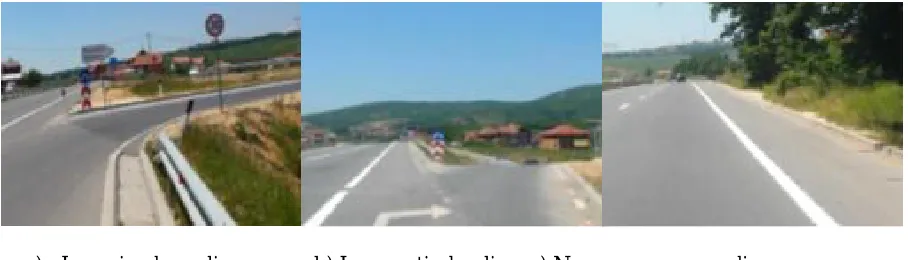
However, from the information gained from the relevant authorities dealing with accidents and accident statistics, there are no specific data for this section of road for weekly, monthly or yearly accidents. It is important to be specified in this paperwork that traffic police neither transportation department of Government of Kosova do not specify in to the contributors of the accidents, possible accidents caused by poor design or not taking in consideration safety issue during the design stage. With pictures are presented some deficiencies of poor design from safety point of view which could have been eliminated if RSA was performed during the preliminary or detail design stage.
a) Low circular radius b) Low vertical radius, c) Narrow emergency line
Figure 7.Current situation of some spots of M9 road as a consequence of not performing the RSA.
6.0 Conclusion and Recommendations
Western Balkan Countries are among the worst performers in road safety in Europe. Although some improvement has been achieved during the last years, the numbers of road accidents, fatalities and injuries remain higher than the respective average in the EU.
These poor performances may be partially attributed to several deficiencies in road safety legislation, policy and institutional capacity in to these countries. An important diversity in the structures and processes at the higher level of road safety management were identified despite the implementation of several successful good practices. The main problems that were identified, are the lack of a road safety dedicated budget, difficulties in the coordination of road safety stakeholders and difficulties in the implementation of safety conditions and measures. In addition, an important lack of availability of data and information necessary to road safety stakeholders for effective decision-making further prevents the improvement of road safety.
As a recommendation to the WBC regarding the road safety audit and road safety inspection as a tool for reducing the traffic accidents is implementation of the following priorities in the national road networks such as:
• Implement the approved law of National Strategy and a National Road Safety Authority. • Ensure sustainable funds for road safety.
• Improvement of road infrastructure.
• Implementation of the Directive 2008/96/EC on the whole road network
• Effective regulation of Road Safety Audit for all new road designs / and RS Inspection for major lines, • Road safety education and /periodical training for all ages, reorganization of the training- and licensing
system).
• Effective enforcement of traffic rules.
• Raising road safety awareness through information campaigns.
The results presented in this paper provide an overall description of the road safety situation in countries of the Western Balkans with special treatment for Albania and Kosovo road network. These can be useful for better understanding the particular characteristics and needs in other countries, and may serve as a basis for decision making by local road safety stakeholders concerning future actions for the improvement of road safety in the area. Implementation of the RSA during the design stages is timely very effective, financially very cheap rather for road users is much friendly ad safe for use and cause less accidents.
7.0 References
Yannis G, Laiou A, Piccoli G. (2015) Road Safety in South-East European Regions. 6th National Conference on Road Safety, Athens March 2015,
Gashi E, Tille M, Mustafa Gj. (2016) Road Safety Audit at the Western Balkan Countries, 3rd BCCCE
Conference, Tirana Albania,
SEETO Report. Road safety Strategy Safety Report, March 2014,
Albanian Ministry of Transportation. Albanian Road Safety Strategy 2015, Kosovo Ministry of Infrastructure. Kosovo Road Safety Strategy 2015, Albanian &Kosova road accidents statistics 2014,
Herber Rudolf- Franz, (2015) Road Safety in Serbia. European Scientific Journal August 2015 edition vol.11, No.23 40 – 59,
Wegman F.C.M, Roszbach. R, Mulder. J.A.G, Schoon& F. Poppe. C.C Road Safety Impact Assessment: RIA, A study commissioned by the European Commission DG VII
SWOW factsheet (2012), The Nederlands institute for road safety research, Road safety newsletter no 16 (November 2014). European Commission,
Pfeiffer L, Jovanov D. The common findings from RSA and RSI in Western Balkan region. X International Symposium "Road Accident Prevention" Novi Sad, 2010,
Tille M, Gashi E. RSA for the Kosovo M9 national road section Komoran- Gjurgjice, Bachelor thesis ( GjenetaHasanaj) September 2015,
Safety Audits of the Road Network, a cost effective way of saving lives on our roads. IRF publication supported by EC Union (2014),