ISSN: 2334-2986 (Print), 2334-2994 (Online) Copyright © The Author(s). 2014. All Rights Reserved. Published by American Research Institute for Policy Development DOI: 10.15640/jea.v2n2a18 URL: http://dx.doi.org/10.15640/jea.v2n2a18
An Analysis of the Level of Professionalism of Personnel in the Application of Total Quality Management Approach in Building Maintenance Practices
Abdul Azeez, A.D.1, Abbas A.2 & Mansur, D.2
Abstract
One of the most important problems affecting coordinated and acceptable application of the total quality management concept is the calibre of the maintenance personnel.Managers in charge of the affairs of building maintenance have a direct and significant relationship with the outcome of maintenance operations in any organization because management is a living force and it is the force that gets things done to acceptable standards. Hence, the research was undertaken to analyse the level of professionalism of the personnel in the application of total quality management approach in building maintenance with a view of enhancing continuous quality improvement. Literature reviews suggested that certain virtues of TQM can be adopted to improve organisational effectiveness and solid conceptual foundation for strategic performance if the concerned managers posses the basic academic and professional wherewithal. To achieve the objectives of the study, senior personnel of the Works and Maintenance department of three Nigerian Universities were surveyed. The sample size was calculated using Kish formula. 75 responses, which accounted for 99% of the total respondents, were received. Simple bar charts and tables were used for the data presentation. The findings from the study indicated that most Universities are dominated by unqualified, ill-trained and unprofessional personnel. Hence, it was recommended that Universities should employ competent personnel, and engage in their training and development.
Keywords: Total Quality Management, Infrastructures, Quality Factor, Training, Framework
Introduction
Total quality management is an enhancement to the traditional way of doing business. It is a proven technique to guarantee survival in world class competition. Langford (1990) and Dikko (2013) affirm that total quality management (TQM) refers to the notion of “never been satisfied” with the current degree of quality and success in meeting customers identified needs, requirements, interest and expectation. This is why TQM involves searching for improvement rather than maintaining current performance. Ammar (2003) stresses that TQM is a necessary journey that will never end because it intends to improve both process and its product. Total quality is about more than being ‘nice to customers and smiling’. It is about listening and entering into a dialogue about people’s fears and aspirations. The best aspects of the professional role are about care and high academic and vocational standards. Blending the best aspects of professionalism with total quality is essential to success.
1
Department of Building, Ahmadu Bello University, Zaria – Nigeria. E-mail: [email protected] 2
It is on the above premise that Adenuga (2012) established that the caliber of managers in charge of the affairs of building maintenance has a direct and significant relationship with the outcome of maintenance operations in any organization. Management is a living force and it is the force that gets things done to acceptable standards. According to Adebayo (1991), management still remains the philosophy or practice of organized human activity, and managers are the people responsible for the conduct and control of such an undertaking. The role of applying such quality approaches in our building maintenance management has received scant attention as a result of the presence of unqualified and inadequate personnel (Akinsolaet al, 2012). This scant attention is equally reflected in the maintenance of our infrastructural stocks like staff quarters, classrooms, laboratories, offices etc held in our various institutions of higher learning. According to Amusan and Bamisile (2005), the few maintenance works that are being undertaken are usually not effective in performance as a result of wrong approach with attendant effects on quality and reliability.
This research was birthed as a result of the assertions thatthe inappropriate maintenance policy and approaches adopted by most Planning and Maintenance departments normally yield an increase in maintenance cost and low building performance (Jackline, 2013), more than half of Maintenance staff are unqualified and inadequate (Adenuga, 2012), the state of physical facilities in most universities are in poor state, severely overstretched and ill-maintained (Report of Committee On Needs Assessment of Nigerian Public Universities, 2012), only 15% of total maintenance problems are remedied in most tertiary institutions (Anthony, 2011) and that dilapidated and unhealthy buildings in a decaying environment depress the quality of life and contribute in some measure to anti-social behaviour (Iyagba, 2005)
Literature Review
Concept of Total Quality Management (TQM)
Total Quality Management (TQM) has been described as a management philosophy and a way of thinking that has helped many organisations towards achieving world-class status (Sha’ri and Elaine, 2000). Having its roots partly in the USA and partly in Japan, Karani and Bichanga (2012) noted that TQM was primarily adopted by some Japanese companies in the decades immediately after World War II. With the greater successes of Japanese companies during the 1980s, companies all over the world found that it was necessary to have good quality management practices in order to stay competitive.
Total quality management (TQM) consists of organization–wide efforts to install and make permanent a climate in which an organization continuously improve its ability to deliver high – quality products and services to customers (Wikipedia 2011, Kanji 1990, Robert and Robert 1998, Muhammedet al 2011). It is an effort that involves every organization in the industry towards improving performance (David and Murat 1997). Different authors have given various definitions of TQM. Escrig (2004) defines it as an approach involving whole organization for understanding each activity of individual at each management layer. This argument is supported by Escrig (2004) who considers TQM as a strategic action that focuses on managing the total organization to provide products or services that satisfy their customer needs by utilizing all resources.
Concept of Building Maintenance
Various definitions have been proposed for the term “Maintenance”. Olanrewaju (2010), Tahboub (2011) and Olanrewajuet al (2011), define Maintenance as the “required processes and services carried out to preserve, repair, protect and care for a building’s fabric and engineering services after completion, repair, refurbishment or replacement to current standards to enable it to serve its intended functions throughout its entire life span without drastically upsetting its basic features and use”. This definition perceives maintenance from the comfort of the users of the buildings. However, Iyagba (2005), Adenugaet al (2010) and Adenuga (2012) consider maintenance as a “work undertaken in order to keep, restore or improve every facility, to an acceptable standard and to sustain the utility and value of the facility. This definition looks at maintenance as a proactive exercise. Elsewhere, Jalal (2003) and Zainalet al (2010) note that, maintenance revolves around the process of reservation and restoration of activity of the structure and components of a building.
Despite significant amount of investigations have already been undertaken to examine quality failures and their causes, maintenance projects are still encountering numerous quality problems.According to Jackline (2013), poor quality performance that results in increased rework and has significant impacts on cost and schedule is among the major defects experienced in maintenance projects. Based on the pilot study undertaken on the Estate Department of Ahmadu Bello University, Zaria a careful look at our environment revealed erratic building maintenance schemes that are not concordant with modern management principles thereby aiding the triumvirate of breakdown, deterioration, and all the types of unplanned events. To some maintenance is war (Iyagba, 2005).
Qualities of a Good Maintenance Manager
According to Mintberge (1973) as explained by Abdul-Azeez (2014), any effective manager is distinguished by the performance of the following ten (10) managerial roles: Interpersonal roles (Figurehead, leader, and liaison), informational roles (monitor, disseminator and spokes person) and decisional roles, which are divided into entrepreneur, disturbance handler, resource allocator and negotiator roles. Successful managers integrate these various roles and are likely to engage in them without making a clear distinction (Blisset, 2004). It is based on this understanding, that this study established for itself the need to outline the qualifications of the maintenance managers with a view of knowing who they are and what they are doing.
According to Stuart and Langford (2005) and Adenuga (2012), a good manager in the field of construction and maintenance is definitively distinguished by the following:
1. Professional experience and development: He must be well experienced in the management of maintenance works, and continually engages professional development through participation in workshops, seminars, conferences and in-house training
2. Human relation skills: a good maintenance manager must be humble and has human feelings for his subordinates. This is a major motivational factor
3. Sound financial and time management: In order to be effective and efficiently a maintenance manager must imbibe the doctrines of adequate management of time and financial resources at his disposal. 4. Intelligence: a good manager must be very intelligent in his work. He should be able to conceive new
maintenance ideals and practices in order to achieve optimization of limited resources. He must be able to intelligently manage any crisis – laden situations with astounding results.
6. Communication and emotional maturity: This attribute serves as a link between the various levels of management in any organization. Hence, a good maintenance manager must be able to communicate adequately, fluently, timely and judiciously to his superiors, partners and subordinates any new, current and already known information. He does this with high sense of emotional maturity (Krass, 2000).
7. Inspirational and motivational: Fox (1956) expatriates on a good manager as someone who must be optimistic, he must radiate confidence and enthusiasm. He must be somebody who can inspire and motivate his co-workers. According to Ubeku (1997) and Iyagba (2005), a discouraged and despondent executive can send a hundred or more employee’s morale in the gutter.
Research Methodology Study Population
The target population of the research included the top and middle level staff members of the Works and Services departments of three selected universities in north-central geo-political zone of the country comprising the University of Ilorin (Unilorin), Federal University of Technology, Minna (FUT Minna) and University of Abuja (UniAbuja). To establish the population size, an organisational chart and list of the staff that are directly involved in maintenance work were obtained from the study areas. Hence, it was gathered that there are 97 senior staff in Unilorin, 46 in FUTMinna and 68 in UniAbuja thereby given a total population of 211.
Sampling Technique and Sampling Size
The sampling techniques adopted for the study included both simple purposive and cluster. The former was adopted because the respondents included some specified categories of staff within the study areas. This was based on the recommendation by Fellows and Liu (2003) and Keller and Warrack (2003). Each of the selected universities was considered as an independent entity for easy comparison and inferences, hence the need to adopt cluster sampling. The minimum statistically acceptable sample size was determined by employing the Kish formula to justify the responsive sample size of the survey. According to Agbodjah (2008), Kish formula states that:
n = M 1+ M
N __________________________________________ (eq. 1) Where n = Sample Size
N = Total population = 211
M = S2
V2 _____________________________________________________________(eq.2)
Where V is the standard error of the sampling distribution and
S is the maximum standard deviation of the population element
S2 = P x (1 −P) _________________________________________ (eq. 3)
P is the proportion of population elements belonging to the defined class. Using a total error of 0.1 at 95% confidence interval,
V is 0.05 and P is 0.5;
S2 = 0.5 X (1 − 0.5) = 0.25
M = 0.25
(0.05) 2
N N= 100 1 + 100 211 N = 100
1.47 = 69
Adding 10% of 69 for non-responsiveness = 69 X 1.1 = 76
Therefore a value of Seventy-six (76) was adopted as the statistically significant sample size for the survey.
Data Collection Instrument
Primary data were collected using structured questionnaire as the instrument of the study. AbdulAzeez (2012) argues that questionnaire is considered “to be the most popular data collection technique in social sciences”. The questionnaire was used to generate data on the respondent’s profile with emphasis on academic and job qualifications.
Administration of Data Collection Instruments
The questionnaires were administered on top and middle management level staff members of the Works and Services departments of three selected Universities in north-central geo-political zone of the country comprising the University of Ilorin, Federal University of Technology, Minna and University of Abuja. The decision to use those categories of staff was informed by the recommendation made by Fox (1956) as cited by Adenuga (2012) that decisions concerning quality in building maintenance operation rest on the decks of top and middle management levels.
Methods of Analysis of Result
Charts were used to express the statistical result concerning the academic and job qualifications of the maintenance managers. This was achieved using Microsoft Excel and, Statistical Product and Service Solutions (SPSS).
Findings and Discussion Result of Pilot Study
To verify the usefulness of the questionnaires in solving the research objective, a preliminary study was conducted on the Estate department of Ahmadu Bello University, Zaria.
A purposive sampling was adopted on the senior and top management staff of the department. In all, 25 questionnaires were administered: 20 at the Samaru campus and 5 at the Kongo campus. Although, all the questionnaires were returned and useable, it was observed that the administration, responses, retrieval and analysis were very challenging.
Analysis of Questionnaire Administration
Professional and Academic Qualifications of Respondents
Adenuga (2012) stated that more than half of Maintenance staff are unqualified and inadequate to achieve the tenets of quality concept in maintenance operations. In affirmation to that, it has been observed that the lack of academic and professional wherewithal by maintenance managers is contributing to the practice to be old-fashioned and lukewarm. Managers tend to do the same thing every time, and opt for new result (Richard and Ruth, 1995).
On the premise of the above assertions, the following are the analysis and discussion on the operational wherewithal of the respondents.
Role undertaken by Maintenance Managers
Figure 1: Role Undertaken by Maintenance Personnel
As depicted in the chart in figure1 above, out of the 75 respondents, 20 (representing 27 %) engage in strategic roles, 41 (55%) in tactical role while the remaining 14 (18%) are operational staff. Generally, available literatures reveal that for efficiency and organisational effectiveness, there must be a reasonable balance between the numbers of workers in the three management levels. Since, the selection of the respondents was randomly done the researcher cannot argue for or against the categorization of the workers in the universities.
Years of Experience of Respondent
The chart in figure 2 below shows the average years of experience of the respondents. In all 33 respondents (44%) indicated that they have 1 to 10 years of experience while 15 noted that they are 11 to 20 years old in the maintenance departments of the studied universities. The implication of this is that the departments are formidably footed on relatively new and less experienced workers.
Figure 2: Years of Experience of Respondents
As a buttress to the assertion, it can be seen that only 6 of the 75 respondents have reached the precious 31 and above years in service while only 21 have spent 21 to 30 years in the departments. This suggests that most of the workers have spent less than 20 years in service.
20 41 14
0 50
Strategic Tactical Operational
N
o
of
R
es
p
on
d
en
ts
Management Roles
33
15 21 6
0 50
1-10 Years 11-20 Years 21-30 Years 31- Above
N
o
o
f
R
es
po
n
de
n
ts
Academic Qualifications of the Respondents
Figure 3: Academic Qualifications of the Respondents
From the chart in figure 3 above, it can be seen that none of the respondents possesses PhD. This suggests that, maintenance work is considered as more of practical than academic. 13 respondents (17%) indicated they possess National Diploma while 19 (25%) out of the 75 respondents responded that they have Higher National Diploma certificate. 31 of the respondents, accounting to 41% indicated they have Bachelor of Science degree. 12 of them claimed they possess MSc in relevant professions. The implication of this is that the studied universities are predominantly occupied by certificated workers. However, it should be quickly added that academic certificate is not a major ally of quality production considering the fact that a wide gap exist between the class theories and industrial scheme.
Academic Background of the Respondents
As described earlier, the application of total quality management approach in building maintenance operations can only be adequately undertaken by, among many factors, those with basic trainings in the requisite profession. Hence, it was deemed necessary for the inclusion of ascertaining the academic background of the respondents in the questionnaire.
As can be seen in figure 4 below, 11 (15%) of the respondents have training in the field of architecture, 14 (19%) are Quantity Surveyors, 14 (19%) are Estate Managers and 3 (4%) indicated that they are Urban Planners.
While 10 (13%) stated that they have their background training in the field of engineering, the remaining 23 (30%) claimed to be Builders. Therefore, it can be inferred that most of the respondents are Builders, which is a good omen for the maintenance practice.
Figure 4: Academic Background of the Respondents
13 19
31
12
0 0
20 40
ND HND BSc MSc PhD
N
o
o
f
R
es
po
n
de
n
ts
Qualifications of Respondents
11 14
23
14
3 10
0 10 20 30
Archietcts Q/Surveyors Builders Estate
Managers
T/Planners Engineers
N
o
o
f
R
es
po
n
de
n
ts
Professional Body of Respondents
Figure 5: Professional Body of Respondents
The chart in figure 5 above indicated that 29 (representing 39%) of the total respondents stated that they lack professional membership. 16 (21%) claimed to be members of the Nigerian Institute of Building while 8 (11%) showed that they possess membership of the Nigerian Institutes of Architects. The Nigerian Institute of Quantity Surveyors and the Nigerian Society of Engineers has 6 (8%) and 5 (7%) members respectively in the studied departments. 5 (7%) respondents indicated that they have membership of the Nigerian Association of Electrical Technicians.
As indicated in chapter two, professionalism and continuous quality improvement are synonymous. On this premise, it can be inferred that most of the workers are relatively non-registered members of their respective professional institutes, and hence their urge for continuous quality improvement may be deficient.
Status of the Professional Membership of the Respondents
Figure 6: Status of the Professional Membership of the Respondents
The chart in figure 6 above indicated that 29 (representing 39%) of the total respondents stated that they lack professional membership. 26 (35%) claimed to have corporate membership of their institutes while 17 (23%) showed that they possess associate membership of their institutes. The chart further showed that 3 (4%) respondents are fellows of their respective institutes.
As indicated earlier, professionalism and continuous quality improvement are synonymous. On this premise, it can be inferred that most of the workers are relatively non-registered members of their respective professional institutes, and hence their urge for continuous quality improvement may be deficient.
0 29
8 6 6 16 5 5
0 10 20 30 40
None NIA NIQS NIESV NIOB NSE Other
N
o
o
f
R
es
po
n
de
n
ts
Professional Bodies
29 26
17
3 0
10 20 30 40
None Corporate Associate Fellow Other
N
o
o
f
R
es
po
n
de
n
ts
Participation in Workshops on Quality Practices
Figure 7: Participation in Workshops on Quality Practices
From the chart in figure 7 above, it can be seen that 31 (41%) out of the 75 respondents indicated that they have not participated or attended any professional workshops dwelling on quality practices within the last five years. However, 23 (31%) and 21(28%) of the total respondents stated that they have attended 1 to 5 and 6 to 10 workshops respectively. It should be reminded that workshops, seminars and conferences are professional avenues for development and exchange of science of professionalism. Hence, they play a cardinal role in improving current situations. Based on this assertion, it can be suggested that most of the workers in the studied universities are deficient in improving their knowledge of quality practices through participation in professional workshops.
Involvement in Maintenance Projects
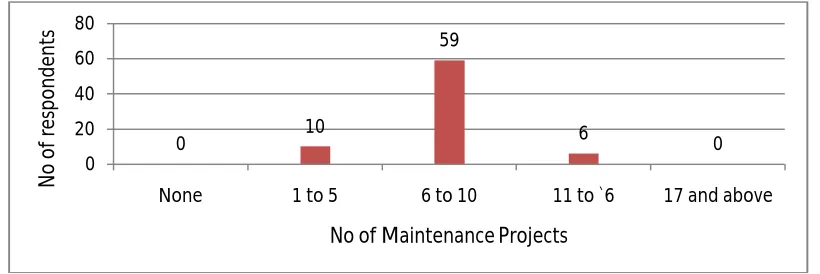
Fifty-nine (79%) of the total respondents stated that they have been involved in 6 to 10 building maintenance projects. While, 10 (13%) indicated that they have in 1 to 5 projects, 6 (8%) respondents stated that they participated in 11 to 16 been involved maintenance projects within the last 5 years. Hence, it can be suggested that most of the workers have been actively involved in projects. This inference is based on the chart in figure 8 below
Figure 8: Involvement in Maintenance Projects Reception of Training/Awareness Programme on Quality Practices
In the chart illustrated in figure 9 below, it can be seen that 70 (93%) of the 75 respondents have not undergone any training or awareness programmes quality issues organised by their departments in the last five years. The remaining 5 (7%) respondents responded that they had undergone some training on quality practices organised by their departments. In view of this, it can be inferred that most of the workers have not received any special training on quality practices in building maintenance organised by their departments.
31
23 21
0 0
0 10 20 30 40
None 1 to 5 6 to 10 11 to 16 17 and above
N
o
o
f
R
es
p
o
n
d
en
ts
No of Workshops
0 10
59
6 0
0 20 40 60 80
None 1 to 5 6 to 10 11 to `6 17 and above
N
o
o
f
re
sp
o
n
d
en
ts
Figure 9: Reception of Training/Awareness Programme on Quality Practices Framework adopted by the Respondents
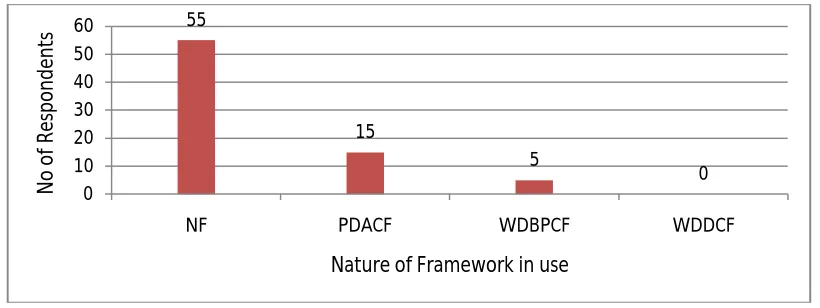
From the chart in figure 10 below, it can be seen that out of the 75 respondents, 55 representing 73% stated they do not have any workable framework (NF) for achieving quality in maintenance activities. 15 respondents noted that they have a framework that is poorly designed and coordinated (PDACF). The remaining 5 respondents representing 7% stressed that their existing framework is well designed but poorly coordinated (WDBPCF).
Figure 10: Framework adopted by the Respondents Conclusions and Further Study
The importance of adopting TQM approach in building maintenance cannot be over-emphasized. However, it is pertinent to note that, based on the research findings much is yet to be achieved in the studied Universities in the area of continuous quality improvement in infrastructural maintenance. Although, most of the Maintenance Managers are highly certificated, they still remain deficient in applying quality improvement principles in the maintenance operations because of lack of adequate professional workshops, trainings and awareness programmes. There is seeming lopsidedness in the academic background of the workers. This assertion is in view of the fact that, maintenance work that is predominantly remedial, rehabilitational and simple in undertaking if done through preventive approach is manned by Engineers that are trained in structural designs and construction.
70
5 0 0 0
0 20 40 60 80
None 1 to 5 6 to 10 11 to 16 17 and above
N
o
o
f
R
es
p
o
n
d
en
ts
No of Awareness Programmes
55
15
5
0 0
10 20 30 40 50 60
NF PDACF WDBPCF WDDCF
N
o
o
f
R
e
sp
o
n
d
e
n
ts
Recommendations
Assessing the degree by which universities in the north-central part of the country adopt TQM principles in the maintenance of their infrastructural facilities, it is right, based on the research findings, observations and conclusions to make the following recommendations:
i. Maintenance departments of the Universities should encourage employee training and development in
quality- related issues through the provision of staff training schemes and sponsorship for the attendance of professional workshops and conferences
ii. Universities must ensure that qualified and adequate numbers of personnel are employed in the services
of the Maintenance department.
iii. Workers should be encouraged to boost the status of their professional membership through the
provision of financial aids and making of the membership a basic requirement for promotion etc.
iv. Maintenance departments should embrace the importance of continuous quality improvement by
adopting change in organisational culture, improving information and communication effectiveness and development of the spirit of team workmanship.
v. As depicted in the findings, the personnel are guided by poorly managed and coordinated framework in
their maintenance undertakings, hence the following framework is recommended for achieving acceptable quality improvement
Reference
AbdulAzeez, A.D. (2012). Development of a Prototype Electronic Document and Record Management System (EDRMS) for Small and Medium Building Firms. Unpublished PhD Dissertation, Ahmadu Bello University, Zaria, Nigeria.
AbdulAzeez, A.D. (2014) Management Roles. Course Materials on Organisational Behaviour for 2012/2013 MSc Construction Management Class. Department of Building, Ahmadu Bello University, Zaria, Nigeria.
Adebayo, S.O. (1991): A Study of the Maintenance Management of Public Buildings in Nigeria. Unpublished Ph.D. Dissertation, University of Lagos, Lagos, Nigeria.
Adenuga, O. A., Olufowobi, V and Raheem A.A. (2010) Effective Maintenance Policy As A Tool For Sustaining Housing Stock In Downturn Economy. Journal of Building Performance. 1 (1): 93-109
Adenuga, O.A. (2012). Maintenance Management Practices in Public Hospital Built Environment: Nigeria Case Study. Journal of Sustainable Development in Africa. 14(1): 185-200.
Agbodjah, L. S (2008) A Human Resource Management Policy Development (HRMPD) Framework for Large Construction Companies Operating in Ghana. (Unpublished PhD Dissertation). Kwame Nkrumah University of Science and Technology, Accra, Ghana.
Akinsola, O.E., Hussaini, P.O., Oyenuga, S.O. and Fatokun, A.O. (2012). Critical Factors Influencing Facility Maintenance Management of Tertiary Institutional Building in Southwest Nigeria. Mediterranean Journal of Social Sciences. 3(11):489-496
Ammar, A. (2003). A Case Study Total Quality Management in a Manufacturing and Construction Firm. Unpublished MSc Thesis. Rand Afrikaans University, Johannesburg, South African.
Amusan, L.M. and Bamisile, A.O. (2006). An Approach to Application of Total Quality Management in Building Maintenance operation.EPP Books, Ghana pp4-19
Anthony, A.C. (2011). Impact of Maintenance of Buildings and Infrastructural Facilities on the National Economy: A Case Study of Shell Camp, Housing Estate, Owerri. Unpublished HND Project. Federal Polytechnic, Nekede, Nigeria.
Blissett, R. (2004) Effective Leadership in Managing Proactive Maintenance and Reliability Programs. The Maintenance Journal. (Available on www.maintenancejournal.com)
Committee on Needs assessment of Nigerian Public Universities Report (2012). Presented to State House 0n 1st
November.
David A. and Murat G. (1997) Total Quality Management in the Construction Process. International Journal of Project Management. 15 (4): 235-243
Dikko K. (2013) Establishing Status 0f Nigerian Building Design Firms Based On European Construction Institute Total Quality Management Matrix In: Smith, S.D and Ahiaga-Dagbui, D.D (Eds) Procs 29th Annual ARCOM Conference, 2-4 September 2013, Reading, UK, Association of Researchers in Construction Management, 1037- 1046.
Dikko, K. (2011). Assessment of Quality Management Practices of Nigerian Building Design Firms. Unpublished PhD Dissertation, Ahmadu Bello University, Zaria, Nigeria.
Escrig, A.B. (2004). TQM as a Competitive Factor: A Theoretical and Empirical Analysis. International Journal of Quality and Reliability Management, 21(6), 612-637. doi:10.1108/02656710410542034, http://dx.doi.org/10.1108/02656710410542034
Fellow, R. and Liu, A. (2003). Research Methods for Construction. BlackWell Science Ltd, UK. Pp 25-26.
Iyagba, R.R.O. (2005). The Menace of Sick Buildings: A Challenge to All for its Prevention and Treatment. Paper Presented at an Inaugural Lecture; Delivered at the University of Lagos, Nigeria.
Jackline, A. (2013). Challenges Facing the Implementation of Total Quality Management Practices In Public Secondary Schools in Kenya (A Survey of Schools in Migori County). Unpublished MSc Thesis. University of Agriculture and Technology, Kenyatta, Kenya
Jalal A. A. (2003)Buildings Maintenance Cost. Unpublished BSc Project Report. College of Environmental Design, King Fahd University Of Petroleum andMinerals, Dhahran, Saudi Arabia
Jolaosa, B.A; Musa,N.A. and Oriola, O.A. (2012). Appraisal of the Maintenance of Public Residential Estates in Ogun State: Case study of Ibara Housing Estate, Abeokuta. Journal of Emerging Trends In Economics and Management Sciences. 3(5): 500-516.
Karani, S. and Bichanga, W (2012). Effects of Total Quality Management implementation on business performance in service institutions: A case of Kenya Wildlife Services. International Journal of Research Studies in Management. 1 (1): 59-76
Keller, G. and Warrack, B. (2003). Statistics for Management and Economics. Thompson Learning inc; USA. Pp. 139-295.
Langford, J. (1990). Advance Project Management Techniques. McGraw Hill Publishers Ltd Englewood Clifs: Pp 123-126
Mohammad-Noora N., Hamid M. Y., Abdul-Ghania, A.A and Harona S. N. (2011)Building Maintenance Budget Determination: An Exploration Study in the Malaysia Government Practice. The 2nd International Building Control Conference in Procedia Engineering 20: 434-444
Muhammad, M. (2011) Application of Total Quality Management Principles in Small and Medium Firms. European Scientific Journal. 8 (25): 20-27
Olanrewaju, A.A. (2010). Qualitative Analysis of Criteria in University Building Maintenance in Malaysia. Australasian Journal of Construction Economics and Building. 10(3):51-61
Olarewaju, A; Mohammed, F.K. and Arazi, I. (2011). Appraisal of the Building Maintenance Management Practices of Malaysian Universities. Journal of Building Appraisal. 6(3/4): 261-275.
Richard, J.H. and Ruth, W. (1995). Total Quality Management: Empirical, Conceptual, and Practical Issues. Administrative Science Quarterly. 40(2):309-342
Sha’ri, M.Y. and Elaine, A. (2000). Total Quality Management Implementation Frameworks: Comparison and Review. Total Quality Management. 11(3): 281-294
Stuart, T. and Langford, B. (2005). Term and Performance in the UK Construction Industry. In: 4th Triennial
International Conference on Rethinking and Revitalising Construction Safety, Health, Environment and Quality. South Africa 17-20 May. Pp 200-210
Tahboub, K.K. (2011). An Assessment of Maintenance Practices and Problems in Jordanian Industries. Jordan Journal of Mecahnical and Industrial Engineering. 5(4): 315-323.
Ubeku, A. K. (1975): Personnel Management in Nigeria, Ethiope Publishing Corporation, Benin, Nigeria. Wikipedia (2013) Quality Management Framework. Retrieved from
http://en.wikipedia.org/w/index.php?title=Quality_management_framework&oldid=508702046