A SHORT-TERM TRAFFIC FLOW FORECASTING METHOD BASED ON STATE
IDENTIFICATION
LAN KUANG, YONGHENG WANG*, QIAN LI, LIN LI
College of Information Science and Engineering, Hunan University, Changsha 410082, China E-mail:[email protected], [email protected],
KEYWORDS:short-term traffic flow prediction, free traffic, jam traffic, congested traffic
ABSTRACT
For most of the short-term traffic flow forecasting model is under the single state of traffic flow prediction, unable to meet the actual traffic induced demand. Therefore, this paper puts forward the a applicable in a mixed state of
discrimination of state based on short term traffic flow prediction model. The short-time traffic flow forecasting method, the wavelet analysis method for decomposition and reconstruction of history traffic data (traffic flow,
speed and density) and obtain the freedom flow state and flow state and blocking flow state state of traffic flow parameters threshold congestion. According to the traffic condition criteria, the current traffic flow parameters are judged, and the corresponding forecast model is selected. The experimental results show that the short-term traffic
flow forecasting model based on state estimation has a higher prediction accuracy than the single forecasting model,
and it is more suitable for the traffic flow prediction.
INTRODUCTION
With the rapid development of China’s economy, the ownership of car in cities keeps increasing which results in the deteriorating road conditions and the inconvenience of people’s life and work. It caused huge economic losses which has become an important factor that restricts the economic development of the city.
Urban road traffic is a very complex system, it is difficult to solve the traffic congestion problem fundamentally when vehicle or road factor is separately considered. Therefore, making full use of the modern technological means, a comprehensive system including transportation infrastructure, tools, traffic participants and environment needs to be analyzed to establish intelligent transportation systems (ITS), which can realize intelligent urban traffic management, constantly improve the utilization of transportation resources, and solve the problems of road traffic. Studying the effective real-time adaptive traffic flow theory and prediction algorithms, estimating the development and variation law of traffic flow information and accurately predicting traffic flow are the significant and difficult parts of ITS research. With the rapid development of predictive models in the field of INTERNET, some novel and sophisticated research methods and theories are applied to the prediction of traffic, with a lot of prediction models and methods in line with the traffic situation and characteristics obtained.
Traditional traffic flow predicting model almost use a single model or a single hybrid model for prediction of a single road. With the improvement of nonlinear uncertainty of traffic flow and the increasing demand of prediction model, however, a single prediction model has been unable to meet the requirements. Therefore, a short-term traffic flow model is presented in this paper based on state discrimination. This model can be used to judge the traffic state based on the current transport traffic flow parameters, and conduct the prediction selectively according to the real-time dynamic conditions with higher precision and adaptability than the previous single model.
Related Works
Since the 1960’s, People start to use other areas of prediction model for short-time traffic flow prediction. Therefore, people had developed hundreds of models and methods to predict. According to the different research methods and ideas, Can be roughly divided into prediction method based on the theory of the traditional statistical, based on knowledge discovery, based on the theory of nonlinear, based on novel technique and the model of combination.
Based on the theory of the traditional statistical forecast method is to use mathematical statistics methods process traffic history data, Based on the prediction of future and the past data has the same characteristics to forecast the traffic flow. Historical average model is applied to urban traffic earliest in 1981, proposed by Stephanedes[1]. After the model has been widely applied to various kinds of traveler information system and the dynamic route guidance system. Ahmed and Cook proposed time series model in the field of traffic flow prediction for the first time in 1979[2]. Based on the time series data, make use of the theory and method of time series analysis and modeling , to found in the data potential change law of things development.In order to forecast the development trend of things or the change of the next moment. In 1976, Box and Jenkins had proposed ARIMA model(Box-Jenkins model), The time series model is one of the most widely applied [3]. Based on the theory of the traditional statistical forecast method operation is simple, Low computational complexity, But for more complex road transport system can't satisfy the prediction accuracy and dynamic feedback request.
The prediction method based on knowledge discovery, Include the methods of neural network, Nonparametric regression, Support vector machine (SVM). Neural network method is to use a lot of historical data training neural network model, get the mapping relationship of output to the input, given the corresponding input using this mapping relationship can get related forecast results.M.S.D oughetry and M.R.E obbett [4] make use of BP neural network for the urban traffic flow rate, speed, share between short-term prediction research .Xiao-yan gong, Shang Shuming[5] is proposed based on nonparametric regression prediction method of short-time traffic flow rate, improved the traditional nonparametric regression algorithm, and through experiment that this method meet the requirements of real-time traffic flow prediction. Compared with the neural network, Support vector machine (SVM) is a research on small samples statistical learning theory as the theoretical basis of the data.Lelitha Vanajashi, Laurenee R.R ilett [6], respectively, compared the effect of neural network and support vector machine (SVM) is used to speed of traffic flow prediction.
Prediction model based on nonlinear theory refers to chaos theory, the dissipative structure theory, coordination theory, self-organization theory of nonlinear system theory as the theoretical basis for establishing prediction model. The development of more mature prediction method is chaos theory and wavelet analysis. Wavelet analysis method uses the theory of wavelet analysis to decompose the data of traffic-flow-time series to get signal with different resolution, and then prediction algorithm is adopted to predict each decomposed signal so we obtain Prediction results, Finally synthesizing each decomposed signal can get the final forecasting result. He, Li and shou-feng ma[7] have proposed a prediction method based on multiresolution wavelet decomposition and reconstruction of short-term traffic flow , in which the determination of model parameters is discussed, and the simulation experiment results is given. This kind of method applies to the traffic flow forecast under nonlinearity and strong uncertainty, at the same time have a good development prospect, but all aspects of development is not yet mature.
Prediction model based on emerging technologies including prediction model based on data fusion technology and the prediction model based on traffic simulation software. The former can reasonably coordinate multiple data and in a short period of time to fully integrate useful information with less cost, and get the data features that the single sensor can not get. While the latter means regarding the vehicle as an entity, with the relevant models and algorithms to describe transport infrastructure and driver behavior in road network. Combined with traffic flow model, using microscopic computer simulation technology to simulate the dynamic traffic running state of the vehicle within road network , thereby predicate the flow of road traffic-related information.
In addition to these typical short-term traffic flow forecasting model, There is also the combination forecasting model of two or more combining prediction methods. This method can give full play to the advantages of each model and make up the defects from each other, but need to adopt appropriate combination methods. S.C.Chang, R.S.Kim, S.J.Kim, B.H.Ahn[8] put the ARIMA model and neural network model together to verify the validity and precision of Combined Model through experiment.
SHORT-TERM
TRAFFIC
FLOW
FORECASTING
BASED
ON
STATE
DISCRIMINATION
3.1 Traffic flow state
Traffic flow is the flow of people and traffic (generally refers to traffic) on the road.The qualitative and quantitative
characteristics of the traffic flow operation called traffic flow state.Some physical quantities used to describe the state of traffic flow are called traffic flow parameters. Including traffic flow elements: traffic flow, velocity and
density. traffic flow rate refers to the unit time through a certain road of a location or a section of the number of vehicles, also known as traffic volume or flow;Density contains two kinds of occupancy and density K.
Based on the parameter model of city expressway traffic flow, traffic flow characteristics based on the combination of basic graph and three-phase traffic flow theory, the flow state is divided into city expressway traffic free flow,
congested traffic and jam traffic state.
(1)In the free flow state, the traffic flow rate is small, the road traffic on the vehicle is basically not
affected by or less affected by other vehicles, can maintain a higher speed.
(2)Crowded flow refers to the vehicle speed is restricted by the front of the car, but the vehicle driving
state is relatively stable, and itself has certain anti-interference ability, in this state, the traffic flow rate can be reached the maximum, and when traffic demand continues to increase, it will produce large fluctuations in the
traffic, and traffic speed appeared significantly decreased, traffic flow show a lot of volatility.
(3)In congested traffic state, traffic flow density is high, and the speed of the vehicle is severely restricted by the front vehicle, vehicle have a small degree of freedom, speed stability is poor, showing a
greater volatility, when traffic flow rate continues to increase, traffic will appear ' stop and go' phenomenon.
3.2 state division
In this paper, the state division method is traffic flow parameters state division based on wavelet analysis. Wavelet analysis is a new branch of Applied Mathematics in the late 80's, and then it has become a new milestone in the
development of Fourier analysis.The purpose of state division is to determine the threshold of traffic flow parameters (flow rate, velocity, density) in different traffic flow states (free flow, congestion and congestion). The
basic process are as follows:
First of all, decompose and reconstruct the average flow rate, average velocity and average density data collected by
the detector in 1-12 level;
Then, according to the time sequence diagram of raw data and reconstructed data and the interval value of each
detector data after reconstruction, obtain its quantitative space;
Finally, according to changing rules of the traffic flow, the velocity, the density and the actual traffic data, determine the threshold of the traffic flow, the speed and the density .
Judging from the current status of traffic flow state estimation algorithm, most algorithms are use one parameter of speed, flow and density as the criterion .In this paper, traffic flow, speed and density are be used as the basis for
judging the traffic flow state.Specific criteria are as follows:
state division:According to the threshold value, the traffic flow state can be divided into 5 kinds, the free flow traffic state A, the free flow and the congested flow cross state AB, the congested flow state B, the congested flow and the jam flow cross state BC, the jam flow state C.(The mixed state is generated by a possible threshold crossing)
State identification:The three parameters of traffic flow, speed and density will be used to determine the status, each parameter will produce a result of the state, and the results of the state value does not necessarily identical.
Therefore, it is necessary to specify a criterion to determine the final result. In semi supervised learning, there is a tri-training algorithm. In the algorithm, three classifiers are be used to simply marked confidence estimation of the
degree of the problem and the prediction problem of unlabeled sample, and using voting method which is often used in ensemble learning to realize the prediction of unlabeled sample. Therefore, in this paper, we can use a method similar to voting method to determine the traffic state, and the three traffic parameters are equivalent to three
classifiers. The following are the specific rules:
(1)If the traffic state identification results of these three parameters are the same, the state will be used as a result of
the current traffic condition;
(2)If two of the results are the same, then we can use the same result as the final result;
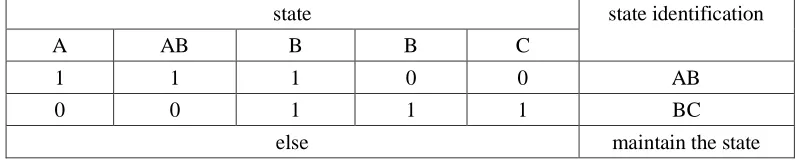
(3)If the results of the 3 parameters have nothing in common with each other, then we can determine the final result according to the rules in the table1:
Table 1.Table1 state discrimination partial rules table
state state identification
A AB B B C
1 1 1 0 0 AB
0 0 1 1 1 BC
else maintain the state
3.4 Short term traffic flow forecasting model based on state discrimination
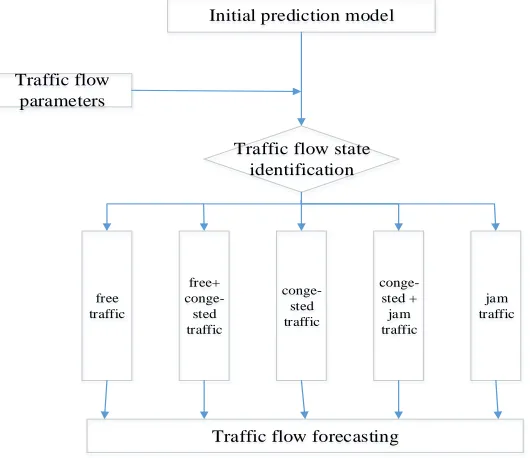
For the original based on the judgement of short-term traffic flow forecasting model of research in this paper, there are two main improvements: (1) considering the problem of cross threshold, in the three state of the original
classification, add two mixed state. Cross the threshold is not completely avoid the problem, after the increase in the mixed state, so that the final results more accurate, also for the mixed state, adopts combination forecasting model
Initial prediction model
free traffic
free+
conge-sted traffic
conge-sted traffic
conge-sted + jam traffic
jam traffic
Traffic flow state identification
Traffic flow forecasting Traffic flow
parameters
Figure 1.traffic flow forecasting model
EMPIRICAL RESEARCH
Experimental Data: The detector collects data every 5 minutes in a fast road network in Beijing City, including
traffic flow, speed and density. According to the traffic data collected from between 1 June 2015 to 3 June 2015, we get the thresholds of traffic flow, speed and density. And the forecast period is 4 June 2015.
Initial Forecast Model: neural network prediction model. And we can conduct contrast experiment, under which we adopt single neural network prediction model instead of changing prediction model based on the actual data.
The prediction models at different states are listed in Table 2:
Table 2 . The prediction models at different states
The states of traffic flow The prediction models
A ARIMA model
AB The combined model of ARIMA and neural network
B neural network model
BC The combined model of neural network and Kalman
filtering
C Kalman filtering model
Evaluation Metric: Mean absolute percentage error (MAPE), mean absolute deviation (MAD).
After (小波)analysis, the thresholds of traffic flow, speed and density is obtained as follows:
Density threshold: free flow state [0, 40], congested flow state [45, 95], blocking flow state (95, 155]. Experiment Results: The error values are listed in Table 3.
Table 3. Error metric
Error Metric MAPE(%) MAD(cars/5min)
Single prediction model 18.497 16
State estimation based prediction model 13.546 10
By comparing the results in Table 3, we can see that our proposed state estimation based prediction model outperform the single neural network prediction model under the same condition.
CONCLUSION
This paper designs a short-term traffic flow prediction method which based on the state of distinguish.It uses wavelet analysis to decompose and reconstruct historical traffic data (traffic flow, speed and density), to obtain traffic flow threshold parameter under three states of the free traffic state, congested traffic state and jam traffic
state.According to the criterion of judging the state of traffic flow parameters to your current traffic status, selecting the corresponding predictive models which is applicable. This method is a dynamic prediction strategy,
that can judge in real-time based on the traffic state traffic flow parameters and then select the predictive model based on the judgment result.This dynamic strategy to overcome the shortcomings that the traditional single
prediction model can not adapt to the dynamic changes in real-time traffic flow. The results show that: short-term traffic flow prediction method which based on the state of distinguish dynamically transform traffic flow forecasting method in real-time, it is possible to obtain more accurate traffic flow predicted values than using a single neural
network forecasting model.
ACKNOWLEDGES
First of all, this work is supported by the National Natural Science Foundation of China (No.61371116).
Second, I would like to express my gratitude to my supervisor, Yongheng Wang, for his instructive guidance and
precious suggestion on my paper. I am deeply grateful of his help in the completion of this thesis. I am also deeply indebted to all the other tutors and teachers for their direct and indirect help to me.
Finally, I am indebted to my parents for their continuous support and encouragement.
REFERENCES
1. Stephanedes V J, Michalopoulos P G, Plum R A. Improved estimation of traffic flow for Real-Time control (Discussion and closure)[J]. Transportation Research Record, 1981 (795).
2. Ahmed M S, Cook A R. Analysis of freeway traffic time-series data by using Box-Jenkins techniques[J]. Transportation Research Record, 1979 (722).
3. Anderson O D. Time series analysis and forecasting;the Box-Jenkins approach[M]. London and Boston:
Butterworths, 1976.
International Journal of Forecasting, 1997, 13(l): 21一31.
5. Xiaoyan Gong, Shuming Tang.Integrated traffic f low forecasting and traffic incident detection algorithm based
on non-parametric regression[J].Chinese Journal of highway, 2003, 16(1): 82-86.
6. Lelinla Vanajakshi, Laurence R.Rilett.A comparison of the performance of artificial neural networks and support vector machines for the prediction of traffic speed[c].2004 IEEE Intelligent Vehicles Symposium, Parma,
Italy;2004:194—199.
7. Guoguang He, Shoufeng Ma, Yu Li.A Study on Forecasting for Time Series Based on Wavelet Analysis[j]. System
engineering theory and Practice, 2002, (9): 101-106.