Iranian Rehabilitation Journal, Vol. 13, Issue 3, Autumn 2015
Original Article
Maladaptive Schemas and Affective Control in Students with Learning
Disability: Benefits of Mindfulness-Based Cognitive Therapy
Nasrollah veysi
Allameh Tabatabaii University, Tehran, Iran
Mohammad Rostami
*; Zohreh Zangooi
University of Social Welfare and Rehabilitation Sciences, Tehran, Iran
Mohammad Ali Khaksar Beldachi
Shahid Beheshti University, Tehran, Iran
Objectives: This study intended to examine the effectiveness of mindfulness-based cognitive therapy on moderating maladaptive schemas and affective control in students suffering from learning disabilities. Methods: This experimental research was conducted using pretest-posttest and a control group. The population included all the female students who were studying in the Koohdasht's middle schools (academic year: 2012-2013). The sample included 40 female students suffering from learning disabilities who had been randomly selected out of Koohdasht's middle school students after identification and a structured clinical interview and they were put into experimental and control groups (20 students each group). For data collection, Affective Control Scale and Young Schema Questionnaire were used. Results: The results of multivariate covariance analysis showed that mindfulness-based cognitive therapy has significantly decreased maladaptive schemas, depression, anxiety, and anger in subjects (p<0.001). Discussion: This finding represents important implications regarding education and mental health improvement in exceptional students. Therefore, it is recommended to use this therapeutic package in schools and clinics as a supplement to other therapies in order to decrease negative emotions and to prevent formation of maladaptive schemas in these students.
Keywords: mindfulness-based cognitive therapy, maladaptive schemas, affective control, learning disability.
Submitted :25 July 2015 Accepted: 20 August 2015
Introduction
Learning disability refers to a group of disorders which are specified with difficulty in acquisition, function of listening, speaking, reading, writing, and calculating. These disorders have a neurological and developmental base beginning before school age and continuing to adulthood (1). According to fourth edition of Diagnostic and Statistical Manual of Mental Disorders (DSM), learning disability is diagnosed when the advancement in standardized tests for reading, mathematics, and writing is under the expected level based on age, education, and level of intelligence (2). In other words, despite the normal intelligence, learning disability can occur and it should be differentiated from normal disorders and educational problems that occur due to time
shortage, weakness in instruction, cultural factor, and ear and eye injuries (3).
society. These individuals suffer from problems like dysfunction in auditory or visual memory, attention maintenance, impulses prevention, motor integration, auditory or visual perception, weakness in motivation, weakness in organization or generalization, weakness in working memory, distraction, weakness in role perception, information processing, visual-motor integration, learning style, and hyperactivity (8,9). Maladaptive schema is one of the factors that the mentioned students struggle with; but the researchers have not pay attention to this issue yet. Cognitive structures organize the base of individual's thoughts and behaviors. Other factors related to these structures may play a mediating role (10). In other words, schemas are the deepest cognitive structures (11). "Early Maladaptive Schema" Defined as the schemas leading to formation of psychological problems. These schemas are the self-destructive emotional and cognitive patterns beginning from early growth and persisting in whole life (12,13). Research show that
factors like impulse control disorder, cognitive,
emotional, and social failure (14), lack of social skills (15), problems of intimate relationships and low
self-esteem (16), cognitive distortions and affective
shortcomings (14), result in formation of maladaptive schemas in students suffering from learning disability. Affect is one of the other variables that the students suffering from learning disability struggle with. Affects form an important and basic part of human life in a way that it is too hard to imagine life without affect. Features and changes of affects, the quality of affective relationships, and interpretation of others' affects play a significant role in organization of personality, moral development, social relations, identity formation, and self-concept (17) All human beings experience emotions and affects in their lives; and it is a natural fact that they show various emotions and affects when facing different situations. But extreme negative emotions are not natural and have destructive and harmful outcomes (17).
Affective control skill is the ability of an individual to know how to identify his/her affects in different situations and how to express and control those affects. Affective control skill affects different aspects of individual's life, interpersonal interactions, and mental and physical health (18). Nowadays, new methods of cognitive psychology have been used to treat students that suffer from learning disability. Mindfulness-based cognitive therapy is one of these therapies. The aim of mindfulness-based cognitive therapy is to facilitate
affective change for a better self-care; it will weaken self-threatening factors, facilitate self-acceptance, and decrease affective turbulence; therefore, it enables individual to control himself/herself more successfully (19).
Despite the fact that mindfulness-based cognitive therapy has not directly been applied for maladaptive schemas in children diagnosed with learning ability, some studies have shown the effectiveness of this method. For example, studies showed that the students diagnosed with learning ability, who had received cognitive strategies training, had better performance in problem-solving as compared to control group members; they had also less negative emotions (20). And students diagnosed with learning ability who had received mindfulness-based cognitive training reported higher hope, self-confidence, health, and positive affects after a two-month follow-up (21). also studies showed that the students diagnosed with learning ability who had received mindfulness-based cognitive therapy possessed positive effects and they had higher efficacy in decision-making, cognitive flexibility, creativity, and problem-solving as compared to their classmates (22). To sum up: 1. students diagnosed with learning disability struggle with behavioral problems, depression, anxiety, negative effects, and other disorders (23); 2. The prevalence of this disorder is high in students; 3. Positive effects and cognition play a role in enhancing health and decreasing psychological problems in these students. 4. There is no local research about applying mindfulness-based cognitive therapy on maladaptive schemas in students diagnosed with learning disability; and most of studies have not been done on an Iranian sample. Therefore, this paper intends to examine the effectiveness of mindfulness-based cognitive therapy on moderating maladaptive schemas and affective control in students suffering from learning disabilities.
Methods
representative of the population and for sake of reliability, the sample size was determined 40 people (20 people for each group) (24).
After getting permission from Koohdasht Education Organization, parents, and participants, identification, interview, and diagnosis were done on the students. First, the objective of the study was stated for them and the pre-test was distributed among them so that they can fill in the questionnaire carefully and completely. The subjects were assured that they can quit the study whenever they want. The confidentiality of the names, identities, and findings was also told for them. Then, the students diagnosed with learning disability were randomly put into experimental and control groups. The experimental group received 12 2-hour group sessions one time a week. The intervention method was mindfulness-based cognitive therapy. This method has been designed by Gilbert (19) as a result of his studies. 1st session: developing relationship with students; reviewing structure of sessions; training body scan (consciousness of body organs in detail); assigning homework. 2nd session: In this session, the students learned to cope with annoying feelings and mental confusion by using body scan. 3rd session: reviewing the last session; learning about the relationship among mood, thoughts, feelings, and events; three- minutes breathing; assigning homework. 4th session: reviewing the last sessions; breathing (as a prerequisite for meditation); meditation; mindfulness training (being conscious of body and breath). 5th and 6th sessions: learning about present problems, accepting and non-judgmental focus, and identification of negative automatic thoughts. 7th session: learning about cognitive distortions, their outcomes, and the ways to cope with them. 8th and 9th sessions: learning about secure strategies, submissive behaviors and self-criticism (challenging patient through Socratic dialogue); assigning homework. 10th to 12th sessions: in these sessions, the patients were asked to talk about self-attacking with attention, thinking, sympathetic behavior, and respect. Then they were taught how to create sympathetic images by meditation. After one week, the post-test was filled in by the participants. It is worthy of notice that the researchers have passed courses on structured interview and mindfulness-based cognitive therapy. In the present study, the following instruments have been used for collecting data:
Structured Clinical Interview for DSM Disorders (SCID): Structured Clinical Interview based on
DSM-IV: SCID: is a semi-structured clinical interview used for diagnosing the first Axis disorders based on DSM. The potential usages of SCID in mental health clinics have been examined in a research. Findings of this study showed that SCID can guarantee a reliable diagnosis (25). Affective Control Scale: An instrument to measure individual's control on his affects. This instrument includes 42 items with four subscales (anger, depressed mood, anxiety, and positive affect). The choices were 7-level rating scale (from very strongly disagree [score=1] to very strongly agree [score=7]). Twelve items are scored inversely. In this scale, 8 items measure anger; 8 items measure depressed mood; 13 items measure anxiety; and 13 items measure positive affect. Internal validity and retesting results were respectively 0.94 and 0.78 (for total score); 0.72 and 0.73 (for anger subscale); 0.91 and 0.76 (for depressed mood subscale); 0.89 and 0.77 (for anxiety subscale); and 0.84 and 0.64 (for positive affect subscale) due to an implementation on BA students. Discriminant and convergent validity were also calculated (26). In Iran examined the reliability of this scale (Cronbach's Alpha: affective control=0.84; anger=0.53; positive affect=0.60; depressed mood=0.76; and anxiety=0.64). These show the suitability of this instrument for Iranian culture (27).
Young Schema Questionnaire-Short Form (YSQ-SF): This questionnaire includes 75 items and it has been developed by Young and Brown to measure 15 early maladaptive schemas. The reliability of all schemas was calculated 0.76 to 0.93. Findings of factor analysis support the internal consistency of this questionnaire. In Iran have also calculated its reliability (Cronbach's Alpha= 0.94) and validity (result of correlation with Irrational Belief Test: 0.34)(28). Ultimately, the data was analyzed using SPSS (version 16). Mean scores, standard deviation, and MANCOVA were presented. Additionally, the findings were reported and their consistency with findings of literature was discussed.
Results
father [mother] in control group was respectively primary education (53 [68]), secondary education (39[23]), associate's (6[6]), bachelor's and higher (2[3]). The percent of Birth order in experimental (control) group was respectively first child (33[29]),
second child (29[27]), third child (26[30]), and fourth child etc. (18[14]). In experimental group, 35 percent of fathers were employees and 65 percent had free jobs. In control group, 37 percent of fathers were employees and 63 percent had free jobs (table 1).
Table1. Mean scores and standard deviations in pre-test and post-test
(For the subscales of both instruments)
experimental control
Pre-test Post-test Pre-test Post-test
variable subscales M SD M SD M SD M SD
Emotional deprivation 15.23 3.45 10.33 2.33 16.12 4.12 14.63 3.36
Abandonment 16 4.1 9.69 1.89 15.89 3.95 16.13 4.15
Mistrust/abuse 16.36 4.23 10.23 2.18 14.23 3.21 15.69 4.23 Social isolation 17.14 5 11.24 2.65 16.1 4.2 14.44 3.89 Defectiveness/shame 14.23 3.2 8.59 1.63 14.55 3.63 15.1 4
failure 16.23 4.2 11 2.1 17 4.52 16.23 4.23
Dependence/incompetence 14.23 3.23 9.69 1.45 16 3.36 15.69 5.1
schemas enmeshment 15.24 3.63 9.41 1.23 15.23 4.68 15.2 4.63
Vulnerability to harm 17.24 5.1 10.21 2.4 14.56 3.54 13.63 3.94
entitlement 14.52 3.21 8.69 1.36 13.63 3.12 14.26 3.65
Insufficient self-control 18 5.12 11.21 2.45 15.45 3.57 16.21 4.12
subjugation 9.85 2.89 17.63 4.33 10.63 2.23 11.36 2.63
Self-sacrifice 9.23 2.29 15.16 3.38 11.23 3.1 12.12 3.1 Emotional inhibition 19.45 6.23 10.47 2.85 17.46 5.65 16.1 4.56 Unrelenting standards 16.63 4.33 9.36 2.23 15.36 4.68 14.26 4.71 Total score 98.85 16.85 72.43 11.55 95.97 15.36 93.36 13.47 depression 34.36 5.63 24.32 4.23 35.42 5.87 33.63 5.89 Affective control anxiety 31.54 4.45 25.74 3.89 29.47 4.78 27.45 5.88
anger 31.42 4.45 22.74 4.87 32.33 5.64 31.45 4.76
Positive affects 21.35 3.64 29.35 3.75 22.36 4.36 21.17 3.25 Total score 105.75 8.63 125.33 12.33 107.55 9.15 104.37 8.56
Before using the parametric test MANCOVA, BOX test and Leven test were used to assure the assumptions of MANCOVA. BOX test was not significant for any of the variables. Therefore, Homogeneity of variance/covariance has been
observed (P=0.27, F=1.33, and BOX=16.34). Leven test was not significant for any of the variables. Therefore, Condition of equality of variances has been observed (table 2).
Table 2. Multivariate variance test indexes
test value DF F P
Pillai's trace 0.768 1 13.89 000.0≤P
group lambda 0.186 1 13.89 000.0≤P
Hotelling trace 3.848 1 13.89 000.0≤P greatest root 3.705 1 13.89 000.0≤P
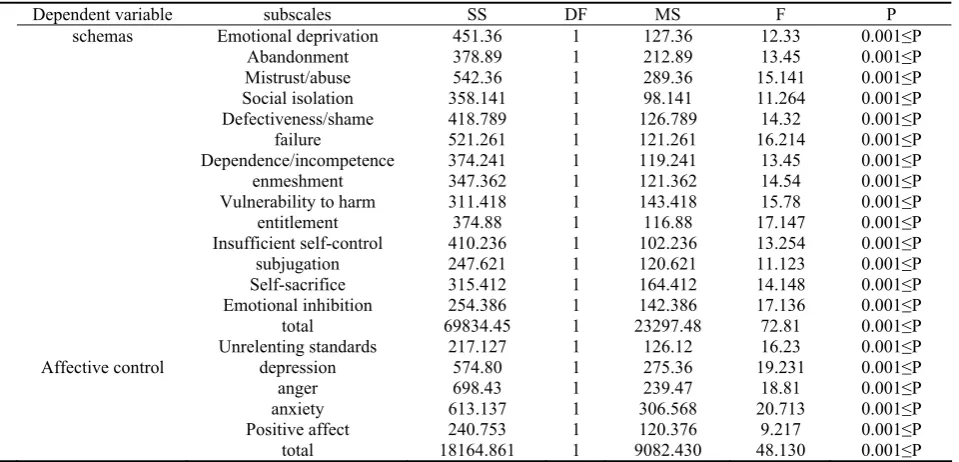
The results of Lambda test showed that the effect of group is significant on the subscales of both instruments [Wilks, F (89, 13) = 0.186, P<0.001]. The result of this test permits to use MANOVA. Findings showed that there is a significant difference between the two groups at least for one of the variables.
Table 3. The results of MANCOVA test for comparing pre-test and post-test of both instruments (in experimental group and control group)
Dependent variable subscales SS DF MS F P
schemas Emotional deprivation 451.36 1 127.36 12.33 0.001≤P
Abandonment 378.89 1 212.89 13.45 0.001≤P
Mistrust/abuse 542.36 1 289.36 15.141 0.001≤P
Social isolation 358.141 1 98.141 11.264 0.001≤P
Defectiveness/shame 418.789 1 126.789 14.32 0.001≤P
failure 521.261 1 121.261 16.214 0.001≤P
Dependence/incompetence 374.241 1 119.241 13.45 0.001≤P
enmeshment 347.362 1 121.362 14.54 0.001≤P
Vulnerability to harm 311.418 1 143.418 15.78 0.001≤P
entitlement 374.88 1 116.88 17.147 0.001≤P
Insufficient self-control 410.236 1 102.236 13.254 0.001≤P
subjugation 247.621 1 120.621 11.123 0.001≤P
Self-sacrifice 315.412 1 164.412 14.148 0.001≤P
Emotional inhibition 254.386 1 142.386 17.136 0.001≤P
total 69834.45 1 23297.48 72.81 0.001≤P
Unrelenting standards 217.127 1 126.12 16.23 0.001≤P
Affective control depression 574.80 1 275.36 19.231 0.001≤P
anger 698.43 1 239.47 18.81 0.001≤P
anxiety 613.137 1 306.568 20.713 0.001≤P
Positive affect 240.753 1 120.376 9.217 0.001≤P
total 18164.861 1 9082.430 48.130 0.001≤P
Discussion
This study intended to examine the effectiveness of mindfulness-based cognitive therapy on moderating maladaptive schemas and affective control in students suffering from learning disabilities. The results of the study showed that mindfulness-based cognitive therapy moderates maladaptive schemas in subjects. These findings are consistent with some other studies' results (19-21) that mindfulness-based cognitive therapy moderates maladaptive schemas like shame, failure, emotional inhibition, social isolation, and abandonment. Schemas shape the base of individual's self-concept and influence the individual's interaction with environment and are able to make individuals vulnerable to their daily problems. In fact, schemas are employed as patterns to process the individual's experiences. Schemas determine the individuals' thoughts, their relationship with others, and the way they perceive themselves and others (13). Because of limited relationship with others and lasting ruminations, maladaptive schemas take form in students diagnosed with learning disability. These structures cannot protect the individuals from negative emotions; and these students feel isolation and abandonment. These schemas are related to a range of psychological problems including cognitive, emotional, and social dysfunctions such as cognitive distortions (14), intimacy problems, feeling loneliness, and low self-esteem (16) (Ward et al.). But, mindfulness-based cognitive therapy includes a sympathetic relationship with oneself; and instead of
helping the individual change, it recommends a new self-care and sympathetic internal processes that can be regarded as a neuro-psychophysiological therapy (19). On the other hand, mindfulness-based cognitive therapy is accompanied with meditation and relaxation; hence, it could be a mediating factor in increasing psychological function and quality of life for these students (29). The findings of the present study also showed that mindfulness-based cognitive therapy decreases negative effects (depression, anger, and anxiety) in experimental group as compared with the control group. This finding is consistent with the findings of other studies (12,13,30).
it may help children regulate their unsuitable behaviors, develop desirable behaviors in themselves, and enhance their mental health (20). Small size of the sample and lack of follow-up stage may be the limitations of this study. It is recommended that the future research be conducted using a larger sample and employing follow-up stage. However, this therapeutic method can be applied for mentally retarded students and their parents as a supplement to other methods.
Conclusion
The results of the study showed that mindfulness-based cognitive therapy moderates maladaptive
schemas in subjects. This finding represents important implications regarding education and mental health improvement in exceptional students. Therefore, it is recommended to use this therapeutic package in schools and clinics as a supplement to other therapies in order to decrease negative emotions and to prevent formation of maladaptive schemas in these students
Acknowledgement
Finally, the authors acknowledge the contributions of Koohdasht's Education Organization who facilitated the implementation of this study.
References
1. Gartland D, Strosnider R. Learning disabilities and young children: Identification and intervention. Learning Disability Quarterly. 2007;30(1):63-72.
2. Fletcher JM, Lyon GR, Fuchs LS, Barnes MA. Learning disabilities: From identification to intervention: Guilford Press; 2006.
3. Sadock BJ, Kaplan HI, Sadock VA. Kaplan & Sadock's synopsis of psychiatry: behavioral sciences/clinical psychiatry: Lippincott Williams & Wilkins; 2007.
4. Association AP. Diagnostic And Statistical Manual Of Mental Disorders DSM-IV-TR Fourth Edition (Text Revision) Author: American Psychiatr. 2000.
5. Narimani M, Degarmandroq N. Emotional disorders and learning disability in primary school classes. one, editor. Ardebil: Nikamooz. (In Persian); 2002.
6. Narimani M, Rajabi S. Examining the prevalence of learning disability in primary school students. Research in Exceptional Children. 2005;5(3):221-52.
7. Anastasi A, Urbina S. Psychological Testing: Study Guide (Paperback). United States: Pearson Education; 1997. 8. Taroyan N, Nicolson R, Fawcett A. Behavioural and
neurophysiological correlates of dyslexia in the continuous performance task. Clinical Neurophysiology. 2007;118(4):845-55.
9. Silver CH, Ruff RM, Iverson GL, Barth JT, Broshek DK, Bush SS, et al. Learning disabilities: the need for neuropsychological evaluation. Arch Clin Neuropsychol. 2008;23(2):217-9. Epub 2007/11/06.
10.Langton CM, Marshall W. Cognition in rapists Theoretical patterns by typological breakdown. Aggression and Violent Behavior. 2001;6(5):499-518.
11.Carvalho J, Nobre PJ. Early maladaptive schemas in convicted sexual offenders: Preliminary findings. International journal of law and psychiatry. 2014;37(2):210-6.
12.Nordahl HM, Holthe H, Haugum JA. Early maladaptive schemas in patients with or without personality disorders: Does schema modification predict symptomatic relief? Clinical Psychology & Psychotherapy. 2005;12(2):142-9. 13.Beck AT, Freeman A, Davis DD. Cognitive therapy of
personality disorders: Guilford Press; 2006.
14.Gannon TA, Collie RM, Ward T, Thakker J. Rape: Psychopathology, theory and treatment. Clinical psychology review. 2008;28(6):982-1008.
15.Ward T, Beech A. An integrated theory of sexual offending. Aggression and Violent Behavior. 2006;11(1):44-63. 16.Ward T, Keenan T, Hudson SM. Understanding cognitive,
affective, and intimacy deficits in sexual offenders: A developmental perspective. Aggression and Violent Behavior. 2000;5(1):41-62.
17.Rostami M, Bahmani B, Bakhtyari V, Movallali G. Depression and Deaf Adolescents: A review. Iranian Rehabilitation Journal. 2014;12(19):43-53.
18.Gross JJ. The emerging field of emotion regulation: An integrative review. Review of general psychology. 1998;2(3):271.
19.Gilbert P, Procter S. Compassionate mind training for people with high shame and self-criticism: Overview and pilot study of a group therapy approach. Clinical Psychology & Psychotherapy. 2006;13(6):353-79.
20.Montague M. The effects of cognitive and metacognitive strategy instruction on the mathematical problem solving of middle school students with learning disabilities. Journal of learning disabilities. 1992;25(4):230-48.
21.DEBATE T. Cognitive and Adaptive Disabilities. Developmental-behavioral Pediatrics: Evidence and Practice. 2008:405.
22.Masten AS. Ordinary magic: Resilience processes in development. American Psychologist. 2001;56(3):227. 23.Paul BM, Fine EM. Learning Disability: Overview. In:
Aminoff MJ, Daroff RB, editors. Encyclopedia of the Neurological Sciences (Second Edition). Oxford: Academic Press; 2014. p. 855-8.
24.Dilawar A. Theoretical Foundations of Research in Humanities and Social Sciences. Tehran: Roshd; 2011. 25.Ventura J, Liberman RP, Green MF, Shaner A, Mintz J.
Training and quality assurance with the structured clinical interview for DSM-IV (SCID-I/P). Psychiatry Research. 1998;79(2):163-73.
26.Williams KE, Chambless DL, Ahrens A. Are emotions frightening? An extension of the fear of fear construct. Behaviour research and therapy. 1997;35(3):239-48. 27.Ghaderi Z, Khodadadi Z, Abbasi Z. Combined therapy
group based on decision-making style and again narrative therapy on control the emotions of adolescent girls in shiraz. Journal of Women and Society. 2010;1(3):137-48.
29.Carmody J, Baer RA. Relationships between mindfulness practice and levels of mindfulness, medical and psychological symptoms and well-being in a mindfulness-based stress reduction program. Journal of behavioral medicine. 2008;31(1):23-33.