.
Research Article
© 2018 Moses et.al.. This is an open access article licensed under the Creative Commons Attribution-NonCommercial-NoDerivs License (http://creativecommons.org/licenses/by-nc-nd/3.0/).
Digitization of Educational Technology Centres for Teaching Electrical and
Electronics Technology in Colleges of Education in North Eastern Nigeria
Dauda Moses
1*Nasiru Bello Mohammed
2Amos Danlami Agbu
3Lumo Adams Gainaka
41School of Technology and Science Education,
MAUTECH, P. M. B. 2076 Yola, Adamawa State, Nigeria
2School of Education, F.C.E (Technical),
P. M. B. 60 Gombe, Gombe State, Nigeria
3Electrical Engineering Department,
Taraba State Polytechnic Suntai, P. M. B. 1030 Jalingo, Taraba State, Nigeria
4Ministry of Education,
P. M. B. 0064, Bauchi, Bauchi State, Nigeria
*Corresponding Author
Doi: 10.2478/ajis-2018-0071
Abstract
The purpose of this study was to assess the level of digitization of Educational Technology Centres for teaching electrical and electronics technology in Colleges of Education in North Eastern Nigeria in order to provide information that will help solve problems of incompetence of public school students in Information and Communication Technology (ICT). The study, guided by two research questions and two hypotheses was conducted in six Colleges of Education in North Eastern Nigeria using descriptive survey research design. The sample of the study was 50 comprising of 15 non-teaching Educational Technology Centres staff and 35 Electrical and Electronics Technology lecturers from five colleges of education in North Eastern Nigeria. Checklist containing 103 expected digital facilities based on National Commission for Colleges of Education (NCCE) minimum standard for Educational Technology Facilities in Colleges of Education in North Eastern Nigeria was used as instrument for data collection. Respondents were required to fill in observed facilities in the required column. Arithmetic percentage and Chi–square test of goodness-of-fit and were used determine the extent of digitization of the Educational Technology Centres in Colleges of Education in North Eastern Nigeria. Findings of the study revealed among others that analog technologies has higher number of frequency counts compared to digital technologies, hence there was low digitization of hardware facilities in Educational Technology Centres in Colleges of Education in North Eastern Nigeria. The study therefore concluded that Educational Technology Centres in Colleges of Education in North Eastern Nigeria were not digitized for instructional purposes; therefore, Government should digitize Educational Technology Centres in Colleges of Education in North Eastern Nigeria by adequately providing both digital hard and soft ware facilities.
Keywords: Digitization, Educational Technology, Centres, Teaching, Colleges of Education
1. Introduction
technology transform every sector, learners are expected to; beside having mastery in art of communication, maths technology and sciences, it is imperative to have skills and competencies in areas such as critical thinking, problem-solving, persistence, and collaboration. However, learners in many countries are not attaining these skills. The World Economic Forum has observed a multi-year initiative, “New Vision for Education”, to evaluate the pressing issue of skills and competency gaps and explore ways to address such gaps through provision of recent digital educational facilities for teaching (World Economic Forum, 2015).
The call for the application of digital technologies learning facilities in instructional delivery in COEs is a means of infusing and injecting efficiency and effectiveness in curriculum implementation in technical education. However, in developing countries like Nigeria, the use of digital technologies in instructional delivery is challenged with problems ranging from lack of trained personnel, digital technologies learning materials such as computers, on–line internet computers, telephones, wireless scanners, printers, e-mail facilities, multimedia television, multimedia projectors, digital Libraries, computer assisted instructions (CAIs) among others (Global Information Technology Report, 2005 in Atueyi & Ikemelum, 2014).
Colleges of Education have not discharged their duties well in equipping present day youths with relevant teaching skills necessary for effective instructional delivery in the 21st Century (Ololube, Ubogu & Egbezor, 2006). The inability to integrate recent digital technologies in instructional delivery in may put the Colleges of Education at a global competitive disadvantage as the colleges would probably be producing low quality teachers at higher cost. The danger here is that if analog and absolute facilities remain in instructional delivery in the Colleges of Education, the objectives of Technical Education in Nigeria may became an illusion and may have a ripple effect on higher education. This situation will eventually bring the Colleges of Education to a halt and eventually pose serious limitations to students’ learning (Ibidapo-Obe, 2007).
The development and impact of digital technologies necessitated educational technology centres in Colleges of Education in North Eastern Nigeria to migrate from analog to digital technologies for the sole purpose of equipping teachers with relevant skills (such as digital technologies and information technology literacy; problem-solving skills and the ability to use digital technology in evaluating and utilizing information and communication technologies for problem-solving in addition to knowledge of subject’s contents) as stipulated in the National Policy on Education (FRN,2013). These knowledge components often considered as ICT-literacy has become part of basic labour requirements in knowledge driven societies and a necessary foundation for higher and lower levels of education and professional development.
Information and Communication Technology (ICT) has produced changes in the economic, political and educational sphere of our daily lives, such that it has become an important index of national and economic development and basic building block of modern society. Globally, the ICT world has initiated a transition of emphasis from analog educational research based technological development to that of digital knowledge based technological development in education (Jude & Dankoro, 2012). Digital technologies for teaching and learning became the strategic alternatives for the Colleges of Education to enhance effective and efficient delivery of quality education.
Educations have transformed to encompass dual modes where both online and on-campus learning options are available (Power, 2008). New digital facilities allow more flexible and innovative educational technology and course design solutions (Olofsson & Lindberg, 2012; Schneckenberg, 2009). This is also the case in Education, where the use of digital facilities to enhance students’ learning has grown rapidly (Maley, Harvey, De Boer, Scott, & Arena, 2008).
In order to cope effectively with challenge of equipping teachers with knowledge that bears relevance to the present need of 21st century of digital ICT age, ETCs that contain analog facilities in Colleges of Education in North Eastern Nigeria need to migrate from analog technologies to digital technologies at all levels. Such migration need to reflect on meaningful changes in infrastructure, educational technology facilities, curriculum and pedagogical practices (Emmanuel, Chiaka, & Edna, 2014). This transformational in the mode of imparting knowledge to students is the prime concern of educational business ((Ololube, Ubogu & Egbezor, 2006). The compelling need therefore to know the level of digitization of educational technology centres to accommodate the wide range of digital literacy shift in for teaching electrical and electronics technology in Colleges of Education in North Eastern Nigeria cannot be overemphasized.
1.1 Purpose of the Study
The purpose of this study was to investigate the level of digitization of Educational Technology Centres for teaching Electrical and Electronics Technology in Colleges of Education in North Eastern Nigeria and specifically to determine the:
1. Extent of digitization of hardware in Educational Technology Centres for Teaching Electrical and Electronics Technology in Colleges of Education in North Eastern Nigeria? 2. Extent of digitization of software in Educational Technology Centres for Teaching Electrical
and Electronics Technology in Colleges of Education in North Eastern Nigeria?
1.2 Research Questions
To achieve the above stated specific purposes, the following research questions were used to guide the study:
1. To what extent are hardware digitized in Educational Technology Centres for Teaching Electrical and Electronics Technology in Colleges of Education in North Eastern Nigeria? 2. To what extent are software digitized in Educational Technology Centres for Teaching
Electrical and Electronics Technology in Colleges of Education in North Eastern Nigeria?
1.3 Research Hypotheses
Two hypotheses guided the study as follows:
HO1: There is no significant difference between the number of digital and analog hardware in Educational Technology Centres for teaching electrical and electronics technology in Colleges of Education in North Eastern Nigeria.
HO2: There is no significant difference between the number of digital and analog software in Educational Technology Centres for teaching electrical and electronics technology in Colleges of Education in North Eastern Nigeria.
2. Methodology
The instrument used for data collection was a checklist containing 103 expected facilities based on National Commission for Colleges of Education (NCCE) minimum standard for educational technology facilities in Colleges of Education in North Eastern Nigeria. Respondents were required to fill in observed facilities in the required column against the column for expected facilities.
Data collected for the study was analyzed the arithmetic percentage and chi-square test of goodness-of-fit. The arithmetic percentage was used to answer the two research questions while the chi-square test of goodness-of-fit was used to test the two null hypotheses at 0.05 level of significance. All the data analyses were conducted using Statistical Package for Social Sciences (SPSS) version 20.0 for windows. The decision on the extent of digitization of facilities for teaching electrical and electronics technology in educational technology centres based computed percentages of observed facilities was as follows: 76-100%; Very High Extent, 51-75%; High Extent, 26-50%; Low Extent and 00-25%; Poor Extent.
3. Results
Results of the study were presented as follows:
3.1 Research Question 1
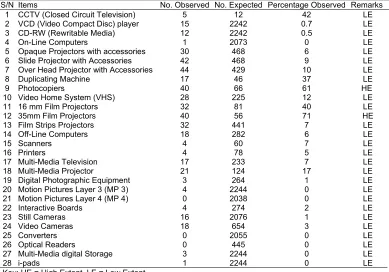
To what extent are hardware digitized in Educational Technology Centres for Teaching Electrical and Electronics Technology in Colleges of Education in North Eastern Nigeria?
Table 1. Extent of Digitization of Electrical and Electronics Hardware Facilities in Educational
Technology Centres
S/N Items No. Observed No. Expected Percentage Observed Remarks
1 CCTV (Closed Circuit Television) 5 12 42 LE
2 VCD (Video Compact Disc) player 15 2242 0.7 LE
3 CD-RW (Rewritable Media) 12 2242 0.5 LE
4 On-Line Computers 1 2073 0 LE
5 Opaque Projectors with accessories 30 468 6 LE
6 Slide Projector with Accessories 42 468 9 LE
7 Over Head Projector with Accessories 44 429 10 LE
8 Duplicating Machine 17 46 37 LE
9 Photocopiers 40 66 61 HE
10 Video Home System (VHS) 28 225 12 LE
11 16 mm Film Projectors 32 81 40 LE
12 35mm Film Projectors 40 56 71 HE
13 Film Strips Projectors 32 441 7 LE
14 Off-Line Computers 18 282 6 LE
15 Scanners 4 60 7 LE
16 Printers 4 78 5 LE
17 Multi-Media Television 17 233 7 LE
18 Multi-Media Projector 21 124 17 LE
19 Digital Photographic Equipment 3 264 1 LE
20 Motion Pictures Layer 3 (MP 3) 4 2244 0 LE
21 Motion Pictures Layer 4 (MP 4) 0 2038 0 LE
22 Interactive Boards 4 274 2 LE
23 Still Cameras 16 2076 1 LE
24 Video Cameras 18 654 3 LE
25 Converters 0 2055 0 LE
26 Optical Readers 0 445 0 LE
27 Multi-Media digital Storage 3 2244 0 LE
28 i-pads 1 2244 0 LE
Table 1 indicated low digitization in 26 items while two items which includes item 9; photocopiers and item 12; 35mm film projectors which are analog facilities had high percentages, indicating that 26 out of 28 hardware for teaching Electrical and Electronics Technology in Educational Technology Centres in Colleges of Education in North Eastern Nigeria are not digitized.
3.2 Research Question 2
To what extent are software digitized in Educational Technology Centres for Teaching Electrical and Electronics Technology in Colleges of Education in North Eastern Nigeria?
Table 2. Extent of Digitization of Electrical and Electronics Software in Educational Technology
Centres
S/No Items No. Observed No. Expected Percentage Observed Remarks
29 Multi-Sim 0 82 0 LE
30 Electronics Work Bench 0 82 0 LE
31 Web 2.0 0 82 0 LE
32 Wikis 0 82 0 LE
33 Podcast 0 82 0 LE
34 Blogs 2 82 2 LE
35 Stencils 38 82 46 LE
36 Audio Tapes 143 82 174 HE
37 Video Tapes 272 82 331 HE
38 Slides 479 82 584 HE
39 16 mm Films 49 82 60 HE
40 35 mm Films 14 82 17 LE
41 Video Cassettes 261 82 318 HE
42 Tempo Markers 37 82 45 LE
43 Poster Colors 22 82 27 LE
44 Over Head Transparencies 73 82 89 LE
45 Transparency Pens 93 82 113 HE
46 Micro Soft Power Point 6 82 7 LE
47 Micro Soft Excel 3 82 4 LE
48 Magnifier 3 82 4 LE
49 Micro Soft Out Look 4 82 5 LE
50 E-microscopes 4 82 5 LE
51 Micro Soft Picture 4 82 5 LE
52 Smart Board 4 82 5 LE
53 Online Images 2 82 2 LE
54 Online Posters 0 82 0 LE
55 Online Graphics 2 82 2 LE
56 Clip Arts Images 1 82 1 LE
57 Internet Protocol Camera 0 82 0 LE
58 Online Maps 0 82 0 LE
59 Graphics software 5 82 6 LE
60 Web Cams 0 82 0 LE
61 Dictionary 5 82 6 LE
62 Computer Assisted Instruction Packages 3 82 4 LE
63 E-Mail Facilities 0 82 0 LE
Key: HE = High Extent, LE = Low Extent
3.3 Hypothesis 1
There is no significant difference between the number of digital and analog hardware in Educational Technology Centres for teaching electrical and electronics technology in Colleges of Education in North Eastern Nigeria.
Table 3. Chi-Square Test of Difference in the Number of Hardware in Educational Technology
Centres
S/N Technology Total χ2 cal. χ2 crit. Df Decision
1 Digital 23 23315.3 40.113 26 Rejected
2 Analog 5
In table 3 above, Chi-square statistics result showed that χ2cal. = 23315.3 was greater than χ2 crit. = 40.113 hence the null hypothesis was rejected indicating a significant difference in the number of digital and analog electrical and electronics hardware in Educational Technology Centres in Colleges of Education in North Eastern Nigeria.
3.4 Hypothesis 2
There is no significant difference between the number of digital and analog software in Educational Technology Centres for teaching electrical and electronics technology in Colleges of Education in North Eastern Nigeria.
Table 4. Chi-Square Test of Difference in the Number of Software in Educational Technology
Centres
S/N Technology Total χ2 Cal. χ2 Crit. Df Decision
1 Digital 24 4772.1 46.194 33 Rejected
2 Analog 11
Table 4 showed Chi-square statistics result with χ2cal = 4772.1 which is greater than χ2 crit. = 46.194 hence the null hypothesis was rejected indicating that there was significance difference in the number of the digital and analog electrical and electronics software in Educational Technology Centres in Colleges of Education in North Eastern Nigeria
3.5 Findings of the Study
Based on the data analyzed with respect to the two research questions and two null hypotheses that guided the study, the following findings emerged.
1. There is low digitization of hardware facilities for teaching electrical and electronics technology in educational technology centres in Colleges of Education in North Eastern Nigeria.
2. There is low digitization of software facilities for teaching electrical and electronics technology in educational technology centres in Colleges of Education in North Eastern Nigeria
3. There was significant difference between the expected digital and analog hardware for teaching electrical and electronics technology in educational technology centres in Colleges of Education in North Eastern Nigeria
3.6 Discussion
Findings of the study regarding research question 1 revealed low extent of digitization of hardware facilities for teaching electrical and electronics technology in Educational Technology Centres in Colleges of Education in North Eastern Nigeria. The finding showed that both analog and digital hardware facilities are low digitized in the Educational Technology Centres. Longe, (2013) argue in support of the findings of the study, public and private colleges have inadequate analog/digital facilities for teaching in ETCs. In response to the condition of Educational Technology Centre for effective teachers education in Nigeria, Udo (2006), agreed that availability, relevance and adequacy of hardware contribute to perceived students’ learning outcome. The findings of this study however, disagreed with the findings of Oyeronke, Ogunlade, and Amos (2013), that facilities and equipment in educational technology centres in some selected Universities in Nigeria were averagely adequate. The difference in these findings was seen to be largely due to the fact that the study conducted by Oyeronke, Ogunlade, and Amos (2013), was conducted in the Universities where the National Universities Commission (NUC) placed more emphasis on educational technology.
Findings on research question 2 revealed low extent of digitization of software facilities for teaching electrical and electronics technology in Educational Technology Centres in Colleges of Education in North Eastern Nigeria. It was found out that a wide difference exists between the analog and digital software expected in Educational Technology Centres in Colleges of Education in North Eastern Nigeria. Both analog and digital software are not adequate in the Educational Technology Centres, an indication that the process of digitization of software in the Educational Technology Centres is slow. This finding was in agreement with findings of Tella (2011), who in his study found that software such as compact disks (CDs) and other digital and analog software were not available, let alone, being used for instructional purpose in colleges of education in South Western Nigeria. The findings also agreed with the findings of Wodi (2009), on the concept of educational technology and the problems prospects of Information and Communication Technology (ICT) in Nigeria. Wodi (2009) found out that soft wares produced overseas are grossly unavailable for teaching and learning in the nations’ undergraduate programmes.
Findings of the study on hypotheses 1 and 2 revealed that a significant difference existed between the expected digital and analog electrical and electronics hard and soft wares in educational technology centres in for teaching electrical and electronics technology Colleges of Education in North Eastern Nigeria. The inadequacies of most of the facilities are absoluteness and non-functionality. In line with these findings was that of Oshinaike and Adekunmisi, (2012), whose findings indicated that multimedia hard and soft wares in Nigerian University System are grossly inadequate.
4. Conclusion
Based on the results of this study, it can be concluded that both hard and soft ware facilities in educational technology centres for teaching electrical and electronics technology in Colleges of Education in in North Eastern Nigeria are not digitized hence cannot be connected with the computer for classroom instruction. Both hard and software facilities in the educational technology centres are not adequate when compared to the number of students that utilize the facilities. The study also concludedthat significant difference existed between the expected digital and analog hard and soft wares in educational technology centres for teaching electrical and electronics technology in Colleges of Education in North Eastern Nigeria.
5. Recommendations
Based on the conclusions, the following recommendations were drowned to the issues addressed by the research questions and hypotheses of this study:
2. More digital hard and soft ware facilities should be procured in educational technology centres for teaching electrical and electronics technology in Colleges of Education in North Eastern Nigeria
6. Sources of Funding of the Study
All costs, including that of undertaking the research study, transportation and welfare of both researchers and assistants were financed by the authors.
7. Acknowledgements
The researchers acknowledged the contributions of the following to the success of the study: Prof. V. V. Apagu, Prof. L. C. Ezugu, Prof. K. R. E. Okoye, Prof. D. K. Diraso, Prof. E. V. Mbaga and Dr. J. D. Medugu. The cooperation of all staff of educational technology centres including those in the micro teaching laboratories and electrical and electronics technology lecturers in colleges of education in north eastern Nigeria is also acknowledged.
Reference
Atueyi, B. J. & Ikemelum, F. K. L.(2014). Multimedia of school. Nijmegen: Institute voor Toegepaste Sociale wetenschappen, Ubbergen: Tandem Felix. Spotts, T.H. (1999). Discriminating factors in faculty use of
instructional technology in higher education.Journal of Educational Technology and Society, 2(4),95.
Catchan, R. (2013). Reflections: How STEM becomes STEAM. The STEAM Journal, 1(1),22
Emmanuel, C. N., Chiaka, A. O. & Edna, N. (2014) Integration of Information Communication Technology (ICT) in the
Curriculum of Federal Unity Schools in Nigeria: Implications for Learning. Greener Journal of Educational
Research vol.4 (4) P p: 91-98. [Online] Available:http://dx.doi.org/10.15580/GJER.2014.4.021714113(May 5, 2016)
Federal Republic of Nigeria (FRN), (2013).National Policy on Education (Rev.ed.).Lagos:NR
Gardner, H. (2012). Commentary, getting at the heart of the creative experience.Creativity: Insights, directions,
and possibilities. Learning Landscapes, 6(1), 45-48
Ibidapo-Obe, O. (2007) The Challenges of teacher education in Nigeria: The University of Lagos Experience. Paper presented at the Second Regional Seminar for Africa, UNESCO Forum on Higher Education, Research and Knowledge, Accra, 36(4), 21-22.
Jude W. I. & Dankaro J. T. (2012).Resources utilization, availability and accessibility by teacher educators for
instructional development in colleges of education, Kastina-Ala. New Media and Mars Communication.3
(3), 1-6
Longe, A. G. (2013), An Impact Assessment Study on the Role of Educational Technology in the Provision of Skills and Competencies in the Design of Instructional Materials in Higher Education Institutions in Lagos
State Nigeria. Computing, Information Systems & Development Informatics.3 (4), 34-45
Maley, M. A. L., Harvey, J. R., De Boer, W. B., Scott, N. W., & Arena, G. E. (2008). Addressing current
problems in teaching pathology to medical students: Blended learning.Medical Teacher, 30(3),1–9.
Olofsson, A. D. & Lindberg, J. O. (Eds.) (2012).Informed design of educational technologies in higher
education.Hershey. IGI Global.
Ololube, N. P., Ubogu, A. E., & Egbezor, D. E. (2006). ICT and Distance Education Program in a Sub-Saharan
African Country: A Theoretical Perspective. Journal of Information Technology Impact, 7(3),181-194.
Oshinaike, A. B. & Adekunmisi, S. R. (2012). "Use of Multimedia for Teaching in Nigeria University System: A
Case Study of University of Ibadan" Library Philosophy and Practice (e journal). Paper 682. [Online]
Available: http://digitalcommons.unl.edu/libphilprac/682 (May 7, 2016)
Oyeronke, O. O. & Amos, A. O. (2013).Evaluation of the adequacy, suitability and use of educational technology in selected faculties of education in Nigeria. Academic Journals http://www.academicjournals.org/JMCS
Journal of Media and Communication Studies,4(4),38-43.
Power, M. (2008). A dual-mode university instructional design model for academic development. International
Journal for Academic Development, 13(1),5-16.
Schneckenberg, D. (2009). Understanding the real barriers to technology-enhanced innovation in higher
education.Journal of Educational Research, 51(4),411–424.
Tella, A. (2011).Availability and use of ict in south-western Nigeria colleges of education. Ethiopia International
Multidisciplinary Journal, 5(5),315-331.
uyo local education authority, AkwaIbom State.Resources for Science Technology and Mathematics
(STM) Education. Science Teachers Association of Nigeria Proceedings of the 47th Annual Conference
Wodi, S. H., (2009). New technologies for teaching and learning: Challenges for higher learning institutions in
developing countries. International Journal of Education and Development using ICT, 3(2), 56.