RESEARCH ARTICLE
Do disciplinary contexts impact
the learning of evolution? Assessing knowledge
and misconceptions in anthropology
and biology students
Elizabeth P. Beggrow
1*and Gena C. Sbeglia
2Abstract
Background: Evolution education research has focused on biology populations, while other disciplines organized around evolutionary theory—such as biological anthropology—remain understudied. Cognitive science and educa-tion research suggest that learning evolueduca-tion within the context of human evolueduca-tion might cause increased under-standing of evolutionary theory, as well as reasoning patterns relating to evolutionary change different from those stemming from learning evolution in a more generalized context. Biological anthropology students could offer a test of this hypothesis. This study incorporates this underrepresented population into the evolution education literature in order to generate insights into the effects of disciplinary context on evolutionary knowledge and reasoning.
Methods: Undergraduate biology and anthropology students (N = 268) completed two validated and published evolution knowledge instruments: Conceptual Inventory of Natural Selection (CINS) and Assessment of Contextual Reasoning about Natural Selection (ACORNS). We varied the surface features of the ACORNS items [i.e., the trait (famil-iar, unfamiliar) and taxon (human, non-human)] and evaluated if the populations differed in their instrument scores or sensitivity to item surface features.
Results: The populations differed in background and demographic variables. Evolutionary knowledge and reason-ing patterns also differed, with biology students havreason-ing higher CINS scores, more key concepts, fewer naive ideas, and higher frequencies of accurate reasoning models. However, scores were generally poor for both populations. When background and demographic factors were controlled, key concept scores were comparable, but anthropology students continued to display lower measures for the other variables. Additionally, biology students’ showed limited sensitivity to the item surface features compared to anthropology students.
Conclusions: Anthropology and biology students displayed significantly different demographic and academic back-grounds, making comparisons complex. We did not find evidence that learning evolution within a human/primate context generated greater instrument scores or lower sensitivities to item surface features. Rather, both anthropol-ogy and biolanthropol-ogy students were novice-like in their evolutionary knowledge and reasoning patterns. Anthropolanthropol-ogy students were more novice-like because they displayed sensitivities to item surface features. Our study raises ques-tions about how best to assess the relative impact of taxon and trait familiarity on the measurement of evolutionary knowledge and reasoning.
Keywords: Evolution, Anthropology, Human evolution, Knowledge, Misconceptions, Context, Undergraduates, Surface Features
© The Author(s) 2019. This article is distributed under the terms of the Creative Commons Attribution 4.0 International License (http://creat iveco mmons .org/licen ses/by/4.0/), which permits unrestricted use, distribution, and reproduction in any medium, provided you give appropriate credit to the original author(s) and the source, provide a link to the Creative Commons license, and indicate if changes were made.
Open Access
*Correspondence: [email protected]
1 Center for Life Sciences Education, The Ohio State University, 1735 Neil
Avenue, Columbus, OH 43210, USA
Background
Although undergraduate coursework in both biology and biological anthropology uses evolutionary theory as a guiding and organizing principle (AAAS 2011; Fuentes 2011), the contextualization of disciplinary core ideas (e.g., heredity, evolution) differs in important ways. For example, while introductory courses in the biological sci-ences typically engage with a range of core ideas using an array of taxonomic contexts from across the tree of life (e.g., archaea, bacteria, fungi, plants, animals), anthropol-ogy courses cover a somewhat overlapping range of core ideas illustrated using human and other primate exam-ples (e.g., Fuentes 2011). These differences in curricular contexts (e.g., primate focused vs. tree of life focused) provide an untapped research context for evolution education studies. Indeed, many evolution education research studies have utilized biology majors and non-majors to explore the challenges inherent to teaching and learning about evolution (e.g., Nehm and Reilly 2007; Gregory 2009). Interestingly, anthropology undergradu-ates have not received comparable attention in evolution education research even though evolution also serves as a core feature of that discipline. The overarching goal of our work is to begin to explore evolutionary knowledge and reasoning patterns in anthropology undergradu-ates, and to compare these findings to samples of biology undergraduates.
Anthropology, biology, and evolution education
Differences in how evolution is contextualized (e.g., focus on primates) means that evolutionary topics cov-ered in anthropology, such as inheritance, mutation, and phenotypic variation, are often situated within human examples. This focus could provide advantages for stu-dents in terms of learning evolution. For one, humans appear to be intrinsically interested in themselves (e.g., Pobiner 2012) and our cognitive tendency to easily dif-ferentiate individuals may help to overcome cognitive biases that hamper evolutionary thinking (i.e., essen-tialism; Sinatra et al. 2008). Anthropology students also learn about variation within a species, which is often a significant barrier to understanding natural selection (Gregory 2009). Finally, the discovery of new fossil taxa creates excitement and interest beyond the sciences, and is often associated with dilemmas and debates (e.g., Does the variation found in a new fossil exemplify intraspecific variation, or should it be named a new species?). The dis-coveries provide important opportunities for discussing and exploring the nature of science, which in and of itself has been associated with improved understanding of core concepts (e.g., Dagher and BouJaoude 1997; Kampoura-kis and Zogza 2009).
The potential advantages of teaching evolution using anthropological contexts have not gone unnoticed in sci-ence education research. A number of anthropologists and science education researchers have written about the importance of including human examples in evolu-tion educaevolu-tion (e.g., Alles and Stevenson 2003; Ashmore 2005; Cunningham and Wescott 2009; DeSilva 2004; Flammer 2006; Hillis 2007; Nickels et al. 1996; Paz-y-Miño and Espinosa 2009; Pobiner 2012, 2016; Price 2012; Wilson 2005) and some have investigated incorporat-ing human examples into biology curricula (e.g., deSilva 2004; Flammer 2006; Price 2012; Pobiner et al. 2018). While there is much evidence to suggest that anthropol-ogy curricula may offer a unique and advantageous way of learning evolutionary theory, there has been no for-mal, comparative research to test this hypothesis. Rather, the current body of work on students’ understanding of evolution, their non-normative ideas, and their accept-ance of evolutionary theory is primarily based on popula-tions of biology students, teachers, and experts. Studies investigating these traits in biological anthropology stu-dents are extremely rare and the results are not readily comparable to other populations, which limits any tests of the role that disciplinary context plays in evolution learning. For instance, Cunningham and Wescott (2009) surveyed students enrolled in an introductory biological anthropology course and found that, despite widespread agreement on the validity of biological evolution, many students held a number of misconceptions regarding evo-lutionary theory and the nature of science. However, this study was not conducted using published and validated measurement instruments, so it is unclear how these scores compare to populations in other studies or if the inferences generated from these scores are robust. There-fore, the relative evolutionary knowledge of populations of anthropology students, teachers and experts and the impact that human-focused evolution instruction has on that knowledge are in need of additional exploration.
Learning evolution using human contexts
(2008) found that an appreciation of individual-level variation by learners is related to a correct understand-ing of the mechanisms of natural selection, suggestunderstand-ing that learners can overcome this cognitive bias. Because individual variation is crucial to population thinking, essentialistic thinking creates potential obstacles for understanding evolutionary theory, particularly the ideas that species are immutable categories or that variation is best conceptualized as ‘noise’ (Gelman and Legare 2011). These obstacles impede learners’ grasp of within-species variation, and, ultimately, a firm understanding of the processes responsible for evolutionary change.
Typological biases could be the result of evolutionary processes favoring expediency and efficiency. Primates exhibit many social-cognitive abilities in order to facili-tate interactions with conspecifics (Axelrod and Hamil-ton 1981; Barret and Henzi 2005a, b; Dunbar 1993, 1998; Hammerstein 2003; de Waal 1997a, b; Humphrey 1974). Forming coalitions, bonding through grooming, and an overall awareness of who to affiliate with versus who to avoid, are crucial skills for social primates, particularly humans. Indeed, Humphrey (1974) found evidence in rhesus macaques that cognition regarding conspecifics is individual-oriented, while cognition about allospecifics tended to be species-oriented. As of 2018, 55% of people worldwide live in urban areas (Population Division 2018), and for this proportion of the global population, interac-tions with large numbers of non-human animals are lim-ited. When considering our own evolutionary history, intraspecific interactions certainly outweigh interspecific ones (Medin and Atran 2004) and, cognitively speaking, it seems as though humans operate accordingly.
Although a bias to think in ‘kinds’ has been docu-mented for people reasoning about non-human animals and plants, there has been research demonstrating that it does not always hold for thinking about other humans, at least biologically (Birnbaum et al. 2010; Rhodes and Gel-man 2009). Situating a biological phenomena in a human context appears to change the cognitive principles at play, and thinking about individual variation becomes more ‘comfortable’ when we are thinking about humans (Nettle 2010). Indeed, support was found among British university students for a stronger tendency towards indi-vidual-based reasoning when that reasoning was focused on humans as opposed to non-human animals (Nettle 2010). When reasoning about humans, students were specifically more likely to think that adaptive change could occur within species instead of the species going extinct and/or being replaced by a novel species (as they did with non-human animals), and they were more likely to accept the idea that individuals did not have to change within a lifetime for population-level changes to occur. Furthermore, when reasoning about humans, students
were less likely to think that novel features would auto-matically become ubiquitous among the entire species and tended not to view competition as a driver of evolu-tionary change. However, Nettle did find that reasoning about human evolution had no effect on two non-norma-tive ideas: that of the utility of a feature correlating with mutation and heredity (i.e., use/disuse), as well as the notion that change is driven by species needs (i.e., teleol-ogy) (2010). Nonetheless, Nettle’s (2010) findings support the idea that different domain-specific cognitive biases exist for reasoning about human versus non-human ani-mals (Atran 1998; Atran et al. 2001; Medin and Atran 2004).
Beyond overcoming essentialistic biases, studying evolution using humans may provide other advantages. Some studies suggest that students would actually pre-fer to learn evolution in the context of humans and that the topic could be a motivational factor (Pobiner et al. 2018; Schrein 2017; Paz-y-Miño and Espinosa 2009; Hillis 2007; Wilson 2005). For example, when asked for feedback on how their experience with the human evolu-tion case studies instrucevolu-tional material compared to pre-vious experiences with evolution content, a majority of students responses were coded as positive and indicated a preference for human examples (Pobiner et al. 2018). A similar preference for learning evolution with human examples was found in both biology majors and non-majors (Paz-y-Miño and Espinosa 2009). These studies suggest that the situations and contexts in which students learn about evolution make a difference.
Situated cognition and learning
Although learning concepts (e.g., evolution) within a particular taxonomic context (e.g., primates) can have advantages, it can also produce disadvantages (Anderson et al. 1996). In terms of knowledge application, an opti-mal recipe for learning is a combination of concrete and abstract examples (Anderson et al. 1996). This suggests that learning environments in which evolutionary con-cepts are taught across a range of contexts should foster improved application skills (e.g., Nehm 2018). It follows that while learning evolutionary concepts situated within anthropology may lead to an ability to apply those con-cepts within human-related contexts, it may not foster the ability to apply those concepts across the tree of life (e.g. both human and non-human contexts).
Although there is debate concerning what it means “to be situated” (Adams and Aizawa 2009; Wilson and Clark 2009), a basic tenet is that cognitive processes are both social and neural, and that knowledge itself is seen as dynamic (in terms of learning, remembering and rein-terpreting) and contextualized (Clancey 2009). The con-textualization of knowledge can be explored at many different scales, ranging from the social nature of the learning environment to more fine-grained questions relating to assessment tasks.
Situated cognition, familiarity and reasoning
Novice reasoning is inextricably linked to the context in which it is situated, thus the specific features of that con-text may contribute to the framing and conceptualization of any problem a novice may face and be a critical part of novice reasoning (Kirsh 2009). The features of a prob-lem that elicit these contextual effects in novice learners are called surface features. The effects of surface features on knowledge acquisition, retrieval and problem solving have been widely investigated within cognitive science (e.g., Caleon and Subramaniam 2010; Chi et al. 1981; DiSessa et al. 2004; Gentner and Toupin 1986; Sawyer and Greeno 2009; Evans et al. 2010; Sabella and Redish 2007). Within biology, the impact of surface features has been explored in a variety of studies, some of which explored context effects in genetics (see Schmiemann et al. 2017 for a review), though most of the research has been focused on understanding of natural selection (e.g., Bishop and Anderson 1990; Clough and Driver 1986; Federer et al. 2015; Kampourakis and Zogza 2009; Nehm et al. 2012; Nehm and Ha 2011; Nehm and Reilly 2007; Nehm and Ridgway 2011; Opfer et al. 2012; Sett-lage, 1994). Evolutionary biology is perhaps more sensi-tive to issues of contextuality than other science domains, namely due to the fact that the units of evolution (indi-viduals and species) already vary across space and time (Nehm and Ha 2011), which may make reasoning about these concepts more susceptible to contextual effects. Nehm and colleagues have found evidence for contex-tual feature effects with assessment items designed to elicit knowledge and non-normative ideas about evolu-tion (Federer et al. 2015; Nehm et al. 2012; Nehm and Ha 2011; Nehm and Reilly 2007; Nehm and Ridgway 2011; Opfer et al. 2012). The reasoning patterns elicited by these items were impacted by the item’s surface features such as the taxon in question (e.g., plant/animal/human), the polarity of evolutionary change in traits (e.g., loss or gain of trait) and the familiarity of the taxon and trait in question (e.g., lily vs. labiatae), though such effects diminish as expertise increases (e.g., Nehm and Ridgway 2011; Opfer et al. 2012).
Young children, the quintessential novices, are thought to hold a theory-like structure of naive ideas in biology that includes the necessary knowledge to rec-ognize biological things and phenomena despite little formal education on the topic, but lack the normative ideas about how those phenomena operate (e.g., Inagaki and Hatano 2006; Opfer et al. 2012). For example, chil-dren envision plants and animals as separate categories and vary accordingly in how they apply biological ideas to these concepts (e.g., Carey 1986; Inagaki and Hatano 1996; Opfer and Siegler 2004). Furthermore, children will use their understanding of humans as an analog to reason about plants and animals or novel situations (Inagaki and Hatano 2002). This is a potentially useful feature of reasoning that could be leveraged in evolu-tionary biology instruction by using familiar human examples as a bridge to the less familiar non-human examples (Seoh et al. 2016).
Research questions
Using a comparative, quantitative research design, this study explores the following research questions:
(RQ 1) How similar are the students that enroll in anthropology and biology classes?
(RQ 2) Do evolutionary knowledge and naive ideas differ across anthropology and biology stu-dents? If so, how?
(RQ 3) Is variation in evolutionary knowledge and naive ideas across these populations explained by background and demographic variables? (RQ 4) To what extent do surface features impact
each population’s evolutionary knowledge and naive ideas? Specifically, do evolutionary knowledge and naive ideas differ based on: (RQ 4.1) the taxon (human vs. non-human)? (RQ 4.2) the familiarity of the trait?
Methods
Recruitment and instruments
Data were gathered from undergraduate students enrolled in an introductory biological anthropology course (referred to here as anthropology) and an intro-ductory biology course at a large, public, Midwestern university. Courses were sampled once towards the end of the fall semester of 2012. Both courses count towards fulfilling the Natural Science GEC requirement and both require students to enroll in a laboratory component. Learning objectives for both courses included being able to explain the mechanisms of evolution (including genetic drift, natural selection, sexual selection) and how they relate to patterns of speciation and extinction (see Additional file 1: Appendix 1). Approximately seven lec-ture hours and three laboratory sessions (55 min each) in anthropology were designated for basic evolution content (history of evolutionary thought, cell biology/inherit-ance/DNA basics, heredity, population genetics, evolu-tionary mechanisms, macroevolution, modern human variation). Approximately eight lecture hours and three laboratory sessions (2 h each) in biology were designated for basic evolution content (artificial selection and natu-ral selection, microevolutionary mechanisms, macro-evolution and systematics, population genetics). Overall, both courses covered the same basic evolutionary cepts for roughly equal amounts of time, while the con-text in which they were taught differed.
Students were recruited to participate in an online survey accessed through SurveyMonkey®. Points were
awarded to students who participated in surveys based on the discretion of the instructors. Though amounts
varied between sections, all amounts were nominal rela-tive to the total grades. Surveys were comprised of a consent agreement, a section for demographic informa-tion, and three instruments. Demographic information (e.g., gender, year, and ethnicity) was gathered in accord-ance with IRB approval, as well as information con-cerning whether English was a first language, previous college level biology courses taken, and previous college level anthropology courses taken. Although participants were asked to identify cultural anthropology courses previously taken in the survey, these courses were not included in the analysis of the data. Year in school was coded as freshman, sophomore, junior or senior. Ethnic-ity was collapsed into two categories and coded as either white only or non-white. In addition to the aforemen-tioned survey components, the survey was comprised of (1) the multiple-choice Conceptual Inventory of Natural Selection (CINS) instrument (Anderson et al. 2002), (2) the open-response Assessment of Contextual Reasoning about Natural Selection (ACORNS) instrument (Nehm et al. 2012), and (3) a familiarity rating scale for 28 bio-logical terms (see Additional file 2: Appendix 2).
CINS
The multiple-choice CINS instrument consists of 20 items with one correct response option. Each item’s alternate answer choices were designed to address typi-cal non-normative ideas regarding natural selection (Anderson et al. 2002). The items are scored as correct/ incorrect, providing a total score ranging from 0 to 20. Although the CINS has been reported to display some psychometric limitations (Battisti et al. 2010), it is a widely used instrument for natural selection knowledge and is generally recognized as an instrument capable of generating valid inferences about general levels of partici-pants’ evolutionary knowledge (Smith 2010). The original CINS paper purports it to be a test of natural selection knowledge, but its questions about speciation mean that the concept of macroevolution is addressed (Futuyma 2009), making it a test of both micro- and macroevolu-tionary concepts.
ACORNS
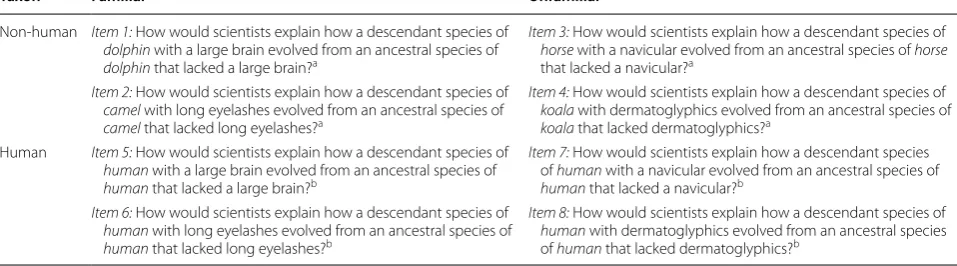
the trait. Specifically, half of the items used non-human taxa (i.e., dolphin, camel, horse, koala) and the other half used humans (Table 1). Likewise, half of the items used familiar traits (i.e., brain, eyelashes) and the other half used unfamiliar traits (i.e., navicular, dermatoglyphics) (Table 1). Familiarity of the taxa and traits was hypoth-esized apriori using Google™ PageRank (cf., Nehm et al. 2012; see Additional file 2: Appendix 2) and confirmed a posteriori. We intended for half of the traits and all of the taxa to be familiar to the survey respondents. All items focused on trait gain. We organized these eight iso-morphic items into two versions of the survey: a version focusing on evolution of the four traits in non-human animals (items 1–4) and a version focusing on evolu-tion of the same four traits but in humans (items 5–8) (Table 1). Half of the biology students and half of the anthropology students were assigned to each version of the survey and each student took only one version.
The order of the ACORNS items in the survey was ran-domly generated for each participant to help control for order effects on responses (e.g., Federer et al. 2015). The ACORNS responses were scored using automated scor-ing models (EvoGrader; Moharreri et al. 2014) developed to assess the accuracy of nine evolutionary concepts: six key concepts (KCs; variation, heritability, competition, limited resources, differential survival/reproduction, and non-adaptive reasoning) and three naive ideas (NIs; adapt, need, use/disuse) (Nehm et al. 2010; Beggrow et al. 2014). KC scores for each item ranged from 0 to 6 (referred to as per-item total KC), and NI scores for each item ranged from 0 to 3 (per-item total NI). A sum of all KCs used across all four items generated a Total KC score and a sum of all NIs used across all four items generated a Total NI score. Model type (MT) was also scored as
either no model (no direct answer to the question), naive model normative ideas only), mixed model (non-normative and (non-normative ideas) or pure scientific model (normative accurate ideas only; Moharreri et al. 2014).
Students’ familiarity with item words
After students completed the open response items, we asked them to rate their familiarity with each trait and taxon along the following scale: (1) “I have never seen/ heard the word before” (i.e., unfamiliar), (2) “I have seen/ heard the word before but do not know what it means” (i.e., somewhat unfamiliar), (3) “I have seen/heard the word before and may know what it means” (i.e., familiar), (4) “I have seen/heard the word before and are certain of its meaning” (i.e., very familiar). All terms were listed individually and devoid of contextual cues. We asked students to provide self-reported familiarity ratings for terms, including those used in the ACORNS items, to confirm a priori hypotheses of familiarity levels. Terms were chosen based on Google™ PageRank scores to rep-resent a selection of biological and anthropological terms that would range from unfamiliar to familiar for both anthropology and biology students (see Additional file 2: Appendix 2). The ratings also helped to generate more accurate measurements of familiarity that varied for each student; this variation was then included in our models.
Sample demographics
A total of 654 students took the survey, with three stu-dents declining to consent to the study (99.5% consent rate). Out of those surveys, 67 were incomplete and removed from the dataset. If students had taken five or more anthropology or biology courses (7) or had com-pleted or were currently enrolled in both anthropology Table 1 ACORNS Items
a Items present on version 1 of the survey. Version 1 consisted of only non-human items and was assigned to half of the biology and anthropology student
populations
b Items present on version 2 of the survey. Version 2 consisted of only human items and was assigned to the other half of the biology and anthropology student
populations
Taxon Familiar Unfamiliar
Non-human Item 1: How would scientists explain how a descendant species of
dolphin with a large brain evolved from an ancestral species of
dolphin that lacked a large brain?a
Item 3: How would scientists explain how a descendant species of
horse with a navicular evolved from an ancestral species of horse
that lacked a navicular?a Item 2: How would scientists explain how a descendant species of
camel with long eyelashes evolved from an ancestral species of
camel that lacked long eyelashes?a
Item 4: How would scientists explain how a descendant species of
koala with dermatoglyphics evolved from an ancestral species of
koala that lacked dermatoglyphics?a
Human Item 5: How would scientists explain how a descendant species of
human with a large brain evolved from an ancestral species of
human that lacked a large brain?b
Item 7: How would scientists explain how a descendant species of human with a navicular evolved from an ancestral species of
human that lacked a navicular?b Item 6: How would scientists explain how a descendant species of
human with long eyelashes evolved from an ancestral species of
human that lacked long eyelashes?b
Item 8: How would scientists explain how a descendant species of
and biology courses (109), they were removed from the dataset. Of the 468 remaining students, 19 students had missing demographic or background data and were removed from the relevant analyses.
We classified students as anthropology or biology stu-dents depending on their prior and current anthropol-ogy and biolanthropol-ogy courses. For the purposes of this study, anthropology students were classified as those who had completed or were currently enrolled in biological anthropology courses but had not taken any, and were not currently enrolled in any, biology courses (N = 208). Biology students were classified as those who had com-pleted or were currently enrolled in biology courses and had not taken any, and were not currently enrolled in any, biological anthropology courses (N = 260).
Analyses
Validity evidence
New items for the ACORNS instrument were intro-duced with this study and to establish convergent validity, Kendall’s Tau B correlation coefficients were calculated between CINS scores and ACORNS Total KC scores using SPSS v.20. Conversions were made according to Gilpin (1993) in order to make them comparable to pub-lished results. The CINS test was used here to estab-lish validity evidence for the ACORNS items because it is considered a proxy for natural selection knowledge (Nehm and Schonfeld 2010).
To address RQ1 (How similar are the students enrolled in anthropology and biology classes?), we compared demographic variables (i.e., gender, ethnicity), other stu-dent background variables (i.e., year, number of prior or current anthropology or biology courses, word count, English as a first language), and evolution knowledge and reasoning variables (i.e., CINS, ACORNS per-item total KCs, ACORNS per-item total NIs, ACORNS MT) between biology and anthropology students. We com-pared the distributions of demographic and background variables between biology and anthropology students using a Chi-Squared test. We compared the knowledge and reasoning variables between biology and anthropol-ogy students using a suite of regressions aligned with data type. CINS scores are numeric, and were analyzed using a linear regression with student classification as the single independent variable. ACORNS per-item total KCs and per-item total NIs are ordinal and were ana-lyzed using separate cumulative link mixed-effects mod-els with a logit link function via the R package ordinal (v. 2018.8-25; Christensen 2018). ACORNS MT data were converted into binary categorical variables (i.e., pure sci-entific MT vs. all other MTs) and were analyzed using a generalized linear mixed-effects model via the R package lme4 (Bates et al. 2018). As each student completed four
ACORNS items and thus had four data points for each ACORNS outcome variable, student id was coded as a random effect in these models. These regression models will be built upon in subsequent research questions, and so these models will be referred to as model set 1.
To address RQ2 (Do evolutionary knowledge and naive ideas differ across anthropology and biology students? If so, how?), we ran the same class of regression models as described above for CINS scores, ACORNS per-item total KCs, ACORNS per-item total NIs and ACORNS MT but, in addition to including student classifica-tion as a predictor variable (as in model set 1), we also included background (i.e., year, number of prior or cur-rent anthropology or biology courses, English as a first language) and demographic variables (i.e., gender, ethnic-ity). These regression models will be referred to as model set 2. With this model, we can then ask RQ3 (Is varia-tion in evoluvaria-tionary knowledge and naive ideas across these populations explained by background and demo-graphic variables?). We report on the impact of student classification for explaining the variation in each of the four knowledge and reasoning outcome variables (CINS scores, ACORNS per-item total KCs, per-item total NIs and MT) while controlling for all background and demo-graphic variables. We report unstandardized regression coefficients (b). We examined the effect size of each sig-nificant variable using generalized eta squared (η2G) via the R package Analysis of Factorial Experiments (afex, v. 0.21-2) (Singmann et al. 2018). η2G measures the addi-tional variance explained by a variable as compared to a model in which it was excluded. η2G can be compared across regression analyses and studies, and is appropri-ate for use in mixed model designs (Bakeman 2005; Lak-ens 2013; Olejnik and Algina 2003). The following cutoff values for interpretation can be used: small effect = 0.01, medium effect = 0.06, and a large effect = 0.14) (Olejnik and Algina 2003). We use a critical p-value of 0.01 for all analyses.
all surface feature variables were included in the model simultaneously, when observing the impact of a particu-lar surface feature variable, the analysis controls for the impact of all the others. We used a critical p-value of 0.01 for all analyses.
Results
Validity evidence
Kendall’s Tau B correlation analyses revealed that the CINS scores and ACORNS total KC scores are sig-nificantly correlated for the non-human taxa items (τ = 0.375, p < 0.01; r =0.562). Both CINS scores (τ =− 0.252, p < 0.01; r =− 0.383) and ACORNS total KC scores (τ =− 0.310, p < 0.01; r =− 0.468) are nega-tively associated with the ACORNS total NI scores. For the human items, the CINS scores had a very strong and significant association with the ACORNS total KC scores (τ = 0.411, p < 0.01; r = 0.600) and both the ACORNS total KC scores (τ =− 0.258, p < 0.01; r =− 0.397) and CINS scores (τ =− 0.160, p < 0.01; r =− 0.249) were sig-nificantly negatively associated with the ACORNS total NI scores.
Trait and taxon classifications
Plots of mean familiarity scores for traits revealed clear distribution differences (Fig. 1). We therefore categorized each trait as either familiar or unfamiliar. In contrast, the taxa were viewed as similarly familiar. Specifically, brain and eyelashes were given a score of 3 or 4 by nearly all of the biology and anthropol-ogy students (Fig. 1a). Conversely, dermatoglyph-ics and navicular were given a score of 1 or 2 by most
biology and anthropology students (Fig. 1a). All taxa were given a score of 4 by nearly all students (Fig. 1b). Therefore, for this population of students, the traits brain and eyelashes were classified as familiar and the traits dermatoglyphic and navicular were classi-fied as unfamiliar. All taxa were classiclassi-fied as familiar but labeled as human or non-human in the models. Therefore, trait familiarity (familiar vs. unfamiliar) and taxon category (human vs. non-human) were the sur-face features examined in this study.
RQ1 (How similar are the students enrolled in anthropology and biology classes?)
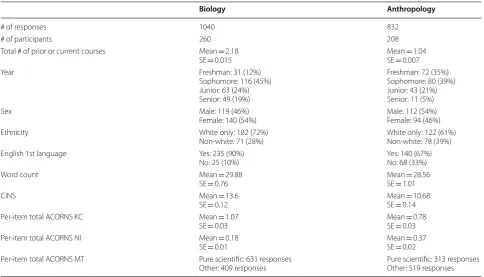
Anthropology and biology students display significantly different patterns for all demographic variables and most background variables. The anthropology population had fewer females (χ2= 12.69, df = 1, p < 0.001), fewer white students (χ2= 23.78, df = 1, p < 0.001), fewer students for whom English was a first language (χ2= 153.15, df = 1, p < 0.001), more students early in their college career (χ2= 181.9, df = 3, p < 0.001), and fewer previous and cur-rent courses (χ2= 1746.8, df = 3, p < 0.001). Word count for the open response ACORNS items was not signifi-cantly different between biology and anthropology stu-dents. See Table 2 for means and standard errors.
RQ2 (Do evolutionary knowledge and naive ideas differ across anthropology and biology students? If so, how?)
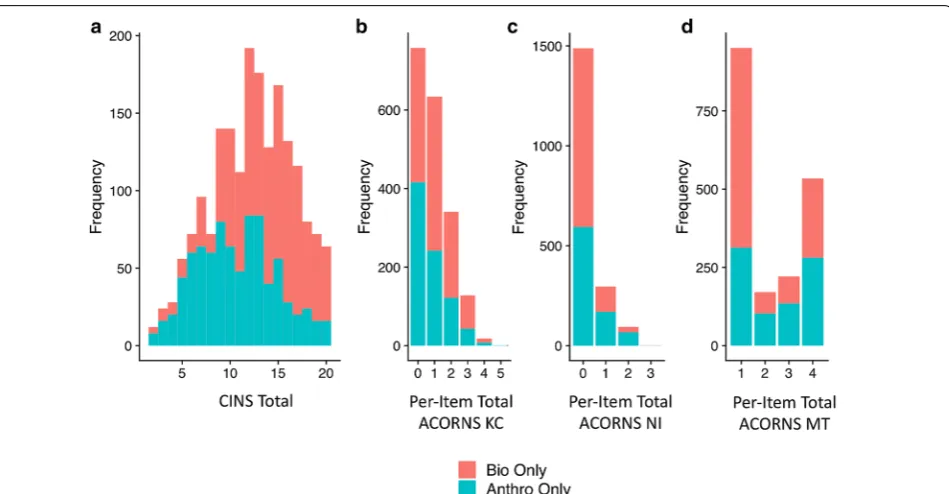
Anthropology and biology students also showed sig-nificant differences in the evolution knowledge and reasoning variables. The anthropology population had lower CINS scores (b =− 2.92, t =− 15.92, p < 0.001, η2G = 0.12), fewer KCs (b =− 0.91, Z =− 4.5, p < 0.001, η2G = 0.04), more NIs (b = 1.22, Z = 5.58, p < 0.001, η2G = 0.06), and a lower probability of a pure scientific model (b =− 1.62, Z =− 6.73, p < 0.001, η2G = 0.09) (Fig. 2a–d). See Table 2 for means and standard errors. As indicated by η2G, the size of the effect of student clas-sification on evolutionary knowledge was small for KCs, and medium for NIs, MT, and CINS.
RQ3 (Is variation in evolutionary knowledge and naive ideas across these populations explained by background and demographic variables?)
The difference in the per-item total KCs between anthro-pology and biology students was explained by back-ground and demographic variables. Specifically, when controlling for background and demographic variables, the per-item total KCs was no longer significantly differ-ent between the two populations. Rather, the number of prior and current biology and anthropology courses was the only significant predictor for the per-item total KCs (b = 0.80, z = 2.68, p < 0.01).
In contrast, the difference in the per-item total NIs, the probability of a pure scientific model, and CINS scores between anthropology and biology students were partially, but not fully explained by demographic and background variables as demonstrated by the sustained significance, but decreased effect size, of the student classification varia-ble (Tavaria-ble 3). Specifically, when controlling for background and demographic variables, the anthropology population maintained significantly lower CINS scores (b =− 1.34, t =− 4.16, p < 0.001, η2G = 0.009), more NIs (b = 1.73, z = 4.24, p < 0.001, η2G = 0.04), and a lower probability of a pure scientific model (b =− 1.16, z =− 2.71, p < 0.01, η2G = 0.01) (Table 3). The classification of the student was the only significant predictor variable for the per-item total NIs and the probability of a pure scientific model. However, in addition to student classification being a significant pre-dictor variable for CINS scores, course history (b = 0.72, t = 3.00, p < 0.001, η2G = 0.005) and English as a first lan-guage (b =− 2.40, t =− 10.35, p < 0.001, η2G = 0.02) also had significant unique effects on CINS scores. Of all the predictor variables, English as a first language had the larg-est effect size on CINS scores.
RQ4.1–4.2 (To what extent do surface features impact each population’s evolutionary knowledge and naive ideas? Specifically, do evolutionary knowledge and naive ideas differ based on: (RQ 4.1) the taxon (human vs. non‑human)?, (RQ 4.2) the familiarity of the trait?)
For biology students, trait familiarity and taxon category did not explain per-item total KCs, per-item total NIs, or the probability of a pure scientific MT (Fig. 3a–d). Therefore, biology students’ open response answers were not impacted by these surface features. In contrast, for anthropology students, the trait familiarity (b = 0.39, z = 2.59, p < 0.01, η2G =0.009) and taxon category (b =− 0.83, z =− 2.82, p < 0.01, η2G = 0.03) explained per-item total KCs, with the highest scores occuring for familiar traits and in a non-human context (Fig. 3a, c). Trait familiarity and taxon category did not impact per-item total NIs for these same anthropology students (Fig. 3b, d). Therefore, anthropology students’ open response answers were impacted by these surface fea-tures for KCs but not NIs. Furthermore, taxon category (b =− 0.95, z =− 2.839, p < 0.01, η2G = 0.03), but not trait familiarity, significantly explained the probability of a pure scientific MT for anthropology students, with the highest probability occurring for the non-human items. Table 2 Demographic, background and evolutionary knowledge measures for biology and anthropology students
Biology Anthropology
# of responses 1040 832
# of participants 260 208
Total # of prior or current courses Mean = 2.18
SE = 0.015 Mean SE = 0.007= 1.04 Year Freshman: 31 (12%)
Sophomore: 116 (45%) Junior: 63 (24%) Senior: 49 (19%)
Freshman: 72 (35%) Sophomore: 80 (39%) Junior: 43 (21%) Senior: 11 (5%)
Sex Male: 119 (46%)
Female: 140 (54%) Male: 112 (54%)Female: 94 (46%) Ethnicity White only: 182 (72%)
Non-white: 71 (28%) White only: 122 (61%)Non-white: 78 (39%) English 1st language Yes: 235 (90%)
No: 25 (10%) Yes: 140 (67%)No: 68 (33%) Word count Mean = 29.88
SE = 0.76 Mean SE = 1.01= 28.56
CINS Mean = 13.6
SE = 0.12 Mean SE = 0.14= 10.68 Per-item total ACORNS KC Mean = 1.07
SE = 0.03 Mean SE = 0.03= 0.78 Per-item total ACORNS NI Mean = 0.18
SE = 0.01 Mean SE = 0.02= 0.37 Per-item total ACORNS MT Pure scientific: 631 responses
Discussion
Undergraduate science education reform has focused attention on the teaching, learning, and assessment of core concepts, such as the disciplinary core idea of evo-lution (e.g., NRC 2001a, b, 2012a, b; AAAS 2011; NGSS Lead States 2013; Sinatra et al. 2008). A large body of research in evolution education has resulted from these initiatives. Much of this work has been directed at stu-dent understanding of evolution and non-normative ideas about evolution, sometimes with the intention of developing pedagogies to initiate conceptual change (e.g., Bishop and Anderson 1990; Demastes et al. 1995a, b, 1996; Nehm and Schonfeld 2007; Scharmann 1994; Nehm and Reilly 2007). These studies form a substan-tial literature regarding the magnitudes of evolution-ary knowledge, non-normative ideas, and acceptance of biology students and teachers. Yet remarkably little is known about evolutionary knowledge and reasoning in another undergraduate population taught in a very different context: biological anthropology (e.g., Cun-ningham and Wescott 2009). Indeed, while biological anthropology and biology share a common ‘language’ of evolution (Wilson 2005), they offer distinct experi-ences when learning evolutionary theory. Anthropol-ogy offers a unique learning environment focusing on a single lineage and associated case studies of evolu-tion occurring in that lineage. Do these different edu-cational experiences produce significant differences in knowledge, misconceptions, and reasoning patterns?
The overarching goal of our work was to begin to explore evolutionary knowledge and reasoning patterns in this population and compare them to undergraduate biology students.
The courses from which our populations of students were sampled appeared to be comparable on paper. Both courses represent one of the two (biology) or three (anthropology) introductory level offerings for each pro-gram, the order of which are unimportant. Both require a laboratory component in addition to the lecture com-ponent. Despite these similarities and the fact that both anthropology courses and biology courses use evolution-ary theory as their foundation, our findings show that the students who come from these backgrounds displayed demographic and knowledge differences. In fact, there Fig. 2 Frequency distribution of CINS (a), ACORNS KCs (b), ACORNS NIs (c), and ACORNS MT (d) for anthropology and biology students
Table 3 Comparison of measures between populations with and without controlling for demographic and background variables
No control variables With control variables
CINS Anthro < Bio
(ηG2= 0.12) Anthro < Bio(ηG2= 0.009)
Per-item total KC Anthro < Bio
(ηG2= 0.04) Anthro = Bio
Per-item total NI Anthro > Bio
(ηG2= 0.06) Anthro > Bio(ηG2= 0.04)
Per-item total MT Anthro < Bio
were significant differences for all demographic and background variables tested. For example, the anthropol-ogy students in our sample were actually less experienced in terms of how many evolution-related courses they had already taken and therefore, had not progressed as far in their overall college coursework. Given this infor-mation, it is perhaps not surprising that the two popu-lations displayed differences in their understanding of evolutionary concepts. Across all measures of knowledge and reasoning, anthropology students had worse scores than the biology students, despite their open-response answers being comparable in terms of verbosity (c.f., Federer et al. 2015). These differences in knowledge and misconceptions were largely (i.e., ACORNS KC) or par-tially explained (i.e., CINS, ACORNS NI, ACORNS MT) by controlling for demographic and background vari-ables, but significant differences, with small effect sizes, remained. Specifically, when controlling for background and knowledge variables, anthropology and biology stu-dents no longer differed in the number of accurate ideas that they used in their evolutionary explanations. Nev-ertheless, as compared to biology students, anthropol-ogy students displayed lower CINS scores, were more likely to bring non-normative ideas into their evolution-ary explanations, and remained further from expert-like reasoning.
Many different variables can be used to place a learner along a novice-expert continuum (e.g., Beggrow and Nehm 2012). In this study, we focused on three variables:
amount of knowledge, amount of misconceptions, and sensitivity to surface features in evolutionary reason-ing. Experts are expected to have high knowledge, few misconceptions, and low sensitivity to surface features (Nehm and Ridgway 2011). It is possible for respondents to demonstrate novice-like behavior for some of these variables and expert-like behavior for others. Biology and anthropology students demonstrated novice-like levels of evolutionary knowledge. Specifically, both populations performed poorly on the CINS, a non-majors test of evo-lutionary knowledge (Anderson et al. 2002), with mean scores of 13.6 and 10.68, respectively. Furthermore, while both biology and anthropology students demonstrated few misconceptions in their explanations of evolution-ary change (i.e., few NIs, 0.18 and 0.37, respectively), they also demonstrated low levels of knowledge (i.e., few KCs, 1.07 and 0.78, respectively) and inconsistent evolution-ary models (i.e., low rates of purely scientific models, 61% and 38%, respectively).
three measures (CINS, ACORNS NI, and ACORNS MT) compared to the biology students, could be reflective of their relatively early stage of learning about evolution. As extreme novices are learning, non-normative ideas can often persist while new and normative scientific ideas are integrated into their knowledge frameworks (e.g., Vosniadou et al. 2008; Kelemen and Rosset 2009; Nehm 2010), resulting in a synthetic model of both normative and non-normative ideas (e.g.,. Beggrow and Nehm 2012; Nehm and Ha 2011; Vosniadou et al. 2008). Accordingly, when a task cues that synthetic model, all the knowledge (normative and non-normative) will be elicited together. This could explain why anthropology students had KCs similar to the biology students but, because they are still in the early stages of building their evolution knowl-edge frameworks, their misconceptions were elicited as well, thereby resulting in a majority of explanations that exhibited non-scientific reasoning models. Simi-larly, on the CINS multiple-choice test, it is likely that for anthropology students, enough misconceptions are being cued, such that the incorrect choices (designed to high-light typical non-normative ideas; Anderson et al. 2002) appear as viable options. Meanwhile, biology students, while they performed as novices overall, did have a slight majority of explanations scored as pure scientific models. On the novice-expert continuum, some of these explana-tions fit the “emerging expert” category (adaptive reason-ing usreason-ing key concepts only), which is is not completely unexpected given prior research findings with similar populations (Beggrow and Nehm 2012; Nehm and Ha 2011; Nehm and Schonfeld 2008).
Sensitivity to item surface features can also be used to place learners along a novice-expert continuum. The fact that item surface features affect student learning and problem solving has been well-documented (e.g., Caleon and Subramaniam 2010; Chi et al. 1981; diSessa et al. 2004; Evans et al. 2010; Gentner and Toupin 1986; Nehm and Ha 2011; Sabella and Redish 2007; Sawyer and Greeno 2009; Schmiemann et al. 2017). In evolutionary biology, changing various types of item surface features (e.g., animal vs. plant taxon; loss vs. gain of trait; famil-iar vs. unfamilfamil-iar taxon/trait) has been found to influ-ence reasoning patterns of novices (Federer et al. 2015; Ha et al. 2006; Nehm et al. 2012; Nehm and Ha 2011; Nehm and Reilly 2007; Nehm and Ridgway 2011; Opfer et al. 2012), yet experts tend to see beneath these surface feature effects (e.g., Chi et al. 1981; Nehm and Ridgway 2011; Opfer et al. 2012). We used two types of surface features in this study—trait familiarity and taxon—and will discuss the results for each in turn.
Surface feature 1
Trait familiarity
did find some effects of familiarity on student knowledge and reasoning patterns, our results did not completely align with those from previous ACORNS research. It raises the question as to whether keeping one item fea-ture familiar is sufficient to mitigate some potential effects unfamiliarity has on student reasoning. Indeed, outside of evolution, in an investigation of familiarity effects on genetics understanding, Schmiemann et al. (2017) compared measures across items that featured familiar or unfamiliar plants and animals with familiar traits and found no effects of their surface features on students’ genetic reasoning. Similar to our study, only the familiarity of one surface feature was altered while the other remained familiar across items. However, while our study varied trait familiarity, their study varied taxon familiarity. Taking their findings into consideration with ours, the question of why it might matter who evolves, or what evolves, remains open. Additionally, while many studies have shown surface features are not expected to impact experts (e.g., Chi et al. 1981; Chi 2006; Nehm and Ha 2011; Nehm and Ridgeway 2011; Opfer et al. 2012), it is not known how the familiarity of surface features would affect experts. Because other surface features do not significantly impact experts, it is likely that experts would not be affected by the familiarity of the surface fea-tures we used here. Therefore, referring back to a novice-expert continuum, biology students demonstrate more expert-like reasoning (relative to anthropology students) in their low sensitivity to the varying familiarity of our item surface features used here, although to confirm this characterization, studies with experts are needed.
Surface feature 2
Taxon
While research into the effects of surface feature familiar-ity is minimal, there is even less work regarding whether the construct of human impacts students’ evolutionary reasoning patterns. Using human examples in evolution education has been suggested to help to: motivate inter-est in the topic, form a bridge to less familiar contexts (i.e., non-human), and help students overcome miscon-ceptions (e.g., Hillis 2007; Medin and Atran 2004; Net-tle 2010; Paz-y-Miño and Espinosa 2009; Pobiner et al. 2018; Seoh et al. 2016; Wilson 2005). However, anthro-pology students learn evolutionary theory within a single context (primate lineages) and their knowledge might be more tightly bound to this context compared to that of biology students (diverse array of taxa) (Bjork and Rich-ardson-Klavehn 1989). Thus, any differences we would expect to see in anthropology students’ reasoning would be between human and non-human item measures; spe-cifically, we would have expected the human context to elicit more key concepts (even if more naive ideas were
also provided). Indeed, our study did find feature effects of taxon category on anthropology students’ knowledge measures and reasoning patterns, but not for the biology students. However, contrary to what was expected for anthropology students, non-human items had higher key concept scores and were significantly more likely to elicit a pure scientific MT, though the effect size was small. These results raise the question of why their knowledge patterns were not as they were predicted. The only other study, to our knowledge, that has looked at differences in evolutionary reasoning across human and non-human items did find similar results (Ha et al. 2006). Ha and colleagues used items asking about evolution in humans and non-humans to examine students’ explanations across various ages for accurate scientific ideas and mis-conceptions. They found that when asked about human evolution, students’ were less likely to use an accurate scientific explanation of evolution by natural selection. Furthermore, both human and animal items were more likely to elicit naive ideas regarding the use/disuse of traits as well as intentionality (Ha et al. 2006). While Ha et al. looked at these patterns in elementary through high school level students (who are not learning evolutionary theory situated within a human context), the similarity in their results align with our placement of anthropol-ogy students (who have received very little evolutionary instruction overall) on the extreme novice end of the continuum for evolutionary reasoning in regards to their sensitivity to taxon category. Our results generated little evidence in support of the claim that learning evolution within a human evolution context (i.e., primate lineage) is advantageous. Incorporating human examples may still be beneficial, but only when interspersed with examples of other taxonomic contexts. Our results raise numerous questions about what might be effective ways of integrat-ing human examples into evolutionary instruction.
vs. non-human evolution (as opposed to investigating impacts of human context on learning evolution) and he neglected to establish evidence for validity and reliabil-ity for the instrument. In contrast, Pobiner et al. (2018) developed human evolution curriculum mini-units for high school biology students and measured evolutionary knowledge both pre- and post-instruction using instru-ments for which validity and reliability evidence has been gathered (e.g., ACORNS). They found that students dis-played a gain in knowledge measures post-instruction, though their analysis was limited to three key concepts (Pobiner et al. 2018). Even though this finding aligns with our results (anthropology students did not differ from biology students in their ACORNS key concept scores), their analyses did not include naive ideas nor did it com-pare their human evolution curriculum with non-human evolution curriculum (Pobiner et al. 2018). Thus, their findings are limited and, beyond student interest or moti-vation, do not provide strong evidence for an advantage of human evolution instruction (Pobiner et al. 2018). Given the paucity of empirical research on human evo-lution instruction, it is entirely possible that the human context itself provides no such advantages described above for learning and applying evolutionary concepts and the advantages seen are rather from increasing the diversity of contexts of evolutionary content, in general.
The NRC (2001a, b) emphasizes that an integrative mental framework utilized across a range of contexts is essential for achieving competency in science. If biology students are better at applying the evolutionary ideas that they have learned across situational features (i.e., non-human and human evolutionary change), it raises the question as to what it is about biology, which anthro-pology lacks, that fosters this more flexible conceptual framework. Theory suggests that this lack of flexibility could be a by-product of the focused nature of evolu-tionary theory learners experience in anthropology (e.g., Jacobson and Spiro 1995; Spiro et al. 1989). By only rep-resenting evolutionary theory using a single theme (e.g., evolution in the primate lineage), the construct of evolu-tion becomes oversimplified, the likelihood of embedded misconceptions increases, and the likelihood of achieving flexible, transferable knowledge frameworks decreases (Jacobson and Spiro 1995). Incorporating a variety of examples across a diversity of contexts has been sug-gested as a more optimal method for teaching (Anderson et al. 1996; Jacobson and Spiro 1995; Nehm, 2018; Opfer et al. 2012; Spiro et al. 1989). Accordingly, the biology students demonstrate some ability to consistently apply their evolutionary knowledge across such a range - a skill the anthropology students do not seem to have mastered yet.
Ultimately, biology students’ explanatory frameworks appear to be relatively more developed and coherent than those of the anthropology students as they exhibit con-sistency in application across taxon categories and across trait familiarity (Kampourakis and Zogza 2009; Nehm 2018). Considering that experts are better at seeing beneath surface features (e.g., Chi 2006), and that trans-fer is a factor of representation and degree of practice (Anderson et al. 1996), it seems an advantage for learn-ing evolutionary concepts and fosterlearn-ing more advanced conceptual frameworks lies in teaching a construct, like evolution, across a diversity of contexts.
While we did control for many demographic and back-ground variables, an alternative explanation could be that some other differences in biology and anthropology stu-dents that we did not control for accounted for the sensi-tivity to taxon that the anthropology students displayed. Their sensitivity to the human taxon could be a result of their limited exposure to anthropology (the majority of the students’ only anthropology course was the one they were currently enrolled in). Future studies including anthropology students with more experience in terms of coursework could help resolve this issue.
Implications for instruction
The finding that naïve ideas were more common in anthropology students compared to biology students (when demographic and background features were held constant) suggests that targeting naive ideas should be an instructional goal for anthropology education. Addi-tionally, considering the positive effects associated with incorporating human examples into biology instruc-tion found by other authors (e.g., deSilva 2004; Flammer 2006; Nettle 2010; Price 2012; Pobiner et al. 2018; Seoh et al. 2016), another potential instructional goal could be incorporating non-human comparative examples into anthropology instruction. Providing a greater diversity of contexts for anthropology students could help build a greater flexibility into their conceptual frameworks and foster more expert-like reasoning. Clearly, more studies including anthropology students, instructors, and experts are called for, as they will continue to help clarify how contextual factors impact the learning of evolution.
Limitations
addition to the one they were in during the survey. There-fore, although both populations were sampled at a similar time in their academic careers, these findings demon-strate that care must be taken to ensure that comparisons between anthropology and biology students are appro-priate. However, even when controlling for the number of prior courses, significant differences between the two populations were still found using regression analyses. A potentially more appropriate method for comparing these two populations could be propensity score match-ing usmatch-ing a larger data set. Additionally, recruitmatch-ing stu-dents from higher level courses could potentially help mitigate these concerns.
As described above, anthropology and biology stu-dents may differ in evolutionary knowledge and reason-ing patterns due to their respective trainreason-ing. However, it is also possible that the populations enrolling in each of these courses are different in the first place, and thus, the outcomes may not be indicative of the impact of their respective types of evolutionary training. We con-trolled for many of the differences among students in the analyses, but we were not able to control for every student variable. For example, is possible that motiva-tion and interest may differ among the biology and anthropology students in the sampled population. Spe-cifically, the introductory biology course in which this study took place was designed for biology majors and most of the students in the class were biology majors. There are alternative introductory level biology courses at the university for non-major students. In contrast, the introductory anthropology class used in this study is taken by both majors and non-majors, and there are no other introductory course offerings for non-majors. The different introductory course structures for these two disciplines may have contributed to the discrep-ancy in previous coursework observed between our two populations, and may differentially impact stu-dent motivation and/or interest. In terms of the former limitation, sampling from upper level courses for com-parison or, alternatively, sampling introductory anthro-pology along with a non-major introductory biology course could lead to more comparable populations. In addition, gathering pre-test data on the populations could also help with this limitation. In terms of the latter limitation, the interaction between context and motivation/interest was beyond the scope of this study, but raises important questions that could be addressed in future work.
Although we were able to determine that there are dif-ferences between populations of biology and anthropol-ogy students, we are unable to tease apart the program these students are situated within and the instructional variation the students are experiencing. In other words,
is it the nature of the content (evolution via biology vs. evolution via anthropology) or characteristics of the instructors in these programs? Accordingly, an alter-native explanation for the differences in measures of knowledge and reasoning seen between the populations is the anthropology students’ lack of familiarity with the assessment format. The biology program involved in this research is strongly rooted in biology education research, conducts its own research studies and incorporates evi-dence-based teaching practices. Thus, the ACORNS item format used in this study, while novel to the anthropol-ogy students, is not novel to the biolanthropol-ogy students. While it is possible that this discrepancy in assessment format familiarity could have impacted the anthropology stu-dents performance (Norman et al. 1996; Opfer et al. 2012; Schmiemann et al. 2017), it seems unlikely considering there was no difference in KC measures between popula-tions. However, the instruction itself could be impacting the results if research on novices’ non-normative ideas is being addressed through targeted instruction. These ambiguities could be addressed with future research including larger samples of students across programs with diverse involvement in biology education research.
Additional files
Additional file 1: Appendix 1. Table S1. Biological terms rated for famili-arity and their expected familifamili-arity based on Google™ PageRank.
Additional file 2: Appendix 2. Table S2. Learning objectives for courses sampled as presented in syllabi.
Abbreviations
CINS: Conceptual Inventory of Natural Selection; ACORNS: Assessment of Contextual Reasoning about Natural Selection; KC: key concepts; NI: naive ideas; MT: model type.
Authors’ contributions
EB designed the study, collected the data, wrote the first draft of the manu-script. GS ran the statistical analyses, interpreted the data and provided edits on the manuscript. Both authors read and approved the final manuscript.
Author details
1 Center for Life Sciences Education, The Ohio State University, 1735 Neil
Avenue, Columbus, OH 43210, USA. 2 Department of Ecology & Evolution,
Stony Brook University, 650 Life Sciences Building, Stony Brook, NY 11794, USA.
Acknowledgements
We would like to thank the Center for Life Sciences Education and the Depart-ment of Anthropology at The Ohio State University for their assistance in the data collection.
Competing interests
The authors declare that they have no competing interests.
Availability of data and materials
Funding
Not applicable.
Publisher’s Note
Springer Nature remains neutral with regard to jurisdictional claims in pub-lished maps and institutional affiliations.
Received: 10 November 2018 Accepted: 24 December 2018
References
Adams F, Aizawa K. Why the mind is still in the head. In: Robbins P, Aydede ME, editors. The Cambridge handbook of situated cognition. Cambridge: Cambridge University Press; 2009. p. 78–95.
Alles DL, Stevenson JC. Teaching human evolution. Am Biol Teach. 2003;65:333–9.
American Association for the Advancement of Science. Vision and change in undergraduate biology education. Washington, DC. 2011. http://visio nandc hange .org. Accessed 1 Nov 2018.
Anderson JR, Reder LM, Simon HA. Situated learning and education. Educ Researcher. 1996;25:5–11.
Anderson DL, Fisher KM, Norman GJ. Development and evaluation of the conceptual inventory of natural selection. JRST. 2002;39:952–78. Ashmore PC. Role of physical anthropology in intermediate and secondary
education. Am J Phys Anthropol. 2005;48:154–62.
Atran S. Folk biology and the anthropology of science: cognitive universals and cultural particulars. Behav Brain Sci. 1998;21:547–609.
Atran S, Medin D, Lynch E, Vapnarsky V, Ucan Ek’ E, Sousa P. Folkbiology doesn’t come from folkpsychology: evidence from Yukatek Maya in cross-cultural perspective. J Cogn Cult. 2001;1:3–42.
Axelrod R, Hamilton WD. The evolution of cooperation. Science. 1981;211:1390–6.
Bakeman R. Recommended effect size statistics for repeated measures designs. Behav Res Methods 2005;37:379–84. https ://doi.org/10.3758/ BF031 92707
Barret L, Henzi SP. Monkeys, markets and minds: biological markets and primate sociality. In: Kappelar P, van Schaik CP, editors. Cooperation in primates and humans: mechanisms and evolution. Berlin: Springer; 2005a. p. 209–32.
Barret L, Henzi SP. The social nature of primate cognition. P R Soc B. 2005b;272:1865–75.
Bates D, Maechler M, Bolker B, Walker S, Christensen RHB, Singmann H, Dai B, Scheipl F, Grothendieck G, Green P. Linear mixed-effects models using ‘Eigen’ and S4. R package. 2018; v. 1.1-18-1.
Battisti BT, Hanegan N, Sudweeks R, Cates R. Using item response theory to conduct a distractor analysis on Conceptual Inventory of Natural Selec-tion. Int J Sci Math Educ. 2010;8:845–68.
Beggrow EP, Nehm RH. Students’ mental models of evolutionary causation: natural selection and genetic drift. EEO. 2012;5:429–44.
Beggrow EP, Ha M, Nehm RH, Pearl DK, Boone WJ. Assessing scientific practices using machine-learning methods: how closely do they match clinical interview performance? J Sci Educ Technol. 2014;23:160–82.
Birnbaum D, Deeb I, Segall G, Ben-Eliyahu A, Diesendruck G. The development of social essentialism: the case of Isreali children’s inferences about Jews and Arabs. Child Dev. 2010;81:757–77.
Bishop BA, Anderson CW. Student conceptions of natural selection. JRST. 1990;27:415–27.
Bjork RA, Richardson-Klavehn A. On the puzzling relationship between environment context and human memory. In: Izawa C, editor. Current issues in cognitive processes: The Tulane Flowerree. Symposium on Cognition. Hillsdale: Erlbaum; 1989. p. 313–44.
Caleon IS, Subramaniam R. Do students know what they know and what they don’t know? Using a four-tier diagnostic test to assess the nature of students’ alternative conceptions. Res Sci Educ. 2010;40:313–37. Carey S. Cognitive science and science education. Am Psychol.
1986;41:1123–30.
Chi MT. Two approaches to the study of experts’ characteristics. In: Charness N, Feltovich P, Hoffman RE, editors. The Cambridge handbook of expertise
and expert performance. Cambridge: Cambridge University Press; 2006. p. 21–30.
Chi MT, Feltovich PJ, Glaser R. Categorization and representation of physics problems by experts and novices. Cogn Sci. 1981;5:121–52. Christensen RHB. Ordinal—regression models for ordinal data. R package.
2018;v. 2018.8-25.
Clancey WJ. Scientific antecedents of situated cognition. In: Robbins P, Aydede ME, editors. The Cambridge Handbook of situated cognition. Cam-bridge: Cambridge University Press; 2009. p. 11–34.
Clough EE, Driver R. A study of consistency in the use of students’ conceptual frameworks across different task contexts. Sci Educ. 1986;70:473–96. Cunningham DL, Wescott DJ. Still more “fancy” and “myth” than “fact” in
stu-dents’ conceptions of evolution. Evol Educ Outreach. 2009;2:505. https ://doi.org/10.1007/s1205 2-009-0123-6.
Dagher ZR, BouJaoude S. Scientific views and religious beliefs of college students: the case of biological evolution. JRST. 1997;34:429–45. de Waal FB. Good natured: origins of right and wrong in humans and other
animals. Cambridge: Harvard University Press; 1997a.
de Waal FB. The chimpanzees’ service economy: food for grooming. Evol Hum Behav. 1997b;18:375–86.
Demastes SS, Good RG, Peebles P. Students’ conceptual ecologies and the process of conceptual change in evolution. Sci Educ. 1995a;79:637–66. Demastes SS, Settlage J, Good RG. Students’ conceptions of natural selection
and its role in evolution: cases of replication and comparison. JRST. 1995b;32:535–50.
Demastes SS, Good RG, Peebles P. Patterns of conceptual change in evolution. JRST. 1996;33:407–31.
DeSilva J. Interpreting evidence: an approach to teaching human evolution in the classroom. Am Biol Teach. 2004;66:257–67.
DiSessa A, Gillespie N, Esterly J. Coherence versus fragmentation in the devel-opment of the concept of force. Cogn Sci. 2004;28:843–900. Dunbar RI. Coevolution of neocortical size, group-size and language in
humans. Behav Brain Sci. 1993;16:681–94.
Dunbar RI. The social brain hypothesis. Evol Anthropol. 1998;6:178–90. Evans EM, Spiegel AN, Gram W, Frazier BN, Tare M, Thompson S, Diamond S. A
conceptual guide to natural history museum visitors’ understanding of evolution. JRST. 2010;47:326–53.
Federer MR, Nehm RH, Opfer JE, Pearl D. Using a constructed-response instru-ment to explore the effects of item position and item features on the assessment of students’ written scientific explanations. Res Sci Educ. 2015;45:527–53.
Flammer L. The evolution solution: teaching evolution without conflict. Am Biol Teach. 2006;68:e1–7.
Fuentes A. Biological anthropology: concepts and connections. 2nd ed. New York: McGraw-Hill Education; 2011.
Futuyma D. Evolution. 2nd ed. Sunderland: Sinauer Associates; 2009. Gelman SA, Legare CH. Concepts and folk theories. Annu Rev Anthropol.
2011;4:379–98.
Gelman SA, Wellman HM. Insides and essences: early understandings of the non-obvious. Cognition. 1991;38:213–44.
Gentner D, Toupin C. Systematicity and surface similarity in the development of analogy. Cogn Sci. 1986;10:277–300.
Gilpin AR. Table for conversion of Kendall’s tau to spearman’s rho within the context of measures of magnitude of effect for meta-analysis. Educ Psychol Meas. 1993;53:87–92.
Gregory T. Understanding natural selection: essential concepts and common misconceptions. EEO. 2009;2:156–75.
Ha M, Lee JK, Cha HY. A cross-sectional study of students’ conceptions on evolution and characteristics of conception formation about it in terms of the subjects: human, animals and plants. JKAIE. 2006;26:813–25. Hammerstein P. Genetic and cultural evolution of cooperation. Cambridge:
MIT Press; 2003.
Hillis DM. Making evolution relevant and exciting to biology students. Evolu-tion. 2007;61:1261–4.
Humphrey NK. Species and individuals in the perceptual world of monkeys. Perception. 1974;3:105–14.
Inagaki K, Hatano G. Young children’s recognition of commonalities between animals and plants. Child Dev. 1996;67:2823–40.