PhD Dissertation
International Doctorate School in Information and Communication Technologies
DIT - University of Trento
E
XPLOITING THE VOLATILE NATURE OF DATA AND
INFORMATION IN EVOLVING REPOSITORIES AND SYSTEMS
WITH USER GENERATED CONTENT
Siarhei Bykau
Advisor:
Prof. Yannis Velegrakis
Universit`a degli Studi di Trento
Abstract
Modern technological advances have created a plethora of an extremely large, highly heteroge-neous and distributed collection of datasets that are highly volatile. This volatile nature makes their understanding, integration and management a challenging task.
One of the first challenging issues is to create the right models that will capture not only the changes that have taken place on the values of the data but also the semantic evolution of the concepts that the data structures represent. Once this information has been captured, the right mechanisms should be put in place to enable the exploitation of the evolution information in query formulation, reasoning, answering and representation. Additionally, the continuously evolving nature of the data hinders the ability of determining the quality of the data that is observed at a specific moment, since there is a great deal of uncertainty on whether this in-formation will remain as is. Finally, an important task in this context, known as inin-formation filtering, is to match a specific piece of information which is recently updated (or added) in a repository to a user or query at hand.
In this dissertation, we propose a novel framework to model and query data which have the explicit evolution relationships among concepts. As a query language we present an expressive evolution graph traversal query language which is tested on a number of real case scenarios: the history of Biotechnology, the corporate history of US companies and others. In turn, to support query evaluation we introduce an algorithm using the idea of finding Steiner trees on graphs which is capable of computing answers on-the-fly taking into account the evolution con-nections among concepts.
To address the problem of data quality in user generated repositories (e.g. Wikipedia) we present a novel algorithm which detects individual controversies by using the substitutions in the revision history of a content. The algorithm groups the disagreements between users by means of a context, i.e. the surrounding content, and by applying custom filters. In the exten-sive experimental evaluation we showed that the proposed ideas lead to high effectiveness on a various sources of controversies.
Finally, we exploit the problem of producing recommendations in evolving repositories by fo-cusing on the cold start problem, i.e. when no or little past information about the users and/or items is given. In the dissertation we present a number of novel algorithms which cope with the cold-start by leveraging the item features using the k-neighbor classifier, Naive Bayes classifier and maximum entropy principle. The obtained results enable recommender systems to operate in rapidly updated domains such that news, university courses and social data.
Keywords
Evolving data, recommender systems, data quality.
Acknowledgements
I’d like to thank my advisor Prof. Yannis Velegrakis for his patience and continuous support. His guidance helped me not only with my PhD studies but also to learn important life lessons. Without a doubt, this dissertation would not have been possible unless Yannis’ help, encourage-ment and optimism. It has been a great honor to be his first PhD student.
Throughout my four years of PhD study I was really fortunate to work with some brilliant people. It is a great pleasure to thank Prof. John Mylopoulos for his inspirational advices and suggestions, Flavio Rizzolo for his help in my early research, the Papyrus project team and especially Nadzeya Kiyavitskaya and Chrisa Tsinaraki for the interesting and productive collaboration, Georgia Koutrika for her guidance and help, Divesh Srivastava and Flip Corn for extremely important and valuable lessons on how to research and make things done.
I’d like to thank my friends who became my family in Italy: Ivan Tankoyeu, Viktoria Am-brushkevich, Heorhi Raik, Dina Shakirova, Liubou Zhauniarovich, Mikalai Tsytsarau, Maksim Khadkevish, Ludmila Polovinko. My special thanks go to Yury Zhauniarovich for his endless support and valuable advices.
Contents
1 Introduction 1
1.1 Motivation . . . 1
1.2 Research Issues and Contributions . . . 3
1.3 Structure of the Dissertation . . . 6
1.4 Published Papers . . . 6
2 Related Work 8 2.1 Modeling and Querying of Data Evolution . . . 8
2.1.1 Modeling Data Evolution . . . 8
2.1.2 Query Answering on Evolving Data . . . 13
2.2 Data Quality in Evolving User-Generated Contents . . . 14
2.2.1 Stability . . . 15
2.2.2 Vandalism . . . 16
2.2.3 Controversy . . . 16
2.3 Recommendation Systems . . . 18
3 Modeling and Querying of Data Evolution 20 3.1 Concept Evolution . . . 20
3.2 Evolution Scenarios . . . 22
3.3 Supporting Evolution-Aware Queries . . . 24
3.3.1 Temporal Databases . . . 25
3.3.2 Modeling Evolution . . . 27
3.3.3 Query Language . . . 29
3.3.4 Query Evaluation . . . 31
3.4 Supporting Evolution-Unaware Queries . . . 31
3.4.1 Modeling Evolution . . . 31
3.4.2 Query Evaluation . . . 35
3.4.3 Steiner Forest Algorithm . . . 37
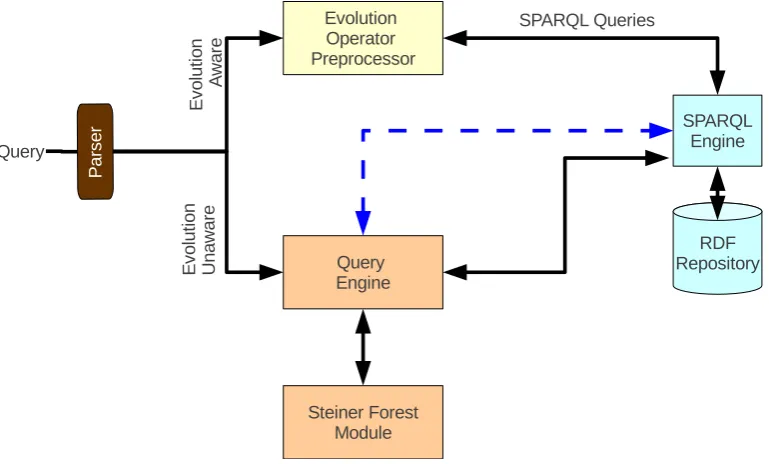
3.5 System Implementation . . . 42
3.6 Case Studies . . . 45
3.7 Evolution-Unaware Query Performance Evaluation . . . 48
3.7.1 Steiner Forest . . . 50
3.7.2 Query Evaluation . . . 52
4 Data Quality in Evolving User-Generated Contents 57 4.1 Data Quality Problem . . . 57
4.2 Modeling Collaborative Data . . . 59
4.3 Detecting Controversies . . . 62
4.4 Experimental Evaluation Setting . . . 65
4.4.1 Sources of Controversy Information . . . 66
4.4.2 Metrics . . . 68
4.5 Experiments . . . 70
4.5.1 Importance of Links . . . 70
4.5.2 Trust and Links . . . 70
4.5.3 Detailed Data Model Experiments . . . 72
4.5.4 Recall of CDA . . . 73
4.5.5 Accuracy of CDA . . . 75
4.5.6 Accuracy of CDA at Large Scale . . . 76
4.5.7 Effectiveness at Level of Pages . . . 78
4.5.8 Controversy Visualization . . . 79
4.5.9 Distributed Controversy . . . 80
4.5.10 Experiment Conclusions . . . 80
5 Coping with Evolving Items and Users in Recommendation Systems 83 5.1 Cold-start Problem . . . 83
5.2 Course Evaluation Scenario . . . 86
5.3 Predicting Evaluations . . . 86
5.3.1 Linear Regression . . . 87
5.3.2 Similarity-based Recommendation . . . 87
5.3.3 Feature-based Recommendation . . . 88
5.3.4 Max Entropy-based Recommendation . . . 88
5.4 Average Rating Confidence . . . 91
5.5 Experimental Evaluation . . . 92
5.5.1 Metrics . . . 92
5.5.2 Datasets . . . 93
5.5.3 Experiment Planning and Tuning . . . 96
5.5.4 Effectiveness . . . 96
5.5.5 Efficiency . . . 99
6 Conclusion 101 6.1 Key Contributions . . . 101
6.1.1 Modeling and Querying of Data Evolution . . . 101
6.1.2 Data Quality in Evolving User-Generated Contents . . . 102
6.1.3 Coping with Evolving Items and Users in Recommender Systems . . . 102
6.2 Future Work . . . 102
6.2.1 Social Data Evolution . . . 102
6.2.2 Big Data Evolution . . . 103
Bibliography 105
Index 113
List of Tables
3.1 A fraction of variable assignments for Example 3.4.11. . . 34
4.1 CDA Configurations parameters . . . 66 4.2 Template descriptions . . . 68 4.3 noise/signal, AvePr, Rand and # of distinct controversies for the text and
linkdata models on a set 25 pages with WPC . . . 77 4.4 Religion pages statistics. . . 77
5.1 5-fold cross-validation results . . . 99
List of Figures
3.1 The concepts of Germany, in a temporal model (a) and in our evolutionary
model(b) . . . 22
3.2 The history of the AT&T Labs. . . 23
3.3 Liaison examples . . . 27
3.4 Formal semantics of nested evolution expressions . . . 30
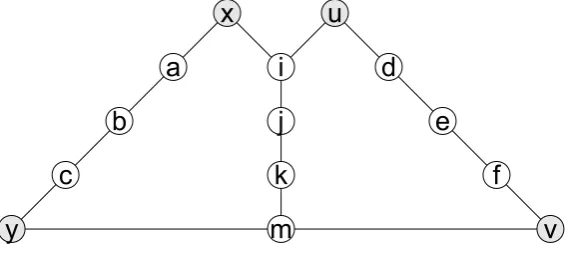
3.5 An illustration of the Steiner forest problem. . . 38
3.6 The TrenDS System Architecture . . . 42
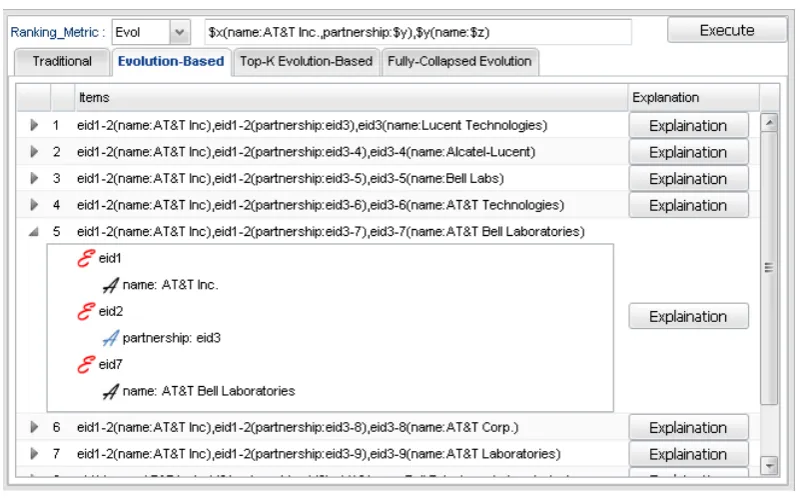
3.7 TrenDS Graphical User Interface . . . 44
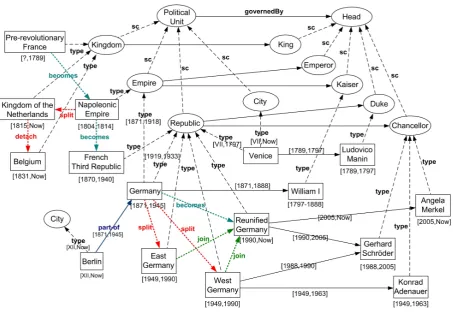
3.8 The evolution of the concepts of Germany and France and their governments (full black lines represent governedBy properties) . . . 45
3.9 The evolution of the concept of Biotechnology . . . 47
3.10 A fraction of the discovered evolution graph of AT&T . . . 50
3.11 Steiner forest discovery performance . . . 51
3.12 Query evaluation performance . . . 53
3.13 Efficiency for varying # of connected components (a) and exponent of data distribution (b) . . . 55
4.1 GUI for user-based evaluation . . . 67
4.2 Coca-Cola edits which involve links . . . 71
4.3 Wikitrust efficiency and effectiveness on thetextandlinkdata models . . . 71
4.4 Chopin controversies for thelinkdata model . . . 73
4.5 The recall experiment on WPC where the first row (a,b,c,d) compares mod-els, the second row (e,f,g,h) compareskthrshld = 1 and kthrshld = 2, and the third row (i,j,k,l) compares the(2,.9)and(8,.75)(rthrshld,cutof fthrshldctx ) parameter pairs. . . 74
4.6 (a) the recall on the entire set of WPC of clean and noisy controversies; the cardinality (b), duration (c) and plurality (d) ranking for 4 levels of visibility of linkandtext. . . 76
4.7 Cardinality,durationandpluralityfor thelink(a) andtext(b) 78 4.8 Precision (a), Recall (b) and NDCG (c) of the approaches based on # of revision (revN), # of unique author (uniqContr), ageAvg and ageProd from [Vuong et al., 2008] and the statistics based on thetextandlinkedits on the set of 204K Religion pages. . . 79
4.9 Digimon Adventure Controversy Bipolarity Author Graph . . . 81
5.1 A Course Evaluation System Data . . . 85 5.2 Parameterkeffect in the Similarity-based approach. . . 94 5.3 Accuracy and coverage for different numbers of terms (ntrain) used as training
on the Course Rating dataset . . . 94 5.4 Effect of the number of features in the various approaches. . . 97 5.5 The efficiency of the three methods. . . 100
List of Algorithms
1 Steiner tree algorithm . . . 39
2 Steiner forest algorithm . . . 41
3 Controversy Detection Algorithm (CDA) . . . 63
4 Generalized Iterative Scaling . . . 90
Chapter 1
Introduction
Modern technological advances have created a plethora of an extremely large, highly heteroge-neous and distributed collection of datasets that are highly volatile. This volatile nature makes their understanding, integration and management a challenging task.
In this section, we introduce the problems of modeling, querying and exploiting the volatile nature of data in evolving repositories and systems with user generated contents. Section 1.1 presents a context and motivation for that problems. Then, in Section 1.2 we discuss the key research problems and our contributions which are presented in this dissertation. Finally, the structure of the dissertation is given in Section 1.3.
1.1
Motivation
Modern information systems produce a tremendous amount of data which is highly heteroge-neous and distributed. Moreover, such data is not static and undergoes many transformations on the way. To cope with the volatile nature of data one need to solve a number of problems. In the following we motivate the three problems addressed in the dissertation, namely how to model and query evolving data, how to improve the data quality of evolving user-generated repositories and how to personalize rapidly changing data.
Modeling and querying of data evolution. To capture not only the changes that have taken place on the values of the data but also the semantic evolution of the concepts that the data structures represent there is a need to create right models. Conceptual modeling languages – including the ER Model, UML class diagrams and Description Logics – are all founded on a notion of “entity” that represents a “thing” in the application domain. Although the state of an entity can change over its lifetime, entities themselves are atomic and immutable [Gregersen and Jensen, 1999, Soo, 1991, Buneman et al., 2002, Chawathe et al., 1999, Lutz et al., 2008]. Unfortunately, this feature prevents existing modeling languages from capturing phenomena that involve the evolution of an entity into something else, such as a caterpillar becoming a butterfly, or Germany splitting off into two Germanies right after WWII. In these cases, there is a general agreement that an entity evolves into one or more different entities. Moreover, there is a strong relationship between the two, which is not captured by merely deleting one entity and then creating another. For example, the concept of Whale evolved over the past two centuries in the sense that whales were considered some sort of fish, but are now recognized as mammals.
2 CHAPTER 1. INTRODUCTION
The aim of this dissertation is to model evolution, not only at the instance and class levels but also across levels: instances may evolve into classes and vice verse.
Having the data model chosen, the next problem is to make use of that data or in other words to enable the user to pose queries. The query language should support the user in formulating queries in an expressive and meaningful way. To query data evolution we need to exploit a large number of possible instances of data which are produced by evolution relationships, e.g. all Germanies are considered as the same country across its history or every ancestor of modern Germany is an individual country. This is done in a similar fashion to the one that probabilities in a probabilistic database are defining possible worlds [Dalvi and Suciu, 2007]. Each such instance, models a way that concepts associated trough some evolution path can be merged into one. The evaluation of a query over an evolution database will have to take into consideration all these possible instances (possible worlds). In contrast to the case of probabilistic databases, the evolution relationships are forming a graph that can be used for the efficient computation of answers across possible worlds. To find all the answers, a connectivity discovery algorithm needs to be executed, but algorithms of this kind have an exponential cost.
Data quality in evolving repositories. An important issue in user generated evolving repos-itories is the data quality. The continuously evolving nature of the data hinders the ability of determining the quality of the data that is observed at a specific moment, since there is a great deal of uncertainty on whether this information will remain as is. Such, Wikipedia, as an extremely success story of collaboratively edited content, rises the situations where there are incompatible viewpoints of the same issue, as often happens in real life. Ideally, a dispute will eventually converge to a community-accepted consensus after undergoing discussion be-tween the disagreeing authors. However, disputes can sometimes degenerate into so-called edit wars which disrupt progress towards improving the article. To obtain better quality articles in such repositories it is important to address the problem of automatically identifying controver-sies [Vuong et al., 2008, Chin et al., 2010, Yasseri et al., 2012]. As an example, consider the Wikipedia entry for “Caesar salad”. At one time, one group of authors argued that the name derives from the Roman emperor Julius Caesar, while another group argued that it was from an Italian-American restauranteur named Caesar Cardini. The controversy resulted in back-and-forth arguments between a large number of different authors until a consensus was reached to attribute the creation to Caesar Cardini.
1.2. RESEARCH ISSUES AND CONTRIBUTIONS 3
Personalization for evolving items/users. Another important task which arises in evolving user-generated repositories is personalization or the task of producing recommendations. A difficult problem commonly faced by recommender systems where items and users are continu-ously evolved is the cold-start problem [Schein et al., 2002]. In that problem, recommendations are required for new items (new-item cold-start) or users for whom little or no information has yet been acquired (new-user cold-start) [Schein et al., 2002]. Unfortunately, most recommen-dation algorithms fail because they cannot build the user’s profile or identify users with similar preferences. In this dissertation, we address the cold-start problem where new items and new users continuously appear (we refer to it as new-item/user cold start). The new-item/user cold start is a setting which is common in several domains. For example, in news recommenda-tions, new or unknown users appear constantly in the system while all users are interested in new content [Liu et al., 2010]. As another example, consider a system which recommends aca-demic courses to students [Parameswaran et al., 2010]. On one hand, users (students) stay in the university for a short time (4years for bachelors) hence they never use the recommender system for long enough. This phenomenon makes it even more difficult to have enough his-torical ratings even in the long run. On the other hand, courses are dynamic and every quarter (semester) they evolve, e.g., new instructors, updated material, new requirements, and so on. In such environment, the problem of cold start is very severe because the system cannot boost the recommendation algorithm even after some time of operation.
1.2
Research Issues and Contributions
Modeling and querying of data evolution. To address the problem of data evolution in het-erogeneous environments the dissertation focuses on the problem of concept evolution which has not been studied comprehensively yet. We aim at supporting the queries of the following form: How has a concept evolved over time? From what (or, to what) other concepts has it evolved? What other concepts have affected its evolution over time? What concepts are related to it through evolution and how? These kinds of queries are of major importance for interesting areas like history, entity management, life sciences, and others. Such, historians may be inter-ested in the evolution of countries such as Germany, with respect to territory, political division or leadership. Alternatively, they may want to study the evolution of scientific concepts, e.g., how the concept of biotechnology has evolved from its humble beginnings as an agricultural technology to the current notion that is coupled to genetics and molecular biology.
In this dissertation we propose a conceptual model [Rizzolo et al., 2009] enhanced with the notion of a lifetime of a class, individual and relationship. The temporal model is an extension of the temporal model proposed in [Guti´errez et al., 2005] with consistency conditions and additional constructs to model merges, splits, and other forms of evolution among concepts. To support querying we introduce anevolution-aware query languagethat supports queries on the lifetime of concepts and describe its formal semantics.
4 CHAPTER 1. INTRODUCTION
evolution phases. For example, a query about the patents of AT&Twould normally return only the patents filled directly to AT&T but not those of the AT&T ancestors (e.g. Bell Labs). Taking into account the merges, spin-offs and acquisitions of AT&T we aim at finding all the patents in thehistoryofAT&T.
Answering queries of the evolution unaware language is a challenging task as well. The evo-lution information recorded in the data is intensionally specifying a large number of possible instances in a similar fashion to the one that probabilities in a probabilistic database are defin-ing possible worlds. Each such instance, models a way that concepts associated trough some evolution path can be merged into one. The evaluation of a query over an evolution database will have to take into consideration all these possible instances (possible worlds). In contrast to the case of probabilistic databases, the evolution relationships are forming a graph that can be used for the efficient computation of answers across possible worlds. To deal with that, we introduce the idea of finding a Steiner forest as a mean of finding the optimal merges that need to be done to generate the possible instances and present indexing techniques for its efficient implementation. The proposed algorithm allowed us to shift the complexity from the exponen-tial to the parameterized, i.e. we have the polynomial time in the size of an evolution graph and exponential time in the size of a query. In turn, as the experimental evaluation showed we are able to produce answers in an online fashion.
The findings on the modeling and querying of data evolution resulted in a research prototype, called TrenDS [Bykau et al., 2013c], which is a part of the European Union research project Papyrus1.
Data quality in evolving repositories. In user generated repositories, the very first example is Wikipedia, the content can be freely updated by any user and therefore it may evolve rapidly. As a result, this content is fresh but sometimes in a corrupted state due to vandalism or disputes. Therefore, the data quality problem for such repositories is a challenging problem. To address that problem, we concentrate on the controversy identification problem. Controversy identifi-cation is a challenging task due to the large number of versions in the history of a document. For example, at the time of writing, Wikipedia contained 4,105,700 entries and was growing at a rate of 25,000 new entries per month; the total number of versions among these entries was approximately 570M and growing at a rate of 5M edits per month.
In contrast to prior work on detecting controversial pages in Wikipedia at the page level, we focus on identifyingfine-grainedcontroversies pinpointing the specific controversial topics, locations within a page and occurrences in time. We observe that controversies often arise from conflicting points of view or opinions on the same topic. Unfortunately, segmenting a page into distinct topics is a very difficult problem in the natural language processing and machine learning literature. Moreover, tracking a topic over time is particularly challenging, even for a minor rewording, since its location within a page can change (say, from the introduction to the biography section). We formalize a syntactic notion of controversy based on the assumption that the associated dispute is expressed as back-and-forth substitutions of content embedded within a similar context (rather than deletions, which was the basis of previous work). We have investigated two different models for that purpose: one sees the document as (space-separated) “words”; the other sees the document as a sequence of the hyperlinks (to other Wikipedia pages) contained within a document, ignoring the text, multimedia and links to external Web sites.
1
1.2. RESEARCH ISSUES AND CONTRIBUTIONS 5
While the former uses a superset of the latter, and therefore has access to more information, the latter exploits the labeling (and, therefore, normalization) of semantic concepts implicit in links, since most real-world entities and concepts now have a Wikipedia page and Wikipedia pages often contain a high density of hyperlinks, as is encouraged in the Wikipedia style guide. We tested our algorithms on a significantly large fraction of Wikipedia and demonstrated that con-troversies can be effectively identified from a document’s version history in a scalable manner. Finally, our experiments have shown that the link model identifies more semantically meaning-ful edits, and as a consequence favors precision, while the word model favors recall.
Recommendations for evolving items/users.Another important task which arises in evolving user-generated repositories is personalization or the task of producing recommendations. In this dissertation, we address the cold-start problem which arises in dynamic repositories since new items and new users continuously appear (we refer to it asnew-item/user cold start). The new-item/user cold start is a novel severe cold-start setting which has not been addressed so far and it is common in several domains. For example, in news recommendations, new or unknown users appear constantly in the system while all users are interested in new content [Liu et al., 2010]. As another example, consider a system which recommends academic courses to students [Parameswaran et al., 2010]. On one hand, users (students) stay in the university for a short time (4years for bachelors) hence they never use the recommender system for long enough. This phenomenon makes it even more difficult to have enough historical ratings even in the long run. On the other hand, courses are dynamic and every quarter (semester) they evolve, e.g., new instructors, updated material, new requirements, and so on. In such environment, the problem of cold start is very severe because the system cannot boost the recommendation algorithm even after some time of operation.
Unfortunately, existing approaches to the cold-start problem are not applicable to the new-item/user cold start because they are designed to tackle one type of cold-start problem, new users or new items, but not both. Furthermore, in practice it has been shown that users are typically reluctant to engage into any interview process for providing their preferences [Liu et al., 2010]. We device three methods to produce recommendations for such repositories, namelySimilarity-based, Feature-basedandMaximum entropy methods. Each of the method leverages item features to produce recommendations in the following ways. The similarity-based method assumes that more similar items contribute to the recommendation more. The feature-based one considers every feature independently and finds how they contribute to an item’s score. Finally, the maximum entropy employs the maximum entropy principle to find such a distribution of ratings over features which conforms to the observed values and doesn’t introduce any additional bias.
6 CHAPTER 1. INTRODUCTION
1.3
Structure of the Dissertation
Chapter 2 discusses the works which are related to the topics of dissertation. In particular, we present an overview of temporal data models from different communities such as Entity Relationship (ER), semi-structured data, Description Logics, ontologies, and others. Then, we present the existing works on probabilistic databases and Steiner trees which are relevant to the query evaluation part of the dissertation. Next, we discuss the data quality problems in user-generated repositories. Finally, we present the existing literature on recommendation systems and, in particular, the cold start problem.
Chapter 3 introduces the problem of modeling and querying data evolution. We define the temporal data model along with the evolution relationships and their semantics. More-over, an expressive query language, denoted the evolution aware query language [Rizzolo et al., 2009][Bykau et al., 2012], based on graph traversing is proposed. We present the query evalua-tion strategy [Bykau et al., 2011][Bykau et al., 2012] for the evoluevalua-tion unaware query language (which is a reduced version of the evolution aware language) along with the Steiner forest algo-rithm which is used for an efficient computation of answers. Finally, the evolution management research prototype called TrenDS [Bykau et al., 2013c] is discussed.
Chapter 4 focuses on the problem of data quality in user generated repositories. In particular, we propose a novel algorithm of controversy identification in Wikipedia [Bykau et al., 2013a] which analyzes the evolution history of a Wikipedia page. The chapter contains the details of the algorithm along an extensive experimental evaluation where we study a number of trade-offs with respect to the possible data models and the algorithm parameters.
Chapter 5 deals with the problem of personalization in evolving repositories. We define the problem of new-user and new-item cold start and propose a number of recommendation algorithms [Bykau et al., 2013b]. Then, we describe an experimental evaluation where we study both the efficiency and effectiveness of the algorithms on the two real datasets, namely the dataset of academic courses and the movie rating dataset.
Finally, we conclude in Chapter 6 and list the key contribution of the dissertation. Also we discuss the future directions of the work.
1.4
Published Papers
1. [Bykau et al., 2013c] Bykau, S., Rizzolo F., Velegrakis Y. A Query Answering System for Data with Evolution Relationships (SIGMOD), 2013
2. [Bykau et al., 2013a] Bykau, S., Korn, F., Strivastava, D., Velegrakis, Y. Controversy Detection in Wikipedia, 2013 (ready for submission)
3. [Bykau et al., 2013b] Bykau, S., Koutrika, G., Velegrakis, Y. On Dealing with the Perma-nent Coping with the Persistent Cold-start Problem, 2013 (ready for submission)
4. [Bykau et al., 2012] Bykau, S., Mylopoulos, J., Rizzolo, F., & Velegrakis, Y. On Modeling and Querying Concept Evolution. Journal on Data Semantics (JoDS), 2012
1.4. PUBLISHED PAPERS 7
on Information and Knowledge Management (CIKM), 2011
6. [Katifori et al., 2011] Katifori, A., Nikolaou, C., Platakis, M., Ioannidis, Y., Tympas, A., Koubarakis, M., Sarris, N., et al. The Papyrus digital library: discovering history in the news. Theory and Practice of Digital Libraries (TPDL), 2011
7. [Bykau et al., 2010] Bykau S., Kiyavitskaya N., Tsinaraki C., Velegrakis Y. Bridging the gap between heterogeneous and semantically diverse content of different disciplines. (FlexDBIST), 2010.
8. [Presa et al., 2009] Presa, A., Velegrakis Y., Rizzolo R., and Bykau S. Modelling Asso-ciations through Intensional Attributes.International Conference on Conceptual Modeling (ER), 2009.
Chapter 2
Related Work
The section discusses the related work of the topics which are presented in the dissertation. In particular, Section 2.1 discusses the areas of data evolution modeling and querying along with the limitations of the existing approaches. Section 2.2 describes the problem of data quality in systems with evolving user-generated contents (e.g. Wikipedia). We highlight the differences between our approach and the previous ones. Finally, in Section 2.3 we present the principles of recommender systems and the problems which arise in the presence of evolving items and users. We indicate the novelties of our solution in comparison to the related approaches.
2.1
Modeling and Querying of Data Evolution
The section focuses on two fields which are related to data evolution. First, we discuss the existing models of temporal and evolving data in Section 2.1.1 and then we present the works on possible world semantics and Steiner trees which are related to the querying of data evolution (Section 2.1.2).
2.1.1 Modeling Data Evolution
A large number of ways have been proposed to cope with evolving (changing) data in recent years. On the one hand, researches deal with the change modeling by means of temporal data models and, on the other hand, they use domain oriented frameworks to cope with data evolu-tion.
Temporal Models
Temporal data models have achieved a significant attention in many research communi-ties and from a number of perspectives such as the relational data model, Entity-Relationship model, semi-structured data, knowledge representation field. In the following, we discuss those perspectives in detail.
Temporal data management is extensively studied in the relational paradigm and a large number of approaches on modeling, querying, indexing and storing the relational data with time have been proposed (see a detailed survey [Soo, 1991]). Versioning approaches store the information of the entire document at some point in time and then use edit scripts and change logs to reconstruct versions of the entire document. In contrast, [Buneman et al., 2002]
2.1. MODELING AND QUERYING OF DATA EVOLUTION 9
and [Rizzolo and Vaisman, 2008] maintain a single temporal document from which versions of any document fragment (even single elements) can be extracted directly when needed.
TheEntity-Relationship(ER) temporal modeling aims to enrich the ER model with a tem-poral dimension. [Gregersen and Jensen, 1999] describes and compares the existing temtem-poral ER models according to the predefined set of parameters such as the valid/transaction time sup-port, explicit/implicit temporal constructs, multiple time granularities, compatibility issues and others. This work sharps the core ideas in the time modeling which have been used not only for the ER modeling but also in other areas of data and knowledge management.
In the domain ofsemi-structureddata, one of the first models for managing historical infor-mation was proposed by Chawathe et al. [Chawathe et al., 1999]. In turn, a versioning scheme for XML was proposed in [Chien et al., 2001]. In temporal models for XML, the time dimension is supported through the time intervals assigned to both XML nodes and containment/reference edges. Such, Rizollo et al. [Rizzolo and Vaisman, 2008] proposed a model for the temporal XML where to deal with the life spans of nodes and edges, the temporal XML defines a set of restrictions which have to be fulfilled in order to have a consistent model. In addition, Rizollo et al. present the algorithms of the consistency checking along with their computational complexi-ties. The querying of temporal XML documents is supported by the TXPath query language, an extension of XPath, which is enriched with temporal statements. In order to support querying, Rizollo et al. define the continuous path, i.e. an XML path which is valid during a particular interval of time. Focusing on the continuous paths of a document, Rizollo et al. proposed an index which supports query evaluation.
In the Description Logics (DLs), temporal assertions are considered at both TBox and ABox levels (see a survey in [Lutz et al., 2008]) allowing the modelers to reason over temporal state-ments. Basically, the temporal DLs are a composition of some non-temporal DL and two special operators:at the next momentandeventually. Using these two building blocks one can produce more expressive operators. The whole family of temporal DLs can be classified in several directions: the point-based versus interval-based time, the explicit/implicit temporal dimension, the external/internal point of view on time [Artale and Franconi, 2001]. The main problem of using DLs for temporal modeling is to find the best trade-off between the expressiv-ity of a logical formalism and its tractabilexpressiv-ity.
A study of evolution constraintsmodeled in DL is presented in [Artale et al., 2007]. The idea of this work is to identify and formalize possible constraints over evolving data by means of DLs and allow for the reasoning about them. To fulfill this goal the authors classify the changes which may appear in temporal models.
• Dynamic integrity constraints. These kinds of constraints are applied to attributes. For example, we may require that the attribute Salary of a person can only increase its value or, for a multivalued attribute, the number of values can only increase (the number of diplomas of a person).
10 CHAPTER 2. RELATED WORK
• Evolution constraints embedded into relationships. Relationships can specify evolutionary constraints itself. Thegeneration relationships[Gupta and Hall, 1992] define the fact that some object generate another. For instance, a company’s department can split into two others, so that we may say that one department “cause” the existence of others. In turn, synchronization relationships [Parent et al., 2006] enforce Allen’s temporal constraints [Allen, 1983] between the participating objects. For example, the relationship which assigns a person to some project forces the participating objects to overlap in time.
To support the aforementioned constrains the authors define a set of temporal class statuses which characterize the life cycles of their objects. Scheduled - an object is not a type of the class, but at some point of time it will be, Active- an object is an instance of the class,
Suspended - captures the temporal inactive relation (an employee taking a temporary leave of absence is an example of what can be considered as a suspended employee), Disabled -an object is not -an inst-ance of the class -and, moreover, c-an not be it at -any point of time in the future. Using these statuses one can formally define constraints on changes.
As a sequel of the previous work, Artale et al. published the paper [Artale et al., 2008] which studies the part-of relation in terms of the lifecycles of objects. In particular, the authors define the following topology of the part-of relation. The mandatory part is the part which must exist for some object (like a heart for a human) during its life time, but it is not crucial to be the same object (transplantation of hearts). In contrast, the essential partis not only a part which must exist for an object, but also it needs to be the same across the whole life time of the object (e.g. the brains of a human). Theimmutable partis called a conditionally essential part which means that an object belongs to some class till it has this part. Through the notions of class statutes, Artale el al. formally describe these types ofpart-of
relation, what, in turn, presents a good use case of the framework described in [Artale et al., 2007].
Ontologies[Guarino, 1995] are well-know formalism to describe data with the ability to in-fer (reason) at class and instance levels. Although ontologies, as a comparatively new research branch in knowledge management, have many similarities in temporal modeling with the corre-sponding approaches in ER, XML and other communities, they have their own distinctions. The survey [Flouris et al., 2008] classifies the whole variety of ontology changes such as mapping, matching, evolution, articulation, versioning, and others. The aforementioned classification of ontology changes pays more attention on the semantic properties of evolution comparing with the data-oriented approaches. For example, it shows the reasons why changes may appear, what changes coming in an integration process (how to change an ontology in order to resolve the heterogeneity between the source and target), how to handle different version of ontologies at different time points, and others.
Similarly to the versioning in databases,ontology versioningstudies the problem of main-taining changes in ontologies by creating and managing different variants of it [Klein and Fensel, 2001]. An approach to model revision in RDF ontologies has been presented in [Kon-stantinidis et al., 2007].
2.1. MODELING AND QUERYING OF DATA EVOLUTION 11
in the terms of the non-temporal RDF. The time dimension is presented by an assignment of validity intervals to triples. Furthermore, the paper proposes the sound and complete inference system what’s entailment does not yield any extra asymptotic time complexity with respect to standard RDF graphs. In addition to that, a sketch of temporal query language is defined.
Most of the methods presented in the temporal models are founded on the notion of “entity” that represents a “thing” in the application domain. Although the state of an entity can change over its lifetime, entities themselves are atomic and immutable. Unfortunately, this feature prevents existing modeling languages from capturing phenomena that involve the evolution of an entity into something else. In our case, we focus on the evolution of a concept that spans different concepts (e.g., student to professor, research lab to independent corporate concept). Evolution Frameworks
Schema evolution [Lerner, 2000] studies changes that appear in a relational schema. In particular, a schema can undergo the following changes: a new attribute is inserted or an old one is deleted, the type of an attribute is changed, the bounds of a range type are changed, and so forth. In the scope of such structural changes some challenging problems are arisen. For instance, during the integration between heterogeneous data sources a structural change over one of the schema should be properly taken into account in the existing mappings [Velegrakis et al., 2004]. Theview maintenancedeals with a problem of an automatic view update in the case of a change in the underlying schemas. To cope with this problem a view update algorithm has been proposed in [Kotidis et al., 2006]. In both cases, the changes occur at the structural level whereas in our work we are interested in the semantics of those changes.
12 CHAPTER 2. RELATED WORK
about the evolution history (e.g. using attributes and associations of entities).
A framework which deals with changes in the semi-structured data model is proposed by Chawathe et al. [Chawathe et al., 1999]. As a motivating example the authors use a web page which is based on a semistructured data (HTML) and undergoes several changes along its life-time. Although the simple storage of all version of a web page allows users to query different states (versions), the authors focus on the ability to pose queries about the changes itself. For example, one may be interested in finding all restaurants whose entree price changed or wants to be notified when some kind of change appears. To support such kind of queries, the change annotations are introduced. In particular, a user can explicitly specify what and when evolved: one can create a new node or update the existing one, a new arc (relationship) or update the ex-isting one. Managing such meta-information gives the possibility to effectively trace the history of data across a series of document versions. The query answering is done through the query rewriting when the constructs asking about the changes are presented as normal statements. In addition, it is shown that this kind of rewriting do not yield additional complexity. In contrast to our work, Chawathe et al. aim at recording and managing changes that are taking place at the values of the data whereas our approach focuses on how concept evolve/mutate into another.
Kauppinen et al. present a new vision on the evolution of ontologies in [Kauppinen and Hyvonen, 2007]. The authors study the very similar problem to that in [Berberich et al., 2009], however narrowing their domain to the Geographical Information Systems (GIS). They show that the museum artifacts should be annotated with geo terms (concepts) which, in turn, have cross temporal dependencies. For instance, asking about nowadays Germany artifacts, it is impossible to infer that also West and East Germany ones should be taken into account because of the Germany history. The paper proposes several novel ideas to deal with evolving concepts. Firstly, it introduces the explicit spatial bridges between concepts. One can express facts about splitting, merging, evolving of concepts. Secondly, the authors provides the semantics of such global bridges by means of local ones. The local bridges connect two sets of concepts allocated in different snapshots. Basically, it specifies how the concepts from one snapshot cover or covered by another. For this purpose the authors define two sets: coversandcoveredBy. For example, the merge of East and West Germany can be translated into the local bridges as following. The territory of new-formed Germany consists of that ones of East and West Germany in the proportion of 0.3 and 0.7, therefore we can write that:
covers={hGermany;EastGermanyi= 1;hGermany;W estGermanyi= 1} (2.1)
coveredBy={hGermany;EastGermanyi= 0.3;hGermany;W estGermanyi= 0.7} (2.2)
2.1. MODELING AND QUERYING OF DATA EVOLUTION 13
Entity linkage[Ioannou et al., 2010, Li et al., 2011] is a problem faced by many modern web storages, i.e. there can be many data records which refer to the same entity (e.g. in DBLP there authors who changed their names and thus there is a need to merge the information about the same entity). To address this problem one need a way to decide whether two records describe the same entity or not. In [Li et al., 2011] Li et al. address the problem of entity linkage from a temporal perspective, i.e. one entity is represented as many data records distributed in time. By using temporal decay and clustering Li et al. link records with the accuracy higher than the existing linkage methods. The above work differs from the work of the dissertation in the following aspects. First, we focus on the semantics of evolution, i.e. what happens with those entities (split, merge, etc.) whereas the temporal linkage considers only one type; we focus on the query evaluation whereas the temporal linkage focus is on the discovery of entity histories (for that purpose we use the trademark dataset, the details are in Section 3.7). To address the entity linkage problem [Ioannou et al., 2010] uses the possible world semantics which is discussed in Section 2.1.2 more in detail.
2.1.2 Query Answering on Evolving Data
To discuss the related work of the area of query evaluation on evolving data we focus on the probabilistic databases and Steiner trees which are the essential parts of our evaluation algo-rithm.
Possible world semantics has been intensively used in many areas such as probabilistic databases, entity linkage, data integration, and others. Informally, possible world semantics defines a set of possible worlds each of which is a valid instance of database under some con-dition. Then, a query is evaluated over all that possible instances and the results are combined into one answer set with some certainties (scores) attached. In the next, we go over the most related applications of possible world semantics.
A seminal paper [Dalvi and Suciu, 2007] on probabilistic databases introduces the semantics of queries where matches can be uncertain, i.e. not all the conditions of a query are necessarily satisfied. This results in answers which are ranked with respect to the relevance to the origi-nal query. In the area of entity linkage, possible world semantics is used to model uncertain linkages [Ioannou et al., 2010]. By considering that linkages have some level of uncertainty, the query answering is reduced to the problem of testing all possible combinations of linkages and finding those that most likely answer the query semantics. In data integration, probabilistic mappings are supported through possible world semantics [Dong and Halevy, 2007]. In this case the connections between the data sources and the mediated schema are defined with some level of confidence. [Dong and Halevy, 2007] provides the algorithm for efficiently computing the answers and study its complexity. The above approaches are similar to our case in the sense that we can treat evolution relationships as a source of uncertainty which allows us to generate possible database instances. However, the query evaluation and optimization in our approach is fundamentally different.
14 CHAPTER 2. RELATED WORK
groups: approximate solutions [Bhalotia et al., 2002, Kacholia et al., 2005, He et al., 2007] and exact, with the latter been based on dynamic programming [Dreyfus and Wagner, 1972, Molle et al., 2005, Ding et al., 2007, Kimelfeld and Sagiv, 2006]. In this section we consider only exact solutions since approximate solutions cannot be applied in our case (see details in Section 3.4.3).
Historically, a first algorithm was proposed by [Dreyfus and Wagner, 1972] and it is based on the decomposition property of a Steiner tree, i.e. for an arbitrary terminal the tree is divided into two Steiner trees of smaller size and one shortest path. Using that decomposition prop-erty [Dreyfus and Wagner, 1972] builds a dynamic programming algorithm which computes the Steiner tree for every subset of terminals until the solution is found. To avoid the computation of all subtrees, [Molle et al., 2005] proposes the division of a Steiner tree into inclusion-maximal regions where each terminal is a leaf. In that case, the Dreyfus-Wagner algorithm is used only for subtrees of the size of the maximum region. [Ding et al., 2007, Kimelfeld and Sagiv, 2006] introduce a new way for the iterative computation of the solution to a Steiner tree problem by gradually growing and merging Steiner subtrees. In our work we proposed an extension of an algorithm from [Ding et al., 2007] that allows for the computation of a Steiner forest.
2.2
Data Quality in Evolving User-Generated Contents
In user-generated repositories (e.g. Wikipedia) a content can be updated by any user at any moment of time. On the one hand, this leads to an up-to-date information which reflects real-time changes in the world but on the other hand to vandalism, controversies, and stability issues. Therefore, the problem of data quality in such repositories is an important and challenging prob-lem. In the following we classify the data quality problem into three sub problems which may overlap in some aspects, namely the contentstabilityprediction [Druck et al., 2008, Papadakis et al., 2011, Adler and de Alfaro, 2007, Adler et al., 2008], the vandalism [Chin et al., 2010, Vi´egas et al., 2004] and controversy [Vi´egas et al., 2004, Vuong et al., 2008, Sepehri Rad and Barbosa, 2011, Yasseri et al., 2012, Sepehri Rad et al., 2012, Kittur et al., 2007, Brandes and Lerner, 2008] detection.
2.2. DATA QUALITY IN EVOLVING USER-GENERATED CONTENTS 15
et al., 2012].
In this section, we discuss all three data quality problems and since in the dissertation we concentrate on the problem of controversy detection, we take a closer look at the controversy problem. Moreover, we discuss the limitations of existing controversy detection works with respect to our approach.
2.2.1 Stability
Thestabilityof content (or an edit) is defined as its ability to stay on a page for a comparatively long time without being altered or modified. The more stable content is of a primary importance for the Wikipedia readers because it is more trustful.
The machine learning techniques are widely used to predict the stability of the Wikipedia content. Such, the problem of predicting the level of stability of an edit is studied by Druck et al. [Druck et al., 2008]. For each edit, the authors identify features such that registered vs. not-registered user edits, the number of reverts done by the user performing an edit, addition of a link or a text deletion and so on. By using a discriminatively-trained probabilistic log-linear model, the approach classifies edits into three classes: the revert, longevity (that the edit will stay on the page) 6 hours, longevity 1 day. The paper discusses the formal notion of an edit quality, the analysis of features which are the most relevant to the data quality of edits. Although the authors used a probabilistic log-linear model, the solution is not scalable to be used at run-time. Similar to [Druck et al., 2008] Paradakis et al. [Papadakis et al., 2011] addresses the problem of entity stability in collaboratively edited data sources. More specifically, Papadakis et al. pursue the goal of detecting entity attribute-value pairs which will not be changed in next revisions. The solution relies on N-Grams and machine learning techniques.
The notion of trust and stability are closely connected because a more trustful content tends to be unaltered for a longer period of time. Adler et al. [Adler and de Alfaro, 2007, Adler et al., 2008]. focus on the trust of Wikipedia pages by measuring the longevity of edits. More specifically, in [Adler and de Alfaro, 2007] Adler et al. define the notion of author reputation and design an algorithm which computes the reputation values of Wikipedia authors. In the nutshell, a Wikipedia author increases its reputation if her edits are not changed by the subsequent edits. This is interpreted as a sign of the approval that the edit should remain on the page and thus the user who did it deserves that her reputation grows. By analyzing the revision history of a page, the WikiTrust system computes the reputation values for all users. In the experimental evaluation, Adler et al. show that the reputation values of authors have a good predictability of the text stability.
In the subsequent paper [Adler et al., 2008], Adler et al. extend their previous work by analyzing the trust of text which is measured through its stability, i.e. the ability of text to stay on the page without being altered or removed. The work leverages the author reputation in order to compute the text trust where the main assumption is that a high reputation author is likely to produce a trustable text. The work results in an online system1 which allows the Wikipedia readers to see the trust of the text of any page of Wikipedia at run-time.
The correlation between various patterns of collaboration and quality of Wikipedia articles is analyzed in [Liu and Ram, 2011]. The patterns are determined as clusters of pages where
1
16 CHAPTER 2. RELATED WORK
contributors with specific roles performed specific kinds of actions. For example, starters, con-tributors focusing on sentence creation, dominate sentence insertions and causal concon-tributors did a lot of sentence modifications. By identifying 5clusters and using the quality labels of Wikipedia articles, the authors statistically prove the correlation between them. Although the work has no direct practical applicability, its theoretical findings about collaboration patterns can be used for building approaches to improve the quality of Wikipedia.
2.2.2 Vandalism
Since Wikipedia allows the authors to freely edit almost any page (there are a few most pop-ular pages where only registered authors can modify the content) some of them intentionally create irrelevant, nonsense or even harmful content. This activity is enormously widespread and known as vandalism. The methods of vandalism detection plays a very important role in Wikipedia since they allow the Wikipedia administrators and readers to quickly identify van-dalized pages.
The problem of vandalism detection was extensively studied by Chin et al. [Chin et al., 2010]. The authors identify different kinds of vandalism based on the type of action (delete, insert, change, revert), the type of change (format, content), the scale of editing (mass deletion or mass insertion). The proposed solution uses machine learning techniques to classify the blanking, large-scale editing, graffiti and misinformation types of vandalism by means of the text features such that the number of known words, perplexity value, number of known bigrams and so on.
A visualization approach for vandalism detection is proposed by Viegas et al. [Vi´egas et al., 2004]. It aims at visualizing the history of a Wikipedia page in order to study its conflict, vandalism and cooperation patterns. The underlying data model is based on text where the basic building block is a sentence delimited by tokens. By consecutively parsing the revisions of a page at the sentence level the system plots colored flows of sentences from one revision to another. This allows the user to observe abnormal content changes (e.g. oscillating flow represents reverts, etc.)
2.2.3 Controversy
The prolonged public disagreements or heated discussions, known as controversy, plays a sig-nificant role in Wikipedia. Detecting the controversial content is of a primary importance both for the Wikipedia authors and readers since usually that kind of content presents some impor-tant topics that the community haven’t developed a single opinion on. Since in the dissertation we concentrate on the problem of controversy detection in the following we discuss the existing approaches along with their limitations in detail.
2.2. DATA QUALITY IN EVOLVING USER-GENERATED CONTENTS 17
with the page controversiality than the baseline approaches like the number of revisions, the number of unique authors and others. Our work is fundamentally different to [Vuong et al., 2008] since we focus on detecting individual controversies whereas Vuong et al. classify entire pages. Moreover, our building block is substitutions, i.e. when authors correct information that they consider incorrect and propose an alternative information, whereas Vuong et al. use insertion/deletions which are more related to vandalism.
Another recent study of conflicts at the page level is proposed by Yasseri et al. [Yasseri et al., 2012]. Similarly to [Chin et al., 2010] (the method for vandalism detection which is discussed in Section 2.2.2), Yasseri et al. use the revert statistics of a page to detect controversies at the page level. With the help of extensive experimental evaluation, the work shows that reverts are a good indicator of the page controversiality.
Machine learning techniques were also widely used to identify controversies, Such a method based on Support Vector Machines (SVM) to predict conflicts was proposed by Kittur et al. [Kit-tur et al., 2007]. As input fea[Kit-tures Kit[Kit-tur et al. used the number of revisions, page length, unique editors, anonymous edits, etc. As a ground truth the paper used controversial templates. A method to learn the positive and negative attitudes between Wikipedia authors using the his-tory of their interactions is proposed by Sepehri et al. [Sepehri Rad et al., 2012] In particular, it builds the author profiles by gathering the statistics of three kinds: the author individual fea-tures, directional and mutual features. The training data is obtained by analyzing the Wikipedia administrator elections where the votes are interpreted as positive/negative attitudes. Sepehri et al. experimentally show that the proposed classifier leads to a high accuracy in predicting the author attitudes to each other and, in addition, the classifier is capable of accurately identifying a controversial content. The main limitation of the above controversy detection solutions is that they focus on controversies at the page level, i.e. they answer the question of how controversial is a particular page. However, our focus is on individual controversies. We aim at looking for the place on a page and time of a controversy along with its topic.
A recent work [Sepehri Rad and Barbosa, 2011] on controversy detection proposes to iden-tify controversial arguments of a page at the section/paragraph level by using the user interaction statistics. More specifically, the authors focus on the two metrics of controversiality, namely the bipolarity of the edit graph of a page and the classifier trained on the featured and controver-sial articles. Two desirable properties are introduced for that metrics, i.e. the discrimination of featured and controversial articles and monotonicity. The latter means that when the controver-sial arguments are removed the controversy metrics should decrease its value. The experiments show that only the classifier has both the monotonicity and discrimination properties whereas the bipolarity doesn’t change its value during the removal of arguments. Although Sepehri et al. [Sepehri Rad and Barbosa, 2011] introduce the idea of controversial argument, they report only preliminary statistical results which cannot be used as a practical method of individual controversy detection.
18 CHAPTER 2. RELATED WORK
2.3
Recommendation Systems
In this section we discuss the work which is related to the problem of recommendation in evolv-ing user-generated repositories. We start by introducevolv-ing the domain of recommender systems and then we discuss the recommendation strategies when items and users rapidly evolve. Fi-nally, we present the recommendation methods which are based the idea of maximum entropy since in the dissertation we use it as a main solution method.
Recommender systems suggest items of interest to users, like products in Amazon and movies in Netflix, based on the users explicit and implicit preferences, the preferences of other users, and user and item attributes. Depending on the type of data upon which recommendations are based, recommender systems can be broadly divided into three categories: content-based fil-tering [Mladenic, 1999], collaborative filfil-tering [Su and Khoshgoftaar, 2009] and hybrid [Burke, 2002].
Historically, a first approach wascontent-based filtering which leverages the existing data about items and users. More specifically, it aims at building users’ profile, the detailed infor-mation about user’s preferences, by analyzing her previous item contents and ratings. To make a recommendation, the algorithm matches the user’s profile with the available items finding the item which is closest to the user’s profile. Collaborative filtering makes a recommenda-tion in two steps. First, it searches for the users who have rated similar items with similar ratings. Those users are likely to have similar tastes with the user the algorithm produces a recommendation to. Second, by looking at the items which obtained high ratings from the sim-ilar users and are not taken by the current user, the collaborative filtering approach produces a recommendation. Finally,hybridapproaches combine content-based and collaborative filtering characteristics.
In evolving repositories both items and users may change rapidly. As a consequence, the system cannot accumulate enough historical information about the users and items. This fact prevents the existing recommendation algorithms from operating properly. The above problem is known as the cold-start problem[Schein et al., 2002] and it have received a lot of attention. In the next, we discuss three research directions which address the cold-start setting.
2.3. RECOMMENDATION SYSTEMS 19
Although this setting is very close to ours there is a fundamental difference. In particular, the method produces a prediction for useriand itemj as the multiplication of vectors which rep-resent the affinity of itemj to theKdifferent latent topics and the affinity of userito the same set of topics. In our case, we have a new user whose affinity vector is not know. However, if we consider the case when the user affinity vector is the same for all users and items are repre-sented as a bag of words (features) we can employ the Latent Dirichlet Allocation (LDA) to find the topics of items and therefore improve the feature connectedness. We analyze this method further in the experimental Section 5.5.
Chapter 3
Modeling and Querying of Data Evolution
In this chapter we introduce, motivate and address the problem of concept evolution, i.e. how to capture not only the changes that have taken places on the values of the data but also the semantic evolution of the concepts that the data structure represents. We start by introducing the idea of concept evolution in Section 3.1. Section 3.2 describes our motivating examples. In Section 3.3 we present a modeling framework for evolution-aware queries. A formal semantics of query answering in the presence of evolution for queries that are evolution-unaware is dis-cussed in Section 3.4. Section 3.5 presents the architecture of the system we have developed that incorporates the evolution-unaware evaluation methods. Two case studies which involve evolution are described in Section 3.6. Finally, the description of a number of experiments for evaluating our evolution-unaware query answering mechanism is shown in Section 3.7.
The work presented in the chapter is published in [Rizzolo et al., 2009], [Bykau et al., 2011], [Bykau et al., 2012] and the demo version is presented in [Bykau et al., 2013c].
3.1
Concept Evolution
Conceptual modeling languages – including the ER Model, UML class diagrams and Descrip-tion Logics – are all founded on a noDescrip-tion of entity that represents a thing in the applicaDescrip-tion domain. Although the state of an entity can change over its lifetime, entities themselves are uniformly treated as atomic and immutable. Unfortunately, this feature prevents existing mod-eling languages from capturing phenomena that involve the mutation of an entity into something else, such as a caterpillar becoming a butterfly, or the evolution of one entity into several (or vice versa), such as Germany splitting off into two Germanies right after WWII. The same difficulty arises when we try to model evolution at the class level. Consider the class Whale, which evolved over the past two centuries in the sense that whales were considered a species of fish, whereas today they are known to be mammals. This means that the concept of Whale-as-mammal has evolved from that of Whale-as-fish in terms of the properties we ascribe to whales (e.g., their reproductive system). Clearly, the (evolutionary) relationship between Whale-as-fish and Whale-as-mammal is of great interest to historians who may want to ask questions such as ”Who studied whales in the past 3 centuries?” We are interested in modeling and querying such evolutionary relationships between entities and/or classes. In the sequel, we refer to both entities and classes as concepts.
3.1. CONCEPT EVOLUTION 21
In the database field, considerable amount of research effort has been spent on the devel-opment of models, techniques and tools for modeling and managing state changes for a con-cept, but no work has addressed the forms of evolution suggested above. These range from data manipulation languages, and maintenance of views under changes [Blakeley et al., 1986], to schema evolution [Lerner, 2000] and mapping adaptation [Velegrakis et al., 2004, Kondy-lakis and Plexousakis, 2010]. To cope with the history of data changes, temporal models have been proposed for the relational [Soo, 1991] and ER [Gregersen and Jensen, 1999] models, for semi-structured data [Chawathe et al., 1999], XML [Rizzolo and Vaisman, 2008] and for RDF [Guti´errez et al., 2005]. Almost in its entirety, existing work on data changes is based on a state-oriented point of view. It aims at recording and managing changes that are taking place at the values of the data.
In the next sections, we present a framework for modeling the evolution of concepts over time and the evolutionary relationships among them. The framework allows posing new kinds of queries that previously could not have been expressed. For instance, we aim at supporting queries of the form: How has a concept evolved over time? From what (or, to what) other concepts has it evolved? What other concepts have affected its evolution over time? What concepts are related to it through evolution and how? These kinds of queries are of major importance for interesting areas which are such as those discussed below.
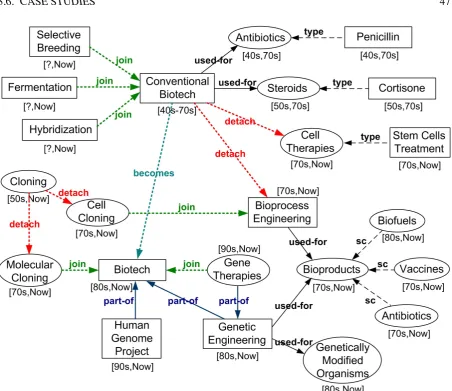
History. Modern historians are interested in studying the history of humankind, and the events and people who shaped it. In addition, they want to understand how systems, tools, concepts of importance, and techniques have evolved throughout history. For them it is not enough to query a data source for a specific moment in history. They need to ask questions on how concepts and the relationships that exist between them have changed over time. For example, historians may be interested in the evolution of countries such as Germany, with respect to territory, political division or leadership. Alternatively, they may want to study the evolution of scientific concepts, e.g., how the concept of biotechnology has evolved from its humble beginnings as an agricultural technology to the current notion that is coupled to genetics and molecular biology.
Entity Management.Web application and integration systems are progressively moving from tuple and value-based towards entity-based solutions, i.e., systems where the basic data unit is an entity, independently of its logical representation [Dong et al., 2005]. Furthermore, web inte-gration systems, in order to achieve interoperability, may need to provide unique identification for the entities in the data they exchange [Palpanas et al., 2008]. However, entities do not remain static over time: they get created, evolve, merge, split, and disappear. Knowing the history of each entity, i.e., how it has been formed and from what, paves the ground for successful entity management solutions and effective information exchange.
22 CHAPTER 3. MODELING AND QUERYING OF DATA EVOLUTION
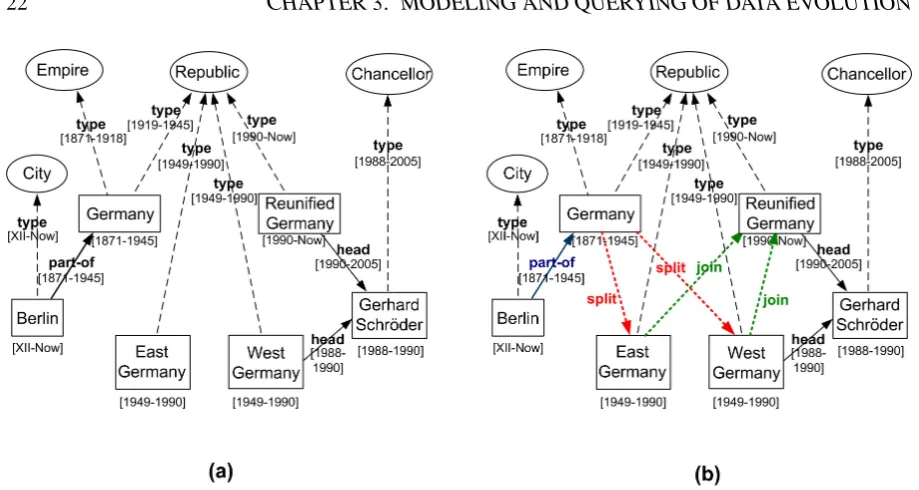
Figure 3.1: The concepts of Germany, in a temporal model(a)and in our evolutionary model(b)
3.2
Evolution Scenarios
Consider a historian database that records information about countries and their political gov-ernance. A fraction of the database modeling a part of the history of Germany is illustrated in Figure 3.1 (a). In it, the status of Germany at different times in history has been modeled through different individuals or through different concepts. In particular, Germany was an em-pire until 1918 and a republic from 1919 to 1945. This change is modeled by the multiple instantiations ofGermanyrelative toEmpireandRepublic. Shortly after the end of the World War II, Germany was split in four zones1 that in 1949 formed East and West Germany. These two entities lasted until 1990, when they were merged to form the republic of Germany as we know it today. This entity is modeled through the individual asReunified Germany.
To model the validity constraints on the states of Germany during different periods, we use a temporal model similar to temporal RDF [Guti´errez et al., 2005]. The model associates to each concept a specific time frame. The time frames assigned to the individuals that model different Germanies are illustrated in Figure 3.1 through intervals. The same applies to every property, instance and subclass relationship. Note, for example, how the instantiation relation-ship of GermanytoEmpirehas a temporal interval from 1871 to 1918, while the one toRepublic has a temporal interval from 1918 to 1945. It is important for such a database to contain no inconsistencies, i.e., situations like having an instantiation relationship with a temporal interval bigger than the interval of the class it instantiates. Although temporal RDF lacks this kind of axiomatization, a mechanism for consistency checking needs to be in place for the accurate representation of concepts and individuals in history. Our solution provides an axiomatization of the temporal RDF that guarantees the consistency of the historical information recorded in a database.
1
3.2. EVOLUTION SCENARIOS 23
Figure 3.2: The history of the AT&T Labs.
Consider now the case of a historian who wants to study the history of Germany. The histo-rian may be interested, for example, in all the leaders and constituents of Germany throughout its history. Using traditional query mechanisms, the historian will only be able to retrieve the individualGermany. Using keyword based techniques, she may be able to also retrieve the re-maining individuals modeling Germany at different times, but this under the assumption that each such individual contains the keyword “Germany”. Applying terminology evolution [Tah-masebi et al., 2008], it is possible to infer that the four terms for Germany, i.e.,Germany, East Germany, West Germany,andReunified Germanyrefer to related concepts regardless of the key-words that appear in the terms. Yet, in neither case the historian will be able to reconstruct how the constituents of Germany have changed over time. She will not be able to find that the East and West Germany were made by splitting the pre-war Germany and its parts, neither that East and West Germany were the same two that merged to form the Reunified Germany. We propose the use of explicit constructs to allow the modeling of evolution in databases, as exemplified in Figure 3.1(b) introducingsplit,joinandpart-ofrelationships.
24 CHAPTER 3. MODELING AND QUERYING OF DATA EVOLUTION
AT&T Labs. The Lucent Bell Labs became Alcatel-Lucent Bell Labs Research in 2006 due to the take-over of Lucent by Alcatel. Furthermore, due to the take-over of AT&T by SBC in 2005, the AT&T Labs were merged with the SBC Labs to form the new AT&T Inc. Labs. Despite being research labs of different legal entities, Lucent and AT&T Labs have actually maintained a special partnership relationship. All these different labs have produced a large number of inventions, as the respective patents can demonstrate. Examples of such inventions are VoIP (Voice over Internet Protocol), the ASR (Automatic Speech Recognition), the P2P (Peer-to-Peer) Video and the laser. A graphical illustration of the above can be found in Figure 3.2 where the labs are modeled by rectangles and the patents by ovals.
Assume now a temporal database that models the above information. For simplicity we do not distinguish among the different kinds of evolution relationships (split, merger, and so on). Consider a user who is interested in finding the lab that invented the laser and the ASR patent. It is true that these two patents have been filed by two different labs, the AT&T Bell Labs and the AT&T Labs Inc. Thus, the query will return no results. However, it can be noticed that the latter entity is an evolution of the former. It may be the case that the user does not have the full knowledge of the way the labs have changed or, in her own mind, the two labs are still considered the same. We argue that instead of expecting from the user to know all the details of how the concept has evolved and the way the data has been stored, which means that the user’s conceptual model should match the one of the database, we’d like the system to try to match the user’s conceptual model instead. This means that the system should have the evolution relationships represented explicitly and take them into account when evaluating a query. In particular, we want the system to treat the AT&T Bell Labs, the AT&T Labs Inc, and the AT&T Labs as one unified (virtual) entity. That unified entity is the inventor of both the laser and the ASR, and should be the main element of the response to the user’s query.
Of course, the query response is based on the assumption that the user did