The optimum air-conditioning system design of water-saving
greenhouse and its effects on growth in plants
Seiji Matsuo
1*, Mami Suzuki
2, Yasunaga Iwasaki
3, Toyohisa Fujita
1,
and Hiroki Umeda
3(1. The University of Tokyo, Department of System Innovation, Japan;
2. Nagaoya University, Graduate School of Bioagricultureal Sciences, Japan; 3. National Institute of Vegetable and Tea Science, Japan)
Abstract: The climate change will make the scarcity of water resources more serious. Especially, in the region where people can’t use clean water and cultivate crops, one of the solutions of the problems is the introduction of greenhouse. The authors designed the optimal air-conditioning system of the water-saving greenhouse and investigated the effects on growth in plants under these conditions. In this design, heat balance model and water balance model in the greenhouse were constructed. Moreover, the objective function unified with electric power in a moisture loss and the electric power used and these constrained conditions were defined. In the examination of plants, in order to evaluate the influence of the plant on this condition, the effect of higher relative humidity levels on the growth chambers of cucumber seedlings were investigated. Three higher relative humidity conditions, RH74.5%, 86% and 97.8%, were taken into consideration in the experiment. Consequently, the air-conditioning system of the water-saving greenhouse that the energy becomes smallest where could be designed. It was useful to introduce the fog cooling system, thermal storage mediums, and the gas absorption refrigerator with dehumidification ability. Furthermore, it was found that the level that cropper's growth becomes biggest exists under the high humidity condition from a cultivation experiment, it was suggested that this design in this water-saving greenhouse is effective.
Keywords:high-efficient water, energy-saving, optimal design, temperature and humidity adjustment, environmental control, photosynthesis
Citation: Matsuo, S., M. Suzuki, Y. Iwasaki, T. Fujita, H. Umeda. 2015. The optimum air-conditioning system design of water-saving greenhouse and its effects on growth in plants. Agric Eng Int: CIGR Journal, Special issue 2015: 18th World Congress of CIGR: 133-140.
1 Introduction
1Recently, the global warming has caused the severe
climate change all over the world. This climate change
makes and will make the scarcity of water resources more
serious (Okazaki et al., 2012). The food storage is
highly related to the water resources; therefore we have to
take some steps about the water shortage. In the region
where people can’t use clean water and cultivate crops,
one of the solutions of the problems is the introduction of
the plant factory. The plant factory let the people
maintain the staple food supply by recycling used water.
Received date: 2014-10-11 Accepted date: 2015-02-23
*Corresponding author: Seiji Matsuo, The University of Tokyo, Department of System Innovation, Japan. E-mail:[email protected]
In addition to that, the plant factory saving energy by
using solar power will be better for them (Kawashiro et
al., 2009). Therefore, the authors have already proposed
a new type greenhouse system (Matsuo et. al, 2011). In
this system, water saving and energy reduction could be
achieved by using various equipment and solar heat
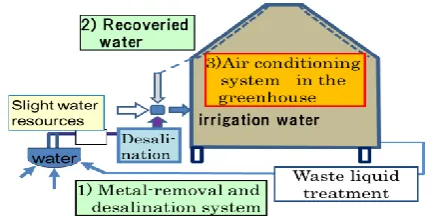
energy (Figure 1). The proposed system is composed of
the following three sections, Desalting system, Recovered
water system and Greenhouse air conditioning system.
In first section, irrigation water is separated from salt
water by freezing method with absorption refrigerator
using high solar energy under arid climate (Fujioka et. al.,
2013). Simultaneously, the cold energy generated from
the desalting system by making ice is supplied to the
greenhouse. In second section, the water in which crops
third section, some apparatus are equipped in green house,
water saving and energy reduction could be achieved.
In addition, it's expected that the humidity in the house
always becomes high because a house maintains the
closed position in this design. The humidity of
greenhouse is an important thing of environmental
control. However, the effect of the humidity on growth
and the yield of plants is insufficiently understood
because high humidity is considered to increase disease
damage. It is suggested that the photosynthetic rate
increased with an increase in relative air humidity
because higher relative air humidity lowers water stress in
the leaf and increases stomatal conductance (Yabuki and
Miyagawa,1970). To maintain relative humidity in the
greenhouse in a suitable range for photosynthesis is one
of the main factors that cause the yield difference
between the Netherlands and Japan (Heuvelink and
Dorais, 2005).
Figure 1 A plant factory with a high-efficient water use
in arid area
The purpose of the study is to design the optimal
air-conditioning system of the water-saving greenhouse
and to investigate the effects on growth in plants under
these conditions. In this design, the authors proposed new
system which consists of the ammonia gas absorption
refrigerator equipped with the dehumidification capability
to use solar heat and the thermal storage of the cold
energy becomes possible in the temperature field of
nighttime without other electric power (Matsuo et al.,
2011). Moreover, Dynamical heat balance and water
balance model in the greenhouse were constructed (Kozai,
T, 2013), and the optimal combination of each air
conditioner was calculated with the optimization
technique. In calculation, an objective function and
constraints are selected. To determine the objective
function, the quantity of the lost water and the
consumption energy of air-conditioning equipment in a
greenhouse were constructed. In the examination of
plants, in order to evaluate the water-saving culture
environment at increased humidity levels, the effect of
increased relative humidity levels, level 1: RH74.5%:
level 2: 86%, level 3: 97.8%, in growth chambers with
cucumber seedlings was investigated. Four assimilation
boxes made by a clear acrylic board were used for an
experiment. An assimilation box was installed in the
homeothermal room set as 295K of temperature.
Relative humidity and the temperature in assimilation box
were controlled by combining two dehumidification
pumps and silica gel and using a control computer.
2 A greenhouse with a high-efficient water
use
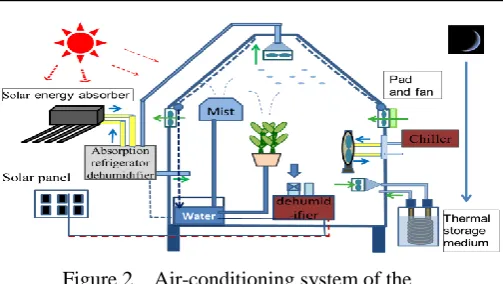
Figure 2 shows the proposed greenhouse system
(Matsuo et al., 2011). In this greenhouse, the cold
temperature of the air conditioner, the fog cooling system,
a single roof ventilator, evaporation from plant and the
latent heat of thermal storage material are equipped for
air cooling. The green-house was naturally ventilated
with a single roof ventilator and a fogging system is the
most effective and economical greenhouse cooling
systems. Irrigated water can be recycled by collecting
evapotranspirated water from plants because of water
saving. It is expected that the thermal storage of the
cold energy becomes possible in the temperature field of
nighttime without other electric power and the
temperature rise in greenhouse can be controlled.
Furthermore, the authors designed the ammonia gas
absorption refrigerator equipped with the
Figure 2 Air-conditioning system of the
energy-efficient and water-saving greenhouse
3 Mathematical model in greenhouse
3.1 Heat balance and water balance equation
In the air-conditioning system in greenhouse, heat
balance and water balance of this system are given by the
following equation.
1) Heat balance equation
Dynamical heat balance in greenhouse is derived from
Equation (1).
ref plt mst hsm acn g w sun v v p o o
ppUT CpUT q q q q q q q q
C dt dT C
V V
p
v
(1) Where, Tv and To are the air temperature of inside and
outside of a house, K, ρ is the density of the atmosphere,
kg/m3, Vv is the house volume,m 3
, Cp is the specific heat
of air, J/kgK. Uv is ventilation rate of the greenhouse,
m3/s, and Uo is ventilation rate from the outside air, m 3
/s,
qacn and qref are the heat of air conditioner and the
absorption refrigeration machine, W. Moreover, qsun, qw,
qg, qplt, qmst and qhsm are the heat of sun flux, the
surface of a wall, a floor, transpiration heat of plant, the
evaporation heat by fog cooling system and latent heat
storage material, W. These are calculated from the
following formula.
Srf
sunCsf sun
q (2)
)
(
w w
w
a
S
T
oT
vq
(3))
(
g g
g
a
S
T
oT
vq
(4)plt plt plt w r S
q (5)
r
w
q
mst
mst
(6)hsm hsm R
r m
qhsm hsm (7)
Where Φsun is the heat flux of the sun, W/m2, Csf is the
damping coefficient of greenhouse, -, aw and ag are
coefficient of heat transfer of the wall-outside air and
floor-outside air, W/m2K. Srf , Sw ,Sg and Splt are the
surface area of the roof, wall and floor, m2, r and rhsm are
vaporization heat of water and latent heat storage material,
J/kg. wplt is the transpiration rate of plant per unit time per
surface area, kg/s/m2,wmst is the flow rate of fog cooling
system, kg/s, and mhsm is the flow rate of latent heat
storage material converted per time, kg/s. Rhsm is the
dehumidification efficiency of an absorption refrigeration
machine, -.
2) Water balance equation
Next, dynamical water balance in greenhouse is
derived from Equation (8).
r e f d e f m s t p l t v v o
o
X
pU
X
w
w
w
w
pU
dt
dX
V
Vv
(8)Where, Xv and Xo show are the absolute humidity of the
air in a house and the outside air, kg/kg, wdef is the
moisture rate of the dehumidifier, kg/s, and wref is the
moisture rate dehumidified with an absorption
refrigeration machine, kg/s, it is expressed with Equation
(9),
)
-(
=
ref v ref refref
U
X
X
R
w
(9)where, Xref is the absolute humidity in an absorption
refrigeration machine, kg/kg, Uref is the feeding rate of it,
m3/s, and Rref is the dehumidification efficiency of an
absorption refrigeration machine, -.
3.2 Derivation of temperature and humidity from
stationary model
Temperature TV in the house drawn from the balanced
conditions of Equation (1) is described by the following
Equation (10)..
)
-(C
C + +
) (
hsm hsm hsm plt plt mst acn sun cnst
ref p g g w w v p
cnst ref ref p g g g o w w o p v
R r m rS w r w q q
U C S a S a pU C
T U C T S a T S a pU C T
On the other hand, the amount Wh of moisture which
exists per unit time within a house is calculated by
substituting for the following equation pXv drawn from
the stationary model of the water balance of Equation (8).
-p ) ( ref def ref ref o 0 plt mst V U U w X pU U X w w V pX W v v h (11) where, Xref and Xo are the absolute humidity in an absorption refrigeration machine and besides a house, and these are drawn from Equation (12) and (13).
)
3
.
237
17.269
exp (
6.1078
=
)
100
-/(
100
0.622
=
o o o oT
T
e
H
e
P
H
e
X
s o s o s o o (12)
)
3
.
237
17.269
exp(
6.1078
=
)
100
-/(
100
0.622
=
ref ref ref ref ref ref ref refT
T
e
H
e
P
H
e
X
s s s (13)Where, P is atmospheric pressure, Pa, Ho and Href are the
relative humidity in a house and a freezer, %. Moreover,
eso and esref are the saturation vapor pressure in the house
exterior and a freezer, hPa.
Finally the relative humidity Hv in a house is denoted
by Equation (15) from the water vapor pressure ev in
Equation (14).
V
W
W
P
X
PX
e
622
.
0
)
622
.
0
/(
h h v v v
(14))) 3 . 273 /( 269 . 17 exp( 1078 . 6 V) 0.622 + ( 100 100 h h v v v s v v T T p W W P e e H (15)
4 The optimal design of air conditioner in a
house by an optimization technique
4.1 Optimization method
Based on the expression of relations drawn for the
previous chapter, the optimal combination of each air
conditioner was calculated with the optimization
technique. In calculation, an objective function and
constraints are selected. To determine the objective
function, the quantity of the lost water and the
consumption energy of air-conditioning equipment in a
greenhouse were constructed.
1) The loss of moisture and the consumption energy of
air-conditioner
The loss Wlos of moisture in the house per time hs is
denoted by the following formula from moisture and
exhaust moisture.
) (
)
( o o
h v o
v
v o s s
los pU X h
V W U h H pU H pU
W (16)
Next, the consumption energy of the air conditioner
was calculated in the time hs, s. Eacn is the amount of
electric power in the time hs of the equipment which
supplies cold energy, J, it is calculated by the following
formula from coefficient-of-performance COPacn of
equipment, kW/kW. s acn acn acn s acn acn
acn q h
E q h q
E )
/ 1 ( ) COP 1
( (17)
Similarly, Edef is the electric power of the dehumidifier in
the time hs, J, it is calculated by the following formula.
Where Pdef is the power consumption of it, kW, adef is the
moisture withdrawal of it, kg/s..
s def def def
def ( ) w h a
P
E (18)
Furthermore, Eref is the electric power of the absorption
refrigeration machine by solar heat utilization in the time
hs, J, it is calculated from Equation (19). Where Pref is the
power consumption of it, kW, aref is the moisture
withdrawal of it , kg/s, and Uref is the air content of unit
time of it , m3/s, COPref is the coefficient-of-performance
of it, kW/kW.
s Eref ref ref ref ref ref ref } COP r )
{( U w R h
a P
E (19)
2) Constraints
The instrumental variable and environment variable
which are shown in Equation (20) were selected as the
environmental element x in the house for the optimal
design. Inequality restrictions of constraints were drawn
state and an instrumental variable based on a cultivation
condition.
Tv v hsm def mst o acn T H T m w w U U q x x x x x x x x ref 8 7 6 5 4 3 2 1 X (20) max
min
x
x
x
(21)In the equation restrictions, the stationary model of the
previous of the heart balance and water balance of
Equation was used for the equation restrictions type.
These equation restrictions are expressed by the
following formula by arranging the relation shown in
Equations (10)-(15).
C
X
A
(22)) ( 0 0 0 0 1 0 0 0 0 0 0 0 0 0 0 0 0 0 0 0 0 0 0 0 X 0 0 0 0 0 1 0 p g g w w 16 16 hms o p ref p w ice s v hms v v
o A a S aS C pU m C+pCU
e A V R r V V W r W p pT C A (23) ) 27 . 17 108 . 6 ) /(ln( ) ln( 3 . 273 0 X V 100 -ref pl ice ice plt sun g g g o w w s v s v e e p w r m r w q T S a T S a C (24)
3) Objective function
In a setup of an objective function, it becomes
important how energy saving of an air conditioner and the
loss of moisture in a water-saving house are minimized.
In this case, if power consumption is chosen as an
objective function, the heat in a house will bring about
the increase in the loss of moisture by an exhaust gas
positively. Conversely, if a moisture loss is chosen as
an objective function, in order to maintain a closed state
in a house, the power consumption of a cold energy unit
will increase. Here, objective functions were all unified
with electric power by transposing the moisture lost in
outdoor to the electric power of the absorption
refrigeration machine collected by dew condensation.
As a result, an objective function is finally described as
follows. s ref los ref o ref def def def los ref acn } COP r COP { ) ( ) ( min function objective h W a U P a w P q W E E E x f acn acn los
i (25)
4.2 Simulation conditions
The optimal combination of the air conditioner was
searched for based on assumption to the preceding
chapter. First, the cultivation condition of the crops in
the assumed water-saving house is as follows. The
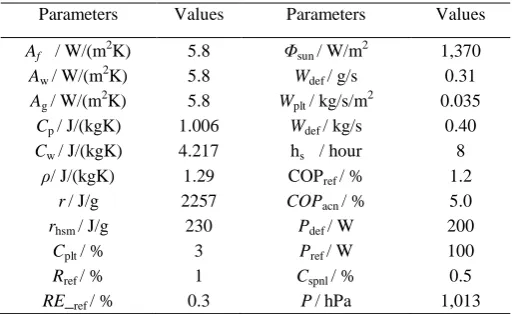
conditions used for the simulation and the inequality
constraints of an optimization technique are shown in
Table1,2 and Figure 3.
- Cultivation method: cultivation (hydroponics),
water-saving culture.
- Crop items: a leaf vegetable, fruit vegetable.
- House quality of the material: lath house.
- House size: 10 m2 ( 50 m2, 100m2 in future ).
- Outside environment: a semiarid land belt, dry land
farming.
Table 1 Simulation conditions
Parameters Values Parameters Values
Af /W/(m2K) 5.8 Φsun /W/m2 1,370
Aw /W/(m2K) 5.8 Wdef /g/s 0.31
Ag /W/(m 2
K) 5.8 Wplt /kg/s/m 2
0.035
Cp / J/(kgK) 1.006 Wdef /kg/s 0.40
Cw /J/(kgK) 4.217 hs / hour 8
ρ/J/(kgK) 1.29 COPref / % 1.2
r/J/g 2257 COPacn /% 5.0
rhsm /J/g 230 Pdef /W 200
Cplt /% 3 Pref /W 100
Rref /% 1 Cspnl /% 0.5
RE_ref /% 0.3 P/hPa 1,013
Table 2 Simulation conditions of inequality constraint
Parameters Values Parameters Values
Uout_min /m3/s 0.01 wmist_max / kg/s 1
Uref_min /m3/s 0.01 wdef_max / kg/s 1
wmist_min / kg/s 0 qacn_max / W 2,000
wdef_min / kg/s 0 Uout_max / m3/s 0.1
Mhsm_min / kg 80 Uref_max / m3/s 0.05
Mhsm_max / kg 120 qacn_min / W 100
Tmin/K 293 Tmin/K 308
Figure 3 The size in water-saving greenhouse
5 Simulation results and discussion
When the outdoor exhaust gas of the air in a house is
set to 0 and only a cooling device with the highest power
consumption is used, an example of the results of a water
loss and power consumption are shown in Figure 4 (a).
Here, Qio, Qwg, Qsun, Qacn, Qhsm, Qmst, Qplt, Qice, and Qref
are cold energy by a house air intake exhaust gas, the
surface of a wall and the ground, solar heat, air
conditioner, latent heat storage material, fog cooling,
vegetable transpiration, and salt removal system, and the
quantity of heat by an absorption refrigeration machine,
respectively. The amount of moisture losses in the
house per unit time and the operating electric energy of a
cooling device and a dehumidifier are shown in the figure.
Figure 4 (b) shows the results of electric power and water
loss when the fog cooling system and house ventilation
which are performed by the usual cultivation are used
together. From this figure, moisture in a house can be
reduced without using a dehumidifier, but the loss of
moisture by the ventilation in a house will increase. So,
although this method is effective only for reduction of
electric power, it is not suitable for water saving.
a) base case
b) case1
Figure 4 Simulation results of energy balance & water
loss, energy
Figure 5 Simulation results by optimization method
Finally, Figure 5 shows the optimum coordination
result of the air-conditioning system obtained by the
optimization technique using the unified objective
function. According to this, it turns out that it has
attained in the combination of the air-conditioner
considered to reduce power consumption where the loss
of moisture of a house is made into the minimum and the
validity of the proposed technique was suggested.
6 Cultivation experiments and results
In order to evaluate the water-saving culture
environment at increased humidity levels, the effect of
increased relative humidity levels, level 1: RH74.5%:
level 2: 86%, level 3: 97.8%, in growth chambers with
cucumber seedlings was investigated.
6.1 Material and methods
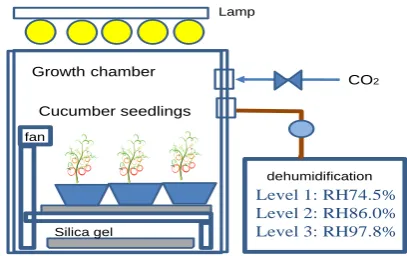
Cucumber was used in an experiment. Figure 6
shows a scheme of an assimilation box under increased
humidity conditions. Four assimilation boxes made by a
clear acrylic board (width 50 cm x depth 50 cm x height
80 cm) were used for an experiment. An assimilation
box was installed in the homeothermal room set as 22℃
of temperature. Relative humidity in the assimilation
box was controlled by combining two dehumidification
pumps and silica gel (about 2 kg). The fan to stir air, a
temperature sensor and a moisture sensor were installed
in the assimilation box. Five light sources were installed
in an assimilation box. The distance from a light source
to the stand in which a stump was installed was 57 cm,
and light quantity on the stand was 136 μ mol, 1/m2 and
1/s. The temperature in assimilation box, relative
humidity and CO2 density were controlled using a control
computer (made of KV3000 and Keyence) during the
session length, and these data were recorded every one
minute.
Figure 6 A schematic diagram of assimilation box
under increased humidity conditions
6.2 Experimental results
Figure 7 Results of mean values of total dry weight at
three levels
Figure 7 shows the results of mean values of total dry
weight at three levels. As can be seen in this figure, dry
matter production and relative growth rate (RGR) were
largest when seedlings were grown in the level 2 chamber.
The leaf area of seedlings became larger under level 2
than under level 1. These results indicated that dry
matter production increased because of the maximum
photosynthetic rate and expansion of leaf areas due to
higher humidity. In contrast, dry matter production
decreased under level 3. The reduction of the
transpiration rate was probably induced by the decreased
nutrient uptake by seedlings under level 3. These results
indicate that good cultivation is possible at high humidity
conditions and there is an optimal humidity level.
Cucumber seedlings Growth chamber
Lamp
fan
dehumidification
CO2
Silica gel
7 Conclusions
The authors designed the optimal air-conditioning
system of the water-saving greenhouse and to investigate
the effects on growth in plants under these conditions. In
this design, the authors proposed the ammonia gas
absorption refrigerator equipped with the
dehumidification capability to use solar heat and the
thermal storage of the cold energy becomes possible in
the temperature field of nighttime without other electric
power. And the optimal combination of each air
conditioner was calculated with the optimization
technique. In the examination of plants, in order to
evaluate the water-saving culture environment at
increased humidity levels, the effect of increased three
relative humidity levels in growth chambers with
cucumber seedlings was investigated. Relative humidity
and the temperature in assimilation box were controlled
by combining two dehumidification pumps and silica gel
and using a control computer. Consequently, it turns out
that it has attained in the combination of the
air-conditioner considered to reduce power consumption
where the loss of moisture of a house is made into the
minimum and the validity of the proposed technique was
suggested. It was also useful to introduce the fog cooling
system, thermal storage mediums, and the gas absorption
refrigerator with dehumidification ability. Furthermore, it
was found that dry matter production and relative growth
rate were largest when seedlings were grown in the 86%
level chamber. The leaf area of seedlings became larger
under level 86% than under level 74.5%, in contrast, the
reduction of the transpiration rate was probably induced
by the decreased nutrient uptake by seedlings under 97.8%
level. These results indicate that good cultivation is
possible at high humidity conditions and there is an
optimal humidity level.
Acknowledgment.
This research was done with grant-in aid for Japan
Science and Technology Agency (JST), Core Research
for Evolu-tional Science & Technology (CREST,
No:205004), Japan. We express our deep appreciation
to all parties concerned.
References
Fujioka, R., L. Pang Wang, G. Dodbiba, and T. Fujita. 2013. Application of progressive freeze concentration for desalination. Desalination, 319(14): 33–37
Heuvelink, E., and M. Dorais. 2012. chapter 4, (ed. By Heuvelink E.),“TOMATOES”, CABI Pub., USA, pp.85-144
Ito, T. 1977. The technology of CO2 application in horticulture (Shisetu-Engei niokeru Tansangasu Seyou Gijyutu). Ag-riculture and horticulture, 52, pp. 199-205(in Japanese).
Kozai, T. 2013. Background, Challenges and Trends in Plant Factory, Refrigeration, 88, pp.3-10 (in Japanese).
Kawashiro, H., K. Tsuchiya, H. Sakiyama, and Y. Udagawa. 2009. Effects of Low-concentration Carbon Dioxide Sup-plementation on Fruit Yield and Economic Value of Cucumber on Forced Culture. Hort. Res., 8(4): 445-449 (in Japanese).
Matsuo, S., R. Fujioka, L. P. Wang, K. Okaya, and T. Fujita. 2011. Energy saving of air-conditioning system in greenhouse using evaporation heat of desalting system in irrigation water under arid climate. Proc. Int. Symposium of Resource Recycling, Kaohsiung, Taiwan pp.668-671.
Okazaki, A. , Pat J. -F. Yeh., K. Yoshimura, M. Watanabe, M. Kimoto, and T. Oki. 2012. Changes in Flood Risk under Global Warming Estimated Using MIROC5 and the Discharge Probability Index. Journal of the Mete-orological Society of Japan, 90: 509-524