Internet of Things System Based on Mobile
Communication Network
https://doi.org/10.3991/ijoe.v14i11.9513
Wanghui Li, Ganghua Bai Hebi Polytechnic, Henan, China [email protected]
Abstract—To successfully establish a unified and standardized Internet of Things (IoT) system, a specific scheme based on the bandwidth and quality of service (QoS) analysis as well as the third generation mobile communication sys-tem is given. The basic architecture of the IoT is introduced, the technical re-quirements of each level on the network are put forward, and the application of the IoT system in different industries is established. At the same time, a conges-tion control algorithm based on the applicaconges-tion layer is proposed. This algorithm can greatly enhance the adaptability and controllability of the communication network of the IoT. Moreover, when the system is in normal operation, the algo-rithm can reasonably allocate and optimize bandwidth resources, thus greatly saving network traffic. The algorithm tests the current network state through the network test module, and then determines whether the data is sent according to the test results to ensure that the system has sufficient resources to respond to the sudden situation.
Keywords—IoT, mobile communication, wireless communication
1
Introduction
With the continuous progress and maturity of the Internet of Things (IoT), countries all over the world are very concerned about this technology development. As we all know, Internet technology has penetrated into all aspects of social life and production, and the research on this aspect is becoming more and more mature. But in contrast, people's understanding of the IoT is not enough, and the market has not fully accepted this emerging thing, so it is necessary to study the IoT. At this stage, a variety of appli-cations developed based on the IoT have sprung up, but these appliappli-cations still are in-sufficient in improving the convenience of people's life. Most of these applications have died soon after the launch. The main reasons for this phenomenon are the lack of system standards, lack of unity, poor compatibility and low scalability of the IoT at the present stage, which seriously impede the progress of the IoT and the development of the in-dustry.
operators have the characteristics of large scale of users, wide coverage of network, and diversified means of access and transmission. These features have created favorable conditions for the establishment of a unified and standardized IoT system. Under the unified rules, the IoT can be connected to each other only by access to the communica-tion network.
The research background of the IoT system under the communication network framework is briefly described, and the current situation and the development prospect of IoT at home and abroad are discussed. In order to successfully establish a unified and standardized IoT system, a specific scheme is given based on bandwidth, quality of service (QoS) analysis and wireless access of the third generation mobile communi-cation system. This scheme contains the following contents: the basic architecture of the IoT is introduced, and the technical requirements of various levels for the network are put forward on this basis. The application of the IoT in different industries is estab-lished, and based on VPDN (Virtual Private Dial-up Networks) and the service load, access mode, service quality and security mechanism provided by the current commu-nication network, a feasible scheme for the realization of the IoT is proposed. VPDN has the function of automatically connecting different industry custom terminals and information processing centers. This is a kind of IoT with unified standard and it relies on the wireless data special network and the high-speed packet data network platform. At the present stage, the mainstream data acquisition system has basically adopted the method of accessing the IoT and the VPDN platform when realizing the interaction of information and communication. At the same time, it also ensures the security of VPDN. Therefore, the unauthorized users are unable to log in the network. Thus, the congestion control algorithm based on application layer is proposed. This algorithm can greatly enhance the adaptability and controllability of the communication network of the IoT. Moreover, when the system is in normal operation, the algorithm can reasona-bly allocate and optimize bandwidth resources, thus greatly saving network traffic. The principle of the algorithm is to prejudge the alarm in the field, and then test the current network state through the network test module and judge whether the data is sent ac-cording to the test results, so as to ensure that the system has sufficient resources to respond to the sudden situation. The algorithm can save nearly 50% of the bandwidth resources.
Based on the above background, the mobile communication network is combined with the IoT and the IoT system based on the mobile communication network is tudied.
2
Literature review
The current international economic situation is still not optimistic, and the impact of the financial storm has not completely disappeared. Many European and American de-veloped countries affected by this influence are trying to find a new field as a magic weapon to get rid of their difficulties. The IoT is undoubtedly a good choice, and due to the concern and investment by all countries, IoT technology continues to develop.
different people in different parts of the country and different industries through ICT), so as to achieve rapid economic development. It mainly involves industries and fields including manufacturing, housing, and furniture [1]. Li et al. (2017) studied and pointed out that, in order to make the information technology industry more quickly and con-veniently serve the general public, the sensor network technology is brought into the national development strategy. The intelligent government responsibility is carried out, the medical information is open and transparent, and the training mechanism of the key talents of education is constructed so as to early achieve the efficient and fast-paced whole society's ability to govern, and promotes the vigorous development of all aspects of society [2].
Kim et al. (2018) discussed and pointed out that, the IoT is an organic extension of the information technology in the physical field, which is essentially different from the modern Internet technology. Compared with Internet technology, the IoT has a very outstanding ductility. The antennae of its technology can be effectively extended to any corner of the national economy. It can penetrate into people's life and work in a com-prehensive and diversified way, and greatly change people's life style and life concept to a great extent and promote the formation of modern economic growth point [3].
Wang et al. (2017) indicated that the emergence of IoT is a modern information technology established based on the diversification of network fusion technology. It has prominent mobility and extensive characteristics in the information node, which results in that the mobile communication technology can be used as the main network-ing technology of the network layer [4]. In recent years, the research of Jain et al. (2018) pointed out that the mobile communication technology in China is constantly updated and upgraded. The third generation of mobile communication has been widely popu-larized, and the fourth generation network has also been extended and widely applied [5]. The research of Wittend et al. (2017) showed that the development of mobile com-munication provides an important material basis for the application and realization of the popularization of IoT technology, which makes the application of the IoT more extensive [6].
3
Method
3.1 Design principle
In the design of the system, it is necessary to use open structure as far as possible, which is conducive to improving the scalability and compatibility of the interface. In addition, because the system often has to collect and transmit large amounts of data, it is necessary to take the security of the system into consideration, and unauthenticated users cannot log in the system; finally, the maintenance and upgrades of the system should be considered.
When designing the system, the layered thought of the IoT should be used as the guidance. The hierarchical structure is used for the system, so as to reduce the coupling between the modules of the system and to ensure their functions to be realized. In order to realize the hierarchical management and control of the scene, the technologies of transmission control and remote decoding should be applied. In order to realize the unified management of the console, it is necessary to centralize the multi-channel com-munication parallelism, linkage alarm, local storage, and video surveillance.
Equipment selection should consider the following problems: first, modularize. whether it is the development of hardware or software, the equipment adopted must meet the requirements of "unity" and "generality", so as to expand and upgrade the system in the future. Second, the selected industrial equipment should have the ideal anti-interference ability and reliability to avoid the impact of site environment. Third, in order to facilitate the repair and maintenance of operators, it is supposed to choose the device integrated with various functions. Fourth, choose the devices with ideal per-formance under the condition of controllable cost.
. (1)
In Formula (1), Si is the strategic collection of player i, S=S1×...×SM is the strategic combination space for all players, x represents Cartesian product, and ui is the utility function of the player i.
3.2 Implementation of field acquisition network
The components of field acquisition network are usually made up of three parts, one is wireless router, the other is IoT network management, and the third is sensor network. The sensor network is made up of humidity sensor, temperature sensor, infrared sensor and video server, which is in the core part of these modules.
Since the advent of the IoT, people are trying to find a way to measure air humidity based on material testing. At first, people mainly used hair hygrometers and wet bulb hygrometers to measure humidity. After development and improvement, people began to measure humidity with capacitors, ceramic humidity sensitive resistors, metal oxides and other sensors. With the rapid development of science and technology and the advent of various advanced instruments and devices, many advanced methods of humidity
{
1, ,
2 M; , ,
1 2 M}
measurement have been excavated. However, no matter which instrument is used, the method and principle of measuring humidity are almost the same. In a simple way, it is to observe the sensitivity of the object to water, and to measure it using the sensitive characteristics of the material to the water molecules, so that the specific measurement data can be obtained.
Under normal circumstances, humidity sensors are basically composed of humidity sensitive components. Materials for making humidity sensitive capacitors are usually polymer film capacitors, such as polyvinyl acetate acetate, polyimide, and polystyrene. The polymer film made of polymer materials has a strong induction of external humid-ity, and its dielectric value will change with the change of external humidity. It has a positive correlation with the capacitance and humidity and such device is the humidity sensitive capacitance. Similarly, if some resistance can induce the change of humidity in time, then it can be called the humidity sensitive resistance. The principle of the humidity sensitive resistance is the same as that of the humidity sensitive capacitance. It is made of the material containing the humidity sensitive material, so once the mate-rial induces the external humidity, it will cause the change of the resistivity and the resistance value. Whether it is a resistance humidity sensor or a capacitive humidity sensor, its response to ambient humidity can be used to test and control the humidity of the outside world. More importantly, the result obtained is quite accurate.
Similar to the capacitive humidity sensitive capacitance and resistance sensitive ca-pacitance introduced above, the principles of measuring humidity measurement of the two methods are the same, that is, to use the characteristics of the dipole moment of water molecules. When the water molecules attach or even penetrate to the surface of the device, these humidity sensitive sensors can react with the characteristics of the water molecules. At this time, only by measuring the capacitance of the resistance value and the change can the specific humidity be obtained. Of course, the humidity can also be measured according to the changes in the physical properties (such as shape and length) of the device, or even judge it by chemical reactions that occur in the device, and can also make a comprehensive judgment by the common changes of the two char-acteristics. In terms of the metal humidity sensor, it is very sensitive to water molecules. Once it is exposed to the water, a violent chemical reaction will occur. When the water molecules attach or permeate to the surface of the device, the oxide on the surface will react with the water, thus causing the change of the humidity characteristic value, which is the physical judgment method. In addition to this, when the water molecules react with the oxide of the surface of the device, the hydroxides will be generated. The hy-droxides will change the characteristics of the devices and determine the specific hu-midity values, which is the chemical judgment method. However, no matter which method is used, it has shortcomings. Because the diagnostic efficiency of the metal humidity sensitive device is not very high, it will inevitably cause certain errors.
thermistor humidity sensing device uses the characteristics of the heat; the device in-troduced here applies the affinity of water molecules to test the humidity of the envi-ronment.
3.3 Implementation of VPDN as a transmission network
At first, VPDN is a network solution for all branches of enterprises to improve public network security communication. The principle of this scheme is to use the Ethernetca-ble-based modem, xDSL, Ethernet and other means by accessing to broadband server, such as building automation system (BAS). And the scheme uses point-to-point proto-col to provide high-quality, safe and reliable VPDN platform. Moreover, it applies ad-vanced network communication protocol and encryption technology to set up a cost-controlled transmission channel on the public network in high-speed packet data net-work, with authorization mechanism and corresponding authentication. However, it is worth noting that BAS does not have sufficient hardware resources. For this point, some configuration should be sued to virtual one or more than one equivalent access server on a BAS to meet the user's personalized operation requirements for the system.
The security management, user management, billing management and packet rout-ing and forwardrout-ing modules between each virtual server are mutually independent, which greatly improves the security of the system. Virtual access server not only sup-ports the second layer tunneling protocols, such as L2TP tunneling protocols, but also supports the third layer routing protocols, including border gateway protocol, open shortest path finite protocol, static routing, and routing information protocol. With the rise of the IoT and the progress and maturity of VPDN technology, people have new views on VPDN. At present, VPDN is relying on the wireless data special network platform and the high-speed packet data network in the custom terminal and the infor-mation processing center. In this way, VPDN can build the private network of the en-terprise by any kind of 3G network. According to customer preferences, the wireless bandwidth VPDN business can be divided into two categories. The wireless VPDN special network system has the authentication and the function of supporting remote terminal identity authentication, that is, only authorized users can access the network legally. This greatly improves the security of the system and also enhances the ability of the system to resist malicious attacks. In addition, if the user wants to monitor the center or collect the data from the field terminal, and even realize the information in-teraction and real-time communication between the dedicated equipment of the enter-prise network, only the VPDN special network system is needed.
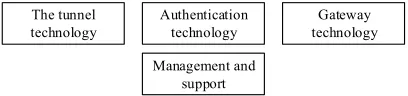
VPDN technology consists of four branches: gateway technology, tunnel technol-ogy, management and support technoltechnol-ogy, and authentication technology. The compo-sition of VPDN technology is shown in Figure 1.
Fig. 1. The composition of VPDN technology
The tunnel
technology Authentication technology technologyGateway Management and
4
Results
4.1 Transmission control protocol (TCP) traffic control and congestion control
The transmission layer and network layer of the TCP protocol stack can control the congestion. In fact, the transmission layer is to adjust the window range under the con-gestion of the source nodes, and then determine the window value. In the actual opera-tion, the TCP transmission control protocol is followed, and the actual content and op-eration steps of the network layer congestion control algorithm are clearly defined in this period. Among them, group scheduling algorithm, explicit congestion feedback mechanism, and intermediate node active queue management should be paid attention to.
During the communication, it is supposed to pay attention to the flow control of TCP, process the received messages based on the processor and memory resources, and ad-just the window size appropriately. Control the transmission information through the sending window, determine the number of network packets and information transfer address, and select the use of network congestion control mode. The message sender should confirm the size of the window before transmitting the information, and set the amount of data that will be sent. In special case, the size of the window needs to be adjusted and the minimum value of the window is taken.
The advantage of the TCP transmission protocol lies in the window mechanism. During the actual application, it can be found that the TCP transmission mechanism requires high data transmission. Before the data transmission, it must be confirmed to ensure the security and effectiveness of the data information during the transmission, and beware of the work affected by the receiver's confirmation delay.
During the transmission of TCP, it is important to notice that both the receiver and the transmitter have a buffer window to reduce the transmission pressure. All the data information will be stored in the sending end window, and the message cannot be suc-cessfully received and sent before the message is confirmed. During the communica-tion, it is obvious that the content of the window changes at any time, and it is not a fixed mode.
The problems that need to be paid attention to in the TCP protocol are transmission efficiency and congestion. In the period of data transmission, many aspects should be taken into consideration, the data transmission line is determined, the utilization rate of resources is improved, and the communication work can be carried out smoothly. If there is a jam during the communication, the size of the window should be adjusted properly, and the line condition and the actual demand should be rationally set to make the window move to the right gradually. If the line is congested, it will be moved to the left properly and the process is the closing of the window.
4.2 Window and congestion window
the transmission byte stream is very different. At this time, it is necessary to focus on the flow control and network congestion control, fully use network bandwidth and be-ware of bandwidth resource waste. The receiver carries out traffic control according to the size of the receiving window and the buffer size, improves the utilization rate of the bandwidth resources, and confirms the received information.
Construct a data communication network and take measures to prevent network con-gestion. In the actual operation process, attention should be paid to the following as-pects. First, the data link layer: the most commonly used are traffic control strategy, random sequence caching strategy, retransmission strategy, and confirmation strategy. Second, the network layer: the most commonly used service strategy, virtual circuit strategy, packet discarding strategy, packet queuing strategy, and group survival man-agement strategy. Third, the transport layer: the most commonly used are the confirma-tion strategy, the random sequence caching strategy, the determinaconfirma-tion timeout strategy, and the retransmission strategy.
The above strategies can fully meet most application requirements, but in reality, these strategies can only be implemented on the ground floor, and it is difficult to obtain accurate network information above the application layer. It is precisely because of this, the application layer process should be adjusted and the network load should be in-creased according to the reality. It is supposed to pay more attention to remote manage-ment and control, supervise the work of each link, make statistics and analysis of the collected data information, and make clear the alarm state of the network information. It is difficult to ensure the full utilization of the bandwidth resources under the poor network condition.
4.3 Congestion control algorithms
The actual application of congestion control algorithm is analyzed. The ultimate aim of the algorithm is to make up the existing technical defects effectively and build a perfect and mature control system. The application layer should be paid attention to in the actual operation process. The basic idea of the algorithm is that the monitoring de-vice has an alarm state during the operation. It does not need to send the monitoring information to the control center, and does not need to exchange information with it. The algorithm contains several auxiliary functional modules, and there are only three main functional modules, which are the sending module, the algorithm startup module and the control center selection module in turn. The realization of module function is introduced below.
reality. The congestion control algorithm is limited to the application layer only, the real-time information is arranged regularly, and the bandwidth resources are fully uti-lized to transfer it to the specified address. Check the operation status of the monitoring point to ensure that it is always in the communication state, and with the interval of 180s, it is connected with other monitoring points. Failing to receive the related infor-mation of the request connection or the connection failure means that the communica-tion state of the network device will change from the original "conneccommunica-tion normal" to the "connection exception". On the contrary, carry on the next step.
The management and control center manages the algorithm startup module. When the central selection module keeps the default or the startup mode, the algorithm starts the module to operate formally. In the execution process, it mainly involves the follow-ing three steps. First, open the network test. In essence, the management and control center needs to confirm after receiving the network test information transmitted by the gateway. The packet test time is usually set to 30s, so that the bandwidth resources will not be wasted and ensure the normal operation of the network system. When accurately calculating the packet round-trip delay, the management and control center plays the leading role in this period. It confirms the relevant information received, knows the size of the window and responds, uses the congestion avoidance algorithm, and then knows the size of the window. The execution time is limited, and the interval time is often set to 120s. Second, load judgment. Automatically or manually select window threshold and time threshold and obtain network parameters according to the calculation formula. Third, send the transmission position. The network congestion is judged according to the second step operation. If there is a network congestion situation, the system will automatically display the warning information, and the mean value of the packet is 1; conversely, it is difficult to transmit the data packets and other related information to the specified address. If there is no network congestion, it means that the data packet is 1, and the system will transmit the monitoring information to the designated address.
In reality, the transmission module is also implemented in the gateway of the moni-toring node network. During this period, access control list (ACL) plays an important role in analyzing the actual application of ACL, controlling the traffic flow, making full use of the bandwidth resources and ensuring the network performance. Strictly follow-ing the access control protocol, the data information that needs to be transmitted is fur-ther determined based on ACL. If the sending bit is 1, the message is allowed to be sent to the specified address; if the sending bit is 0, it means that it can be discarded. The professional network management personnel maintain it, further clarify the access con-trol conditions, ensure the security of the network system, and improve the network performance.
4.4 Congestion management configuration
The central content of congestion management is how to formulate a resource sched-uling strategy when congestion occurs, so as to decide the processing order of message forwarding. The ways to deal with congestion include classifying messages, creating new queues, adjusting queues, and sending messages to other queues.
For congestion management, queuing technology is generally used, a queue algo-rithm is used to classify traffic, and then some priority level algoalgo-rithm is used to send these traffic out. Whatever queue algorithm is designed to solve the problem of network traffic, and it has a great impact on the configuration, delay and jitter of bandwidth.
Queue scheduling conducts grading treatment for messages belonging to different priority classes and messages with higher priority will be sent first. Next, the queue scheduling that is often used is introduced.
The sketch map of FIFO (first in first out) queue is shown in Figure 2.
Fig. 2. The sketch map of FIFO queue
From the above figure, it is seen that FIFO determines the order of the packet on the forward on the basis of the arrival time. The first entered is forwarded first and the later entered is forward later, without carrying out the queue scheduling. It is also found that FIFO only focuses on the length of the queue, because the queue length has a great impact on delay and packet loss rate.
The sketch map of PQ (priority queue) is shown in Figure 3.
The PQ is designed with the key business as its object. It is found that the key busi-ness has a very important feature, that is, it can control the delay by providing priority services to solve the congestion problem. The basis for PQ to prioritize is message length, network protocol, source address / destination address, and data inflow inter-face. Common types of insulation are: normal priority queue (normal), top priority queue (top), bottom priority queue (bottom), and medium priority queue. Data flow automatically enters the normal priority queue by default. Each queue will follow the FIFO principle strictly when entering.
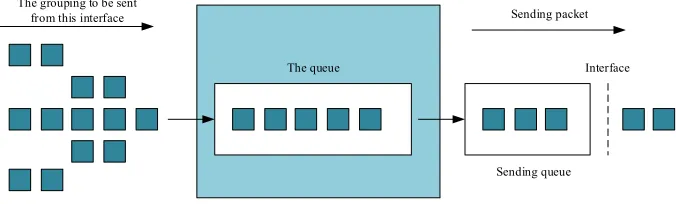
The sketch map of CQ (custom queue) is shown in Figure 4. The grouping to be sent
from this interface
The queue
Fig. 3. The sketch map of PQ
Fig. 4. The sketch map of CQ
According to the established rules, the CQ can divide the packets into 16 classes, and the different packets can also be entered into the CQ based on the advanced first in first out strategy of their own category. In these queues, users can configure the rules that are followed by the classification, and specify the proportion of the user queues on the interface or the bandwidth. In queue scheduling, the packets in the system queue will be transmitted preferentially. Until there is no queue in the system queue, polling is used to transmit packets in queues from No. 1 to No. 16.
The sketch map of WFQ (weighted fair queue) is shown in Figure 5.
The grouping to be sent from this interface
High queue
Sending queue Interface Sending packet Middle queue
Normal queue
Bottom queue
Classification Scheduling
The grouping to be sent from this interface
Queue 1
Sending queue Interface Sending packet Queue 2
Queue 15
Queue 16
Classification Scheduling
…
Ten percent
Thirty percent
Ten percent
Fig. 5. The sketch map of WFQ
Compared with FQ, WFQ has increased priority in calculating the scheduling se-quence of messages. Statistically speaking, WFQ enables the messages with high pri-ority obtains more opportunities for pripri-ority scheduling than those with low pripri-ority. WFQ can be classified according to the information of the stream in the "session", and it can be queued to the maximum, so that all the streams can be balanced in the queue, and thus the delay of all streams is balanced. When the queue is out, WFQ will classify the mechanical capacity of the bandwidth according to the priority of the flow. Among them, the smaller the numerical priority is, the fewer the bandwidth will be allocated; the higher the numerical priority is, the more the bandwidth will be allocated.
5
Conclusion
The main content of this research work is the development of the IoT business. The actual application of the existing communication technology is studied, and combined with the actual situation, a VPDN-based IoT system is put forward. The research results are as follows: the application model of the IoT is studied, including video monitoring, data collection and transmission, intelligent identification, and urgent monitoring. The actual needs of four types of services in connectivity, QoS, and bandwidth are discussed and analyzed. VPDN data special network platform is constructed, tunnel technology is applied in actual operation process, appropriate access methods are chosen in com-bination with reality, and a reasonable plan is proposed to ensure the security of the implementation scheme. Based on VPDN, the IoT system is constructed and a reason-able planning scheme is proposed. The actual application situation of the system is studied, the characteristics of the system are clearly defined, and the congestion control algorithm is chosen in the actual operation process. However, the algorithm is only implemented in the application layer and in terms of theory, the bandwidth resources can be saved by 50%.
The grouping to be sent from this interface
Sending queue Interface Sending packet
Queue N-1 weight N-1
Queue N weight N
Classification Scheduling
…
6
References
[1]Pelgrum, W. J., & Plomp, T. (2017). The use of computers in education worldwide: re-sults from a comparative survey in 18 countries. Studies in Educational Evaluation, 19(2): 24. [2]Li, X., Li, D., Wan, J., Vasilakos, A. V., Lai, C. F., & Wang, S. (2017). A review of
in-dustrial wireless networks in the context of industry 4.0. Wireless Networks, 23(1): 23-41. https://doi.org/10.1007/s11276-015-1133-7
[3]Kim, C., Srimuk, P., Lee, J., & Presser, V. (2018). Enhanced desalination via cell volt-age extension of membrane capacitive deionization using an aqueous/organic bi-electrolyte. De-salination, 443: 56–61. https://doi.org/10.1016/j.desal.2018.05.016
[4]Wang, F., Hu, L., Zhou, J., Hu, J., & Zhao, K. (2017). A semantics-based approach to multi-source heterogeneous information fusion in the internet of things. Soft Compu-ting, 21(8): 2005-2013. https://doi.org/10.1007/s00500-015-1899-7
[5]Jain, P., Goel, A., & Gupta, S. C. (2018). Monitoring checklist for ceph object storage infra-structure. Ifip Advances in Information & Communication Technology, 456: 611-623. https://doi.org/10.1007/978-3-319-19578-0_50
[6]Witten, N. A., & Humphry, J. (2018). The electronic health literacy and utilization of tech-nology for health in a remote hawaiian community: lana'i. Hawaii J Med Public Health, 77(3): 51-59.
[7]Zhu, Y. Q., Chen, B., Gao, D., Qin, M., Huang, Q. A., & Huang, J. Q. (2016). A robust and low-power 2-d thermal wind sensor based on a glass-in-silicon reflow process. Microsystem Technologies, 22(1): 151-162. https://doi.org/10.1007/s00542-015-2423-9
[8]Deng, X., Sun, R., Yang, H., Nie, J., & Wang, W. (2017). Data transmission method of pasture internet of things based on opportunistic network. Nongye Jixie Xuebao/transactions of the Chinese Society of Agricultural Machinery, 48(2): 208-214.
7
Authors
Wanghui Li works as associate professor at Electronic Information Engineering College, Hebi Polytechnic, Henan, China.
Qiong Ren works as associate professor at Electronic Information Engineering Col-lege, Hebi Polytechnic, Henan, China.