optical networks can be.
—Vincent Chan, Professor, MIT Department of Electrical Engineering and Computer Science
This book is not only essential reading for anyone in the optical networks industry, it is important. It provides the necessary foundation of learning for anyone hoping to contribute to this technology’s rapid evolution.
—Scott Clavenna, President, PointEast Research
The authors’ grasp of what is truly workable and worthwhile in optical networks is fundamental, and they have effectively packaged this knowledge in an easy-to-comprehend text that will be valued to both veterans and those new to optical networking.
—Scott Grout, President and CEO, Chorum Technologies
This is a comprehensive and authoritative work on optical networks, ranging in scope from components and systems to overall design principles. I find the book well organized and easy to use, and I particularly like the treatment of network design and operation. An essential book for anyone seriously interested in optical networks.
—Goff Hill, Chief Network Architect, Altamar Networks, UK
I really enjoy the bottoms-up approach taken by the authors to address fundamentals of optical components as the enablers, optical transmission system design and engineering as the building blocks, and network architecture and its management features that deliver applications to the network operators and services providers at the top of the food chain.
—Shoa-Kai Liu, Director of Advanced Technology, Worldcom
This book not only provides the fundamentals and details of photonics, but the pragmatic perspective presented enables the service provider, the equipment manufacturer, and the academician to view light from a real-life standpoint. —Mathew Oommen, Vice President, Network Architecture, Williams Communications Group
This book functions as both an introduction to optical networking and as a text to reference again and again. Great for system designers as well as those marketing and selling those systems. Optical Networks provides theory and applications. While no text can be truly state-of-the-art in the fast moving area of optical networking, this one comes as close as possible. —Alan Repech, System Architect, Cisco Systems Optical Transport
This book provides the most comprehensive coverage of both the theory and practice of optical networking. Its up-to-date coverage makes it an invaluable reference for both practitioners and researchers.
—Suresh Subramaniam, Assistant Professor, Department of Electrical and Computer Engineering, George Washington University
This book provides an excellent overview of the complex field of optical networking. I especially like how it ties the optical hardware functionality into the overall networking picture. Everybody who wants to be a player in the optical networking space should have this book within easy reach.
P2P Networking and Applications John Buford, Heather Yu, and Eng Lua
The Illustrated Network Walter Goralski
Broadband Cable Access Networks: The HFC Plant David Large and James Farmer
Technical, Commercial and Regulatory Challenges of QoS: An Internet Service Model Perspective
XiPeng Xiao
MPLS: Next Steps
Bruce S. Davie and Adrian Farrel
Wireless Networking
Anurag Kumar, D. Manjunath, and Joy Kuri
Internet Multimedia Communications Using SIP Rogelio Martinez Perea
Information Assurance: Dependability and Security in Networked Systems Yi Qian, James Joshi, David Tipper, and Prashant Krishnamurthy
Network Analysis, Architecture, and Design, 3e James D. McCabe
Wireless Communications & Networking: An Introduction Vijay K. Garg
IPv6 Advanced Protocols Implementation Qing Li, Tatuya Jinmei, and Keiichi Shima
Computer Networks: A Systems Approach, 4e Larry L. Peterson and Bruce S. Davie
Network Routing: Algorithms, Protocols, and Architectures Deepankar Medhi and Karthikeyan Ramaswami
IPv6 Core Protocols Implementation Qing Li, Tatuya Jinmei, and Keiichi Shima
Smart Phone and Next-Generation Mobile Computing Pei Zheng and Lionel Ni
GMPLS: Architecture and Applications Adrian Farrel and Igor Bryskin
Content Networking: Architecture, Protocols, and Practice Markus Hofmann and Leland R. Beaumont
Network Algorithmics: An Interdisciplinary Approach to Designing Fast Networked Devices George Varghese
Network Recovery: Protection and Restoration of Optical, SONET-SDH, IP, and MPLS Jean Philippe Vasseur, Mario Pickavet, and Piet Demeester
Routing, Flow, and Capacity Design in Communication and Computer Networks Michał Pióro and Deepankar Medhi
Wireless Sensor Networks: An Information Processing Approach Feng Zhao and Leonidas Guibas
Communication Networking: An Analytical Approach Anurag Kumar, D. Manjunath, and Joy Kuri
The Internet and Its Protocols: A Comparative Approach Adrian Farrel
Modern Cable Television Technology: Video, Voice, and Data Communications, 2e Walter Ciciora, James Farmer, David Large, and Michael Adams
Policy-Based Network Management: Solutions for the Next Generation John Strassner
MPLS Network Management: MIBs, Tools, and Techniques Thomas D. Nadeau
Optical Networks: A Practical Perspective, 3e
Rajiv Ramaswami, Kumar N. Sivarajan, and Galen Sasaki
Internet QoS: Architectures and Mechanisms Zheng Wang
TCP/IP Sockets in Java: Practical Guide for Programmers Michael J. Donahoo and Kenneth L. Calvert
TCP/IP Sockets in C: Practical Guide for Programmers Kenneth L. Calvert and Michael J. Donahoo
Multicast Communication: Protocols, Programming, and Applications Ralph Wittmann and Martina Zitterbart
High-Performance Communication Networks, 2e Jean Walrand and Pravin Varaiya
Internetworking Multimedia
Jon Crowcroft, Mark Handley, and Ian Wakeman
Understanding Networked Applications: A First Course David G. Messerschmitt
Integrated Management of Networked Systems: Concepts, Architectures, and their Operational Application
Heinz-Gerd Hegering, Sebastian Abeck, and Bernhard Neumair
Virtual Private Networks: Making the Right Connection Dennis Fowler
Networked Applications: A Guide to the New Computing Infrastructure David G. Messerschmitt
Wide Area Network Design: Concepts and Tools for Optimization Robert S. Cahn
This book is printed on acid-free paper.
© 2010 ELSEVIER Inc. All rights reserved.
No part of this publication may be reproduced or transmitted in any form or by any means, electronic or mechanical, including photocopying, recording, or any information storage and retrieval system, without permission in writing from the publisher. Details on how to seek permission, further information about the Publisher’s permissions policies and our arrangements with organizations such as the Copyright Clearance Center and the Copyright Licensing Agency, can be found at our website: www.elsevier.com/permissions. This book and the individual contributions contained in it are protected under copyright by the Publisher (other than as may be noted herein).
Notices
Knowledge and best practice in this field are constantly changing. As new research and experience broaden our understanding, changes in research methods, professional practices, or medical treatment may become necessary.
Practitioners and researchers must always rely on their own experience and knowledge in evaluating and using any information, methods, compounds, or experiments described herein. In using such information or methods they should be mindful of their own safety and the safety of others, including parties for whom they have a professional responsibility.
To the fullest extent of the law, neither the Publisher nor the authors, contributors, or editors, assume any liability for any injury and/or damage to persons or property as a matter of products liability, negligence or otherwise, or from any use or operation of any methods, products, instructions, or ideas contained in the material herein.
Library of Congress Cataloging-in-Publication Data
Application submitted
British Library Cataloguing-in-Publication Data
A catalogue record for this book is available from the British Library.
ISBN: 978-0-12-374092-2
For information on all Morgan Kaufmann publications, visit our Web site at www.mkp.com or www.elsevierdirect.com
Optical Networks
A Practical Perspective
Third Edition
Rajiv Ramaswami
Kumar N. Sivarajan
Galen H. Sasaki
AMSTERDAM • BOSTON • HEIDELBERG • LONDON NEW YORK • OXFORD • PARIS • SAN DIEGO SAN FRANCISCO • SINGAPORE • SYDNEY • TOKYO
Foreword xxi
Preface to the First Edition xxv
Preface to the Second Edition xxix
Preface to the Current Edition xxxiii
1 Introduction to Optical Networks 1
1.1 Telecommunications Network Architecture . . . 2
1.2 Services, Circuit Switching, and Packet Switching . . . 5
1.2.1 The Changing Services Landscape . . . 8
1.3 Optical Networks . . . 10
1.3.1 Multiplexing Techniques . . . 11
1.3.2 Second-Generation Optical Networks . . . 13
1.4 The Optical Layer . . . 15
1.5 Transparency and All-Optical Networks . . . 22
1.6 Optical Packet Switching . . . 24
1.7 Transmission Basics . . . 26
1.7.1 Wavelengths, Frequencies, and Channel Spacing . . . 26
1.7.2 Wavelength Standards . . . 28
1.7.3 Optical Power and Loss . . . 29
1.8 Network Evolution . . . 30
1.8.1 Early Days—Multimode Fiber . . . 30
1.8.2 Single-Mode Fiber . . . 33
1.8.3 Optical Amplifiers and WDM . . . 34
1.8.4 Beyond Transmission Links to Networks . . . 37
Summary . . . 38
Further Reading . . . 39
References . . . 40
I
Technology
45
2 Propagation of Signals in Optical Fiber 47 2.1 Loss and Bandwidth Windows . . . 482.1.1 Bending Loss . . . 51
2.2 Intermodal Dispersion . . . 51
2.2.1 Geometrical Optics Approach . . . 52
2.2.2 Bit Rate–Distance Limitation . . . 54
2.2.3 Controlling Intermodal Dispersion: Graded-Index Multimode Fiber . . 55
2.2.4 Multimode Fiber in Practice . . . 57
2.3 Optical Fiber as a Waveguide . . . 58
2.3.1 Wave Theory Approach . . . 59
2.3.2 Fiber Modes . . . 63
2.3.3 Polarization Modes and Polarization-Mode Dispersion . . . 65
2.3.4 Other Waveguides . . . 68
2.4 Chromatic Dispersion . . . 70
2.4.1 Chirped Gaussian Pulses . . . 71
2.4.2 Controlling the Dispersion: Dispersion-Shifted Fibers . . . 75
2.5 Nonlinear Effects . . . 78
2.5.1 Effective Length and Area . . . 79
2.5.2 Stimulated Brillouin Scattering . . . 81
2.5.3 Stimulated Raman Scattering . . . 82
2.5.4 Propagation in a Nonlinear Medium . . . 83
2.5.5 Self-Phase Modulation . . . 85
2.5.6 SPM-Induced Chirp for Gaussian Pulses . . . 88
2.5.7 Cross-Phase Modulation . . . 90
2.5.8 Four-Wave Mixing . . . 92
2.5.9 Fiber Types to Mitigate Nonlinear Effects . . . 95
2.6 Solitons . . . 99
2.6.1 Dispersion-Managed Solitons . . . 102
2.7.1 Photonic Crystal Fiber . . . 103
2.7.2 Plastic Optical Fiber . . . 105
Summary . . . 106
Further Reading . . . 107
Problems . . . 108
References . . . 110
3 Components 113 3.1 Couplers . . . 114
3.1.1 Principle of Operation . . . 116
3.1.2 Conservation of Energy . . . 117
3.2 Isolators and Circulators . . . 118
3.2.1 Principle of Operation . . . 119
3.3 Multiplexers and Filters . . . 121
3.3.1 Gratings . . . 124
3.3.2 Diffraction Pattern . . . 128
3.3.3 Bragg Gratings . . . 129
3.3.4 Fiber Gratings . . . 132
3.3.5 Fabry-Perot Filters . . . 136
3.3.6 Multilayer Dielectric Thin-Film Filters . . . 139
3.3.7 Mach-Zehnder Interferometers . . . 141
3.3.8 Arrayed Waveguide Grating . . . 145
3.3.9 Acousto-Optic Tunable Filter . . . 149
3.3.10 High Channel Count Multiplexer Architectures . . . 154
3.4 Optical Amplifiers . . . 157
3.4.1 Stimulated Emission . . . 158
3.4.2 Spontaneous Emission . . . 159
3.4.3 Erbium-Doped Fiber Amplifiers . . . 160
3.4.4 Raman Amplifiers . . . 165
3.4.5 Semiconductor Optical Amplifiers . . . 167
3.4.6 Crosstalk in SOAs . . . 171
3.5 Transmitters . . . 172
3.5.1 Lasers . . . 172
3.5.2 Light-Emitting Diodes . . . 182
3.5.3 Tunable Lasers . . . 184
3.5.4 Direct and External Modulation . . . 192
3.5.5 Pump Sources for Raman Amplifiers . . . 196
3.6 Detectors . . . 198
3.6.1 Photodetectors . . . 198
3.7 Switches . . . 205
3.7.1 Large Optical Switches . . . 207
3.7.2 Optical Switch Technologies . . . 213
3.7.3 Large Electronic Switches . . . 220
3.8 Wavelength Converters . . . 221
3.8.1 Optoelectronic Approach . . . 222
3.8.2 Optical Gating . . . 224
3.8.3 Interferometric Techniques . . . 225
3.8.4 Wave Mixing . . . 228
Summary . . . 229
Further Reading . . . 230
Problems . . . 231
References . . . 237
4 Modulation and Demodulation 245 4.1 Modulation . . . 245
4.1.1 Signal Formats . . . 246
4.2 Subcarrier Modulation and Multiplexing . . . 248
4.2.1 Clipping and Intermodulation Products . . . 249
4.2.2 Applications of SCM . . . 251
4.3 Spectral Efficiency . . . 251
4.3.1 Optical Duobinary Modulation . . . 252
4.3.2 Optical Single Sideband Modulation . . . 254
4.3.3 Multilevel Modulation . . . 255
4.3.4 Capacity Limits of Optical Fiber . . . 255
4.4 Demodulation . . . 256
4.4.1 An Ideal Receiver . . . 258
4.4.2 A Practical Direct Detection Receiver . . . 259
4.4.3 Front-End Amplifier Noise . . . 260
4.4.4 APD Noise . . . 261
4.4.5 Optical Preamplifiers . . . 261
4.4.6 Bit Error Rates . . . 264
4.4.7 Coherent Detection . . . 269
4.4.8 Timing Recovery . . . 271
4.4.9 Equalization . . . 272
4.5 Error Detection and Correction . . . 273
4.5.1 Reed-Solomon Codes . . . 276
4.5.2 Interleaving . . . 278
Summary . . . 278
Problems . . . 280
References . . . 285
5 Transmission System Engineering 289 5.1 System Model . . . 289
5.2 Power Penalty . . . 290
5.3 Transmitter . . . 292
5.4 Receiver . . . 294
5.5 Optical Amplifiers . . . 295
5.5.1 Gain Saturation in EDFAs . . . 296
5.5.2 Gain Equalization in EDFAs . . . 297
5.5.3 Amplifier Cascades . . . 299
5.5.4 Amplifier Spacing Penalty . . . 300
5.5.5 Power Transients and Automatic Gain Control . . . 302
5.5.6 Lasing Loops . . . 303
5.6 Crosstalk . . . 304
5.6.1 Intrachannel Crosstalk . . . 305
5.6.2 Interchannel Crosstalk . . . 307
5.6.3 Crosstalk in Networks . . . 309
5.6.4 Bidirectional Systems . . . 309
5.6.5 Crosstalk Reduction . . . 311
5.6.6 Cascaded Filters . . . 313
5.7 Dispersion . . . 314
5.7.1 Chromatic Dispersion Limits: NRZ Modulation . . . 315
5.7.2 Chromatic Dispersion Limits: RZ Modulation . . . 317
5.7.3 Dispersion Compensation . . . 320
5.7.4 Polarization-Mode Dispersion (PMD) . . . 325
5.8 Fiber Nonlinearities . . . 328
5.8.1 Effective Length in Amplified Systems . . . 329
5.8.2 Stimulated Brillouin Scattering . . . 331
5.8.3 Stimulated Raman Scattering . . . 332
5.8.4 Four-Wave Mixing . . . 334
5.8.5 Self-/Cross-Phase Modulation . . . 338
5.8.6 Role of Chromatic Dispersion Management . . . 340
5.9 Wavelength Stabilization . . . 341
5.10 Design of Soliton Systems . . . 342
5.11 Design of Dispersion-Managed Soliton Systems . . . 343
5.12 Overall Design Considerations . . . 347
5.12.1 Fiber Type . . . 347
5.12.3 Chromatic Dispersion Compensation . . . 348
5.12.4 Modulation . . . 349
5.12.5 Nonlinearities . . . 349
5.12.6 Interchannel Spacing and Number of Wavelengths . . . 349
5.12.7 All-Optical Networks . . . 350
5.12.8 Wavelength Planning . . . 351
5.12.9 Transparency . . . 353
Summary . . . 353
Further Reading . . . 354
Problems . . . 355
References . . . 362
II
Networks
367
6 Client Layers of the Optical Layer 369 6.1 SONET/SDH . . . 3716.1.1 Multiplexing . . . 373
6.1.2 VCAT and LCAS . . . 377
6.1.3 SONET/SDH Layers . . . 378
6.1.4 SONET Frame Structure . . . 379
6.1.5 SONET/SDH Physical Layer . . . 384
6.1.6 Elements of a SONET/SDH Infrastructure . . . 386
6.2 Optical Transport Network . . . 389
6.2.1 Hierarchy . . . 391
6.2.2 Frame Structure . . . 392
6.2.3 Multiplexing . . . 395
6.3 Generic Framing Procedure . . . 396
6.4 Ethernet . . . 399
6.4.1 Frame Structure . . . 402
6.4.2 Switches . . . 403
6.4.3 Ethernet Physical Layer . . . 406
6.4.4 Carrier Transport . . . 407
6.5 IP . . . 411
6.5.1 Routing and Forwarding . . . 413
6.5.2 Quality of Service . . . 414
6.6 Multiprotocol Label Switching . . . 415
6.6.1 Labels and Forwarding . . . 417
6.6.2 Quality of Service . . . 419
6.6.4 Carrier Transport . . . 420
6.7 Resilient Packet Ring . . . 421
6.7.1 Quality of Service . . . 422
6.7.2 Node Structure . . . 423
6.7.3 Fairness . . . 424
6.8 Storage-Area Networks . . . 425
6.8.1 Fibre Channel . . . 426
Summary . . . 427
Further Reading . . . 428
Problems . . . 429
References . . . 430
7 WDM Network Elements 433 7.1 Optical Line Terminals . . . 436
7.2 Optical Line Amplifiers . . . 438
7.3 Optical Add/Drop Multiplexers . . . 438
7.3.1 OADM Architectures . . . 441
7.3.2 Reconfigurable OADMs . . . 447
7.4 Optical Crossconnects . . . 452
7.4.1 All-Optical OXC Configurations . . . 458
Summary . . . 461
Further Reading . . . 463
Problems . . . 464
References . . . 466
8 Control and Management 469 8.1 Network Management Functions . . . 469
8.1.1 Management Framework . . . 471
8.1.2 Information Model . . . 473
8.1.3 Management Protocols . . . 474
8.2 Optical Layer Services and Interfacing . . . 476
8.3 Layers within the Optical Layer . . . 478
8.4 Multivendor Interoperability . . . 479
8.5 Performance and Fault Management . . . 481
8.5.1 The Impact of Transparency . . . 481
8.5.2 BER Measurement . . . 482
8.5.3 Optical Trace . . . 483
8.5.4 Alarm Management . . . 483
8.5.5 Data Communication Network (DCN) and Signaling . . . 485
8.5.7 Optical Layer Overhead . . . 487
8.5.8 Client Layers . . . 492
8.6 Configuration Management . . . 493
8.6.1 Equipment Management . . . 493
8.6.2 Connection Management . . . 494
8.6.3 Adaptation Management . . . 499
8.7 Optical Safety . . . 501
8.7.1 Open Fiber Control Protocol . . . 503
Summary . . . 505
Further Reading . . . 506
Problems . . . 507
References . . . 508
9 Network Survivability 511 9.1 Basic Concepts . . . 513
9.2 Protection in SONET/SDH . . . 518
9.2.1 Point-to-Point Links . . . 518
9.2.2 Self-Healing Rings . . . 521
9.2.3 Unidirectional Path-Switched Rings . . . 523
9.2.4 Bidirectional Line-Switched Rings . . . 525
9.2.5 Ring Interconnection and Dual Homing . . . 530
9.3 Protection in the Client Layer . . . 532
9.3.1 Protection in Resilient Packet Rings . . . 533
9.3.2 Protection in Ethernet . . . 534
9.3.3 Protection in IP . . . 536
9.3.4 Protection in MPLS . . . 538
9.4 Why Optical Layer Protection . . . 541
9.4.1 Service Classes Based on Protection . . . 548
9.5 Optical Layer Protection Schemes . . . 549
9.5.1 1 + 1 OMS Protection . . . 552
9.5.2 1:1 OMS Protection . . . 552
9.5.3 OMS-DPRing . . . 552
9.5.4 OMS-SPRing . . . 553
9.5.5 1:N Transponder Protection . . . 553
9.5.6 1 + 1 OCh Dedicated Protection . . . 553
9.5.7 OCh-SPRing . . . 557
9.5.8 OCh-Mesh Protection . . . 557
9.5.9 GMPLS Protection . . . 563
9.6 Interworking between Layers . . . 564
Further Reading . . . 566
Problems . . . 567
References . . . 569
10 WDM Network Design 573 10.1 Cost Trade-Offs: A Detailed Ring Network Example . . . 577
10.2 LTD and RWA Problems . . . 584
10.2.1 Lightpath Topology Design . . . 585
10.2.2 Routing and Wavelength Assignment . . . 590
10.2.3 Wavelength Conversion . . . 593
10.3 Dimensioning Wavelength-Routing Networks . . . 596
10.4 Statistical Dimensioning Models . . . 599
10.4.1 First-Passage Model . . . 600
10.4.2 Blocking Model . . . 601
10.5 Maximum Load Dimensioning Models . . . 609
10.5.1 Offline Lightpath Requests . . . 610
10.5.2 Online RWA in Rings . . . 615
Summary . . . 618
Further Reading . . . 618
Problems . . . 619
References . . . 623
11 Access Networks 629 11.1 Network Architecture Overview . . . 631
11.2 Enhanced HFC . . . 636
11.3 Fiber to the Curb (FTTC) . . . 638
11.3.1 PON Evolution . . . 648
Summary . . . 649
Further Reading . . . 650
Problems . . . 650
References . . . 651
12 Photonic Packet Switching 653 12.1 Optical Time Division Multiplexing . . . 658
12.1.1 Bit Interleaving . . . 660
12.1.2 Packet Interleaving . . . 661
12.1.3 Optical AND Gates . . . 665
12.2 Synchronization . . . 668
12.2.1 Tunable Delays . . . 670
12.3 Header Processing . . . 673
12.4 Buffering . . . 674
12.4.1 Output Buffering . . . 676
12.4.2 Input Buffering . . . 677
12.4.3 Recirculation Buffering . . . 678
12.4.4 Using Wavelengths for Contention Resolution . . . 680
12.4.5 Deflection Routing . . . 683
12.5 Burst Switching . . . 688
12.6 Testbeds . . . 689
12.6.1 KEOPS . . . 690
12.6.2 NTT’s Optical Packet Switches . . . 691
12.6.3 BT Labs Testbeds . . . 693
12.6.4 Princeton University Testbed . . . 693
12.6.5 AON . . . 694
12.6.6 CORD . . . 694
Summary . . . 696
Further Reading . . . 696
Problems . . . 698
References . . . 699
13 Deployment Considerations 707 13.1 The Evolving Telecommunications Network . . . 707
13.1.1 The SONET/SDH Core Network . . . 709
13.1.2 Architectural Choices for Next-Generation Transport Networks . . . . 712
13.2 Designing the Transmission Layer . . . 718
13.2.1 Using SDM . . . 719
13.2.2 Using TDM . . . 720
13.2.3 Using WDM . . . 721
13.2.4 Unidirectional versus Bidirectional WDM Systems . . . 722
13.2.5 Long-Haul Networks . . . 724
13.2.6 Long-Haul Network Case Study . . . 725
13.2.7 Long-Haul Undersea Networks . . . 732
13.2.8 Metro Networks . . . 734
13.2.9 Metro Ring Case Study . . . 736
13.2.10 From Opaque Links to Agile All-Optical Networks . . . 738
Summary . . . 739
Further Reading . . . 740
Problems . . . 741
A Acronyms 747
B Symbols and Parameters 757
C Standards 761
C.1 International Telecommunications Union (ITU-T) . . . 761
C.1.1 Fiber . . . 761
C.1.2 SDH (Synchronous Digital Hierarchy) . . . 761
C.1.3 Optical Networking . . . 762
C.1.4 Management . . . 762
C.2 Telcordia . . . 763
C.2.1 Physical and Environmental . . . 763
C.2.2 SONET . . . 763
C.2.3 Optical Networking . . . 764
C.3 American National Standards Institute (ANSI) . . . 764
C.3.1 SONET . . . 764
C.3.2 Fibre Channel . . . 764
D Wave Equations 765 E Pulse Propagation in Optical Fiber 769 E.1 Propagation of Chirped Gaussian Pulses . . . 772
E.2 Nonlinear Effects on Pulse Propagation . . . 773
E.3 Soliton Pulse Propagation . . . 776
Further Reading . . . 777
References . . . 777
F Nonlinear Polarization 779 G Multilayer Thin-Film Filters 781 G.1 Wave Propagation at Dielectric Interfaces . . . 781
G.2 Filter Design . . . 785
References . . . 788
H Random Variables and Processes 789 H.1 Random Variables . . . 789
H.1.1 Gaussian Distribution . . . 790
H.1.2 Maxwell Distribution . . . 791
H.1.3 Poisson Distribution . . . 791
H.2 Random Processes . . . 792
H.2.2 Gaussian Random Process . . . 794
Further Reading . . . 794
References . . . 794
I Receiver Noise Statistics 795 I.1 Shot Noise . . . 797
I.2 Amplifier Noise . . . 798
References . . . 800
J Asynchronous Transfer Mode 801 J.1 Functions of ATM . . . 802
J.1.1 Connections and Cell Forwarding . . . 803
J.1.2 Virtual Paths . . . 804
J.2 Adaptation Layers . . . 805
J.2.1 AAL-1 . . . 805
J.2.2 AAL-5 . . . 806
J.3 Quality of Service . . . 806
J.4 Flow Control . . . 807
J.5 Signaling and Routing . . . 807
Bibliography 809
by Paul E. Green, Jr.
Director, Optical Network Technology Tellabs, Inc.
Not too many years ago, whenever one wanted to send messages effectively, there were really only two choices—send them by wire or send them by radio. This situation lasted for decades until the mid-1960s, when the fiber optics revolution began, quietly at first, and then with increasing force as people began to appreciate that sending pulses of light through tiny strands of glass wasn’t so crazy after all. This revolution is now in full cry, with 4000 strand miles of fiber being installed per day, just in the United States alone. Fiber has been displacing wire in many applications, and gradually it is emerging as one of the two dominant Cinderella transmission technologies of today, wireless being the other. One of these (wireless) goes anywhere but doesn’t do much when it gets there, whereas the other (fiber) will never go everywhere but does a great deal indeed wherever it reaches. From the earliest days of fiber communication, people realized that this simple glass medium has incredible amounts of untapped bandwidth capacity waiting to be mined, should the day come when we would actually need it, and should we be able to figure out how to tap it. That day has now come. The demand is here and so are the solutions.
This book describes a revolution within a revolution, the opening up of the capacity of the now-familiar optical fiber to carry more messages, handle a wider variety of transmission types, and provide improved reliabilities and ease of use. In many places where fiber has been installed simply as a better form of copper, even the gigabit capacities that result have not proved adequate to keep up with the demand. The inborn human voracity for more and more bandwidth, plus the growing realization that there are other flexibilities to be had by imaginative use of the fiber, have led people to explore all-optical networks, the subject of this book.
Such networks are those in which either wavelength division or time division is used in new ways to form entire network structures where the messages travel in purely optical form all the way from one user location to another.
When I attempted the same kind of book in 1993, nobody was quite sure whether optical networking would be a roaring success or disappear into the annals of “what-ever happened to. . .” stories of technology that had once sounded great on paper, but that had somehow never panned out in the real world. My book (Fiber Optic Networks,Prentice Hall) spent most of its pages talking about technology building blocks and lamenting their limitations since there was little to say about real net-works, the architectural considerations underlying them, and what good they had ever done anybody.
In the last four years, optical networking has indeed really happened, essentially all of it based on wavelength division multiplexing, and with this book Ramaswami and Sivarajan, two of the principal architects of this success, have redressed the insufficiencies of earlier books such as mine. Today, hundreds of millions of dol-lars of wavelength division networking systems are being sold annually, major new businesses have been created that produce nothing but optical networks, and band-width bottlenecks are being relieved and proliferating protocol zoos tamed by this remarkably transparent new way of doing networking; what’s more, there is a rich architectural understanding of where to go next. Network experts, fresh from the novelties of such excitements as the Web, now have still another wonderful toy shop to play in. The whole optical networking idea is endlessly fascinating in itself—based on a medium with thousands of gigabits of capacity yet so small as to be almost in-visible, transmitters no larger than a grain of salt, amplifiers that amplify vast chunks of bandwidth purely as light, transmission designs that bypass 50 years of hard-won but complex coding, modulation and equalization insights, network architectures that subsume many functions usually done more clumsily in the lower layers of clas-sical layered architectures—these are all fresh and interesting topics that await the reader of this book.
a teacher planning a truly up-to-date communication engineering curriculum, a stu-dent looking for a fun lucrative career, or a midcareer person in need of a retread, this volume will provide the help you need.
Edition
Fiber optics has become the core of our telecommunications and data networking infrastructures. Optical fiber is the preferred means of transmission for any data over a few tens of megabits per second and over anything from a kilometer and upwards. The first generation of fiber optic networks used optical fiber predominantly as a re-placement for copper cable for transmission at higher bit rates over longer distances. The second generation of fiber optic networks is just emerging. These networks re-ally exploit the capacity of fiber to achieve overall transmission capacities of several tens of gigabits per second to terabits per second. Moreover, they exploit routing and switching of signals in the optical domain. The rapid evolution of technology, coupled with the insatiable demand for bandwidth, is resulting in a rapid transition of these networks from research laboratories into the marketplace.
The fundamentals of optical fiber transmission are covered well in several books. There is, however, a need for a book that covers the transmission aspects of second-generation fiber optic networks, and focuses on the networkingaspects such as architectures, and control and management issues. Such a book would not be complete without describing the components needed to build these networks, par-ticularly since the network architectures strongly depend on these components, and a person designing optical networks will need to be familiar with their capabilities. Thus this book attempts to cover components, transmission, and networking issues related to second-generation optical networks. It is targeted at professionals who are network planners, designers or operators, graduate students in electrical engineering and computer science, and engineers wanting to learn about optical networks.
Teaching and Learning from This Book
This book can be used as a textbook for graduate courses in electrical engineer-ing or computer science. Much of the material in this book has been covered in courses taught by us. Part I covers components and transmission technology aspects of optical networking, and Part II deals with the networking aspects. To understand the networking issues in Part II, students will require a basic undergraduate-level knowledge of communication networks and probability. We have tried to make the transmission-related chapters in Part I of the book accessible to networking profes-sionals. For example, components are treated first in a simple qualitative manner from the viewpoint of a network designer, but their principle of operation is then explained in detail. Some prior knowledge of electromagnetics will be useful in un-derstanding the detailed quantitative treatment in some of the sections. Advanced sections are marked by an asterisk; these sections can be omitted without loss of continuity.
With this background, the book can be the basis for a graduate course in an elec-trical engineering curriculum. Alternatively, a graduate course in a computer science department might emphasize network architectures and control and management, by focusing on Part II, and skim over the technology portions of the book in Part I. Likewise, a course on optical transmission in an electrical engineering department might instead focus on Part I and omit the remaining chapters. Each chapter is ac-companied by a number of problems, and instructors may obtain a solution manual by contacting the publisher at[email protected].
Second, we have attempted to provide an overview of much recent work in this emerging field, so as to make the book useful to researchers in the field as an up-to-date reference. Each chapter includes an extensive list of references for those who might wish to explore further. The problems include some research topics for further exploration as well. Finally, we hope that the book will also serve as an introduction to people working in other areas who wish to become familiar with fiber optics.
Overview of the Book
electrical signals are converted to light signals (the modulation process) at the trans-mitter and how they are recovered at the receiver (demodulation). Chapter 5 focuses on the physical layer design of the latest generation of transmission systems and networks, and the factors limiting the system performance.
Part II is devoted to a variety of networking aspects of optical networks. Chap-ter 6 describes the different first-generation optical networks that are deployed widely today. Chapter 7 covers broadcast and select WDM networks that are suitable for LANs and MANs. Different topologies, media-access, and scheduling methods will be described and compared in a uniform framework. Chapter 8 describes networks using wavelength routing. These networks are emerging from the laboratories into commercial deployment. The chapter covers the architectural aspects of these net-works and focuses on the key design issues. Chapter 9 describes how to overlay virtual networks, for example, IP or ATM networks over an underlying second-generation optical network. Chapter 10 covers control and management, including connection management, fault management, and safety management. Chapter 11 describes sev-eral significant experimental wavelength routing demonstrations, field trials, and pro-totypes. Chapter 12 describes passive optical network solutions for fiber-to-the-curb and fiber-to-the-home access network applications. Chapter 13 covers the issues as-sociated with deploying the new second-generation technology in different types of telecommunications networks. Chapter 14 covers optical time division multiplexed networks, which are today in the research labs but offer future potential for trans-mission at very high rates on each WDM channel.
The appendices cover some of the basics of stochastic processes and graph theory for readers as background material for the book. The large number of symbols and parameters used in Part I (Technology) is also summarized in an appendix.
Acknowledgments
We would also like to thank the folks at Morgan Kaufmann; in particular, our editor, Jennifer Mann, for guiding us through the entire process from start to finish and for her efforts to improve the quality of our book, and our production editor, Cheri Palmer, for orchestrating the production of the book.
Edition
Since the first edition of this book appeared in February 1998, we have witnessed a dramatic explosion in optical networking. Optical networking used to be confined to a fairly small community of researchers and engineers but is now of great interest to a broad audience including students; engineers in optical component, equipment, and service provider companies; network planners; investors; venture capitalists; and industry and investment analysts.
With the rapid pace in technological advances and the widespread deployment of optical networks over the past three years, the need for a second edition of this book became apparent. In this edition we have attempted to include the latest advances in optical networks and their underlying technologies. We have also tried to make the book more accessible to a broader community of people interested in learning about optical networking. With this in mind, we have rewritten several chapters, added a large amount of new material, and removed some material that is not as relevant to practical optical networks. We have also updated the references and added some new problems.
The major changes we’ve made are as follows: We have mostly rewritten the introduction to reflect the current understanding of optical networks, and we’ve added a section called “Transmission Basics” to introduce several terms commonly used in optical networking and wavelength division multiplexing (WDM) to the layperson.
In Chapter 2, we’ve added significant sections on dispersion management and solitons, along with a section describing the different fiber types now available.
In Chapter 3, we now cover electro-absorption modulated lasers, tunable lasers, Raman amplifiers, and L-band erbium-doped fiber amplifiers, and we have signifi-cantly expanded the section on optical switching to include the new types of switches using micro-electro-mechanical systems (MEMS) and other technologies.
In Chapter 4, we cover return-to-zero modulation and other newer modulation formats such as duobinary, as well as forward error correction, now widely used in high-bit-rate systems. Chapter 5 now includes expanded coverage of chromatic dis-persion and polarization effects, which are important factors influencing the design of high-bit-rate long-haul systems.
The networking chapters of the book have been completely rewritten and ex-panded to reflect the signficant progress made in this area. We have organized these chapters as follows: Chapter 6 now includes expanded coverage of SONET/SDH, ATM, and IP networks. Chapter 7 is devoted to architectural considerations un-derlying WDM network elements. Chapter 8 attempts to provide a unified view of the problems associated with network design and routing in optical networks. Chapter 9 provides significantly expanded coverage of network management and control. We have devoted Chapter 10 to network survivability, with a detailed discussion on optical layer protection. Chapter 11 covers access networks with a focus on emerging passive optical networks (PONs). Chapter 12 provides up-dated coverage of optical packet-switched networks. Finally, Chapter 13 focuses on deployment considerations and is intended to provide the reader with a broad understanding of how telecommunications networks are evolving. It includes a cou-ple of detailed network planning case studies on a typical long-haul and metro network.
There is currently a great deal of standards activity in this field. We’ve added an appendix listing the relevant standards. We have also added another appendix listing the acronyms used in the book and moved some of the more advanced material on pulse propagation into an appendix.
While we have mostly added new material, we have also removed some chapters present in the first edition. We have eliminated the chapter on broadcast-and-select networks, as these networks are mostly of academic interest today. Likewise, we also removed the chapter describing optical networking testbeds as they are mostly of historical importance at this point. Interested readers can obtain a copy of these chapters on the Internet atwww.mkp.com/opticalnet2.
Teaching and Learning from This Book
optical networking, and Chapters 6–13 deal with the networking aspects. To under-stand the networking issues, students will require a basic undergraduate-level knowl-edge of communication networks. We have tried to make the transmission-related chapters of the book accessible to networking professionals. For example, compo-nents are treated first in a simple qualitative manner from the viewpoint of a net-work designer, but their principle of operation is then explained in detail. Some prior knowledge of semiconductors and electromagnetics will be helpful in appreciating the detailed treatment in some of the sections.
Readers wishing to obtain a broad understanding of the major aspects of optical networking can read Chapters 1, 6, 7, and 13. Those interested in getting a basic appreciation of the underlying components and transmission technologies can read through Chapters 1–5, skipping the quantitative sections.
The book can be the basis for a graduate course in an electrical engineering or computer science curriculum. A networks-oriented course might emphasize network architectures and control and management, by focusing on Chapters 6–13, and skim over the technology portions of the book. Likewise, a course on optical transmission in an electrical engineering department might instead focus on Chapters 2–5 and omit the remaining chapters. Each chapter is accompanied by a number of prob-lems, and instructors may obtain a solution manual by contacting the publisher at
Acknowledgments
Edition
Optical networking has matured considerably since the publication of the last edition of this book in 2002. A host of new technologies including reconfigurable optical add/drop multiplexers and sophisticated modulation formats are now mainstream, and there has been a significant shift in telecommunications networks migrating to a packet-over-optical infrastructure. We have incorporated many of these into this revised edition.
In Chapter 2, we expanded the discussion on multimode fiber and added sections on photonic crystal and plastic fibers. Chapter 6 has been rewritten with new sections on Generic Framing Procedure, Optical Transport Network, and Resilient Packet Ring (RPR). The coverage of Synchronous Optical Networks (SONET) now includes Virtual Concatenation (VCAT) and the Link Capacity Adjustment Scheme (LCAS). There is also expanded coverage of Ethernet and Multiprotocol Label Switching (MPLS) that includes the development of these technologies to support carrier grade service. Chapter 7 is devoted to architectural considerations underlying Wavelength Division Multiplexing (WDM) network elements, and we have updated the section on Reconfigurable Optical Add Drop Multiplexers (ROADMs). Chapter 8 reflects the changes in network management and control, including more discussion on packet transport considerations. Chapter 9 includes network survivability of client layer protocols such as Ethernet, MPLS, and RPR, which is important to understand the role of optical networks in survivability.
As with the previous editions, this book is intended to for use by a broad au-dience including students, engineers in optical component, equipment, and service provider companies, network planners, investors, venture capitalists, and indus-try and investment analysts. It can be used as a textbook for graduate courses in
electrical engineering or computer science. Please see the section “Teaching and Learning from This Book" on page xxx for some guidance on this. Instructors can obtain a solutions manual by contacting the publisher through the book’s web page, www.elsevierdirect.com/9780123740922.
1
c h a p t e r
Introduction to Optical
Networks
A
s we begin the new millenniumtelecommunications industry that have far-reaching implications for our, we are seeing dramatic changes in the lifestyles. There are many drivers for these changes. First and foremost is the con-tinuing, relentless need for more capacity in the network. This demand is fueled by many factors. The tremendous growth of the Internet and the World Wide Web, both in terms of number of users and the amount of time, and thus bandwidth taken by each user, is a major factor. Internet traffic has been growing rapidly for many years. Estimates of growth have varied considerably over the years, with some early growth estimates showing a doubling every four to six months. Despite the variations, these growth estimates are always high, with more recent estimates at about 50% annu-ally. Meanwhile, broadband access technologies such as digital subscriber line (DSL) and cable modems, which provide bandwidths per user on the order of 1 Mb/s, has been deployed widely. For example, in 2008 about 55% of the adults in the United States had broadband access at home, while only 10% had access through dialup lines of 28–56 kb/s. Fiber to the home has shown steady growth with Asian markets showing the highest market penetration.At the same time, businesses today rely on high-speed networks to conduct their businesses. These networks are used to interconnect multiple locations within a company as well as between companies for business-to-business transactions. Large corporations that used to lease 155 Mb/s lines to interconnect their internal sites are commonly leasing 1 Gb/s connections today.
There is also a strong correlation between the increase in demand and the cost of bandwidth. Technological advances have succeeded in continously reducing the
cost of bandwidth. This reduced cost of bandwidth in turn spurs the development of a new set of applications that make use of more bandwidth and affects behavioral patterns. A simple example is that as phone calls get cheaper, people spend more time on the phone. This development in turn drives the need for more bandwidth in the network. This positive feedback cycle shows no sign of abating in the near future.
Another factor causing major changes in the industry is the deregulation of the telephone industry. It is a well-known fact that monopolies impede rapid progress. Monopolistic companies can take their time adapting to changes and have no incen-tive to reduce costs and provide new services. Deregulation of these monopolies has stimulated competition in the marketplace, which in turn has resulted in lower costs to end users and faster deployment of new technologies and services. Deregulation has also resulted in creating a number of new start-up service providers as well as start-up companies providing equipment to these service providers.
Also, traffic in a network is dominated by data as opposed to traditional voice traffic. In the past, the reverse was true, and so legacy networks were designed to efficiently support voice rather than data. Today, data transport services are perva-sive and are capable of providing quality of service to carry performance sensitive applications such as real-time voice and video.
These factors have driven the development of high-capacity optical networks and their remarkably rapid transition from the research laboratories into commercial deployment. This book aims to cover optical network technologies, systems, and networking issues, as well as economic and other deployment considerations.
1.1
Telecommunications Network Architecture
Our focus in this book is primarily on the so-called public networks, which are networks operated byservice providers,orcarriers,as they are often called. Carriers use their network to provide a variety of services to their customers. Carriers used to be essentially telephone companies, but today there are many different breeds of carriers operating under different business models, many of whom do not even provide telephone service. In addition to the traditional carriers providing telephone and leased line services, today there are carriers who are dedicated to interconnecting Internet service providers (ISPs), carriers that are in the business of providing bulk bandwidth to other carriers, and even virtual carriers that provide services without owning any infrastructure.
today—buried underground, strung on overhead poles, and buried beside oil and gas pipelines and railroad tracks. In other cases, carriers may lease facilities from other carriers and in turn offer value-added services using these facilities. For exam-ple, a long-distance phone service provider may not own a network at all but rather simply buy bandwidth from another carrier and resell it to end users in smaller portions.
Alocal-exchangecarrier (LEC) offers local services in metropolitan areas, and an
interexchangecarrier (IXC) offers long-distance services. This distinction is blurring rapidly as LECs expand into long distance and IXCs expand into local services. In order to understand this better, we need to step back and look at the history of deregulation in the telecommunications services industry. In the United States, before 1984, there was one phone company—AT&T. AT&T, along with the local Bell operating companies, which it owned, held a monopoly for both long-distance and local services. In 1984, with the passing of the telecommunications deregulation act, the overall entity was split into AT&T, which could offer only long-distance services, and a number of “baby” Bells, or regional Bell operating companies (RBOCs), which offered local services and were not allowed to offer long-distance services. Long-distance services were deregulated, and many other companies, such as MCI and Sprint, successfully entered the long-distance market. The baby Bells came to be known as the incumbent LECs (ILECs) and were still monopolies within their local regions. There has been considerable consolidation in the industry, where RBOCs have even acquired long-distance companies. For example, RBOC Southwestern Bell Communications acquired AT&T to form AT&T Inc., and Verizon Communications (formerly the RBOC Bell Atlantic) acquired MCI. Today, the RBOCs are under three companies: AT&T Inc., Verizon, and Qwest. In addition to the RBOCs, there are other competitive LECs (CLECs) that are less regulated and compete with the RBOCs to offer local services.
The terminology used above is prevalent mostly in North America. In Europe, we had a similar situation where the government-owned postal, telephone, and telegraph (PTT) companies held monopolies within their respective countries. Over the past decade, deregulation has set in, and we now have a number of new carriers in Europe offering both local and long-distance services.
In the rest of the book, we will take a more general approach and classify carriers as metro carriers or long-haul carriers. Although the same carrier may offer metro and long-haul services, the networks used to deliver long-haul services are somewhat different from metro networks, and so it is useful to keep this distinction.
to construct networks. Networks within buildings spanning at most a few kilometers are called local-area networks(LANs); those that span a campus or metropolitan area, typically tens to a few hundred kilometers, are called metropolitan-area net-works(MANs); and networks that span even longer distances, ranging from several hundred to thousands of kilometers, are calledwide-area networks(WANs). We will also see a similar type of classification used in public networks, which we study next. Figure 1.1 shows an overview of a typical public fiber network architecture. The network is vast and complex, and different parts of the network may be owned and operated by different carriers. The nodes in the network arecentral offices,sometimes also calledpoints of presence(POPs). (In some cases, POPs refer to “small” nodes and hubs refer to “large” nodes.) The links between the nodes consist of fiber pairs and, in many cases, multiple fiber pairs. Links in the long-haul network tend to be very expensive to construct. For this reason, the topology of many North American long-haul networks is fairly sparse. In Europe, the link lengths are shorter, and the long-haul network topologies tend to be denser. At the same time, it is imperative to provide alternate paths for traffic in case some of the links fail. These constraints have resulted in the widespread deployment of ring topologies, particularly in North America. Rings are sparse (only two links per node) but still provide an alternate path to reroute traffic. In many cases, a meshed network is actually implemented in the form of interconnected ring networks.
Interexchange network Interoffice network Access network Business
Home Central office
Metropolitan Metropolitan
Long haul
Figure 1.1 Different parts of a public network.
The network shown in Figure 1.1 is a terrestrial network. Optical fiber is also extensively used in undersea networks. Undersea networks can range from a few hundred kilometers in distance to several thousands of kilometers for routes that cross the Atlantic and Pacific oceans.
1.2
Services, Circuit Switching, and Packet Switching
Many types of services are offered by carriers to their customers. In many cases, these are connection-oriented services in that there is the notion of a connection between two or more parties across an underlying network. The differences lie in the bandwidth of the connection and the type of underlying network with which the connection is supported, which has a significant impact on the quality-of-service guarantees offered by the carriers to their customers. Networks can also provide
connectionlessservice; we will discuss this type of service later in this section. There are two fundamental types of underlying network infrastructures based on how traffic is multiplexed and switched inside the network: circuit-switched
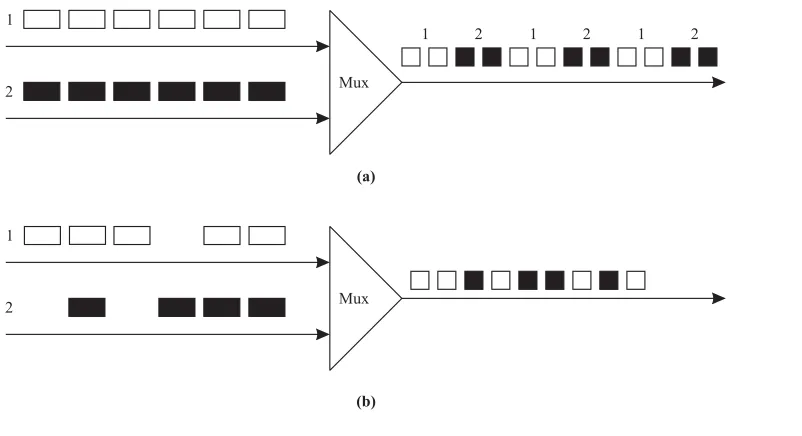
and packet-switched. Figure 1.2 illustrates some of the differences in the type of multiplexing used in these cases.
1 2 1 2 1 2
(a)
(b)
1
2
1
2
Mux
Mux
Figure 1.2 Different types of time division multiplexing: (a) fixed, (b) statistical.
than the link bandwidth. The most common example of a circuit-switched network is the public-switched telephone network (PSTN), which provides a nailed-down connection to end users with a fixed amount of bandwidth (typically around 4 kHz) once the connection is established. This circuit is converted to a digital 64 kb/s circuit at the carrier central office. This network was designed to support voice streams and does a fine job for this application.
The circuit-switched services offered by carriers today include circuits at a variety of bit rates, ranging from 64 kb/s voice circuits all the way up to several Gb/s. These connections are typically leased by a carrier to its customers and remain nailed down for fairly long periods, ranging from several days to months to years as the bandwidth on the connection goes up. These services are also calledprivate lineservices. The PSTN fits into this category with one important difference—in the PSTN, users dial up and establish connections between themselves, whereas with private line services, the carrier usually sets up the connection using a management system. This situation is changing, and we will no doubt see users dialing for higher-speed private lines in the future, particularly as the connection durations come down.
a steady rate. When the user pauses, there is no traffic. Another example is Web browsing. When a user is looking at a recently downloaded screen, there is almost no traffic. When she clicks on a hyperlink, a new page needs to be downloaded as soon as possible from the network. Thus a bursty stream requires a lot of bandwidth from the network whenever it is active and very little bandwidth when it is not active. It is usually characterized by anaveragebandwidth and apeakbandwidth, which correspond to the long-term average and the short-term burst rates, respectively. In a circuit-switched network, we would have to reserve sufficient bandwidth to deal with the peak rate, and this bandwidth would be unused a lot of the time.
Packet switching was invented to deal with the problem of tranporting bursty data traffic efficiently. In packet-switched networks, the data stream is broken up into small packets of data. These packets are multiplexed together with packets from other data streams inside the network. The packets are switched inside the network based on their destination. To facilitate this switching, a packet header is added to the payload in each packet. The header carries addressing information, for example, the destination address or the address of the next node in the path. The intermediate nodes read the header and determine where to switch the packet based on the information contained in the header. At the destination, packets belonging to a particular stream are received, and the data stream is put back together. The predominant example of a packet-switched network is the Internet, which uses the Internet Protocol (IP) to route packets from their source to their destination.
Packet switching uses a technique calledstatistical multiplexingwhen multiplex-ing multiple bursty data streams together on a link. Since each data stream is bursty, it is likely that at any given time only some streams are active and others are not. The probability that all streams are active simultaneously is quite small. Therefore the bandwidth required on the link can be made significantly smaller than the bandwidth that would be required if all streams were to be active simultaneously.
is called a datagramservice. This leads to even more variations in the delays expe-rienced by different packets and also forces the higher-layer transport protocol to resequence packets that arrive out of sequence at their destinations.
Thus, traditionally, such a packet-switched network provides what is called best-effortservice. The network tries its best to get data from its source to its destination as quickly as possible but offers no guarantees. This is indeed the case with much of the Internet today. Another example of this type of service isframe relay.Frame relay is a popular packet-switched service provided by carriers to interconnect corporate data networks. When a user signs up for frame relay service, she is promised a certain average bandwidth over time but is allowed to have an instantaneous burst rate above this rate, though without any guarantees. In order to ensure that the network is not overloaded, the user data rate may be regulated at the input to the network so that the user does not exceed her committed average bandwidth over time. In other words, a user who is provided a committed rate of 64 kb/s may send data at 128 kb/s on occasion, and 32 kb/s at other times, but will not be allowed to exceed the average rate of 64 kb/s over a long period of time.
This best-effort service provided by packet-switched networks is fine for a number of applications, such as Web browsing and file transfers, which are not highly delay-sensitive applications. However, applications such as real-time video or voice calls cannot tolerate random packet delays. Therefore, a great deal of effort is being made today to design packet-switched networks that can provide some guarantees on the
quality of servicethat they offer. Examples of quality of service (QoS) may include certain guarantees on the maximum packet delay as well as the variation in the delay, and guarantees on providing a minimum average bandwidth for each connection. The Internet Protocol has also been enhanced to provide similar services. Most of these QoS efforts rely on the notion of having a connection-oriented layer. For example, in an IP network, multiprotocol label switching (MPLS) provides virtual
circuits to support end-to-end traffic streams. A virtual circuit forces all packets belonging to that circuit to follow the same path through the network, allowing better allocation of resources in the network to meet certain quality-of-service guarantees, such as bounded delay for each packet. Unlike a real circuit-switched network, a virtual circuit does not provide a fixed guaranteed bandwidth along the path of the circuit due to the fact that statistical multiplexing is used to multiplex virtual circuits inside the network.
1.2.1
The Changing Services Landscape
capacity from 155 Mb/s to 2.5 Gb/s and even 10 Gb/s. Note that in many cases, a carrier’s customer is another carrier. The so-called carrier’s carrier essentially delivers bandwidth in large quantities to interconnect other carriers’ networks. Also, because of increased competition and customer demands, carriers now need to be able to deliver these connections rapidly in minutes to hours rather than days to months, once the bandwidth is requested. Moreover, rather than signing up for contracts that range from months to years, customers would like to sign up for much shorter dura-tions. It is not unthinkable to have a situation where a user leases a large amount of bandwidth for a relatively short period of time, for example, to perform large back-ups at certain times of the day, to handle special events, or to deal with temporary surges in demands.
Another aspect of change has to do with theavailabilityof these circuits, which is defined as the percentage of time the service is available to the user. Typically, carriers provide 99.999% availability, which corresponds to a downtime of less than 5 minutes per year. This in turn requires the network to be designed to provide very fast restoration of service in the event of failures such as fiber cuts, today in about 50 ms. Although this will remain true for a subset of connections, other connections carrying data may be able to tolerate higher restoration times. Some connections may not need to be restored at all by the carrier, with the user dealing with rerouting traffic on these connections in the event of failures. Very fast restoration is usually accomplished by providing full redundancy—half the bandwidth in the network is reserved for this purpose. We will see in Chapter 9 that more sophisticated techniques can be used to improve the bandwidth efficiency but usually at the cost of slower restoration times.
Thus carriers in the new world need to deploy networks that provide them with the flexibility to deliver bandwidth on demandwhenneeded,whereneeded, with the appropriate service attributes. The “where needed” is significant because carriers can rarely predict the location of future traffic demands. As a result, it is difficult for them to plan and build networks optimized around specific assumptions on bandwidth demands.
1.3
Optical Networks
Optical networks offer the promise to solve many of the problems we have discussed. In addition to providing enormous capacities in the network, an optical network provides a common infrastructure over which a variety of services can be delivered. These networks are also increasingly becoming capable of delivering bandwidth in a flexible manner where and when needed.
Optical fiber offers much higher bandwidth than copper cables and is less suscep-tible to various kinds of electromagnetic interferences and other undesirable effects. As a result, it is the preferred medium for transmission of data at anything more than a few tens of megabits per second over any distance more than a kilometer. It is also the preferred means of realizing short-distance (a few meters to hundreds of meters), high-speed (gigabits per second and above) interconnections inside large systems.
Optical fibers are widely deployed today in all kinds of telecommunications net-works. The amount of deployment of fiber is often measured insheathmiles. Sheath miles is the total length of fiber cables, where each routein a network comprises many fibercables.For example, a 10-mile-long route using three fiber cables is said to have 10 route miles and 30sheath(cable) miles. Each cable contains manyfibers.
If each cable has 20 fibers, the same route is said to have 600 fiber miles. A city or telecommunications company may present its fiber deployment in sheath miles; for example, a metropolitan region may have 10,000 fiber sheath miles. This is one way to promote a location as suitable for businesses that develop or use information technology.
When we talk about optical networks, we are really talking about two gener-ations of optical networks. In the first generation, optics was essentially used for transmission and simply to provide capacity. Optical fiber provided lower bit error rates and higher capacities than copper cables. All the switching and other intelligent network functions were handled by electronics. Examples of first-generation optical networks are SONET (synchronous optical network) and the essentially similar SDH (synchronous digital hierarchy) networks, which form the core of the telecommu-nications infrastructure in North America and in Europe and Asia, respectively, as well as a variety of enterprise networks such as Fibre Channel. We will study these first-generation networks in Chapter 6.
1
2
N
Bb/s
NBb/s
TDM or OTDM mux
1
1
2
2
N
N Bb/s
Bb/s
WDM mux
l1
l1
l2
l2
lN
lN
...
...
...
(a)
(b)
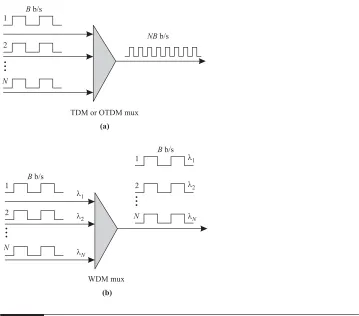
Figure 1.3 Different multiplexing techniques for increasing the transmission capacity on an optical fiber. (a) Electronic or optical time division multiplexing and (b) wavelength division multiplexing. Both multiplexing techniques take inNdata streams, each ofBb/s, and multiplex them into a single fiber with a total aggregate rate ofNBb/s.
1.3.1
Multiplexing Techniques
multiplexer typically interleaves the lower-speed streams to obtain the higher-speed stream. For example, it could pick 1 byte of data from the first stream, the next byte from the second stream, and so on. As an example, sixty four 155 Mb/s streams may be multiplexed into a single 10 Gb/s stream. Today, the highest transmission rate in commercially available systems is 40 Gb/s TDM technology. To push TDM technology beyond these rates, researchers are working on methods to perform the multiplexing and demultiplexing functionsoptically.This approach is calledoptical time division multiplexing (OTDM). Laboratory experiments have demonstrated the multiplexing/demultiplexing of several 10 Gb/s streams into/from a 250 Gb/s stream, although commercial implementation of OTDM is not yet viable. We will study OTDM systems in Chapter 12. However, multiplexing and demultiplexing high-speed streams by itself is not sufficient to realize practical networks. We need to contend with the various impairments that arise as these very high-speed streams are transmitted over a fiber. As we will see in Chapters 5 and 13, the higher the bit rate, the more difficult it is to engineer around these impairments.
Another way to increase the capacity is by a technique calledwavelength division multiplexing(WDM). WDM is essentially the same as frequency division multiplex-ing (FDM), which has been used in radio systems for more than a century. For some reason, the termFDMis used widely in radio communication, but WDM is used in the context of optical communication, perhaps because FDM was studied first by communications engineers and WDM by physicists. The idea is to transmit data si-multaneously at multiple carrier wavelengths (or, equivalently, frequencies or colors) over a fiber. To first order, these wavelengths do not interfere with each other pro-vided they are kept sufficiently far apart. (There are some undesirable second-order effects where wavelengths do interfere with each other, and we will study these in Chapters 2 and 5.) Thus WDM provides virtual fibers, in that it makes a single fiber look like multiple “virtual” fibers, with each virtual fiber carrying a single data stream. WDM systems are widely deployed today in long-haul and undersea networks and are being deployed in metro networks as well.
1.3.2
Second-Generation Optical Networks
Optics is clearly the preferred means of transmission, and WDM transmission is widely used in networks. Optical networks are capable of providing more func-tions than just point-to-point transmission. Major advantages are to be gained by incorporating some of the switching and routing functions that were performed by electronics into the optical part of the network. For example, as data rates get higher and higher, it becomes more difficult for electronics to process data. Suppose the elec-tronics must process data in blocks of 70 bytes each (e.g., a small Ethernet packet). In a 100 Mb/s data stream, we have 5.6μs to process a block, whereas at 10 Gb/s, the same block must be processed within 56 ns. In first-generation networks, the electronics at a node must handle not only all the data intended for that node but also all the data that is being passed through that node on to other nodes in the network. If the latter data could be routed through in the optical domain, the burden on the underlying electronics at the node would be significantly reduced. This is one of the key drivers for second-generation optical networks.
OLT
OADM
OXC
l1 l1
l1
l1
l2
l2
l2
Lightpath A
B
C D
E F
X IP
router
IP router IP
router IP
router SONET
terminal
SONET terminal
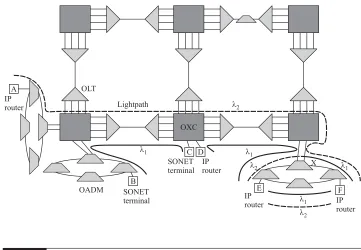
Figure 1.4 A WDM wavelength-routing network, showing optical line terminals (OLTs), optical add/drop multiplexers (OADMs), and optical crossconnects (OXCs). The network provides lightpaths to its users, which are typically IP routers or SONET terminals.
The key network elements that enable optical networking are optical line ter-minals(OLTs),optical add/drop multiplexers(OADMs), andoptical crossconnects
Optical networks based on the architecture described above are already being deployed. OLTs have been widely deployed for point-to-point applications. OADMs are now used in long-haul and metro networks. OXCs are beginning to be deployed first in long-haul networks because of the higher capacities in those networks.
1.4
The Optical Layer
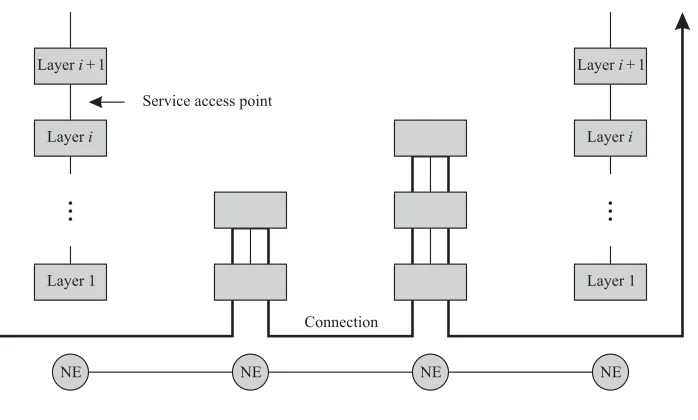
Before delving into the details of the optical layer, we first introduce the notion of a layered network architecture. Networks are complicated entities with a variety of different functions being performed by different components of the network, with equipment from different vendors all interworking together. In order to simplify our view of the network, it is desirable to break up the functions of the network into different layers, as shown in Figure 1.5. This type of layered model was proposed by the International Standards Organization (ISO) in the early 1980s. Imagine the layers