UNIVERSIT `A DEGLI STUDI DI TRENTO Dipartimento di Matematica
DOTTORATO DI RICERCA IN MATEMATICA XXV CICLO
A thesis submitted for the degree of Doctor of Philosophy
Giovanni Franzina
Existence, Uniqueness, Optimization
and Stability for low Eigenvalues
of some Nonlinear Operators
Supervisor:
Existence, uniqueness, optimization
and stability for low eigenvalues
of some nonlinear operators
Ph.D. Thesis Giovanni Franzina
November 12th, 2012
Members of the jury: Lorenzo Brasco – Universit´e Aix-Marseille
Filippo Gazzola – Politecnico di Milano
Peter Lindqvist – Norwegian Institute of Technology
Francesco Serra Cassano – Universit`a di Trento
Creative Commons License
Contents
Introduction v
Chapter 1. Basic preliminaries on nonlinear eigenvalues 1
1. Differentiable functions 1
2. Constrained critical levels and eigenvalues 4
3. Existence of eigenvalues: minimization and global analysis 6 4. Existence of eigenvalues for variational integrals 19 Chapter 2. Classical elliptic regularity for eigenfunctions 25
1. L∞ bounds 25
2. H¨older continuity of eigenfunctions 30
Chapter 3. Hidden convexity for eigenfunctions and applications 35
1. Hidden convexity Lemma 35
2. Uniqueness of positive eigenfunctions 39
3. Uniqueness of ground states 43
4. Uniqueness of positive fractional eigenfunctions 45
Chapter 4. Spectral gap 49
1. A Mountain Pass lemma 49
2. Low variational eigenvalues on disconnected domains 54
3. The Spectral gap theorem 56
Chapter 5. Optimization of low Dirichlet p-eigenvalues 61
1. Faber-Krahn inequality 63
2. The Hong-Krahn-Szego inequality 65
3. The stability issue 66
4. Extremal cases: p= 1 and p=∞ 70
5. Sharpness of the estimates: examples and open problems 73 Chapter 6. Optimization of a nonlinear anisotropic Stekloff p-eigenvalue 76 1. The Stekloff spectrum of the pseudo p-Laplacian 76
2. Existence of an unbounded sequence 79
3. The first nontrivial eigenvalue 81
4. Halving pairs 86
iv CONTENTS
5. An upper bound for σ2,p 89
Chapter 7. Anisotropic weighted Wulff inequalities 93
1. Basics on convex bodies 93
2. Differentiation of norms 93
3. Weighted Wulff Inequalities 94
4. Stability issues 98
Chapter 8. An eigenvalue problem with variable exponents 101
1. Preliminaries 101
2. The Euler Lagrange equation 104
3. Passage to infinity 111
4. Local uniqueness 115
5. Discussion about the one-dimensional case 121
Appendix A. Elementary inequalities in RN 125
1. The case p≥2 125
2. The case 1 < p <2 125
3. A useful compactness criterion 128
Introduction
This thesis is devoted to introduce and discuss the most noteworthy features of what it will be referred to as a nonlinear eigenvalue. A ultimate definition of such a mathematical object lacks in the literature, and may be missing also in the future. In fact, despite looking as acontradictio in terminis(“eigentheories” are all-linear theories), the vague idiomatic ex-pression ofnonlinear eigenvaluedoes however arise naturally from the variational viewpoint. During the last decades, non-linear eigenvalue problems captured the interest of several re-searchers from different areas of mathematical analysis. The model problem is driven by the so-called p-Laplacian, defined by
∆pu:= div |∇u|p−2∇u
for all smooth functions u : RN → R. Note that taking p = 2 one is back to the familiar Laplace operator. Almost all features of a nonlinear eigenvalue problem are encoded in this nonlinear operator, which is singular or degenerate depending on whether p < 2 or p > 2. Several existence, uniqueness and stability results about the p-Laplacian are easily extended to rather general nonliner partial differential equations.
In the thesis, an account is given also of the eigenvalues of some non-local operators. After being studied for a long time in potential theory and harmonic analysis, fractional operators defined via singular integrals are riveting attention since equations involving the fractional Laplacian or similar nonlocal operators naturally surface in several applications.
A great attention in the thesis is devoted to carefully define a suitable notion of eigen-values when the exponent itself p is replaced by a function p(x). The definition of p(x )-eigenvalues seems to be new. The viscosity theory for second order differential equations allows one to study the asymptotic behaviour ofp(x)-eigenvalues asp(x) approaches a “vari-able infinity”∞(x). This passage to infinity is accomplished replacing the variable exponent by jp(x) and sending j → ∞. The limit problem is identified, and it has a nice geometric interpretation.
Owing to the importance of superposition principles in nature, the eigenvalues of linear second order elliptic operators appear in areas of mathematical physics ranging from classical to quantum mechanics. For example, the normal modes in the small oscillations near stable equilibria are determined by eigenvalues. Furthermore, in a quantum system the eigenvalues of Schr¨odinger operator represent the possible energy levels. Linear eigenvalues also play a
vi INTRODUCTION
crucial role for a better understanding of qualitative properties and long time behaviour of solutions to several partial differential equations governing many physical phaenomena.
A model case of elliptic linear eigenvalue problem is given by the celebrated Helmholtz equation
−∆u=λu, in Ω,
with the Dirichlet conditions u = 0 on the boundary ∂Ω of the open set Ω ⊂ RN. The eigenvalues, i.e. the numbers λ such that the above problem is solvable, are the critical values of the Dirichlet integral
Z
Ω|∇
u|2dx subject to the constraint
Z
Ω
u2dx= 1.
Reading the other way round, by computing the first variation of the Rayleigh quotient
Z
Ω|∇
u|2dx
Z
Ω
u2dx
one ends up with an eigenvalue problem for the linear Laplace operator −∆. Note that eigenfunctions can be multiplied by constants. In addition to that, the equation is also additive. The linearity is due to the quadratic growth in the integrals. If the square is replaced by a different power the linearity is destroyed. Nonetheless the homogeneity is preserved.
The fact that the eigenfunctions may be multiplied by constants is an expedient feature of the eigenvalue problems. Despite being non-linear, the problems considered in this thesis do however satisfy this property. LetH(x, z) be convex, even and positively homogeneous of degree p > 1 in the variable z ∈RN. Then, the critical values λ of the variational integrals
Z
Ω
H(x,∇u)dx
subject to the constraint Z Ω|
u|pdx= 1 are the numbers λ such that the Euler-Lagrange equation
−1
pdiv ∇zH(x∇u)
=λ|u|p−2u, in Ω,
INTRODUCTION vii
so does cu. Thus the critical values λ of the quotient
Z
Ω
H(x,∇u(x))dx
Z
Ω|
u(x)|pdx
will be called eigenvalues. The corresponding critical points solve the Euler-Lagrange equa-tion and they are said to beeigenfunctions. The same names are used for critical values and critical points of the quotient if the Dirichlet integral is replaced by the double integral
Z Z
RN×RN
|u(y)−u(x)|pK(x, y)dx dy
where K(x, y) is some convolution kernel that makes the integral meaningful. In that case the (weak) Euler-Lagrange equation reads
Z Z
RN RN
|u(y)−u(x)|p−2(u(y)−u(x))(ϕ(y)−ϕ(x))K(x, y)dx dy=λ
Z
Ω|
u(x)|p−2u(x)ϕ(x)dx.
When p = 2, a suitable choice of the kernel leads to the eigenvalue problem for the linear operator formally definded by
−(−∆)su(x) =Cs,N
Z
RN
u(x+y) +u(x−y)−2u(y)
|y|N+2s dy,
where CN,s is some normalization constant. This is called the fractional s-Laplacian. For
some accounts about the integro-differential equation involving this non-local operator, the interested reader is referred to the survey [F3] written with Enrico Valdinoci.
Basic preliminaries on nonlinear eigenvalues. It is well known that the Dirichlet Laplace operator admits infinitely many eigenvalues
0< λ1 ≤λ2 ≤. . .≤λn→ ∞.
This basically relies on the Rellich compactness Theorem for the embedding of the Sobolev space H1
0(Ω) intoL2(Ω), which makes compact the “resolvent”, i.e. the self-adjoint operator mapping each right hand side f ∈L2(Ω) to the solution u∈H1
0(Ω) of equation
−∆u =f, in Ω,
with Dirichlet boundary conditions on ∂Ω. Hence by spectral theorem the resolvent admits a sequence of eigenvalues µn converging to zero, and the corresponding un’s are in fact
eigenfunctions of −∆ with eigenvalues λn = µ−n1. Moreover, these eigenfunctions give an
Hilbert basis of L2(Ω).
viii INTRODUCTION
case, and tools of nonlinear analysis may be of help. There is no reliable spectral theory for producing a “basis” of eigenfunctions. However, there is a plenty of classical procedures to produce eigenvalues. The first chapter is focused on a well established formula for defining a non-decreasing unbounded sequence of critical values of a convex p-homogeneous functional
F, defined on some Banach space X, along the one-codimensional manifold M =G−1({1}), where G is another convex and p-homogeneous functional on X. Namely, one sets
λn = inf
f maxω F(fω)
for all n∈N. Here ω ranges among all unit vectors inRn and the infimum is performed on the class of all odd continuous mappings ω 7→fω from the unit sphere ofRn toM.
According to the main existence result of Chapter 1, the λn’s are critical values of F
along M provided that the Palais-Smale condition holds, see Theorem 1.3.3. Basically, that compactness condition reads as follows:
F(un)→λ =⇒ un →u strongly
for all sequences such that the differential ofF alongM goes to zero in the cotangent norm. This restriction induces the functional to be strongly coercive along sequences of almost critical points. Very likely, the requirement should be fullfield if some strong monotonocity of the differential holds. Namely, condition
hF′(un)− F′(u), un−ui →0 =⇒ un→u strongly
will do. The convexity ofF gives the pairing a sign, but does not ensure that the above holds. Nevertheless, in the applications the functionals have a nice modulus of strict convexity. That allows to apply the full existence machinery. The results are applied in particular to the case when
F(u,Ω) =
Z
Ω
H(x,∇u)dx, G(u,Ω) =
Z
Ω|
u(x)|pdµ
where µ stands either for the Lebesgue measure of for the (N −1)-dimensional Hausdorff measure of the boundary. In the second case Ω is assumed to be smooth enough and the second integral is understood in the sence of traces.
Classical Elliptic Regularity for eigenfunctions. This chapter is devoted to survey-ing the main achievements of regularity theory that are needed in the thesis. The strong minimum principle for non-negative eigenfunctions u (i.e., either u > 0 or u ≡ 0) is of-ten helpful. That is provided by Harnack inequality, which holds for the eigenfunctions if the integral RΩH(x,∇u) satisfies natural growth conditions. Moreover, the eigenfunctions are H¨older continuous. The first section of the chapter summarizes these classical results. Actually, most eigenvalue problems are solvable in C1,α, the eigenfunctions being analytic
INTRODUCTION ix
Then explicit bounds for the eigenfunctions are provided. This discussion is restricted to the caseH(z) =kzkpwherek·kdenotes the norm associated with a (symmetric) convex body
in RN. Similar bounds hold valid if the Dirichlet integral is replaced by a Gagliardo-type (semi)norm
Z Z
RN×RN
|u(y)−u(x)|p
|y−x|N+sp dxdy
where s ∈(0,1).
Hidden convexity for eigenfunctions and applications. Chapter 3 is based on the paper [F2] written with Lorenzo Brasco. The purpose is that of relating some well-known facts about the positive eigenfunctions of the p-Laplacian to the convexity of the energy functional
t 7−→
Z
Ω
H(x, γt(x))dx
along suitable curves γ : [0,1]→M laying on the level setM of G. Incidentally, such curves are constant speed geodesics for a suitable distance between positive functions belonging to
M (different from the Finsler metric induced by the Sobolev space). In Theorem 3.2.1, this geodesic convexity is used to trivialize the global analysis, proving that the energy functional can not have any critical point, other than its global minimizer on M.
As a byproduct, the only possible eigenfunctions having constant sign are the ones asso-ciated with λ1(Ω). This is a well known result which had been derived in various places for the p-Laplacian
H(z) = |z|p, µ=LN
under different assumptions on the regularity of Ω (see [4, 61, 72] and [79] for example). The most simple and direct proof of this fact was given by Kawohl and Lindqvist ([61]), in turn inspired by [79]. The proof in [61] is based on a clever use of the equation, but it does not clearly display the reason behind such a remarkable result.
The advantage of the viewpoint introduced in the paper [F2] is to reduce those well-known uniqueness results to a convexity-based device which applies to rather general nonlinear eigenvalue problems.
Spectral gap. This chapter focuses on the second variational eigenvalue λ2(Ω) of the
p-Laplacian (and similar nonlinear operators). Theorem 4.3.2 gives a new proof of the existence of a spectral gap: there is no eigenvalue between λ1(Ω) and λ2(Ω). This fact had been originally proved in [73].
Another very classical result in this topic is the so-called Mountain-Pass. Theorem 4.1.3 contains a simple (new) proof of this characterization of the second variational eigenvalue. Namely
λ2(Ω) = inf
γ maxu∈γ
Z
Ω
x INTRODUCTION
where γ ranges among all continuous paths onM connecting the first eigenfuction u1 to its opposite function −u1. For the p-Laplacian, this formula is due to [32].
Then the attention is turned to λ2(Ω) in the case when Ω is a disconnected set. In this case, the eigenvalues on the domain are obtained by gathering the eigenvalues on the single connected components. Note that the first eigenvalue may be multiple (for example, that is the case if Ω consists of two equal balls) or simple (think of two disjoint balls with different radii). In the second case, it turns out that
λ2(Ω) = min
n
λ > λ1(Ω) : λ is an eigenvalue
o
.
This is proved in Theorem 4.1.3. Some care is taken about the consistency of the well-posedness of the minimum. On the contrary, according to Theorem 4.3.3, if the first eigen-value is multiple then the second variational eigeneigen-value “collapses” on the first one.
Optimization of low Dirichlet p-eigenvalues. This chapter concerns the stability of optimal shapes for the second variational eigenvalue of thep-Laplacian. The results reported were obtained in collaboration with Lorenzo Brasco in the paper [F5]. A quantitative version of the so-called Hong-Krahn-Szego inequality for λ2(Ω) is derived in Theorem 5.3.1. As a consequence, the disjoint union of two equal balls is proved to be a stable minimizer for the second variational eigenvalue.
For n≥3, very little is known about the spectral optimization problem of minimizing
(0.0.1) λn(Ω)
among all open sets Ω having a prescribed volume. Here λn(Ω) is the n−th variational
Dirichlet eigenvalue of the p−Laplace operator. Even in the linear case p = 2, existence, regularity and characterization of optimal shapes for a problem like (0.0.1) are still open issues. Concerning the existence, a general (positive) answer has been given only very recently, independently by Bucur [21] and Mazzoleni and Pratelli [76].
On the contrary, the solutions to the problems (0.0.2) min{λ1(Ω) :|Ω|=c}
and
(0.0.3) min{λ2(Ω) : |Ω|=c}
are well-known. Under the volume constraint, the first eigenvalue is uniquely minimized by the ball of volume c. This is the Faber-Krahn inequality
INTRODUCTION xi
The second problem is uniquely solved by the union of two disjoint balls of the same volume1. That amounts to say that inequality
(0.0.5) |Ω|p/Nλ2(Ω)≥2p/N|B|p/Nλ1(B)
holds for all open set Ω of finite measure. In the linear case p = 2, This “isoperimetric” property of balls has been discovered (at least) three times: first by Edgar Krahn ([64]) in the ’20s, but then the result has been probably neglected, since in 1955 George P´olya attributes this observation to Peter Szego (see the final remark of [83]). However, almost in the same years as P´olya’s paper, there appeared the paper [56] by Imsik Hong, giving once again a proof of this result. It has to be noticed that Hong’s paper appeared in 1954, just one year before P´olya’s one. For this reason, (0.0.5) is referred to as the Hong-Krahn-Szego inequality.
The chapter then addresses some stability issues. Roughly speaking, a positive answer to the question
λn(Ω) ∼= optimal
?
=⇒ Ω∼= optimal is given for n = 1,2. Once the optimal shape Ω∗
n is known, that can be accomplished by
proving estimates of the type
|Ω|p/Nλ
n(Ω)− |Ω∗n|p/Nλn(Ω∗n)≥Φ(d(Ω,On)),
where d(·,On) is a suitable “distance” from the “manifold” On of optimizers (open sets having the same shape as Ω∗
n) and Φ is some continuous strictly increasing function, with
Φ(0) = 0.
Given an open set Ω⊂RN having |Ω|<∞, its Fraenkel asymmetryis defined by
A(Ω) = inf
k1Ω−1BkL1
|Ω| : B is a ball such that|B|=|Ω|
.
This is a scaling invariant quantity such that 0 ≤ A(Ω) < 2, with A(Ω) = 0 if and only if Ω coincides with a ball, up to a set of measure zero. Note that the Fraenkel asymmetry may be regarded to as an L1 distance from the set of balls. A quantitative version of the Faber-Krahn inequality (0.0.4) in terms of A is provided in the paper [49] by Fusco, Maggi and Pratelli and reads as follows
|Ω|p/Nλ1(Ω) ≥ |B|p/N 1 +C
N,pA(Ω)2+p
.
In the planar case, the quantitative Faber-Krahn inequality was proved previously by Bhat-tacharya in his paper [14] with the better exponent 3. Moreover, for convex sets Melas [75] 1On assuming an additional convexity constraint, the problem has been conjectured by Troesch [88] to be
solved by the convex envelope of the two balls, calledstadium. That in fact is false, which was first proved by Henrot and Oudet [55]. For a proof of this fact based on over-determined problems, see [43]. In fact in the
planar case the minimizer contains no arc of circle: according to [68], the sharp regularity of the minimizer
xii INTRODUCTION
had also provided a similar result. His estimate was given in terms of the Hausdorff asym-metry, a sort of L∞ distance, which is natural under the convexity constraint. For the linear
Laplace operator, another proof was given by Hansen and Nadirashvili [52]. Eventually, the quantitative estimate for the second eigenvalue of the Laplacian was also proved by some probabilists (see Sznitman [86] for the planar case and Povel [84] in higher dimensional spaces).
In the case of the Hong-Krahn-Szego inequality, the relevant notion of asymmetry is the Fraenkel 2−asymmetry, introduced in [19]. It is defined for all open sets Ω of finite measure by setting
A2(Ω) = inf
k1Ω−1B1∪B2kL1
|Ω| : B1, B2 balls such that |B1∩B2|= 0, |Bi|= |Ω|
2 , i= 1,2
.
Then in Theorem 5.3.1 the following quantitative estimate
|Ω|p/Nλ2(Ω)≥2p/N|B|p/Nλ1(B) [1 +CN,pA2(Ω)κ2],
is proved. The exponent κ2 depends on the dimension and on the sharp exponent κ1 for the quantitative Faber-Krahn inequality. The analysis covers the whole range of p. Indeed, the same proof can be adapted to cover the cases p = 1 and p = ∞ as well, when λ2 becomes the second Cheeger constant and thesecond eigenvalue of the ∞−Laplacian, respectively.
Optimization of a nonlinear p-Stekloff eigenvalue. This chapter reports some re-sults obtained in collaboration with Lorenzo Brasco in the paper [F4] about the optimization of the first nontrivial eigenvalue σ2,p(Ω) of the so-called pseudop−Laplacian operator
e
∆pu:= N
X
i=1
∂ ∂xi
∂u ∂xi
p−2
∂u ∂xi
!
.
In the linear case p= 2 this operator coincides with the usual Laplacian and σ2(Ω) has the value of the best constant in the following Poincar´e-Wirtinger trace inequality
cΩ
Z
∂Ω|
u(x)−u∂Ω|2dHN−1 ≤
Z
Ω|∇
u(x)|2dx, u∈W1,2(Ω), where HN−1 stands for the (N −1)−dimensional Hausdorff measure and u
∂Ω denoted the average of the trace of the function uon the boundary.
In analogy with the well-known Dirichlet and Neumann cases (see [54, Chapters 3 and 7]), one may be interested in the spectral optimization problem of maximizing2 σ
2 under volume constraint. A well-known result asserts that the (unique) solutions to this problem are given by balls. This is the so-calledBrock-Weinstock inequality(see [20, 91]). For ease of completeness, it is worth mentioning that Weinstock’s result (valid only in dimensionN = 2) is even stronger, since it asserts that disks are still maximizers among simply connected set of given perimeter. By observing that σ2 scales like a length to the power −1 and that 2On the contrary, it is not difficult to see that the problem of minimizingσ
INTRODUCTION xiii
σ2(BR) = R−1 for a ball of radius R, the Brock-Weinstock inequality can be written in
scaling invariant form as follows
(0.0.6) σ2(Ω) ≤
ωN
|Ω|
1 N
,
where ωN is the measure of the N−dimensional ball of radius 1.
In the non-linear case p 6= 2, the pseudo p-Laplacian is an anisotropic operator, which considerably differs from the more familiar p−Laplacian. Its first non-trivial eigenvalue
σ2,p(Ω) coincides with the best constant in
cΩ
min
t∈R
Z
∂Ω|
u+t|p̺ dHN−1
≤
N
X
i=1
Z
Ω|
uxi|
pdx, u
∈W1,p(Ω).
By adapting Brock’s method of proof (Theorems 6.5.2 and 6.5.3) it follows that
(0.0.7) σ2,p(Ω) ≤
|Bp|
|Ω|
p−1 N
,
where Bp is the N−dimensional ℓp unit ball, i.e. Bp ={x ∈RN : |x1|p+· · ·+|xN|p <1}.
The previous inequality can be seen as a nonlinear counterpart of (6.5.3).
Anisotropic weighted Wulff inequalites. This chapter concerns the weighted anisotropic perimeter discussed in the paper [F4] written with Lorenzo Brasco. Besides recalling some basics about convex geometries in RN, the main result discussed here is the following weighted Wulff inequality
(0.0.8)
Z
∂Ω
V(kxk)kνΩk∗dHN−1 ≥N|K|1/N|Ω| N−1
N V
(|Ω|/|K|)N1
which is proved in Theorem 7.3.4, generalizing the results of [18]. Herek · kandk · k∗ denote
two dual norms, respectively defined as the Minkowski gauge and the support function of a convex body K, whereas νΩ stands for the outward pointing unit normal to the boundary of the Lipschitz set Ω. The function V : R+ → R+ is called the weight. Equality can hold if and only if Ω = K, up to a scaling factor. The proof of (0.0.8) is an adaptation of the calibration technique used in [18]. Under suitable additional assumptions on the regularity of the weight, Theorem 7.4.1 provides a quantitative version of the above anisotropic weighted Wulff inequality, which reads as follows:
Z
∂Ω
V(kxk)kνΩk∗dHN−1 ≥Nω
1 N
K,N|Ω|1−
1 N
"
V
|Ω|
ωK,N
1 N
+CN,V,|Ω|
|Ω∆(TΩK)|
|Ω|
2#
,
xiv INTRODUCTION
An eigenvalue problem with variable exponents. The last chapter concerns the eigenvalue problem introduced in collaboration with Peter Lindqvist in the recent paper [F6] about the minimization of the “Rayleigh quotient”
(0.0.9) k∇ukp(x),Ω
kukp(x),Ω
among all functions belonging to the Sobolev space W01,p(x)(Ω) with variable exponent p(x). The norm is the so-called Luxemburg norm.
If p(x) = p, a constant in the range 1< p < ∞, one reduces to the eigenvalue problem for the Dirichlet p-Laplacian. It is decisive that homogeneity holds: if u is a minimizer, so is cufor any non-zero constant c. On the contrary, the quotient
(0.0.10)
Z
Ω|∇
u|p(x)dx
Z
Ω|
u|p(x)dx
with variable exponent does not possess this expedient property, in general. Therefore its infimum over all ϕ ∈ C∞
0 (Ω), ϕ 6≡ 0, is often zero and no mimizer appears in the space
W01,p(x)(Ω), except the trivial ϕ ≡ 0, which is forbidden. For an example, see [42, pp. 444–445]. A way to avoid this collapse is to impose the constraint
Z
Ω|
u|p(x)dx = constant.
Unfortunately, in this setting the minimizers obtained for different normalization constants are difficult to compare in any reasonable way, except, of course, when p(x) is constant. For a suitable p(x), it can even happen that any positive λ is an eigenvalue for some choice of the normalizing constant. Thus (0.0.10) is not the proper generalization of the eigenvalue problem for the p-Laplacian to the case of a variable exponent.
A way to avoid this situation is to use the Rayleigh quotient (0.0.9), where the notation (0.0.11) kfkp(x),Ω= inf
(
γ >0 :
Z
Ω
f(x)
γ
p(x)
dx p(x) ≤1
)
was used for the Luxemburg norm. This restores the homogeneity. In the integrand, the use of p(x)−1dx (rather than p(x)) has no bearing, but it simplifies the equations a little. The existence of minimizers follows easily by the direct method in the Calculus of Variations. The Euler-Lagrange equation is obtained by computing the first variation of the Luxembourg norms and reads
(0.0.12) div ∇u
K
p(x)−2
∇u K
!
+ K
k S
uk
p−2u
INTRODUCTION xv
where the K, k, S are constants depending on u.
Then the passage to infinity is accomplished so that p(x) is replaced by jp(x), j = 1,2,3. . . The viscosity theory for second order equations allows one to identify the limit equation which is
(0.0.13) max
Λ∞− |∇ u|
u , ∆∞(x)
u
K
= 0,
where
(0.0.14) K =k∇uk∞,Ω, Λ∞=
1
maxx∈Ωdist(x, ∂Ω) and
(0.0.15) ∆∞(x)v =
n
X
i,j=1
∂v ∂xi
∂v ∂xj
∂2v
∂xi∂xj
+|∇v|2 ln |∇v|∇v,∇lnp.
For a constant exponent, this has been treated first in [59] (see also [60, 58, 27]). An interesting interpretation in terms of optimal mass transportation is given in [28]. According to a recent manuscript by Hynd, Smart and Yu, there are domains such that there can exist several linearly independent positive eigenfunctions, see [57]. Thus the eigenvalue Λ∞ is not
always simple.
If Λ∞is given the value (0.0.14), the same as for a constant exponent, then the existence of
a non-trivial solution is guaranteed. A local uniquenessresult also holds, cf. Theorem 8.4.4. Namely, in a sufficiently interior domain the solution cannot be perturbed continuously.
CHAPTER 1
Basic preliminaries on nonlinear eigenvalues
If X is a normed vector space, X∗ will denote the strong dual space, consisting of all
the linear functionals on X that are continuous with respect to the topology induced on X
by the norm and h ·, · i will denote the duality pairing between X and X∗. If Y is another
normed space, then L(X, Y) will stand for the space of all continuous linear mappings from
X to Y.
1. Differentiable functions
Let (X,k · kX) and (Y,k · kY) be two normed vector spaces,A⊂X, uan interior point of
A and v ∈X. Thedirectional derivative of a functionJ :A →Y atu along the directionv
is defined by
∂vJ(u) = lim t→0
J(u+tv)− J(u)
t ,
provided the limit exists in Y.
The function J is said to be(Fr´echet) differentiable atuif there exists a continuous and linear mapping L∈ L(X, Y) such that the limit
(1.1.1) lim
h→0
J(u+h)− J(u)−L(h)
khkX
= 0
holds in Y. If there exists such a linear functionL, then it is uniquely determined, is denoted
L=J′(u),
and is said to be the (Fr´echet) differentialof J atu. Moreover,
kJ(u+h)− J(u)kY ≤ kL(h)kY +o(khkX),
as h→0 in Y and J is continuous at u.
The function J is called Gˆateaux differentiable at u if there exists a linear mapping
T ∈ L(X, Y) such that the limit
(1.1.2) lim
ε→0
J(u+εv)− J(u)
ε =T(v)
holds in Y. If there exists such a linear mapping T, then it is unique, we denote it by
T =DJ(u),
2 1. BASIC PRELIMINARIES ON NONLINEAR EIGENVALUES
and we call it the Gˆateaux differentialof J at u. Moreover,
kJ(u+εv)− J(u)kY ≤εkT(v)kY +o(ε),
as ε→0 and J is continuous along all the straight lines passing through u.
Clearly, if J is differentiable then it is Gˆateaux differentiable and the two differentials coincide, that is
DJ(u)[v] =J′(u)(v),
for all v ∈ X, but the converse does not hold. For example, allthough the functional
J :X →Rdefined byJ(u) =kuk2sin(1/kuk2), ifu6= 0, and J(0) = 0 is not differentiable at the origin, all its directional derivatives at the origin do however exists and and depend linearly on the direction (in fact, they are all equal to zero).
Of course, if J is Gˆateaux differentiable at uthen there exists the derivative of J along all directions, and one has
∂vJ(u) =DJ(u)[v],
for all v ∈ X. Again, the converse does not hold, since the map v 7→ ∂vJ(u), which is
always homogeneous, may fail to be additive, even if there exists the directional derivative of J along all directions. For example, the directional derivative ∂uJ(0) of an odd and
positively 1-homogeneous functional J : X → R equals the value J(u) that the functional takes at u, hence its dependance on u must not be linear as soon as the functional itself is nonlinear in u.
It is worth recalling that any linear mapping from X to Y such that (1.1.1) holds is automatically continuous. Indeed,
L(v) =J(u+v)− J(u) +o(kvkX),
as v → 0 in X. Thus, by the continuity at u of J, L is continuous at the origin. Being
L linear, the continuity of L follows. On the contrary, if X is infinite-dimensional, a linear mapping T from X toY may well fail to depend continuously on v even if (1.1.2) holds.
We recall a sort of mean value property holds for the functions admitting directional derivatives. Namely, if there exists the directional derivative of J at the point u along the direction v then the inequality
(1.1.3) kJ(u+tv)− J(u)kY ≤t sup s∈[0,t]k
∂vJ(u+sv)kY,
holds for all t ≥ 0. One can employ (1.1.3) to prove the following criterion for the Fr´echet differentiability of functions, which is of remarkable use.
Proposition 1.1.1. Let X, Y be normed spaces, A ⊂X, u an interior point of A, and let
J :A→Y be Gˆateaux differentiable in a neighborhood ofu inX. If the Gˆateaux differential
DJ is continuous at u, then J is Fr´echet differentiable at u.
Proof. The proof is standard. For every s∈[0,1], the function
1. DIFFERENTIABLE FUNCTIONS 3
is Gˆateaux differentiable in a neighborhood of the origin sufficiently small, and
∂wRs(v) =s ∂wJ(u+sv)−∂wJ(u)
,
for all w∈X, provided kvkX is small enough. Note that
Rt(sv) = Rts(v),
for all t∈[0,1]. Thus, sinceR1(0) = 0, by (1.1.3) it follows that
kR1(v)kY ≤ sup s∈[0,1]k
∂vR1(sv)kY = sup s∈[0,1]k
∂vRs(v)kY
≤ sup
s∈[0,1]
s·∂vJ(u+sv)−∂vJ(u)
Y
≤ sup
s∈[0,1]
s· kDJ(u+sv)−DJ(u)kL(X,Y)kvkX
≤ sup
s∈[0,1]k
DJ(u+sv)−DJ(u)kL(X,Y)kvkX,
provided kvkX is sufficiently small. Since DJ is continuous at u,
kDJ(u+sv)−DJ(u)kL(X,Y) ≤2 max
kwkX≤εkDJ(u+w)kL(X,Y)<+∞,
provided ε is small enough. Thus, the above implies lim
kvkX→0
kR1(v)kY
kvkX
= 0,
which is precisely the Fr´echet differentiability of J atu.
Let X, Y be normed spaces. Recall that
kPkL2(X×X,Y) = sup{kP(u, v)kX :kukX,kvkX ≤1},
defines a norm on the vector space of all continuous mappings from X ×X to Y that are bilinear, that is linear in each variable. By setting
φ(P)(u)(v) =P(u, v), u, v ∈X,
for all P ∈ L(X×X, Y), one defines an isometryφ:L2(X×X, Y)→ L(X,L(X, Y)). LetAbe an open set inX. A differentiable function J fromAtoY be is said to betwice (Fr´echet) differentiable atu ∈A if the function J′ : A→ L(X, Y) is itself differentiable at u. If this is the case, we denote by
J′′(u)
the continuous and bilinear map which is uniquely associated with (J′)′(u) via the isometry
L(X,L(X, Y)) ∼= L2(X ×X, Y) described above. It can be proved that J′′(u), that we
call the second (Fr´echet) differential of J at u, is in fact a symmetric bilinear form. The
n-th (Fr´echet) differentialof a mapping is defined inductively and is a symmetric continuous
4 1. BASIC PRELIMINARIES ON NONLINEAR EIGENVALUES
Let X, Y be normed space and A ⊂ X be an open set. A function J : A → Y is said to be of class Ck on A if its k-th differential is continuous on A. We say that ϕ is a Ck
diffeomorphism with its image if it is one-to-one it is of class Ck with its inverse function.
1.1. Local inversion of differentiable functions. IfX, Y, Z are normed spaces u0 ∈
X, v0 ∈Y and J :X×Y →Z is a function, we denote by JX′ (u0, v0) the differential at u0 of the function u 7→ J(u, v0).
Theorem 1.1.2 (Implicit function theorem). Let X, Y, Z be Banach spaces, A an open subset of X×Y, (u0, v0)∈ A and J : X×Y →Z be a continuous function. Assume that
J′
Y exists and is continuous in A. If the mapping JY′(u0, v0) if an isomorphism fromY to Z then there exist a neighborhood U of u0 in X, a neighborhood V of v0 in Y and a continuous function φ:U → V such that
J−1({0}) = graph(φ).
If, in addition, J is of class Ck then so is φ. If this is the case, then
φ′(u0) =−J′
Y(u0, v0)
−1
◦ J′
X(u0, v0).
Theorem 1.1.3 (Local inversion Theorem). LetX, Y be Banach spaces,Abe an open subset of X, u0 ∈A and J a C1 function from A to Y. IfJ′(u0)is an isomorphism from X to Y, then there exists an open neighborhood U of u0 such that the restriction of J to U is an C1 diffeomorphism with its image V and
(J−1)′(v0) = J′(u0)−1.
We refer to [9] for the proof of the above classical theorems.
2. Constrained critical levels and eigenvalues
A topological space M is said to be aCkBanach manifold modelled on the Banach space
X if there exist a set I, an open covering {Uı}ı∈I of M, a family of closed vector subspaces
Xı of X and a collection of mappings ϕı: Uı → Xı which are homeomorphisms with their
images, such that ϕı(Uı ∩U) is open in X and ϕ ◦ϕ−ı 1 induces a Ck diffeomorphism of
ϕı(Uı∩U) onto ϕ(Uı∩U). The pairs (Uı, ϕı) are called charts.
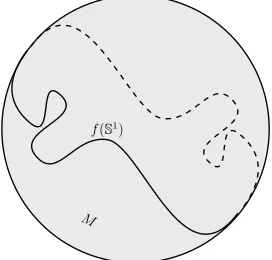
When it happens that all the Xı’s are one-codimensional subspaces of X, M is said
to be a one-codimensional Banach manifold. Since in this Thesis we aim to adress some issues regarding real eigenvalues, which are nothing but critical levels of functionals along one-codimensional manifolds, we restrict ourselves to this case.
Let G :X → R be a C1 functional, such that the topological subspace M of X defined by
(1.2.1) M =u∈X : G(u) = 1 ,
consists of regular points for G, that is Xu = kerG′(u) 6= X, for all u ∈ M. Then M is a
2. CONSTRAINED CRITICAL LEVELS AND EIGENVALUES 5
its point u the vector space
TuM =
n
ϕ∈X :hG′(u), ϕi= 0o,
consisting of all tangent vectors toM atu. That recovers the abstract definition via deriva-tions. Obviously, the norm of X makes the tangent space at ua Banach space. The strong dual of TuM is the cotangent space to M at u and is denoted by Tu∗M. By Hahn-Banach
Theorem, it is isomorphic to a closed vector subspace of X∗ with the norm defined by
kΛk∗ = max
n
Λ, ϕ :ϕ∈TuM, kϕkX = 1
o
,
for all Λ ∈T∗
uM, where h·,·i stands for the natural duality pairing.
If F : X → R is a C1 functional, then its restriction to M is also C1, its differential at a point u ∈ M being nothing but the restriction F′(u)
|TuM of the differential F
′(u). Thus,
a number cis a critical value of F along M if F(u) = cand there exist a point u∈M such that
(1.2.2) hF′(u), ϕi= 0, for all ϕ ∈TuM,
and if this happens u is called a critical point of F along M corresponding to the critical value λ.
By Lagrange multipliers’ rule, a point u ∈ M is a critical point of F along M is such that
(1.2.3) F′(u) =λG′(u),
in X∗ for some real number λ. Indeed, by (1.2.2) the kernel of F′(u) contains the kernel of
G′(u). These differentials are linear mappings. Hence there has to be a number λ such that
the diagram
X R
R
λ G′(u)
F′(u)
is commutative, and (1.2.3) follows.
Let F, G be C1 functionals on a Banach space X. In addition, assume that both the functionals are even and positive homogenous of degree p ≥ 1. Then M = G−1({1}) is a regular one-codimensional manifold in X. Indeed, by the homogeneity it follows that
G′(u), u=pG(u) =p,
6 1. BASIC PRELIMINARIES ON NONLINEAR EIGENVALUES
Definition 1.2.1 (Nonlinear eigenvalues). LetF,GbeC1 even and positively homogeneous functionals of degree p≥1 on the Banach space X, andM =G−1({1}). A real numberλ is said to be an eigenvalue of the pair (F,G) if there exists u∈X\ {0} such that
(1.2.4) hF′(u), vi=λhG′(u), vi,
holds for all v ∈X. If this is the case, then u is called an eigenvector corresponding to λ. Note that eigenvectors and eigenvalues of the pair (F,G) are precisely given by the critical points and critical values F alongM. To see that, note that (1.2.2) holds for all eigenvectors
u ∈ M corresponding to the eigenvalue λ. Conversely, if u ∈ M is a constrained critical point associated with the critical value c, then equation (1.2.4) holds with λ = c. Indeed, there has to be λ such that (1.2.3) holds, and by plugging u=v in, one gets
λ= 1
pλhG ′(u), u
i= 1
phF ′(u), u
i=F(u) =c.
3. Existence of eigenvalues: minimization and global analysis
We discuss the existence of eigenvalues for a pair (F,G) ofC1 functionals which are even and positively homogeneous of degree p >1. Min-max formulae of the type
λn= inf f maxω
F(fω)
G(fω)
play a role. The maximum is taken among all unit vectors ωinRn, whereas f ranges over all odd and continuous mappings ω 7→fω from the unit sphere Sn−1 of Rn into M =G−1({1}).
A mapping f fromSn−1 to M is said to be odd if f−ω =−fω, for all ω ∈Sn−1.
This is a well established method for producing eigenvalues of the pair (F,G). The procedure hardly would deserve a comment. Yet, for sake of completeness we discuss a proof of this existence result in next section 3.1, nonetheless. The λn’s are almost critical levels,
see sections 3.2 and 3.3. The conclusion that they actually are eigenvalues holds provided that a suitable compactness on the almost critical sequences is valid. This is discussed in next section, see Theorem 1.3.3.
3.1. Palais-Smale condition and existence of eigenvalues. We introduce the fol-lowing condition, which dates back to the work of Palais and Smale [81] on the generalized Morse theory.
Definition 1.3.1. Let X be a Banach space, M a one-codimensional C1 regular manifold in X, and Φ be a C1 functional on X.
(i) We call {uk}k∈N ⊂ M a (P S)λ sequence for Φ if
lim
k→∞Φ(uk) =λ, klim→∞kΦ ′(u)
|TuMk∗ = 0,
3. EXISTENCE OF EIGENVALUES: MINIMIZATION AND GLOBAL ANALYSIS 7
Moreover, we say that Φ satisfy the Palais-Smale condition on Mif it satisfies the Palais-Smale condition on Mat any level λ.
Remark 1.3.2. IfX ∼=RmandMis, say, a smooth compact hypersurface, then by Bolzano– Weierstrass Theorem any (P S)λsequence admits a subsequence converging to a critical level.
The same conclusion can be drawn if X ∼= Rm, M is any compact hypersurface, and Φ is bounded by below and coercive. As a matter of fact, if X is infinite dimensional then there may well exist functionals Φ which are coercive, bounded from below and do not satisfy the (PS) condition on some manifold M. For example, the coercive functional
Z
Ω |∇
u| −1p+dx
does not satisfy the Palais-Smale condition on the Lp(Ω) sphere in W1,p
0 (Ω).
The following theorem contains the existence result. This will be applied in Section 4 for producing a sequence of variational eigenvalues of some nonlinear operators.
Theorem 1.3.3. LetX be a uniformly convex Banach space,F,Gbe two even and positively homogeneous C1 functionals of degreee p > 1 on X. For all n ∈ N, denote by V
n the set of
all odd and continuous mappings ω 7→fω from Sn−1 to M =G−1({1}) and set
λn= inf f∈Vn
max
ω∈Sn−1F(fω).
Then, if F satisfies the Palais-Smale condition on M, the λn’s are an increasing divergent
sequence of eigenvalues of the pair (F,G).
The proof of the theorem requires some technical results, that are discussed in next section.
3.2. Deformations and pseudo-gradient vector fields. In order to prove Theo-rem 1.3.3, a standard strategy is that of deforming the sublevels of the functional F in such a way that the values around a noncritical level are suitably lowered down. This would yield a contradiction if the λn’s were regular values. Namely, by deformation we mean the
following.
Definition 1.3.4. A continuous mapping η : M → M is said to be a deformation if it is homotopic to the identity map, namely if there exists a continuous function H: [0,1]×M → M such that
H(0, u) =u, H(1, u) = η(u),
for all u∈M.
8 1. BASIC PRELIMINARIES ON NONLINEAR EIGENVALUES
point u ∈ M, admits a unique solution Φt(u) by the classical Cauchy-Lipschitz theory for
ordinary differential equations. For small t >0, this flow yields the desired deformation. Since here the functional F may well be not sufficiently regular, the technique described above can not be applied. Thus one needs the notion of pseudo-gradient vector field, which seems to be due to Palais [80]. Recall that, in general, by vector field on M it is meant any right inverse of the natural projection
π : [
u∈M
{u} ×TuM →M.
The disjoint union of the tangent spaces to M at its points is called the tangent bundle, is denoted by T M and naturally inherits a Finsler metric structure from M. In fact, a vector field V from M to T M is locally Lipschitz continuous if there exists, for every compact subset K of M, a positive constant LK such that
kV(u)−V(w)kX ≤LKku−wkX,
for all u, w∈K.
Definition 1.3.5. Let Σ consist of all critical points ofF onM. A locally Lipschitz vector field V :M →T M is said to be a pseudo gradient vector field onM for F if
(1.3.1) kV(u)k ≤2kF′(u)|TuMk∗,
D
F′(u), V(u)E≥ kF′(u)|TuMk2∗,
for all u∈M\Σ.
A deformation can be constructed by considering the flow associated with a locally Lip-schitz pseudo-gradient vector field on M, even if the functional F is merely of class C1, see Proposition 1.3.9 below. The existence of pseudo-gradient vector fields being locally Lip-schitz continuous is a little demanding even in the unconstrained case, for which we refer to [8]. However, for sake of completness, we prove the following Lemma. The idea of the proof is to patch all the steep directions tangent toM “pushed” byF′ by a suitable partition
of unity, consisting of locally Lipschitz continuous functions.
Lemma 1.3.6. There exists an odd locally Lipschitz pseudo–gradient vector field on M for
F.
Proof. Letu be a regular point of F on M. Owing to the definition of
kF′(u)
|TuMk∗ = sup
n
hF′(u), vi:v ∈T
uM,kvkX = 1
o
,
there exists v ∈TuM such that kvkX = 1 and
(1.3.2) 2
3kF
′(u)
|TuMk∗ <hF ′(u), v
i.
Note that the right hand side in (1.3.2) changes sign if u is replaced by −u. Indeed, the differential F′ is odd, since the functional F is even. Therefore, there exists an odd vector
3. EXISTENCE OF EIGENVALUES: MINIMIZATION AND GLOBAL ANALYSIS 9
Let now W :M →T M be the odd vector field defined by
W(u) = 3 2kF
′(u)
|TuMk∗v(u),
for all u∈M. Using (1.3.2),
hF′(u), W(u)i>kF′(u)
|TuMk2∗, kW(u)k<2kF′(u)|TuMk∗.
Let us denote by Σ the set of all critical points ofF onM. Sinceu∈M\Σ was arbitrary and F′ is continuous, for every u∈M \Σ there exists a radius ̺ >0 and a ball
B̺(u) = {w∈M :ku−wkX ≤̺}={w∈X(Ω) :ku−wkX ≤̺} ∩M
such that
(1.3.3) hF′(w), W(u)i>kF′(u)|TuMk2∗, kW(u)k<2kF′(w)|TwMk∗,
for all w∈B̺(u). This defines an open coveringM\Σ⊂Su∈M B̺u(u), which can be refined
by taking a locally finite one, which we denote by
O ={B̺ı(uı) : ı∈I}.
We now consider the collection Osym of the balls
Bı:=B̺ı(uı), and B−ı :=B̺ı(−uı), ı∈I.
This is still a locally finite open convering of M\Σ. Note that by construction one has
(1.3.4) u∈Bı ⇐⇒ −u∈B−ı,
for all ı∈I.
We now construct a partition of the unit associated with Osym, consisting of locally
Lipschitz continuous functions. Let dı (respectively, d−ı) denote the distance (induced by
the norm) to the complementary of the ball Bı (resp.,B−ı). Namely, for every ı∈I,
dı(u) = inf φ∈E\B̺ı(uı)k
u−φk,
for all u∈M\Σ, and a similar formula holds for d−ı.
The distance functions to a subset of a metric space are always Lipschitz continuous. Hence the functions defined, for every ı∈I, by setting
κı(u) =
dı(u)
P
∈Id(u)
, and κ−ı(u) =
d−ı(u)
P
∈Id(u)
,
for allu∈M\Σ, are locally Lipschitz continuous, by composition. Indeed, the denominator is always strictly positive, as the open covering is locally finite. Moreover, Pı∈Iκı(u) = 1.
10 1. BASIC PRELIMINARIES ON NONLINEAR EIGENVALUES
We claim that
V(u) =X
ı∈I
κı(u)W(uı), u∈M \Σ,
defines an odd locally Lipschitz continuous function.
Indeed, all the sums defining V are finite sums, asκ±ı(u)= 06 ⇔u∈B±ı and u belongs
at most to a finite number of the balls. To prove the claim, it is then sufficient to prove that
V is odd. To this end, note that
V(−u) = X
ı∈I
κı(−u)W(uı) =
X
−u∈Bı
κı(−u)W(uı) =
X
u∈B−ı
κ−ı(u)W(uı).
The last equality follows by (1.3.4) and (1.3.5). On the other hand W is odd. Thus
X
u∈B−ı
κ−ı(u)W(uı) =−
X
u∈B−ı
κ−ı(u)W(−uı) =−
X
ı∈I
κ−ı(u)W(−uı) = −V(u).
and the claim is proved.
Eventually, (1.3.3) entails (1.3.1) by a straightforward computation.
By means of an odd pseudo–gradient vector field, an odd deformation may be manifac-tured by taking the flow associated with the corresponding initial value problem. To this aim, we need the following two elementary lemmas.
Lemma 1.3.7. Let Ψ :M →T M be a locally Lipschitz continuous vector field such that
(1.3.6) sup
w∈Mk
Ψ(w)kX(Ω) <+∞.
For every u∈M let α(u, t) denote the unique solution of the Cauchy problem
(1.3.7)
d dtα u, t
= Ψ α u, t, α u,0=u.
Then the maximal time
(1.3.8) supnT >0 :α(u, t) is defined for all t ≤To
is equal to +∞ for all u∈M, and the function x7→α(u(x), t) belongs to M, for all t >0. Proof. Letu∈M. Arguing by contradiction, assume that the maximal timeTudefined
by (1.3.8) is finite. Then, one has
α(u, r)−α(u, s) =
Z s r
d
dtα(u, t)dt=
Z s r
3. EXISTENCE OF EIGENVALUES: MINIMIZATION AND GLOBAL ANALYSIS 11
for all 0< r, s < Tu. Hence, by (1.3.6), there exists a positive constantC > 0 such that
α(u, tj)−α(u, tk)
X ≤
Z tk
tj
Ψ α(u, t)X dt≤C|tj−tk|,
for all sequences (tm)m∈N ⊂(0, Tu). Since all the Cauchy sequences converge inX, it follows
that the limit
lim
tրTu
α(u, t)
exists in X, let us denote it by vu. Note that the Cauchy problem
d
dtβ(vu, t) = Ψ(vu, t),
β(vu, Tu) =vu,
admits a solution β defined in a neighborhood (Tu−ε, Tu+ε) of the initial timeTu. Thus,
setting
γ(u, t) =
α(u, t), 0< t≤Tu,
β(vu, t), Tu < t < Tu +ε,
it turns out thatγis a solution of the initial value problem (1.3.7), contradicting the definition
of Tu.
Lemma 1.3.8. Let Ψ : M → T M be an odd locally Lipschitz continuous vector field such that (1.3.6) holds. For all u ∈ M, let α(u,·) : [0,∞) → M be the unique solution of the differential equation dα/dt= Ψ(α), with the initial data α(0) =u. Then,
α(−u, t) =−α(u, t),
for all t≥0 and all u∈M.
Proof. Let us denote β(u, t) = −α(u, t). Then the conclusion readily follows by ob-serving that
dβ dt =−
dα
dt =−Ψ(α) = Ψ(−α) = Ψ(β),
and β(0) =−α(0) =−u.
Now we can prove the existence of a deformation.
Proposition 1.3.9. Let λ, δ > 0be such that
12 1. BASIC PRELIMINARIES ON NONLINEAR EIGENVALUES
for all u∈M. Then, there exists an odd deformation η ∈C(M, M) such that
F(u)≤λ+δ =⇒ F(η(u))≤λ−δ
(1.3.10)
F(u)≤λ−2δ =⇒ η(u) =u,
(1.3.11) for all u∈M.
Proof. We adapt the proof of [8, Lemma 8.4] from the “flat” to the constrained case. All the details remain the same, but we report the proof for sake of completeness. Set
A={u∈M :λ−δ≤ F(u)≤λ+δ},
and
B ={u∈M :F(u)≤λ−2δ} ∪ {u∈M :F(u)≥λ+ 2δ},
and define
dA(u) = inf
w∈Aku−wkX, dB(u) = infz∈Bku−zkX,
for all u ∈ M. Note that dA, dB are Lipschitz continuous on M, being distance functions
from a subset of X. Moreover,
(1.3.12) dA(u) +dB(u)≥ inf w∈A z∈B
kw−zk>0,
where the second inequality holds because F is continuous. Thus, the real-valued function
g defined on M by
g(u) = dB(u)
dA(u) +dB(u)
,
for all u∈M, is also Lipschitz continuous by composition. Indeed, by (1.3.12) the denomi-nator is always greater than a positive constant. Note also that
(1.3.13) 0≤g(u)≤1, g ≡0 on B, and g ≡1 on A.
Moreover, since the functional F is even, the functiong is also even, i.e. (1.3.14) g(−u) = g(u), for all u∈M.
Let Σ denote the set of all critical points ofF alongM and letV :M\Σ→T M be a locally Lipschitz pseudo-gradient vector field on M for F, whose existence follows by Lemma 1.3.6. Fix a function ξ :R →R such that ξ(t) = 1 fort ∈ [0,1], and ξ(t) = 1/t for all t ≥ 1, and define
(1.3.15) Ψ(u) =
−g(u)ξkF′(u) |TuMk∗
V(u), u∈M \Σ,
0 u∈Σ,
3. EXISTENCE OF EIGENVALUES: MINIMIZATION AND GLOBAL ANALYSIS 13
By (1.3.9), Σ is contained in B, where g ≡0 by (1.3.13). Hence, Ψ is a locally Lipschitz continuous. Moreover, note that
(1.3.16) sup
u∈Mk
Ψ(u)kX <+∞.
Indeed, since V is a pseudogradient vector field for F on M, (1.3.1) holds. Thus
kΨ(u)kX =g(u)ξ(kF′(u)|TuMk∗)kV(u)kX ≤2,
for all u∈M. Furthermore, by (1.3.14) and (1.3.15), it follows that Ψ is odd.
Thus, by Lemma 1.3.7 and Lemma 1.3.8, for every u∈M the initial value problem
(1.3.17)
d
dtα(u, t) = Ψ(α(u, t))
α(u,0) =u,
admits a unique solution, which we denote by α(u, t), belonging to M and globally defined for all t≥0. Moreover,
(1.3.18) α(−u, t) =−α(u, t),
for all t≥0 and all u∈M.
Let u∈M. We claim that the function
t7→ F α(u, t),
is non-increasing. Indeed,
d
dtF(α(u, t)) =hF
′(u), d
dtα(u, t)i
=hF′(u),Ψ(α(u, t))i
=−g(α(u, t))ξ kF′(α(u, t))k ∗
F′(α(u, t)), V(u),
(1.3.19)
for all t≥0. Recall thatV is a pseudo-gradient vector field. Thus, (1.3.20) ξ kF′(α(u, t))|Tα(u,t)Mk∗
F′(α(u, t)), V(u) ≥ kF′(α(u, t))|Tα(u,t)Mk∗,
for all t ≥ 0. Indeed, (1.3.20) follows by the definition of the auxiliary function ξ and the second inequality of (1.3.1). Since g ≥0, (1.3.20) and (1.3.19) imply that
d
dtF α(t, u)
≤0,
for all t≥0, and the claim is proved.
We now prove that the desidered odd deformation can be obtained by setting
η(u) =α(u,2/δ), u∈M.
14 1. BASIC PRELIMINARIES ON NONLINEAR EIGENVALUES
First, let us prove that (1.3.10) holds. Arguing by contradiction, assume that there exists
u∈M such that F(u)≤λ+δ and F(η(u))> λ−δ. By the above claim, it follows that (1.3.21) α(u, t)∈A, for all t∈[0,2/δ].
Therefore, by (1.3.13), we have that g(α(u, t)) = 1, for allt ∈[0,2/δ]. Thus, by (1.3.9),
F(η(u))− F(u) =
Z 2/δ
0
d
dtF α(u, t)
dt
=
Z 2/δ
0
F′ α(u, t),, d
dtα(u, t)
dt=
Z 2/δ
0
F′ α(u, t),Ψ α(u, t)dt
=−
Z 2/δ
0
g(α(u, t))ξ kF′(α(u, t))
|Tα(u,t)Mk∗
F′ α(u, t), V(α(u, t))dt
=−
Z 2/δ
0
ξ kF′(α(u, t))|Tα(u,t)Mk∗
F′ α(u, t), V(α(u, t))dt
≤ −
Z 2/δ
0 kF
′(α(u, t))
|Tα(u,t)Mk∗dt≤ −
2
δδ
2 =−2δ, whence
F η(u))≤ F u)−2δ≤λ+δ−2δ =λ−δ,
that is a contradiction. Since u∈M was arbitrary, (1.3.10) is proved.
In order to prove (1.3.11), assume that u∈ M is such that F(u)≤ λ−2δ. Recall that the function t 7→ F(α(u, t)) is non-increasing. Thus,
α(u, t)∈B, for all t∈[0,2/δ].
Then, by (1.3.13) one has that g(α(u, t))≡0. Hence,
F(η(u)) =F(u) +
Z 2/δ
0
F′ α(u, t),Ψ α(u, t)dt=F(u).
Since u∈M was arbitrary, (1.3.11) follows.
3.3. Proof of Theorem 1.3.3. Using the odd and continuous deformation provided by Proposition 1.3.9, the following theorem can be proved arguing by contradiction. Then Theorem 1.3.3 plainly follows by the definition of Palais-Smale condition.
Theorem 1.3.10. Let X be a uniformly convex Banach space, F,G be two even and posi-tively homogeneous C1 functionals of degreee p >1 on X. For all n ∈N, denote by V
n the
set of all odd and continuous mappings ω 7→fω from Sn−1 to M =G−1({1}) and set
λn= inf f∈Vn
max
ω∈Sn−1F(fω).
Then, there exist a sequence {uk}k∈N⊂M such that
(1.3.22) F(uk)→λn, kF′(uk)
3. EXISTENCE OF EIGENVALUES: MINIMIZATION AND GLOBAL ANALYSIS 15
as k → ∞.
Proof. The antithesis is the existence of a positive number δ bounding from below the cotangent norm
F′(u)T
uM
∗ ≥δ,
for all u∈M such that
|F(u)−λn| ≤2δ.
Hence, by Proposition 1.3.9, there exists an odd deformation η∈C(M, M) such that (1.3.23) F(u)≤λn+δ =⇒ F(η(u))≤λn−δ,
for all u∈M.
The number λn is defined as an infimum among connected and symmetric n-paths on
M. Hence there exists a sequence {fk}k∈N of odd and continuous mappings from the unit
sphere Sn−1 toM such that
(1.3.24) 0≤Fn(fk)−λn ≤2−kδ, for all k ∈N, where
(1.3.25) Fn(fk) = max
ω∈Sn−1F(fk(ω)), k ∈
N.
Let k ∈ N, and ωk be a unit vector in Rn realizing the maximum in (1.3.25). Now, on the one hand, if ν ∈Sn−1, then
F(fk(ν))≤ max
ω∈Sn−1F(fk(ω)) =
Fn(fk)≤λn+ 2−kδ ≤λn+δ. Thus by (1.3.23)
F(η(fk(ν)))≤λn−δ.
Therefore by taking the maximum among all unit vectors ν ∈Sn−1 Fn(η◦fk) = max
ν∈Sn−1F(η(fk(ν)))≤λn−δ.
On the other hand, since η : M → M is odd and continuous, the composite function
gk =η◦fkis an odd and continuous mapping fromSn−1toM, hence an admissible competitor
for the infimum definining λn and one has
Fn(η◦fk) = Fn(gk)≥ inf
g∈Vn
Fn(g) = λn,
a contradiction.
16 1. BASIC PRELIMINARIES ON NONLINEAR EIGENVALUES
3.4. PS sequences and convex energies. In the following, we need the next two technical lemmas. The first is a generalized H¨older inequality for convex homogeneous functionals. The second is a sufficient condition for the convergence of convex and weakly lower semicontinuous energies.
Lemma 1.3.11. Let u, v ∈X. Let G be a Gˆateaux differentiable, even convex and positively
p-homogeneous functional on a normed space X. Then
|hG′(u), vi| ≤pG(u)p−p1G(v) 1 p,
for all v ∈X.
Proof. SinceG is positively homogeneous of degree p, one has
hG′(u), ui=pG(u).
The functional G is Gˆateaux differentiable at u∈X. Thus
hDG(u), vi= G(u+t(v−u))− G(u)
t +o(1) +pJ(u)
as t→0+. But the convexity implies that
G(u+t(v−u))− G(u)≤tG(v)− G(u),
for all t∈[0,1]. Thus sending t→0+ gives
hDG(u), vi − G(v)≤(p−1)G(u).
Note that the first summand in the left hand side is positively homogeneous of degree 1, with respect to the variable v, whereas the second one is homogeneous of degree p. Thus, one has
hDG(u), vis− G(v)sp ≤(p−1)G(u),
for all s >0. Hence by elementary optimization
hG′(u), vi ≤pG(u)p−p1G(v) 1 p
for all u, v ∈ X. Since the functional is even, by possibly replacing v by −v, the thesis
follows.
Lemma 1.3.12. Let F be a convex and weakly lower semicontinuous functional on X. If
un⇀ u weakly in X and
lim
n→∞hF ′(u
n), u−uni= 0