CSC479
Data Mining
Lecture # 9
Mining Frequent Patterns
Mining Frequent Itemsets
TID Items
1 Bread, Milk
The itemset
lattice
null
AB AC AD AE BC BD BE CD CE DE
A B C D E
ABC ABD ABE ACD ACE ADE BCD BCE BDE CDE
ABCD ABCE ABDE ACDE BCDE
ABCDE
Given d items, there are
2d possible itemsets
The Apriori Principle
Apriori
principle (Main observation):
–
If an itemset is
frequent
, then all of its
subsets
must
also be frequent
–
If an itemset is
not frequent
, then all of its
supersets
cannot be frequent
–
The support of an itemset
never exceeds
the
support of its subsets
–
This is known as the
anti-monotone
property of
support
)
(
)
(
)
(
:
,
Y
X
Y
s
X
s
Y
X
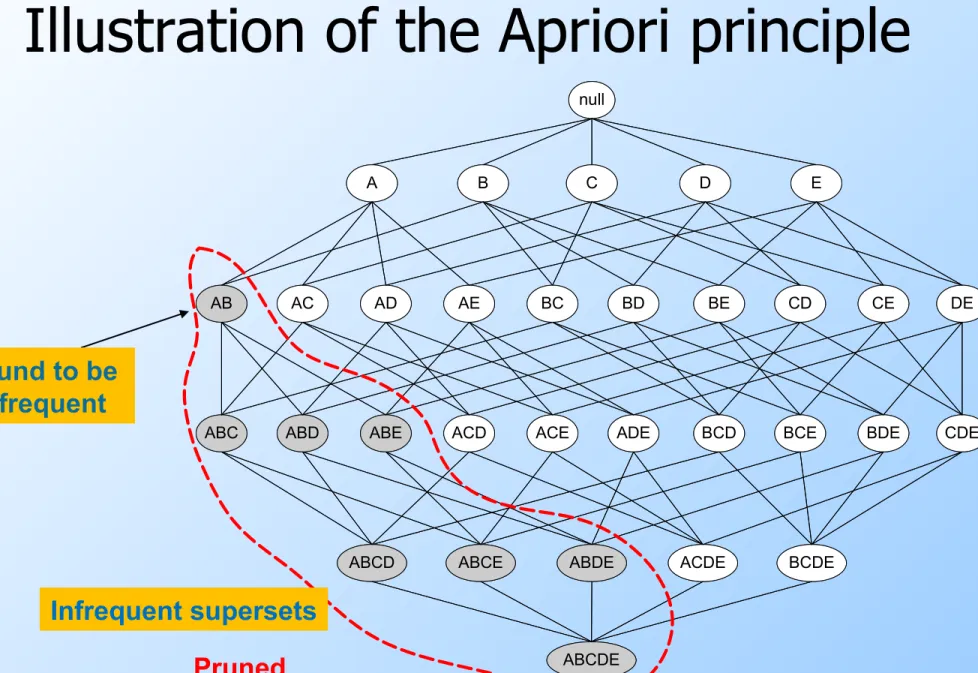
Illustration of the Apriori principle
Illustration of the Apriori principle
Found to be Infrequent
null
AB AC AD AE BC BD BE CD CE DE
A B C D E
ABC ABD ABE ACD ACE ADE BCD BCE BDE CDE
ABCD ABCE ABDE ACDE BCDE
ABCDE null
AB AC AD AE BC BD BE CD CE DE
A B C D E
ABC ABD ABE ACD ACE ADE BCD BCE BDE CDE
ABCD ABCE ABDE ACDE BCDE
ABCDE Pruned
R. Agrawal, R. Srikant: "Fast Algorithms for Mining Association Rules",
Proc. of the 20th Int'l Conference on Very Large Databases, 1994.
The Apriori algorithm
Level-wise approach
C
k=
candidate
itemsets of size
k
L
k=
frequent
itemsets of size
k
Candidate generation
Frequent itemset generation
1.
k = 1
,
C
1= all items
2. While
C
knot empty
3. Scan the database to find which itemsets
in
C
kare
frequent
and put them into
L
k4. Use
L
kto generate a collection of
candidate
itemsets
C
k+1of size
k+1
Candidate Generation
Basic principle (Apriori):
An itemset of size
k+1
is candidate to be
frequent only if
all
of its subsets of size
k
are known to be frequent
Main idea:
Construct a
candidate
of size
k+1
by
combining
two
frequent
itemsets of size
k
Prune
the generated
k+1
-itemsets that do
Mining Association Rules
Example:
Beer } Diaper , Milk { 4 . 0 5 2 | T | ) Beer Diaper, , Milk (
s 67 . 0 3 2 ) Diaper , Milk ( ) Beer Diaper, Milk, (
c
Association Rule
– An implication expression of the form
X Y, where X and Y are itemsets
– {Milk, Diaper} {Beer}
Rule Evaluation Metrics
– Support (s)
Fraction of transactions that contain both X
and Y = the probability P(X,Y) that X and Y
occur together
– Confidence (c)
How often Y appears in transactions that
contain X = the conditional probability P(Y| X) that Y occurs given that X has
occurred.
TID Items
1 Bread, Milk
2 Bread, Diaper, Beer, Eggs 3 Milk, Diaper, Beer, Coke 4 Bread, Milk, Diaper, Beer 5 Bread, Milk, Diaper, Coke
Problem Definition
– Input A set of transactions T, over a set of items I, minsup, minconf values
Mining Association Rules
Two-step approach:
1.
Frequent Itemset Generation
–
Generate all itemsets whose
support
minsup
2.
Rule Generation
–
Generate
high confidence
rules from each
frequent itemset, where each rule is a
partitioning of a frequent itemset into
Left-Hand-Side (
LHS
) and Right-Hand-Side (
RHS
)
Association Rule anti-monotonicity
Confidence is
anti-monotone
w.r.t. number
of items on the
RHS
of the rule (or
monotone
with respect to the
LHS
of the
rule)
e.g.,
L = {A,B,C,D}:
Rule Generation for APriori Algorithm
Candidate rule is generated by merging two rules that share the same
prefix
in the RHS
join(CDAB,BDAC)
would produce the candidate rule D ABC
Prune rule D ABC if its
subset ADBC does not have high confidence
Essentially we are doing APriori on the RHS
BD->
A
C
CD->
A
B
Closed Itemset
An itemset is closed if
none
of its immediate
supersets
has the
same
support
as the itemset
Maximal vs Closed Itemsets
Frequent Itemsets
Closed Frequent
Itemsets
Maximal Frequent
Pattern Evaluation
Association rule algorithms tend to produce too many
rules but many of them are
uninteresting
or
redundant
Redundant if {A,B,C} {D} and {A,B} {D} have same support
& confidence
•Summarization techniques
Uninteresting, if the pattern that is revealed does not offer useful
information.
•Interestingness measures: a hard problem to define
Interestingness measures
can be used to prune/rank the
derived patterns
Subjective measures: require human analyst Objective measures: rely on the data.
In the original formulation of association rules, support &
Computing Interestingness Measure
Given a rule
X
Y
, information needed to compute rule
interestingness can be obtained from a
contingency table
f11 f10 f1+ f01 f00 fo+ f+1 f+0 N
Contingency table
for
X
Y
f
11: support of
X
and
Y
f
10: support of
X
and
Y
f
01: support of
X
and
Y
f
00: support of
X
and
Y
Used to define various measures
support, confidence, lift, Gini,
J-measure, etc.
: itemset X appears in tuple : itemset Y appears in tuple
Drawback of Confidence
Coffee Coffee
Tea
15
5
20
Tea
75
5
80
90
10
100
Association Rule:
Tea
Coffee
Confidence= P(Coffee|Tea) =
0.75
but P(Coffee) =
0.9
•
Although confidence is high, rule is misleading
•
P(Coffee|Tea) = 0.9375
Number of people that drink coffee and tea
Number of people that drink coffee but not tea
Number of people that drink coffee
Statistical Independence
Population of 1000 students
600 students know how to
swim (S)
700 students know how to
bike
(B)
420 students know how to
swim
and
bike
(
S
,
B
)
P(S
B)
= 420/1000 = 0.42
P(S)
P(B)
= 0.6
0.7 = 0.42
Statistical Independence
Population of 1000 students
600 students know how to
swim (S)
700 students know how to
bike (B)
500
students know how to
swim
and
bike
(
S
,
B
)
P(S
B)
= 500/1000 =
0.5
P(S)
P(B)
= 0.6
0.7 = 0.42
Statistical Independence
Population of 1000 students
600 students know how to
swim (S)
700 students know how to
bike (B)
300
students know how to
swim
and bike (
S
,
B
)
P(S
B)
= 300/1000 =
0.3
P(S)
P(B)
= 0.6
0.7 = 0.42
Example: Lift/Interest
Coffee Coffee
Tea
15
5
20
Tea
75
5
80
90
10
100
Association Rule: Tea
Coffee
Confidence= P(Coffee|Tea) =
0.75
but P(Coffee) =
0.9
Lift
= 0.75/0.9=
0.8333
(< 1, therefore is negatively associated)
Another Example
of the of, the
Fraction of
documents 0.9 0.9 0.8
P
(
of , the
)
≈ P
(
of
)
P
(
the
)
If I was creating a document by picking words randomly, (of, the) have more or less the same probability of appearing together by chance
hong kong hong, kong
Fraction of
documents 0.2 0.2 0.19
P
(
hong ,kong
)
≫
P
(
hong
)
P
(
kong
)
(hong, kong) have much lower probability to appear together by chance. The two words appear almost always only together
obama karagounis obama, karagounis Fraction of
documents 0.2 0.2 0.001
(obama, karagounis) have much higher probability to appear together
by chance. The two words appear almost never together
No correlation
Positive correlation
Drawbacks of Lift/Interest/Mutual
Information
honk konk honk, konk Fraction of
documents 0.0001 0.0001 0.0001
𝑀𝐼
(
h
𝑜𝑛𝑘
,
𝑘𝑜𝑛𝑘
)
=
0.0001
0.0001
∗
0.0001
=
10000
hong kong hong,
kong Fraction of
documents 0.2 0.2 0.19
𝑀𝐼
(
h
𝑜𝑛𝑔
,
𝑘𝑜𝑛𝑔
)
=
0.19
0.2
∗
0.2
=
4.75