1 INTRODUCTION
in modern organizations, such as most international organisations (subsidiaries of mNC’s) present in Albania, Hrm is seen as an important management topic and Hr practices are implemented, according to the guidelines of the foreign head office. in smaller Albanian companies Hrm is often limited to basic personnel administration; the company’s director takes the responsibility for personnel matters (hiring, firing, rewarding - the term Hrm would be an overstatement), and many of these directors have a far from professional attitude towards Hrm. important basic questions on Hrm cannot be answered as yet, such as: - how much and what kind of Hrm is practiced in companies in Western Balkan countries?; - how much Hrm would companies need to have the right people on board and achieve an optimal performance?; - which arrangements of Hrm investments and practices are likely to give the best returns?
e number of studies on Hrm in Central and Eastern Europe (CEE) is still limited. An extensive study on Hr in the CEE region, including an overview of references and other research work done, has been carried out by Poór et al. (2015). eir study concludes, amongst many other things, that Hrm in organisations of the Visegrad region is more developed than in organisations in countries of the Balkan region. in a study of Czech Hr systems, Šikýř (2013) states that organizational performance and competitiveness are determined by employee performance, and therefor this subject should figure high on the list of management objectives. He also concludes that the Hr function should be further developed. Jawor-Joniewicz and Sienkiewicz (2016) conclude in their work on Hrm and competitiveness in Poland, that Polish organizations lag quite far behind European and American ones, and that this distance can be reduced, e.g. by the popularization of tools for measuring human resources in Polish enterprises. Pološki Vokić (2015) studied the situation in Croatia and concludes that on average Hrm practices of Croatian organizations cannot be labelled competitive, and Croatian organizations on average are not attractive places for competitive, results oriented employees. Constantin et al. (2006) give a picture of the Hrm situation in romania and conclude that Hrm still faces important challenges: “Hrm does not seem to be one of the priorities of the managers included in the present study. most of them have never solicited Hrm consulting and do not intend to do so in the near future, nor have they hired an Hrm specialist” (2006, 764). in an empirical study in Kosovo, Qehaja and
Journal of HUMAN RESOURCE MANAGEMENT
www.jhrm.eu • iSSN 2453-7683
High performance work practices in Albania
Peter Nientied, Dritan Shutina
A B ST r AC T
in this article, Hrm practices - articulated as Hrm for high performance work practices – are studied in Albanian companies. from a pre-study, the indication was that Hrm is still in an early stage of development. A questionnaire based survey and interviews were conducted to substantiate this premise. e empirical results show that indeed Hrm is not well developed. e data also reveal only minor differences between foreign owned companies and Albanian companies and between small and larger companies. e results of the study should be understood in the context of the Albanian small economy, slowly picking up. it is concluded that developing Hrm high performance work practices has considerable potential for Albanian companies, and that employers’ associations and universities should play a role as Hrm champions. Hrm also deserves much more academic attention.
Human resource management, high performance work practices, Albania, Western Balkan.
K E Y W O r D S
J E L C o d e : m 5 0
CONTACT iNfOrmATiON:
Kutllovci (2015, 47) come to the conclusion “.. that wholesale distribution firms of food and non-food products in Kosovo do not consider human resources significant resources in providing competitive advantage. erefore, they do not possess a standard strategy for human resource development. Another assumption was that most of these firms have human resource departments, but in practice these departments mainly deal with administrative work.” from the Hrm literature in CEE countries and from discussions with many management managers and professionals, it looks as if in Balkan countries overall levels of economic development and competitive environments positively correlate with the development of the Hrm function. in a study on Hrm in Bulgaria, fYr of macedonia, romania and Serbia, Psychogios et al. (2016) found that Hrm in small and medium enterprises is related to the degree of internationalisation, the particular sector and the organisational size. ese three factors positively affect the level of Hrm development.
in Albania, the situation looks comparable to what has been described in the studies of Qehaja and Kutllovci (2015) on Kosovo and Pološki Vokić (2015) on Croatia. in Albania, there are very few thoughtful studies on the subject of Hrm. Cania (2014) asked to 30 organizations whether they are familiar with the concept of strategic Hrm, and a majority confirmed that they were, and expected a positive impact from strategic Hr on the results. e study was limited to asking the single question to managers, not checking how the actual situation in the organisations was. Berberi & Ceni’s (2015) work is mainly a literature review. in the Albanian public sector Hrm has received some attention, due to international programs from EU and UN, in view of accountability and quality of staff (Kraja & radonshiqi, 2015).
is reflection on Hrm in CEE and in particular in Albania sets the context for our study on to what extent modern Hrm is applied in Albanian companies. We have first done a literature search and interviews with a number of professionals and managers in different companies. Next, a basic questionnaire was selected and tested. e questionnaire asks for the use of high performing work practices (HPWP) (Boselie, 2014, 133). Since many international companies have entered the Balkan, and they have imported more modern personnel management systems, we also wanted to know whether these systems include HPWP, and to what extent national organisations have adopted Hrm practices. Since the maturity of the Hrm function is expected to be quite modest and publications on Hr in Albanian organisations are limited, this study focuses on stock taking, on making an inventory of the current situation of Hrm practices.
2 HRM AND PERFORMANCE
Working with a model of HPWP, asks for some explanation. e relationship between Hrm and performance has been extensively discussed in theory and studied in practice. Amongst others, Buller and mcEvoy (2012) and Ayalew melesse (2016) give an overview of the discussion. Studies on the return on investment in Hr show some positive results (Armstrong, 2014; Aguta and Balcioglu, 2015), but Hrm academicians also use the notion of the black box – there is no clear relation between investment in Hr, and the financial and production results of the company. investing in Hr practices means an indirect relationship with company performance (Armstrong, 2014; Buller and mcEvoy, 2012). Guest (2011) cautions researchers: basic questions on measurement of Hr systems and practices, specific conditions, implementation of Hr systems, etc., and their effect on performance are far from clear and difficult to operationalize. e relationship between Hr and performance is also questioned, amongst others, by White and Bryson (2011; 2013). ey conclude that is unclear how exactly the relation between application of Hr instruments and performance works, how much Hr is needed, and how much Hr investment leads to positive results. indeed, it is difficult to establish a direct relationship between Hr and productivity in a complex organisational environment in which many interwoven factors influence productivity. interesting is the work of Kathou (2014), who studies the reverse causality and suggests that his study supports the view that although Hrm policies do not directly lead to high organizational performance, it is high-performing firms that can directly afford Hrm policies. in short, the academic discussion on the relationship between Hrm and performance is far from conclusive.
Hrm does not only work for higher productivity and better financial performance – it also has a task to safeguard the application of legislation, contribute to a company’s attractiveness, etc. As Boselie (2014) suggests, Hrm has to serve various goals. instead of performance as a criterion, francis et al. (2012) prefer the broader concept organisational effectiveness, pointing at the multiple goals to which Hrm contributes. ey suggest that Hrm conducts an important role to enhance the productive capacity of the people, and to achieve other goals such as flexibility of the organisation, corporate social responsibility and innovation.
to develop. Already some time ago, Delery and Shaw (2001) have drawn the following conclusions from the literature that still stand today: 1) human capital can be a source of competitive advantage, 2) Hr practices have the most direct influence on human capital, and; 3) Hr systems can influence the inimitability of the organisation and make sure that performance structures and results cannot easily be copied by others. e development of effective practices for managing the organization’s human resources for improved performance has been extensively discussed in literature (Boxall and macky, 2007; Boxall and macky, 2009; Boselie, 2014).
ere is academic debate about the so-called ‘best practice’ approach: whether a number of best Hr practices can be identified that are universally relevant (Boselie, 2014). e study of Šikýř (2013) on companies in Czech republic opts for a best practices approach, and Šikýř suggests that “Any organization seeking to achieve excellent performance and sustained competitiveness should therefore systematically compare its actual performance and competitiveness with the performance and competitiveness of the best organizations in a specific sector or region to apply appropriate best practices in human resource management.” (2013, 44) His study shows that his respondents are not very convinced that in human resource management, there are universally applicable best practices that positively influence organizational performance and competitiveness. in contrast to the ‘best practice’ approach, the ‘best fit’ approach suggests that context matters a lot, and that the internal context (the organization’s history and administrative heritage, its cultural DNA) and external fit (institutional mechanisms and market conditions) are significant factors to be considered (Boselie, 2014). Our stance is the best fit approach, and in a later section of this article, we will contextualize our findings to enhance the understanding of Hrm in Albanian companies.
for this study, it was opted for the notion of HPWP / HPWS (high performance work practice, high performance work system). A HPWS is a bundle or cluster of Hrm practices that increases company performance; for example in terms of labour productivity, service quality and flexibility (cf. Boxall and macky, 2009). important is an internal fit between individual Hr practices; coherent and consistent Hr is needed for an impact on performance. if for example workforce selection policies and practices of a company are good, but no Hr systems are in place for general training or performance evaluation, then the return on the investment in selective recruitment will be suboptimal. A basic HPWP approach, in rather plain and recognizable fashion, fits the current stage of development of Hrm in the Western Balkan better than more comprehensive HWPS models. investigating a HPWP like talent management would not be very appropriate in the Balkan because first, the concept is still widely discussed in literature (exclusive or inclusive approaches of talent management) and second, many managers in the Balkan do not know this term. Also topics like diversity, competency based Hrm and engagement are new terms for many managers, and do not fit (as yet) in the Western Balkan regional context.
e system of HPWP selected in our study is therefore a ‘starter’s kit’. it follows the list of 15 HPWP’s of Boselie (2014), who selects the AmO model as a basis for identifying HPWP’s. is model has been elaborated by Appelbaum et al. (2000). e AmO model stands for abilities, motivation, and opportunity for employee participation. e model states that people perform well when: they are Able to do so; they have motivation to do so: and -Opportunities and support are provided in the work environment for people to perform.
- Ability practices include selective recruitment and selection and training and development (of skills, knowledge and abilities)
- motivation practices include fair pay, evaluation and feedback, coaching and mentoring, internal promotion opportunities, etc.
- Opportunity practices include autonomy for employees, involvement, job rotation, participating in team work and in decision making.
Hr practices are built around this logic.
3 METHODOLOGY
have the questionnaires filled out and get an answer on the 16th open ended question (that also functioned as a check on the answers given). Post graduate students are typically in the age category of 28 to 40 years, have positions with responsibilities, have enjoyed an academic study before and now aim at a next step in their career and opt for a mBA, broadening their knowledge and study.
The survey sample is not representative for the country as a whole. most of the interviewers (mBA students) live in the Tirana – Durres region, which is the prime economic region of Albania. They have approached respondents from companies in this region, and therefore the survey conducted has a bias towards more modern companies, towards larger companies and towards international companies. This implies that, in comparison to Albania as a whole, the data are likely to give a more positive picture of Hrm. We do not know exactly how significant this bias is.
e survey excluded the government sector because government is not performance based but rule based with centralised guidelines for personnel administration and Hr. Also excluded were small enterprises (10 people or less), where Hr is expected to be informally organized and based on personal relationships. in total 77 valid questionnaires were processed, and this number should give an adequate insight into Hrm practices. in the tables below in paragraph 4, plain results are presented in tables; statistical analysis has been limited because the plain figures speak for themselves, and in categories the numbers are getting small. in the discussion we also submit remarks on interpreting the scores.
After the questionnaire survey, we conducted interviews with 14 managers and Hr staff of the participating private sector companies (not necessarily the persons who filled in the questionnaires, and selected on basis of convenience sampling). We discussed two items: - how they react to the ourcomes of the survey results, and – their perspective on Hrm in their company and in Albania’s private sector in general.
4 RESULTS
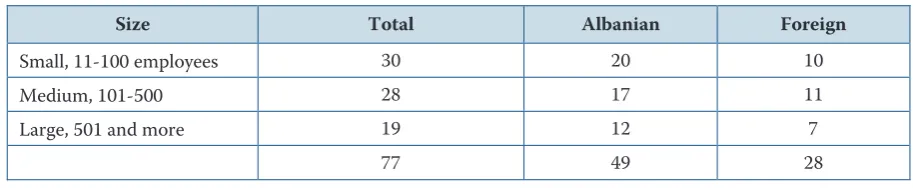
e companies approached include almost all major companies in the Durres – Tirana regions; banks and insurance companies, service industries and manufacturers. Of all companies approached, 36.4% was subsidiary of a mNC, and 63.6% was Albanian. Sometimes the distinction is not really clear (like a company selling cars – Albania based with Albanian management, but with strict guideless from the supplier). Our criterion was the nature of ownership and management – meaning that for example Opel Cars Albania is an Albanian company, and raifeissenbank is foreign. Table 1 shows the sizes of the companies.
Table 1: Company size
Source: own research.
Compared to the overall 2015 figures given by the Albanian statistical office iNSTAT (2016), the company sizes are much larger. in the table ‘Basic indicators, income statement and investments for all market producers of goods and services, by enterprise size class and economic activity 2015’, iNSTAT shows that only a few percent of Albanian companies employ more than 50 persons. Our sample thus represents a group of companies that is larger. it is also more international. it is reasonable to expect that this group of companies has the most modern Hrm that can be found in the country.
Table 2: Overall results
Source: own research. Explanation: 1 = very little; 2 = little; 3 = neutral; 4 = intensive; 5 = very intensive. e % refers to the number of times a score to an answer has been given. 100% refers to N=77.
With a range from 1 – 5, the average is 3, and per questionnaire the total scores can vary from a minimum of 15 to a maximum of 75. in the above table, questions Q1-Q5 refer to Abilities, questions Q6-Q10 to motivation and questions Q11-Q15 to Opportunities. e minimum per factor (Abilities, motivation, Opportunities) can therefor range from 5-25. e average scores on this Likert scale for these AmO factors are as follows.
e overall score means an average total score of 48,4 points (or 3.3 on a Likert scale). Boselie (2014, 143) suggests that scores below 50 might indicate a mediocre Hr system.
interesting is that the scores between national and international companies do not show much variation. e results suggest that the group of Albanian companies have adopted Hrm practices that are present in foreign companies too. it should be noted that the responses of foreign companies were quite divers. international banks for example score well above average, but on the other hand, a large foreign owned call centre with 500+ employees, had a score that was among the lowest in the whole sample.
Table 3: AmO scores – averages
Source: own research.
Table 4: shows averages of companies of different sizes (n=77)
Source: own research.
e answers on the 16th open ended question regarding the opinion of the respondents about Hrm improvements resulted in quite diverse answers, without a clear set of priorities. Low salaries were mentioned frequently, and also opportunities to grow in the company. e picture that appears from the answers goes in the direction of improving motivation; less priority is given to the categories abilities and opportunities. An explanation for this is, as far as we could get, that respondents are quite concerned with basics (including their own salary and opportunities) and found it difficult to take a companywide perspective. Top management could be expected to have such perspective, but, as mentioned, our experience with interviewing top managers is not very positive.
After the survey, we conducted interviews with 14 managers and Hr staff of private sector companies. from these interviews, it was confirmed that most subsidiaries of mNC’s import their Hr policies and systems from the head office. Not all; we mentioned the case of the large call centre which has a pretty mediocre Hrm system. Other forerunners in the Hrm field could be found in organisations with specialised, highly educated people who are in direct contact with customers, or run projects, do consultancy assignments, etc. Compared to general managers, Hr professionals (with international education or experience) have a broader understanding of what Hrm can contribute to the performance of a company. ey stress that constructive relationships will benefit both employees and the company. ey also comment on the work ethos of Albanian workers that is different from Western European workers, a culture that originates from socialist times. most managers need to supervise their employees, otherwise their output is low. Hr has to help management to find a right balance between supervision and giving more responsibility and autonomy to employees. Hr people also often mention managerial mind-sets as a factor hindering Hr development, with managers contributing to low trust working environments. from our interviews with managers we conclude that they do see the importance of having good people in their company, but ‘good’ is often seen in terms of diligent, hardworking, and obedient – not in terms of creative and entrepreneurial. in general, managers don’t give a high priority to investing in people, guiding and rewarding them. most managers are not familiar with topics such as engagement, corporate entrepreneurship and talent management. in contrast to Cania (2014), we came across very few managers only who understand the concept of strategic Hr. from the interviews, we conclude that raising consciousness about Hrm, along the themes of for example the AmO model is a first requirement to improve the currently low Hrm maturity.
5 CONTEXTUALIZATION
in the previous paragraph, data were presented that lead to the conclusion that development of Hrm in Albania is at a rather early stage. for a better understanding of Hrm in Albania, it is important to comprehend the national context. Elsewhere, we have tried to contextualize the lack of innovative capacity of Albanian companies (Nientied and Karafili, 2016). ree pointers regarding this lack of innovation capacity can fittingly be applied to the modest maturity of Hrm.
i Albania is a formerly isolated country, still catching up.
organizations still lag quite far behind their European counterparts. Poór et al. (2015) have explained that developing Hrm maturity in Visegrad countries takes time. in the Western Balkan countries it will take more time. in Albania the nature of inflow of international companies has been different from the inflow in the countries mentioned: mNC’s were market seeking, be present in the Albanian market with products (all sorts of consumer and producer goods) and services (such as banking or supermarkets). Only few companies have come to Albania to take advantage of low labour costs or specific resources. in other words, Albania, and the Western Balkan countries in general, have befitted less from economic modernization. is has had an impact on the development of Hrm practices.
ii e economy and competitive environment in Albania
Before 1991 Albania was a closed economy and after 1991 Albania has never entered really into international competition (let alone global competition). e country has a somewhat outdated economy with limited exports (Gabrich et al., 2016). for Prašnikar et al. (2012) the domestic nature of competition of Albanian firms is a key feature; due to the lack of competition, one of the major innovation drivers has been non-existent. e same holds for Hrm development. Given that most business is in the domestic market, the nature of competition is largely determined by the characteristics of domestic competition. in other words, the reference of Hrm is national, not international. at means that, rightly or wrongly, the perceived push to invest in Hrm has been limited.
in many sectors there is sufficient supply of people willing to work. e unemployment rate in Albania is high; it averaged 15 percent from 1993 until 2016, reaching an all time high of 22.3 percent in the fourth quarter of 1993 and a record low of 12.1 percent in the fourth quarter of 1996. End 2016 it was 15.2%, according to www.tradingeconomics.com. Till recently, it was rather easy to fire people. e situation of high unemployment and easy hiring and firing, helps to explain why many firms focus on direct productivity of people, not on engagement and human resource development. in international companies the situation is different. Banks for example do experience (domestic) competition, they aim at increasing their share in the Albanian market and they invest in Hrm and HPWP, like selective recruitment, general and more specific skills training and job security for staff showing good performance. A number of organisations in specialized work environments (like iT and other specialized technical or academic environments) experience a shortage of skilled labour. it is a push factor for better Hrm. us, only in small specialized segments a (modest) ‘war for talent’ is going on. Short term contracts are common, and for managers with a short term result focus, hiring and firing is more understandable than novel Hrm practices that have an unknown positive contribution to the company’s result.
iii Lack of HRM champions
Business institutions, government and educational organisations have done very little to help companies increase their awareness that better Hrm can pay off. Government has focused on labour regulations and administration, and some experiments with employment initiatives for youth. Higher education institutes have paid little attention to Hrm, and therefor mBA students have not learned about current developments in Hrm. e academic systems in CEE carry a legacy from the past. is has been concisely and well described by Poór et al. (2015) and in more detail by Zientara (2014). e limited attention to Hrm in higher education can be seen as part of this legacy.
6 CONCLUDING REMARKS
We have illustrated and explained that Hrm in Albania is in an early stage of development. Our expectation is that some factors will push for a gradual change in the way companies now conceive Hrm. Among these factors are the changing nature of work with more iT and services and less traditional production, changes in society and in the labour force, increased global competition and the need for more innovation. ese and more factors have been analysed by World Economic forum (WEf, 2016). ey also apply to the Western Balkan, albeit that the factors need to be contextualised. Elsewhere we have argued that the nature of the Albanian economy is going to change because Albania has to make a shift a focus from the domestic market to the international market (Nientied and Karafili, 2016). is will have mixed implications for Hrm. Take for example the tourism sector, which is a sector with positive growth prospects in Albania. On the one hand the sector can employ low skilled labour and this will help reduce unemployment. managers will feel comfortable to handle the workforce in the conventional management style. But on the other hand, modern day tourism development asks for skills to operate in the global tourism market, and this requires skills in the fields of iT, commerce, innovation, collaboration, value chains and specific managerial skills (Nientied et al., 2017). People with these skills, will not perform well in companies with oldfashioned Hrm approaches. for successful tourism development, modern Hrm will have to be developed.
company – explaining that positive interventions regarding the AmO factors (abilities, motivation and opportunities) are likely to pay off in the middle long run. return on investment and getting right staff, signifies language that Albanian managers understand better than modern Hrm concepts. Higher education, business institutions and the government should strengthen their role as Hrm champion, to raise awareness and support companies making the modernization of Hrm.
REFERENCES
Aguta, U., & Balcioglu, H. (2015). The impact of Human resource management Practices on Organizational Per-formance: A Case of Private Banks in North Cyprus.International Journal of Business and Social Science 6(6), 251-268.
Appelbaum, E., Bailey, T., Berg, P. & Kalleberg, A. (2000). Manufacturing advantage: Why high performance work sys-tems pay off. New York: Cornell University Press.
Armstrong, m. (2014).Armstrong’s handbook of human resource management practice. London: Kogan Page.
Ayalew melesse, S. (2016). The effect of high performance work systems utilization on firm performance: does human resource attribution of employees matter?Journal of Human Resource ManagementXIX(2), 63-74.
Boxall, P., & macky, K. (2007). High-performance work systems and organisational performance: Bridging theory and practice.Asia Pacific Journal of Human Resources 45(3), 261-270.
Boxall, P., & macky, K (2009). research and theory on high-performance work systems: progressing the high-in-volvement stream. Human Resource Management Review 19(1), 2-23.
Boselie, P. (2014).Strategic human resource management - a balanced approach. maidenhead Berhshire: mcGraw Hill.
Buller, P., & mcEvoy, G. (2012). Strategy, human resource management and performance: sharpening line of sight. Human Resource Management Review 22(1), 43-56.
Cania, L. (2014). The impact of strategic human resource management on organizational performance.Economia. Seria Management, 17(2), 373-383.
Constantin, T., Pop, D., & Stoica-Constantin, A. (2006). romanian managers and human resource management. Journal of Organizational Change Management 19(6), 760-765.
Delery, J., & Shaw, J. (2001). The strategic management of people in work organizations: review, synthesis, and ex-tension.Research in Personnel and Human Resource Management 20,165-197.
francis, H., L. Holbeche, & reddington, m.eds. (2012).People and organizational development: a new agenda for organisational effectiveness.London; CiPD.
Gabrisch, H., Hanzl-Weiss, D., Holzner, m., Landesmann, m., Pöschl, J. & Vidovic, H. (2016). Improving Compet-itiveness in the Balkan Region – Opportunities and Limits. Vienna; The Vienna institute for international Economic Studies. Wiiw research report No. 411.
Guest, D. E. (2011). Human resource management and performance: Still searching for some answers. Human Re-source Management Journal,21(1), 3–13.
iNSTAT (2016) Basic indicators, income statement and investments for all market producers of goods and services, by enterprise size class and economic activity, 2015. http://www.instat.gov.al/en/themes/enterprises-economic-indicators.aspx?tab=tabs-5 [retrieved 4 march 2017]
Jawor-Joniewicz, A., & Sienkiewicz, L. (2016). Human capital and Hrm as a source of competitive advantage and effectiveness: evidence from Poland. in: P. Trapczyński et al. (eds.)Competitiveness of CEE Economies and Busi-nesses. Springer international Publishing, 175-196. DOi 10.1007/978-3-319-39654-5_9.
Kathou, A. (2012). investigating reverse causality between human resource management policies and organiza-tional performance in small firms.Management Research Review, 35(2), 134 – 156.
Nientied, P., & Karafili, E. (2016). Towards a pragmatic perspective on business innovation in Western Balkan Coun-tries: the case of Albania.International Journal of Business and Management, 11(3), 193-202.
Nientied, P., Porfido, E., & Ciro, A. (2017, forthcoming). Sustainable tourism development in Albania in times of liq-uid modernity Proceedings international WorkshopEnhancing Sustainable Tourism in Adriatic-Ionian region. macerata, 15-16 September 2016.
Pološki Vokić, N. (2015).Competitiveness and sustainability of HRM activities in Croatia – CRANET survey results. University of Zagreb, faculty of Economics and Business. EfZG Working Paper Series, no. 15-06.
Poór, J., Engle, E.D., Szlávicz, A., Kerekes, K., Szabó, K., Kovács, i.E., & Józsa, i. eds. (2015).Human resources man-agement issues and challenges in foreign owned companies: Central and Eastern Europe (2011-2013). Komárno, Slovakia: faculty of Economics, J. Selye University.
Prašnikar, J., redek, T., & memai, f. (2012).Albania: the role of intangible capital in future growth. Ljubljana: fac-ulty of Economics.
Psychogios, A., Szamosi, L.T., Prouska, r. & Brewster, C. (2016). A three-fold framework for understanding Hrm practices in South-Eastern European SmEs.Employee Relations 38(3), 310-331.
Qehaja, A., & Kuttlovci, E. (2015). The role of human resources in gaining competitive advantage.Journal of Human Resource Management XVIII/2,47-61.
Šikýř, m. (2013). Best practices in human resource management: the source of excellent performance and sustained competitiveness.Central European Business Review 2(1), 43-48.
WEf - World Economic forum (2016).The future of jobs. Geneva: WEf.
White, m., & Bryson, A. (2011).HRM and workplace motivation: incremental and threshold effects.London School of Economic, Centre for Economic Performance. CEP Discussion Paper No 1097.
White, m., & Bryson, A. (2013). Human resource management: how much do firms really need?CentrePiece 18(2), 26-28.