29 | P a g e
The Impact of Learning-Style and Task-Based Teaching of Language on Learners’
Achievement
Emad A. S. Abu-Ayyash * Mohammad Assaf**
Abstract
The purpose of this paper is to examine the relationship between learning-style and task-based teaching and learning and students’ academic achievement in standard-based tests in English. The data were collected from two public secondary schools in the emirate of Fujairah, the United Arab Emirates (UAE). A sample of purposefully selected 54 Grade 10 students from both schools was surveyed with a VAK questionnaire. SPSS was used to compare the mean of the two standard-based tests. The results show that there is a relationship between a learning-style-based, task-based learning (TBL) model and Madaras Al Ghad (Arabic translation for Schools of Future: MAG) learners’ achievement in standard-based language tests. The theoretical implications of the findings are discussed in this paper, together with recommendations pertaining to the significance of considering students’ learning styles and task-based learning in the educational process. The significance of the present study rests on the fact that the links between learning-style and TBL model and students’ academic achievement have been examined for the first time in public secondary schools in the UAE and the Arabic context. The findings of this study will be of interest to educators, policymakers as well as researchers.
Keywords: learning styles, VAK model, task-based learning, students’ achievement
Introduction
This study has been conducted in two of MAG Schools in the United Arab Emirates, Fujairah Zone. The purpose of the study was to investigate whether, or not, espousing a learning-style-based, TBL approach with grade 10 students would improve their achievement in standard-based tests. MAG schools are part of the Ministry of Education’s Specialized Schools Project, which has been implemented in some UAE state-run schools whose aim is
*Dr. British University in Dubai (BUiD) United Arab Emirates (UAE)
E-mail: [email protected]
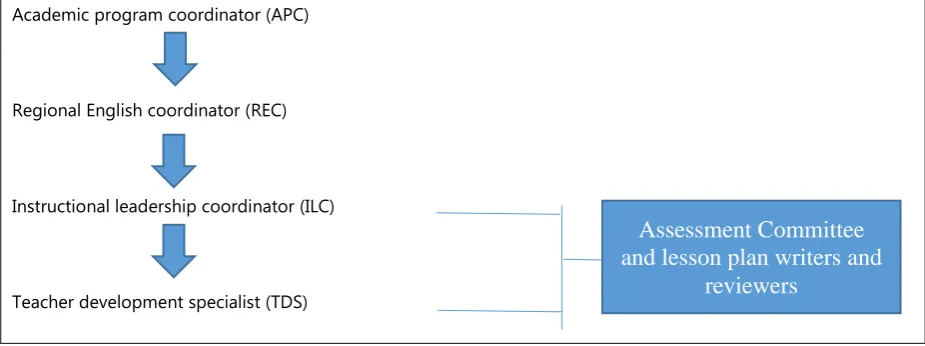
30 | P a g e to provide students with standard-based teaching that is based on the Common European Framework of Reference for Languages (CEFR), which describes foreign language proficiency at six levels: A1 and A2 (basic user), B1 and B2 (independent user) and C1 and C2 (proficient user) (Council of Europe, 2014). The MAG Curriculum Committee has selected a set of standards for each grade level. As far as the current study is concerned, it has been conducted in two grade 10 classes in two schools, which will be referred to as School 1 and School 2. The academic school year is divided into three trimesters. In the first two, grade 10 students are expected to meet A2 standards, whereas, in Trimester III, they move to B1 standards. The CEFR standards that students are expected to meet are distributed on six units, as students cover two units each trimester. As far as assessment within MAG schools is concerned, there are two types: Continuous Assessment (CA) and Standard Assessment (SA). The former focuses on one unit, and therefore, students receive two CA tests per trimester, whereas the latter is intended to assess the standards covered in two units, which means that there is only one SA for each trimester. Every SA contains four tasks that address the four major language skills: speaking, listening, reading and writing. The present study addresses variance in the results of the SA in Trimesters II and III for the two sample groups. SA tests are written by the MAG Assessment Committee, which is assigned by the academic program coordinator and the regional English coordinator. The members of the committee are professional instructional leadership coordinators and teacher development specialists, who are lesson plan writers and reviewers as well. Figure 1 shows where the Assessment Committee exactly lies within MAG’s organisational structure.
Academic program coordinator (APC)
Regional English coordinator (REC)
Instructional leadership coordinator (ILC)
Teacher development specialist (TDS)
Figure 1: MAG Organisational Structure
Literature Review
This section of the paper is divided into two sub-parts: learning styles and task-based learning. The rationale behind including these two in this section is to address the literature on how the students prefer to learn and how the
Assessment Committee
and lesson plan writers and
31 | P a g e teachers would deliver the curriculum. Therefore, the literature provided here reflects the present research’s foci on preferences about learning and teaching, which consists of the procedural part of the present study.
Learning Styles
The notion of learning styles has been defined in a variety of ways. This variety was, in fact, criticised as confusing and perplexing, and thus taken as a shortcoming of research on learning styles (Curry, 1990; Spence, 2012). However, whether they are viewed as “a student’s orientation toward learning” (Nunan, 1999, p. 310), “a student’s consistent way of responding to and using stimuli in the context of learning” (Clark, 2011), “a description of the attitudes and behaviour which determine an individual’s preferred way of learning” (Honey & Mumford, 1992, p.1) or just “a preferred way of learning and studying” (Pritchard, 2009, p. 43), all the definitions seem to rest on the idea that learning styles are about how learners prefer to learn, rather than what they learn. The main distinction between learning styles and learning strategies is that the former is inherently dependent on the learner’s ‘built-in’, natural cognitive and behavioral characteristics, whereas the latter refers to the actions a learner uses and develops deliberately to learn (Bilash, 2009; Wong & Nunan, 2011).
Despite the conspicuous commonalities apparent in the definitions of learning styles, e.g., that they are a preferred way of or orientation toward learning (Clark, 2011; Pritchard, 2009), there has been, quite understandably, a plethora of models developed, based on how different researchers have approached the issue. The 1962-model known as Myers-Brigs Type Indicator (MTBI) comprises a list of sixteen personality variations (Myers et al., 1998) and is too general to be considered for classifying students in a classroom setting. Another broad model is that introduced by Honey and Mumford (1982), which divides learning styles into activist, theorist, pragmatist and
reflector. These four styles, however, are depicted in terms of general personality traits. An activist is an open-minded person who shows enthusiasm for immediate experiences. A theorist, on the other hand, is analytical and prefers to take time before making a decision. According to this model, pragmatists are practical people who rely on experimenting new ideas, whereas reflectors meditate about past and present experiences and like to observe people in action. It is worth noting that the Honey and Mumford Learning Styles Questionnaire (LSQ) includes 80 questions (Honey & Mumford 2006). It is not hard to realise that, compared to the MTBI’s sixteen personality types, these too are hard to measure within a classroom context because they are general personality traits.
Fleming and Mills (1992) first introduced the VARK model, with VARK standing for Visual, Aural,
32 | P a g e a reading/writing way, thus integrating other learning styles. The authors argue, though, that what makes this understanding of the kinesthetic style is experience, whether it is practical or simulated. The seminal work of Fleming and Mills would appear in ample literature about learning styles and in different forms years after (e.g., Kharb et al., 2013; Marcy, 2001). One can rightly argue at this point that the VARK model has been the starting point for more research on learning styles inside the classroom. Following are two adaptations of the VARK model.
Based on Neuro-Linguistic Programming, which emphasises the way communication occurs and the way it affects learning, Pritchard (2009) prefers the model that divides learners into three categories as far as their learning styles are concerned: visual, auditory and kinesthetic. As already mentioned, visual learners like to learn by seeing, which makes pictures, diagrams, graphs, maps and posters their preferred representation of information. Auditory learners, on the other hand, prefer learning via listening and tend to “benefit from discussion, lectures, interviewing, hearing stories and audiotapes, for example” (ibid, p. 45). Finally, kinesthetic learners by and large prefer learning that occurs via doing. It is hard for these learners to keep still, and in addition to physically moving, they like manipulating objects.
Prashnig (2006) makes a distinction between kinesthetic and tactile learning styles, thus adopting a VATK (Visual – Auditory – Tactile –Kinesthetic) rather than Pritchard’s VAK (Visual – Auditory – Kinesthetic) model of learning styles. The difference between the two models seems to be nested in the notion of mobility. Prashnig maintains that a tactile learning style has to do mobility, whereas a kinesthetic style characterizes learners who learn better by doing and physically experiencing a learning situation. Tactile learners’ mobility, according to Prashnig, involves experiencing learning either by either moving the body or keeping it still. Despite Prashnig’s distinction between tactile and kinesthetic, many researchers and authors still prefer the VAK distinction (Brown, 2007; Clark, 2011; Fleming, 2012). It might be worth noting that the VAK and VATK models above have not replaced the old VARK model, which has been around for decades now. The idea behind the absence of “Reading” learning style could be that if reading is done silently, then it can be embedded within “Visual,” and if done aloud within “Auditory”.
learning-33 | P a g e style-based lesson. In addition to these, activities that utilize language forms in real communicative situations (Richards & Rodgers, 2001) can be also conducted to cater for different learning styles.
Anderson and Adams (1992) stress that the delivery of information alone cannot lead to effective teaching and that there is a need to build the delivery on a model that digs deep into the minds at work. The authors argue that the most effective learning occurs when teachers acknowledge and explore their students’ learning styles and deliberately build their instruction on them.
Although learning styles do matter, Hatami (2013) emphasizes that the research on the relationships between the learning styles and learning outcomes has yet yielded contradictory results. Ellis (2008, p. 671), for instance, states that “at the moment there are few general conclusions that can be drawn from the research on learning style”. It looks like that the relation exists, but is weak. This is why it is usually recommended that teacher appeals to the variety of styles, to develop students’ cognitive and metacognitive development and to satisfy all students in the class. Besides, learning styles of the same person may change during life, this is why we should not base teaching only on the style preferable for the students right now.
The second part of this review sheds light on different definitions of tasks and the TBL models that were designed on the basis of these definitions. The point behind including the literature on TBL in this study is that this teaching method was conducted to teach the materials that were included in the SA tests.
Tasks and TBL Models
Skehan (1996) defines a task as a meaning-focused activity related to the real world,that has an outcome to be assessed. Following from this definition, Skehan stresses that the main characteristic of a well-chosen task is having ‘an effective balance between fluency and accuracy’ (ibid, 1996, p. 53). Skehan, therefore, draws a TBL model that houses a twin focus on accuracy and fluency. His model suggests that a TBL lesson be divided into pre-emptive work (pre-task), during-task, post-task 1 and post-task 2. ‘Pre-emptive work’ establishes the target language, ‘during-task’ mediates accuracy and fluency, ‘post-task 1’ encourages accuracy over fluency, and ‘post-task 2’ features synthesis and analysis. The significance of accuracy and fluency also appears in an earlier model which stresses that acquired units be integrated into functional relationships via production, or practice (Chaudron, 1988).
34 | P a g e Johnson (2003) is interested in how an activity is designed rather than how it is defined and, therefore, does not provide his own definition of a task. The author, though, introduces a model that is similar to Willis’s as far as task stages are concerned. Johnson divides a task-based lesson into preparation, main activity and follow-up. Although the sub-components of each stage are very much similar to Willis’s, this model highlights some more valuable additions. For instance, production, viewed from a perspective similar to that of Willis’s report, can be done through regrouping, defined by Johnson (2003, p. 153) as a “procedure whereby Ls [learners] form new groups to describe what has been done in an earlier group”.
Ellis (2003) defines a task with regard to its main features by claiming that it is a work plan, mainly focuses on meaning, employs real-world-related language, can be about listening, speaking, listening, and/or reading, involves cognitive processes and has an unequivocal communicative outcome. Although Ellis acknowledges Willis’s pedagogic classification of tasks, he adds Prabhu’s (1987) cognitive information gap, reasoning-gap and opinion gap activities to the list of task types. Ellis’s framework of a TBL lesson differs substantially from Willis’s. The model includes a pre-task, during-task and post-task. Nevertheless, Ellis (2003) asserts that the ‘during-task’ phase alone can be sufficient for a TBL lesson, which might suggest that flinging the pre-task and post-task through the window would not really affect the smooth flow of a TBL lesson. Since Ellis places a learner report in the non-obligatory post-task phase, he - as opposed to Willis - implicitly maintains that reporting is dispensable.
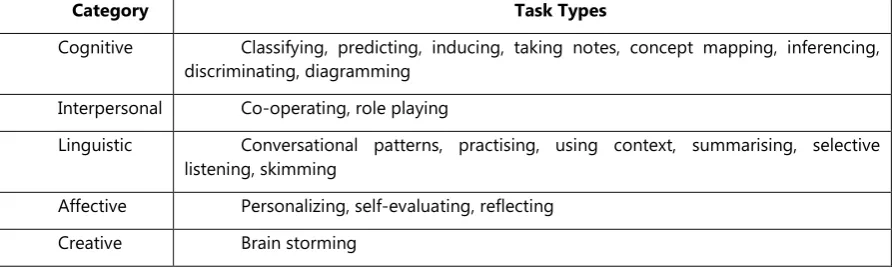
In his definition of a pedagogical task, Nunan (2004) adds more dimensions and stresses the learners’ engagement in understanding, using, generating and interacting in the target language. He adds that a task should focus on conveying meaning by means of form, or grammatical knowledge. Nunan places task types within five categories. Table 1 provides a rough summary of the five categories together with the tasks that fall into each category:
Category Task Types
Cognitive Classifying, predicting, inducing, taking notes, concept mapping, inferencing, discriminating, diagramming
Interpersonal Co-operating, role playing
Linguistic Conversational patterns, practising, using context, summarising, selective listening, skimming
Affective Personalizing, self-evaluating, reflecting
Creative Brain storming
Table 1: Task types (developed by the researcher based on Nunan, 2004)
35 | P a g e Essentially, the above-cited models tend to divide a TBL lesson into three parts, although with different titles for each part. Ellis (2003), who is at odds with most of the models, maintains that only the ‘during’ stage is essential in a TBL lesson. In fact, Ellis could be right. Particular TBL lessons can be designed to be delivered over more than one teaching period, in which case, the pre-task at least will only be needed at the commencement of the first period. The variation of TBL models have also led to a plethora of suggested task types that can only be viewed as a rich resource for teachers who are in favour of applying TBL in their classrooms.
TBL offers many advantages, however, this in neither a perfect way of teaching. Tang, Chiou & Jarsaillon (2015), for instance, state that their study with participation of 76 intermediate EFL learners during 15 weeks at a Taiwanese university revealed that TBL was effective in fluency, lexical and syntactic complexity, but ineffective in accuracy.
Research Methods
This study, which was conducted at two grade 10 MAG classes, used a quantitative method for a number of reasons. The main aim of this paper is to measure variations in students’ achievement in standard-based exams. Holloway and Wheeler (2013) point out that while a qualitative approach is process-oriented, a quantitative research is product-oriented. Following from this distinction, the quantitative paradigm has been preferred over the qualitative one for this study since the focus is the product, the students’ results in SA tests, rather than the process. On a similar note, Kumar (2011) states that quantitative designs are more appropriate than qualitative designs when the focus of research is to measure the magnitude of a certain variation. Since discovering and clarifying attitudes, feelings and beliefs of the involved teachers and students do not fall within the scope of the current study, a qualitative design has not been employed.
36 | P a g e The learning-style questionnaire used in this study was introduced by Pennsylvania Higher Education Assistance Agency (http://www.educationplanner.org/students/self-assessments/learning-styles.shtml). Using a VAK, rather than any other learning styles model, in this questionnaire is due to the fact that VAK distinction is “salient in a formal classroom setting” (Brown, 2007, p. 129). The questionnaire was translated into Arabic, the mother -tongue of the participants, who are the students of two MAG grade 10 classes aged between 15-16 years old, to provide a better comprehension of the items. Parents were asked to complete a consent form to allow their sons to take part in the research (see Appendix B). Following the elicitation of students’ learning preferences via the VAK questionnaire, the teachers were familiarised with different TBL frameworks. The action plan of the TBL course was determined on the basis of the students’ learning styles, on the one hand, and the content/standards they were going to learn/cover, on the other. By way of illustration, the students were divided into groups, based on their responses to the questionnaire and each TBL lesson was designed in a way that assured that the content was delivered in the preferred way of each group, which means that each lesson was designed and delivered on the basis of the students’ learning styles. The English teachers did not interfere in writing the SA since all the SAs are designed by the MAG Assessment Committee.
The SAs are basically based on the CEFR, B1 standards covered during Trimester III. Given that, the SA of Trimester III was based on Units five and six, and the layout of the test was identical to the format of Trimester II test. The teachers, groups of students, method of teaching and the classroom were also the same. The only difference was that the TBL model was based on students’ learning styles – a factor that was not considered in Trimester II. The independent variable was the change, or lack of it, in the students’ achievement in the SA tests between the second and the third trimesters.
Analysis and Discussion
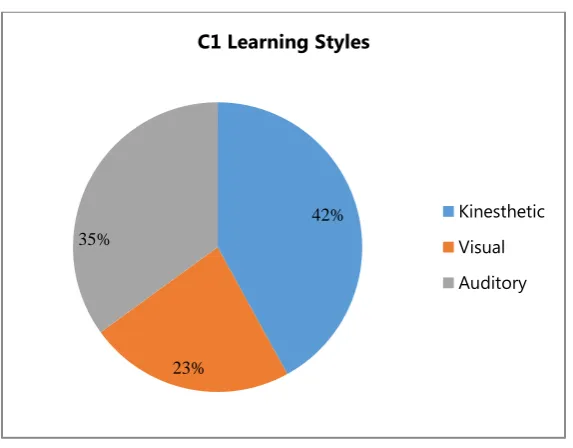
37 | P a g e Figure 2: Generic representation of CI students' dominant learning styles
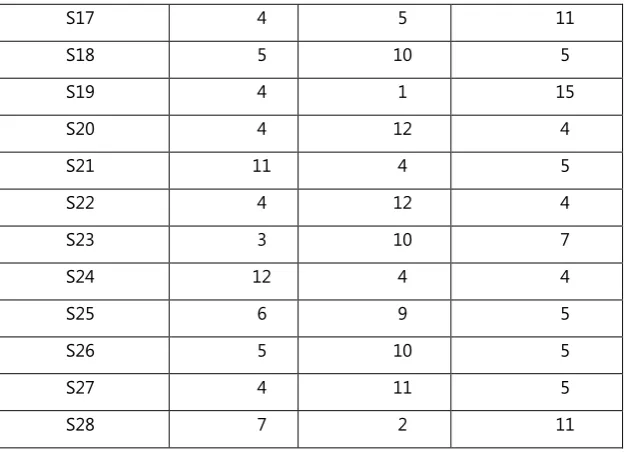
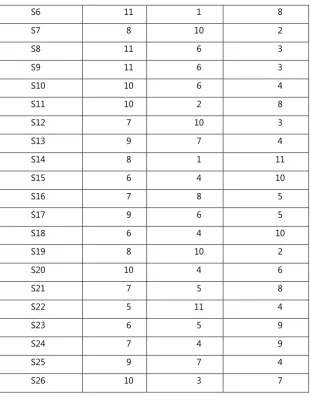
Table 2 outlines the exact responses of CI participants to each question. Students’ names have been kept anonymous (S stands for student) and listed according to the dominant learning styles.
Participant Visual Auditory Kinesthetic
S1 5 6 9
S2 5 4 11
S3 7 4 9
S4 3 9 8
S5 5 7 8
S6 2 5 13
S7 5 4 11
S8 4 7 9
S9 11 2 9
S10 13 3 4
S11 12 2 6
S12 4 3 13
S13 5 4 11
S14 7 8 5
S15 12 5 3
S16 7 9 4
42%
23% 35%
C1 Learning Styles
38 | P a g e
S17 4 5 11
S18 5 10 5
S19 4 1 15
S20 4 12 4
S21 11 4 5
S22 4 12 4
S23 3 10 7
S24 12 4 4
S25 6 9 5
S26 5 10 5
S27 4 11 5
S28 7 2 11
Table 2: Summary of CI students' responses
CII results were different from CI’s as the dominant learning style in CII was the visual, rather than the kinesthetic. Figure 3 shows that 50% of the students in CII are visual, 15% - auditory and 35% - kinesthetic.
Figure 3: Generic representation of CII students' dominant learning styles Table 3 outlines the exact responses of CII participants to each question.
Participant Visual Auditory Kinesthetic
S1 10 3 7
S2 11 6 3
S3 6 5 9
S4 9 6 5
S5 6 5 9
35%
50% 15%
CII Learning Styles
39 | P a g e
S6 11 1 8
S7 8 10 2
S8 11 6 3
S9 11 6 3
S10 10 6 4
S11 10 2 8
S12 7 10 3
S13 9 7 4
S14 8 1 11
S15 6 4 10
S16 7 8 5
S17 9 6 5
S18 6 4 10
S19 8 10 2
S20 10 4 6
S21 7 5 8
S22 5 11 4
S23 6 5 9
S24 7 4 9
S25 9 7 4
S26 10 3 7
Table 3: Summary of CII students' responses
So far, there have been two options as far as class organisation is concerned. The first option involves dividing the class into groups based on the students’ dominant learning styles, since the questionnaire has originally been designed to elicit this basic information. This type of organisation has ended up with five groups in CI and six groups in CII, given that the group should not consist of more than six students. Table 4 below shows the groups’ distribution and the students who have formed each group for both classes (V stands for visual, A for auditory and
K for kinesthetic).
Groups based on learning styles C I C II
V1 S9, S10, S11, S15, S21, S24 S1, S2, S4, S6, S8
V2 --- S9, S10, S11, S13
V3 --- S17, S20, S25, S26
40 | P a g e
A2 S22, S23, S25, S26, S27 ---
K1 S1, S2, S3, S5, S6, S7 S3, S5, S14, S15
K2 S8, S12, S13, S17, S19, S28 S18, S21, S23, S24
Table 4: Distribution of groups based on the dominant learning style
Obviously, although CI has a bigger number of students, 28 students compared to 26 in CII, the number of groups in CII is higher. The reason behind this is that the groups have been formed based on two criteria: the dominant learning style for each student and the size of the group, which should not exceed six per group. As shown in Table 4, the results of this grouping led to the option of creating five groups in CI (one visual, two auditory and two kinesthetic) and six groups in CII (three visual, one auditory and two kinesthetic). The sizes of the groups are apparently different due to the variation observed in the students’ learning styles.
The second option involves dividing students into pairs. Each pair will consist of two learners on the basis of their dominant learning styles.
Learning style CI Pairs CII Pairs
Visual S9 & S21; S10 & S11; S15 & S24
S2 & S6; S8 & S9; S10 & S20; S1, S11 & S26; S4 &
S17; S13 & S25 Auditory S23; S4 & S25; S14 & S16 S20 & S22; S26 & S27; S18 & S12 & S22; S7, S16 & S19
Kinesthetic S13 & S28; S1 & S8; S3 & S5 S12 & S19; S6 & S17; S2 & S7; S24; S3 & S5; S21 & S23 S14 & S15; S18 & Table 5: Pair distribution as per the dominant learning style
Using the second distribution can be a good option for a number of reasons. First, not only will learners in each pair have the same learning style, but they will also have almost the same degree of preference. Secondly, with the minor exception of the two triad groups in CII, all groups have the same size, which helps the teacher having more control over learning activities. The third advantage of using pair distribution is that the teacher will be able to observe each student’s performance during tasks easily. To put it differently, in large groups it is likely that some learners may prefer to sit back and watch other members of the group do the task.
41 | P a g e To start with, the TBL framework of the course under investigation was divided into three parts: pre-task, task
and post-task. This general layout is similar to a number of frameworks discussed above, including those proposed by Willis (1996), Ellis (2003) and Johnson (2003). Nevertheless, the pre-task and post-task phases were neglected in lessons where the students’ focus had to be on the task alone and in activities where the emphasis was mainly on form rather than on oral production. Thus, the model adopted for this course is closer to that of Ellis (2003), who maintains that pre-task and post-task are non-obligatory in a TBL lesson.
By and large, all the pre-task activities involved materials that were in accordance with the students’ learning styles. For example, since the use of videos appeals for auditory and visual learners, some videos were displayed in order to prepare the students for the relevant tasks. Other pre-task activities involved questions that elicited the students’ knowledge about certain topics. These pre-task discussions involved using pictures (appealing to visual learners), eliciting oral answers or reading aloud statements that described pictures (appealing to auditory learners) and asking the students to move to the blackboard and stick the pictures next to the corresponding words, phrases or sentences (appealing to kinesthetic learners). The post-task, where implemented, focused on the content and was, therefore, done through a worksheet that measured the students’ understanding of the target content.
As far as tasks are concerned, almost all of them were designed and produced in three different versions that were compatible with the students’ learning styles. Classifying (Nunan, 2004), or ordering and sorting (Willis, 1996), was widely implemented throughout the course in pairs and groups. By way of illustration, while groups of visual learners were provided with images that represent target lexical items and asked to match them with corresponding, usually written in different colours, words, kinesthetic groups were asked to cut out the images and paste them next to the corresponding words, while auditory learners were asked to listen to the words and say the answers aloud. Other tasks that involved all the learning styles included: diagramming, role-play, personalising, listing, comparing, problem-solving and sharing personal information.
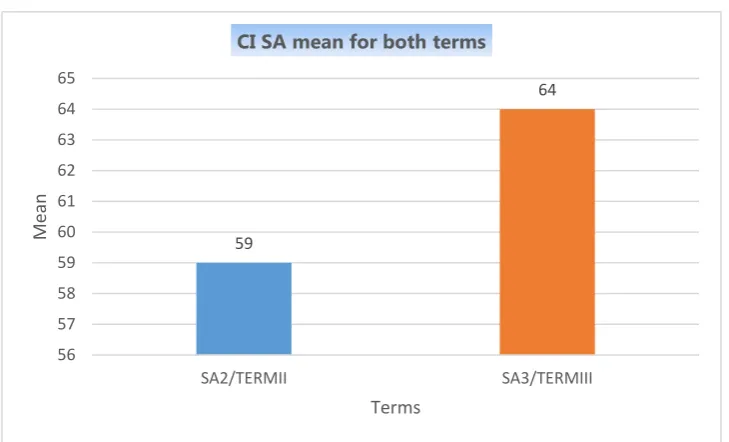
42 | P a g e Figure 4: CI SA mean for both terms
Figure 5: CII SA mean for both terms
Figures 4 and 5 indicate that there was an obvious improvement in the marks of the majority of the students in both classes. While the average score in CI increased by 5% (from 59 to 64), the average score in CII rose by 4% (from 73 to 77). Moreover, it can be noticed from Figure 6 that 89% of the students in CI improved their grades in SA tests following the course.
59
64
56 57 58 59 60 61 62 63 64 65
SA2/TERMII SA3/TERMIII
Me
an
Terms CI SA mean for both terms
73
77
71 72 73 74 75 76 77 78
SA2/TERMII SA3/TERMIII
Mean
Terms
43 | P a g e Figure 6: CI SA results for both terms
The same applies to CII where 62% of the students achieved higher marks in the SA in Trimester III as shown in Figure 7.
Figure 7: CII SA results for both terms
Although the big picture shows that the programme has affected the students’ achievement positively, one should not turn a blind eye to the fact that some students’ grades in both classes either dropped or remained the same. This can be due to some reasons that were out of the scope of this study, which will be discussed in the Limitation section of this paper. And, of course, the 4-5% growth of the skills’ level reveals a positive, but weak relation between the learning style and the learning outcomes.
S1 S2 S3 S4 S5 S6 S7 S8 S9 S10 S11 S12 S13 S14 S15 S16 S17 S18 S19 S20 S21 S22 S23 S24 S25 S26 S27 S28 TERMII SAII 72 82 50 46 72 60 58 70 60 74 60 54 78 52 52 52 58 30 50 62 54 72 72 56 52 52 60 50 TERMIII SAIII 77 91 56 50 73 61 67 70 64 86 63 56 99 54 57 63 61 51 53 63 57 71 74 60 53 61 60 53
0 20 40 60 80 100
SC
O
RE
o
u
t
o
f 100
TERMS CI SA results for both terms
TERMII SAII TERMIII SAIII
S1 S2 S3 S4 S5 S6 S7 S8 S9 S10 S11 S12 S13 S14 S15 S16 S17 S18 S19 S20 S21 S22 S23 S24 S25 S26
TERMII SA2 94 48 64 88 84 92 74 70 66 64 76 68 80 84 60 86 70 62 62 78 78 78 76 56 76 80
TERMIII SA3 97 63 73 97 89 99 61 61 61 67 81 67 74 86 73 97 70 67 76 71 76 83 70 84 70 84
0 20 40 60 80 100
Score
o
u
t
o
f
100
TERMS CII SA results for both terms
44 | P a g e Implications about the Procedures
The twin focus of the current study on students’ learning styles and the proper model has had several implications that are worth elucidating as far as content and SA are concerned.
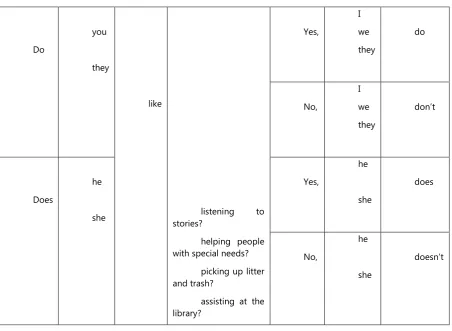
Grammar was introduced in a way that attracted all the learners in the target groups. Utilising the notion of substitution tables is one example. Below is a substitution table on which a core TBL task was designed.
Do
you
they
like
listening to stories?
helping people with special needs?
picking up litter and trash?
assisting at the library?
Yes,
I we they
do
No,
I we they
don’t
Does
he
she
Yes,
he
she
does
No,
he
she
doesn’t
Table 6: Sample substitution table
45 | P a g e kinesthetic learners, who move to the board and write their responses. The teacher, then, asks auditory learners to read the examples aloud.
Vocabulary exercises were also conducted in a way that encompassed both students’ learning styles and appropriate TBL corresponding tasks. Students benefit from using graphic organisers in understanding new words. One strategy that was used by teachers in teaching vocabulary is the KIM strategy, where KIM organisers were utilised to introduce most of the vocabulary items for Units five and six. KIM organisers involved writing the key vocabulary items in the “K” column, their definition or any information about them inthe “I” column and memory clues, such as sentences or drawings, in the “M” column. Visual learners were asked to design the chart and colour the headings. Kinesthetic learners were asked to cut and paste relevant definitions and/or images on the chart instead of writing them. Auditory learners were required to report, or say the words, their definitions and corresponding memory clues aloud.
The illustration above does not mean that form was introduced as a separate ‘island’ without attention to meaning. All the tasks conducted in class had focus on both meaning and form, therefore, was utilised to serve communicative purposes. On the one hand, the tendency to blend form and meaning was derived from a core characteristic of TBL lessons, specifically through which classroom activities students should be able to recognise how language forms are used in real communicative situations. On the other hand, practical conversations are one element of the final written exam. That is why students have to learn and practice different conversations and dialogues via a variety of tasks, such as role-play and problem-solving.
Following is an example that involves using role-play and problem-solving in a vocabulary exercise and employing the target form in an authentic practice. The dialogue below is adapted from Evans and Dooley (2003, p.56):
A: Hi, Sarah. How is your new job?
B: It is great. I love teaching, and I really enjoy working with the children in my class. However, it’s hard work too. A: Do you start early in the morning?
B: Yes, school starts at nine o’clock, but I always get there at half past eight. Then I have lessons all morning. A: Do you get a lunch break?
B: Yes. I usually bring something with me from home, or sometimes I get a sandwich from the school canteen. Then I have a few more lessons in the afternoon and school finishes at four o’clock.
A: Oh, that is good. You have your evenings free. B: Not really. I often have work to do.
46 | P a g e B: Well, I always go to the gym after work, for about an hour. When I get home, I just finish my work and then watch TV or read a book.
A: Do you go out during the week?
B: Very rarely…because I like to go to bed early. A: I see. Well, at least you never work at weekends. B: That is true.
The students were asked to listen to the conversation and then to perform it in role-play, thus responding to the learning preferences of the auditory learners. Kinesthetic and visual learning styles were also catered for when the text was written on the board with the task being converted into a problem-solving task called ‘Kill the Text then Bring it Back to Life’. In this task, each student was asked to choose two words from the dialogue and write them down. Students were then asked to use the words they have chosen in sentences of their own. Whenever a sentence was produced correctly, the word was erased from the dialogue. After ‘killing the text’ by producing correct sentences, students were asked to bring it back to life by moving to the board and writing the missing words. Apparently, this activity involved all learning styles and made use of different task types.
In running dictation, groups were organised in a way that each group would consist of students from different learning styles. Five or six copies of the target text were placed in different locations in the classroom. Kinesthetic learners were asked to run, each to his/her assigned copy, read as much as he can remember, run back to his group and dictate what s/he remembered to the auditory learners. This was repeated until the texts were fully dictated. The visual learners were then given coloured marking rubrics and asked to mark the products.
Limitations
Although many variables that could have affected the findings of the study were controlled, a few limitations need to be acknowledged. Firstly, attendance and absence records of students were not taken into account. If this had been done, probably it would have accounted for the scores that declined or remained the same in the two classes.
Secondly, the study was conducted in Trimester III, which is a B1 level, and the results were compared to Trimester II, which is an A2 level. This variable could have been controlled in a better way, had the study been conducted in Trimester II and the results compared to those of Trimester I, since both these trimesters are at level A2.
47 | P a g e Besides, the population sample was limited and permits to make conclusions only about the students involved in the study.
Finally, the study needs to cover other school subjects besides English to obtain a better picture of the intervention.
Conclusion
The current study has explored whether designing and implementing TBL tasks according to the students’ learning styles can help improve their achievement in SA tests. In order to measure the change in this variable, Trimesters II and III results of Grade 10 students in two MAG were compared. The reliability of the measurement stems from different factors, including the fact that the course was conducted in both trimesters under investigation by using the same classroom setting, the same students, the same teacher, the same core textbook, the same teaching method (TBL) and on top of those the same final, blind SA test written by the MAG Assessment Committee. The tests of both trimesters had the same structure, but were based on the standards presented in each trimester. The results of the participants show that, with a small number of exceptions, the students’ achievement did improve. Finally, although the current study signals a relation between the implementation of a teaching method based on learning styles and achievement in standard-based exams, it is still a context-specific endeavour, and therefore, it is recommended that this type of study be implemented in other educational contexts before coming out with a generalisation.
References
Anderson, J. & Adams, M. (1992). Acknowledging the learning styles of diverse student populations: implications for instructional design. New Directions for Teaching and Learning, 49, 19 – 33.
Balnaves, M. & Caputi, P. (2001). Introduction to Quantitative Research Methods. London: SAGE Publications Ltd. Bilash, O. (2009). Learning styles and language learning strategies. Retrieved September 9, 2016 from
http://www.educ.ualberta.ca/staff/olenka.bilash/best%20of%20bilash/language%20learning%20strats.html. Brown, H.D. (2007). Principles of Language Learning and Teaching. New York: Pearson Education, Inc.
Council of Europe. (2014). Common European Frame of References for Languages. Retrieved September 11, 2016 from http://www.coe.int/t/dg4/linguistic/cadre1_en.asp.
48 | P a g e Clark, D. (2011). Visual, Auditory, and Kinesthetic Learning Styles (VAK). Retrieved September 5, 2016 from
http://nwlink.com/~donclark/hrd/styles/vakt.html.
Cook, V. (2001). Second Language Learning and Language Teaching. London: Hodder Headline Group. Curry, L. (1990). A critique of the research on learning styles. Educational leadership, 4 (1), 50 – 57. Dobbs, J. (2001). Using the Board in the Language Classroom. Cambridge: Cambridge University Press.
Dörnyei, Z. (2003). Questionnaires in Second Language Research: Construction, Administration and Processing. New Jersey: Lawrence Erlbaum Associates, Inc.
Ellis, R. (2008). The Study of Second Language Acquisition. Oxford: Oxford University Press. Ellis, R. (2003). Task-Based Language Learning and Teaching. Oxford: Oxford University Press. Evans, V. & Dooley, J. (2003). Enterprise Listening Tests. Berkshire: Express Publishing.
Fleming, G. (2012). Tactile learning: People who learn by doing. Retrieved September 5, 2016 from http://homeworktips.about.com/od/homeworkhelp/a/tactile.htm.
Fleming, N. & Mills, C. (1992). Not another inventory, rather a catalyst for reflection. Improve the Academy, 11, 137 – 147.
Hart, B. (2010). English in Mind Level 2 Teacher's Resource Book. Cambridge: Cambridge University Press. Hatami, S. (2013). Concepts in ELT: Learning Styles. ELT Journal, 67, 4, 488-490.
Holloway, I. & Wheeler, S. (2013). Qualitative Research in Nursing and Healthcare. 3rd ed. Ames, Iowa, USA: Wiley-Blackwell.
Honey, P. & Mumford, A. (2006). The Learning Styles Questionnaire, 80-Item Version. Maidenhead, UK: Peter Honey Publications.
Johnson, K. (2003). Designing Language Teaching Tasks. Hampshire: Palgrave Macmillan.
Kharb, P., Samanta, P.P., Jindal, M., & Singh, V. (2013). The learning styles and the preferred teaching-learning strategies of first year medical students. Journal of Clinical & Diagnostic Research, 7 (6), 1089 – 1092. Kumar, R. (2011). Research Methodology. London: SAGE Publications Ltd.
Nation, I.S.P. & Newton, J. (2008). Teaching ESL/EFL Listening and Speaking. New York: Routledge.
Nichols, W., Rupley, W., & Kiser, K. (2009). How can vocabulary instruction be made an integral part of learning in middle and high school classrooms? (p. 175-200). In Lewis, J. (Ed.), Essential Questions in Adolescent Literacy: Teachers and Researchers Describe What Works in classroom?
49 | P a g e Marcy, V. (2001). Adult learning styles: How the VARK learning style inventory can be used to improve student
learning. Journal of the Association of Physician Assistant Programs, 12 (2), 1 – 5.
Myers, I.B, McCaulley, M.H, Quenk, N.L., & Hammer, A.L. (1998). MBTI Handbook: A Guide to the Development and Use of the Myers-Briggs Type Indicator, 3rd ed. Menlo Park, CA: Consulting Psychologists Press.
Nunan, D. (1999). Second Language Teaching and Learning. Boston: Heinle & Heinle Publishers. Nunan, D. (2004). Task-Based Language Teaching. Cambridge: Cambridge University Press. Prabhu, N. S. (1987). Interactive Language Teaching. Cambridge: Cambridge University Press.
Prashnig, B. (2006). Learning Styles and Personalised Teaching. London: Network Continuum Education.
Pritchard, A. (2009). Ways of Learning: Learning Theories and Learning Styles in the Classroom. New York: Routledge. Richards, J. & Rodgers, T. (2001). Approaches and Methods in Language Teaching. Cambridge: Cambridge University
Press.
Skehan, P. (1996). A framework for the implementation of task-based instruction. Applied Linguistics, 17 (1), 38 – 62. Spence, L.D. (2012). Getting over learning styles. Retrieved September 13, 2016 from
http://www.facultyfocus.com/articles/learning-styles/getting-over-learning-styles/
Tang, H., Chiou, J.-S., & Jarsaillon, O. (2015). Efficacy of task-based learning in a Chinese EFL classroom: A case study.
English Language Teaching, 8,5,168-176
Taylor, B. (2010). Empowering Kids to Shape Our Future: Inspirational Global Issues. Lessons for Primary School Children. Glasgow: John Catt Educational Ltd.
Pennsylvania Higher Education Assistance Agency. (2011). What’s Your Learning Style. (2011). Retrieved August 15, 2016 from http://www.educationplanner.org/students/self-assessments/learning-styles-quiz.shtml.
Willis, J. (1996). A Framework for Task-Based Learning. Harlow, Essex: Pearson Education Limited.
50 | P a g e Appendix A: VAK Questionnaire
Learning Styles (ملعتلا طامنأ)
Dear students,
We are kindly asking you to help us by answering the following questions concerning your learning styles. This survey is conducted by Emad Abu Ayyash and Mohammad Assaf, doctorate students at the British University in Dubai. This is not a test so there are no “right” or “wrong” answers. Please, give your answers sincerely as only this will help us design the proper course that will help you improve your grades in the final exam. Thank you very much for your help.
،بلاطلا يئازعأ
وبأ دامع ثحبلا اذه يرجي .مكيدل ملعتلا طامنأب قلعتت يتلا ةلئسلأا ضعب ىلع ةباجلإا يف انودعاست نأ مكنم وجرن نحن شايع
و ةبلط ،فاسع دمحأ دمحم
ىلع اوبيجت نأ وجرأ .أطخ ىرخأو ةحيحص ةباجإ كانه سيل يلاتلابو ،ًارابتخا سيل اذه .يبد يف ةيناطيربلا ةعماجلا يف ةاروتكدلا هدحو اذه نلأ ةنامأب ةلئسلأا
.مكتدعاسم ىلع ًلايزج ًاركش .يئاهنلا رابتخلاا يف مكتاجرد نيسحت يف مكدعاسيس مئلام جمانرب ميمصت يف اندعاسي ام وه
Name: ……… Age: ……….
In the following section, you are kindly asked to choose A, B, or C.
.ج وأ ،ب ،أ :تاباجلإا ىدحإ رايتخا مكنم وجرن يلاتلا مسقلا يف
1. What kind of book would you like to read for fun?
؟ةعتملل هأرقت نأ بحت يذلا باتكلا عون ام . 1
a. A book with lots of pictures in it روصلا نم ريثكلا هيف باتك .أ b. A book with lots of words in it تاملكلا نم ريثكلا هيف باتك .ب c. A book with word searches or crossword
puzzles
تاملكلا نع ثحبلاو ةعطاقتملا تاملكلا ةبعل هيف باتك .ج
2. When you are not sure how to spell a word, what are you most likely to do?
لامإ نم ًادكأتم نوكت لا امدنع ىلع لعفت اذام ،ةملك ء
؟حجرلأا 2 .
51 | P a g e 3. You’re out shopping for clothes, and you’re
waiting in line to pay. What are you most likely to do while you are waiting?
كرود نلآا رظتنتو ،سبلاملا ضعب ءارشل قوستت تنأ يذلا ام ،حجرلأا ىلع .عفدتل ؟كراظتنا ءانثأ هلعفتس
3 .
a. Look around at other clothes on the racks فوفرلا ىلع ةضورعملا سبلاملا ىلإ كلوح رظنت .أ b. Talk to the person next to you in line روباطلا يف كبرق فقي يذلا صخشلا عم ثدحتت .ب c. Fidget or move back and forth فلخلاو ماملأل كرحتلاب أدبتوأ لملمتت .ج 4. When you see the word “cat,” what do you do
first?
مدنع ا
؟هلعفت ءيش لوأ ام ،"ةطق" ةملك ىرت .4
a. Picture a cat in your mind كغامد يف ةطقلل ةروص ليختت .أ
b. Say the word “cat” to yourself كسفنل "ةطق" ةملك لوقت .ب c. Think about being with a cat (petting it or
hearing it purr)
)اهتوص ىلإ عمتست وأ اهللدت( ةطق عم نوكت نأ يف ركفت .ج
5. What is the best way for you to study for a test?
؟ام ناحتملا سردتل كيدل ةقيرط لضفأ ام .5
a. Read the book or your notes and review pictures or charts
لاكشلأاو روصلا عجارتو كتاظحلام أرقت وأ باتكلا أرقت .أ
b. Have someone ask you questions that you can answer out aloud
توصب اهيلع بيجتو ةلئسأ كلأسي نأ مهدحأ نم بلطت عفترم
.ب
c. Make up index cards that you can review اهتعجارمب أدبتو تاقاطب ىلع تاظحلام بتكت .ج 6. What’s the best way for you to learn about
how something works?
؟ام ءيش لمع ةقيرط ملعتتل اهعبتت ةقيرط لضفأ ام .6
a. Get someone to show you كلذ كيري نأ مهدحأ نم بلطت .أ
b. Read about it or listen to someone explain it
رقت
اهحضوي صخش ىلإ عمتست وأ اهنع أ .ب
c. Figure it out on your own كسفنب اهلمع ةقيرط فشكتست .ج
7. If you went to a school dance, what would you be most likely to remember the next day?
اهنم هركذتتس يذلا وه ام ،ةيسردم ةلفح ىلإ تبهذ اذإ مويلا يف حجرلأا ىلع ؟يلاتلا
7 .
a. The faces of the people who were there ةلفحلا يف نيدجاوتم اوناك نيذلا سانلا هوجو .أ
b. The music that was played تفزُع يتلا ىقيسوملا .ب
c. The dance move you did and the food you ate
هتلوانت يذلا ماعطلاو تاصقرلا وأ تاكبدلا .ج
8. What do you find most distracting when you are trying to study?
52 | P a g e
a. People walking past you كبرقب نورمي نيذلا سانلا .أ
b. Loud noises ةجعزملا ةيلاعلا تاوصلأا .ب
c. An uncomfortable chair حيرملا ريغ يسركلا .ج
9. When you are angry, what are you most likely to do?
نابضغ نوكت امدنع أ
؟حجرلأا ىلع هلعفتس يذلا ام ، .9
a. Put on your “mad” face كهجو ىلع بضغلا رهظُت .أ
b. Yell and scream جتحتو خرصت .ب
c. Slam doors فنعب باوبلأا برضت .ج
10. When you are happy, what are you most likely to do?
؟حجرلأا ىلع هلعفتس يذلا ام ،ًاديعس نوكت امدنع .10
a. Smile from ear to ear ةضيرع ةماستبا مستبت .أ
b. Talk up a storm عفترم توصب ًاحرف ثدحتت .ب
c. Act really hyper مراع حرفب كرحتت وأ زفقت .ج
11. When in a new place, how do you find your way around?
؟كقيرط ىلع لدتست فيك ،ديدج ناكم يف نوكت امدنع .11
a. Look for a map or directory that shows you where everything is
ءيش لك ناكم كيرت ةيداشرإ ةحول وأ ةطيرخ نع ثحبت .أ
b. Ask someone for directions هاجتلاا نع ًاصخش لاست .ب
c. Just start walking around until you find what you are looking for
هنع ثحبت ام دجت ىتح لوجتلاب أدبت .ج
12. Of these three classes, which is your favourite?
؟ةثلاثلا هذه نيب نم كيدل ةلضفملا ةصحلا يه ام .12
a. Art class مسرلا ةصح .أ
b. Music class ىقيسوملا ةصح .ب
c. Gym class ةيضايرلا نيرامتلا ةصح .ج
13. When you hear a song on the radio, what are you most likely to do?
ىلع هلعفتس يذلا ام ،ويدارلا ىلع ةينغأ عمست امدنع ؟حجرلأا
13 .
a. Picture the video that goes along with it ةينغلأا قفاري يذلا ويديفلا ليختت .أ
b. Sing and hum along with the music ىقيسوملا عم متمتتو ينغت .ب
c. Start dancing or tapping your foot ًابرط كمدق زهب وأ صقرلاب أدبت .ج 14. What do you find most distracting when in a
class?
ف كهابتنا تتشي ءيش رثكأ ام
؟فصلا ي .14
53 | P a g e b. Noises from the hallway or outside the
building (like traffic or someone cutting the grass)
توصك( ىنبملا جراخ نم وأ رمملا يف ةجعزملا تاوصلأا هدحأ توص وأ تارايسلا )بشعلا ُزجي م
.ب
c. The temperature being too hot or too cold ةرارحلا ةجرد ضافخنا وأ عافترا .ج 15. What do you like to do to relax? ؟ةحارلل ًابلط لعفت نأ بحت اذام .15
a. Read أرقت .أ
b. Listen to music ىقيسوملل عمتست .ب
c. Exercise (walk, run, play sports, etc.) )خلا ،ةضايرلا بعلت ،ضكرت ،يشمت( نرمتت .ج 16. What is the best way for you to remember a
friend’s phone number?
؟كقيدص فتاه مقر ركذتتل كيدل ةقيرط لضفأ ام .16
a. Picture the numbers on the phone as you would dial them
لع ماقرلأا ليختت
مقرلا بلطت امنيب فتاهلا زاهج ى .أ
b. Say it out aloud over and over and over تارمو تارم لاع توصب مقرلا لوقت .ب c. Write it down or store it in your phone
contact list
كفتاه ىلع ءامسلأا ةمئاق يف هنزخت وا مقرلا بتكت .ج
17. If you won a game, which of these three prizes would you choose?
؟راتختس ثلاثلا زئاوجلا هذه يأ ،ةارابم تحبر اذإ .17
a. A poster for the wall رادجلا ىلع قصلم .أ
b. A music CD or mp3 download mp3 جمانرب وأ ىقيسوم صرق .ب
c. A game of some kind (or a football or a soccer ball, etc.)
)خلا ،مدق ةرك وأ( ام عون نم ةبعل .ج
18. Which would you rather go to with a group of friends?
؟اهيلإ كئاقدصأ ةقفارمب بغرتس ةثلاثلا هذه نم يأ .18
a. A movie مليف .أ
b. A concert ةلفح .ب
c. An amusement park باعلأ ةنيدم .ج
19. What are you most likely to remember about new people you meet?
نيذلا ددجلا سانلا يف حجرلأا ىلع هركذتتت يذلا ام ؟مهلباقت
19 .
a. Their face but not their name مهؤامسأ لا ،مههوجو .أ
b. Their name but not their face مههوجو لا ،مهئامسأ .ب
c. What you talked about with them هب مهعم تثدحتت ام .ج
20. When you give someone directions to your house, what are you most likely to tell them?
ىلع مهل لوقت اذام ،كلزنمل هاجتلاا مهدحلأ فصت امدنع ؟حجرلأا
54 | P a g e a. A description of the buildings and
landmarks they will pass on the way
مهقيرط يف اهب نورميس يتلا تاملاعلاو ينابملل ًافصو .أ
b. The names of the roads or streets they will be on
اهب نونوكيس يتلا عراوشلاو قرطلا ءامسأ .ب
c. “Follow me – it will be easier if I just show you how to get there.”
ينوعبتا" – لأا نم نوكيس
".قيرطلا مكيرأ نأ لهس .ج
Appendix B
Consent Form: On Behalf of a Minor or Dependent Person
I, of Hereby give consent for my son / dependent to be a subject of a human research study to be undertaken by Emad Abu Ayyash and Mohammad Ahmad Assaf.
I have read the ‘Statement for Participants’ relevant to the research study and I understand that the purpose of the research is: The purpose of the study is to investigate whether or not espousing a learning-style-based, task-based language (TBL) approach with Grade 10 students will improve their achievement in standard-based tests. The study intends to answer the following question:
What is the Impact of a Learning-styles-based, Context-specific TBL Model on MAG Learners’ Achievement in Standard-Based Tests?
We believe that the findings of this research project will be useful in improving English teaching strategies. I acknowledge that:
1. The aims, methods, and anticipated benefits, and possible hazards of the research, have been explained to me. 2. I voluntarily and freely give my consent to my child's participation in such research study.
3. I understand that the findings will be used for research purposes and may be reported in academic journals. 4. Individual results will not be released to any person including medical practitioners.
5. I am free to withdraw my consent at any time, during the study in which event my child's / dependent's participation in the research study will immediately cease and any information obtained from me will not be used.
Signature: