Collaborative Robotic Arm
Justin Baby
1, Basil Kurian
2, Naveen Anil
3, Akshay Krishna S
4and Anand Rajagopal
51, 2, 3, 4
Student, Muthoot Institute of Technology and Science Department of Mechanical Engineering, APJ Abdul Kalam Technological University, Kochi, Kerala, India
5
Assistant Professor, Muthoot Institute of Technology and Science Department of Mechanical Engineering
Abstract
The project is to design and manufacture a collaborative robot, which is a robot intended to physically interact with humans in a shared work space. The industrial robot is intended to work a specific task, protected by a barrier. The project focuses on designing a collaborative arm capable of working alongside with humans in workplace or home. The robotic arm is having a four degrees of freedom with a capacity to lift a weight of 300g. Robot Operating System (ROS) was used for coding the program. The arm can perform repeated actions like pick and place, soldering. It can detect human presence with the help of sensors. It can be easily reprogrammed for performing other actions.
Keyword: Robot, ROS, ARM
I. Introduction
A co-robot or cobot is a robot that is supposed to interact physically with people in a shared workspace. This contrasts with other robots that are designed for autonomous operation or limited guidance. These were the most industrial robots until the decade of the years 2010.
The cobots can do many things: from autonomous robots that can work with people in an office environment, you can ask for help from industrial robots with their protections removed. Collaborative industrial robots are highly complex machines capable of working hand in hand with humans. The robots support and relieve the human operator in a common workflow.
There are many reasons for the emergence of collaborative robots: companies use them because they can be placed next to humans in small assembly lines of electronic products because they are affordable and easy to train, and because they are flexible, small, and perform work boring repetitive jobs and ergonomically challenging tasks.
Industrial robots are kept in cages to protect people from danger. Service robots must leave the cage safely when performing tasks for people. Collaborative robots are available in all shapes and sizes, with integrated sensors and smooth, rounded surfaces to ensure safety and reduce the risk of impact and crushing. The greatest safety feature of collaborative robots is the limited force joints, which detect forces on impact and react quickly. Most professional service robots work together in collaboration, so robots are not just for SMS or for production. Offices, homes, laboratories, warehouses, farms, distribution centers, hospitals and health facilities allow service robots to improve their work.The market is open, but the current use of co-bots includes machinecare,materialhandling,assemblytasks, and packaging. As more co-bots are provided, more uses are discovered.
II. Literature Survey
It is expected that the global supply of industrial robots will increase by 13% annually. It is estimated that 2.6 million industrial robots will be operational by 2019, with the highest expected demands in the automotive and electronics industries. Other small and medium-sized companies are increasingly using collaboration solutions to implement robots and human capabilities. Most development and development efforts for easy-to-use automation and robotics are related to industrial manufacturing. To have a competitive advantage in the current market, the manufacturing industry depends on automation.
The widespread use of robots in the industry is limited by the inability of robots to work together safely and with human labor. Because robots cannot collaborate, communicate and understand their actions, roles and tasks, the benefits of robots are reduced in applications where tasks cannot be performed in a single robot. The performance of a collaborative robotic system provides the methods, protocols, and metrics needed to evaluate the collaborative capabilities of the robotic system, and utilizes the decomposition of task-driven manufacturing processes to evaluate and ensure the safety and effectiveness of human collaboration teams -robot. In general, industrial robots are kept behind some type of safety barrier to perform high-performance manufacturing tasks, such as welding. On the other hand, collaborative robots can work safely together with humans
screen, a safety mat, other presence detectors) must be provided to ensure the safety of the robot and the state. Basically, the movement of the robot is conditional and, finally, the power supply is removed and the robot stops completely. The effect of this slows down production.
The innovative advantage in industrial robotics and automation includes easy-to-use, accessible collaborativerobot solutions. The performance of the human workforce contributes to this collaboration with inherentcognitive abilities and flexibility, while robot systems provide high speed, precision, accuracy andrepeatability. In the current economy of high speed and high precision, manufacturingcompanies continue to defend greater efficiency, production speed, quality and safety at work. Collaborated robots can do much to protect workers while increasing productivity and reducing operating costs and associated costs.
Fig 1: Industrial arm
Collaborative robotics allows manipulation of robot work movements so that people can share the workspace. For example, robots in the same workspace could bring heavy slabs closer together while an expert operator would mark them, although that process would have to be done. By combining human-robot collaboration, you can significantly reduce downtime and increase productivity.
It is expected that the global supply of industrial robots will increase by 13% annually. It is estimated that 2.6 million industrial robots will be operational by 2019, with the highest expected demands in the automotive and electronics industries. Other small and medium-sized companies are increasingly using collaboration solutions to implement robots and human capabilities.Most development and development efforts for easy-to-use automation and robotics are related to industrial manufacturing. To obtain a competitive advantage in today's market, the manufacturing industry relies on automation and robotics to stay ahead of the curve.
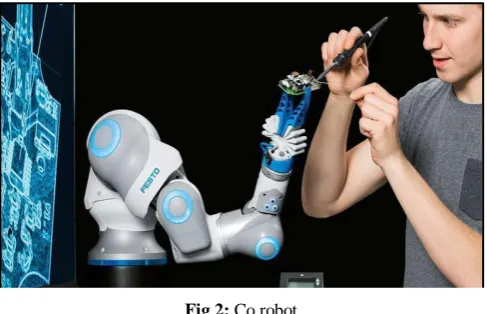
Fig 2: Co robot
protective equipment. When an operator comes into contact with the robot (e.g. loading or unloading of materials), safety control systems(e.g.lightscreen,safetymat,otherpresence detectors) would have to be present to ensure the safety of the robot's position and condition. Basically, the movement of the robot isconditional and eventually the power source is removed and the robot then stops completely. The effect ofthis slows down production.
The innovative edge in industrial robotics and automation comprises accessible and user-friendly collaborative robot solutions. The performance of the human workforce contributes to this collaboration with inherent cognitive abilities and flexibility, while the robot systems provide high speed, accuracy, precision, and repeatability. In today's high-speed, high-accuracy economy, manufacturing companies continue to champion greater efficiency, production speed, quality and occupational safety. Collaborated robots can do a great deal to protect workers while increasing productivity and reducing operating costs and associated costs.
Collaborative robotics allows manipulation of the robot's working movements so that people can share the workspace. In the same workspace, for example, robots could bring heavy slabs closer while the skilled operator marked them, though this process would have to take place. The combination of human-robot collaboration can significantly reduce downtime, increase productivity and increase safety even further.
III.Methodology A. Specification Flexibility- 4 DOF Payload-300g Reach- 300mm
End effector - Parallel jaw gripper (span-5cm) ROS interface
B. Proposed Design
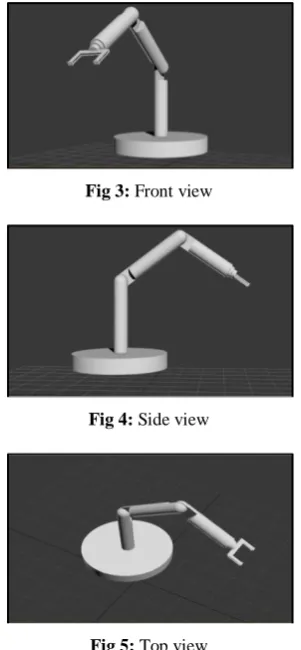
Fig 3: Front view
Fig 4: Side view
Fig 5: Top view
A. Torque Calculations
The torque of arm is calculated in order to choose the right motor for each joint of robotic arm. The torque required at each joint is calculated as a worst case scenario i.e. lifting weight at 90 degrees.
L3= 16cm L4 = 18cm W1= 0.2kg W2= 0.2kg W3= 0.6kg W4= 0.2kg
Fig 6: Free body diagram (extreme case)
M2=(L2/2)*W1+L2*W4+(L2+(L3/2))*W2+(L2+L4)*W3 =(16/2)*0.2+16*0.2+(16+(16/2))*0.2+(16+18)*0.6 =30kg.cm M3=(L3/2)*W2+L4*W3
=(16/2)*0.2+18*0.6 = 12.4kg.cm M1=I*α =(I1+I2+I3+I4+I5+I6+I7)*α =38.75*0.85
=32.9kg.cm
Where
L1 =Length of link 1 L2 =Length of link 2 L3 =Length of link 3 M1 =Torque due to motor 1 M2 =Torque due to motor 2 M3=Torque due to motor 3
I1 =Moment of inertia due to link 1 I2 =Moment of inertia due to link 2 I3 =Moment of inertia due to link 3 I4 =Moment of inertia due to motor 2 I5 =Moment of inertia due to motor 3 I6 =Moment of inertia due to motor 4 I7 =Moment of inertia due to gripper arm
IV.B. Modified Design
The design was modified after the torque calculation.
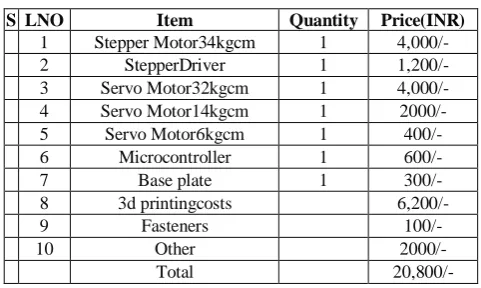
V. Cost Analysis
Table 1: Cost Analysis
S LNO Item Quantity Price(INR)
1 Stepper Motor34kgcm 1
4,000/-2 StepperDriver 1
1,200/-3 Servo Motor32kgcm 1
4,000/-4 Servo Motor14kgcm 1
2000/-5 Servo Motor6kgcm 1
400/-6 Microcontroller 1
600/-7 Base plate 1
300/-8 3d printingcosts
6,200/-9 Fasteners
100/-10 Other
2000/-Total
20,800/-I. Conclusion
At present, collaborative robots are being introduced in several vertical industries, including manufacturing, supply chain management and healthcare. Typically, they have lower power requirements than their large autonomous counterparts, are often mobile and use collision detection to avoid injury to their human counterparts.
With advances in mobile technology, machine vision, cognitive computing and touch technology, small and low-power robots can take advantage of their environment and perform various types of tasks close to their employees. When Cobot works side by side, Cobot can learn tasks quickly through demonstration and reinforcement learning.
The cobots deliberately point to this fear. A collaborative robot is not intended to improve the capabilities of the human worker, nor to replace the human worker. In many cases, the Cobot has the shape of an arm and gives the worker additional hands.
Acknowledgment
First and foremost, we wish to thank omnipotent God for his blessings.
We are grateful to Prof. Manoj George (Head of the Mechanical Department) for his support during this project. We wish to express indebtedness to our guide Prof. Anand Rajagopal (Assistant Professor of Mechanical Engineering Department) for his valuable guidance in bringing out this project.
At last, not the least we are grateful to all the faculty of Mechanical Engineering Department and our friends for their support and feedback.
References
1. Robot Operating System (ROS)Available:http://wiki.ros.org/urdf/
2. Development of collaborativerobots(COBOTS) for flexible human-integrated assembly automation Available:https://ieeexplore.ieee.org/document/5756781.
3. AFrameworkfor Collaborative Robot(CoBot)Integrationin Advanced Manufacturing Systems Available:https://www.researchgate.net/publication/301273389_A_Framework_for_Collaborative_Robot_C oBot_Integration_in_Advanc ed_Manufacturing_Systems