Evaluating the Frequency of
Arcobacter
in Fecal Samples
from Slaughterhouse Workers and Poultry Meat Sellers
in Arak City
A B S T R A C T
C I T A T I O N L I N K S A R T I C L E I N F O
Article Type
Original Research
Authors
Karamghoshchi A.MSc,
Akbari M. * PhD,
Arjomanzadegan M.PhD,
Ahmadi A.PhD
How to cite this article
Karamghoshchi A, Akbari M, Arjomanzadegan M, Ahmadi A. Evaluating the Frequency of Acrobacter in Fecal Samples from Slaughterhouse Workers and Poultry Meat Sellers in Arak City. Infection Epidemiology and .Microbiology. 2019;5(1):25-34
Microbiology Department, Infectious Diseases Research Center, Arak University of Medical Sciences, Arak, Iran
* Correspondence Address: Department of
Immunology and Microbiology, School of Medicine, Arak university of Medical Sciences, Arak, Iran
Phone: +98 9183613851- [email protected]
Article History
Received: February 4 ,2019 Accepted: April 8 ,2019 ePublished: May 30 ,2019
[1] its public health concerns and advances in... [2] Identification by 16S ribosomal RNA
gene sequencing of... [3] isolated from an estuarine sediment and... [4] Efficacy of waste -water treatment on ... [5] Comparative detection and quantification of... [6] Arcobacter butzleri an emerging enteropathogen... [7] cryaerophilus in human... [8] Arcobacter spp. at retail food from... [9] Detection of Arcobacter butzleri and Arcobacter cryaerophilus in clinical samples of humans and foods of animal origin by cultural ... [10] Isolation of Group 2 aerotolerant Campylobacter species from Thai children with diarrhea... [11] Prevalence of Arcobacter species among humans, Belgium... [12] Rao UA. Prevalence of Campylobacter jejuni and enteric bacterial pathogens among hospitalized HIV infected versus non-HIV in-fected patients with diarrhoea in southern India... [13] detection and enumeration of
Campy-lobacteraceae in irrigation water and wastewater using a miniaturized MPN-qPCR assay... [14] characterization of the emerging foodborn pathogen ... [15] Phenotypic and ribosomal
RNA characterization of Arcobacter species isolated from porcine aborted fetuses... [16] Occurrence and diversity of Arcobacter... [17] Hausdorf L, Fröhling A, Schlüter O, Klocke M. Analysis of the bacterial community within carrot wash water. Can J Microbiol... [18] Milesi S. Emerging pathogen Arcobacter spp. in food of animal origin [19] Occurrence and genetic diversity of Arcobacter spp. in a spinach-processing plant and evaluation of two
Arcobacter-specific quantitative PCR assays. .. [20]. isolated from humans and animals with diarrheal illness... [21] Occurrence of Arcobacter in Iranian poultry and slaughterhouse samples ... [22] Arcobacter butzleri, a new waterborne pathogen, to water distribution pipe surfaces... [23] detection methods for Arcobacter infections in diarrhea specimens among children under six years in ... [24] multiplex PCR assay for the simultaneous detection and
identification of Arcobacter butzleri, Arcobacter cryaerophilus and Arcobacter skirrowii... [25] A selective medium for the isolation of Arcobacter from meats... [26] Research methods for the behavioral sciences: Cengage ... [27] Prevalence of Campylobacter, Arcobacter, Heli-cobacter... [28] Induction and resuscitation of viable nonculturable Arcobacter ... [29]
Fill-ing the gaps in clinical proteomics: a do-it-yourself guide for the identification of the emerg -ing pathogen Arcobacter by... [30] Evaluation of detection methods for Campylobacter... Aims: In recent years, Arcobacter has been isolated from various samples. It can cause diseases both in human and animal and be transmitted to human through water, food, and continuous contact with poultry meat. Therefore, people exposed to the contaminated meat such as chicken meat can be exposed to Arcobacter too and as a part of its transmission route. Thus, in this study, the frequency of Arcobacter species was evaluated in slaughterhouse workers and poultry meat sellers and healthy people not exposed to the poultry meat. Materials &Methods:In the present study, 85 slaughterhouse workers and poultry meat sellers (exposed group) and 85 healthy people with other jobs (non-exposed group) were studied. By simple method, fecal samples were collected fromHealth Center of Arak city and tested by 4 methods including direct observation, culture, PCR, and m-PCR.
Findings: Campylobacter-like organisms were observed in 32 out of 85 samples from the
exposed group and in 11 out of 85 samples from the non-exposed group by microscopic
observation method. No sample was positive by culture method. However, by PCR method,
the frequency of Arcobacter strains was 20 in the exposed group and 6 in the non-exposed group. According to the m-PCR results, among the 170 samples, 21 A. cryaerophilus and 14 A.
butzleri strains were identified.
Conclusion: Chicken carcass are introduced as a main reservoir for Arcobacter; therefore,
continuous contact with poultry meat can have a significant effect on the transmission of Arcobacter strains to individuals. Therefore, this study showed that the frequency of Arcobacter strains is more in exposed group than in non-exposed group.
Introduction
Arcobacter spp. are introduced as food and water borne pathogens which can cause various diseases in humans, including gastroenteritis, bacteremia, endocarditis, peritonitis, and diarrhea [1-2] . This organism
is a Gram-negative, curved, spiral or bacilli-shaped, and non-spore forming bacterium which can move fast like a corkscrew due to
its monotrichous or amphitrichous flagella.
Its length and width are 1 to 3 µm and 0.2 to 0.9 µm, respectively [3]. Arcobacter is a new
genus introduced in 1991 by Vandamme et al. The genus Arcobacter is closely related to the Campylobacter species and a member of family Campylobacteraceae [4]. Arcobacter
can be differentiated from Campylobacter by growing in air at the temperatures of 15 to 30 °C [3]. Among its species, A. butzleri, A.
cryaerophilus, and A. skirrowii species are clinically of great importance (5). The most
common culture method for the detection of Arcobacter strains is samples enrichment with CAT broth and inoculation of enriched
samples on agar media with 5% defibrinated sheep blood by passive filtration method (size of filters 0.45 micron) [6-7] . In several
studies, molecular methods were used to detect Arcobacter spp. PCR and multiplex-PCR assays were mostly used for the detection of Arcobacter at genus and species levels, respectively [7-9]. The prevalence of
Arcobacter spp. was reported to be 57% in adult with diarrhea and 2.4% in children with diarrhea [10]. whereas this bacterium is
considered as the second cause of diarrhea after Campylobacter spp. in Iran, it is introduced as the fourth common species causing diarrhea in South Africa, Belgium, and France [11]. In a study conducted in
India, it was isolated from 1.5% of fecal specimens of HIV positive patients with diarrhea [12]. In another study, Arcobacter
spp. were isolated from stools of healthy people, especially those dealing with animal
origin products and working in slaughterhouses [13]. In this regard, in a
study conducted in Netherlands (2006), A. cryaerophilus species was found in 1.4 % of fecal samples of slaughterhouse workers, meat sellers, and healthy people not exposed to chicken meat [14]. Arcobacter spp.
can cause diarrhea, mastitis, and abortion in animals, it can be also isolated from healthy animals [15]. Animals can act as a
major reservoir and source of Arcobacter infection for humans. Animal-origin food products, contaminated vegetables, and dairy products are thought to be as the potential transmission routes for Arcobacter
[16]. Arcobacter spp. have been isolated from
various samples of chicken, pig, cow, and seafood products [17]. According to the
research, contamination rate of poultry meat is higher than red meat; thus, Arcobacter infection may be occurred in humans due to direct contact and consumption of contaminated raw meat [18].
Furthermore, water plays a main role in the contamination of vegetables and slaughtered animals during washing [19].
Approximately, 63% of diseases caused by A. butzleri are associated with the consumption of or contact with contaminated water [20]. Several studies
demonstrated the presence of A. butzleri and A. cryaerophilus species on the instruments used in slaughterhouses and chicken meat shops; therefore, cross-contamination may occur by contacting them [21]. The consecutive proliferation of
Arcobacter in slaughterhouses and chicken meat shops environment is mainly due to
the biofilm formation ability of Arcobacter strains on physical surfaces [22]. Therefore,
it is thought that slaughterhouse workers and chicken meat sellers can be mainly exposed to Arcobacter. In other words, they can act as healthy carriers for Arcobacter.
the frequency of Arcobacter strains in poultry slaughterhouse workers and poultry meat sellers.
Materials and Methods
Sample collection: This study was a
descriptive study. Sample collection was carried out during May to September 2018. A total of 170 samples were collected at Health Center of Arak city, Iran and divided into two groups of exposed and non-exposed groups. About 85 fecal samples collected from chicken meat sellers and slaughterhouse workers were included in the exposed group, and 85 fecal samples collected from individuals with other jobs were included in the non-exposed group. According to the used questionnaire, people working at slaughterhouses or poultry meat shops and not taking antibiotics were listed in the exposed group, and those having no chicken-related job and not using any antibiotics were listed in the non-exposed group.
Gram staining: Bacterial smears from
mucoid parts of stool were stained by
modified Gram staining method, in which
fuchsin 3% solution was used [23].
Isolation of Arcobacter: Fecal samples were enriched using Arco broth media containing cefoperazone, amphotericin B, and teicoplanin (CAT) antibiotics and incubated for 48 hr at 28 °C in candle jar. After that, enriched fecal samples were inoculated on Brucella agar medium containing 5% defibrinated sheep blood by passive filtration method using cellulose acetate filter membrane with pour size of 0.45 µm. Afterwards, the plates were incubated for 48 hr at 28 °C in candle jar [7].
Quality control of culture media: In order to control the quality of culture media, Arcobacter strains isolated from chicken specimens were used. They were cultivated according to the mentioned principles.
DNA extraction: DNA extraction from direct
fecal samples was carried out by a
commercial kit (FAVORGEN, Taiwan)
through cellulose acetate columns.
Genus specific-PCR: 16SrRNA gene was targeted to identify Arcobacter strains in genus level by PCR [23]. Arc1
(5’AGAACGGGTTATAGCTTGCTAT3’) and Arc2 (5’GATACAATACAGGCTAATCTCT3’) were used as primers. PCR mixture was prepared in a
final volume of 15 μl containing 1.5 μl of DNA template, 7.5 μl of Master Mix Super-PCR (Yekta Tajhiz Azma Co.), 0.7 μl of each primers, and 4.6 μl of water with molecular
grade. PCR was performed in thermal cycler (Eppendorf, Germany) under the following conditions: an initial denaturation at 94 °C for 5 min, followed by 28 cycles including denaturation step at 94 °C for one min, annealing step at 52.7 °C for 55 sec, extension
step at 72 °C for 55 sec, and a final extension
step at 72 °C for 8 min. The Genome obtained from Arcobacter colonies was used as positive control, and distilled water with molecular grade was utilized as negative control. The PCR product was checked using gel electrophoresis (padideh nojen, Iran).
Specific-PCR (m-PCR): This method was
used to identify three important Arcobacter species [24]. Specific primers of each species
are shown in Table 1. The PCR mixture was
prepared in a final volume of 15 μl containing 3 μl of DNA template, 6.2 μl of Master Mix Super-PCR (Yekta Tajhiz Azma Co.), 0.7 μl of each primers, and 4.4 μl of distilled water
with molecular grade. PCR was performed in thermal cycler (Eppendorf, Germany) under the following conditions: an initial denaturation at 94 °C for 5 min, followed by 35 cycles including denaturation step at 94 °C for one min, annealing step at 52.7 °C for 55 sec, extension step at 72 °C for 1 min, and
final extension step at 72 °C for 10 min. PCR
Table 1) Characteristics of Specific primers used to determine Arcobacter species
references annealing
Product size (bp) Target gene
Sequence (5′ to 3′) Name of
the primer
(25) 52.7° C
181
16SrRNA (genus)
AGAACGGGTTATAGCTTGCTAT GATACAATACAGGCTAATCTCT Arc 1 (F)
Arc 2 (R)
(30) 52.7° C
401
16SrRNA (butzleri)
CCTGGACTTGACATAGTAAGAATGA CGTATTCACCGTAGCATAGC Butz (F)
Arco (R)
(30) 52.7° C
257
23SrRNA
(cryaerophilus) CAGAGGAAGAGAAATCAAAT
CCCACTATTCCATCAGTGAG CryF (F)
CryR (R)
(25) 52.7° C
198
23SrRNA (skirrowii)
TCAGGATACCATTAAAGTTATTGATG GCYAGAGGAAGAGAAATCAA SkiR (R)
ArcoF(F)
Findings
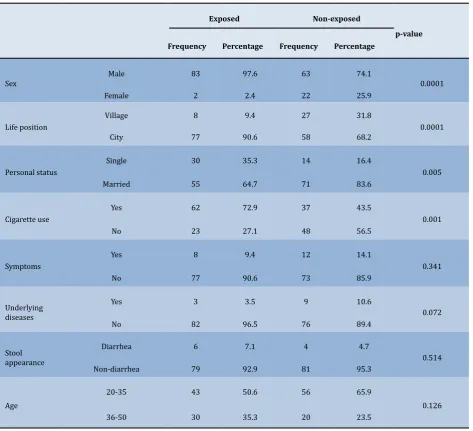
Sample collection: Demographic information of both groups are shown in Table 2.
Table 2) Shows the frequency distribution of the characteristics of individual in each group based on the questionnaire
Exposed Non-exposed
p-value Frequency Percentage Frequency Percentage
Sex Male 83 97.6 63 74.1 0.0001
Female 2 2.4 22 25.9
Life position
Village 8 9.4 27 31.8
0.0001
City 77 90.6 58 68.2
Personal status
Single 30 35.3 14 16.4
0.005
Married 55 64.7 71 83.6
Cigarette use
Yes 62 72.9 37 43.5
0.001
No 23 27.1 48 56.5
Symptoms
Yes 8 9.4 12 14.1
0.341
No 77 90.6 73 85.9
Underlying diseases
Yes 3 3.5 9 10.6
0.072
No 82 96.5 76 89.4
Stool appearance
Diarrhea 6 7.1 4 4.7
0.514
Non-diarrhea 79 92.9 81 95.3
Age
20-35 43 50.6 56 65.9
0.126
Gram staining: According to the microscopic observations, of 85 fecal samples collected from the exposed group, 32 (37.64%) cases were positive for Campylobacter-like organisms,and among the 85 fecal samples collected from the non-exposed group, 11 (12.94%) cases were reported as positive (Figure 1).
Figure 1) Gram stained bacterial smear from stool
samples indicates Campylobacter like-organisms (curved, bacilli and gram negative organisms)
Culture: In all samples, no colony was grown.
Genus-specific PCR: PCR results showed that of 85 fecal samples collected from the exposed group, 20 (23.5%) samples were positive, and of 85 samples collected from the non-exposed group, 6 (7.5%) samples were positive (Figure 2).
Figure 2) Agarose gel electrophoresis of Genus
specific-PCR product (181bp): 31,41,43,45,51 lanes belong to slaughterhouse workers’ samples, 48.68.70 lanes are samples of unexposed group and 68.70 lanes are related to chicken meat sellers’ samples and C- lane is as negative controls. The Ladder size is 50bp (Yekta Tajhiz Azma Co.).
Species-specific PCR: Species-specific PCR
indicated that in the exposed group, A. cryaerophilus species was detected in 9 (10.58%) samples, A. butzleri species was detected in 4 (4.70%) samples, and both A. cryaerophilus and A. butzleri species were detected in 7 (8.23%) samples. In the non-exposed group, A. cryaerophilus species was detected in 3 (3.52%) samples, A. butzleri species was detected in 1 (1.17%) sample, and both species were detected in 2 (2.35%) specimens. No A. skirrowii species was detected in fecal samples (Figure 3).
Figure3) the results of m-PCR on agarose gel
electrophoresis. Lanes: 1: A.butzleri (401bp), 2: A.
cryaerophilus (258bp), 3: Negative control, 4:both, 5:
Ladder with size of 50bp (Yekta Tajhiz Azma Co.).
Statistical analyses: All data were
statistically significant (p<0.005).
Discussion
humans and animals. In addition to diarrhea and bacteremia, it also causes diseases in animals. However, some studies conducted worldwide reported the presence of Arcobacter species in raw meat, especially poultry meat, and emphasized that continuous contact with contaminated meat may be a potential transmission route of Arcobacter to humans [25].
It is assumed that poultry slaughterhouse workers or chicken meat sellers who are exposed to poultry carcasses can be as the potential carriers for Arcobacter. Therefore, this study aimed to detect Arcobacter species in fecal specimens of people exposed to and non-exposed to the chicken meat. In the present study, the frequency distribution of smoking in two groups was statistically
significant, and the ratio of smoking
frequency was higher in the exposed group. Based on the direct microscopic observation of smears from symptomatic people in
different studies, modified Gram straining
method is considered as one of the main methods to identify Arcobacter species, in which the use of 3% fuchsin instead of normal fuchsin for 1-2 min is usually suggested. It can improve the Arcobacter strains observation because they can be observed as Gram negative with a weak tonality (sometimes like-shadow) and spiral, making them to be reported as Campylobacter-like organisms. Sensitivity
and specificity of this method are very high.
In the present study, according to the direct observations results,, Campylobacter-like organisms were observed in 32 (37.64%) smears belonging to exposed group, whereas they were observed in 11 (12.94%) smears belonging to non-exposed group. Data were
statistically significant in both groups, and
the frequency of the positive results was higher in the exposed group.
In a study by Khalili et al. (2018) in Iran, from among the 150 fecal samples collected
from people with diarrhea, Campylobacter-like organisms were observed in 79 smears
[23]. This technique depends on laboratory
expert’s experience, which can be the reason for variability in various studies results [26].
In other studies, the studied population mainly included asymptomatic healthy people and patients named symptomatic people; however, asymptomatic individuals were divided into two groups of exposed and non-exposed to bacteria, they were participated to be used as criteria to compare the results of groups. But the present study focused on asymptomatic people divided into exposed and non-exposed groups, in which the poultry slaughterhouses workers and chicken meat sellers were included in exposed group. In the present study, no Arcobacter species was isolated using culture method. In a study by Houf et al. (2006) in Switzerland, from a total of 501 fecal specimens collected from asymptomatic people, Arcobacter strains were isolated only from 7 (1.4%) samples using enriched culture [14]. In another study by Enberg et al.
in Denmark (2000), no Arcobacter strain was isolated from 107 healthy individuals by culture method [27]. The frequency of culture
positive results of asymptomatic healthy people in other studies was also very low, and in some studies, it even reached nearby zero; Arcobacter susceptibility to antimicrobial agents existing in these culture media is probably one of its reasons. Fera et al. (2008) suggested that the low level of Arcobacter detection in fecal specimens using enriched culture media may be due to
the competition of normal flora with
Arcobacter strains [28]. Other studies also
similarly confirmed the defective specificity
of culture media to isolate A. butzleri isolates from stool specimens. According to the
genus-specific PCR results, of 26 positive
samples belonged to the non-exposed group.
Data were statistically significant, and the
frequency of positive results in the exposed group was higher. In a study by Webb et al. (2016) in Canada, using PCR, the prevalence of Arcobacter strains was reported as 60% among the 1482 patients and 88 asymptomatic healthy people. In their study, Arcobacter spp. were found in 57% and 46% of patients and asymptomatic healthy
people, respectively, confirming the present
study results [5]. In the present study,
Campylobacter-like organisms were observed in 43 direct Gram-stained smears. However, the presence of Arcobacter strains
was confirmed just in 13 smears using PCR.
If PCR is considered as a gold standard, the
sensitivity and specificity of the Gram
staining method for detecting Arcobacter species in asymptomatic individuals were 50% and 71.17%, respectively. In a study by Khalili et al. (2017) in Iran, among the 79 Gram-stained smears from symptomatic individuals who were positive for Campylobacter-like organisms, 28 smears
were identified as Arcobacter using PCR. In
their study, the sensitivity and specificity of
the Gram staining method for detecting Arcobacter spp. were 100% and 65.5%, respectively […]. However, it should be noted
that all positive smears are not always related to the Arcobacter species, since Gram-negative, curved, and spiral-shaped bacteria in smears are reported as Campylobacter-like organisms, including Campylobacter, Arcobacter, and Helicobacter spp. [23]. According to the multiplex-PCR
results, from among 170 samples, 21 (12.35%) A. cryaerophilus and 14 (8.22%) A. butzleri strains were identified. Among the
exposed group, A. cryaerophilus species was
identified in 9 samples, A. butzleri species
was identified in 4 samples, and both species were identified in 7 samples, while in the
non-exposed group, A. cryaerophilus species
was identified in 3 samples, A. butzleri
species was identified in 1 sample, and both species were identified in 2 samples. No A. skirrowi species was detected in samples. In a study by Houf et al. (2006), Arcobacter strains were detected in 7 out of 501 healthy individuals’ stool samples, all of which were
identified as A. cryaerophilus [14]. In another
study by Khalili et al. (2018) in Iran, from a total of 230 diarrheal samples collected from symptomatic individuals, 26 (11.30%) cases
were identified as A. butzleri, 13 cases as A. cryaerophilus, and 5 cases as A. skirrowii [23].
Arcobacter different detection levels reported in different studies can be associated with different factors, including geographical variations, seasonal variations, health conditions in different locations, the number of microorganisms in samples under study, and difference in sensitivity
and specificity of isolation methods used [29].
Despite the lack of colony growth on the media and limitations in access to healthy exposed people during sample collection,
DNA-based methods were more suitable to
detect Arcobacter and its distinct species.
Conclusion
Poultry raw meat can be a very important reservoir for the transmission of Arcobacter to humans. Consequently, workers’ and Sellers’ direct contact with poultry raw meat in slaughterhouses and shops and smoking
during work could have a significant effect
on the transmission of this bacterium to them and probably on making them as the Arcobacter carriers. Therefore, poultry slaughterhouse workers and chicken meat sellers can be healthy while potentially Arcobacter carriers. Accordingly, there is a possibility of these bacteria transmission from these individuals to healthy poultry meat or to healthy individuals. In addition,
identification and treatment of asymptomatic
contamination can reduce this bacterium prevalence in population. It is suggested that direct observation method be used as a very effective method to diagnose Arcobacter strains in healthy people, and PCR as a method making Arcobacter detection fast.
Acknowledgements: The authors would
like to thank the staff of Infectious Diseases Research Center of Arak University of Medical Sciences for their help to this study. The authors would also like to thank the staff of Health Center of Arak City for assisting in sampling. This study is performed in Arak University of Medical Sciences.
Conflicts of interest: The authors express
they have no conflict of interests.
Ethical Permissions: This study was
performed by IR.ARAKMU.REC.1396.248 Etichs number.
Authors’ Contributions: All authors had equal roles in this research.
Funding/Support: There was no
competition for financial interests.
References
1. Ramees TP, Dhama K, Karthik K, Rathore RS, Kumar A, Saminathan M, et al. Arcobacter: An emerging food-borne zoonotic pathogen, its public health concerns and advances in diagnosis and control–a comprehensive review. Vet Q. 2017;37(1):136-61.
2. Lau S, Woo P, Teng J, Leung K, Yuen K.
Identification by 16S ribosomal RNA gene
sequencing of Arcobacter butzleri bacteraemia in a patient with acute gangrenous appendicitis. Mol Pathol. 2002;55(3):182.
3. Jyothsna TS, Rahul K, Ramaprasad E, Sasikala C, Ramana CV. Arcobacter anaerophilus sp. nov., isolated from an estuarine sediment and emended description of the genus Arcobacter. Int J Syst Evol Microbiol. 2013;63(12):4619-25.
4. Webb AL, Taboada EN, Selinger LB, Boras VF, Inglis GD. Efficacy of wastewater
treatment on Arcobacter butzleri density and strain diversity. Water Res. 2016; 105:291-6.
5. Webb AL, Boras VF, Kruczkiewicz P,
Selinger LB, Taboada EN, Inglis GD. Comparative detection and quantification of
Arcobacter butzleri in stools from diarrheic and non-diarrheic human beings in southwestern Alberta, Canada. J Clin Microbiol. 2016; 54 (4): 1082-8.
6. Fernández H, Krause S, Paz Villanueva M. Arcobacter butzleri an emerging enteropathogen: Communication of two cases with chronic diarrhea. Braz J Microbiol. 2004; 35 (3): 216-8.
7. Fernandez H, Villanueva MP, Mansilla I, Gonzalez M, Latif F. Arcobacter butzleri and A. cryaerophilus in human, animals, and food sources, in southern Chile. Braz J Microbiol. 2015; 46 (1): 145-7.
8. Vicente-Martins S, Oleastro M, Domingues FC, Ferreira S. Arcobacter spp. at retail food from Portugal: Prevalence, genotyping, and antibiotics resistance. Food Control. 2018; 85: 107-12.
9. Ramees TP, Rathore RS, Bagalkot PS, Mohan HV, Kumar A, Dhama K. Detection of Arcobacter butzleri and Arcobacter cryaerophilus in clinical samples of humans and foods of animal origin by cultural and multiplex PCR based methods. Asian J Anim Vet Adv. 2014;9: 243-52.
10. Taylor DN, Kiehlbauch JA, Tee W,
Pitarangsi C, Echeverria P. Isolation of Group 2 aerotolerant Campylobacter species from Thai children with diarrhea. J Infect Dis. 1991;163(5):1062-7.
versus non-HIV infected patients with diarrhoea in southern India. Scand J Infect Dis. 2007;39(10):862-6.
13. Banting GS, Braithwaite S, Scott C, Kim J,
Jeon B, Ashbolt N, et al. Evaluation of various Campylobacter-specific qPCR assays for
detection and enumeration of Campylobacteraceae in irrigation water and
wastewater using a miniaturized MPN-qPCR
assay. Appl Environ Microbiol. 2016:82(15);4743-4756.
14. Houf K, Stephan R. Isolation and characterization of the emerging foodborn pathogen Arcobacter from human stool. J Microbiol Methods. 2007;68(2):408-13.
15. Schroeder-Tucker L, Wesley IV, Kiehlbauch JA, Larson DJ, Thomas LA, Erickson GA.
Phenotypic and ribosomal RNA
characterization of Arcobacter species isolated from porcine aborted fetuses. J Vet Diagn Invest. 1996; 8 (2): 186-95.
16. Collado L, Kasimir G, Perez U, Bosch A, Pinto R, Saucedo G, et al. Occurrence and diversity of Arcobacter spp. along the Llobregat River catchment, at sewage
effluents and in a drinking water treatment
plant. Water Res. 2010;44 (12): 3696-702. 17. Hausdorf L, Fröhling A, Schlüter O, Klocke M. Analysis of the bacterial community within carrot wash water. Can J Microbiol. 2011; 57 (5): 447-52.
18. Milesi S. Emerging pathogen Arcobacter spp. in food of animal origin. 2011.
19. Hausdorf L, Neumann M, Bergmann I,
Sobiella K, Mundt K, Fröhling A, et al. Occurrence and genetic diversity of Arcobacter spp. in a spinach-processing plant and evaluation of two
Arcobacter-specific quantitative PCR assays. Syst Appl
Microbiol. 2013;36(4):235-43.
20. Kiehlbauch J, Brenner D, Nicholson M,
Baker C, Patton C, Steigerwalt A, et al. Campylobacter butzleri sp. nov. isolated from humans and animals with diarrheal illness. J Clin Microbiol. 1991;29(2):376-85.
21. Khoshbakht R, Tabatabaei M, Shirzad
Aski H, Seifi S. Occurrence of Arcobacter in
Iranian poultry and slaughterhouse samples implicates contamination by processing equipment and procedures. Brit Poultry Sci. 2014;55(6):732-6.
22. Assanta MA, Roy D, Lemay M-J, Montpetit D. Attachment of Arcobacter butzleri, a new waterborne pathogen, to water distribution pipe surfaces. J Food Prot. 2002;65(8):1240-7.
23. Dermani K, Akbari M. Evaluation of detection methods for Arcobacter infections in diarrhea specimens among children under six years in Arak City. Infection, Epidemiol Microbiol. 2017;3(4):127-31.
24. Houf K, Tutenel A, De Zutter L, Van Hoof J, Vandamme P. Development of a multiplex PCR assay for the simultaneous detection
and identification of Arcobacter butzleri,
Arcobacter cryaerophilus and Arcobacter skirrowii. FEMS Microbiol Lett. 2000;193(1):89-94.
25. De Boer E, Tilburg J, Woodward D, Lior H, Johnson W. A selective medium for the isolation of Arcobacter from meats. Lett Appl Microbiol. 1996;23(1):64-6.
26. Gravetter FJ, Forzano L-AB. Research methods for the behavioral sciences: Cengage Learning; 2018.
27. Engberg J, On SL, Harrington CS, Gerner-Smidt P. Prevalence of Campylobacter, Arcobacter, Helicobacter, Andsutterella spp. in human fecal samples as estimated by a reevaluation of isolation methods for campylobacters. J Clin Microbiol. 2000; 38(1): 286-91.
28. Fera MT, Maugeri TL, Gugliandolo C, La Camera E, Lentini V, Favaloro A, et al. Induction and resuscitation of viable nonculturable Arcobacter butzleri cells. Appl Environ Microbiol. 2008; 74(10): 3266-8.
guide for the identification of the emerging
pathogen Arcobacter by matrix-assisted laser
desorption ionization-time of flight mass
spectrometry. J Microbiol Meth. 2018; 152: 92-7.
30. Mushi MF, Paterno L, Tappe D, Deogratius
AP, Seni J, Moremi N, et al. Evaluation of
detection methods for Campylobacter
infections among under-fives in Mwanza