Development of Alternative Roofing System by Using
Ferrocement Channel
Swapnil Somnath Gaikwad1, Abdulrashid Chand Attar2 1
P.G Scholar, Department of Civil Engineering, Rajarambapu Institute of Technology, Rajaramnagar, Sakharale (Islampur),Tal. Walwa, Dist. Sangli-415414
2
Dean (Quality Assurance), Department of Civil Engineering, Rajarambapu Institute of Technology, Rajaramnagar, Sakharale (Islampur),Tal. Walwa, Dist. Sangli-415414
[email protected] [email protected]
Abstract -The cost of construction is rising day by day due to increasing cost of basic building materials such as steel, sand, cement, brick, timber and labour. The cost of construction using conventional building materials and construction techniques are not economical particularly for low income groups of population as well as middle income groups. Therefore there is a need to develop a cost effective construction technique either by up-gradation conventional technique or by applying new technique. This paper compares construction cost of ferrocement roofing channel system to conventional roofing system. This roofing system is design as a segmental element, which is very easy to cast, cure and then manually erect over the bearing walls. The strength and rigidity are developed through this roofing system and it is cost effective. Hence it is ideally suited for prefabricated construction particularly for low cost housing.
Keyword - Chicken mesh, Cost effective, Ferrocement channel, Weld mesh.
1. I
NTRODUCTIONFerrocement is a form of reinforced concrete that differs from conventional reinforced concrete primarily by the manner in which the reinforcing elements are dispersed and arranged. It consists of closely spaced, multiple layers of mesh or fine rods completely embedded in cement mortar. A composite material is formed that behaves differently from conventional reinforced concrete in strength, deformation, and potential applications, and thus is classified as a separate and distinct material. Unlike conventional concrete, ferrocement reinforcement can be assembled into its final desired shape and the mortar can be plastered directly in place without the use of a formwork.
Welded mesh, mild steel angles or bars are used for forming skeleton, while chicken mesh, square mesh or expanded metal are used as mesh reinforcement. Mortar mix may be (1:1.5) to (1:4) by volume. With ferrocement it is possible to fabricate a variety of structural elements, may be used in foundations, walls, floors, roofs, shells
high degree of impermeability. Applications of ferrocement is in all field of civil construction, including water and soil retaining structures, building components, space structures of large size, bridges, water tank, domes, dams, boats, conduits etc.
2.
H
ISTORYFerro-cement is the name given by Italian Professor Pier Luigi Nervi to a thin slab of mortar reinforced with superimposed layers of wire mesh and small diameter bars. The result is a product with a high degree of elasticity and resistance to cracking which can be cast without the use of formwork. Nervi successfully proved on many jobs the remarkable strength and lightness of this method of construction and its great adaptability to any shape. The end result of Nervi’s experiments was a medium in which the thickness of a finished slab was only a very little greater than that of the assembled layers of mesh, the difference being only as much as was necessary to provide adequate cover for the steel. This Ferro-cement was found on testing to have very little in common with normal reinforced concrete, however, since it possesses the mechanical characteristics of a completely homogeneous material. ACI Committee 549, Ferrocement and other thin Reinforced Products, was organized in 1974 and was given the mission to study and report on the engineering properties, construction practices, and practical applications of ferrocement and to develop guidelines for ferrocement construction.
3. H
OUSINGP
ROBLEMCopyright © 2014 CTTS.IN, All right reserved
4. A
DVANTAGES OFF
ERROCEMENTFerrocement is a suitable technology in developing countries for the following reasons:
1. Its basic raw materials are readily available in most countries.
2. It can be fabricated into any desired shape. 3. The skills for ferrocement construction can be
acquired easily.
4. Heavy plants and machinery are not involved in ferrocement construction.
5. In case of damage, it can be repaired easily. 6. Being labor intensive, it is relatively
inexpensive in developing countries.
7. Less use of cement and steel for any section compared with RCC, with corresponding reduction in self weight.
8. This technique dose not required any scaffolding, shuttering or a concrete mixer or a vibrator.
5. D
ESIGN ANDC
ONSTRUCTIONP
ROCESSDetails of section
Fig. 1 Section of Ferrocement Channel
Dimensions:
Length : 3 m Width : 400 mm Height : 150 mm Thickness: 25 mm
Steel reinforcement : 2 tor steel rods 8mm at bottom
1 tor steel rod 6mm or 8mm at top
Mesh Reinforcement : 22gage GI hexagonal mesh (Two layers)
Water/Cement ratio : 0.45 Cement/Sand : 1/2 Curing period : 21days Manufacturing time : 3hrs.
Weight : 30kg/running meter
5.1. Mould Preparation
Steel mould: If steel mould used for manufacturing of concrete pipe is easily available then it is used for manufacturing of roofing channel or manufacture the steel mould for channel that have to be casted but it is expensive.
Fig. 2 Steel mould
Mud mould: This is permanent fixed construction built up with the help of mud and bricks in to the shape of roofing channel. After preparing of desired shape the whole construction is coated with cement mortar of about 10 mm thickness proper curing is required in order not to develop cracks during the casting periods of roof channel. The curing of construction is over the entire surface of the mould is cleaned with sand paper and coated with engine oil; this procedure is repeated until the cement stops absorbing the oil. Now the mud mould is ready for continuous casting of ferrocement roof channels.
5.2. Steel and Mesh Preparation
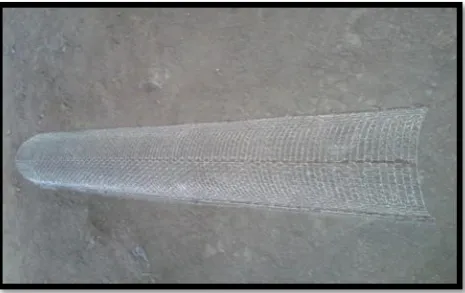
The two bottom steel rods either 8, 10 or 12mm thickness. It changes according to the span of the channel and load taken on channel. One top steel rods of 6 or 8mm thickness are used. Weld mesh and chicken mesh are tied with the help of binding wire to the steel rods longitudinally.
5.3. Casting procedure
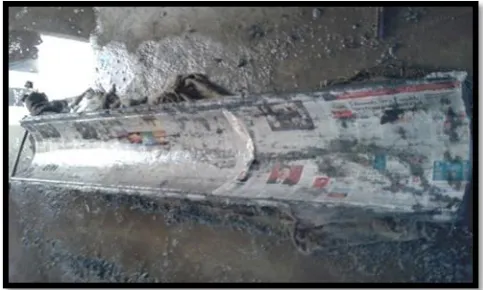
1. The steel mould is lightly coated with waste engine oil. After that news papers are laid on mould.
2. The total amount of mortar required is prepared with ratio of water/ cement/ sand as 0.45:1:2 3. The first layer of mortar mix is applied on top of
the mould already coated with waste engine oil and news paper. This mortar mix is evenly spread out over whole surface of the mould. 4. The prepared steel and mesh frame is placed on
the first layer of cement mortar.
5. The second and final layer of cement mortar is applied over the steel and mesh frame. Several irregular lines are made on the lower portion of both sides of roofing channel in order to facilitate the bonding process with the concrete mix while joining the channel together. If the channel is used as roof, some final polishing is done with the mason’s trowel. This is not necessary in case roof channel is used as floor or filled up for heat insulation.
6. After the casting the channel is left for four days on mould.
5.4. Demoulding Procedure
The demoulding of the roof channel is done after 48 hours (with more handling experience one can even try to demould on the very next day) For this purpose, the specially made small gaps in the bottom of the mould for an easy grip during the demoulding – are opened by removing the mud. The roof channel is slightly lifted on one side by using the gaps right under the border of the element, the other side is lifted and in the next move the whole channel is carried to the curing space.
Fig. 4 Demoulding of Ferrocement Channel
5.5. Curing Procedure
We use for curing the left over “waste” material from the fiber husk of the coconut shell, also called “coir dust”. This material is light, easy to apply and to remove and has great water retention capacity which is an excellent quality for curing practices. Other material, like sand or
This procedure ensures that there is sufficient moisture on the inside of the roof channel during the whole curing period. The curing medium is kept moist all the time and never allowed to dry out. One should keep watering accordingly. Curing may also be done by any other appropriate method for curing cement elements. A curing period of minimum 7 days to maximum 10 days is recommended.
Fig. 5 Curing of Ferrocement Channels
5.6. Installation Procedure
1. Care should be taken while handling the channels and sufficient people to lift the channels. Normally two people per running meter are sufficient.
2. The lifting on top of the wall is usually done with the help of small scaffolding.
3. The dimensions of the roof channel define the size of the roof/floor of the building. Allowance for the gap between the channels during installation is calculated.
4. The channels are placed next to each other and the valley between these channels is filled with concrete mix 1:2:4 and finishing is done. 5. Proper curing practice or method should be
applied at least 7 days since the structure has to function as roof, proper curing of the joined channels is the most important.
6. In case of floor application a brick border is provided around the entire floor structure, with height corresponding to chosen thickness of the overall filling.
7. The valleys can also be used for laying of conduit pipes for electricity prior to filling them up.
Copyright © 2014 CTTS.IN, All right reserved Fig .6 Finished Ferrocement Roofing Channel
6. C
OSTA
NALYSISTable 1 Cost analysis for single ferrocement channel
Item Qty. Rate Amount (Rs.)
Steel 3.55 kg 46/kg 164
Chicken mesh
36 sq. ft. 5.5/sq. ft 198
Cement 0.5 bag 300/bag 150
sand 0.035 cu. m 4500/brass 56
Labour (skill)
1 125/3hr. 125
(semi-skill) 2 80/3hr. 160
Total 853
Contingencies, Tools and plants charges (Add 2% in
total)
900
Therefore cost for 3m ferrocement roofing channel roofing = 900 Rs.
Consider Room size: 10ft. × 10ft. No. of ferrocement channel required = 8 Cost of channels required =8×900
=7200 Rs.
Cost of gap filling between channels and installation=1000Rs.
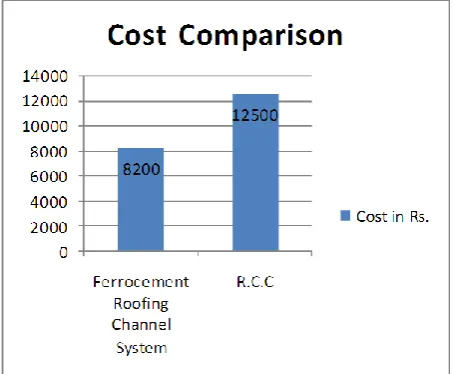
Total cost required for 100sq. ft. =8200 Rs.
Therefore Total cost using ferrocement channel roofing system = 82 Rs. /sq. ft
Total cost using conventional (R.C.C) roofing system = 125 Rs. /sq. ft
Therefore % saving = 35%
Graph 1 Cost Comparison
Concluding Remark
From the cost analysis it is conclude that Ferrocement channels casted using chicken mesh are 35% cheaper than conventional roofing systems (R.C.C) and also the weight of ferrocement roofing channel system is less than the conventional roofing system. If chicken mesh is replaced by weld mesh then cost as well as weight of the channel increases. Channel casted using chicken mesh and channel casted using weld mesh gives nearly similar strength so channel casted using chicken mesh is preferred.
7. T
ESTING OFF
ERROCEMENTC
HANNELGraph 2 Load Vs Deflection
Actual Deflection = 6.7 mm
Allowable Deflection = 3000/250
= 12 mm …….Hence safe
8. C
ONCLUSIONFerrocement channel is efficient for flooring/roofing system with many advantages that it is viable option for low cost housing. This is very suitable alternative technique to conventional roof. It is very easy to cast and cure then manually erected over the bearing walls. These channels are 30 to 35% cheaper than conventional roofing systems. It can be produce on commercial scale also and sold directly to contractors and builders like precast members.
A
CKNOWLEDGMENTI would like to thank Dr. A. C. Attar, all technical and non technical staff for continuous guiding and helping for completion of this project.
R
EFERENCE[1] A. K. Jain and M. C. Paliwal, “Adoption of Appropriate and Cost Effective Technologies in Housing: Indian Experience” World Academy of Science, Engineering and Technology, 2012, Vol. 63, pp.206-208
[2] ACI Committee 549, “State-of-the-art report on Ferrocement”, ACI549-R97, in Manual of Concrete Practice, ACI, Detroit, 1997, pp.26 [3] ACI committee 549-1R-88, “Guide for design
construction and repair of ferrocement,” ACI 549-1R-88 and 1R-93, in Manual of Concrete Practice, ACI, Detroit, 1993, pp.27
[4] B. V. Venkatarama Reddy, “Sustainable Building Technologies”, Current Science, October 2004, Vol.87, No.7, pp.899-907
[5] B. V. Venkatarama Reddy and K. S. Jagadish, “Emboided Energy of comman and alternative building materials and technologies”, Energy and Buildings, Vol.35, 2003, pp.129-137
[6] Nagesh M. Kulkarni, D. G. Gaidhankar, “Analysis and design of ferrocement panels an experimental study”, IJIES, volume-1, Issue-5, April 2013, pp.1-8
[7] S. F. Ahmad, “Precast Ferrocement Barrel Shell Planks as Low Cost Roof”, Taylor & Francis Group, London, 2010, pp.645-649
[8] Vivian W. Y. Tam, “Cost Effectiveness of using Low Cost Housing Technologies in Construction”, Science Direct Procedia Engineering, Vol.14, 2011, pp.156-160
[9] Wail N Al-Rifaie, Azad Ahmed, “Experimental Investigation on Thin ferrocement Structures”, IJEAT, volume-3, Issue-2, December 2013, pp.373-377
[10] Dr. B. N. Divekar (2012), “ferrocrete Technology- A construction Manual”, pp.1-15
[11] K.S. Jagadish, B.V. Venkatarama Reddy and K. S. Nanjunda Rao “Alternative Building Material and Technologies”, 2007, pp.160-184 and 108-112 [12] K. Chandrashekhara, “Analysis of Thin Concrete