every month at a reasonably rapid rate at www.threatenedtaxa.org. All articles published in JoTT are registered under Creative Commons Attribution 4.0 International License unless otherwise mentioned. JoTT allows allows unrestricted use, reproduction, and distribution of articles in any medium by providing adequate credit to the author(s) and the source of publication.
www.threatenedtaxa.org
ISSN 0974-7907 (Online) | ISSN 0974-7893 (Print) Building evidence for conservation globally
Journal of Threatened Taxa
For Focus, Scope, Aims, Policies, and Guidelines visit https://threatenedtaxa.org/index.php/JoTT/about/editorialPolicies#custom-0 For Article Submission Guidelines, visit https://threatenedtaxa.org/index.php/JoTT/about/submissions#onlineSubmissions For Policies against Scientific Misconduct, visit https://threatenedtaxa.org/index.php/JoTT/about/editorialPolicies#custom-2 For reprints, contact <[email protected]>
Communication
Habitat suitability modeling of Asian Elephant
Elephas maximus (Mammalia: Proboscidea: Elephantidae)
in Parsa National Park, Nepal and its buffer zone
Puja Sharma, Hari Adhikari, Shankar Tripathi, Ashok Kumar Ram & Rajeev Bhattarai
26 October 2019 | Vol. 11 | No. 13 | Pages: 14643–14654 DOI: 10.11609/jott.4467.11.13.14643-14654
Partner
Member
Publisher & Host
OPEN ACCESSCommunica
tion
DOI:https://doi.org/10.11609/jott.4467.11.13.14643-14654
Editor: L.A.K. Singh, Bhunaneswar, Odisha, India Date of publication: 26 October 2019 (online & print) Manuscript details: #4467 | Received 02 August 2018 | Final received 27 June 2019 | Finally accepted 18 September 2019
Citation:Sharma, P., H. Adhikari, S. Tripathi, A.K. Ram & R. Bhattarai (2019).Habitat suitability modeling of Asian Elephant Elephas maximus (Mammalia: Proboscidea: El
-ephantidae) in Parsa National Park, Nepal and its buffer zone. Journal of Threatened Taxa 11(13): 14643–14654; https://doi.org/10.11609/jott.4467.11.13.14643-14654
Copyright: © Sharma et al. 2019. Creative Commons Attribution 4.0 International License. JoTT allows unrestricted use, reproduction, and distribution of this article in any medium by adequate credit to the author(s) and the source of publication.
Funding: None.
Competing interests:The authors declare no competing interests.
For Author details & Author contribution see end of this article.
Acknowledgements: Permission for the study was acquired from the Department of National Park and Wildlife Conservation, the government of Nepal. We would
like to thank Hari Bhadhra Acharya (Chief Conservation Officer, Parsa National Park (PNP) for his support during this study. This article is based on the bachelor thesis submitted to Agriculture and Forestry University, Faculty of Forestry, Hetauda, Nepal in partial fulfillment of the requirements for the degree of Bachelor of Forestry Science. Anonymous reviewers and the Journal Editor are thanked for useful insights and comments that helped improve this work.
Habitat suitability modeling of Asian Elephant
Elephas maximus (Mammalia: Proboscidea: Elephantidae)
in Parsa National Park, Nepal and its buffer zone
Puja Sharma 1 , Hari Adhikari 2 , Shankar Tripathi 3 , Ashok Kumar Ram 4 & Rajeev Bhattarai 5
1,3 Faculty of Forestry, Agriculture and Forestry University, Hetauda, Nepal.
2 Earth Change Observation Laboratory, Department of Geosciences and Geography, University of Helsinki, Finland. 2 Institute for Atmospheric and Earth System Research, Faculty of Science, University of Helsinki, Finland. 4 Conservation Officer, Department of National Parks and Wildlife Conservation Nepal.
5 Tribhuvan University, Institute of Forestry, Pokhara, Nepal.
1 [email protected] (corresponding author), 2 [email protected], 3 [email protected], 4 [email protected], 5 [email protected]
Abstract: Asian Elephants Elephas maximus in Nepal are known to have habitats and movement corridors in Parsa National Park (PNP) and its buffer zone (BZ), located east of Chitwan National Park. A study was conducted in this area to assess the suitability of PNP and BZ as elephant use areas, and to determine factors relevant to the presence of elephants in PNP. Field measurements were carried out in 67 plots for vegetation analysis. Boosted Regression Tree (BRT) analysis was used to examine the relationship of habitat suitability and variables including topography (slope, aspect, altitude), climate (precipitation, temperature), habitat preference, ground cover and crown cover. The results indicate that elephant habitat suitability is mainly determined by the dominant plant species, temperature, altitude, habitat preference and precipitation. Slope, ground cover, crown cover and substrate have lesser effects. Elephants were recorded up to 400m in the northeast and southeast aspects of the study area. Most suitable habitats were low slope forest dominated by Acacia catechu
and Myrsine semicerate that received 300mm annual precipitation. The model emphasizes environmental suitability, and contributes to knowledge for conservation of elephants in PNP and BZ by delineating sites that require specific planning and management.
Keywords: Boosted Regression Tree, corridor, elephant habitat suitability, important value index, vegetation.
ISSN 0974-7907 (Online) ISSN 0974-7893 (Print)
PLATINUM OPEN ACCESS
INTRODUCTION
The Asian Elephant was recognized as an endangered species in 1975 after its inclusion in Appendix I of CITES (Convention on International Trade in Endangered Species of Wild Fauna and Flora) (Bisht 2002) and listed as “Endangered” on the IUCN Red List of Threatened Species (IUCN 2017). These elephants are found in a variety of habitats that include grasslands, tropical evergreen, moist deciduous, dry deciduous and dry thorn forests, as well as secondary forest, scrublands, and cultivated areas (Sukumar 2003). Armbruster & Lande (1993) stated that human encroachment of natural habitats is one of the most critical issues facing elephant conservation. In Asia, elephants have lost extensive habitat areas, and as a result, conflicts with people have increased (Santiapillai 1997).
In Nepal, elephants are distributed throughout the lowland Terai in four isolated populations ranging over 10,982km2 of forest habitat (DNPWC 2008). The
estimated number of resident wild elephants in Nepal is between 107 and 145 (DNPWC 2008; Pradhan et al. 2011). The eastern population has 7–15 resident animals and 100 migratory animals from India. In central Nepal, 20–25 elephants reside primarily in Parsa National Park (PNP) and Chitwan National Park (CNP). The western and far western populations consist of 60–80, and 15– 20, wild elephants respectively (DNPWC 2008; Pradhan et al. 2011).
Habitat conservation is an important aspect of wildlife conservation, and habitat suitability analysis is an essential aspect of management of wild animals such as elephants. Habitat suitability modeling can predict the quality and suitability of habitats for given species based on predictor variables such as topography (aspect, slope, altitude), climate (temperature, precipitation) and other biotic and abiotic factors. Different methods of modeling are used to determine suitable habitats for elephants. The boosted regression trees (BRT) method is an ensemble tree-based species distribution modelling technique that iteratively grows small/ simple trees based on the residuals from all previous trees (Elith et al. 2008). BRT has proven useful for working with large datasets of environmental variables and observations (Elith et al. 2008). For example it has been used to identify determinants of above ground biomass (Adhikari et al. 2017) and fish species distribution (Elith et al. 2008; Trigal & Degerman 2015). BRT and geographic information have also proven to be effective in the assessment of habitat quality.
The present study aims: 1) to assess the suitable
habitat of elephants, and 2) to determine which explanatory variables better explain elephant presence in PNP and buffer zone. This study has assessed habitat suitability in order to provide insights towards better management of elephant populations.
METHODS AND MATERIALS
Study area
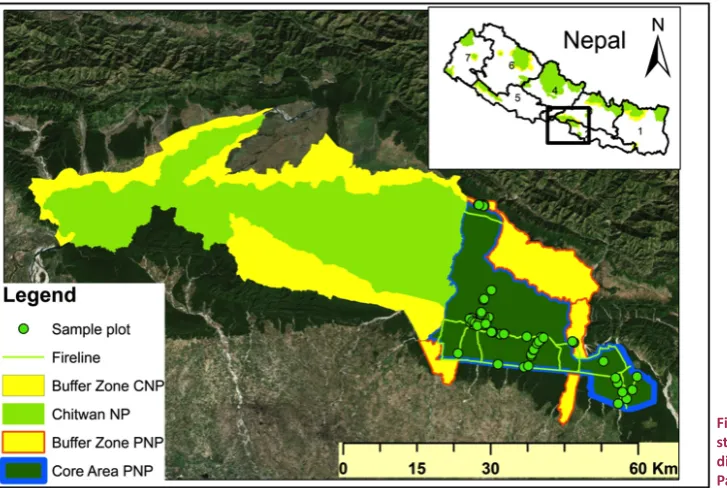
The study was conducted in Parsa National Park (PNP) and its buffer zone (BZ), located in the sub-tropical zone of the southern part of Nepal. It has an area of 627km2.
In 1984, PNP was established to preserve the habitat of natural populations of Asian Elephant Elephas maximus, Tiger Panthera tigris, and Gaur Bos gaurus (Rimal et al. 2018). The BZ of PNP was declared in 2005, which covers an area of 285.17km2 encompassing three districts and
11 village development committees (VDC) (Figure 1). The region experiences four different seasons: summer (April–June), rainy/monsoon (July–September), winter (October–December), and spring (January–March).
The forests of PNP consist of tropical and subtropical tree species. Sal Shorea robusta forests compose about 90% of the park’s vegetation. The riverine forests are found along the banks of rivers entailing species like Sisso Dalbergia sisoo, Silk Cotton Tree Bombax ceiba, and Khair Acacia catechu. Grass including Siru Imperata cylindrica and Kans Saccharum spontaneum are in the park. PNP and BZ support various endangered animal species including wild Asian Elephant, Royal Bengal Tiger Panthera tigris, and Sloth Bear Melursus ursinus. Mammals including Blue Bull Boselaphus tragocamelus, Sambar Rusa unicolor, Hog Deer Axis porcinus, Barking Deer Indian muntjac, Rhesus Macaque Macaca mulatta, and Palm Civet Paradoxurus hermaphrodites are also found in the park. Anthropogenic pressures like sand extraction, shifting cultivation and domestic cattle grazing are high in PNP and BZ (CHEC Nepal 2012).
Quantitative data collection
global positioning system (GPS) with a 2–5 m accuracy. Nested quadrats of different size were purposively assigned in the study area (Figure 2). Total 67 plots were assigned and used to assess the status of tree, pole and regeneration condition. Quadrats of 10m × 10m were set in the study area to calculate the intensity for tree species. All plant species within each quadrat were identified and counted. For trees, trunk diameter at breast height (DBH; 1.3m) and height was measured. Quadrats of 5m × 5m were allocated randomly for shrubs. Herbs and regeneration were recorded from nesting sampling of 1m × 1m quadrate within the 5m × 5m quadrate.
Tree diameter, height, dominant species, crown cover and ground cover were measured, poles and regeneration were counted and in cases of grasses, clumps were counted within each quadrat. Plant species were identified by a local para-taxonomist, field guide and also based on literature related to plant identification in Nepal (Rimal et al. 2018). Leaves of unidentified tree species were brought to the faculty of forestry at Agriculture and Forestry University (AFU) and were identified.
To assess the habitat, important value index (IVI) and prominence value (PV) of vegetation available in the habitat range is crucial. The vegetation data collected in the field were used to calculate IVI, density, relative density, frequency, and relative frequency of the tree species by using equations 1–8 explained in Greig-Smith (1983). The IVI of a species signifies its dominance and
ecological success, its good power of regeneration and greater amplitude. The IVI was calculated by using three measures including relative frequency, relative density, and relative dominance. Vegetation data were calculated following the broad principle described by Mishra (1968) and Mueller-Dombois & Elienberg (1974). Basal area helps to determine the dominance and nature of the community and it refers to the actual ground covered by the stems. Density is generally used for large plants that have discrete individuals (Zobel et al. 1987). Frequency and relative frequency give an index on the spatial distribution of a species (Krebs 1978). To calculate the Figure 1. Location of the study area and sample plot distribution in Parsa National Park and buffer zone, Nepal.
Figure 2. The layout of the quadrate used to assess the status of tree, pole and regeneration condition.
10m
prominence value, the percentage cover of each species is estimated in each quadrate and recorded in classes as follows, for high coverage = > 50%, medium= 26–50% and low = 0–25%. Prominence value is used to calculate the availability of plants in the research sites (Jnawali 1995).
1. Density of species = (Total number of individuals of a species) / (Total number of quadrats sampled × area of a quadrate)
2. Relative density of species (RD) = (Total individuals of species) / (Total individual of all species)
3. Frequency of species = Number of plots in which a particular species occurs / Total number of plots sampled × 100
4. Relative frequency of species (RF) = Frequency value of a species / Total frequency of all species × 100
5. Relative dominance of species = Total basal area of a species / Total basal area of all species × 100
6. Basal area = π d2/4
7. Important value index (IVI) = Relative density + Relative frequency + Relative dominance
8. PVX = MX (√FX)
(where, d = diameter at breast height (1.3 m) of tree, PVX = prominence value of species X; MX = mean percentage cover of species X; FX = Frequency of occurrence of species X)
Explanatory variables for modeling of habitat suitability distribution
A range of explanatory variables was derived from geospatial data sets for modeling habitat suitability. Table 1 presents the complete list of variables. The slope, aspects, and altitude were derived from the Japan Aerospace Exploration Agency (JAXA) digital elevation model (dem). Precipitation and temperature were downloaded from WorldClim data. Field measurements, dominant species, habitat preference, segment type, crown and ground cover and substrate conditions were derived. All topographic, climatic, and land use data available for the study area were resampled to 30m resolution and UTM 45N, WGS 84 projection system. For each absence and presence of GPS location, these variables were extracted. The correlation co-efficient between the explanatory variables and presence-absence data of elephant is shown in Appendix 1.
Statistical analysis
Boosted regression tree (BRT) (Elith et al. 2008) was used for examining the habitat preference area for elephant. BRT handles different types of predictor variables and accommodates missing data (Elith et al.
2008). Besides these, there is no need for prior data transformation or elimination of outliers. This is an advanced form of regression methods, which consists of two component—regression trees and boosting. BRT analysis was done using the ‘dismo’ package in R. The Bernoulli error distribution was used. Furthermore, the minimum predictive error was achieved when using a learning rate of 0.001, tree complexity (interaction depth) of 5, bag fraction of 0.75 and tolerance method “fixed”. All predictor variables were used as BRT can handle multi-collinearity among variables.
RESULTS
Habitat assessment
IVI was calculated to find out the dominant tree species (Appendix 2) and prominence value was observed in the case of shrubs and herbs (Appendix 3 & 4). We calculated the species diversity of the study area for trees. Fifty-seven species were present in the quadrates; among them, 10 tree species were the dominant tree species present in the study area. In the study area, Sal (IVI–50.7753) was found most dominant and Careya arborea (IVI–5.2802) as least dominant. The species including Mallotus philipinensis, Dillenia pentagaina, and Careya arborea have the highest IVI among all, and they are the most preferred species of the elephant.
To determine the preferred habitat used by elephant, we calculated the PV of shrubs and herbs. Among 40 species, each of shrubs and herbs was present in the study area. Among the shrub species, Eupatorium spp. (PV–306.25) was the most abundant species and
Bauhinia vahilli (PV–53.07) was the least abundant. Among the herb species, Imperata cylindrica (PV– 317.66) was the most abundant and Piper longum (PV– 29.48) the least abundant. The shrub species including
Eupatorium odoratum, Leea macrophylla, and Cleroden dronviscosum and herb species including Imperata cylindrica, Saccharum spontaneum, and Fritillaria camschatcensis have the highest PV among all species found in the study area as well as, they are the most preferred species of the elephant in the study area.
Habitat suitability
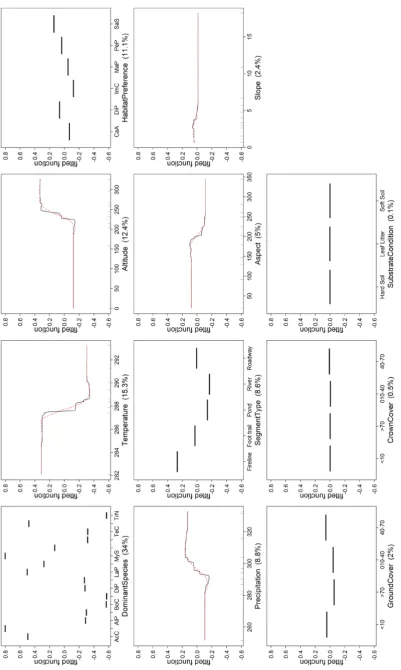
precipitation, temperature, slope, and aspect is shown in Appendix 1. The relative influence of each predictor variables is shown in Figure 3. Each predictor variable has different relative contributions for the BRT model. Dominant species, temperature, and altitude have higher relative influence, whereas ground cover, crown cover and substrate condition have a lower relative influence.
Prioritized dependence plots visualize the effect of a single variable on the model response, holding all other variables constant. Model results vary the most with dominant species as seen in the first left plot (Figure 3). Dominant species (34%), temperature (15.3%), altitude (12.4%), habitat preference (11.1%) and precipitation (8.8 %) have the highest relative influence percentage and play a crucial role in the elephant distribution based on these plots. For more details on how they were calculated and model parameters used, see Sharma (2017).
On the basis of partial dependence plots, the elephant was more available at the altitude of 250–350 m with precipitation 310mm. The suitable habitat for the elephant was at the temperature of 28.5°C, a slope of 0–5° and in the northeastern and southeastern regions. Dominant species shows that Acacia catechu (AcC) and
Myrsine semicerata (MyS)forest are more suitable for the elephant. Species including Dillenia pentagaina
(DiP), Saccharum spontaneum (SaS),and Pennnisetum purpureum (PeP) are the most preferable species of the elephant. Elephants dwelled in forest dominated by Mallotus philipinensis followed by Syzigiym cumini. Thus areas having these species were the most suitable
habitats.
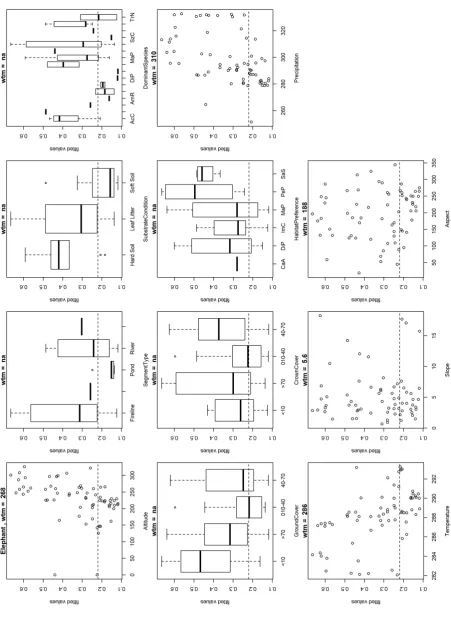
The weighted mean of discrete data was not available, whereas the weighted mean of continuous data was altitude (264m), precipitation (310mm), temperature (28.6 °C), slope (5.6°) and aspect (190°). Elephants were found mostly around the fire line and river, at an altitude of 150–350 m with temperature around 28.6 °C, crown cover 40–70 and slope below 0–5° (Figure 4).
The correlation between elephant presence-absence and temperature is 0.24, that implies a slight positive relationship between them, the elephant is mostly found in increasing temperature (Appendix 1). Whereas there is almost no linear association between presence-absence, and slope, dominant species, land cover of the plot, crown cover and ground cover. The relationship of altitude with temperature is negative, i.e., 0.84, the temperature of the area increases with a decrease in altitude and vice versa.
The elephant distribution prediction map based on altitude, slope, aspect, precipitation, and temperature only using boosted regression tree model is presented in Appendix 5. Other predictor variables were based specifically on field data and their extrapolation to spatial scale was not possible.
DISCUSSION
The elephant population in Nepal is restricted to the Terai and Siwalik regions, where there have been large-scale conversion of forest and expansion of agricultural lands (Koirala et al. 2015). This has resulted Table 1. Predictor variables used to model the habitat of Elephant.
Predictor variables Format (Source) Description
Temperature (× 10 °C)
(1km × 1km) Raster (WorldClim) 1* The temperature of June was used Precipitation (mm)
(1km × 1km) Raster (WorldClim) 1* Precipitation of June was used Slope (°) (30m × 30m) Raster (Jaxa DEM) 2*
Aspect (30m × 30m) Raster (Jaxa DEM) 2* Altitude
(30m × 30m) Raster (Jaxa DEM) 2*
Habitat preference Field measurement Species preferred by elephant, including pentagina, Saccharum spontaneum, Careya arboreaMallotus philipinensis, Imperata cylindrica, Dillenia , and Pennisetum purpureum
Dominant Species Field measurement Area dominated by species like Albizzia procera (AlP), Lagerstroemia parviflora Acacia catechu (AcC),(LaP), Bombax ceiba Terminalia chebula (BoC), Dillenia pentagaina ((TeC), Trewia nudifolia DiP), (TrN), and Myrsine semicerata (MyS)
Segment type Field measurement Divides the area into the segment by fire line, foot trail, pond, river, and railway
Crown and ground cover Field measurement Cover (%) of forest crown and ground
Substrate condition Field measurement The condition of the soil, including hard soil, soft soil, and leaf litter
Figur
e
3.
Single-variable
partial
dependence
plots
and
smoothed
response
cur
ves
for
the
pr
edict
or
variables,
wher
e
Y-a
xis
is
the
fitt
ed
function
for
the
response
variable
(elephan
t).
The
rela
tiv
e
in
fluence is sho
wn in par
an
Figur
e 4. The w
eigh
ted mean of all pr
edict
or v
in negative human-elephant interactions in many parts of Nepal. Movement of elephants outside the national park and wildlife reserve could have been the result of unsuitable habitat, reduced supply of food and water, and encroachment by human beings. Assessing habitat suitability of elephants assists in the preparation of sustainable management plans. PNP and BZ has been the habitat of elephant for long time, but habitat suitability studies are rare in this area. This research examines habitat suitability of the elephant in PNP and BZ based on different variables including dominant species, temperature, altitude, habitat preference, precipitation, segment type, aspect, slope, ground cover, crown cover and substrate condition.
Based on the BRT model, PNP and BZ are suitable habitats for elephants. We witnessed the outcome of parameters as per the physical, biological and climatic features of the area like slope, aspect, altitude, precipitation, temperature, habitat preference, crown cover and ground cover. The result shown by Koirala et al. (2016) posits that species like Spatholobus parviflorus, Saccharum spontaneum, Shorea robusta,
Mallotus phillippensis, Garuga pinnata, Litsea mono-petala contributed the highest proportion of diet for an elephant in the PNP. In consent with our result, similar species of trees, shrubs, and herbs have the highest IVI and PV and distributed in the lower part of the area. This result concludes that the study area is the most suitable for elephant to dwell. Our study revealed that the habitat is suitable in the Northeast and Southeast region of the study area, which is similar to the result of Shamsuddoha & Aziz (2015).
Rood et al. (2010) studies have found that the elephant’s habitat use in a tropical forest is depicted by areas of high forest cover. Our analysis, however, found no marked relationship between ground cover, crown cover, and presence of elephants. Our findings revealed that in the study area, slope 0–5° and altitude 400m is suitable for elephants which are almost similar to the result of Areendran et al. (2011). In accordance with the studies of Douglas et al. (2006), Lin et al. (2008) and Ochieng (2015), suitable habitat for elephants was found to be limited by augmentation of both altitude and slope. There is no abundance of elephants’ presence sign with the increment of the altitude and slope in PNP. In order to preserve their energy needs, Ntumii et al. (2005) mention that elephants avoid the height and steeply sloped area.
Variability in results might have occurred due to the differences in sampling methods, variance in forest condition, composition, and sampling area, etc. The
research outcome was concluded based on only one season field work; however, taking all the results of four seasons might produce more effective result. Data of precipitation and temperature were extracted from Worldclim; the data taken from the nearest metrological station of Samara could be better with more accuracy. The outcomes from this study, linked to slope, and elevation are valid for PNP only, and cannot be generalized to the habitat of an elephant in other countries. Further research should focus on creating map of elephant distribution, habitat suitability, and threats to elephant from invasive species.
CONCLUSION
BRT was applied to assess elephant habitat suitability in PNP. In this study, we analyzed the distribution of elephant using a combination of biotic and abiotic environmental variables, including the topographic and climatic factors. The model emphasizes on environmental suitability and contributes to knowledge for conservation of elephant in PNP. It provides a basis for habitat analysis. Elephants were recorded up to 400m and in northeastern and southeastern aspects. Its presence could not be related to forest cover and substrate condition. The result from the modeling may become useful to plan and delineate areas for management of elephant. It presents scope to minimize HEC through precautionary measures.
REFERENCES
Adhikari, H., J. Heiskanen, M. Siljander, E. Maeda, V. Heikinheimo & P.K.E. Pelikka (2017). Determinants of aboveground biomass across an Afromontane landscape mosaic in Kenya. Remote Sensing 9(8): 827. https://doi.org/10.3390/rs9080827
Areendran, G., K. Raj, S. Mazumdar, M. Munsi, H. Govil & P.K. Sen (2011). Geospatial modelling to assess elephant habitat suitability and corridors in northern Chhattisgarh, India. Tropical Ecology 52: 275–283.
Armbruster, P. & R. Lande (1993). A population viability analysis for African Elephant (Loxodonta africana): how big should reserves be? Conservation Biology 7(3): 602–610. https://doi.org/10.1046/ j.1523-1739.1993.07030602.x
Bisht, S.S. (2002). An overview of elephant conservation in India.
Indian Forester 128(2): 121–136
CHEC Nepal (2012). An assessment of Tiger (Panthera tigris) and its
habitat in Bara forest, Nepal. A report submitted to District Forest Office, Simara, Bara.
DNPWC (2008). The Elephant Conservation Action Plan for Nepal. Ministry of Forest and Soil Conservation, Department of National Parks and Wildlife Conservation, Kathmandu, Nepal, 30pp. Douglas-Hamilton, I., S. Bhalla, G. Wittemyer & F. Vollrath (2006).
Elith, J., J.R. Leathwick & T. Hastie (2008). A working guide to boosted regression trees, (Ml), 802–813. https://doi.org/10.1111/j.1365-2656.2008.01390.x
Greig-Smith (1983). Quantitative Plant Ecology. University of California Press, Berkeley, CA, xiv+359pp.
IUCN (2017). The IUCN Red List of Threatened Species. Version 2017-1.https://www.iucnredlist.org
Jnawali, S.R. (1995). Population ecology of greater one horned rhinoceros (Rhinoceros unicornis) with
particular emphasis on habitat preference, food ecology and ranging behavior of a reintroduced population in Royal Bardiya National Park in Low land Nepal (A Doctor Scientiarum Thesis 1995: 4), i-vii, 128pp.
Koirala, R.K., W. Ji, A. Aryal, Jessica Rothman & D. Raubenheimer (2015). Dispersal and ranging patterns of the Asian Elephant (Elephas maximus) in relation to their interactions with humans in Nepal. Ethology Ecology & Evalution 28(2): 221–231. https://doi.org/10.1080/03949370.2015.1066872
Koirala, R.K., D. Raubenheimer, A. Aryal, M.L. Pathak & W. Ji (2016). Feeding preferences of the Asian Elephant (Elephas maximus) in Nepal. BMC Ecol., 16 (1): 54. https://doi.org/10.1186/s12898-016-0105-9
Krebs, C.J. (1978). Ecology: The Experimental Analysis of Distribution and Abundance. 2nd Ed. Harper & Row
Publishers, 678pp.
Lin, L., L. Feng, W. Pan, X. Guo, J. Zhao, A. Luo & L. Zhang (2008). Habitat selection and the change in
distribution of Asian elephants in Mengyang Protected Area, Yunnan, China. Acta Theriologica 53: 365– 374. https://doi.org/10.1007/BF03195197
Mishra, R. (1968). Ecology Work Book. Oxford and IBH Publishing Company, Calcutta, 244pp.
Mueller-Dombois, D. & H. Elienberg (1974). Aims and Methods of Vegetation Ecology. John Wiley & Sons, New York, 547pp.
Ntumi, C.P., R.J. van Aarde, N. Fairall & W.F. de Boer (2005). Use of space and habitat use by elephants
(Loxodonta africana) in the Maputo Elephant Reserve, Mozambique. South African Journal of Wildlife Research 35(2): 139–146.
Ochieng, E.O. (2015). Characterizing the spatial distributions of elephants in Mpala, Kenya. MSc Thesis, University of Twente, 53pp.
Pradhan, N.M.B., A.C. Williams & M. Dhakal (2011). Current status of Asian elephants in Nepal. Gajah
35: 87–92.
Ram, A.K. (2008). Impact of Mikania micrantha on Rhinoceros unicornis habitat in Chitwan National Park,
Chitwan Nepal (Bachelor thesis submitted to Tribhuwan University), 79pp. https://doi.org/10.13140/ RG.2.1.1756.8244
Rimal, S., H. Adhikari & S. Tripathi (2018). Habitat suitability and threat analysis of Greater One-horned Rhinoceros Rhinoceros unicornis Linnaeus, 1758 (Mammalia: Perissodactyla: Rhinocerotidae) in Rautahat District, Nepal. Journal of Threatened Taxa 10(8): 11999–12007. https://doi.org/10.11609/ jott.3948.10.8.11999-12007
Rood, E., A.G. Abdullah & V. Nijman (2010). Using presence-only modelling to predict Asian Elephant habitat use in a tropical forest landscape: implications for conservation. Diversity and Distributions 16: 975–984. https://doi.org/10.1111/j.1472-4642.2010.00704.x
Santiapillai, C. (1997). The Asian Elephant conservation: a global strategy. Gajah 18: 21–39.
Shamsuddoha, M. & M.A. Aziz (2017). Raiding pattern of migratory elephants in a human dominated landscape in northern Bangladesh. Ecoprint 24: 21–27. https://doi.org/10.3126/eco.v24i0.20643 Sharma, P. (2017). Habitat suitability modeling of Asian wild elephant and its interaction with people in
Parsa National Park and its Buffer Zone. Submitted to Agriculture Forest University, Faculty of Forestry, Hetauda, Nepal in partial fulfilment of the requirement for the degree of Bachelors’ in forestry, i-xi, 46pp. Sukumar, R. (2003). The living elephants: evolutionary ecology, behavior, and conservation. Oxford
University Press, New York, 478pp.
Trigal, C. & E. Degerman (2015). Multiple factors and thresholds explaining fish species distributions in lowlands streams. Global Ecology and Conservation 4 589–601. https://doi.org/10.1016/j. gecco.2015.10.009
Zobel, D.B., U.K. Yadav, P.K. Jha & M.J. Behan (1987). A practical manual for ecology. Rani Printing Press, Kathmandu, Nepal.
Author details: Puja Sharma is doing
MSc in Tropical and International Forestry at University of Gottingen, Germany. She has completed BSc in forestry from Agriculture and Forestry University and worked in the field of Natural Resource Management and wildlife. Hari Adhikari defended his PhD at University of Helsinki, Finland. He has international working experience on wildlife and forestry in Nepal, India, Philippines, Kenya, Germany
and Finland. Shankar Tripathi is young
faculty member of Faculty of Forestry at AFU, who have involve in lecturing and research on forest measurement and application of Remote sensing and GIS in the field of nature conservation. He has accomplished post graduate degree in Forestry from Tribhuvan University. Ashok Kumar Ram holds MSc
on Forestry from Institute of Forestry Pokhara, Nepal and studying his PhD on Wildlife Science from Wildlife Institute of India. He is an IUCN Species survival commission members for Asian Elephant specialist group. Rajeev Bhattarai is
a graduate student in School of Forest Resources, University of Maine with a undergraduate degree in forestry from Tribhuvan University, Nepal.
Author contribution: PS planned and
Appendix 1. P
ear
son c
orr
ela
tion be
tw
een diff
er
en
t pr
edict
or v
ariables and their sc
att
Appendix 2. Important Value Index (IVI) of dominance tree species
Scientific name Local name Relative frequency Relative density dominance %Relative Important value index (IVI)
Shorea robusta Sal 13.36 0.27 37.14 50.77
Mallotus philipinensis Sindure 6.45 0.14 10.60 17.20
Terminalia tomentosa Asna 4.60 0.04 8.22 12.87
Acacia catechu Khair 4.60 0.11 5.57 10.29
Lagestromia parviflora Bot dhayero 6.91 0.05 3.44 10.41
Dillenia pentagaina Tatari 6.45 0.05 3.73 10.23
Adina cordifolia Haldu 3.68 0.02 3.44 7.14
Garuga piñata Dabdabe 5.06 0.03 1.97 7.08
Albigia procera Setosiris 2.76 0.01 3.10 5.88
Careya arborea Kumbe 2.76 0.01 2.50 5.28
Appendix 3. Prominence value of shrubs in the study area.
Scientific name Local name Number of individuals Frequency
Mean cover of individual species
(Mx) Prominence value (PVx)
Eupatorium odoratum Setobanmara 188 50.72 43 306.25
Leea macrophylla Galini 213 50.72 38 270.64
Clerodendron viscosum Bhati 248 33.33 25 144.33
Murraya koenigii Curry leaf 72 26.08 20 102.15
Fritillaria spp. Thulobandhan 19 5.79 30 72.23
Lantana camera Lantana 14 4.34 30 62.55
Asparagus racemosus Kurilo 34 18.84 14 60.76
Agiratus conyzoides Gande 111 5.79 25 60.19
Parthenium spp. Parthenium 517 5.79 24 57.78
Bauhinia vahlli Bhorla 20 8.69 18 53.07
Appendix 4. Prominence value of herbs in the study area.
Scientific name Local name Number of individuals Frequency
Mean cover of individual species
(Mx)
Prominence value (PVx)
Imperata cylindrica Siru 3516 42.02 49 317.66
Saccharum spontaneum Kans 970 13.04 32 115.57
Fritillaria camschatcensis Ban dhan 1035 18.84 20 86.81
Hemalthriya compressa Ghodeydubo 699 10.14 25 79.62
Cynodon dactylon Dubo 634 7.24 29 78.06
Digitarea spp. Chitrebanso 382 10.14 23 73.25
Pennisetum purpureum Elephant grass 163 4.34 22 45.87
Barlaria cristata Kuro 151 7.24 16 43.07
Dendrobium spp. Orchid 27 7.24 11 29.61
ISSN 0974-7907 (Online) | ISSN 0974-7893 (Print)
October 2019 | Vol. 11 | No. 13 | Pages: 14631–14786 Date of Publication: 26 October 2019 (Online & Print)
DOI: 10.11609/jott.2019.11.13.14631-14786
www.threatenedtaxa.org
publishing peer-reviewed articles online every month at a reasonably rapid rate at www.threatenedtaxa.org. All articles published in JoTT are registered under Creative Commons Attribution 4.0 International License
unless otherwise mentioned. JoTT allows allows unrestricted use, reproduction, and distribution of articles in any medium by providing adequate credit to the author(s) and the source of publication.
Communications
Camera trap survey of mammals in Cleopatra’s Needle Critical Habitat in Puerto Princesa City, Palawan, Philippines
– Paris N. Marler, Solomon Calago, Mélanie Ragon & Lyca Sandrea G. Castro, Pp. 14631–14642
Habitat suitability modeling of Asian Elephant Elephas maximus (Mammalia: Proboscidea: Elephantidae) in Parsa National Park, Nepal and its buffer zone
– Puja Sharma, Hari Adhikari, Shankar Tripathi, Ashok Kumar Ram & Rajeev Bhattarai, Pp. 14643–14654
Current population status of the endangered Hog Deer Axis porcinus (Mammalia: Cetartiodactyla: Cervidae) in the Terai grasslands: a study
following political unrest in Manas National Park, India
– Alolika Sinha, Bibhuti Prasad Lahkar & Syed Ainul Hussain, Pp. 14655– 14662
A food spectrum analysis of three bufonid species (Anura: Bufonidae) from Uttarakhand region of the western Himalaya, India
– Vivekanand Bahuguna, Ashish Kumar Chowdhary, Shurveer Singh, Gaurav Bhatt, Siddhant Bhardwaj, Nikita Lohani & Satyanand Bahuguna, Pp. 14663–14671
Moulting pattern and mortality during the final emergence of the Coromandel Marsh Dart Damselfly Ceriagrion coromandelianum (Zygoptera: Coenagrionidae) in central India
– Nilesh R. Thaokar, Payal R. Verma & Raymond J. Andrew, Pp. 14672– 14680
Diversity of parasitic Hymenoptera in three rice-growing tracts of Tamil Nadu, India
– Johnson Alfred Daniel & Kunchithapatham Ramaraju, Pp. 14681–14690
Mapping octocoral (Anthozoa: Octocorallia) research in Asia, with particular reference to the Indian subcontinent: trends, challenges, and opportunities
– Ghosh Ramvilas, Kannan Shalu, Rajeev Raghavan & Kutty Ranjeet, Pp. 14691–14721
SEM study of planktonic chlorophytes from the aquatic habitat of the Indian Sundarbans and their conservation status
– Gour Gopal Satpati & Ruma Pal, Pp. 14722–14744
Is cultivation of Saussurea costus (Asterales: Asteraceae) sustaining its conservation?
– Chandra Prakash Kuniyal, Joel Thomas Heinen, Bir Singh Negi & Jagdish Chandra Kaim, Pp. 14745–14752
Short Communications
A first photographic record of a Yellow-bellied Weasel Mustela kathiah Hodgson, 1835 (Mammalia: Carnivora: Mustelidae) from western Nepal – Badri Baral, Anju Pokharel, Dipak Raj Basnet, Ganesh Bahadur Magar & Karan Bahadur Shah, Pp. 14753–14756
Mammal diversity in a montane forest in central Bhutan – Tashi Dhendup, Kinga Thinley & Ugyen Tenzin, Pp. 14757–14763
Notes
First record of Otter Civet Cynogale bennettii (Mammalia: Carnivora: Viverridae) kept as a pet in Indonesia, representing a possible new threat to the species
– Jamie Francis Bernard Bouhuys, Pp. 14764–14766
An observation of the White-bellied Sea Eagle Haliaeetus leucogaster preying on Saltwater Crocodile hatchlings Crocodylus porosus in Bhitarkanika Wildlife Sanctuary, India
– Nimain Charan Palei, Bhakta Padarbinda Rath & Bimal Prasanna Acharya, Pp. 14767–14769
Elusive, rare and soft: a new site record of Leith’s Softshell Turtle Nilssonia leithii (Reptilia: Testudines: Trionychidae) from Bhadra Tiger Reserve, Karnataka, India
– H.S. Sathya Chandra Sagar, M. Mrunmayee, I.N. Chethan, Manish Kumar & D.V. Girish, Pp. 14770–14772
A new distribution record of the Pentagonal Sea Urchin Crab Echinoecus pentagonus (A. Milne-Edwards, 1879) (Decapoda: Brachyura: Pilumnidae) from the Andaman Islands, India
– Balakrishna Meher & Ganesh Thiruchitrambalam, Pp. 14773–14776
First records of the ghost moth genus Palpifer Hampson, [1893] (Lepidoptera: Hepialidae) from the Indian subcontinent south of the Himalaya
– Siyad A. Karim & John R. Grehan, Pp. 14777–14779
First record of longhorn beetle Calothyrza margaritifera (Cerambycidae: Lamiinae: Phrynetini) from western India
– Vishwas Deshpande & Hemant V. Ghate, Pp. 14780–14783
Extended distribution of Ceropegia mahabalei Hemadri & Ansari (Apocynaceae) to the state of Gujarat, India
– Mukta Rajaram Bhamare, Hemantkumar Atmaram Thakur & Sharad Suresh Kambale, Pp. 14784–14786