Copyright © 2015 IJECCE, All right reserved
210
An Agent-Mediated Architecture for Collective
Collaborative Design
Rafik Hadfi
Department of Computer Science and Engineering, Nagoya Institute of Technology, Japan
email: [email protected]
Takayuki Ito
Department of Computer Science and Engineering, Nagoya Institute of Technology, Japan
email: [email protected]
Abstract: The expansion of the Internet has changed the
way business models are conceived. In addition, several e-commerce models were built for a wide range of applications. Due to the proliferation of advanced and efficient techno-logies, individuals are using more interactive and rich Internet applications. At the same time, Multi-agent Systems have shown their efficiency to solve complex problems and to deal with situations where the collaboration between heterogeneous agents is needed. Collaboration among auton-omous agents represents an important and challenging field of study, since most of the business models can be adopted and implemented according to this architecture. In this paper, we will develop a collaborative architecture for 3D design, based on the collaboration of an agent and a human. With the guidance of the agent, the user will parametrically design the product using a 3D environment. After the design phase, the agent will submit the design as a contract. A mediator will collect the submitted model(s), and a final model will be chosen based on a particular strategy. We also investigate the possible representations of a specific type of contracts as to represent 3D objects. We note the existing interplay between different types of attributes and therefore establish new assumptions related to general contracts modeling.
Keywords: Collaboration, Multi-Issue Negotiation,
Human-Agent Interaction, Platforms for Collaboration, Consumer-To-Business, Virtual Agents Applications, Agent Models and Architectures, Interfaces for Collaborative Work, Architect-ures and Design of Collaborative Systems, Web3D, X3D, C2B, Interdependence, Constraint-Based Utility Space, Nonlinearity
I.
I
NTRODUCTIONOver the past few decades, the Internet has experienced a significant expansion on multiple levels. It has had a huge impact on economics and the Internet-based business models. Moreover, thanks to the decrease of transactions’ costs, large communities of people have become connec-ted, and therefore, many types of commercial relationships were created.
At the same time, the new advances of the Web 2.0 [1] gave the users more visual and interactive experiences by using Rich Internet Applications (RIA) [1, 2]. Several electronic commerce (e-commerce) business models were proposed for a wide range of applications and services [3].
Customer-to-Business (C2B) is a business model characterized by the inversion of roles known in the traditional business models [3]. In this model, customers can develop and offer products or services to companies. Given the potential of an open and peer-to-peer environm-ent, a C2B model can be efficiently implemented as a
multi-agent framework. In this scheme, customers will interact with agents to develop their products, and the agents will negotiate the product with a given company.
On another level, collaboration and negotiation mechan-isms have been studied widely and represent an exciting field of research. Especially, when the negotiation involves multiple and interdependent issues [4, 5, 6, 7] as it is the case of many real-world decision making problem. In this type of negotiations, user preferences have a nonlinear form. Several works have been done to deal with nonlinear utilities [8, 9, 10] and also to reveal possible utilities representations [6, 11, 12].
Most of real word consensus problems involve interdep-endent issues, which make optimal contracts finding difficult. For instance, complex design is an example of domains involving a large number of issues governed by nonlinear relationships. Despite the multitude of models for multi-issue negotiation in nonlinear settings, none of the above works had proposed a concrete solution that could be deployed for a real-world problem. In fact, most of the proposed models are restricted to monetary domains that do not fully reflect the real challenges found in complex consensus making.
It is within this perspective that we propose our framework to show the possible interplay between the utilitarian nonlinearity found in the previous formulations and its analogous formulation found in complex design. It is our belief that it is possible to extend the based formulation of utility spaces into the constraint-based definition of the geometrical design space.
In this paper, we develop a collaboration architecture for products’ design, according to a C2B scheme, and through the collaboration of an agent for the negotiation and the use of a 3D client application for the design of the product. At the same time, we will investigate possible representa-tions of a specific type of contracts, representing a 3D object. We will also highlight the existing semantics between attributes and therefore establish possible assum-ptions related to general contracts modeling.
Copyright © 2015 IJECCE, All right reserved
211
II.
C
OLLABORATIVED
ESIGNS
YSTEMThe system is an online collaboration framework allowing users to design a given product (C2B scheme). Users can acquire the initial template of a model from a mediator and can use a 3D modeling IDE to propose their designs. The initial template is defined in terms of constraints, specified by the mediator on the behalf of a company.
The end-user will have to specify his preferences by providing the design of the shapes and eventually some technical details of the model. Once the user has specified all his preferences, a bidding process will start and all the contracts related to the users’ products will be sent to the mediator [4, 5].
The auction-like business logic will be deployed on the mediator. It will accept contracts from clients up to the final bidding time for the current product. Hence, a time limit must be specified for each design session. During this period, users will design their products and the agents might negotiate over the resulting contracts. Each bid from a user must be accompanied by a relevant product identifier, which might be selected by the user to avoid the submission of an invalid code.
The design and bidding operations will be done through the collaboration of the human user and the agent. The user will have to design the product and the agent will negotiate the provided contract with the mediator. The mediator will synthesize all the received contracts into a unified group consensus. Then, an agreement might be made based on the assumption that the final contract will satisfy all the users’ expectations.
A final contract ensures that the agents’ choices hold and coincide with the constrained initial model of the product, i.e., the template. After designing his product, each user will be expecting that hopefully the final contract will correspond to his design. The mediator will have to find the contract that represents all the individuals’ preferences, therefore the best design of the product. In our context, an optimal contract will have to satisfy all the agents’ bids and users’ expectations.
More generally, the overall models of the agents will code the users’ preferences just as if they are voting for the best product. For example, if the users are designing a specific type of toy, an elephant for instance. The mediator will try to maximize the expected number of designs (contracts), by finding the intersections between all the provided models and, by maximizing the most common features or attributes.
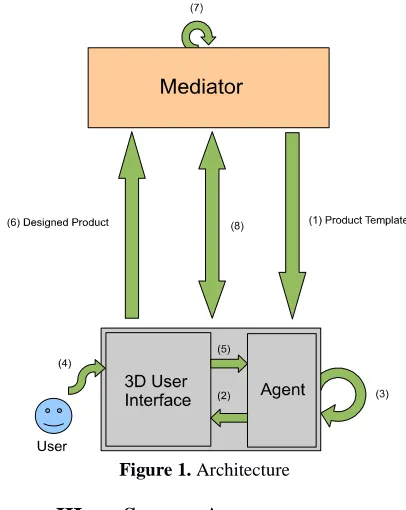
Figure 1. Architecture
III.
S
YSTEMA
RCHITECTUREA. Description
Our framework is based on a client/server model, where a client is represented by both the 3D user interface for the design and the automated agent. The server represents the mediator [13, 14] where we implement the business logic used for the consensus making. Several agents will be participating in the design process guided by their interface agents.
As indicated in Figure 1, the coupling of the UI and the agent was done to separate tasks during the Human-Agent interaction phase. The main purpose of the UI is the acquisition of the user’s preferences (4) through means of 3D shapes modifications. Initially, the agent is used for the acquisition of the product template provided by the mediator (1). The template will be issued to the UI from the agent (2), allowing the user to design his product according to his viewpoint (4). The agent will assist the user by allowing him to specify a parameterized description of the templates. Based on this paramete-rization, the agent will recursively generate the structure of the model.
Once the new product is available (5), the agent will prepare a contract (3) specifying the product attributes and will send it back to the mediator (6). Eventually, the agent can generate several contracts and start a negotiation with multiple bids (8) [8, 15, 16]. The mediator will collect all the contracts issued from the clients and try to find a combination of bids that maximizes social welfare (7).
Copyright © 2015 IJECCE, All right reserved
212
case, all the submitted contracts will converge to a unique contract, which satisfies both of the mediator constraints and the clients’ preferences.
Since the agents are negotiating over contracts based on an initial model (template), there will be no possible conflicts between the agents on the designed product: all the chosen values for each attribute will fall within the constrained shapes specified initially by the mediator in the template.
This whole negotiation process will iteratively yield a better design of the. Once the time limit is reached, the final contract will be adopted by the mediator and sent to the users. The time limit must ensure enough time for the clients to design their products, and also for the agents to negotiate the contracts. In this way, the negotiation process will converge and yield the optimal contract.
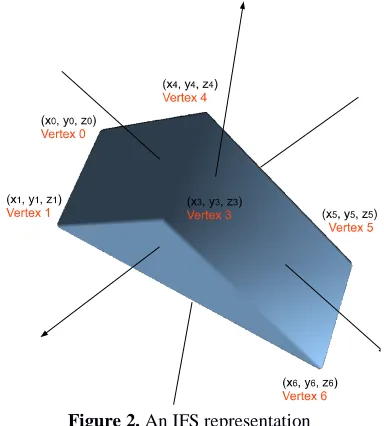
Figure 2. An IFS representation
B. Contracts construction
In our work, we focus on a specific type of contracts, representing a product as a 3D model. As we will show later, these types of contracts share common character-istics, which make them different from other studied, contracts [17, 9, 12], in the way attributes are represented and connected [9, 11, 12].
Therefore, we introduce the concept of graphical and non-graphical attributes. A graphical attribute corresponds to a variable which can be modeled and manipulated by the user in a three dimensional space. A 3D shape will be represented as a collection of graphical attributes, including points, colors and so forth. A non-graphical attribute is related to an abstract type of attribute, that cannot be represented in 3D space. For example, the type of an engine, the class of a fuel, the category of a metal, the price of a chair, are non-graphical attributes.
In our modeling, we adopt the X3D standard [1, 2] as a framework to represent our designed products. In addition, all our graphical objects will be defined using the
IndexedFaceSet (IFS) geometry node [2]. This component
allows the encapsulation of a set of attributes in the same entity, which will be identified as a group. A group will contain a number of interdependent attributes describing the same entity and sharing the same space.
As we can see in Figure 2, a graphical attribute can be represented by a vertex(, , ) in a 3D space. However, it might also be a color, an opacity indicator or any other graphical element [2].
A group of graphical attributes is an IFS composed of a finite number of vertices, connected under the assumption that these vertices will describe a compact and unique simplex. Ultimately, the whole designed product will be a collection of groups, assembled to form the global 3D product. This structure can be generalized using a multilayered structure with a recursive definition.
After designing the product, i.e., the design of graphical and non-graphical attributes, the final contract will be defined as a collection of the whole attributes grouped according to a certain logic. Therefore, a contract containing n groups can be represented as in (1).
= (, … , , … , ) (1)
Where every group G j is a collection of attributes:
Gi= (,, … , ,, , , … , ,, … , ,) (2)
With (,… ,, , ) being the graphical attributes, and (,… ,) being the non-graphical ones.
A group has vertices and non-graphical attributes. Other graphical attributes can be added to the group, for example, the color ci and the shininess .
C. Groups' decomposition
As we have stated above, the negotiation process starts when the template of the product is sent to the client. Then, the user will have to modify it according to his conception under the guidance of the agent, which proposes ways of generating the new transformations. In fact, the agent will recursively alter the initial template given the parameterization chosen by the user. Initially, the template is represented as an XML document including the X3D graphical representation of the product as well as additional information. In other words, the template is a simple, minimalistic, unfinished representa-tion of the product. The XML representarepresenta-tion of the product must be converted into an appropriate format. For this purpose, we provide an algorithm that disassembles the XML representation of the product into more atomic components, in order to be manipulated by the user through the UI. The product is represented by an object, which can be described by the relation (3).
= ⋃"# !"= ⋃"# ⋃#"(", ", ") (3)
Copyright © 2015 IJECCE, All right reserved
213
configuration of the object is computed and updated dynamically.
As we can see in the procedure Design shape, the input is the X3D template to change (Object), and the output is the new product. The whole process is executed on 4 matrices T, F, E and R. The process is described as following.
• T%,&: Is built based on the product template. It contains all the attributes of the product (the graphical and non-graphical).
• F(,& : Is built based on T by removing redundant vertices. Those redundancies are due to the representation of the faces of an object by vertices’ indexing [2].
• E(,& : Contains the modifications made by the user for m vertices. The ith entry in E corresponds to the new coordinate of the vertex.
• *%,&: The resulting matrix, containing the newly designed product.
IV.
C
ONSENSUSM
AKINGSome assumptions regarding the way the mediator operates to find the optimal contract must be introduced. In our adopted model [5, 4, 18], neither the agents nor the users do share their preferences with other designers.
It is also important to mention that the way contracts are represented is governed by a constraint-based viewpoint that is coherent with the usage of the X3D representation (IFSs).
We note that in our model the design space is considered according to two different viewpoints. One viewpoint is static, purely geometrical, defined as the 3D design space of the user. In other words, it is the visible configuration or choice space that the user perceives.
The second viewpoint is dynamical, and is governed by the user’s preferences that may change during the consensus making process. In fact, a chosen shape or vertex will be assigned a specific utility value. Even if the user is unaware of these assignments, it is important to keep in mind that the agent will have to perform some preferences elicitation during the interaction with both the user and the mediator. Therefore, there is a need to assign
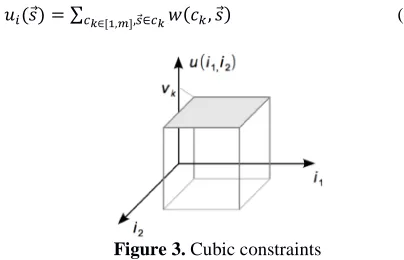
evaluations to the different possibilities that are given to the user.The design space is defined in terms of constraints, making the utility space a constraint-based utility space. That is, all the models are built based on an aggregation of shapes according to the cube constraints+defined inthe mediator’s template as sub-regions of the total *& design space, shown as in Figure 2. We say that the cube c-has value .(c-, ) for contract ifc- is satisfied by . That is, when the contract point falls within the sub-space of c-. This is the case where the user’s chosen shape falls in the bounds of the cubic constraint defined by the mediator. The utilitarian evaluation of a possible design is thus defined as in (4).
/( ) = ∑12∈[5,6],8∈12.(+, ) (4)
Figure 3. Cubic constraints
The mediator will gather all the submitted bids from the agents, and search for the optimal contract(s). In our architecture, maximizing the negotiation outcome is finding the contract that corresponds the most to the clients’ expectations. Therefore, the objective function can be described as in (5).
∗
::: = ;<8∑∈=/( ) (5)
The used protocol tries to find the contract :::∗ that maximizes social welfare, i.e., the total utilities for all agents [9, 8]. In our model, utilities represent the users’ preferences, which are specified through the design process. The utilities specified by a client as a set of preferences will also represent the same utility functionu? of the agent.
In case the agents are proposing bundles of models instead of one single contract, we will be using the approach [8] illustrated in search solution. That is, the mediator starts by finding all the combinations of bids, one from each agent that are mutually consistent.
Ag: A set of agents, B: A set of Bid-set of each agent (@ = A@B, @… @=C) the set of bids from agent i is @= D,B, ,… ,E.
Copyright © 2015 IJECCE, All right reserved
214
V.
E
XPERIMENTALR
ESULTSA. Description
We have implemented the full architecture including both the agent and the mediator. Herein, the agent is nothing more then a Python-coded plugin deployed under the Blender 3D environment. Figure 5 shows the main interface of Blender as well as the user interface of the agent (red square). Once Blender is launched, the agent interface will be visible in the Tools panel. The user will firstly connect to the mediator in order to load the template and launch the agent. When started, the agent will start generating the proposed parametric changes while ackno-wledging the user’s modifications of the 3D model.
The adopted parametric design is described by a number of constraints or initial parameters specified by the mediator through the template. For instance, in Figure 5, we are designing the structure of a four-legged animal based on multiple parameterizations of the model’s parts: the body, the 4 legs, the feet, the neck, the forehead and the head. Each user will have to pick specific values for these parameters, and the agent will start building the structure of the model recursively through means of geometric extrusion.
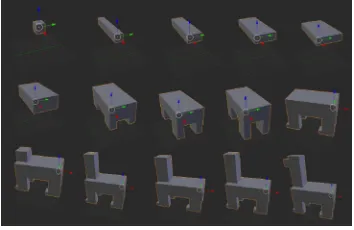
The parameterized recursive extrusion, shown in Figure 4, is performed as following.
1. The agent starts by creating an initial cube, the seed, corresponding to an example of initial constraint. An example of such constraints is represented in Figure 3 and relating to a two-dimensional attribute-space with a particular utility value v-.
2. Recursively, and depending on the user’s specified parameters for the body, the agent will extrude the cube into a line of cubes. Then, the line will be extruded again into a plane of cubes, and the same plane into a bigger structure until forming the main body of the animal.
3. The agent will then pick four distinct cubes located under the structure and perform an extrusion towards the bottom. These extruded lines will form the legs. Similarly, taking the faces of the bottom of each leg will extrude the feet. The dimensions specified by the user govern all these operations.
4. Picking a cube on the top of the body will extrude the neck of the structure. The head and the forehead are generated in a similar manner based on the parameters specified by the user.
Figure 4. Parameterized Extrusion
It is important to highlight that such choice of parameterized generative design gives more autonomy to the interface agent through the recursive generation. Indeed, the recursion and the parameterization will generate an initial structure that the user can elaborate upon until finding his ideal design. Additionally, this generative method makes the design process easier for an inexperienced user, especially in the presence of complex 3D design environment like Blender.
The way the design is parameterized will basically relate the user’s preferences. Since there are many agents involved in the design process, we should find the right mechanism yielding the final collective design. Satisfying both the mediator constraints as well as the conflicting user preferences is the objective.
Figure 5. Interface Agent under Blender
B. Discussion
1) Adopted formalism
Besides the implementation of the collaborative archite-cture for 3D design, our work revealed a number of points, which might be investigated and generalized. In fact, we focus on a specific type of contracts, where we design a product by providing all its attributes and also by specifying the interdependencies between them. What makes this design easy compared to contracts characteri-zed with nonlinear utilities [8, 15, 16], is the fact that the attributes are well structured and assembled according to a certain logic. This logic is defined by the geometrical topology of the manipulated attributes as part of a 3D object.
Copyright © 2015 IJECCE, All right reserved
215
prospect will be decomposed based on how partial components of the problem relate to each other internally as to maximize an internal utility function.
In our model, the hypothesis was defined by the geometry of the 3D shapes we are manipulating. Plus, the nature of the utility space being explored, which can be described as the union of two subspaces: a three-dimensional space for graphical attributes (3D design), and another subspace for non-graphical attributes. After considering the nature of the manipulated contracts, we can assume that, unlike the other ways of grouping attributes into clusters [12, 11], this representation retraces more the hierarchical and graphical coupling and cohesion between attributes. As long as the encapsulation between groups is respected, the same way of composition for 3D objects can be adopted to decompose multi-attributed contracts into groups, or eventually recursive groups. For instance, the IFS formalism could be extended to other domains, only by specifying the issues and the constraints that govern them. In the same way and IFS is a constrained collection of graphical attributes.
Graphical modeling of issues is a realistic way to understand and analyze attributes’ dependencies, by positioning our product in the adequate utility space. In this way, constraints could be identified easily and optimal contracts could be designed. We assume that the separation between the graphical 3D structure of a product and the non-graphical features is more intuitive than manipulating attributes without taking into consideration the possible correlations between them.
2) Consensus Model
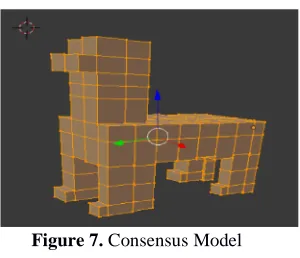
Once the user has finished his design, the agent will submit the produced model to the mediator. After collecting the models as IFS collections, the mediator will perform an averaging over all the vertices forming the faces of the models. The goal is to find the locations that describe the general tendency of the agents’ design as well as attempt to discard bad designs by giving the priority to uniform distributions amongst the clouds of points. For instance, Figure 6provides an example of designs taken amongst 6 agents. The advantage of the adopted parameterized method is that it allows extrusion diversity.
By adopting the averaging mechanism mentioned above, the resulting model for Figure 6 is given in Figure 7. It is important to highlight the advantage of the averaging in its ability to smoothen the rugged faces of the IFSs by providing aligned faces’ edges.
Figure 6. Submitted Models
The collective behavior of the users, coupled with the recursive extrusion-based assistance of the agents is reflected in the final model. This aggregation of the wisdom of the users [20] was allowed given the geometrical nature of the problem in hand as well as the usage of recursion in the way models are generated. The recursive and parameterized way of generating the models provides a compact designing method and a way of simulating distinct human users’ behaviors.
Figure 7. Consensus Model
VI.
C
ONCLUSIONWe developed an agent-based architecture for 3D graphical design of products throughout a collaborative process. The negotiated contracts are different from the previously studied ones; in the way attributes are classified. In fact, in our case a contract represents a 3D object, designed by the user as to reflect his preferences. The whole process can be described as agent-user interaction as well as users-users collaboration. The agent-user interaction takes advantage from a parameterized and recursive generation method used to guide the user in his design.
Furthermore, we have investigated the possible repres-entations of graphical contracts by studying the existing relationships between attributes, and therefore established possible assumptions related to general contracts modeling.
The next step will be an improvement of the constraints’ management methods for non-graphical attributes by allowing monetary attributes to be involved in the assessment process.
R
EFERENCE[1] Web 3D consortium. http://www.web3d.org/ [2] X3D http://www.web3d.org/x3d/
[3] Deng-Neng Chen, B. Jeng, Wei-Po Lee, Cheng-Hung Chuang, An agent-based model for consumer-to-business electronic commerce, Expert Systems with Applications, Volume 34, Issue 1, January 2008, Pages 469-481
[4] K. Fujita, T. Ito, and M. Klein. Preliminary Result on Secure Protocols for Multiple Issue Negotiation Problems. Proc. of the 11th Pacific Rim International Conference on Multi-Agents (PRIMA-2008), Hanoi, 161-172, 2008. [5] K. Fujita, T. Ito, and M. Klein. Approximately fair and
Confere-Copyright © 2015 IJECCE, All right reserved
216
nce on Autonomous Agents and Multi-Agent System (AAMAS-2009), Budapest, 1287-1288, 2009.
[6] S. Fatima, M. Wooldridge, and N.R. Jennings. An analysis of feasible solutions for multi-issue negotiation involving non-linear utility functions. Proc. of the Eighth International Joint Conference on Autonomous Agents and Multi-agent Systems (AAMAS-2009), Budapest, 1041-1048, 2009. [7] E.H. Gerding, D.J.A. Somefun, and J.A. La Poutre.
Efficient methods for automated multi- issue negotiation: Negotiating over a two-part tariff. International Journal of Intelligent Systems, Vol. 21, pp. 99-119, 2006
[8] T. Ito, H. Hattori, and Mark Klein. Multi-issue negotiation protocol for agents: Exploring non linear utility spaces. Proc. of the 20th International Joint Conference on Artificial Intelligence (IJCAI-2007), Hyderabad, 1347- 1352, 2007. [9] K. Fujita, T. Ito, and M. Klein. A secure and fair negotiation
protocol in highly complex utility space based on cone-constraints. Proc.
[10]Fujita, T. Ito, and M. Klein. A representative- based multi-round protocol for multi-issue negotiations Proc. of the Seventh International Joint Conference on Autonomous Agents and Multi-agent Systems (AAMAS-2008), Estoril, 1573-1576, 2008.
[11]V. Robu, D.J.A. Somefun, and J.A. La Poutre. Modeling complex multi-issue negotiations using utility graphs Proc. of the 4th International Joint Conference on Autonomous Agents and Multi- Agent Systems (AAMAS2005), Utrecht, 280-287, 2005.
[12]shajewska and D. Koller. Utilities as random variables: Density estimation and structure discovery In Proceedings of the Sixteenth Annual Conference on
Uncertainty in Artificial Intelligence (UAI-00), Stanford, 63-71, 2000.
[13]R.J. Lin and S.T. Chou. Bilateral multi-issue negotiations in a dynamic environment Proc. of the AAMAS Workshop on Agent Mediated Electronic Commerce (AMEC-2003), Melbourne, 2003.
[14]Barbuceanu and W. Lo. Multi-attribute utility theoretic negotiation for electronic commerce Proc. of the AAMAS Workshop on Agent Mediated Electronic Commerce (AMEC-2000), Barcelona, 15-30, 2000.
[15]Marsa-Maestre, M.A. Lopez-Carmona, J.R. Velasco, and E. de la Hoz. Effective bidding and deal identification for negotiations in highly non linear scenarios Proc. of the Eighth International Joint Conference on Autonomous Agents and Multi-agent Systems (AAMAS-2009), Budapest, 1057-1064, 2009.
[16]M. Klein, P. Faratin, H. Sayama, and Y. Bar-Yam. Negotiating complex contracts Group Decision and Negotiation, Vol. 12, No. 2, pp. 58-73, 2003.
[17]H. Tamura and Y. Nakamura. Decompositions of multi attribute utility functions based on convex dependence Operations Research, Vol. 31, No. 3, pp. 488-506, 1983. [18]K. Fujita, T. Ito, H. Hattori, and M. Klein. An approach to
implementing a threshold adjusting mechanism in very complex negotiations: A preliminary result Proc. of the 2nd International Conference on Knowledge, Information and Creativity Support Systems (KICSS-2007), Japan, 2007. [19]The Xj3D Project (http://www.xj3d.org)
[20]Surowiecki, James, The Wisdom of Crowds", Anchor, 3005
A
UTHOR'
SP
ROFILERafik HADFI is currently a PhD student in the department of Computer Science and Engineering at the Nagoya Institute of
Technology (Japan). He received the M.E. from the Nagoya Institute of Technology in 2012. His research interests include Multi-agent Negotiation, Consensus Building, Decision Making under Uncertainty, and Preferences Elicitation.
Dr. Takayuki Ito is Professor of Nagoya Institute of Technology. He received the B.E., M.E, and Doctor of Engineering from the Nagoya Institute of Technology (Japan) in 1995, 1997, and 2000, respectively. From 1999 to 2001, he was a research fellow of the Japan Society for the Promotion of Science (JSPS). From 2000 to 2001, he was a visiting researcher at USC/ISI (University of Southern California/Information Sciences Institute). From April 2001 to March 2003, he was an associate professor of Japan Advanced Institute of Science and Technology (JAIST). From 2005 to 2006, he is a visiting researcher at Division of Engineering and Applied Science, Harvard University and a visiting researcher at the Center for Coordination Science, MIT Sloan School of Management. From 2008 to 2010, he was a visiting researcher at the Center for Collective Intelligence, MIT Sloan School of Management. He is a board member of IFAAMAS, Executive Committee Member of IEEE Computer Society Technical Committee on Intelligent Informatics, the PC-chair of AAMAS2013, PRIMA2009, General-Chair of PRIMA2014, and was a SPC/PC member in many top-level conferences (IJCAI, AAMAS, ECAI, AAAI, etc.). He received the JSPS Prize, 2014, the Prize for Science and Technology (Research Category), The Commendation for Science and Technology by the Minister of Education, Culture, Sports, Science, and Technology, 2013, the Young Scientists' Prize, The Commendation for Science and Technology by the Minister of Education, Culture, Sports, Science, and Technology, 2007, the Nagao Special Research Award of the Information Processing Society of Japan, 2007, the Best Paper Award of AAMAS2006, the 2005 Best Paper Award from Japan Society for Software Science and Technology, the Best Paper Award in the 66th annual conference of 66th Information Processing Society of Japan, and the Super Creator Award of 2004 IPA Exploratory Software Creation Projects. He is Principle Investigator of the Japan Cabinet Funding Program for Next Generation World-Leading Researchers (NEXT Program). Further, he has several companies, which are handling web-based systems and enterprise distributed systems. His main research interests include multi-agent systems, intelligent agents, group decision support systems, agent-mediated electronic commerce, and software engineering on offshoring.