Volume 3, Issue 3 (2014) pp. 155-166
155 | Page Original Article
The Effect of Strategic Purchasing on Supplier
Development and Performance
Habibollah Javanmard
1*, Majid Jalaei
21Department of Management, Islamic Azad University, Arak Branch, Iran 2MSc of Business Administration, Islamic Azad University, Arak Branch, Iran
*Corresponding Author E-mail: [email protected]
Received: 02 April 2014, Revised: 05 May 2014, Accepted: 15 June 2014
ABSTRACT
Purpose: The aim of this article is to introduce the effect of strategic purchase (SP) on the
suppliers’ development (SD) and purchasing performance.
Design/methodology/approach: The research method is causal applied one and in order to gather data, the questionnaire was used under field method. The questionnaires were distributed among 241 companies among the suppliers of Imam Khomeini Oil Refinery Company of Shazand. Method of data analysis is also Structural Equation Modeling. Findings: this study indicate that there is significant evidence to support the hypothesized model in which SP a direct influence on SD practices and purchasing performance, as well as an indirect impact on purchasing performance mediated through SD. Research limitations/implications: Further research is necessary to increase our understanding of a buyer’s strategic purchasing and supplier development practices and more specifically how suppliers could develop a supporting environment to facilitate the strategic alignment of these two concepts. The limitations of the survey are also discussed. Practical implications: The findings from this study provide supplying firms with an understanding of how buying firms use SD to deploy their SP initiatives in order to achieve improvements in purchasing performance. Originality/value: While there is some literature analyzing SP and the implications for buyer-supplier relationships, the relationship between SP and SD practices and their effect on purchasing performance has not been yet analyzed.
Keywords: Strategic Purchasing, Supplier Development, Purchasing Performance.
Introduction
Purchasing plays a pivotal role in organizations, mediating the flow of critical production inputs into the firm. Increasingly, the purchasing function is viewed as an integral part of closely coordinated, cross-functional systems such as material requirements planning (MRP)
and just-in-time logistics (J-I-T) (Sriram et al, 1997).The make or buy decision is being given more consideration within organizations because of its strategic implications. The make or buy decision can often be a major determinant of
156 | Page contribution to the financial health of a
company (Mcivor et al, 1997).
Several studies maintain that business performance depends on the role that this function plays in the company’s strategic planning process (Narasimhanand Das, 2001; Chen et al., 2004). Thus, to explain
business performance, it appears
necessary to take the strategic behavior of the purchasing function into account. The concept of a purchasing and supply strategy appears in various ways and different perspectives, though most literature focuses on characterizing and classifying purchasing strategies according
to the practices and initiatives
implemented by the purchasing function (Gonza´lez-Benito, 2010).
In new millennium, restructure and reformation of purchasing and SCM to face new era of challenges in global competition plays an important role for organizations. The role of purchasing not only limited in obtaining the right material, but been extended in acquisition of product in the right quantities, with right delivery time and place, from the right source and at the right market place which been encompass as purchasing function
(Thrulogachantar and Zailani,2011).
During trade, buyers assess the bundle of potential costs and benefits represented by a supplier’s sales offerings, and either place orders, negotiate a better deal, or seek alternative sources (Ramsay and
Wagner, 2009).The term “supplier
development” found its first application in the academic literature by Leenders
(1966) as a means by which
manufacturers can increase the number of qualified suppliers and as a way to improve supplier performance. Over time, supplier development programs have had a major influence on overall supply chain performance (Mortensen and Arlbjørn,
2012).Critical to the success of
relationship marketing is the exchange of resources between buyer and supplier. In this regard, both supplier and buyer play a key role in ensuring the overall quality
and effectiveness of relationship
marketing efforts (Sa´nchez-Rodrı´guez, 2009). Strategic purchasing is considered critical to fostering and facilitating close interactions with a limited number of suppliers, thus making effective use of the firm's supply base .The relational competency perspective suggests that having close ties with a limited number of suppliers and increasing investments in relationship-specific assets ultimately fosters greater trust, dependability and cooperation among supply-chain partners . Trust and trustworthiness gain strategic value precisely when conditions exist for a partner to behave opportunistically, but the partner chooses not to do so in order to realize mutual gains (Chen et al, 2004). The concept of a purchasing and supply strategy appears in various ways and different perspectives, though most literature focuses on characterizing and classifying purchasing strategies according
to the practices and initiatives
implemented by the purchasing function. Krause et al. (2001) demonstrate that a purchasing function's strategy also could be articulated in terms of Hayes and Wheelwright’s (1984) generic competitive objectives (i.e. quality, cost, dependability, and flexibility), but no empirical research applies this framework to analyze the relationship between the purchasing and supply strategy and business performance (Gonza´lez-Benito,2010).
The importance and necessity of research include:
Suitable practice in Purchase and supplies
Section, strategic and competitive
157 | Page on the performance of the purchasing unit
is.
The supplier's development is one of the main of long-term strategy, that there are in the core of competitiveness Buyer organizations. Many companies with a significant level of marginal costs cannot do without the help and cooperation of self-suppliers to improve quality, reduce costs and provide a new product to market to act. It is essential, the role of suppliers development in the performance of purchasing unit.
This research could also expand the existing literature on the importance of purchase and supplier development strategy has helped lead to future research.
The aim of this study is determine the effect of strategic purchasing on supplier development and purchasing performance Oil Refining Company Imam Khomeini Shazand and exploitation in order to increase the purchase. The main research question is what is the impact of strategic purchasing on supplier development and purchasing performance?
Theoretical framework and hypotheses Strategic purchasing and supplier development
Strategic purchasing has been identified as
a critical antecedent of supplier
involvement in the buyer’s new product
development process and the
implementation of effective
communication and evaluation practices with suppliers, thus making it an integral part of building successful buyer-supplier
relationships (Sa´nchez-Rodrı´guez,
2009).Supplier development is a process that improves the supplier’s performance. To this end, firms reduce the supplier base and improve the remaining suppliers’ efficiencies (Park et al, 2010).Carter and Narasimhan (1995) identified buyer–
supplier relationship development as a component of strategic sourcing in their study of future trends in purchasing and supply management (Narasimhan and Das, 2001).
There is a large variety of actions that can be deployed to improve suppliers’
performance, ranging from low
involvement activities such as supplier evaluation to much more elaborate and resource demanding activities such as investing in production equipment and training of supplier employee.
An important question in this respect is how various types and levels of supplier development are linked to actual outcomes for both the suppliers and the buying company. Modi and Mabert (2007) and Wagner and Krause (2009) conclude that
the development of a supplier’s
capabilities requires more than low involvement activities such as audits or incentives. Still, more insight is needed regarding the question of how various types and levels of supplier development are connected to different types of outcomes for the suppliers (Arroyo Lo´pez, 2012).
158 | Page structural changes in the supply market,
and so on . . . Quayle (1998, 2002) cites the same reasons for purchasing strategy changes in the public sector (Faes & Matthyssens, 2009).
The supplier development literature consists primarily of case studies of one to ten firms. In addition, much of the supplier development literature focuses on the auto industry, both in the USand elsewhere. One exception is an article by Watts and Hahn that reported on the responses to a survey questionnaire by 81 purchasers from a variety of industries. Watts and Hahn
reported that although supplier
development was performed primarily by large firms, it was more prevalent among US buying firms than they expected. Further, they reported that the focus of supplier development activities was most likely to be a short-term focus, targeted at improving suppliers’ product or service performance instead of a long-term focus on improving suppliers’ capabilities. Buying firms may use a variety of activities to develop suppliers’ performance and/or capabilities. Previous research described activities that take place within the context of supplier development. These activities include introducing competition into the supply base, supplier evaluation as a
prerequisite to further supplier
development activities, raising
performance expectations, recognition and awards, the promise of future benefits, training and education of the supplier’s personnel, exchange of personnel between the buying firm and the supplier, and direct investment in the supplier by the buying firm (Krause & Ellram, 1997).As such, the hypotheses proposed are:
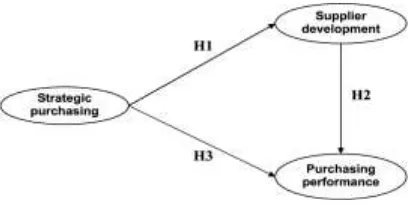
H1. Strategic purchasing will be positively
related to supplier development
Strategic purchasing and purchasing performance.
Strategic planning processes that are well developed, properly implemented, and controlled have a positive effect on a firm’s performance. Therefore, the participation of purchasing in the strategic planning process of the company (strategic purchasing) should also have a positive
effect on the buyer’s purchasing
performance. A planned and proactive approach to the strategic management of the purchasing function both show enormous potential for the firm in terms of
increased profit and improved
competitiveness in the marketplace. Accordingly, strategic purchasing would be expected to have a positive direct effect on a buyer’s performance. However, the effect of strategic purchasing on performance could also be mediated by supply management practices. It could be the
unique combination of strategic
purchasing and supplier development
practices or activities and their
configuration with the buying firm’s strategic goals as well as the supplying firm’s specific resources and capabilities, what may protect the buying firm’s competitive advantage. Thus, we expect that a buying firm’s strategic purchasing
efforts should lead to increased
performance both directly and indirectly (mediated by supplier development) (Sa´nchez-Rodrı´guez, 2009).The following hypotheses generalize the relationship of Strategic purchasing and purchasing performance.
H2.Strategic purchasing will be positively
and directly related to purchasing performance.
Linking supplier development and purchasing performance
One common definition of supplier development is ‘‘any set of activities undertaken by a buying firm to identify,
159 | Page performance and facilitate the continuous
improvement of the overall value of goods and services supplied to the buying company’s business unit’’ (Krause et al., 1998; Bai & Sarkis, 2011).
The success of a supplier development programs has been usually evaluated by the buying firm in terms of outcomes such as cost reductions or delivery time. However, it has been proposed that supplier development may be more effective when is process-oriented rather than results-oriented, because process-oriented practices contribute to build capabilities which guarantee permanent improvements. Wagner and Krause (2009)
differentiated between supplier
development goals which involve the improvement of short-term abilities to become a qualified supplier and the
advancement of more long-term
capabilities like product innovation, collaboration and continuous process improvement. The authors argued that under a relational perspective, the supplier-customer dyad derives benefits not so much from corrective actions in case of poor supplier performance but from closer partnerships, mutual learning and the combination of complementary capabilities. Thereby, instead of traditional short-term and outcome oriented measures; the efforts of the buying firm when developing suppliers should take a strategic perspective and be measured in terms of improved dynamic capabilities (Arroyo-Lo´pez,2012).
The supplier development process begins even before a product is manufactured and may relate to the design specifications of the products. Initially, the supply chains need to be constructed and is heavily reliant on the strategic capacity of the organization which sets the foundation for the supplier selection process and supplier network design (Bai & Serkis, 2011).
Supplier development enables these four rent-generating mechanisms. For example, involvement of the supplier in the buyer’s new product design process enables joint investment and combining valuable and scarce resources; sharing of cost structure information enables knowledge exchange; and the reward and recognition of a supplier’s achievements enables more effective governance mechanisms. In this context, supplier development could be viewed a strategy where both buyer and supplier access and combine other firms’ resources with their own in order to
improve performance and garner
otherwise unavailable competitive
advantages. Initial evidence from the literature is supportive of the positive effect of individual supplier development practices on performance. For example, Krause (1997) and Krause et al. (2000) reported that the evaluation of suppliers through site visits and the use of supplier reward and recognition systems improve supplier performance. For ker and Hershauer (2000)found that involvement of the buyer in the supplier’s new product design process resulted in better performance for both supplier and buyer. Timely and accurate information is also crucial to buyer-supplier decision-making and ultimately to supplier performance (Handfield et al., 2000). Tan et al. (1998)
reported that sharing confidential
information (e.g. production schedules, production costs) with the suppliers is positively correlated with a firm’s overall
business performance. Additionally,
160 | Page 1999). The above discussion suggests that
implementation of supplier development results in increasing supplier performance which, subsequently, would produce improvements in a buying firm’s
purchasing performance
(Sa´nchez-Rodrı´guez, 2009). Thus, the following hypothesis was formulated:
H3: Supplier development will be
positively related to purchasing
performance.
Figure 1. Research model
Methodology
A survey methodology was chosen to test
the research hypotheses. Survey
methodology was chosen because the phenomena to be studied required obtaining information regarding a firm’s relationships with their suppliers and this type of information is not available publicly. Thus, an appropriate method to obtain this information was to survey purchasing manager’s perspectives on supplier development and strategic
purchasing. In addition, survey
methodology ensures greater
generalizability of the results when compared to case based research. Based
on the research purposes, its
implementation method is an applied one because the results obtained would be applicable in the firms and organizations contained in the research sample. The present research is classified as a casual research because it deals with the research factors interrelationships using the Structural Equation Modeling (SEM) technique.
The research sample includes the suppliers of Imam Khomeini Oil Refinery
Company of Shazand. The questionnaires were distributed among 241 companies among the suppliers of Imam Khomeini Oil Refinery Company of Shazand. Method of data analysis is also Structural Equation Modeling.
The plain stochastic sampling method is employed in choosing the research sample. In such a method known as random or probabilistic sampling, the subjects are selected by chance and the results obtained are assumed generalize able into the entire considered sample so it has a high degree of scientific recognition and credit.
The sample was split into 27 percent females and 72 percent males, providing a sample close to that of the managers and suppliers of Imam Khomeini Oil Refinery Company of Shazand. The highest age rate is assigned to suppliers and managers in the age range of 35-45 (47/3%).
Anonymous questionnaire has been used
for data collection and objective
161 | Page Company of Shazand. The questionnaire
includes 15 questions, in relation to the
research main variables measured
according to five point Likert scale. Various methods are used for the calculation of reliability coefficient and the present research chooses Cronbach’s alpha method for the purpose. Early distribution of 40 questionnaires results in the reliability index equal to0.792, With regard to the point that the minimum
reliability index for research
questionnaires is 0.70, so it is observed that the obtained Cronbach's alpha coefficient is appropriate and thus ensures the questionnaire reliability., the items
reliability coefficients were obtained using Cronbach’s alpha method and SPSS 16 software; its results are reported in Table 1. Since the questionnaire uses standard
questions obtained from
Sanchez-Rodrigues research, so the measurement tool employed in the research has desired content validity.250 questionnaires were distributed among managers and suppliers of Imam Khomeini Oil Refinery Company of Shazand. Of the all questionnaires, 241 returns were received, 9 returns were omitted due to incomplete information leaving 241 usable returns for the research analysis.
Table 1. Cronbach’s alpha values
No. Variable Ques. No. Cronbach’s alpha coefficient
1 Strategic purchasing 4 0/80
2 Supplier development 6 0/749
3 Purchasing Performance 5 0/816
Results
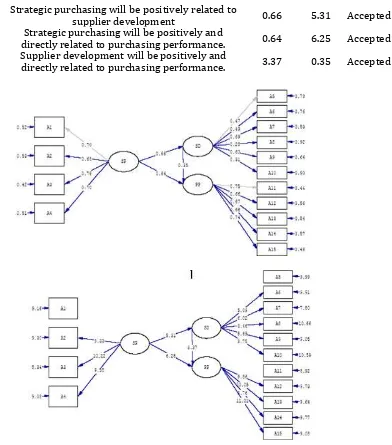
The research hypothesis testing was carried out using path analysis method. The path diagram can be used as a tool to show which variables cause some changes in other variables. If a model drawn as the path diagram is confirmed through fit goodness indexes, the diagram can be employed to test the hypotheses showing a casual relation between the displayed variables in the path diagram. To find an answer for the question, it is necessary to
evaluate x2/df value (ratio of chi-square to
freedom degree) along with other variables which are related to the model fit goodness. With regard to LISREL’s output,
the calculated x2/df value equals to 2.73
which its smallness confirms the model fit goodness. The main fit goodness indexes for the model are NNFI, IFI, RMSEA, CFI and RMS. Table 2 shows the output of LISREL software and optimal values of these indexes. We show the results of the path analysis in Table 3 and Figure 2.
Table 2. Fit indices of model
Index Index value based on the model Results
x2/df 2.73 The model’s fit goodness is confirmed
SRMR 0.066 The model’s fit goodness is confirmed
NNFI 0.82 The model’s fit goodness is confirmed
GFI 0.88 The model’s fit goodness is confirmed
AGFI 0.84 The model’s fit goodness is confirmed
IFI 0.88 The model’s fit goodness is confirmed
Table 3. Results of the path analysis
162 | Page H1 Strategic purchasing will be positively related to supplier development 0.66 5.31 Accepted
H2 directly related to purchasing performance. Strategic purchasing will be positively and 0.64 6.25 Accepted
H3 Supplier development will be positively and directly related to purchasing performance. 3.37 0.35 Accepted
Chi-Square= 236.73, df= 87, P-value= 0.000, RMSEA= 0.085
Figure 2. Research model estimation results
Conclusions and Implication
The results of this research provide support for the relationship between
strategic purchasing and supplier
development. This is very important for
industrial marketers given the
importance and interactive character of relationship marketing efforts. Industrial marketers could benefit from a buyer’s efforts towards supplier development by
163 | Page and supplier development and how it
creates value for the buying firm. The study’s results suggest that strategic purchasing on supplier development has a positive effect, strategic purchasing on purchasing performance has a positive effect and supplier development on purchase performance has a positive effect. The results of the research hypotheses are parallel Sanchez (2009). Since long-term value creation is one of
the key organizational goals of
businesses, and strategic purchasing and supplier development leads to improved performance in the buying firm (customer), it is therefore advisable for supplying firms and industrial marketers in particular, to understand strategic purchasing and supplier development, and how they are related. In this regard, this research offers a general guideline for industrial marketers regarding strategic purchasing practices (e.g. participation of purchasing in the strategic planning process, the existence of a formal purchasing plan, and the existence of direct links between
purchasing executives and top
management) and supplier development activities (e.g. frequent visits to suppliers to assess their processes, establishment of a system to reward and recognize
supplier improvements, providing
training to suppliers, sharing of quality
and production information,
collaboration with suppliers in
improving existing and new materials, and involving the supplier in the company’s new product development process). Thus, in order to support the buying firm’s supplier development efforts and ensure their success, the supplying firms could provide training to its sales and operations personnel on how to collaborate with the customer firm on new product development,
establishment of a system to reward and recognize supplier improvements, or
developing inter organizational
information systems. The findings of this research suggest that strategically oriented supplier development practices could help the supplier in creating value for the buying firm in four dimensions: product quality, delivery, direct product costs, and process costs (Ulaga, 2003,
Sánchez-Rodríguez, 2009). Thus,
suppliers should strive to reorient their relationship marketing efforts in order to support their customers’ strategic
purchasing activities, but more
importantly their customers’ strategic priorities. In this way, industrial marketers have the challenge to develop and establishing a process in the
company with the capability of
identifying a supplier’s degree of alignment with their customer’s strategic priorities in order to align their business processes to satisfy those priorities. Limitation & Future research
A potential limitation of this study is that all of the items included in the paper were measured using a five-point Likert-type scale. The use of only one Likert-type of measure for all concepts might introduce a mono-method bias, and thus decrease the evidence of this empirical study. This study highlights the importance of
strategic purchasing and supplier
development in improving customer value (purchasing performance), thus meriting management consideration and resources from both suppliers and buyers when developing an integrated supply chain strategy. The findings suggest that a buying firm’s supplier
development practices that are
164 | Page superior performance. More specifically,
we identified that the implementation of
strategically-oriented supplier
development activities allows buyer and supplier to synergistically combine, exchange, or invest in idiosyncratic
assets, knowledge, and
resources/capabilities that permit the
realization of rents increasing
performance. This study identified a number of opportunities and areas for future research. It is necessary to deepen our understanding of the alignment between a buyer’s strategic purchasing and supplier development practices and more specifically how suppliers could develop a supporting environment to facilitate such strategic alignment. The use of a single key informant from participating businesses could be seen as a potential limitation of the study. This study’s findings should be confirmed in the future using information directly obtained from actual suppliers and internal customers (i.e. the company’s
internal manufacturing, R&D, and
marketing personnel). The study
incorporated a cross-sectional and descriptive sample of the manufacturing industry at a singular point in time. A more stringent test of the relationships between strategic purchasing, supplier development, and purchasing and
business performance requires a
longitudinal study, or field experiment, which could gather information about
strategic purchasing and supplier
development practices and performance over a more extended time span. Regardless of the strength of the relationships between the constructs in the model, we cannot obviate the fact that these relationships may apply to larger firms more than to smaller firms.
References
Arroyo-López P., Elsebeth H., Luitzen de B. (2012). “How do supplier development programs affect suppliers? Insights for suppliers, buyers and governments from an empirical study in Mexico”, Business Process Management Journal, Vol. 18 No. 4, pp. 680-707.
Azar, A. (2002). “Path analysis and reasoning in the management science”, Qom Excellency Association Journal, Vol. 4, No. 15
Azar, A. and Momeni, M. (2006). “Statistics and its application in management: statistic analysis”, 9th Edition, Tehran: Samt Publications
Bai, C. Joseph, S. (2011). “Evaluating supplier development programs with a grey based rough set methodology”, Expert Systems with Applications, No.38 , pp.13505–13517.
Chen, Injazz J., Antony, Paulraj,
Augustine, A.L. (2004). “Strategic
purchasing, supply management, and firm performance”, Journal of Operations Management No.22, pp. 505–523.
Faes, W. Paul, M. (2009). “Insights into the process of changing sourcing Strategies”, Journal of Business & Industrial Marketing, Vol. 24 Issue: 3 pp. 245 – 255.
Ghazi Tabatabaei, M. (2002).
“Development, implementation and
interpretation process for LISREL model
output: an observational model”,
Research Yearbook, No.1, Tabriz
University
165 | Page Hafez Nia, M.R. (1998). “An introduction
to research methodology in human science”, First Edition, Tehran: Samt Publications
Han, S.L., Wilson, W. and Dant, S.P. (1993). “Buyer-supplier relationships
today”, Industrial Marketing
Management, Vol. 22 No. 4, pp. 331-8.
Handfield, R.B., Krause, D.R., Scannell, T.V. and Monczka, R.M. (2000). “Avoid
the pitfalls in supplier
development”,,Sloan Management
Review, Vol. 40 No. 2, pp. 37-49.
Hooman, Heidar A. (2005). “Structural Equation Modeling with LISREL software functions”, First Edition, Tehran: Samt Publications
Khaki, G.R. (1999). “Research
methodology with thesis compilation approach”, First Edition, Tehran: Iran Scientific Research Center, Drayat publications
Krause, DR., Lisa M.E. (1997). “Success
factors in supplier Development”,
International Journal of Physical
Distribution & Logistics Management, Vol. 27 No. 1, pp. 39-52.
McIvor, R.T, Mulvenna, M.D, Humphreys, P.K. (1997). “A Hybrid knowledge-based system for strategic purchasing, Expert systems with application, Vol., 12, No, 4, pp.497-512.
Møller, Morten, John, Johansen, Harry,
Boer, “Managing buyer-supplier
relationships and inter-organisational competence development”, Integrated Manufacturing Systems, Vol. 14, Iss: 4, pp. 369 – 379.
Mortensen, Mads, Jan, A. (2012). “Inter-organizational supplier development: The case of customer attractiveness and
strategic fit”, Supply Chain Management: An International Journal, No, 17/2, pp. 152–171.
Nadery, E. and Seif Naraghi, M. (1992). “Research methodologies and their evaluation approaches in the human science emphasizing on educational sciences”, 4th Edition, Badr Research and Publication Center
Narasimhan, R., Ajay, D. (2001). “The impact of purchasing integration and
practices on manufacturing
performance”, Journal of Operations Management, No, 19, pp. 593–609.
Park J., Kitae S., Tai-Woo Chang, J.P. (2010). “An integrative framework for
supplier relationship management”,
Industrial Management & Data Systems, Vol. 110, No. 4, pp. 495-515.
Ramsay, J., Beverly A.W. (2009). “Organizational Supplying Behavior: Understanding supplier needs, wants and preferences”, Journal of Purchasing & Supply Management, No, 15, pp.127–138.
Sánchez-Rodríguez C. (2009). “Effect of
strategic purchasing on supplier
development and performance: a
structural model”, Journal of Business & Industrial Marketing, 24/3/4, pp. 161– 172.
Sarmad, Z., Bazargan, A., and Hejazi, E. (2001). “Research methodologies in behavioristic sciences”, 5th Edition, Tehran: Agah Publications
Srirman, V., Rodney, S., Snehamay, B.
(1997). “Information technology
166 | Page Thrulogachantar P., Suhaiza Z. (2011).
“The influence of purchasing strategies on manufacturing performance”, Journal
of Manufacturing Technology
Management, Vol. 22 No. 5pp. 641-663.
Trent, R. and Monczka, R. (1999). “Achieving world-class supplier quality”, Total Quality Management, Vol. 10 No. 6, pp. 927-38.
How to cite this article:Habibollah Javanmard, Majid Jalaei, The Effect of Strategic
Purchasing on Supplier Development and Performance. International Journal of
Advanced Studies in Humanities and Social Science, 2014, 3(3), 155-166.