Pharmaceutical Society of South Africa
Getting to know the PSSA Presidential
Committee
This month we speak to the Presidential Committee of the PSSA and get to know them a little better. They were all asked the same questions and their answers give us insight into what makes them tick.
Sarel Malan – President
1. Tell us what work you do and where?
Firstly I’m a pharmacist, but practice in academia as Professor and Director of the School of Pharmacy at the University of the Western Cape, Bellville.
2. Why did you get involved with the PSSA?
I had an excellent mentor in Jakkie van der Watt who got me involved in the Academy of Pharmaceutical Sciences and through it in the PSSA. As a younger academic pharmacist, I then realised for the first time what a crucial role the PSSA plays in the continued sustainability and professional practice of the pharmacist. For me it became clear – if you want to ensure your future you have to work and contribute to it where it matters most, and for me it was clear that the PSSA would be the place to do it.
3. Are your expectations for the Society being met?
I think that in terms of seeing things happen, being involved and hopefully influencing decisions to the advancement of the profession, my personal expectations are being met. In the bigger picture of how we move forward as pharmacy, I think we can never do enough and when we feel that everything has been done, we have a problem – there is so much that has to be done and in that sense we will never meet all expectations.
4. What are your goals for PSSA in 2018?
To work as a united pharmacy profession towards the future, NHI and way further than that.
5. What do you think is the biggest challenge facing pharmacy?
Externally I think the biggest threat is that pharmacy is being relegated to the procurement and dispensing role in NHI and Universal Access to Medicine. Our challenge is to get the national health mind shift to recognising the critical role of the pharmacist in primary health care, treating of minor ailments and referral in the health system.
Our biggest challenge internally (in the profession) is the proliferation of minor bodies and streams claiming to represent specific groups of pharmacists and then developing documents and communications that does not support the profession in its totality.
6. If the answer is 42, what is the question?
In the Hitchhiker’s galaxy it might be the answer to the question of life and the universe, but from my experience in the pharmacy world it would be: “It’s the age where you really cannot claim to be a young or even ‘younger’ pharmacist anymore!”
Stéphan Möller – Deputy President
1. Tell us what work you do and where?
sometimes assist with turnarounds at hospitals that are struggling, whether private or state. Southdowns Office Park in Irene is my second home. My office window allows me to enjoy a Highveld view, untouched by civilisation (for now at least).
2. Why did you get involved with the PSSA?
I initially joined SAAHIP to attend its conference, which gave me the opportunity to negotiate with the trade members manning the stands nearly two decades ago. I then met Andy Gray, my external dissertation examiner, who was also the president of SAAHIP at the time. Initially I did not understand a word these distinguished gentlemen and ladies uttered, however .... it made me extremely curious and interested. It was only after a decade went past that I really started to commit myself to organised pharmacy.
3. Are your expectations for the Society being met?
With age comes wisdom. I believe that I now know how absolutely important it is for us to treasure and grow our profession. If it had not been for the Society, my life would have been considerably duller and I would have lost out on my opportunity to be a positive change agent in a tremendously challenging healthcare environment.
4. What are your goals for PSSA in 2018?
My personal goals in life are simple: Something to do, something to look forward to and someone to love. I have found all three personal goals met within the PSSA. In terms of the PSSA, I want to follow the same avenue of simplicity. I only have two goals for the PSSA in 2018. The first is to take hands with the other healthcare professionals (something to look forward to) in our country and tackle the daunting healthcare challenges we face (something to do). My second goal is to convince each and every fellow pharmacist I come across of their worth and that they should believe in themselves (someone to love). Only after we have accepted that we do matter and that the people of South Africa are dependent on our professional care, will the rest of the healthcare professionals start to treat us as equals and accept our interventions and services as experts in our fields.
5. What do you think is the biggest challenge facing Pharmacy?
If I am honest, I would have to say technology. Our profession needs to adapt to the changing environment if we are to remain indispensable. Biotech companies in the UK are confident that they will be able to produce printable medicine technology within 5 – 10 years. Would pharmacists be required if an algorithm informs a person to take the tablet that has been printed specifically for that time of day, with all the required active ingredients in one oral delivery form? In other areas Deep Transcranial Magnetic Stimulation is a non-invasive procedure, utilising magnetic resonance to stimulate the brain briefly and in doing so, treat neuro/brain related illnesses, from Alzheimers to chronic pain. If it sounds futuristic, the technology already bears FDA approval. Pharmacists will have to perform tasks and functions we do not currently know or understand.
6. If the answer is 42, what is the question?
If you were born in the same year that the SABC introduced its television service in South Africa, how old would you be?
If your age and the country code for the Czech Republic were the same, how old would you be?
How old was I on the last day of August 2016?
Joe Ravele – Treasurer
1. Tell us what work you do and where?
I am a proud community pharmacist working in my own pharmacy in Mamelodi, Pretoria.
2. Why did you get involved with the PSSA?
I wanted to learn more about my profession from my peers and also to contribute constructively to the wellbeing and sustainability of the profession.
3. Are your expectations for the Society being met?
Absolutely. I’ve learned a lot and I believe that the work that the PSSA does is vitally important to the profession and its contribution to healthcare in this country.
4. What are your goals for PSSA in 2018?
I believe that the PSSA must make more inroads amongst the young pharmacists and encourage them to be positive about their career choice and their future within the PSSA. I also believe that the PSSA must stamp its authority as the voice of the profession.
5. What do you think is the biggest challenge facing pharmacy?
The legal environment in which pharmacy operates is not always easy to navigate. From a community pharmacy point of view, we are hampered by the failure of medical schemes to reimburse pharmacies appropriately. Pharmacists must also position themselves correctly so that their inclusion as healthcare providers under NHI offers more than just logistical support for medicine supply.
6. If the answer is 42, what is the question?
Gareth Kilian – Vice President: Academia
1. Tell us what work you do and where?
I am employed by the newly-named Nelson Mandela University (formerly the Nelson Mandela Metropolitan University and before that the University of Port Elizabeth) in the Department of Pharmacy as an associate professor of pharmaceutical sciences. The Department is celebrating 90 years of pharmacy education in Port Elizabeth this year.
2. Why did you get involved with the Academy?
In 2003 I entered the Academy’s Young Scientist competition and won. This opened many doors for me and I realised the power that the Academy has in promoting research in the pharmaceutical sciences in South Africa. Along with this, one of my colleagues and former chairperson of the Academy, Prof Shirley-Anne Boschmans, convinced me to get involved in the executive committee. I was elected onto the committee in 2009 and have served in various roles since.
3. Are your expectations of the Academy being met?
Yes they are. The networking opportunities that the Academy and the Pharmaceutical Society provide are invaluable in any young person’s career (not that I’m ‘young’ anymore, but I was when I joined the executive committee). I would really encourage all young pharmacists to become active members of the Society.
4. What are your goals for Academy in 2018?
My primary goal for the Academy is to increase our national and international online presence through an integrated social media campaign. As an executive committee, we want to provide our members with networking opportunities with local and international researchers that will stimulate research in South Africa. As part of this campaign, we have started by co-opting a member onto the committee who is well versed in all aspects of social media that will drive this process.
5. What do you think is the biggest challenge facing pharmacy?
Pharmacists tend to be our own worst enemies. We do what we do behind the counter or closed doors without showing the general public the value we add to the health care system. They don’t make TV shows about us or write suspense novels about us, yet we know that the health care system would collapse without
pharmacists. Our biggest challenge is to let the public know what value we add to their lives.
6. If the answer is 42, what is the question?
Besides the obvious (What is the meaning of life, the universe and everything), it is also the answer to: How many tablets would you dispense if the prescription calls for ii tds X 1/52?
Christine Venter – Vice President: Community
pharmacy
1. Tell us what work you do and where?
I am a community pharmacist who happened to land in education a few years ago. I was in community pharmacy operations for many years; during this time I realised that there is a huge need for training on operational procedures and processes in the industry. There is also a need for assistance with the implementation of standard operating procedures. I started Pharmacy Development Academy (or PDA, as we are commonly known) a few years ago, and our offices are based in Delmas, Mpumalanga. We are a training provider which is accredited for two wholesale and retail qualifications; we also develop customised course material for Dis-Chem and The Local Choice pharmacies.
2. Why did you get involved with SAACP?
I love being a pharmacist and I decided many moons ago I would like to give some of my time, skills and work experience to SAACP to further the profession. My “career” in the Society started at Southern Gauteng, and continued at the Pretoria branch after I relocated there. My passion is community pharmacy and hopefully through my involvement with SAACP I helped to advance SAACP and the existence of community pharmacists.
3. Are your expectations for the Society being met?
4. What are your goals for PSSA in 2018?
SAACP has identified six strategic themes during the past year and I would like to implement three projects in 2018 in line with these strategic themes. The first project I would like to implement is to improve the communication between pharmacists and the SAACP through the implementation of a web application. Secondly, to actively promote the role and value of the pharmacist in medication management, health promotion, prevention and management of disease by our involvement in the development of a pharmaceutical service model for universal health care. Lastly, I’d like to see SAACP enhance its value as a one stop resource centre.
5. What do you think is the biggest challenge facing pharmacy?
I personally think the biggest threat to our profession is the reluctance of pharmacists to adopt change. The only constant in life is change and we need to embrace change by looking at alternative ways of doing things that we have been doing for many years. Our patients are changing, society is changing, medicine is changing, so we would be foolish to think we don’t have to change.
6. If the answer is 42, what is the question?
How old were you when you become President of SAACP?
Joggie Hattingh – Vice President: Hospital and
institutional pharmacy
1. Tell us what work you do and where?
I work for the Western Cape Government: Health as Manager Pharmaceutical Service for Eden District. It covers the area from The Crags east of Plettenberg Bay up to Heidelberg (WC) on the coast and from Uniondale to Ladismith (WC) in the Klein Karoo. My office is in George.
2. Why did you get involved with SAAHIP?
Initially I was not actively involved in SAAHIP activities, as the branch activities were all in Cape Town, which is 500km from George, but when the SAAHIP Western Cape Branch experienced challenges after the chairperson resigned mid-term, I was elected as chairperson during a special AGM. From then on I was caught hook, line and sinker and drawn into SAAHIP and PSSA activities, although my committee had to be very accommodating and were willing to arrange meetings on dates that I was in Cape Town for
work. With all said, I was not selected by popular choice…. I was the only choice left and elected by default.
3. Are your expectations for the Society being met?
Both in SAAHIP and PSSA, my expectations were not only met, but exceeded by far. The office at PSSA comprise of a very dedicated team that really goes the extra mile for the members and for the profession, whilst all members of the NEC voluntarily contribute their knowledge, time and effort to serve the profession. The SAAHIP team is actually a family and we were joined by our Director, Boitumelo Ntsoane in 2017, who immediately became part of the family. As a family-business we run a tight ship and each and every member of the Executive Committee (Exco) really works hard and contributes to our outputs.
4. What are your goals for SAAHIP in 2018?
I have already overstayed the initial two year term I committed to and will hand over the reins at our AGM in March 2018. There is a large amount of work that was started in my 3 year tenure, and I will avail myself to help conclude some of it, in the capacity as past-president. There are a number of documents that must be finalised and submitted, such as the document on Staffing Norms and we are participating in the Pharmacy Stakeholders Forum on NHI and UHC. We also started a discussion with the Unions on representation of pharmacists at negotiating forums that needs to be continued. SAAHIP has a lot of hard work to do in 2018. However, it is the prerogative of the incoming SAAHIP President to set the tone and pace for 2018 and I will be at his/her service.
5. What do you think is the biggest challenge facing Pharmacy?
The biggest challenge facing pharmacy is to get recognition for the enormous role we play as a profession in health care delivery. This recognition will only be given if we unite as a pharmacy profession and if we work as a unified front. The Pharmacy Stakeholders Forum on NHI and UHC is a very positive move in this direction.
6. If the answer is 42, what is the question?
The question was: How many pharmacists should be in the National Cabinet? How do I get to 42??? If all are of the calibre and integrity of Pravin Gordhan, 42 Pharmacists in Cabinet should suffice.
1. Tell us what work you do and where?
I am in academia at the North-West University, School of Pharmacy. I have two PhDs, one in pharmaceutical chemistry and the other in pharmacology. I am involved in the South Africa Medicines regulator’s committees as an expert in pharmacology and pharmaceutical chemistry. In addition, I am API auditor. I am currently the president of SAAPI, leading a dynamic team to fulfil the vision of SAAPI.
2. Why did you get involved with SAAPI?
I have been involved in GMP and was chair of the Analytical Committee of MCC, which increasingly shifted my interest towards regulatory sciences and manufacturing. These interests started in the late 1980’s. SAAPI is therefore the ideal environment to grow your experience and expertise and offer your knowledge to the Society and its members.
3. Are your expectations of SAAPI being met?
Indeed they are! SAAPI is a dynamic environment and is in the forefront of the access of medicines to patients. The members of SAAPI therefore provide the scientific basics for the quality, safety and efficacy of the medicines and health products in health care in South Africa and the African continent. SAAPI is further a key provider of training to the industry. Skills development is a critical activity of SAAPI. These CPD programmes offer opportunities to advance the careers of our members and to empower them in their workplaces. As strategic leader of SAAPI, I focus on advancing SAAPI to new heights, expand its horizons beyond our borders and engage with the regulator, industry and other sectors of the pharmacy profession at continental and international level. We are focusing on providing leadership for the envisaged transitions in healthcare, pharmacy, regulatory bodies and the industry in South Africa.
4. What are your goals for PSSA in 2018?
The goals of SAAPI are:
• To become a repository of practice-based industrial pharmacy education and continuous professional development programmes across the pharmaceutical value chain to advance the competence of industrial pharmacists and associated personnel. In this regard we would want to develop training material (and own the IP) for programmes in RA, QA, GMP, PV, ethics, RP training and other areas as needed.
• To bridge the gaps and facilitate linkages between industry and academia. In this regard we can go as far as leveraging our contacts within the HRDC.
• To be a pioneer of thought leadership and influence government and other stakeholders on pertinent industry matters. In this regard we will look at partnerships with the likes of ISPE, FIP, SAHPRA and other organisations.
• To advocate and promote the interests of industrial pharmacists and the pharmacy profession.
5. What do you think is the biggest challenge facing Pharmacy?
Pharmacy is not proactive enough to take the lead in the envisaged transitions in healthcare, pharmacy, regulatory matters and the industry in South Africa.
6. If the answer is 42, what is the question?
• What is the significance of what you do? • Have we made a difference?
And from a future leader:
Thabang Malatji – President of the South
African Pharmaceutical Students’ Federation
1. Tell us what work you do and where?
Professionally, I am a pharmacist intern at a DisChem Pharmacy. In the capacity of SAPSF President, I represent the aspirations of all pharmacy students in the country, and above that I need to be the face of SAPSF.
2. Why did you get involved with SAPSF?
My personal interest is in uniting communities. I want to see pharmacy students united. I was attracted to SAPSF because it is an organisation where we can share similar objectives.
3. Are your expectations for SAPSF being met?
My expectations were met and exceeded. Nationally and internationally, SAPSF programmes are able to affect communities. That gives me immense pleasure.
4. What do you think needs to happen in 2018?
In particular, I humbly request SAAHIP to move out of its comfort zone. In institutions, particularly government institutions, I really wish to see SAAHIP being in the forefront of creation of clinical pharmacists’ posts. Creation of such posts will inspire more people to venture into that field.
5. What do you think is the biggest challenge facing pharmacy?
In South Africa, it is infrastructure. Implementation of development requires infrastructure. For example, most international universities offer a clinical based PharmD. Due to infrastructure, most of our universities can’t offer that qualification.
6. If the answer is 42, what is the question?
Pharmacy Month 2017
Towards the end of 2016, the Director General of the National Department of Health (NDoH), Malebona Precious Matsoso, approved the request by the Directorate: Affordable Medicines to change Pharmacy Week to Pharmacy Month. Previously, Pharmacy Week took place in the first week of September. From 2017, the entire month of September will be reflected as Pharmacy Month in the annual National Health Calendar of South Africa.
The annual campaign is a joint venture between the National Department of Health (NDoH), the Pharmaceutical Society of South Africa (PSSA) and the South African Pharmacy Council (SAPC). The 2017 theme was vaccination, and the Expanded Programme on Immunisation (EPI) joined the partnership. It was agreed that it was essential to help the citizens of South Africa to understand the benefits of vaccination.
Campaign materials were developed by a committee of representatives from each of the four organisations. Questions such as “What are vaccines?”, “How do vaccines work?”, “Why are vaccines important?”, “Who needs to be vaccinated?” and “When or where should I be vaccinated?” were asked and answered in Pharmacy Month pamphlets.
The key message was that vaccines are not restricted to babies and toddlers, but that adults and the elderly can also benefit from certain vaccinations. The aim was to inform the public that with vaccination you can protect yourself, your family and the community as vaccines are a safe and effective way to stop infectious diseases from spreading in a community.
Campaign posters and pamphlets were developed in nine of South Africa’s eleven official languages. The literacy level used in the promotional material was appropriate to the majority of citizens in South Africa, avoiding technical terminology that will not be understood by the general public.
The EPI outlines the national vaccination schedule for neonates and children. The NDoH supports vaccinations and approved a broad range of vaccinations for South Africans. Generally, countries only provide polio, tuberculosis, diphtheria, pertussis, tetanus and measles vaccines. In South Africa, hepatitis B was added to the programme in 1995, Haemophilus Influenzae type B in 1999 and both pneumococcal and rotavirus vaccines in 2009. South Africa was the first sub-Saharan country to introduce these vaccines into its routine immunisation schedule. Inactivated polio vaccines are also administered on four more occasions following the initial polio drops on day of birth and 6 weeks after birth. The latest vaccine to be added to the programme is the Human papillomavirus vaccine in 2014 to Grade 4 learners (age 9 to 10) in preventing cervical cancer. Consumers may opt to receive the measles-mumps-rubella vaccine rather than the measles-only vaccine.
For adult and elderly patients, a variety of vaccines which may be administered by pharmacists available. The seasonal flu vaccine is available without a prescription from a medical practitioner. Other vaccines such as tetanus for adults, hepatitis A, rabies, yellow fever,
Varicella-zoster, pneumonia, meningococcal and typhoid are only available on prescription by an authorised prescriber although the pharmacist may still perform the immunisation.
In 2017, all pharmacists in South Africa (currently more than 14 000) were urged to participate in this campaign. The promotional material (posters and pamphlets) was uploaded in electronic format to the PSSA website, as well as that of the SAPC, and distributed in hard copy to all public health facilities in all nine provinces of South Africa. PSSA members were encouraged in PSSA Newsletter #15 and the Pharmaciae electronic publication of
Nelson Mandela Children’s Hospital
The pharmacy staff at the newly opened (June 2017) Nelson Mandela Children’s Hospital in Johannesburg, Gauteng (Annexure 2) held a Pharmacy Month Launch Day where they distributed pamphlets, recited the Pharmacy Oath in front of colleagues and handed out goodie bags to colleagues and patients. Interactive talks were arranged so that experts shared their knowledge with the pharmacy staff. The pharmacy also reached out to local high schools sharing the role and purpose of a pharmacist as part of the health care team with the scholars. To ensure that other hospital staff is aware of the value of the pharmacy department, a weekly competition was hosted throughout September.
Life Bay View Private Hospital
Life Bay View Private Hospital, situated in Mosselbaai, Western Cape Province also had a packed programme. They distributed pamphlets to mothers in the maternity ward, children in the paediatric ward and at the pharmacy. The pharmacy staff also visited two radio stations in their area and engaged with more than 300 000 listeners on the importance of vaccination. They
also visited a nearby nursing college and educated the 3rd year students on vaccination. The pharmacy staff participated at the hospital’s Wellness Day, where they reached out to colleagues and used the opportunity to provide them with information.
Worcester Hospital
In the same province, Worcester Hospital made an educational display exhibiting the value of vaccinations, the benefits and how it works. This initiative reached the local newspaper and an article was published (in Afrikaans) on immunisation awareness.
Piet Retief Hospital
In the Mpumalanga province, three initiatives were hosted. Firstly the pharmacy staff of Piet Retief Hospital presented a puppet show in the Paediatric ward.
Embhuleni Pharmacy
The staff from Embhuleni Pharmacy situated in Elukwatini-B, talked about vaccinations on the local radio station, Radio Alpha.
(l to r) Thato Ramela (aseptic dispensing pharmacist), Ephraim Mosima (pharmacy buyer), Sonya Kolman (clinical pharmacist), Agnes Molefe (post-basic pharmacist’s assistant), Emily Jiane (cashier), Philistas Mashilo (receiving clerk), Isabella Mphuthi (head of pharmacy), Thomas Mpfupa (pharmacy stock controller), Ayanda Kunene (pharmacist), Tracy Matlou (ward stock controller)
Pharmacists engaged with other staff members at the hospital
Worcester Hospital pharmacy’s education display
Pharmacists communicating with young patients
SAAHIP Mpumalanga branch
The SAAHIP Mpumalanga branched hosted a Pharmacy Month sports day at the Swanepoel Stadium in Ermelo for all pharmacy staff in the province.
Vhembe district
Pharmacists in the Vhembe district of Limpopo province submitted a comprehensive report on their detailed pharmacy month initiatives. All eight hospitals in this district presented a four day programme which included interactive educational health talks, visits to schools, old age homes, outpatient departments, health centres and clinics as well as radio talks. Some pharmacists also teamed up with nursing staff to assist with vaccination catch-up campaigns. Career guidance was provided at local schools. What makes this report unique is that the pharmacists identified their achievements, lessons learnt, challenges and recommendations.
Sefako Makgatho Health Sciences University
Pre- and post-graduate students from the Public Health Pharmacy and Management Division at the Sefako Makgatho Health Sciences University in Gauteng Province teamed up with several other health care workers to conduct vaccine catch-up campaigns in a number of venues over a five week period in the northern part of the province. More than a thousand immunisations were administered and parents of children appreciated the programme.
Television coverage
The NDoH (presented by Gavin Steel), PSSA (presented by Lorraine Osman and Boltumelo Ntsoane) and SAPC (presented
by Amos Mosango) Mowere invited to participate in an hour-long live television broadcast by the South African Broadcasting Corporation (SABC). It was an interactive programme where viewers were invited to phone in with their queries. (https://www. youtube.com/watch?v=lRvzwrh6Gws). Two videos from the FIP “I am a pharmacist” project were used to introduce the show.
The value of Pharmacy Month
This health promotion campaign is unique in the sense that there aren’t many other Pharmacy Month initiatives in other countries where the largest professional pharmacists’ association in the country (PSSA), the national statutory body of the pharmacy profession (SAPC) and the country’s national health department (NDoH) take hands in campaigning together for the benefit that pharmacists contribute to public health.
It is also unique in that, countrywide, pharmacists in all sectors of pharmacy make their own decisions on when and how to contribute in different ways, based on the need in their community or facility and their resources. All efforts indicate that pharmacists and pharmacy support personnel conveyed the same message throughout – vaccines protect you, your family and ultimately the community where you live.
All of these efforts were made out of love for the profession and those involved were not remunerated for their contributions. Not only was support generated by the campaign partners, pharmaceutical companies and other health care professionals also participated in hosting health talks and information sessions during the month of September to support the initiative.
Pharmacists and pharmacist’s assistants enjoyed the sports day
Vaccination Catch-up Campaign:
Multidisciplinary teams led by public
health pharmacists
Prof Hannelie Meyer and Tumelo MoilaFollowing outbreaks of measles in South Africa, Master of Pharmacy (MPharm) students from the Public Health Pharmacy and Management Division of the School of Pharmacy at Sefako Makgatho Health Sciences University (SMU) identified the need to carry out a vaccination catch-up campaign, in order to address inadequate vaccine coverage in general. In partnership with Gauteng Department of Health (DoH), Tshwane District Expanded Programme on Immunisation (EPI), they embarked on a 7-week vaccination catch-up campaign, during National Child Health Month (August), and Pharmacy Month (September). The South African Vaccination and Immunisation Centre (SAVIC) at SMU actively supported this community initiative, with events being hosted on Saturdays at various locations across the City of Tshwane Metropolitan Municipality. Postgraduate and undergraduate pharmacy students from the School of Pharmacy actively participated in these events (Figure 1).
The aim of the campaign was to create awareness about the importance of vaccination, and to provide access to vaccines for children up to the age of 12 years, thereby providing an opportunity for all children who have missed any routine vaccinations to get vaccinated. In addition to the vaccines, which were administered by nurses from the EPI team (Figure 2), the DoH, Tshwane District EPI team also provided deworming agents and Vitamin A supplementation (Figure 3).
Pharmacy Month was officially launched with a special event promoting vaccination amongst community members, hosted at the Phomolong Bus Rank in Mamelodi, on 9 September 2017. This event was a collaborative effort of an enthusiastic group of pharmacists and pharmacy students comprised of the SMU team, the Pretoria Branch of the Pharmaceutical Society of South Africa (PSSA), undergraduate pharmacy students from Tshwane University of Technology (TUT), and all the other partners (Figure 4).
As a result of the 7-week catch-up campaign, 1 081 children were reached of whom 914 (84.5%) were vaccinated, 56.6% received Vitamin A supplementation and 56.1% deworming. A third (30.6%) of the catch-up vaccinations were for measles and 22.1% were for
Figure 1: SMU team members at Soshanguve Crossing
Figure 2: Vaccines provided by the Department of Health, Tshwane District EPI team
the tetanus diphtheria (Td) combination. Two events hosted in the most resource-limited areas of Winterveldt and Mabopane, contributed to nearly half (27.0% and 18.6% respectively) of all the children reached. The response from the community towards the vaccination catch-up campaign was overwhelmingly positive. A reason often cited for missed vaccination, was the mother being too busy or at work during the week. One of the mothers who brought her child to be immunised at Soshanguve Crossing Mall said, “Prevention is always better than cure and I am grateful for this programme as I was worried about my child being exposed to dangers of not being immunised. From now onwards I can sleep peacefully knowing that my child is safe.” (Figure 5)
From the catch-up campaign it was evident that there is a need for vaccination services after hours and over weekends, especially in under-resourced areas. The number of children who were not vaccinated against measles and diphtheria is concerning,
considering the recent diphtheria and measles outbreaks in various provinces of South Africa. These outbreaks may warrant a more focused campaign among children at early learning centres for catch-up vaccination.
In addition, HIV screening was offered in line with the 90-90-90 target set by the Joint United Nations Programme on HIV and AIDS (UNAIDS) to bring the AIDS epidemic to an end by 2030 globally. During the campaign, 249 community members were screened, of whom 4.8% tested positive.
The campaign also provided an opportunity to promote awareness about non-communicable diseases, which are on the increase in South Africa, by making available screening services for blood pressure. Of 267 people screened for hypertension, only 39.0% had a normal blood pressure.
Figure 4: Pharmacy Month launch at Phomolong Bus Rank in Mamelodi
Figure 5: Satisfied community members waiting for vaccination in Winterveldt
The School of Pharmacy at SMU also extended the Pharmacy Month theme of ‘Don’t wait – Vaccinate’ to the primary healthcare (PHC) practice-based learning module for second year BPharm students in October 2017. Each student had to make a poster to create awareness about vaccination, which they then used during their two-week practice-based learning period at PHC facilities, to provide patient education and promote the importance of vaccination in protecting against infectious diseases. Posters emphasised the benefits of vaccination; the protection against diseases afforded by vaccination; where vaccines are available; and when they should be administered, according to the recommended vaccination schedule (Figure 6).
It is evident from this successful vaccination campaign that pharmacists can play an important role in improving public health in South Africa through increased vaccination coverage, which is essential for protecting against infectious diseases and increasing herd immunity. Although the initiative was spearheaded by pharmacists, it would not have been a success without the commitment and participation of other healthcare professionals such as those from Unjani Clinic, Eesterust branch, who assisted with HIV and blood pressure screening. The cooperation between nurses, peer educators, pharmacists, pharmacy students, ward-based outreach teams and other healthcare professionals made the campaign a success. The initiative highlighted the importance of collaboration for a multidisciplinary team to function optimally. In conclusion, the campaign would not have been possible without the support of various partners and sponsors, which
included organisations such as the PSSA, Clicks, Cipla, Botshilu Private Hospital, DENOSA, Biovac, Sanofi Pasteur, Jubilee Mall, Ga-Rankuwa City Shopping Centre, Soshanguve Crossing Mall and Wonderpark Shopping Centre (Figure 7). This illustrated the importance of Private Public Partnerships, as healthcare service is a collective responsibility of all stakeholders. Collaboration with the EPI, other partners and sponsors, as well as marketing strategies are essential for successful campaigns like this one.
For more information about SAVIC at SMU, visit http://www.savic. ac.za/.
Figure 7: SMU team with various partners at Jubilee Mall
A retrospective view on the importance
of patient education based on the Alan
Blyth Hospitals initiative
Daniel EkarThis is an ongoing project, which was used this year to draw attention to Pharmacy Month.
As health care professionals we often get caught up in certain routines and forget other important aspects of our profession. We need to take a step back, re-evaluate our roles in the health care system and how we can improve our service to patients and patient adherence. In essence, we need to remind ourselves of the meaning of pharmaceutical care and not just the definition. As many brilliant minds have previously stated, the days of the licking and sticking pharmacist, pharmacist’s assistant and pharmacy technician are over. The initiative of Alan Blyth Hospital staff to educate their patients on rational and appropriate use of their medication, as well lifestyle choices that impact on health status, is one such means to carve a different role for pharmacy
personnel. Before going into detail of the initiative, let us first take a retrospective view on the importance of patient education.
The Alan Blyth Hospital initiative consists of using educational tools in combination with informal health talks to teach patients about the different generics available for each of the most commonly used medicines in the categories of the most common disease states of the patients residing in Ladismith, Western Cape. It is well known that providing education using different modalities reinforces teaching.
The disease categories used were diabetes, hypertension, heart
disease and high cholesterol; other disease categories were also considered but were decided against due to either sensitivity or possible stigma associated with them. The educational tool used is a colourful poster consisting of different drugs of the category as well as generics, accompanied by simplified easily understandable illustrations that sidesteps language barriers and the need to read, as much of the community is illiterate; it also consists of recommended lifestyle choices and those not encouraged for each disease state.
The health talk is done by the post basic pharmacist’s assistant Jane Scott, who is well known and has a good rapport with patients, in order to develop a trust relationship with the patients during the chronic issue days in order to accumulate large patient numbers. A teach back method of teaching is also used with patients being asked questions on what they have learned and encouraged to ask questions. Jane is also the person responsible for interventions. The initiative has garnered positive results from patients with effects including more patients collecting their chronic medication on time, a notable decrease in patients returning with complaints that they received incorrect medicine when they were actually given a different generic, correct medicine usage by illiterate patients and a generally positive attitude between patients and pharmacy staff.
Department of Health Vhembe District
Pharmaceutical Services - Pharmacy Month Report
Theme: Don’t wait, vaccinate!
Mabilo KT , Maluleke RL, Pharamela T
Organizing Technical Team: Maluleke RL, Mabilo T, Pharamela T, Netshiungani T, Masupa M, Shihambi L, Monyela RM, Baloyi M, Mlambu T, Mohloana T, Mthombeni M, Muthelo T, Mkhawani D
Background
Pharmacy week forms part of the national health calendar in South Africa supported by both the National Department of Health (NDoH), Pharmaceutical Society of South Africa (PSSA) and the South African Pharmacy Council (SAPC). Each year, NDoH, PSSA and SAPC determine a theme that will be of the health needs of patients. It was decided by these bodies that the focus on the theme should not be for a week but for the whole month. This significant development shows the importance of vaccination in public health. The theme was: Don’t wait, Vaccinate.
Introduction
Vhembe district is a category C municipality located in the northern part of the Limpopo Province. The Limpopo River makes the border between the district and the country’s international borders such as Zimbabwe and Botswana. It is comprised of four municipalities namely Musina, Mutale, Makhado and Thulamela. It is predominantly a rural area and a strong cultural hub.(Vhembe DHP,2016) It is comprised of eight hospitals, 123 clinics and 8 Community Health Centres with their attached mobile clinics. Vhembe district comprises of the following hospitals, which to varying degrees, participated in pharmacy week.
• Siloam Hospital • Donald Fraser Hospital • Tshilidzini Hospital • Louis Trichardt Hospital
• Hayani Specialised Hospital • Malamulele Hospital • Musina Hospital • Elim Hospital
This report outlines all activities that happened in Vhembe district during pharmacy month September 2017.
The relevance of this year’s theme couldn’t have come at a better time. The importance of vaccines and immunisation in public health has been proven over the years. The main purpose of an effective immunisation program is to prevent and eradicate Vaccine Preventable Diseases (VPDs). The immunisation programme has shown to be successful in eradicating smallpox, and considerably reducing the number of cases of VPDs.
The current focus by World Health Organisation (WHO) is the eradication of polio and measles.
Vhembe District Pharmaceutical Services embarked on this campaign from 1st to 9th September.
Objectives
The objectives of Pharmacy Month were
a. To educate the public on the importance of vaccination b. To promote and highlight the role of pharmacists in vaccination
programmes.
c. To advocate for and promote effective immunisation programmes in the community
Methodology
The district assembled a team comprising of pharmacists, community service pharmacists, and interns, representing each hospital, to be responsible for the planning and running of the pharmacy week projects.
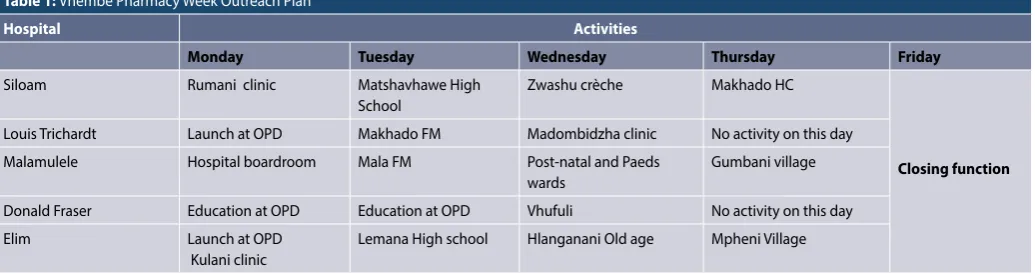
The activities were carried out from Monday (1 September 2017) to Thursday (7th September 2016) in each hospital. Friday (8
September 2017) was a closing function that occurred in Louis Trichardt hospital.
Siloam hospital
Siloam hospital had a comprehensve outreach programme where the allied health professonals joined the team. According to the health calendar, September is also Oral Health month
which made it easier for pharmacy to team up with Oral Health in their outreaches. This was teamwork between Oral Health and Pharmacy which was very succesful.
Table 1: Vhembe Pharmacy Week Outreach Plan
Hospital Activities
Monday Tuesday Wednesday Thursday Friday
Siloam Rumani clinic Matshavhawe High School
Zwashu crèche Makhado HC
Closing function
Louis Trichardt Launch at OPD Makhado FM Madombidzha clinic No activity on this day Malamulele Hospital boardroom Mala FM Post-natal and Paeds
wards
Gumbani village
Donald Fraser Education at OPD Education at OPD Vhufuli No activity on this day
Elim Launch at OPD
Kulani clinic
Lemana High school Hlanganani Old age Mpheni Village
Table 2: Siloam Activity Plan
Monday Tuesday Wednesday Thursday
Rumani clinic
A health talk on importance of vaccination was given to patients. This was an interaction session between patients and pharmacy personnel.
Visited Matshavhawe High school
• Had a team of Allied Health professionals
• Conducted career guidance and motivational talk
• Quizzes and prizes to participating students
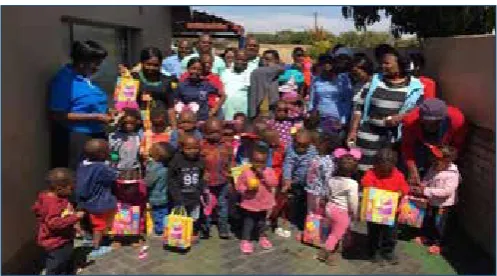
Went to Zwashu creche
• Advice and health talk on importance of vaccination to parents
• Education on where to get vaccinated and VPDs
Went to Makhado HC
• Talk on the importance of vaccination • General guidance on youth empowerment • Dental advice and oral hygiene • Quizzes and prizes to participating
listeners
Table 3: Elim activity schedule
Monday Tuesday Wednesday Thursday
Launch at OPD and Kulani clinic
• Launched pharmacy week at OPD • Education and discussion to the
hospital community on the theme • Sang a composed vaccination song • Presentation to patients about
vaccines
Lemana High School
• Motivational talk to grade 11 and 12 learners
• Discussed pharmacy as a career and sectors in pharmacy
• Provided career guidance e.g diet, medicine, physiotherapy etc • Distributed donated sanitary pads to
selected learners
Hlanganani old age home
Talks presented: • Vaccination * • Proper medicine use • General health care, exercise
Mpheni village
• Went to Mpheni village
• Did door to door visit to educate people about their medication
• Went to Mpheni ZCC church to give education on general health issues and vaccines
Career guidance by Siloam professionals Siloam pharmacists celebrating
Pharmacy Week success stories
Elim hospital
Malamulele Hospital
Louis Trichardt hospital
Launch at hospital OPD
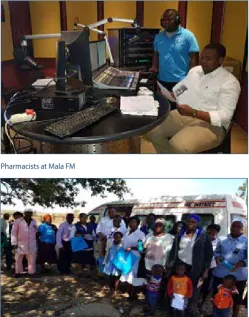
Outreach at Gumbani village Pharmacists at Mala FM
Handing out donated sanitary pads
Home visit at Mpheni village
Interview at Makhado FM
Table 4: Malamulele hospital activity schedule
Monday Tuesday Wednesday Thursday
Launch at Boardroom with management Mala Fm
Educate the community on the
importance of vaccines and immunisation
Paeds and Post natal wards Gumbani village outreach Health talk to the community about vaccination
Table 5: Louis Trichardt activity schedule
Monday Tuesday Wednesday Thursday
Launch at OPD
• General education on the importance of vaccination
• Patients received freebies for participating in the session
Makhado FM
• Radio interview to listeners • The theme was presented in detail to
the community on radio
Madombizha clinic
Education and advice given to patients on the importance of vaccination
Donald Fraser Hospital
Tshilidzini
Closing function
This event was held at Louis Trichardt hospital hall on Friday 8th
September 2017. This was a successful event which was supported and attended by District Director Health care support Ms Tshikovhi N, Limpopo Province Cold Chain Manager Mr Mthombeni TC and Deputy Director Pharmaceutical Services Ms Mohale BC.
All pharmacy professionals were invited .The purpose of this event was to give feedback and report on activities that happened in each hospital, through short presentations and illustrations. Sponsors were given a platform to talk to the pharmacy professionals and everyone who was present. These included Mylan and Sanlam.
Outreach to Madombidzha
Table 6: Donald Fraser Activity schedule
Monday Tuesday Wednesday Thursday
Patient education OPD
• General education on the importance of vaccination
• Patients were handed freebies for participating in the session
Paediatric day at OPD Mothers were given education on the importance of vaccination and immunisation
Vhufuli clinic
• Education and advice given to patients on the importance of vaccination • Vaccine supply to the clinic
• Vaccination session was coordinated by pharmacists
No activities on this day
Table 7: Tshilidzini pharmacy week plan
Monday Tuesday Wednesday Thursday
Launch at hospital
Patients were educated on vaccination. This was done in collaboration with nurses.
Community creche
Education and general health talk was given to parents and teachers attending
Career guidance
High school learners were given career advice and health education
No activities on this day
Patient education at OPD
Pharmacists preparing for outreach Deputy Director Pharmaceutical Services opening the function
Achievements
• Interactive educational sessions held at OPDs, home visits, old age homes, clinics and health centres
• School visits whereby career guidance was given • Teaming up with nurses for catch up campaigns
• The allied health care professionals assisted in career guidance at high schools
• A comprehensive feedback session which addressed management
Lessons learnt
• Involvement of management structures from the start of the programme yields better results
• Due to lack of resource materials for outreaches, being innovative can be of vital importance.
• Involving other health care professionals is of greater benefit to the community.
• Giving feedback to management about the programme sets the scene for a better support system in the near future.
Challenges
• Lack of sponsorships (pharmacy week activities require materials to hand out to communities visited, this includes but not limited to, food parcels, office stationery, educational materials, transport and t-shirts).
• Transport to conduct outreach programs • Shortage of vaccines at the hospital
• Shortage of staff and lack of interest leads to limited number of outreaches
• Posters for pharmacy week launch usually come late and this
affects the launch of the theme at facilities
• School visits could not be done in some hospitals because learners are writing exams
• Language barrier: In some cases the rural areas could only understand their mother tongue and this affects the education given
Recommendations
• Approach sponsors in time and make necessary arrangements • Keep consistency in committee members to alleviate
confusion and to uphold the standard of planning efficiency • Establish a solid relationship with private sponsors and give
them recognition
• Plan activities in time, preferably three months ahead • Improve communication channels
• Motivate all staff to be active partakers in pharmacy week • The SAPC should make Pharmacy Month poster available to
facilities in time for activities
• Management should avail transport for outreach programs
Acknowledgements
1. We would like to acknowledge our sponsors who gave us freebies to facilitate our outreaches. These include:
• Mylan (Mohlala P)
• Sanlam (Nghatsane N and Tshivhenga V) • Cipla (Thwala D)
• Makhado FM • Mala FM
2. Manager pharmaceutical services: Labuschagne M 3. Louis Trichardt hospital management
4. Vhembe district pharmacy personnel 5. Pharmacy week technical team 6. Mr Mafarafara NG
7. All the facilities mentioned above for hosting the activities
Conclusion
The outreach programmes that pharmacists conducted in the district had a great impact on the knowledge of patients. This was identified during interaction sessions whereby patients would show understanding of the education given by pharmacists. With the support from both district and provincial level, pharmacy month has been a success.
References
Vhembe District. 2015. District Health Plan, 2015/16. Vhembe District. Limpopo Provincial Government